Leabharlann UCD
An Coláiste Ollscoile, Baile
Átha Cliath,
Belfield, Baile Átha Cliath 4,
Eire
UCD Library
University College Dublin,
Belfield, Dublin 4, Ireland
UCD Library and GreenGlass
Defining needs, redefining collections
Catherine Ryan
Collections Support Librarian
Collection Services
Background
• Review (and weed!) of print book collections
• Began life as the GreenGlass project in December
2017
• Collections curation and management project
– Defining what our users need on the shelves
– Defining what we want in our collections
– Weeding
– Purchasing new materials
– Long-term, sustainable approach to managing
collections and library spaces
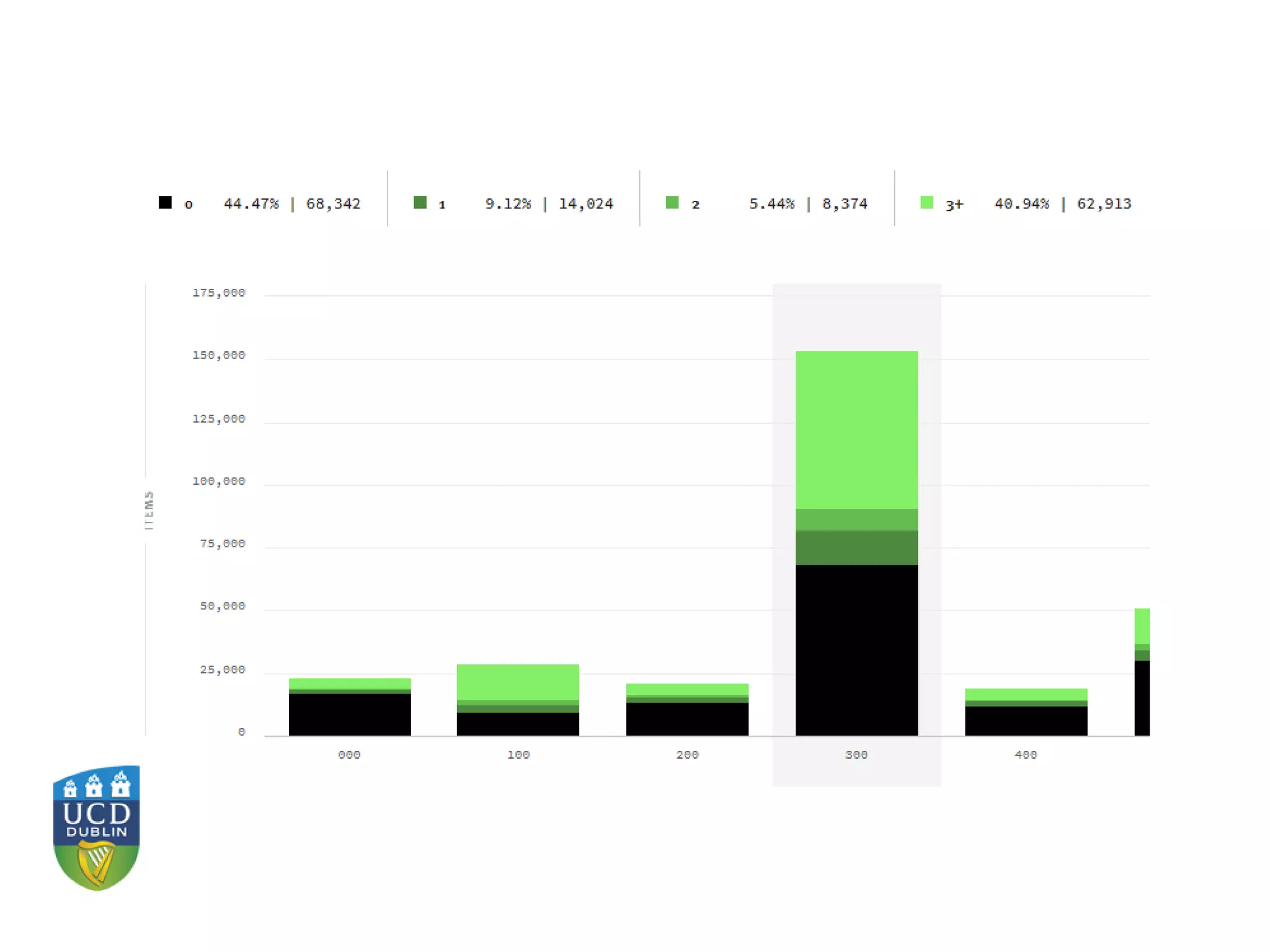
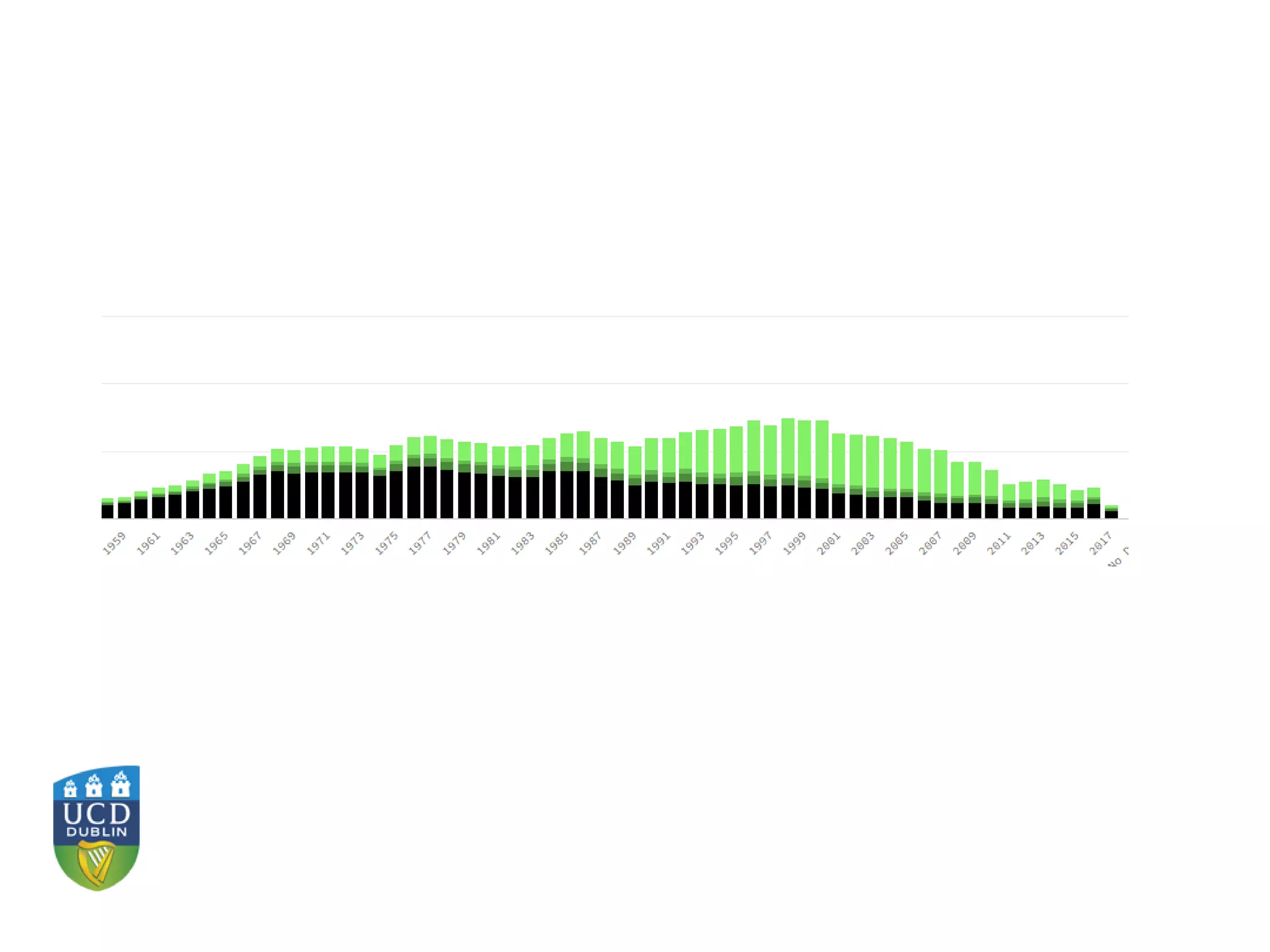
Why are we doing this?
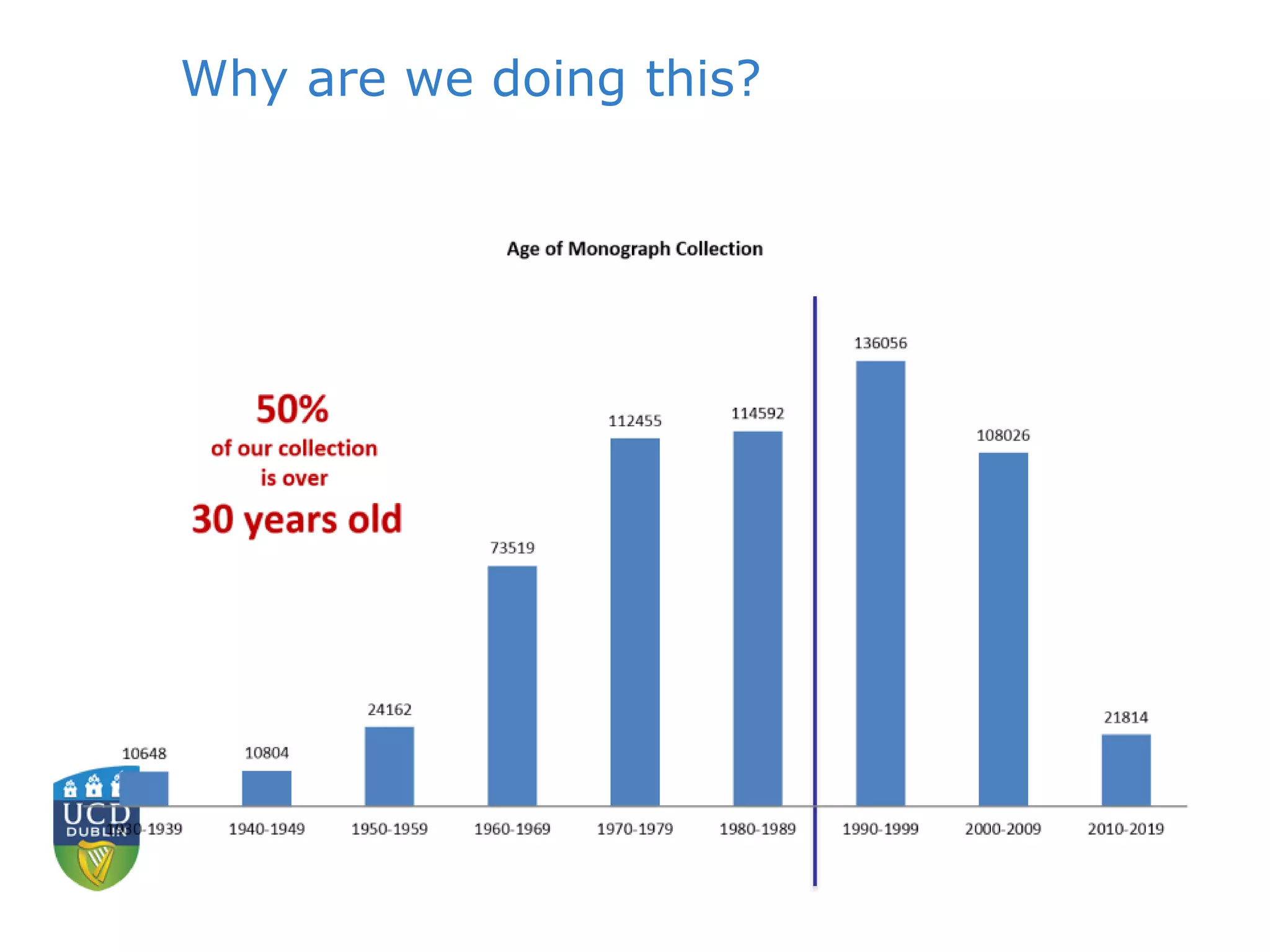
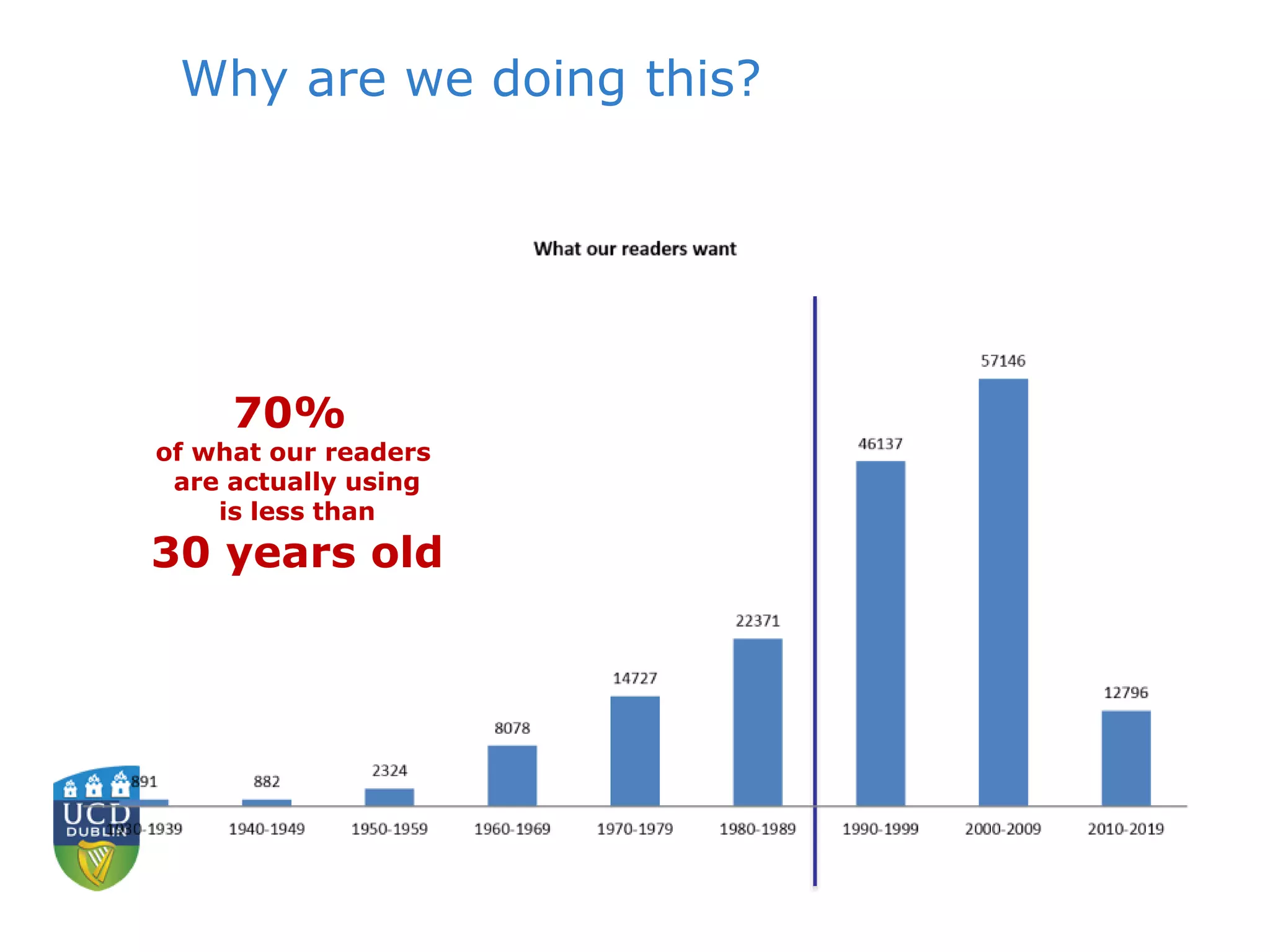
70%
of what our readers
are actually using
is less than
30 years old
Why are we doing this?
• Increases user satisfaction
• Can actually find relevant books
• Shelves look better, more pleasing to browse
• Less staff time maintaining shelves means more time
with users
• Better use of space
• Competing requirements for space and money, more
strategically deployed on services that users want
• Study spaces, social spaces, events
• Strategic alignment
• UCD Library strategic plan 2016-2020
• 2015 Quality Review Report
GreenGlass
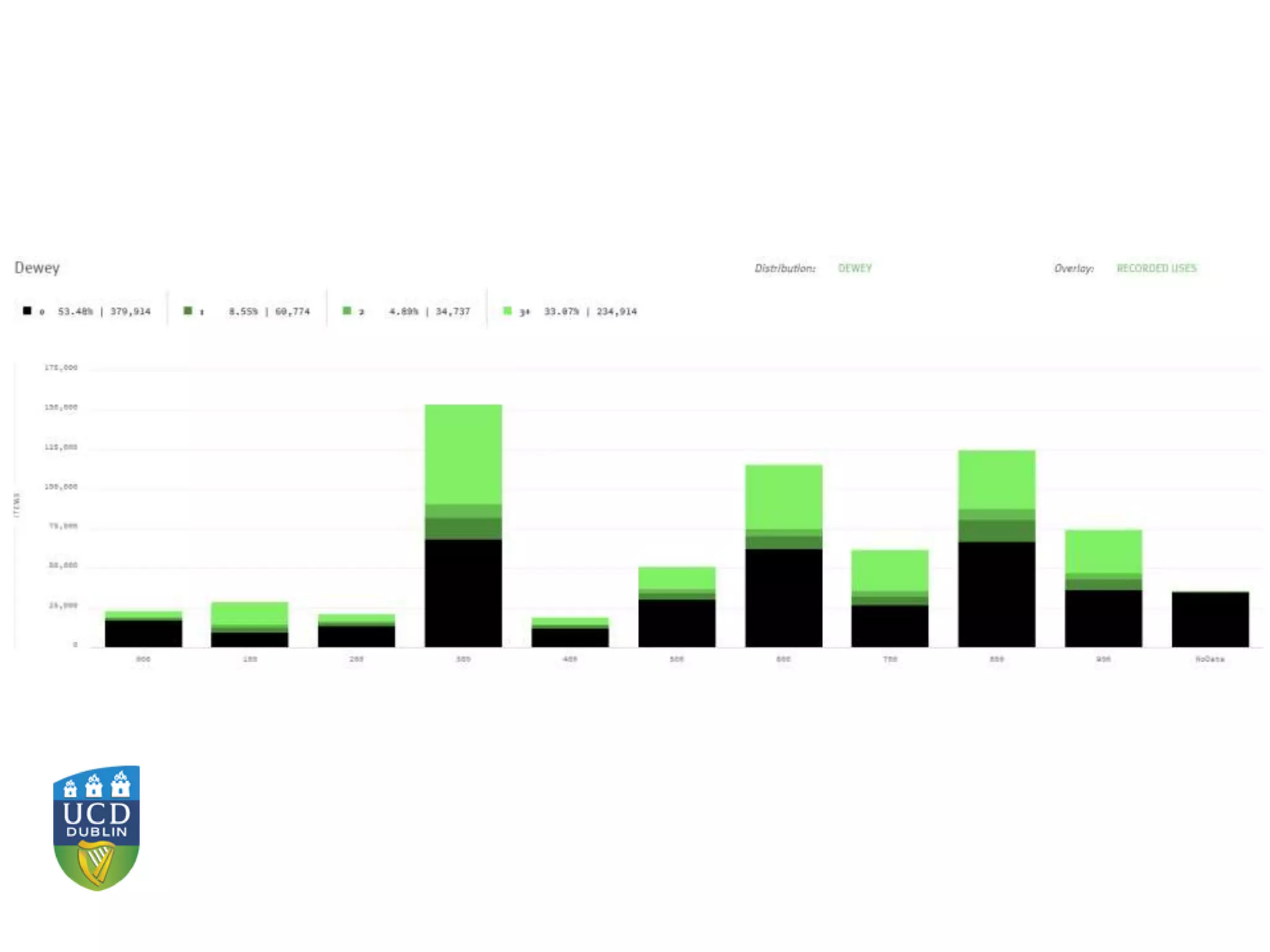
• Sustainable Collection Solutions (SCS) and OCLC
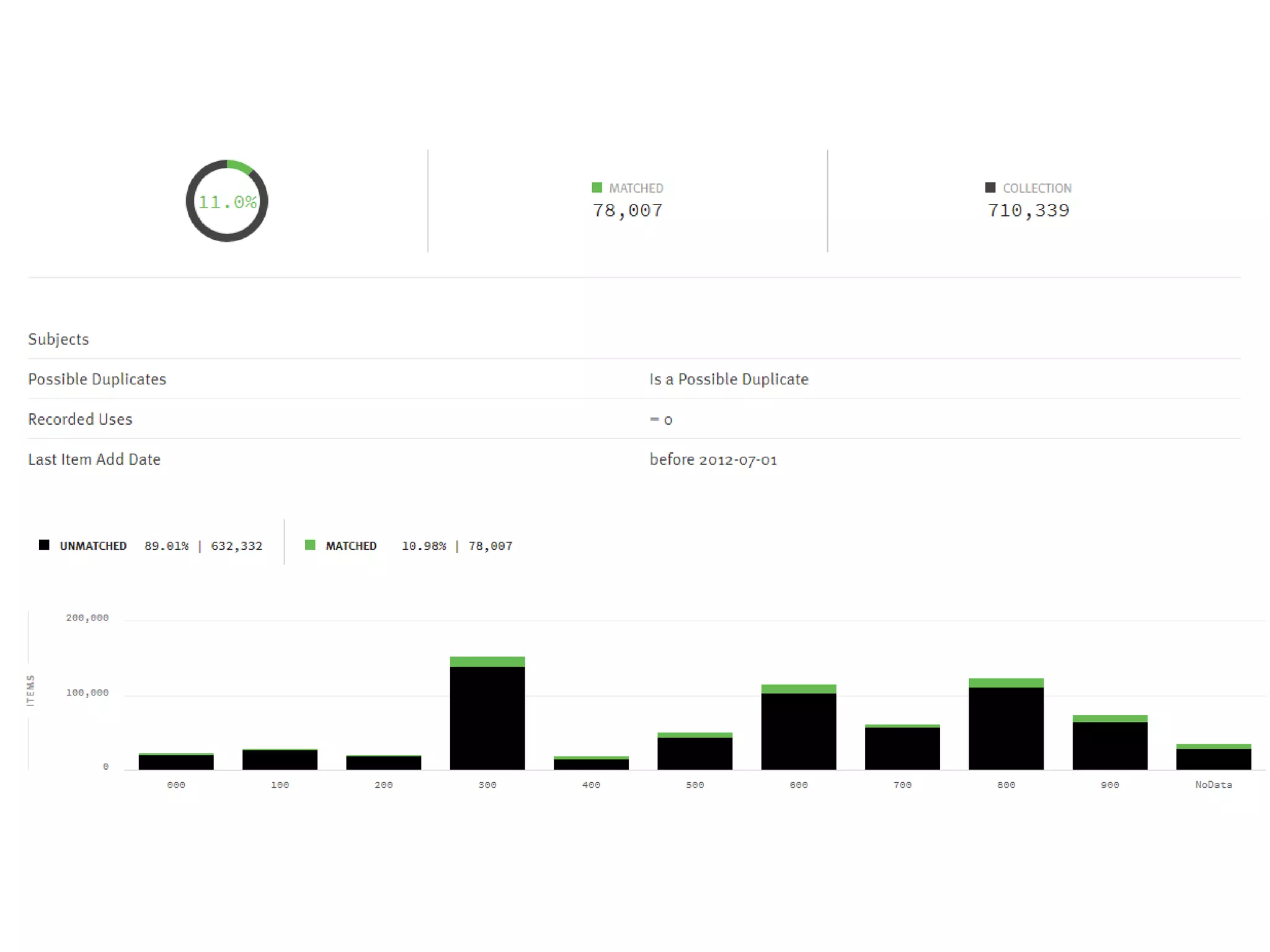
• Collection analysis and decision support tool
• Usage data, acquisition data…
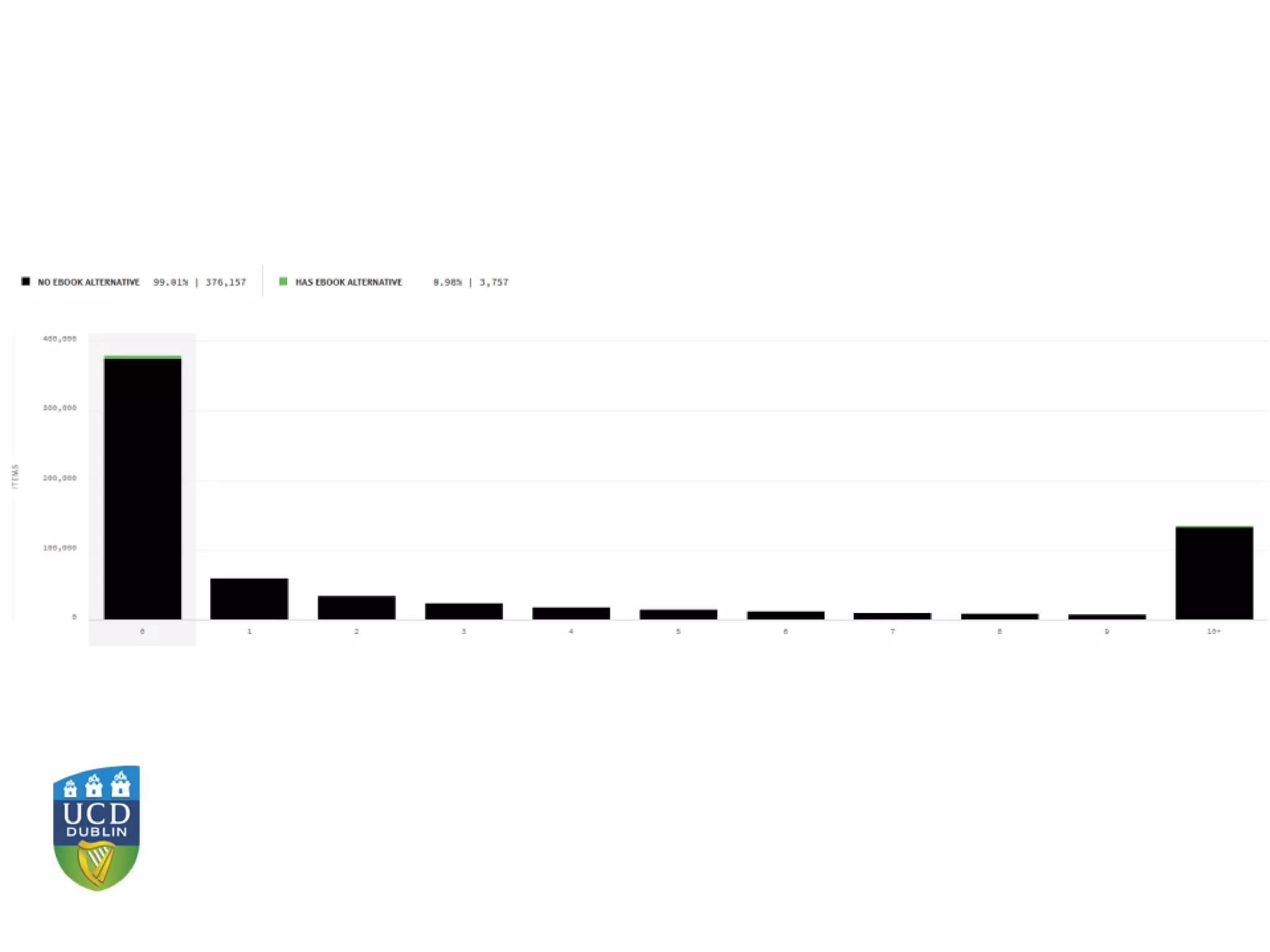
• Ebook alternative, duplicates
• Authoritative lists (Choice)
• Comparison to holdings in other institutions in
Ireland, UK, and Europe
• Available in HathiTrust
Literature and Criteria
• Quantitative criteria
• Usage
– Total circulation
– Last checkout date
• Age
– Not as useful as we
think!
• Size
• Qualitative criteria
– Locally dependent
• Relevance
• Local authors
– Key contributions
– Condition
– Available elsewhere
Projects start with usage
data
Review titles based on
local qualitative criteria
Literature and Criteria
• Large-scale, rules-based projects
– Lugg and Fischer spoke about defining the universe
by choosing the parameters, or criteria for
withdrawal.
– More data available
• Comparisons to other institutions, authoritative lists,
HaithiTrust, etc.
– Weed at scale (in theory)
• Automated rules-based criteria - GreenGlass
Literature and Criteria
• Core Collections (Trueswell, 1964)
– Small portion of the library’s holdings that circulate
very frequently
– Percentage of the collection that would satisfy a
given percentage of user demand
• Rightsizing (Ward, 2015)
– Core collection
– Systematic, rules-based approach
– Shapes collection to user needs
– Providing access v. ownership
– Collaborative collection management
Our Approach
Curation!
– Determining ‘value’ of our collections
• To our user communities
• To UCD Library, UCD
– Revitalising and updating collections through weeding
and purchasing of new resources
– Retaining scarce, historical materials
– Defining a long-term, sustainable approach
• Managing library spaces
• Collection management policy and workflows
Our Approach
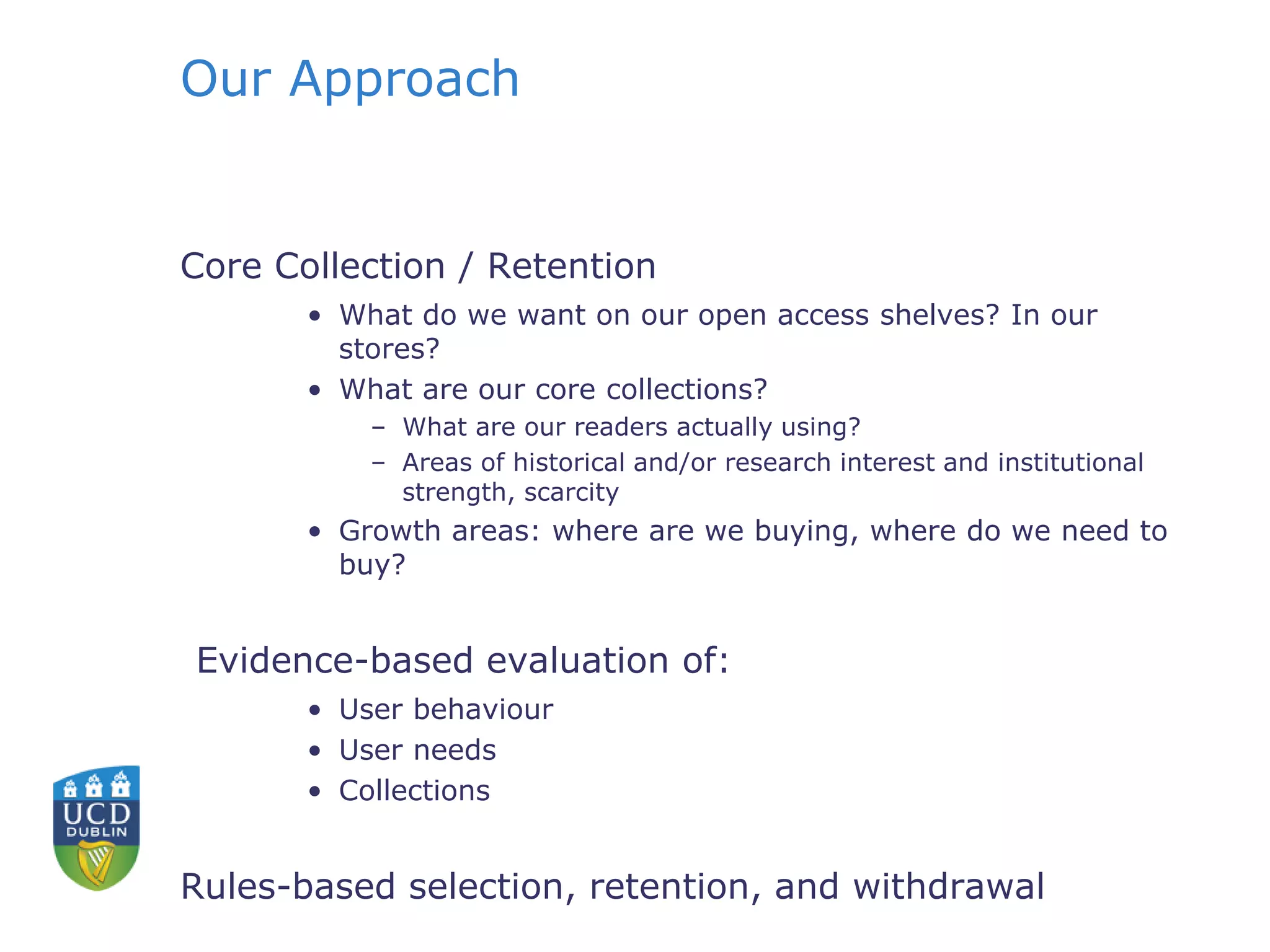
Core Collection / Retention
• What do we want on our open access shelves? In our
stores?
• What are our core collections?
– What are our readers actually using?
– Areas of historical and/or research interest and institutional
strength, scarcity
• Growth areas: where are we buying, where do we need to
buy?
Evidence-based evaluation of:
• User behaviour
• User needs
• Collections
Rules-based selection, retention, and withdrawal
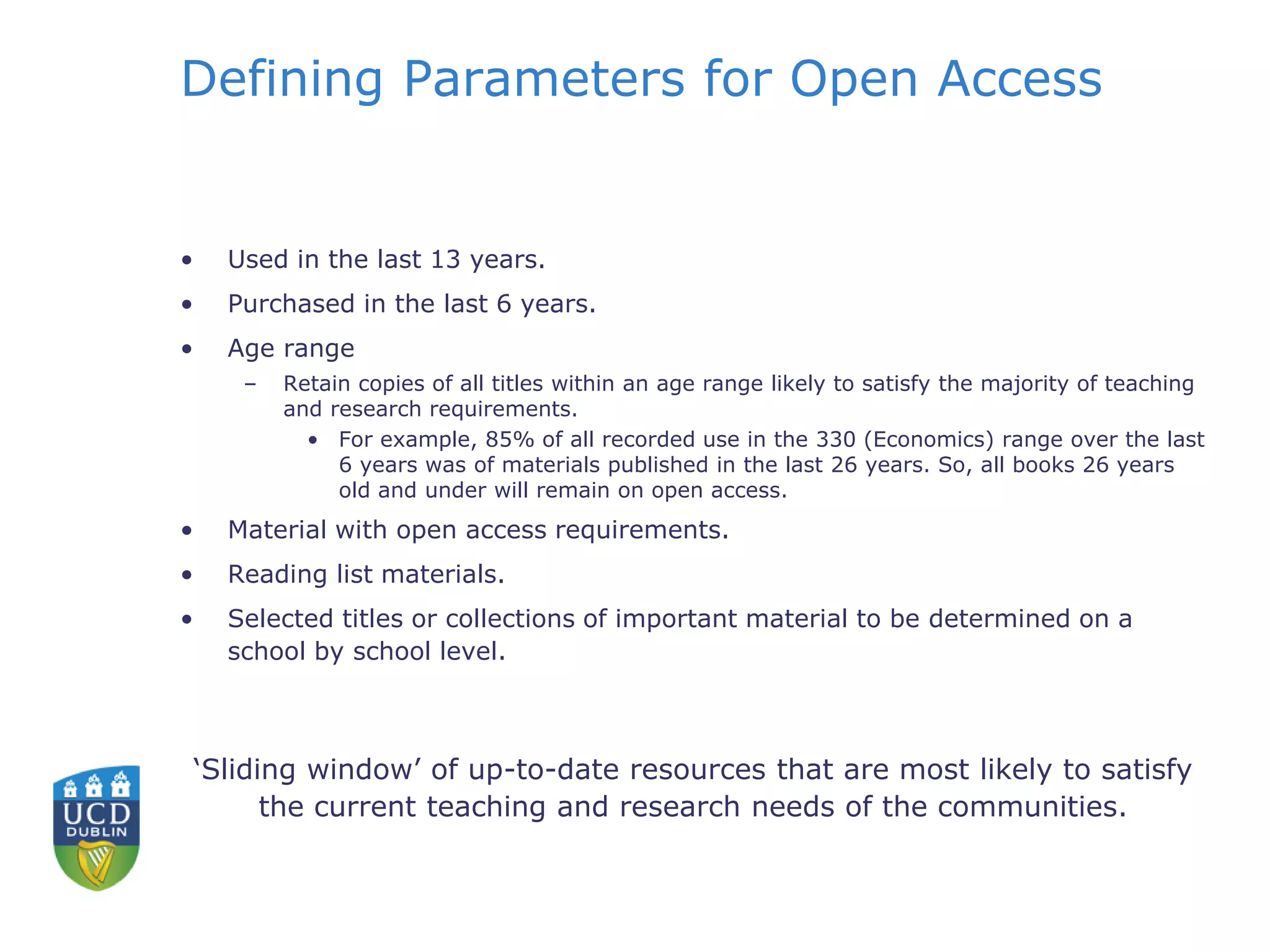
Defining Parameters for Open Access
• Used in the last 13 years.
• Purchased in the last 6 years.
• Age range
– Retain copies of all titles within an age range likely to satisfy the majority of teaching
and research requirements.
• For example, 85% of all recorded use in the 330 (Economics) range over the last
6 years was of materials published in the last 26 years. So, all books 26 years
old and under will remain on open access.
• Material with open access requirements.
• Reading list materials.
• Selected titles or collections of important material to be determined on a
school by school level.
‘Sliding window’ of up-to-date resources that are most likely to satisfy
the current teaching and research needs of the communities.
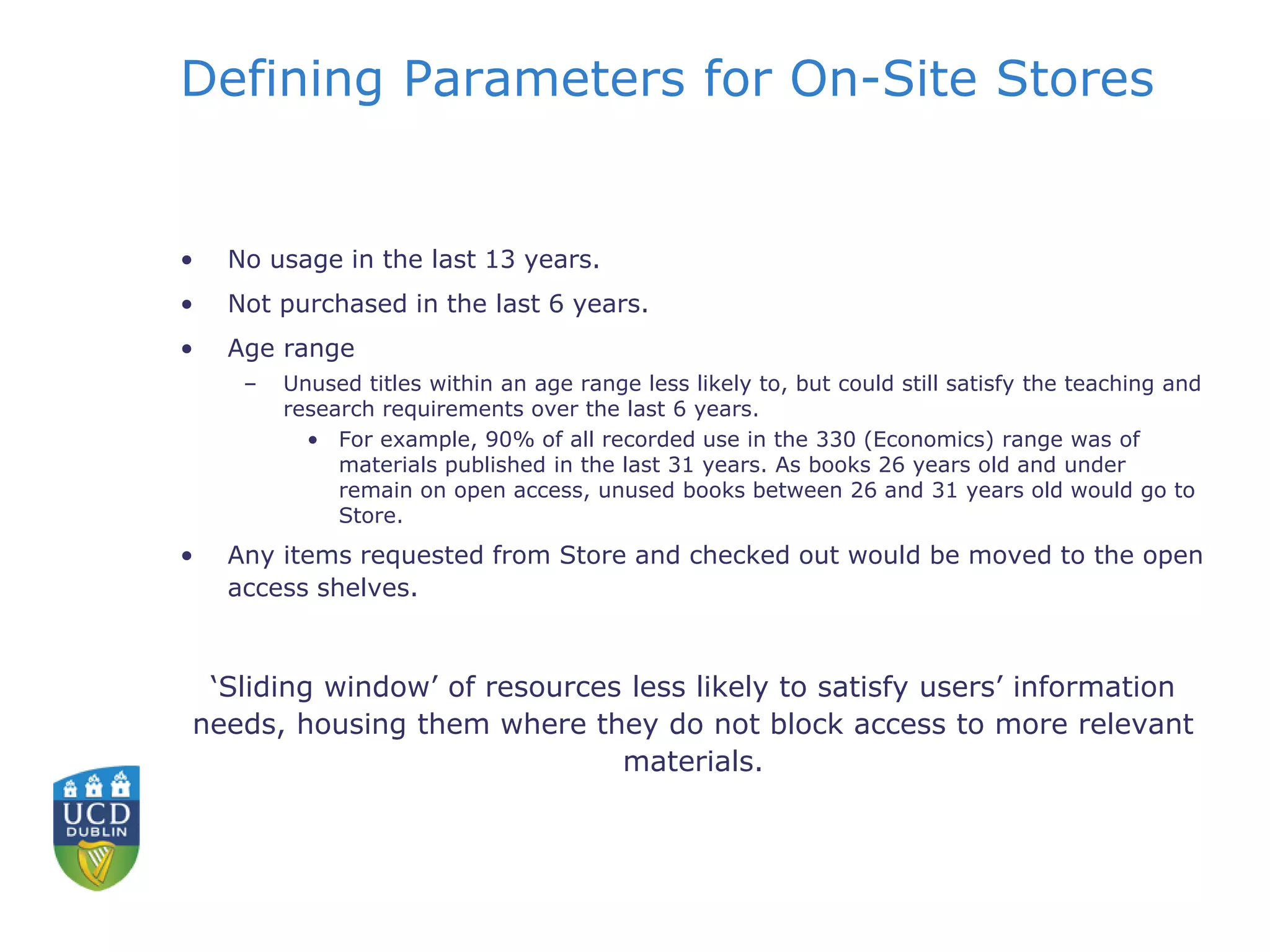
Defining Parameters for On-Site Stores
• No usage in the last 13 years.
• Not purchased in the last 6 years.
• Age range
– Unused titles within an age range less likely to, but could still satisfy the teaching and
research requirements over the last 6 years.
• For example, 90% of all recorded use in the 330 (Economics) range was of
materials published in the last 31 years. As books 26 years old and under
remain on open access, unused books between 26 and 31 years old would go to
Store.
• Any items requested from Store and checked out would be moved to the open
access shelves.
‘Sliding window’ of resources less likely to satisfy users’ information
needs, housing them where they do not block access to more relevant
materials.
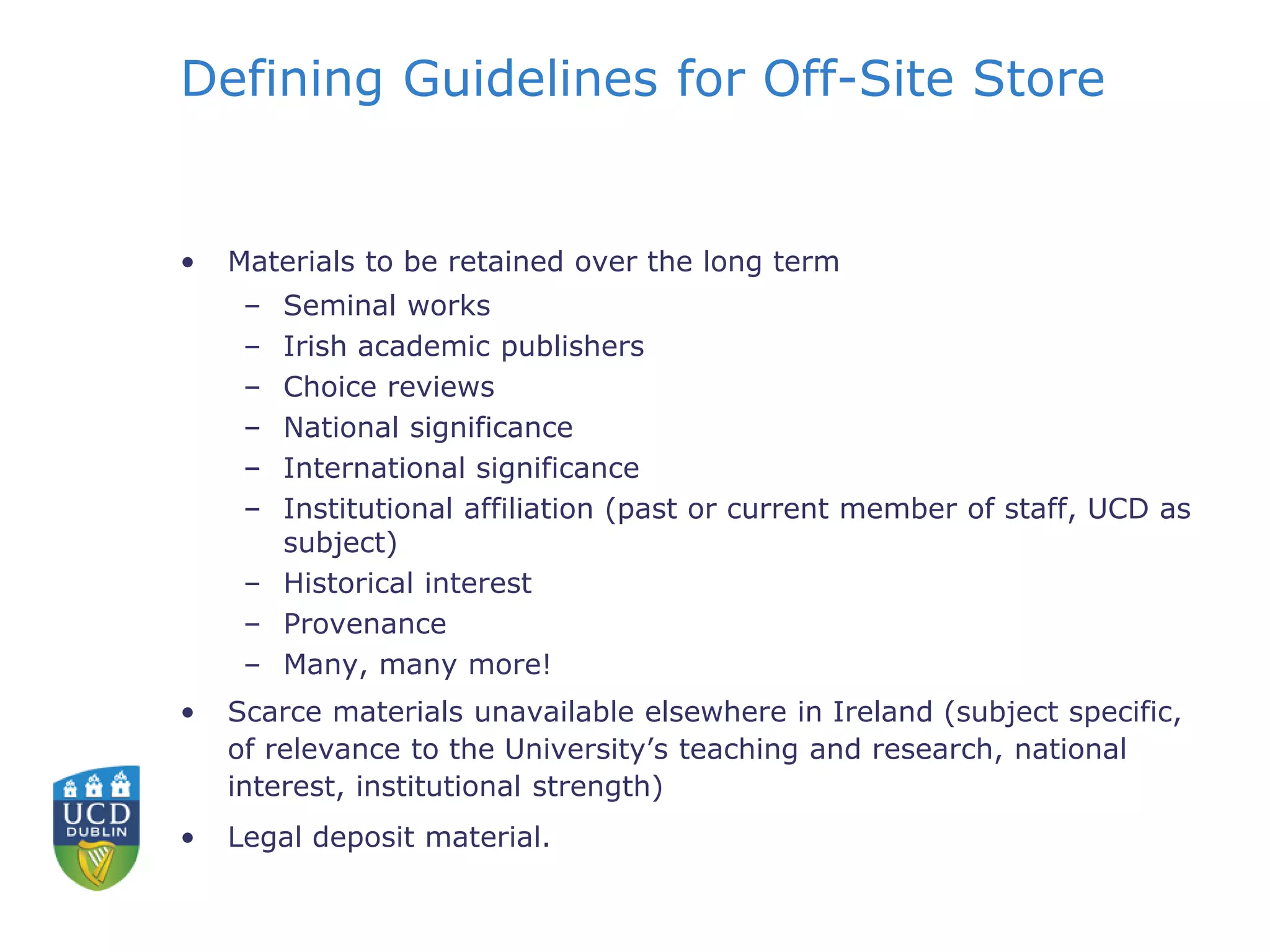
Defining Guidelines for Off-Site Store
• Materials to be retained over the long term
– Seminal works
– Irish academic publishers
– Choice reviews
– National significance
– International significance
– Institutional affiliation (past or current member of staff, UCD as
subject)
– Historical interest
– Provenance
– Many, many more!
• Scarce materials unavailable elsewhere in Ireland (subject specific,
of relevance to the University’s teaching and research, national
interest, institutional strength)
• Legal deposit material.
School Profiles
Inform both weeding criteria and selection of new materials
• Review of each School’s current teaching and research
– Current modules
– Current research
– Emerging graduate programmes
• Review of subject area
– Key titles
– Key authors
– Key viewpoints
– Areas of interest to UCD
– This will be added to as we go through the collections
These will be developed further over Summer 2018
School Profiles
• Collection Evaluation
– Size
– Age
– Growth areas
– Usage and use patterns (part of retention criteria)
– Physical condition
– Collections of interest to the School
– Collections of institutional or historical interest
These will be developed further over Summer 2018
Candidates for Withdrawal
Any title that does not meet
the quantitative and qualitative criteria
developed for each School
and outlined in the profile
Only retain a title where there is a reason to do so
Long-Term Integration
• Ensure that the open access shelves contain, and continue to
contain, the most current and relevant resources and that these
resources are not hidden away by unused, irrelevant, or out-dated
material
• Give full consideration to resources of historical, national, or
institutional interest
• Better planning and managing of the collections and the spaces that
they inhabit by ensuring that stock levels in open access and on-site
store areas will remain approximately the same size over the
medium-term.
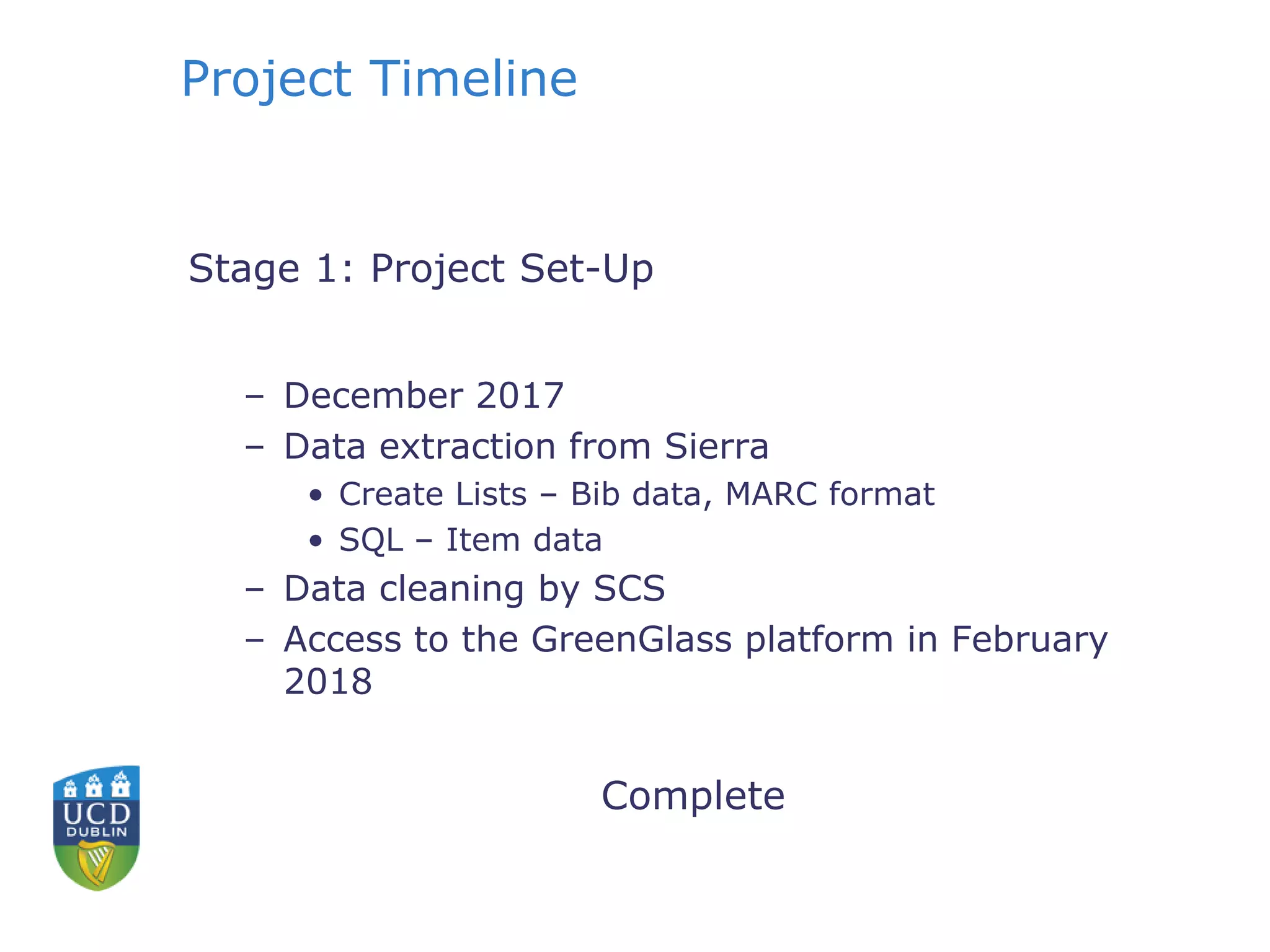
Project Timeline
Stage 1: Project Set-Up
– December 2017
– Data extraction from Sierra
• Create Lists – Bib data, MARC format
• SQL – Item data
– Data cleaning by SCS
– Access to the GreenGlass platform in February
2018
Complete
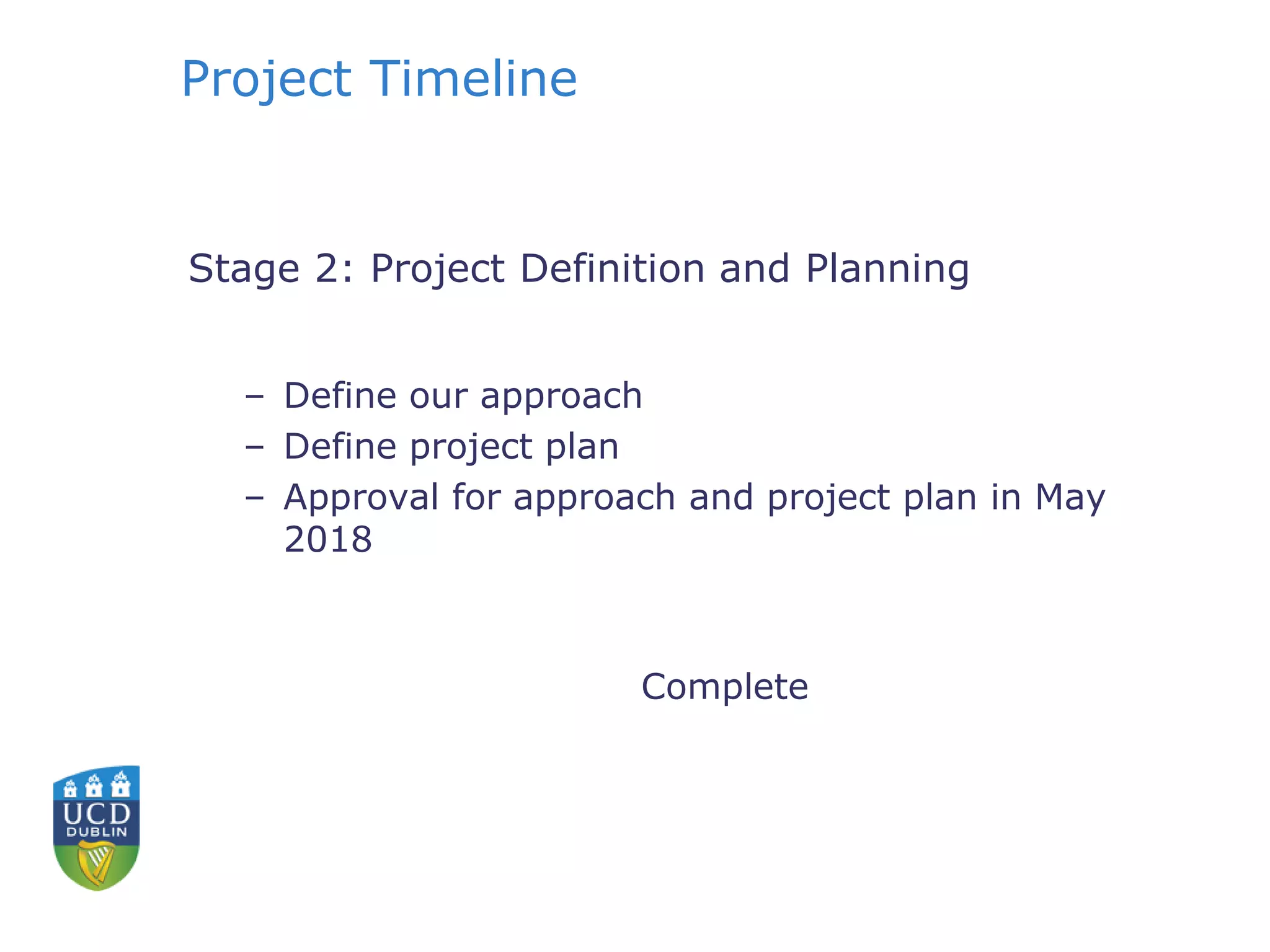
Project Timeline
Stage 2: Project Definition and Planning
– Define our approach
– Define project plan
– Approval for approach and project plan in May
2018
Complete
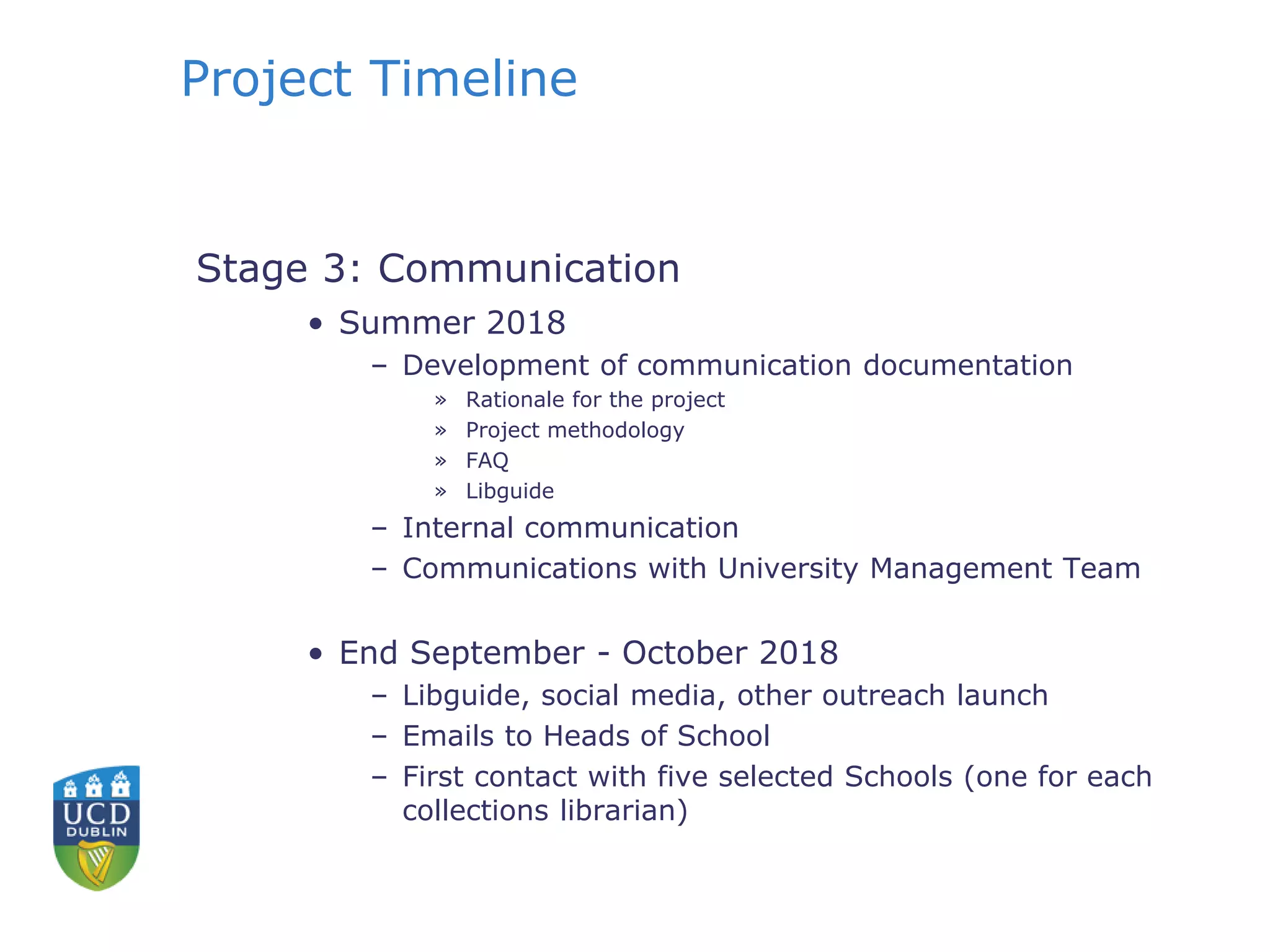
Project Timeline
Stage 3: Communication
• Summer 2018
– Development of communication documentation
» Rationale for the project
» Project methodology
» FAQ
» Libguide
– Internal communication
– Communications with University Management Team
• End September - October 2018
– Libguide, social media, other outreach launch
– Emails to Heads of School
– First contact with five selected Schools (one for each
collections librarian)
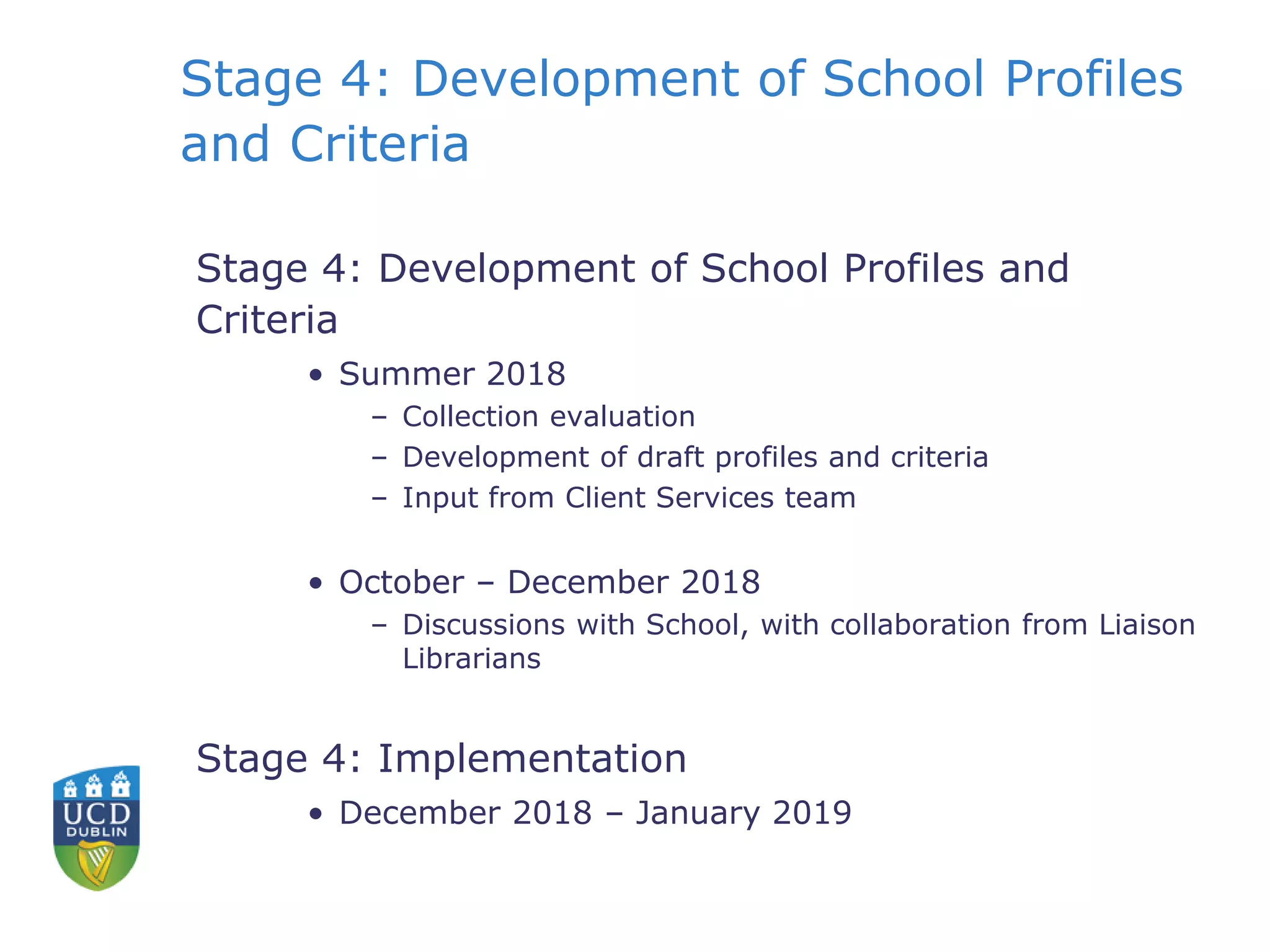
Stage 4: Development of School Profiles
and Criteria
Stage 4: Development of School Profiles and
Criteria
• Summer 2018
– Collection evaluation
– Development of draft profiles and criteria
– Input from Client Services team
• October – December 2018
– Discussions with School, with collaboration from Liaison
Librarians
Stage 4: Implementation
• December 2018 – January 2019
References
Weeding
• Ackerman, E., & DeLuca, L. (2018). Weed ’em and reap? Deselection of political science books. The Journal of Academic Librarianship, 44(1),
88–95. https://doi.org/10.1016/j.acalib.2017.10.003
• Baba, K., Minami, T., & Nakatoh, T. (2016). Predicting Book Use in University Libraries by Synchronous Obsolescence. Procedia Computer
Science, 96, 395–402. https://doi.org/10.1016/j.procs.2016.08.082
• Buckland, M. K. (1975). Book availability and the library user. New York: Pergamon Press. Retrieved from
https://archive.org/details/bookavailability00buck
• DeMars, M., & Roll, A. (2016). Weeding out in the open: what will the neighbours think? In Where Do We Go from Here?: Charleston
Conference Proceedings 2015. Purdue University Press. https://doi.org/10.5703/1288284316252
• Dubicki, E. (2008). Weeding: facing the fears. Collection Building, 27(4), 132–135. https://doi.org/10.1108/01604950810913689
• Fussler, H. H., & Simon, J. L. (1961). Patterns in the use of books in large research libraries. Chicago: University of Chicago Library. Retrieved
from https://catalog.hathitrust.org/Record/003908643
• Handis, M. W. (2007). Practical advice for weeding in a small library. Collection Building, 26(3), 84–87.
https://doi.org/10.1108/01604950710761643
• Held, T. (2018). Curating, not weeding. Technical Services Quarterly, 35(2), 133–143.
• Johnson, P. (2014). Fundamentals of collection development and management. (3rd ed.). London: Facet.
• Joswick, K. E., & Stierman, J. P. (1994). Systematic reference weeding: A workable model. Collection Management, 18(1), 103–115.
• Lugg, R. (2012). Data-driven deselection for monographs: a rules-based approach to weeding, storage, and shared print decisions. Insights,
25(2), 198–204. https://doi.org/10.1629/2048-7754.25.2.198
• Lugg, R., & Fischer, R. (2008). Future tense--The disapproval plan: Rules-based weeding & storage decisions. Against the Grain, 20(6).
References
Weeding, cont’d
• Lugg, R., & Fischer, R. (2013). Future tense--doing what’s obvious: Library space and the fat smoker. Against the Grain, 21(1), 47.
https://doi.org/10.7771/2380-176X.2530
• McHale, C., Egger-Sider, F., Fluk, L., & Ovadia, S. (2017). Weeding without walking: a mediated approach to list-based deselection. Collection
Management, 42(2), 92–108. https://doi.org/10.1080/01462679.2017.1318729
• McKee, P. (1981). Weeding the Forest Hill Branch of Toronto Public Library by the Slote Method: A Test Case. Library Research, 3(3), 283–301.
• Metz, P., & Gray, C. (2005). Perspectives on public relations and library weeding. The Journal of Academic Librarianship, 31(3), 273–279.
https://doi.org/10.1016/j.acalib.2005.01.005
• Murphy, E. (2013). Assessing University Library Print Book Collections and Deselection: A Case Study at The National University of Ireland Maynooth.
New Review of Academic Librarianship, 19(3), 256–273. https://doi.org/10.1080/13614533.2013.808252
• Oliva, V. T. (2016). Deselection of print monographs in the humanities and social sciences in the digital age. Collection Building, 35(2), 37–47.
https://doi.org/10.1108/CB-02-2016-0002
• O’Neill, J. L. (2016). Weeding with ADDIE: developing training for deselection at an adacemic library. Reference & User Services Quarterly, 56(2), 108–
115.
• Osheroff, S. K., & Knittel, M. C. (1990). Team weeding in a university library. College & Research Libraries News, 51(8), 723–725.
• Perrault, A. H., Madaus, R., Armbrister, A., Dixon, J., & Smith, R. (1999). The Effects of High Median Age on Currency of Resources in Community College
Library Collections. College & Research Libraries, 60, 316–339.
• Poller, M. (1976). Weeding Monographs in the Harrison Public Library. Collection Management, 1(1), 6–7.
• Reed-Scott, J. (1985). Implementation and evaluation of a weeding program. Collection Management, 7(2), 59–67.
• Slote, S. J. (1997). Weeding library collections : library weeding methods. (4th ed.). Englewood: Libraries Unlimited.
References
Weeding, cont’d
• Snyder, C. E. (2014). Data-driven deselection: multiple point data using a decision support tool in an academic library. Collection Management, 39(1),
17–31. https://doi.org/10.1080/01462679.2013.866607
• Soma, A. K., & Sjoberg, L. M. (2010). More than just low-hanging fruit: A collaborative approach to weeding in academic libraries. Collection
Management, 36(1), 17–28. https://doi.org/10.1080/01462679.2011.529241
• Trueswell, R. (1964). User behaviour patterns and requirements and their effect on the possible applications of data processing and computer techniques
in a university library. (PhD). Northwestern University, Illinois.
• Ward, S. M. (2015). Rightsizing the academic library collection. Chicago: ALA Editions.
• Way, D., & Garrison, J. (2013). Developing and implementing a disapproval plan: One university library’s experience. College & Research Libraries News,
74(6).
• White, B. (2017). Citations and circulation counts: data sources for monograph deselection in research library collections. College & Research Libraries,
78(1). https://doi.org/doi:10.5860/crl.78.1.53
• Williams, P. C., & Halvonik, Brent. (2004). Collection management: assessing and weeding the foreign language collection. College & Undergraduate
Libraries, 11(2), 103–127. https://doi.org/10.1300/J106v11n02_09
• Zuber, P. (2012). Weeding the collection: an analysis of motivations, methods, and metrics. Presented at the American Society for Engineering
Education / Engineering Libraries Division Annual Conference, Texas.
References
Collection Evaluation and Development
• Agee, J. (2005). Collection evaluation: a foundation for collection development. Collection Building, 24(3), 92–95.
http://dx.doi.org/10.1108/01604950510608267
• Borin, J., & Yi, H. (2008). Indicators for collection evaluation: a new dimensional framework. Collection Building, 27(4), 136–143.
https://doi.org/10.1108/01604950810913698
• Bushing, M. C. (2001). The evolution of conspectus practice in libraries: the beginnings and the present applications. In CASLIN 2001: Popis a
zpřístupnění dokumentů : nová výzva. Czech Republic: Czech and Slovak Library Information Network. Retrieved from
http://klement.nkp.cz/Caslin/caslin01/sbornik/conspectus.html
• Calvert, P. J. (1997). Collection development and performance measurement. In Collection Management for the 21st Century: A Handbook for Librarians
(pp. 121–133). Westport, CT: Greenwood Press.
• Chipp, J. (2018). Developing a collections review framework at the University of Southampton. SCONUL Focus, 70. Retrieved from
https://www.sconul.ac.uk/sites/default/files/documents/28.Developing%20a%20collections%20review.pdf
• Rowley, G., & Black, W. K. (1996). Consequences of change: the evolution of collection development. Collection Building, 15(2), 22–30.
https://doi.org/10.1108/01604959610113879
Thank you!
Any questions?

UCD Library and GreenGlass: defining needs, redefining collections, and weeding in UCD Library - Catherine Ryan (UCD)

  • 1.
    Leabharlann UCD An ColáisteOllscoile, Baile Átha Cliath, Belfield, Baile Átha Cliath 4, Eire UCD Library University College Dublin, Belfield, Dublin 4, Ireland UCD Library and GreenGlass Defining needs, redefining collections Catherine Ryan Collections Support Librarian Collection Services
  • 2.
    Background • Review (andweed!) of print book collections • Began life as the GreenGlass project in December 2017 • Collections curation and management project – Defining what our users need on the shelves – Defining what we want in our collections – Weeding – Purchasing new materials – Long-term, sustainable approach to managing collections and library spaces
  • 3.
    Why are wedoing this?
  • 4.
    Why are wedoing this?
  • 5.
    Why are wedoing this? 70% of what our readers are actually using is less than 30 years old
  • 6.
    Why are wedoing this? • Increases user satisfaction • Can actually find relevant books • Shelves look better, more pleasing to browse • Less staff time maintaining shelves means more time with users • Better use of space • Competing requirements for space and money, more strategically deployed on services that users want • Study spaces, social spaces, events • Strategic alignment • UCD Library strategic plan 2016-2020 • 2015 Quality Review Report
  • 7.
    GreenGlass • Sustainable CollectionSolutions (SCS) and OCLC • Collection analysis and decision support tool • Usage data, acquisition data… • Ebook alternative, duplicates • Authoritative lists (Choice) • Comparison to holdings in other institutions in Ireland, UK, and Europe • Available in HathiTrust
  • 13.
    Literature and Criteria •Quantitative criteria • Usage – Total circulation – Last checkout date • Age – Not as useful as we think! • Size • Qualitative criteria – Locally dependent • Relevance • Local authors – Key contributions – Condition – Available elsewhere Projects start with usage data Review titles based on local qualitative criteria
  • 14.
    Literature and Criteria •Large-scale, rules-based projects – Lugg and Fischer spoke about defining the universe by choosing the parameters, or criteria for withdrawal. – More data available • Comparisons to other institutions, authoritative lists, HaithiTrust, etc. – Weed at scale (in theory) • Automated rules-based criteria - GreenGlass
  • 15.
    Literature and Criteria •Core Collections (Trueswell, 1964) – Small portion of the library’s holdings that circulate very frequently – Percentage of the collection that would satisfy a given percentage of user demand • Rightsizing (Ward, 2015) – Core collection – Systematic, rules-based approach – Shapes collection to user needs – Providing access v. ownership – Collaborative collection management
  • 16.
    Our Approach Curation! – Determining‘value’ of our collections • To our user communities • To UCD Library, UCD – Revitalising and updating collections through weeding and purchasing of new resources – Retaining scarce, historical materials – Defining a long-term, sustainable approach • Managing library spaces • Collection management policy and workflows
  • 17.
    Our Approach Core Collection/ Retention • What do we want on our open access shelves? In our stores? • What are our core collections? – What are our readers actually using? – Areas of historical and/or research interest and institutional strength, scarcity • Growth areas: where are we buying, where do we need to buy? Evidence-based evaluation of: • User behaviour • User needs • Collections Rules-based selection, retention, and withdrawal
  • 18.
    Defining Parameters forOpen Access • Used in the last 13 years. • Purchased in the last 6 years. • Age range – Retain copies of all titles within an age range likely to satisfy the majority of teaching and research requirements. • For example, 85% of all recorded use in the 330 (Economics) range over the last 6 years was of materials published in the last 26 years. So, all books 26 years old and under will remain on open access. • Material with open access requirements. • Reading list materials. • Selected titles or collections of important material to be determined on a school by school level. ‘Sliding window’ of up-to-date resources that are most likely to satisfy the current teaching and research needs of the communities.
  • 19.
    Defining Parameters forOn-Site Stores • No usage in the last 13 years. • Not purchased in the last 6 years. • Age range – Unused titles within an age range less likely to, but could still satisfy the teaching and research requirements over the last 6 years. • For example, 90% of all recorded use in the 330 (Economics) range was of materials published in the last 31 years. As books 26 years old and under remain on open access, unused books between 26 and 31 years old would go to Store. • Any items requested from Store and checked out would be moved to the open access shelves. ‘Sliding window’ of resources less likely to satisfy users’ information needs, housing them where they do not block access to more relevant materials.
  • 20.
    Defining Guidelines forOff-Site Store • Materials to be retained over the long term – Seminal works – Irish academic publishers – Choice reviews – National significance – International significance – Institutional affiliation (past or current member of staff, UCD as subject) – Historical interest – Provenance – Many, many more! • Scarce materials unavailable elsewhere in Ireland (subject specific, of relevance to the University’s teaching and research, national interest, institutional strength) • Legal deposit material.
  • 21.
    School Profiles Inform bothweeding criteria and selection of new materials • Review of each School’s current teaching and research – Current modules – Current research – Emerging graduate programmes • Review of subject area – Key titles – Key authors – Key viewpoints – Areas of interest to UCD – This will be added to as we go through the collections These will be developed further over Summer 2018
  • 22.
    School Profiles • CollectionEvaluation – Size – Age – Growth areas – Usage and use patterns (part of retention criteria) – Physical condition – Collections of interest to the School – Collections of institutional or historical interest These will be developed further over Summer 2018
  • 23.
    Candidates for Withdrawal Anytitle that does not meet the quantitative and qualitative criteria developed for each School and outlined in the profile Only retain a title where there is a reason to do so
  • 24.
    Long-Term Integration • Ensurethat the open access shelves contain, and continue to contain, the most current and relevant resources and that these resources are not hidden away by unused, irrelevant, or out-dated material • Give full consideration to resources of historical, national, or institutional interest • Better planning and managing of the collections and the spaces that they inhabit by ensuring that stock levels in open access and on-site store areas will remain approximately the same size over the medium-term.
  • 25.
    Project Timeline Stage 1:Project Set-Up – December 2017 – Data extraction from Sierra • Create Lists – Bib data, MARC format • SQL – Item data – Data cleaning by SCS – Access to the GreenGlass platform in February 2018 Complete
  • 26.
    Project Timeline Stage 2:Project Definition and Planning – Define our approach – Define project plan – Approval for approach and project plan in May 2018 Complete
  • 27.
    Project Timeline Stage 3:Communication • Summer 2018 – Development of communication documentation » Rationale for the project » Project methodology » FAQ » Libguide – Internal communication – Communications with University Management Team • End September - October 2018 – Libguide, social media, other outreach launch – Emails to Heads of School – First contact with five selected Schools (one for each collections librarian)
  • 28.
    Stage 4: Developmentof School Profiles and Criteria Stage 4: Development of School Profiles and Criteria • Summer 2018 – Collection evaluation – Development of draft profiles and criteria – Input from Client Services team • October – December 2018 – Discussions with School, with collaboration from Liaison Librarians Stage 4: Implementation • December 2018 – January 2019
  • 29.
    References Weeding • Ackerman, E.,& DeLuca, L. (2018). Weed ’em and reap? Deselection of political science books. The Journal of Academic Librarianship, 44(1), 88–95. https://doi.org/10.1016/j.acalib.2017.10.003 • Baba, K., Minami, T., & Nakatoh, T. (2016). Predicting Book Use in University Libraries by Synchronous Obsolescence. Procedia Computer Science, 96, 395–402. https://doi.org/10.1016/j.procs.2016.08.082 • Buckland, M. K. (1975). Book availability and the library user. New York: Pergamon Press. Retrieved from https://archive.org/details/bookavailability00buck • DeMars, M., & Roll, A. (2016). Weeding out in the open: what will the neighbours think? In Where Do We Go from Here?: Charleston Conference Proceedings 2015. Purdue University Press. https://doi.org/10.5703/1288284316252 • Dubicki, E. (2008). Weeding: facing the fears. Collection Building, 27(4), 132–135. https://doi.org/10.1108/01604950810913689 • Fussler, H. H., & Simon, J. L. (1961). Patterns in the use of books in large research libraries. Chicago: University of Chicago Library. Retrieved from https://catalog.hathitrust.org/Record/003908643 • Handis, M. W. (2007). Practical advice for weeding in a small library. Collection Building, 26(3), 84–87. https://doi.org/10.1108/01604950710761643 • Held, T. (2018). Curating, not weeding. Technical Services Quarterly, 35(2), 133–143. • Johnson, P. (2014). Fundamentals of collection development and management. (3rd ed.). London: Facet. • Joswick, K. E., & Stierman, J. P. (1994). Systematic reference weeding: A workable model. Collection Management, 18(1), 103–115. • Lugg, R. (2012). Data-driven deselection for monographs: a rules-based approach to weeding, storage, and shared print decisions. Insights, 25(2), 198–204. https://doi.org/10.1629/2048-7754.25.2.198 • Lugg, R., & Fischer, R. (2008). Future tense--The disapproval plan: Rules-based weeding & storage decisions. Against the Grain, 20(6).
  • 30.
    References Weeding, cont’d • Lugg,R., & Fischer, R. (2013). Future tense--doing what’s obvious: Library space and the fat smoker. Against the Grain, 21(1), 47. https://doi.org/10.7771/2380-176X.2530 • McHale, C., Egger-Sider, F., Fluk, L., & Ovadia, S. (2017). Weeding without walking: a mediated approach to list-based deselection. Collection Management, 42(2), 92–108. https://doi.org/10.1080/01462679.2017.1318729 • McKee, P. (1981). Weeding the Forest Hill Branch of Toronto Public Library by the Slote Method: A Test Case. Library Research, 3(3), 283–301. • Metz, P., & Gray, C. (2005). Perspectives on public relations and library weeding. The Journal of Academic Librarianship, 31(3), 273–279. https://doi.org/10.1016/j.acalib.2005.01.005 • Murphy, E. (2013). Assessing University Library Print Book Collections and Deselection: A Case Study at The National University of Ireland Maynooth. New Review of Academic Librarianship, 19(3), 256–273. https://doi.org/10.1080/13614533.2013.808252 • Oliva, V. T. (2016). Deselection of print monographs in the humanities and social sciences in the digital age. Collection Building, 35(2), 37–47. https://doi.org/10.1108/CB-02-2016-0002 • O’Neill, J. L. (2016). Weeding with ADDIE: developing training for deselection at an adacemic library. Reference & User Services Quarterly, 56(2), 108– 115. • Osheroff, S. K., & Knittel, M. C. (1990). Team weeding in a university library. College & Research Libraries News, 51(8), 723–725. • Perrault, A. H., Madaus, R., Armbrister, A., Dixon, J., & Smith, R. (1999). The Effects of High Median Age on Currency of Resources in Community College Library Collections. College & Research Libraries, 60, 316–339. • Poller, M. (1976). Weeding Monographs in the Harrison Public Library. Collection Management, 1(1), 6–7. • Reed-Scott, J. (1985). Implementation and evaluation of a weeding program. Collection Management, 7(2), 59–67. • Slote, S. J. (1997). Weeding library collections : library weeding methods. (4th ed.). Englewood: Libraries Unlimited.
  • 31.
    References Weeding, cont’d • Snyder,C. E. (2014). Data-driven deselection: multiple point data using a decision support tool in an academic library. Collection Management, 39(1), 17–31. https://doi.org/10.1080/01462679.2013.866607 • Soma, A. K., & Sjoberg, L. M. (2010). More than just low-hanging fruit: A collaborative approach to weeding in academic libraries. Collection Management, 36(1), 17–28. https://doi.org/10.1080/01462679.2011.529241 • Trueswell, R. (1964). User behaviour patterns and requirements and their effect on the possible applications of data processing and computer techniques in a university library. (PhD). Northwestern University, Illinois. • Ward, S. M. (2015). Rightsizing the academic library collection. Chicago: ALA Editions. • Way, D., & Garrison, J. (2013). Developing and implementing a disapproval plan: One university library’s experience. College & Research Libraries News, 74(6). • White, B. (2017). Citations and circulation counts: data sources for monograph deselection in research library collections. College & Research Libraries, 78(1). https://doi.org/doi:10.5860/crl.78.1.53 • Williams, P. C., & Halvonik, Brent. (2004). Collection management: assessing and weeding the foreign language collection. College & Undergraduate Libraries, 11(2), 103–127. https://doi.org/10.1300/J106v11n02_09 • Zuber, P. (2012). Weeding the collection: an analysis of motivations, methods, and metrics. Presented at the American Society for Engineering Education / Engineering Libraries Division Annual Conference, Texas.
  • 32.
    References Collection Evaluation andDevelopment • Agee, J. (2005). Collection evaluation: a foundation for collection development. Collection Building, 24(3), 92–95. http://dx.doi.org/10.1108/01604950510608267 • Borin, J., & Yi, H. (2008). Indicators for collection evaluation: a new dimensional framework. Collection Building, 27(4), 136–143. https://doi.org/10.1108/01604950810913698 • Bushing, M. C. (2001). The evolution of conspectus practice in libraries: the beginnings and the present applications. In CASLIN 2001: Popis a zpřístupnění dokumentů : nová výzva. Czech Republic: Czech and Slovak Library Information Network. Retrieved from http://klement.nkp.cz/Caslin/caslin01/sbornik/conspectus.html • Calvert, P. J. (1997). Collection development and performance measurement. In Collection Management for the 21st Century: A Handbook for Librarians (pp. 121–133). Westport, CT: Greenwood Press. • Chipp, J. (2018). Developing a collections review framework at the University of Southampton. SCONUL Focus, 70. Retrieved from https://www.sconul.ac.uk/sites/default/files/documents/28.Developing%20a%20collections%20review.pdf • Rowley, G., & Black, W. K. (1996). Consequences of change: the evolution of collection development. Collection Building, 15(2), 22–30. https://doi.org/10.1108/01604959610113879
  • 33.