Building a Productive Team
One Person at a Time
GAMMA
Gary Wheeler, SPHR, GPHR, CCP, CBP
DO YOU
KNOW
MGMA?
2
Brief Activity
GoogleSearch
• What comes up when you type in GAMMA?
• The 3rd letter of the Greek Alphabet
Trivia question
• How many letters in the Greek Alphabet?
• 24
• Can anyone recite the Greek Alphabet?
3
MedicalGroupManagementAssociation
• Who was the founder of MGMA?
• Harry J. Harwick
• Where did he go to work?
• MAYO Clinic
• What year?
• 1908
• When was the first MGMA conference?
• 1926
• What year did GAMMA begin?
• 1984
4
• Are you a manager or a leader on the job?
• Manage to accomplish tasks
• Lead to achieve goals
• In your role, you have to do both
• Leaders build teams
Building Your Team
Objectives
• Building a Team Through
• Communication
• Relationships
• Team Opportunities
• What Does a Team Look Like?
7
Objective
• Communication
8
• Greet your team daily with enthusiasm
• Conduct a 3-minute daily meeting
• Meet face-to-face to ask questions (v. email)
• Mix small talk in with your conversations
• Hold weekly meetings with team
• Hold monthly staff meetings with team
Daily Communication
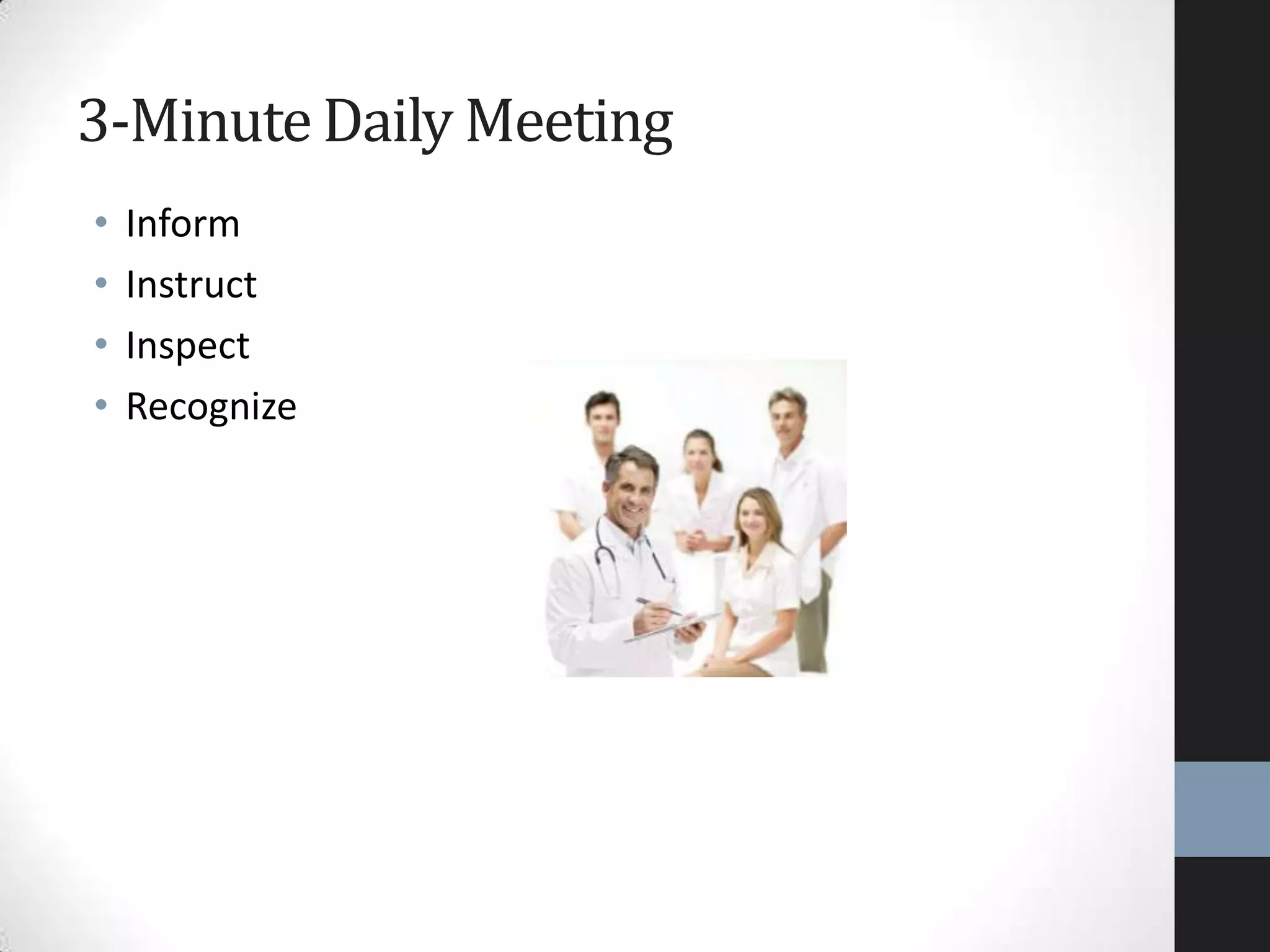
• Inform
• Instruct
• Inspect
• Recognize
3-MinuteDaily Meeting
Employees respect leaders who are respectful and honest
• Address the situation the first time
• Maintain and enhance self-esteem
• Communicate openly and honestly
• Speak from the heart
• Listen and respond with empathy
• Ask for help in solving the problem
• Communicate, communicate, communicate
Correcting Behavior
Employees respect leaders who are fair and listen
• Talk with and note the conversation
• Talk with, write up, signed
• Talk with, write up, signed, one-day suspension
• Talk with, write up, signed final warning
• Talk with, write up, signed termination
ProgressiveDiscipline
Correct behavior based on individual and situation
• Stay away from pre designed forms and templates
• Handwritten documentation
• Typed documentation
• Does not have to be fancy
• Correct within an appropriate time frame
Discipline
Correct behavior based on individual and situation
• Don’t make it personal
• Talk with individuals respectfully
• Shake hands afterwards
• Encourage the person and let them know you believe
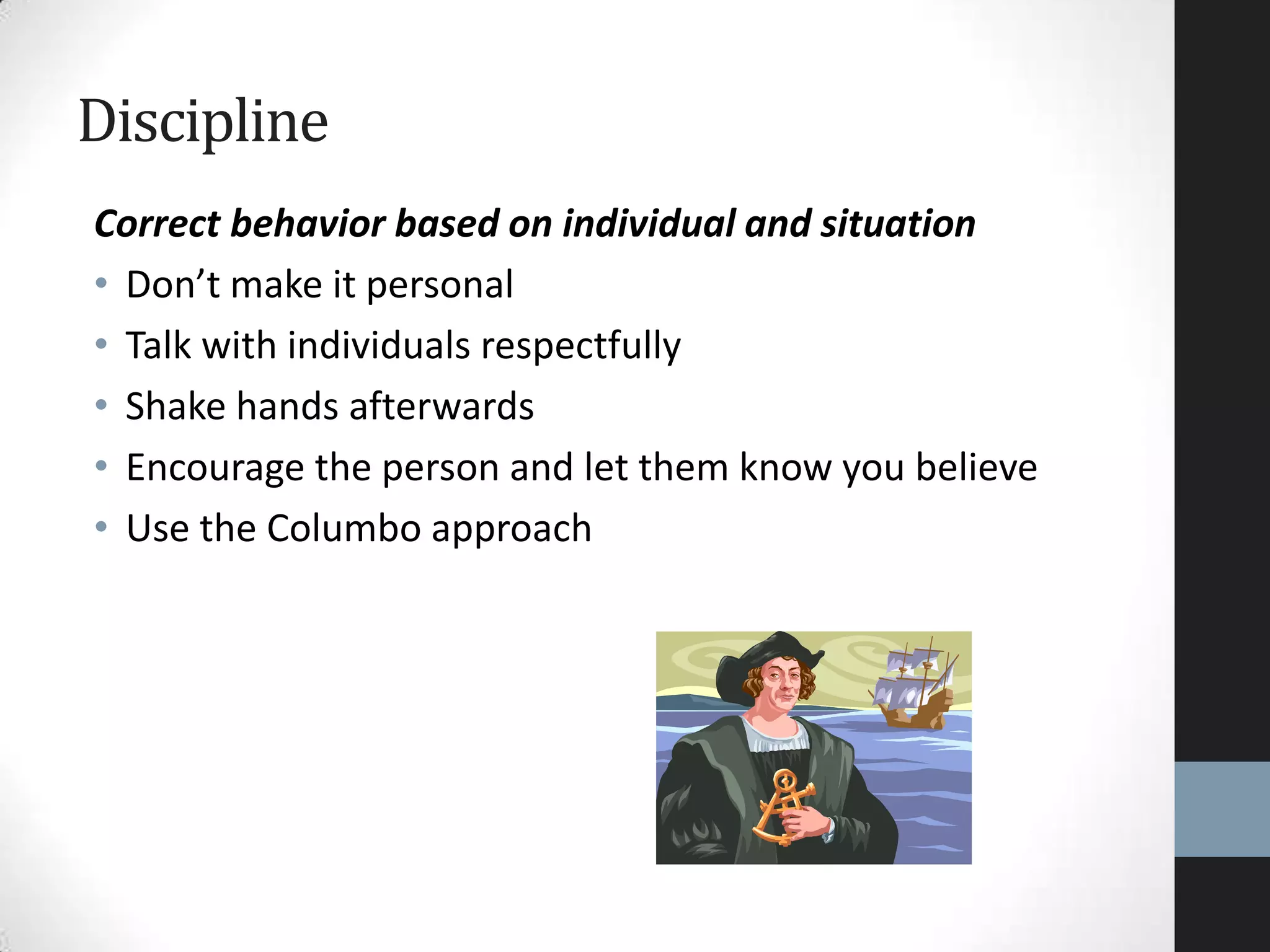
• Use the Columbo approach
Discipline
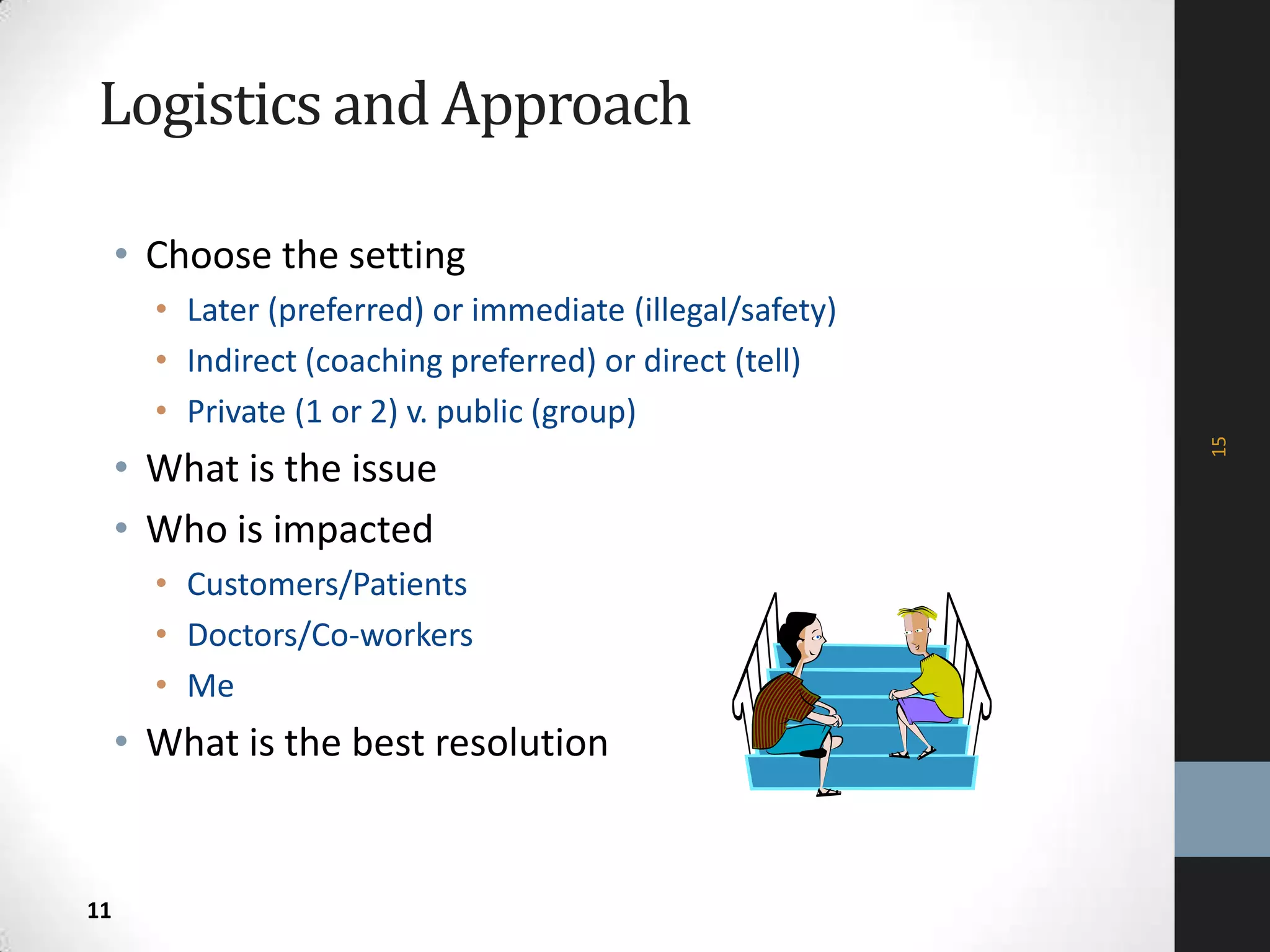
Logistics and Approach
• Choose the setting
• Later (preferred) or immediate (illegal/safety)
• Indirect (coaching preferred) or direct (tell)
• Private (1 or 2) v. public (group)
• What is the issue
• Who is impacted
• Customers/Patients
• Doctors/Co-workers
• Me
• What is the best resolution
15
11
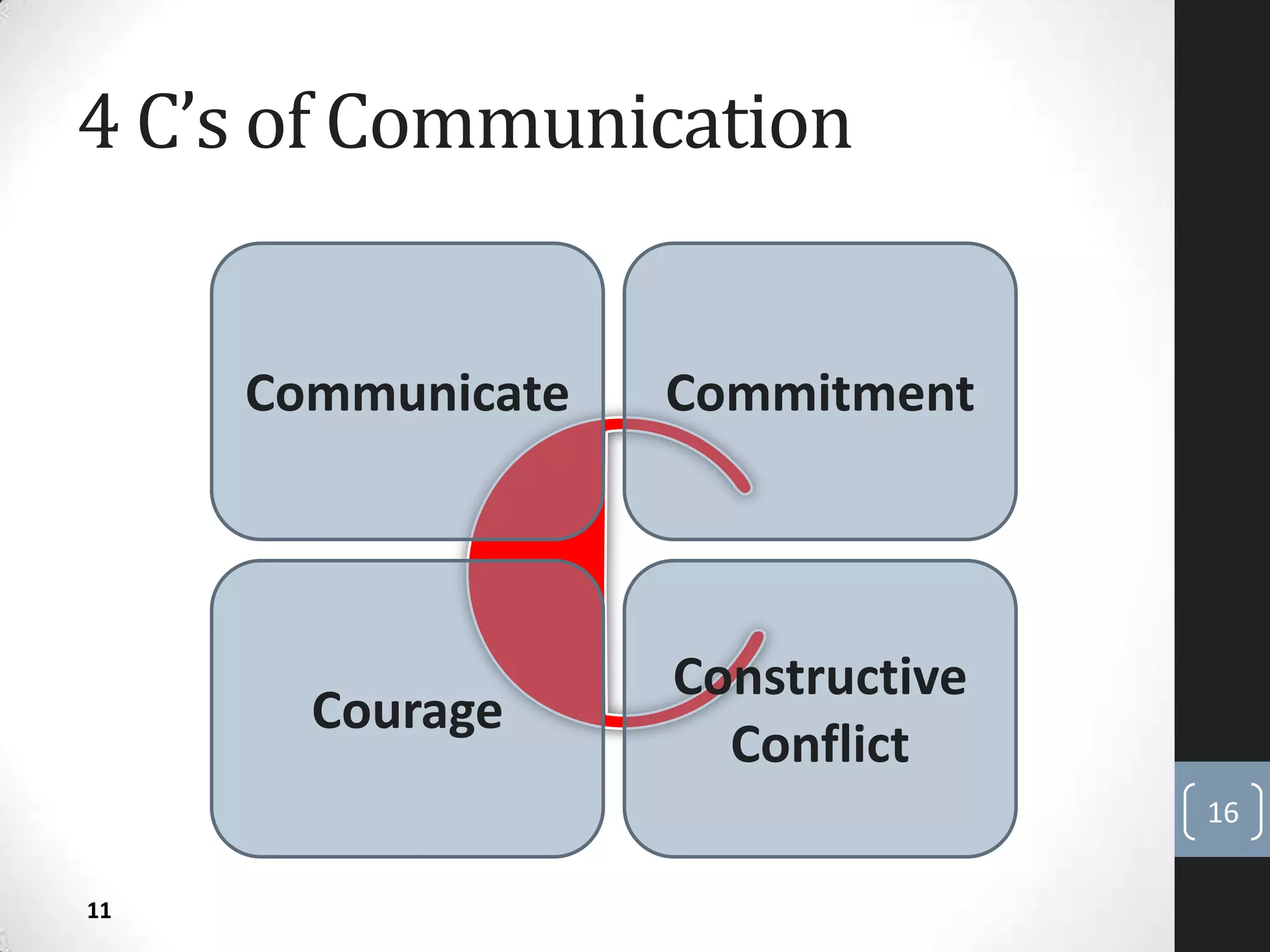
4 C’s of Communication
16
Communicate
Constructive
Conflict
Courage
Commitment
11
Objective
• Relationships
17
Talk, Listen and Commit
• Leadership tool to build productive relationships
18
13
Communication
• Talk, Listen and Commit
• Employee talks
• Manager listens
• We commit to work
together
• Keys to Positive
Communication
• Maintain and
enhance self-esteem
• Listen and respond with
empathy
• Ask for help in solving the
problem
19
13
Planning the Talk
• Notify the employee in advance
• Choose a private place free of distractions
• Allow 15 to 30-minutes
• Plan to take notes
• Be prepared to follow up promptly after the talk
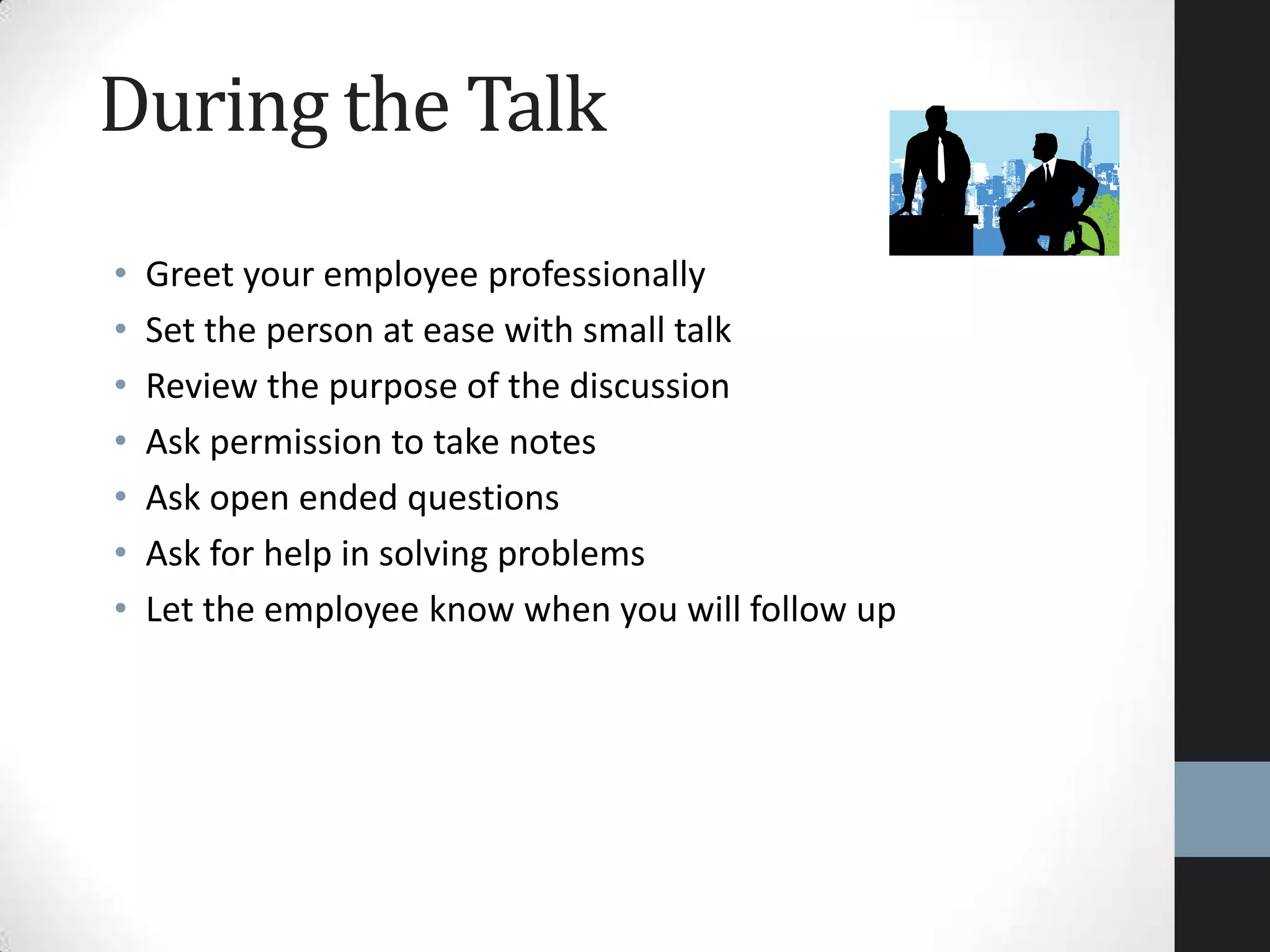
During the Talk
• Greet your employee professionally
• Set the person at ease with small talk
• Review the purpose of the discussion
• Ask permission to take notes
• Ask open ended questions
• Ask for help in solving problems
• Let the employee know when you will follow up
Follow Up
• The most important part of the discussion is to follow
up on issues, questions and concerns
• Send a thank you note
Summary
• Talk, Listen and Commit is a leadership tool
• Brand the talk as talk, listen and commit or TLC
• Conduct at least two TLC’s per year
• The key is to listen
• The most important element is to follow up
• Your people should be able to come to you with any
situation (performance, relationships)
• Never get upset
Summary cont.
• Ask for help in solving the challenge, problem, issue,
question or concern
• TLC can be used to proactively correct behavior
• People work for their manager
• Conduct informal TLC’s to build relationships
• Relationships drive results/success
• Our primary goal is to get our people to come to us
• BUILD A TEAM ONE PERSON AT A TIME
• Know the names of spouses and kids
• Know staff hobbies, interests and accomplsihments
• Know if employee is a public or private person
• Understand what the motivation climate is for your
employees
Relationship Building
• Send a birthday card through the mail signed by the
doctors and staff
• Send holiday cards through mail and email
• Desk side chats
• 3 by 5 card thank you
• Spontaneous thank you letter mailed to home
• Coffee meeting
• Gift certificate to Massage Envy
• Starbucks Coffee gift card
Relationship Ideas
Objective
• Team Opportunities
27
• Monthly birthday and company anniversary celebrations
• Favorite candy bar
• Ice cream break
• After work happy hour
• Picnic
• Backyard cookout
• Bowling tournament
• Baseball game
• Other ideas
Team Relationship Ideas
Objective
• What Does a Team Look Like?
29
Definition of a team
• A small number of people with complementary skills who
are committed to a common purpose and who are
working interdependently to achieve specific
performance goals using an approach for which they
hold themselves mutually accountable
Successfulteam Characteristics
• Commitment to a common goal
• Clear roles and work assignments
• Respect for each other
• Full participation
• Conflict management
• Mutual accountability
• Honest communication
• Active listening
• Appreciation for each other
• Trustworthiness
• Willingness to share
Stages of Team Performance
• Forming
• Storming
• Norming
• Performing
• Adjourning
Forming
• Team members feel uncertainty or confusion about team
goals
Storming
• Team members may clash with and confront each other
on all aspects of the project
• Team members begin to assess their commitment to the
project and their attitude toward other team members
• Team members begin to refine their pattern of
interaction; some choose to withdraw
• Morale may go from high to low
Norming
• Team members cooperate and collaborate with each
other
• The team begins to form a group identity; members
appreciate each other and are committed to the project
• Team members begin to open up to each other and
freely exchange ideas and thoughts
• Team members work toward mutually agreed upon goals
• Team members interact according to what has been
established and accepted by the team
Performing
• Team structure, goals and responsibilities are firmly
established
• Team members work consistently to accomplish project
tasks
• Team maintains effectiveness, either by continuing to
learn and develop or by maintaining a routine
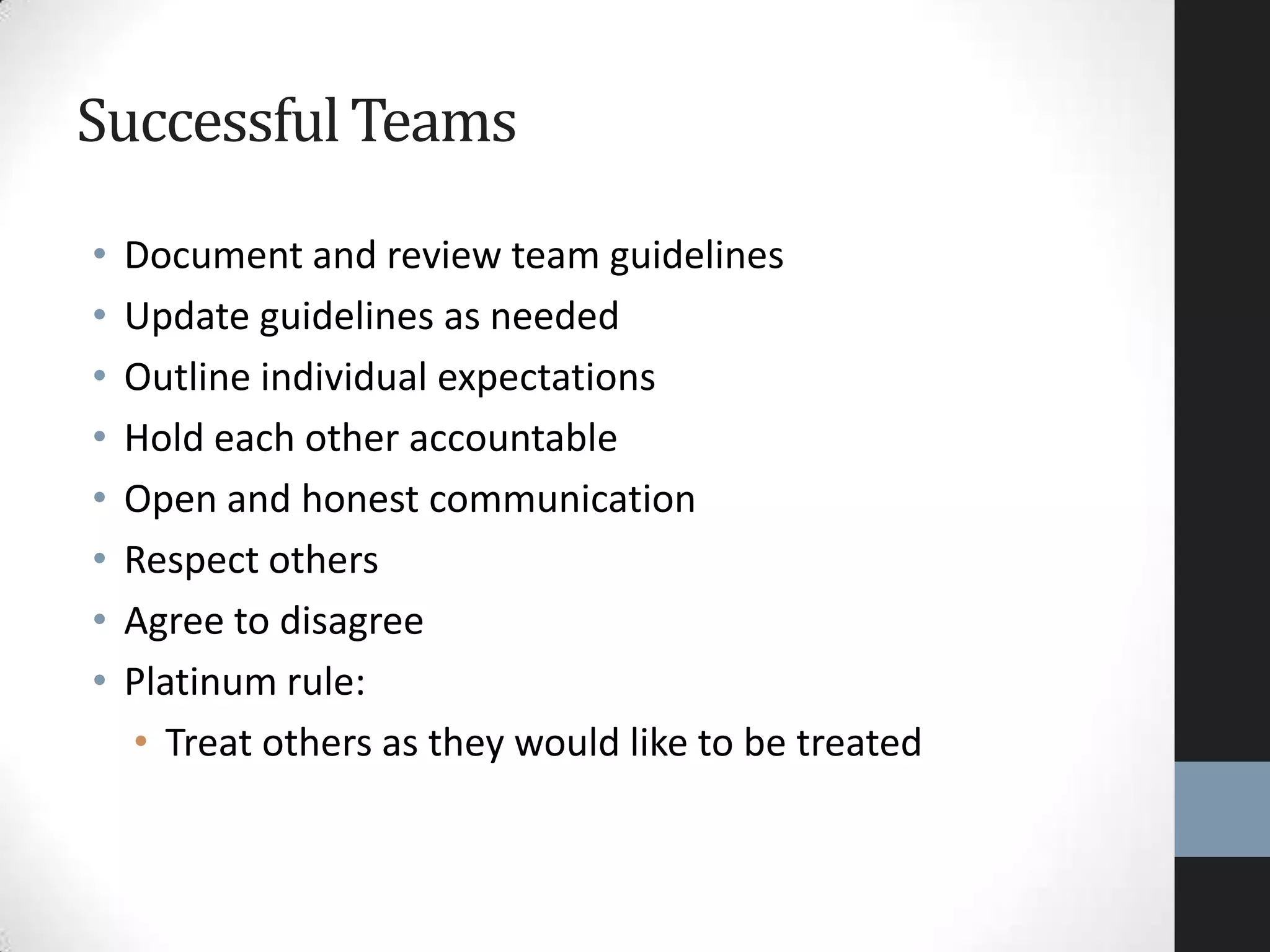
SuccessfulTeams
• Document and review team guidelines
• Update guidelines as needed
• Outline individual expectations
• Hold each other accountable
• Open and honest communication
• Respect others
• Agree to disagree
• Platinum rule:
• Treat others as they would like to be treated
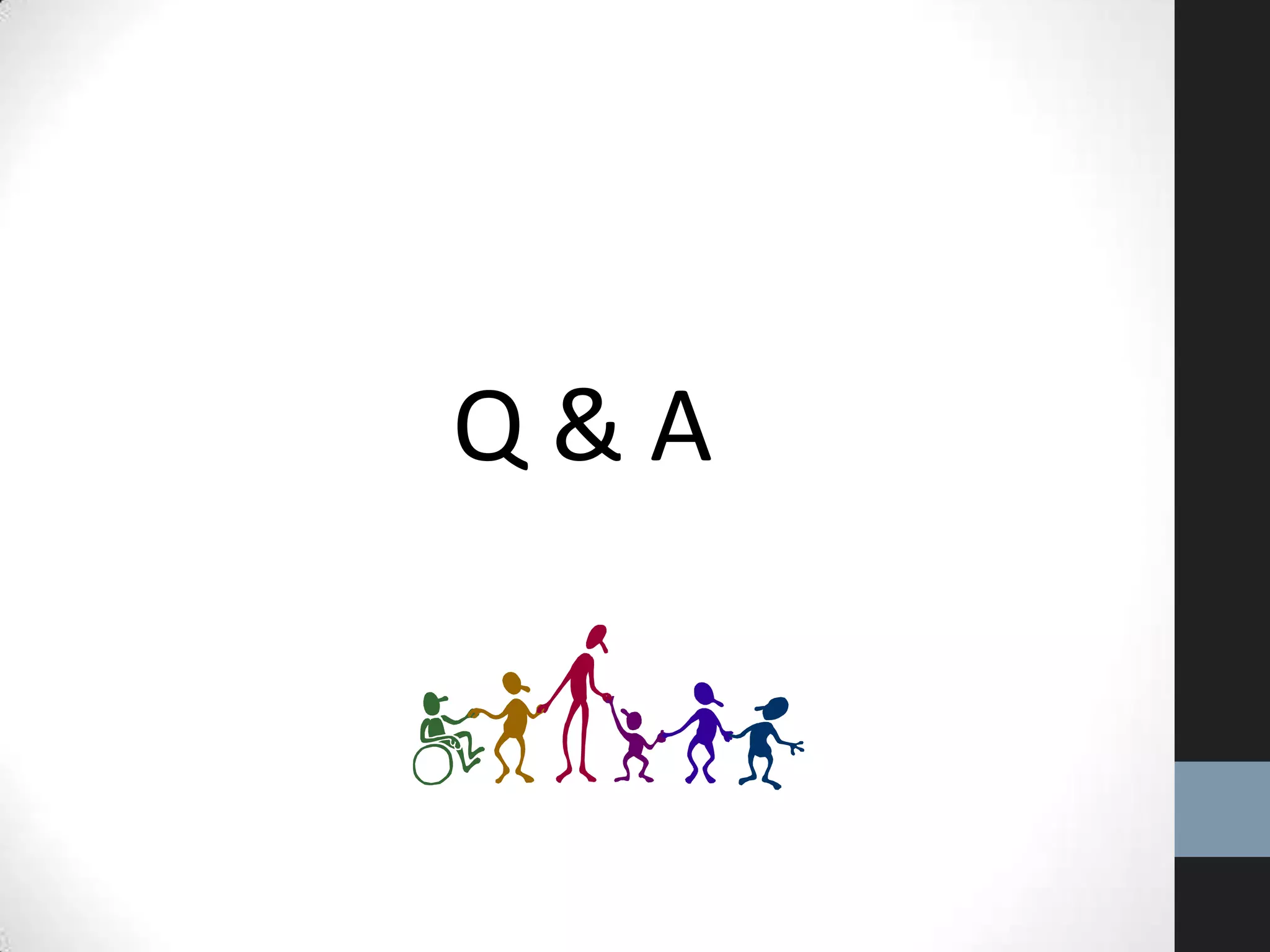
Q & A
•Your Virtual HR Manager
•$500 Per Year
Annual Membership Program
• Unlimited phone calls or emails to review employee issues,
questions or concerns
• Employee performance issues
• HR compliance issues
• Contractor v. employee
• Exempt v. non-exempt
• Recruiting and retention challenges
• EEO & harassment complaints
• Safety challenges
Unlimited Calls or Emails
• Customized employee handbook
• HR Compliance Risk Audit
• Resources to mitigate HR Risks
• Customized employee application
• Essential employment forms
• I-9 Training
• Reference Request form
• New Employee Orientation Power Point Template
OtherBenefits
• Hazardous Communication Training Power Point
• OSHA Forms (301, 300, 300A) Training
• Online Sexual Harassment Training Video
• Online Training on How to Communicate and Document
Discipline
• 8 Job descriptions
• 8 Performance evaluations linked to business profitability
• Monthly newsletter
• Weekly video or best practices
• Stay current on HR litigation
OtherBenefits cont.
Gary Wheeler
The Virtual HR Director, LLC
678-997-0017
gary@thevirtualhrdirector.com
http://www.thevirtualhrdirector.com
Thank You

Building a Productive Team One Person at a Time

  • 1.
    Building a ProductiveTeam One Person at a Time GAMMA Gary Wheeler, SPHR, GPHR, CCP, CBP
  • 2.
  • 3.
    GoogleSearch • What comesup when you type in GAMMA? • The 3rd letter of the Greek Alphabet Trivia question • How many letters in the Greek Alphabet? • 24 • Can anyone recite the Greek Alphabet? 3
  • 4.
    MedicalGroupManagementAssociation • Who wasthe founder of MGMA? • Harry J. Harwick • Where did he go to work? • MAYO Clinic • What year? • 1908 • When was the first MGMA conference? • 1926 • What year did GAMMA begin? • 1984 4
  • 6.
    • Are youa manager or a leader on the job? • Manage to accomplish tasks • Lead to achieve goals • In your role, you have to do both • Leaders build teams Building Your Team
  • 7.
    Objectives • Building aTeam Through • Communication • Relationships • Team Opportunities • What Does a Team Look Like? 7
  • 8.
  • 9.
    • Greet yourteam daily with enthusiasm • Conduct a 3-minute daily meeting • Meet face-to-face to ask questions (v. email) • Mix small talk in with your conversations • Hold weekly meetings with team • Hold monthly staff meetings with team Daily Communication
  • 10.
    • Inform • Instruct •Inspect • Recognize 3-MinuteDaily Meeting
  • 11.
    Employees respect leaderswho are respectful and honest • Address the situation the first time • Maintain and enhance self-esteem • Communicate openly and honestly • Speak from the heart • Listen and respond with empathy • Ask for help in solving the problem • Communicate, communicate, communicate Correcting Behavior
  • 12.
    Employees respect leaderswho are fair and listen • Talk with and note the conversation • Talk with, write up, signed • Talk with, write up, signed • Talk with, write up, signed, one-day suspension • Talk with, write up, signed final warning • Talk with, write up, signed termination ProgressiveDiscipline
  • 13.
    Correct behavior basedon individual and situation • Stay away from pre designed forms and templates • Handwritten documentation • Typed documentation • Does not have to be fancy • Correct within an appropriate time frame Discipline
  • 14.
    Correct behavior basedon individual and situation • Don’t make it personal • Talk with individuals respectfully • Shake hands afterwards • Encourage the person and let them know you believe • Use the Columbo approach Discipline
  • 15.
    Logistics and Approach •Choose the setting • Later (preferred) or immediate (illegal/safety) • Indirect (coaching preferred) or direct (tell) • Private (1 or 2) v. public (group) • What is the issue • Who is impacted • Customers/Patients • Doctors/Co-workers • Me • What is the best resolution 15 11
  • 16.
    4 C’s ofCommunication 16 Communicate Constructive Conflict Courage Commitment 11
  • 17.
  • 18.
    Talk, Listen andCommit • Leadership tool to build productive relationships 18 13
  • 19.
    Communication • Talk, Listenand Commit • Employee talks • Manager listens • We commit to work together • Keys to Positive Communication • Maintain and enhance self-esteem • Listen and respond with empathy • Ask for help in solving the problem 19 13
  • 20.
    Planning the Talk •Notify the employee in advance • Choose a private place free of distractions • Allow 15 to 30-minutes • Plan to take notes • Be prepared to follow up promptly after the talk
  • 21.
    During the Talk •Greet your employee professionally • Set the person at ease with small talk • Review the purpose of the discussion • Ask permission to take notes • Ask open ended questions • Ask for help in solving problems • Let the employee know when you will follow up
  • 22.
    Follow Up • Themost important part of the discussion is to follow up on issues, questions and concerns • Send a thank you note
  • 23.
    Summary • Talk, Listenand Commit is a leadership tool • Brand the talk as talk, listen and commit or TLC • Conduct at least two TLC’s per year • The key is to listen • The most important element is to follow up • Your people should be able to come to you with any situation (performance, relationships) • Never get upset
  • 24.
    Summary cont. • Askfor help in solving the challenge, problem, issue, question or concern • TLC can be used to proactively correct behavior • People work for their manager • Conduct informal TLC’s to build relationships • Relationships drive results/success • Our primary goal is to get our people to come to us • BUILD A TEAM ONE PERSON AT A TIME
  • 25.
    • Know thenames of spouses and kids • Know staff hobbies, interests and accomplsihments • Know if employee is a public or private person • Understand what the motivation climate is for your employees Relationship Building
  • 26.
    • Send abirthday card through the mail signed by the doctors and staff • Send holiday cards through mail and email • Desk side chats • 3 by 5 card thank you • Spontaneous thank you letter mailed to home • Coffee meeting • Gift certificate to Massage Envy • Starbucks Coffee gift card Relationship Ideas
  • 27.
  • 28.
    • Monthly birthdayand company anniversary celebrations • Favorite candy bar • Ice cream break • After work happy hour • Picnic • Backyard cookout • Bowling tournament • Baseball game • Other ideas Team Relationship Ideas
  • 29.
    Objective • What Doesa Team Look Like? 29
  • 30.
    Definition of ateam • A small number of people with complementary skills who are committed to a common purpose and who are working interdependently to achieve specific performance goals using an approach for which they hold themselves mutually accountable
  • 31.
    Successfulteam Characteristics • Commitmentto a common goal • Clear roles and work assignments • Respect for each other • Full participation • Conflict management • Mutual accountability • Honest communication • Active listening • Appreciation for each other • Trustworthiness • Willingness to share
  • 32.
    Stages of TeamPerformance • Forming • Storming • Norming • Performing • Adjourning
  • 33.
    Forming • Team membersfeel uncertainty or confusion about team goals
  • 34.
    Storming • Team membersmay clash with and confront each other on all aspects of the project • Team members begin to assess their commitment to the project and their attitude toward other team members • Team members begin to refine their pattern of interaction; some choose to withdraw • Morale may go from high to low
  • 35.
    Norming • Team memberscooperate and collaborate with each other • The team begins to form a group identity; members appreciate each other and are committed to the project • Team members begin to open up to each other and freely exchange ideas and thoughts • Team members work toward mutually agreed upon goals • Team members interact according to what has been established and accepted by the team
  • 36.
    Performing • Team structure,goals and responsibilities are firmly established • Team members work consistently to accomplish project tasks • Team maintains effectiveness, either by continuing to learn and develop or by maintaining a routine
  • 37.
    SuccessfulTeams • Document andreview team guidelines • Update guidelines as needed • Outline individual expectations • Hold each other accountable • Open and honest communication • Respect others • Agree to disagree • Platinum rule: • Treat others as they would like to be treated
  • 38.
  • 39.
    •Your Virtual HRManager •$500 Per Year Annual Membership Program
  • 40.
    • Unlimited phonecalls or emails to review employee issues, questions or concerns • Employee performance issues • HR compliance issues • Contractor v. employee • Exempt v. non-exempt • Recruiting and retention challenges • EEO & harassment complaints • Safety challenges Unlimited Calls or Emails
  • 41.
    • Customized employeehandbook • HR Compliance Risk Audit • Resources to mitigate HR Risks • Customized employee application • Essential employment forms • I-9 Training • Reference Request form • New Employee Orientation Power Point Template OtherBenefits
  • 42.
    • Hazardous CommunicationTraining Power Point • OSHA Forms (301, 300, 300A) Training • Online Sexual Harassment Training Video • Online Training on How to Communicate and Document Discipline • 8 Job descriptions • 8 Performance evaluations linked to business profitability • Monthly newsletter • Weekly video or best practices • Stay current on HR litigation OtherBenefits cont.
  • 43.
    Gary Wheeler The VirtualHR Director, LLC 678-997-0017 gary@thevirtualhrdirector.com http://www.thevirtualhrdirector.com Thank You