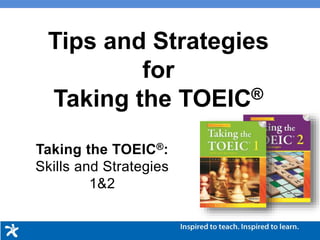
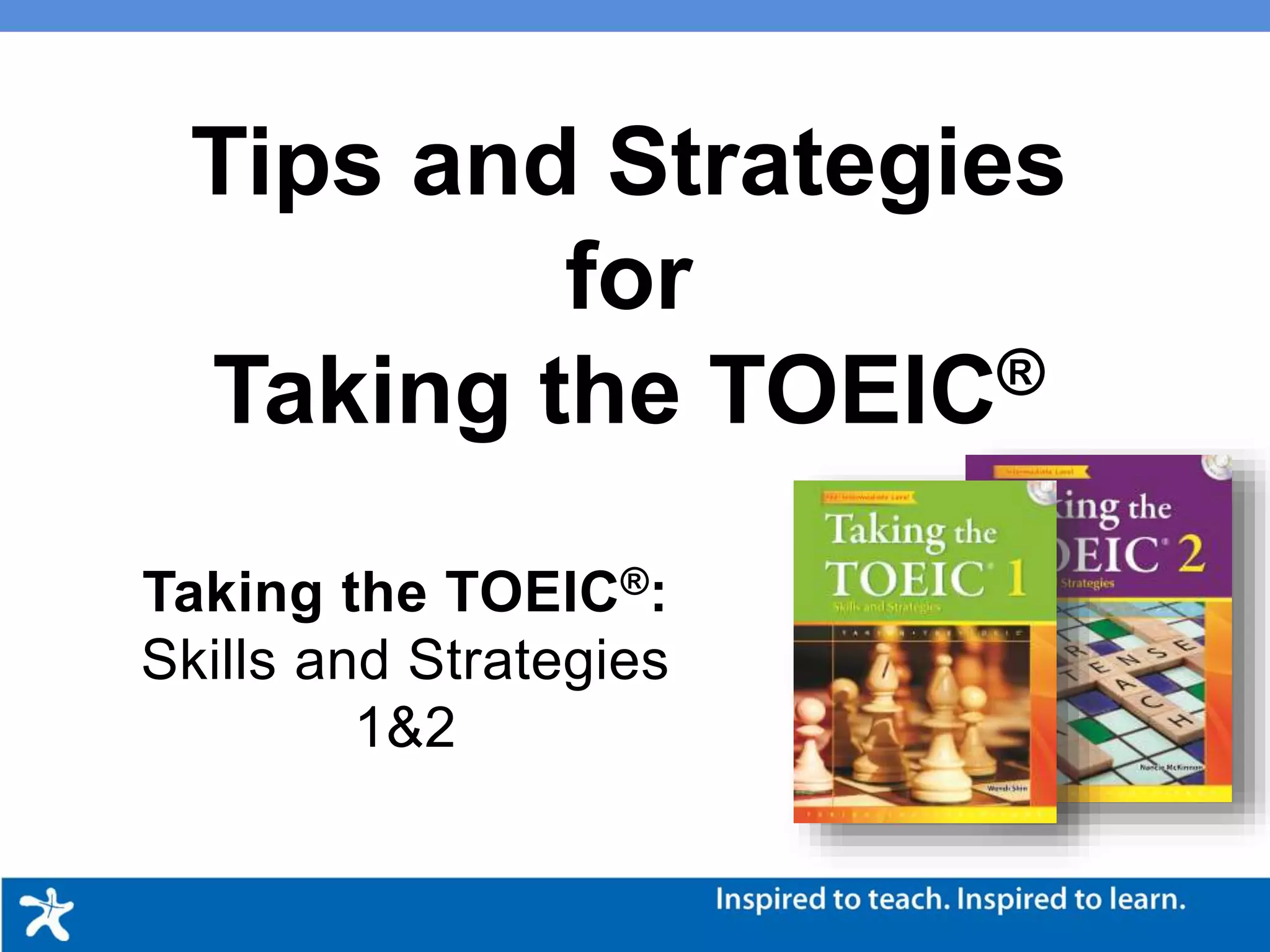
Taking the TOEIC®:
Skills and Strategies
1&2
Tips and Strategies
for
Taking the TOEIC®
Tips and Strategies for
Taking the TOEIC®
In This Presentation:
• Show how to organize a curriculum to prepare
students for taking the TOEIC® Listening and
Reading Test
• Apply key methodologies for assisting students
• Use the principles found in Wendi Shin’s Taking the
TOEIC ® 1 & 2
• We will explore effective tips and strategies for
teaching students preparing for the TOEIC ® Test
• Incorporate poignant activities
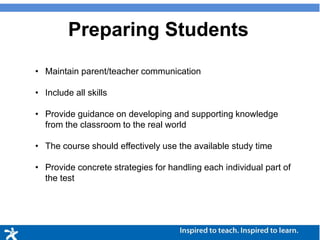
Preparing Students
• Maintain parent/teacher communication
• Include all skills
• Provide guidance on developing and supporting knowledge
from the classroom to the real world
• The course should effectively use the available study time
• Provide concrete strategies for handling each individual part of
the test
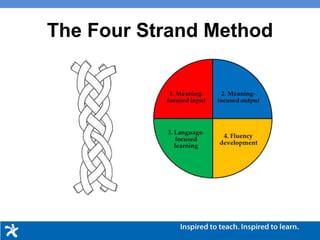
The Four Strand Method
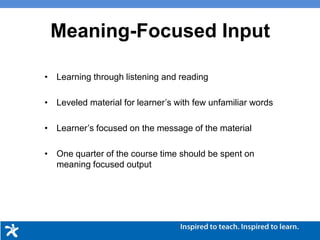
• Learning through listening and reading
• Leveled material for learner’s with few unfamiliar words
• Learner’s focused on the message of the material
• One quarter of the course time should be spent on
meaning focused output
Meaning-Focused Input
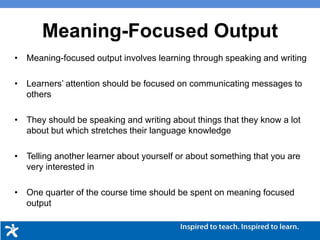
• Meaning-focused output involves learning through speaking and writing
• Learners’ attention should be focused on communicating messages to
others
• They should be speaking and writing about things that they know a lot
about but which stretches their language knowledge
• Telling another learner about yourself or about something that you are
very interested in
• One quarter of the course time should be spent on meaning focused
output
Meaning-Focused Output
Language Focused Learning
• Deliberate learning of pronunciation, vocabulary, grammar, and
discourse structure
• Deliberate attention to language features
• Use of language-learning strategies
Fluency Development
• Learners are encouraged to make the best use of what is
already known
• Developing fluency in the four skills
• Developing speed
• Reinforcing learning
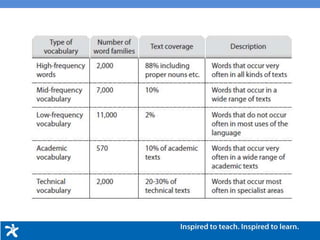
• Reading comprehension depends on the meaning students give to
words
• The more words students know, the more they can read and
understand
• In order to be able to remember new words, students must practice
and apply
Why Is Vocabulary Important?
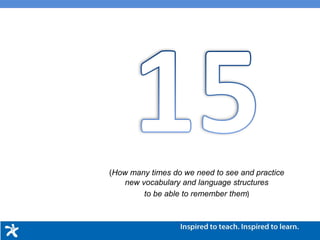
(How many times do we need to see and practice
new vocabulary and language structures
to be able to remember them)
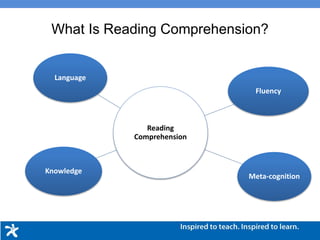
What Is Reading Comprehension?
Reading
Comprehension
Language
Fluency
Meta-cognition
Knowledge
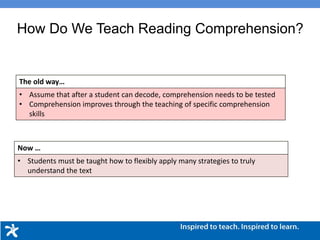
How Do We Teach Reading Comprehension?
The old way…
• Assume that after a student can decode, comprehension needs to be tested
• Comprehension improves through the teaching of specific comprehension
skills
Now …
• Students must be taught how to flexibly apply many strategies to truly
understand the text
What Do Good Readers Do?
• Use background knowledge to make predictions
• Identify key areas in the text that they are reading and familiar with,
text structures
• Monitor their own comprehension and adjust their reading strategies
if needed
• Use a variety of reading strategies effectively
• Start to form opinions and critical thinking
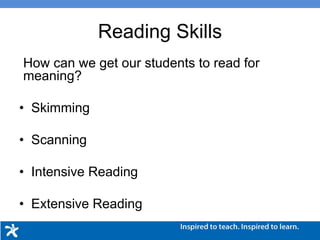
Reading Skills
How can we get our students to read for
meaning?
• Skimming
• Scanning
• Intensive Reading
• Extensive Reading
SKIMMING
• Basic understanding or general idea of
input
• Ability to provide basic summary as
output
SCANNING
• Specific Information
• Answer specific content based output
INTENSIVE READING
• Language focused learning
• Meaning focused input development
EXTENSIVE READING
• Speed and fluency development
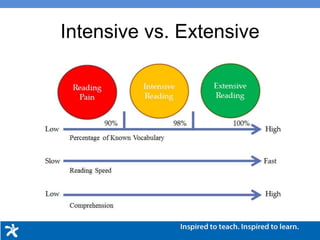
Intensive vs. Extensive
Taking the TOEIC ® Book Overview
• Taking the TOEIC ® 1 & 2: Skills and Strategies is intended for pre-
intermediate and intermediate students of English who need to start
preparation for the TOEIC ® Test
• The book is divided into four sections, or chapters, dealing with the
areas tested in TOEIC ® :
• Chapter 1- Listening Practice
• Chapter 2- Grammar Practice
• Chapter 3- Reading Practice
• Chapter 4- Practice Test
• Support
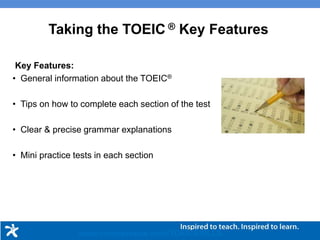
Key Features:
• General information about the TOEIC®
• Tips on how to complete each section of the test
• Clear & precise grammar explanations
• Mini practice tests in each section
Taking the TOEIC ® Key Features
www.compasspub.com/TOEICSKILLS
The TOEIC® Listening and
Reading Test
with
Taking the TOEIC®: Skills and
Strategies
About TOEIC ® :
• TOEIC® stands for Test of English for
International Communication. This book
focuses on preparation for the TOEIC ®
Listening and Reading Test
• The listening section tests the ability to
understand spoken English
• The reading section tests the knowledge of
grammar and vocabulary usage and the
ability to read and understand short passages
Information about the TOEIC® Listening and
Reading Test
Information about the TOEIC® Listening and
Reading Test
TOEIC® Test Structure:
• Section 1 Listening Test
Listening Total: 100 questions
Time: 45 minutes
• Section 2 Reading Test
Reading Total: 100 questions
Time: 1 hour 15 minutes
Information about the TOEIC® Test
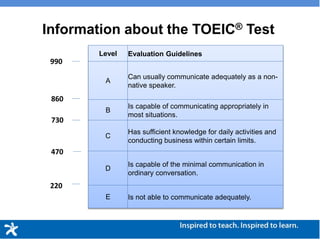
Level Evaluation Guidelines
A
Can usually communicate adequately as a non-
native speaker.
B
Is capable of communicating appropriately in
most situations.
C
Has sufficient knowledge for daily activities and
conducting business within certain limits.
D
Is capable of the minimal communication in
ordinary conversation.
E Is not able to communicate adequately.
730
860
470
220
990
Let’s Explore the TOEIC®
Listening and Speaking Test
with
Taking the TOEIC®:
Tips and Strategies
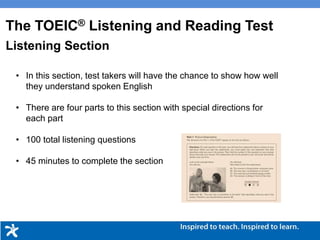
• In this section, test takers will have the chance to show how well
they understand spoken English
• There are four parts to this section with special directions for
each part
• 100 total listening questions
• 45 minutes to complete the section
Listening Section
The TOEIC® Listening and Reading Test
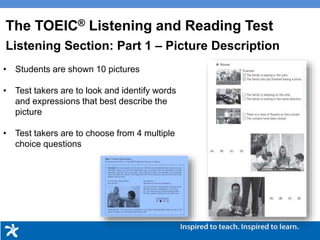
• Students are shown 10 pictures
• Test takers are to look and identify words
and expressions that best describe the
picture
• Test takers are to choose from 4 multiple
choice questions
The TOEIC® Listening and Reading Test
Listening Section: Part 1 – Picture Description
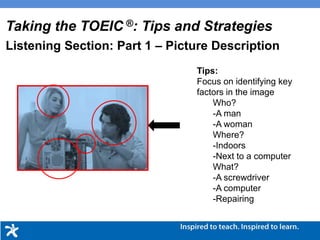
Tips:
Focus on identifying key
factors in the image
Who?
-A man
-A woman
Where?
-Indoors
-Next to a computer
What?
-A screwdriver
-A computer
-Repairing
Taking the TOEIC ®: Tips and Strategies
Listening Section: Part 1 – Picture Description
Strategies:
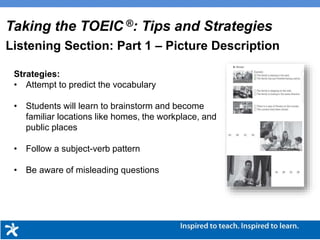
• Attempt to predict the vocabulary
• Students will learn to brainstorm and become
familiar locations like homes, the workplace, and
public places
• Follow a subject-verb pattern
• Be aware of misleading questions
Taking the TOEIC ®: Tips and Strategies
Listening Section: Part 1 – Picture Description
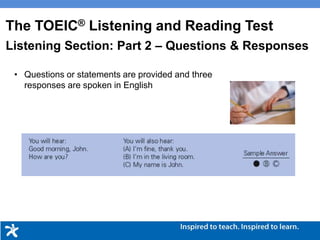
• Questions or statements are provided and three
responses are spoken in English
The TOEIC® Listening and Reading Test
Listening Section: Part 2 – Questions & Responses
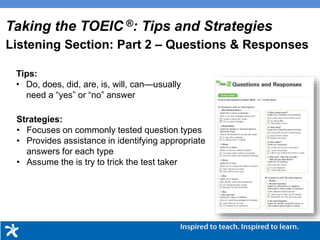
Tips:
• Do, does, did, are, is, will, can—usually
need a “yes” or “no” answer
Strategies:
• Focuses on commonly tested question types
• Provides assistance in identifying appropriate
answers for each type
• Assume the is try to trick the test taker
Taking the TOEIC ®: Tips and Strategies
Listening Section: Part 2 – Questions & Responses
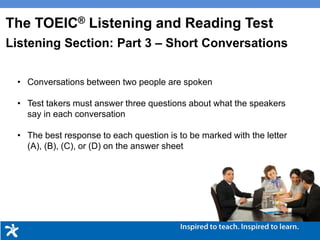
• Conversations between two people are spoken
• Test takers must answer three questions about what the speakers
say in each conversation
• The best response to each question is to be marked with the letter
(A), (B), (C), or (D) on the answer sheet
The TOEIC® Listening and Reading Test
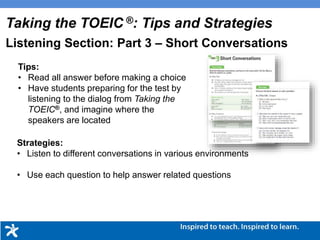
Listening Section: Part 3 – Short Conversations
Tips:
• Read all answer before making a choice
• Have students preparing for the test by
listening to the dialog from Taking the
TOEIC®, and imagine where the
speakers are located
Strategies:
• Listen to different conversations in various environments
• Use each question to help answer related questions
Taking the TOEIC ®: Tips and Strategies
Listening Section: Part 3 – Short Conversations
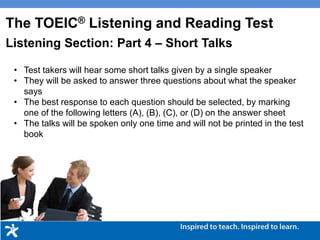
• Test takers will hear some short talks given by a single speaker
• They will be asked to answer three questions about what the speaker
says
• The best response to each question should be selected, by marking
one of the following letters (A), (B), (C), or (D) on the answer sheet
• The talks will be spoken only one time and will not be printed in the test
book
The TOEIC® Listening and Reading Test
Listening Section: Part 4 – Short Talks
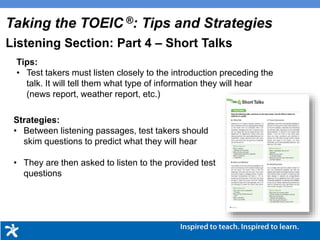
Tips:
• Test takers must listen closely to the introduction preceding the
talk. It will tell them what type of information they will hear
(news report, weather report, etc.)
Strategies:
• Between listening passages, test takers should
skim questions to predict what they will hear
• They are then asked to listen to the provided test
questions
Taking the TOEIC ®: Tips and Strategies
Listening Section: Part 4 – Short Talks
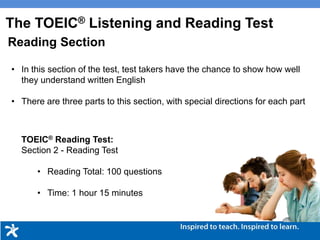
• In this section of the test, test takers have the chance to show how well
they understand written English
• There are three parts to this section, with special directions for each part
Reading Section
TOEIC® Reading Test:
Section 2 - Reading Test
• Reading Total: 100 questions
• Time: 1 hour 15 minutes
The TOEIC® Listening and Reading Test
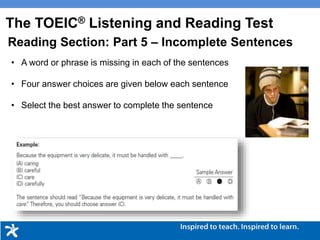
• A word or phrase is missing in each of the sentences
• Four answer choices are given below each sentence
• Select the best answer to complete the sentence
The TOEIC® Listening and Reading Test
Reading Section: Part 5 – Incomplete Sentences
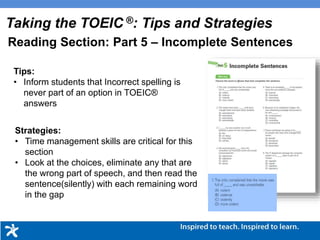
Tips:
• Inform students that Incorrect spelling is
never part of an option in TOEIC®
answers
Strategies:
• Time management skills are critical for this
section
• Look at the choices, eliminate any that are
the wrong part of speech, and then read the
sentence(silently) with each remaining word
in the gap
Taking the TOEIC ®: Tips and Strategies
Reading Section: Part 5 – Incomplete Sentences
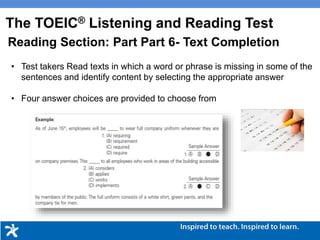
• Test takers Read texts in which a word or phrase is missing in some of the
sentences and identify content by selecting the appropriate answer
• Four answer choices are provided to choose from
The TOEIC® Listening and Reading Test
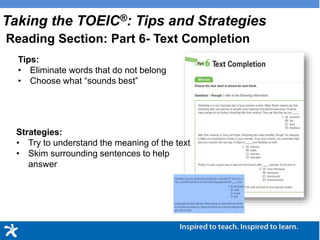
Reading Section: Part Part 6- Text Completion
Tips:
• Eliminate words that do not belong
• Choose what “sounds best”
Strategies:
• Try to understand the meaning of the text
• Skim surrounding sentences to help
answer
Taking the TOEIC®: Tips and Strategies
Reading Section: Part 6- Text Completion
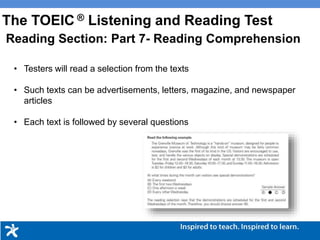
• Testers will read a selection from the texts
• Such texts can be advertisements, letters, magazine, and newspaper
articles
• Each text is followed by several questions
Reading Section: Part 7- Reading Comprehension
The TOEIC ® Listening and Reading Test
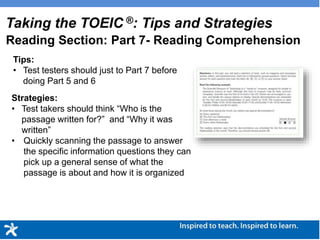
Tips:
• Test testers should just to Part 7 before
doing Part 5 and 6
Strategies:
• Test takers should think “Who is the
passage written for?” and “Why it was
written”
• Quickly scanning the passage to answer
the specific information questions they can
pick up a general sense of what the
passage is about and how it is organized
Taking the TOEIC ®: Tips and Strategies
Reading Section: Part 7- Reading Comprehension
Picture Description
• Place a selection of test photos on the
table between students and read out
sentences from the transcript.
• Students race to slap their palms down on
the correct picture
• Students cannot move their hands if the
sentence doesn’t match any of the
pictures.
• You can then continue with the students
reading out the transcript sentences and
then making up their own sentences
Listening Section: Part 1 - Picture Description
Extension Activity: Picture Slap
Picture Description
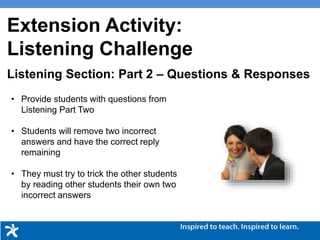
• Provide students with questions from
Listening Part Two
• Students will remove two incorrect
answers and have the correct reply
remaining
• They must try to trick the other students
by reading other students their own two
incorrect answers
Picture Description
Listening Section: Part 2 – Questions & Responses
Extension Activity:
Listening Challenge
Picture Description
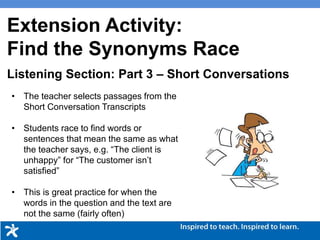
• The teacher selects passages from the
Short Conversation Transcripts
• Students race to find words or
sentences that mean the same as what
the teacher says, e.g. “The client is
unhappy” for “The customer isn’t
satisfied”
• This is great practice for when the
words in the question and the text are
not the same (fairly often)
Listening Section: Part 3 – Short Conversations
Extension Activity:
Find the Synonyms Race
Thank You!
For information on this product or
other ELT materials, connect with us!
facebook.com/compasspublishing
@CompassELT
info@compasspub.com
PPT available at:
www.slideshare.net/compasspublishing
ASEAN Regional Manager:
Gio Panizzon
giopanizzon@compasspub.com

Taking the TOEIC 1 & 2 Academic Presention

  • 1.
    Taking the TOEIC®: Skillsand Strategies 1&2 Tips and Strategies for Taking the TOEIC®
  • 3.
    Tips and Strategiesfor Taking the TOEIC® In This Presentation: • Show how to organize a curriculum to prepare students for taking the TOEIC® Listening and Reading Test • Apply key methodologies for assisting students • Use the principles found in Wendi Shin’s Taking the TOEIC ® 1 & 2 • We will explore effective tips and strategies for teaching students preparing for the TOEIC ® Test • Incorporate poignant activities
  • 4.
    Preparing Students • Maintainparent/teacher communication • Include all skills • Provide guidance on developing and supporting knowledge from the classroom to the real world • The course should effectively use the available study time • Provide concrete strategies for handling each individual part of the test
  • 5.
  • 6.
    • Learning throughlistening and reading • Leveled material for learner’s with few unfamiliar words • Learner’s focused on the message of the material • One quarter of the course time should be spent on meaning focused output Meaning-Focused Input
  • 7.
    • Meaning-focused outputinvolves learning through speaking and writing • Learners’ attention should be focused on communicating messages to others • They should be speaking and writing about things that they know a lot about but which stretches their language knowledge • Telling another learner about yourself or about something that you are very interested in • One quarter of the course time should be spent on meaning focused output Meaning-Focused Output
  • 8.
    Language Focused Learning •Deliberate learning of pronunciation, vocabulary, grammar, and discourse structure • Deliberate attention to language features • Use of language-learning strategies
  • 9.
    Fluency Development • Learnersare encouraged to make the best use of what is already known • Developing fluency in the four skills • Developing speed • Reinforcing learning
  • 11.
    • Reading comprehensiondepends on the meaning students give to words • The more words students know, the more they can read and understand • In order to be able to remember new words, students must practice and apply Why Is Vocabulary Important?
  • 13.
    (How many timesdo we need to see and practice new vocabulary and language structures to be able to remember them)
  • 14.
    What Is ReadingComprehension? Reading Comprehension Language Fluency Meta-cognition Knowledge
  • 15.
    How Do WeTeach Reading Comprehension? The old way… • Assume that after a student can decode, comprehension needs to be tested • Comprehension improves through the teaching of specific comprehension skills Now … • Students must be taught how to flexibly apply many strategies to truly understand the text
  • 16.
    What Do GoodReaders Do? • Use background knowledge to make predictions • Identify key areas in the text that they are reading and familiar with, text structures • Monitor their own comprehension and adjust their reading strategies if needed • Use a variety of reading strategies effectively • Start to form opinions and critical thinking
  • 17.
    Reading Skills How canwe get our students to read for meaning? • Skimming • Scanning • Intensive Reading • Extensive Reading
  • 18.
    SKIMMING • Basic understandingor general idea of input • Ability to provide basic summary as output
  • 19.
    SCANNING • Specific Information •Answer specific content based output
  • 20.
    INTENSIVE READING • Languagefocused learning • Meaning focused input development
  • 21.
    EXTENSIVE READING • Speedand fluency development
  • 23.
  • 24.
    Taking the TOEIC® Book Overview • Taking the TOEIC ® 1 & 2: Skills and Strategies is intended for pre- intermediate and intermediate students of English who need to start preparation for the TOEIC ® Test • The book is divided into four sections, or chapters, dealing with the areas tested in TOEIC ® : • Chapter 1- Listening Practice • Chapter 2- Grammar Practice • Chapter 3- Reading Practice • Chapter 4- Practice Test • Support
  • 25.
    Key Features: • Generalinformation about the TOEIC® • Tips on how to complete each section of the test • Clear & precise grammar explanations • Mini practice tests in each section Taking the TOEIC ® Key Features www.compasspub.com/TOEICSKILLS
  • 26.
    The TOEIC® Listeningand Reading Test with Taking the TOEIC®: Skills and Strategies
  • 27.
    About TOEIC ®: • TOEIC® stands for Test of English for International Communication. This book focuses on preparation for the TOEIC ® Listening and Reading Test • The listening section tests the ability to understand spoken English • The reading section tests the knowledge of grammar and vocabulary usage and the ability to read and understand short passages Information about the TOEIC® Listening and Reading Test
  • 28.
    Information about theTOEIC® Listening and Reading Test TOEIC® Test Structure: • Section 1 Listening Test Listening Total: 100 questions Time: 45 minutes • Section 2 Reading Test Reading Total: 100 questions Time: 1 hour 15 minutes
  • 29.
    Information about theTOEIC® Test Level Evaluation Guidelines A Can usually communicate adequately as a non- native speaker. B Is capable of communicating appropriately in most situations. C Has sufficient knowledge for daily activities and conducting business within certain limits. D Is capable of the minimal communication in ordinary conversation. E Is not able to communicate adequately. 730 860 470 220 990
  • 30.
    Let’s Explore theTOEIC® Listening and Speaking Test with Taking the TOEIC®: Tips and Strategies
  • 31.
    • In thissection, test takers will have the chance to show how well they understand spoken English • There are four parts to this section with special directions for each part • 100 total listening questions • 45 minutes to complete the section Listening Section The TOEIC® Listening and Reading Test
  • 32.
    • Students areshown 10 pictures • Test takers are to look and identify words and expressions that best describe the picture • Test takers are to choose from 4 multiple choice questions The TOEIC® Listening and Reading Test Listening Section: Part 1 – Picture Description
  • 33.
    Tips: Focus on identifyingkey factors in the image Who? -A man -A woman Where? -Indoors -Next to a computer What? -A screwdriver -A computer -Repairing Taking the TOEIC ®: Tips and Strategies Listening Section: Part 1 – Picture Description
  • 34.
    Strategies: • Attempt topredict the vocabulary • Students will learn to brainstorm and become familiar locations like homes, the workplace, and public places • Follow a subject-verb pattern • Be aware of misleading questions Taking the TOEIC ®: Tips and Strategies Listening Section: Part 1 – Picture Description
  • 35.
    • Questions orstatements are provided and three responses are spoken in English The TOEIC® Listening and Reading Test Listening Section: Part 2 – Questions & Responses
  • 36.
    Tips: • Do, does,did, are, is, will, can—usually need a “yes” or “no” answer Strategies: • Focuses on commonly tested question types • Provides assistance in identifying appropriate answers for each type • Assume the is try to trick the test taker Taking the TOEIC ®: Tips and Strategies Listening Section: Part 2 – Questions & Responses
  • 37.
    • Conversations betweentwo people are spoken • Test takers must answer three questions about what the speakers say in each conversation • The best response to each question is to be marked with the letter (A), (B), (C), or (D) on the answer sheet The TOEIC® Listening and Reading Test Listening Section: Part 3 – Short Conversations
  • 38.
    Tips: • Read allanswer before making a choice • Have students preparing for the test by listening to the dialog from Taking the TOEIC®, and imagine where the speakers are located Strategies: • Listen to different conversations in various environments • Use each question to help answer related questions Taking the TOEIC ®: Tips and Strategies Listening Section: Part 3 – Short Conversations
  • 39.
    • Test takerswill hear some short talks given by a single speaker • They will be asked to answer three questions about what the speaker says • The best response to each question should be selected, by marking one of the following letters (A), (B), (C), or (D) on the answer sheet • The talks will be spoken only one time and will not be printed in the test book The TOEIC® Listening and Reading Test Listening Section: Part 4 – Short Talks
  • 40.
    Tips: • Test takersmust listen closely to the introduction preceding the talk. It will tell them what type of information they will hear (news report, weather report, etc.) Strategies: • Between listening passages, test takers should skim questions to predict what they will hear • They are then asked to listen to the provided test questions Taking the TOEIC ®: Tips and Strategies Listening Section: Part 4 – Short Talks
  • 41.
    • In thissection of the test, test takers have the chance to show how well they understand written English • There are three parts to this section, with special directions for each part Reading Section TOEIC® Reading Test: Section 2 - Reading Test • Reading Total: 100 questions • Time: 1 hour 15 minutes The TOEIC® Listening and Reading Test
  • 42.
    • A wordor phrase is missing in each of the sentences • Four answer choices are given below each sentence • Select the best answer to complete the sentence The TOEIC® Listening and Reading Test Reading Section: Part 5 – Incomplete Sentences
  • 43.
    Tips: • Inform studentsthat Incorrect spelling is never part of an option in TOEIC® answers Strategies: • Time management skills are critical for this section • Look at the choices, eliminate any that are the wrong part of speech, and then read the sentence(silently) with each remaining word in the gap Taking the TOEIC ®: Tips and Strategies Reading Section: Part 5 – Incomplete Sentences
  • 44.
    • Test takersRead texts in which a word or phrase is missing in some of the sentences and identify content by selecting the appropriate answer • Four answer choices are provided to choose from The TOEIC® Listening and Reading Test Reading Section: Part Part 6- Text Completion
  • 45.
    Tips: • Eliminate wordsthat do not belong • Choose what “sounds best” Strategies: • Try to understand the meaning of the text • Skim surrounding sentences to help answer Taking the TOEIC®: Tips and Strategies Reading Section: Part 6- Text Completion
  • 46.
    • Testers willread a selection from the texts • Such texts can be advertisements, letters, magazine, and newspaper articles • Each text is followed by several questions Reading Section: Part 7- Reading Comprehension The TOEIC ® Listening and Reading Test
  • 47.
    Tips: • Test testersshould just to Part 7 before doing Part 5 and 6 Strategies: • Test takers should think “Who is the passage written for?” and “Why it was written” • Quickly scanning the passage to answer the specific information questions they can pick up a general sense of what the passage is about and how it is organized Taking the TOEIC ®: Tips and Strategies Reading Section: Part 7- Reading Comprehension
  • 48.
    Picture Description • Placea selection of test photos on the table between students and read out sentences from the transcript. • Students race to slap their palms down on the correct picture • Students cannot move their hands if the sentence doesn’t match any of the pictures. • You can then continue with the students reading out the transcript sentences and then making up their own sentences Listening Section: Part 1 - Picture Description Extension Activity: Picture Slap
  • 49.
    Picture Description • Providestudents with questions from Listening Part Two • Students will remove two incorrect answers and have the correct reply remaining • They must try to trick the other students by reading other students their own two incorrect answers Picture Description Listening Section: Part 2 – Questions & Responses Extension Activity: Listening Challenge
  • 50.
    Picture Description • Theteacher selects passages from the Short Conversation Transcripts • Students race to find words or sentences that mean the same as what the teacher says, e.g. “The client is unhappy” for “The customer isn’t satisfied” • This is great practice for when the words in the question and the text are not the same (fairly often) Listening Section: Part 3 – Short Conversations Extension Activity: Find the Synonyms Race
  • 51.
    Thank You! For informationon this product or other ELT materials, connect with us! facebook.com/compasspublishing @CompassELT info@compasspub.com PPT available at: www.slideshare.net/compasspublishing ASEAN Regional Manager: Gio Panizzon giopanizzon@compasspub.com

Editor's Notes

  • #4 Y
  • #5 Y
  • #7 The strand of meaning-focused input involves learning through listening and reading. Learners’ attention should be focused on the message of the material that they are listening to or reading. The materials should be at the right level for them in that they contain a few new language items which are easily understandable through background knowledge and context clues. A good example of an activity in the meaning-focused input strand is reading a graded reader which is at the right vocabulary level so that only around two out of every one hundred words in the text were previously unfamiliar to the reader. One quarter of the course time should be spent on meaning-focused input. Dkimiing scamming Intensive reading and Coming back for review First time will be intensive and then in the following situations Note that this is on Becky’s presentantion
  • #8 The strand of meaning-focused input involves learning through listening and reading. Learners’ attention should be focused on the message of the material that they are listening to or reading. The materials should be at the right level for them in that they contain a few new language items which are easily understandable through background knowledge and context clues. A good example of an activity in the meaning-focused input strand is reading a graded reader which is at the right vocabulary level so that only around two out of every one hundred words in the text were previously unfamiliar to the reader. One quarter of the course time should be spent on meaning-focused input. Dkimiing scamming Intensive reading and Coming back for review First time will be intensive and then in the following situations Note that this is on Becky’s presentantion
  • #9 Y The strand of meaning-focused input involves learning through listening and reading. Learners’ attention should be focused on the message of the material that they are listening to or reading. The materials should be at the right level for them in that they contain a few new language items which are easily understandable through background knowledge and context clues. A good example of an activity in the meaning-focused input strand is reading a graded reader which is at the right vocabulary level so that only around two out of every one hundred words in the text were previously unfamiliar to the reader. One quarter of the course time should be spent on meaning-focused input. Dkimiing scamming Intensive reading and Coming back for review First time will be intensive and then in the following situations Note that this is on Becky’s presentantion
  • #10 Y The strand of meaning-focused input involves learning through listening and reading. Learners’ attention should be focused on the message of the material that they are listening to or reading. The materials should be at the right level for them in that they contain a few new language items which are easily understandable through background knowledge and context clues. A good example of an activity in the meaning-focused input strand is reading a graded reader which is at the right vocabulary level so that only around two out of every one hundred words in the text were previously unfamiliar to the reader. One quarter of the course time should be spent on meaning-focused input. Dkimiing scamming Intensive reading and Coming back for review First time will be intensive and then in the following situations Note that this is on Becky’s presentantion
  • #11 Y The strand of meaning-focused input involves learning through listening and reading. Learners’ attention should be focused on the message of the material that they are listening to or reading. The materials should be at the right level for them in that they contain a few new language items which are easily understandable through background knowledge and context clues. A good example of an activity in the meaning-focused input strand is reading a graded reader which is at the right vocabulary level so that only around two out of every one hundred words in the text were previously unfamiliar to the reader. One quarter of the course time should be spent on meaning-focused input. Dkimiing scamming Intensive reading and Coming back for review First time will be intensive and then in the following situations Note that this is on Becky’s presentantion
  • #23 Y The strand of meaning-focused input involves learning through listening and reading. Learners’ attention should be focused on the message of the material that they are listening to or reading. The materials should be at the right level for them in that they contain a few new language items which are easily understandable through background knowledge and context clues. A good example of an activity in the meaning-focused input strand is reading a graded reader which is at the right vocabulary level so that only around two out of every one hundred words in the text were previously unfamiliar to the reader. One quarter of the course time should be spent on meaning-focused input. Dkimiing scamming Intensive reading and Coming back for review First time will be intensive and then in the following situations Note that this is on Becky’s presentantion
  • #25 n
  • #26 y
  • #28 y
  • #29 n
  • #30 n
  • #31 n
  • #32 Y
  • #33 Y
  • #34 ok
  • #35 Y
  • #36 Y
  • #37 Y
  • #40 Y
  • #41 Y
  • #42 Y
  • #43 Y
  • #44 Y
  • #46 Y
  • #47 Y
  • #48 Y
  • #49 Y
  • #50 Y
  • #51 Y