Matching Sentence Endings
Reading: Tips & Strategy
Reading
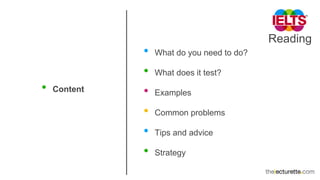
• Content
• What do you need to do?
• What does it test?
• Examples
• Common problems
• Tips and advice
• Strategy
Reading
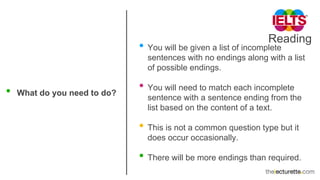
• What do you need to do?
• You will be given a list of incomplete
sentences with no endings along with a list
of possible endings.
• You will need to match each incomplete
sentence with a sentence ending from the
list based on the content of a text.
• This is not a common question type but it
does occur occasionally.
• There will be more endings than required.
Reading
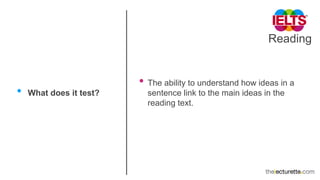
• What does it test?
• The ability to understand how ideas in a
sentence link to the main ideas in the
reading text.
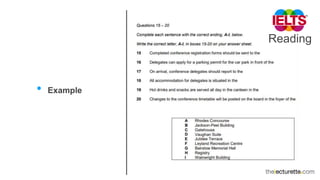
• Example
Reading
Reading
• Common Problems
• Students treat this type of question as a
grammar test rather than a reading test,
matching sentences that only grammatically
make sense.
• Students focus on exact vocabulary
matches in the text and in the questions
while the examiner will probably use
synonyms and paraphrases.
Reading
• Tips
• Locate question one first. The answers are in
the same order as the text, so this will give
you a good place to start.
• Predict how the sentence will end before
looking at the endings that are given.
• Look at the incomplete sentences first before
you examine the endings. Looking at the
endings first wastes time because there will
be more endings than sentences.
Reading
• More Tips
• The examiner is unlikely to use the same
words in the sentences so look for synonyms
and paraphrases.
• All the sentence endings will appear in the
text. However, it is best to just read the ones
you decide to match with the incomplete
sentences.
• When reading the text, highlight names,
places and dates. This makes it easier to find
them later.
Reading
• Even More Tips
• When matching, don’t just match to get
grammatically correct sentences. Make sure
the meaning matches with the text.
• Keep in mind that matching the first sentences
takes more time. The last ones will go faster
because you will have fewer matching options
left.
Reading
• Strategy
• Read the questions carefully.
• Read the incomplete sentences first, without
looking at the endings. Highlight keywords,
names, places, and dates in the text.
• Try to predict what the ending might be,
keeping in mind the word type you are
looking for to make the sentence
grammatically correct. (verbs, nouns,
adjectives, adverbs, etc.)
Reading
• More Strategy
• Glance over the endings to see if there are
any obvious answers and eliminate the
options that don’t fit grammatically.
• Match the answers you think might be
correct, even if there are more than one.
Reading
• Even More Strategy
• Find the correct part of the reading text for
the complete sentence while paying attention
to synonyms and paraphrases.
• Make sure you understand the selected part
of the text and choose your answer based on
meaning.
• Repeat this for all the questions.

IELTS Reading: Matching Sentence Endings

  • 1.
  • 2.
    Reading • Content • Whatdo you need to do? • What does it test? • Examples • Common problems • Tips and advice • Strategy
  • 3.
    Reading • What doyou need to do? • You will be given a list of incomplete sentences with no endings along with a list of possible endings. • You will need to match each incomplete sentence with a sentence ending from the list based on the content of a text. • This is not a common question type but it does occur occasionally. • There will be more endings than required.
  • 4.
    Reading • What doesit test? • The ability to understand how ideas in a sentence link to the main ideas in the reading text.
  • 5.
  • 6.
    Reading • Common Problems •Students treat this type of question as a grammar test rather than a reading test, matching sentences that only grammatically make sense. • Students focus on exact vocabulary matches in the text and in the questions while the examiner will probably use synonyms and paraphrases.
  • 7.
    Reading • Tips • Locatequestion one first. The answers are in the same order as the text, so this will give you a good place to start. • Predict how the sentence will end before looking at the endings that are given. • Look at the incomplete sentences first before you examine the endings. Looking at the endings first wastes time because there will be more endings than sentences.
  • 8.
    Reading • More Tips •The examiner is unlikely to use the same words in the sentences so look for synonyms and paraphrases. • All the sentence endings will appear in the text. However, it is best to just read the ones you decide to match with the incomplete sentences. • When reading the text, highlight names, places and dates. This makes it easier to find them later.
  • 9.
    Reading • Even MoreTips • When matching, don’t just match to get grammatically correct sentences. Make sure the meaning matches with the text. • Keep in mind that matching the first sentences takes more time. The last ones will go faster because you will have fewer matching options left.
  • 10.
    Reading • Strategy • Readthe questions carefully. • Read the incomplete sentences first, without looking at the endings. Highlight keywords, names, places, and dates in the text. • Try to predict what the ending might be, keeping in mind the word type you are looking for to make the sentence grammatically correct. (verbs, nouns, adjectives, adverbs, etc.)
  • 11.
    Reading • More Strategy •Glance over the endings to see if there are any obvious answers and eliminate the options that don’t fit grammatically. • Match the answers you think might be correct, even if there are more than one.
  • 12.
    Reading • Even MoreStrategy • Find the correct part of the reading text for the complete sentence while paying attention to synonyms and paraphrases. • Make sure you understand the selected part of the text and choose your answer based on meaning. • Repeat this for all the questions.