LISTENING PART 4
Short Talks
 This part of the TOEIC test consists of ten short talks.
 There are three questions for each short talk.
 Each question has four answer choices.
 You must choose the correct answer from the four choices.
 The short talks are all given by one speaker.
 You can read the question and answer choices, but not the short
talks.
 You Will hear each short talk only once.
 After each short talk, you will hear three questions.
 There is a pause of eight seconds after each question.
These are the exercises that you Will
cover on the TOEIC test Part 4: Short
Talks
 Listening for Main Ideas: Listening to short talks for overall
conprehension, identifying the speaker, the topic, the audience, the
location and the purpose of the short talk.
 Listening for Details: Listening to short talks for specific
information, identifying numbers, dates and times, reasons and
requests, people and places, problems and suggestions, plans and
sequences.
 Making Inferences: Listening to short talks for information that is
not direct stated.
In the TOEIC Test
there are short talks on many
different topics.
 News bulletins
 Weather forecasts
 Recorded announcements
 Advertisements
 Public announcements
 Business presentations, etc.
 As you work through look back at your
answers and try to identify your strenghts and
weaknesses.
 Notice what problems you have, and focus on
the áreas you need to improve.
 Don’t worry about words you miss. You do not
need to understand every single word in a short
talk in order to understand the main idea.
 Remember: On the actual tests, you will hear
but NOT see each short talk.
Listening for the Main Idea
In Part 4 You need to show that you have a good
overall understanding of the short talks you hear.
Questions that test your ability to understand main
ideas in a short talk may ask about the speaker, the
topic, the audience, the location and the purpose of
the talk.
TIPS
Look for questions like:
 Who is speaking?
 What is the message mainly about?
 What is the purpose of the talk?
As you listen ask yourself these fundamental
questions:
 Who is the speaker?
 What is the speaker talking about?
 Who is the speaker talking to?
 Where is this taking place?
 What is the aim of the talk?
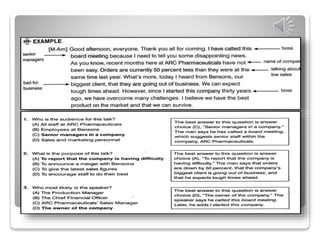
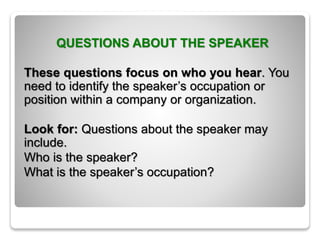
QUESTIONS ABOUT THE SPEAKER
These questions focus on who you hear. You
need to identify the speaker’s occupation or
position within a company or organization.
Look for: Questions about the speaker may
include.
Who is the speaker?
What is the speaker’s occupation?
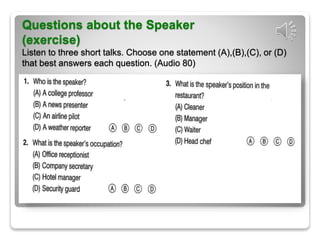
Questions about the Speaker
(exercise)
Listen to three short talks. Choose one statement (A),(B),(C), or (D)
that best answers each question. (Audio 80)
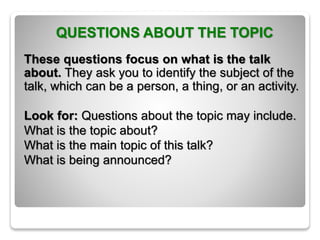
QUESTIONS ABOUT THE TOPIC
These questions focus on what is the talk
about. They ask you to identify the subject of the
talk, which can be a person, a thing, or an activity.
Look for: Questions about the topic may include.
What is the topic about?
What is the main topic of this talk?
What is being announced?
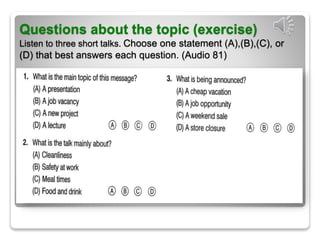
Questions about the topic (exercise)
Listen to three short talks. Choose one statement (A),(B),(C), or
(D) that best answers each question. (Audio 81)
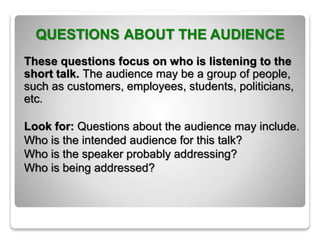
QUESTIONS ABOUT THE AUDIENCE
These questions focus on who is listening to the
short talk. The audience may be a group of people,
such as customers, employees, students, politicians,
etc.
Look for: Questions about the audience may include.
Who is the intended audience for this talk?
Who is the speaker probably addressing?
Who is being addressed?
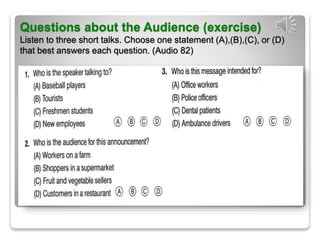
Questions about the Audience (exercise)
Listen to three short talks. Choose one statement (A),(B),(C), or (D)
that best answers each question. (Audio 82)
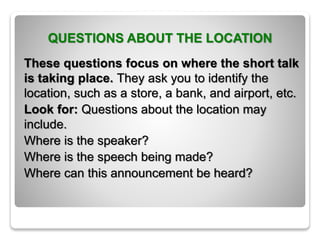
QUESTIONS ABOUT THE LOCATION
These questions focus on where the short talk
is taking place. They ask you to identify the
location, such as a store, a bank, and airport, etc.
Look for: Questions about the location may
include.
Where is the speaker?
Where is the speech being made?
Where can this announcement be heard?
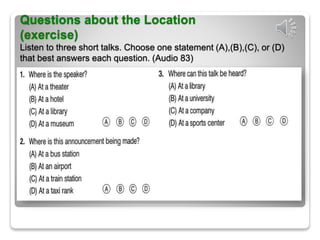
Questions about the Location
(exercise)
Listen to three short talks. Choose one statement (A),(B),(C), or (D)
that best answers each question. (Audio 83)
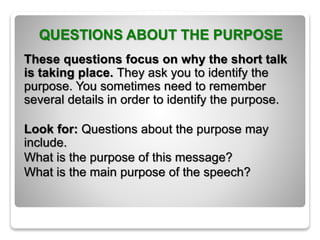
QUESTIONS ABOUT THE PURPOSE
These questions focus on why the short talk
is taking place. They ask you to identify the
purpose. You sometimes need to remember
several details in order to identify the purpose.
Look for: Questions about the purpose may
include.
What is the purpose of this message?
What is the main purpose of the speech?
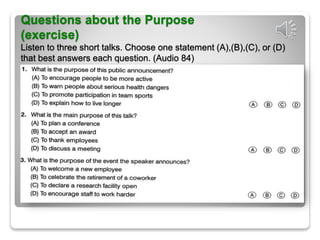
Questions about the Purpose
(exercise)
Listen to three short talks. Choose one statement (A),(B),(C), or (D)
that best answers each question. (Audio 84)
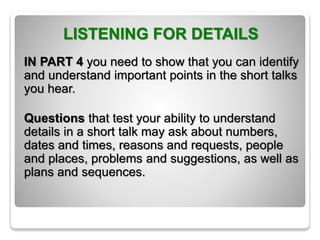
LISTENING FOR DETAILS
IN PART 4 you need to show that you can identify
and understand important points in the short talks
you hear.
Questions that test your ability to understand
details in a short talk may ask about numbers,
dates and times, reasons and requests, people
and places, problems and suggestions, as well as
plans and sequences.
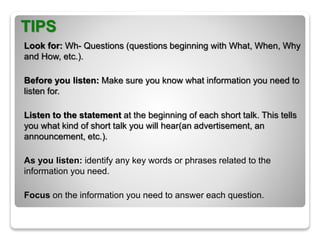
TIPS
Look for: Wh- Questions (questions beginning with What, When, Why
and How, etc.).
Before you listen: Make sure you know what information you need to
listen for.
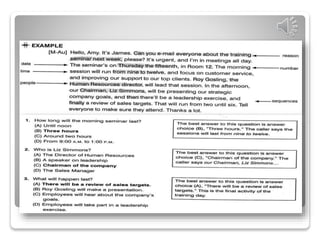
Listen to the statement at the beginning of each short talk. This tells
you what kind of short talk you will hear(an advertisement, an
announcement, etc.).
As you listen: identify any key words or phrases related to the
information you need.
Focus on the information you need to answer each question.
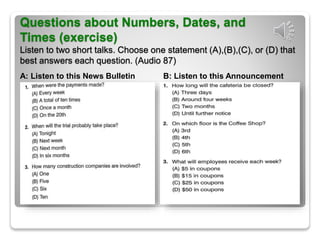
Questions about Numbers, Dates, and
Times (exercise)
Listen to two short talks. Choose one statement (A),(B),(C), or (D) that
best answers each question. (Audio 87)
A: Listen to this News Bulletin B: Listen to this Announcement
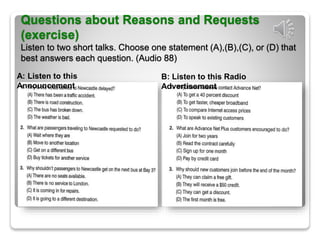
Questions about Reasons and Requests
(exercise)
Listen to two short talks. Choose one statement (A),(B),(C), or (D) that
best answers each question. (Audio 88)
A: Listen to this
Announcement
B: Listen to this Radio
Advertisement
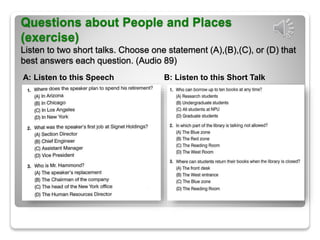
Questions about People and Places
(exercise)
Listen to two short talks. Choose one statement (A),(B),(C), or (D) that
best answers each question. (Audio 89)
A: Listen to this Speech B: Listen to this Short Talk
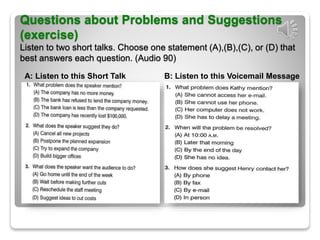
Questions about Problems and Suggestions
(exercise)
Listen to two short talks. Choose one statement (A),(B),(C), or (D) that
best answers each question. (Audio 90)
A: Listen to this Short Talk B: Listen to this Voicemail Message
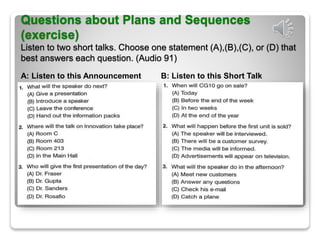
Questions about Plans and Sequences
(exercise)
Listen to two short talks. Choose one statement (A),(B),(C), or (D) that
best answers each question. (Audio 91)
A: Listen to this Announcement B: Listen to this Short Talk
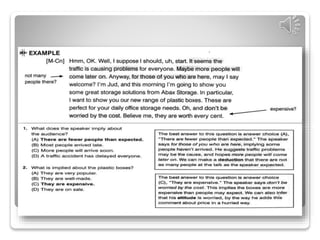
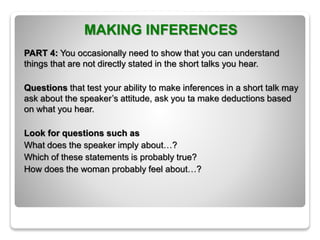
MAKING INFERENCES
PART 4: You occasionally need to show that you can understand
things that are not directly stated in the short talks you hear.
Questions that test your ability to make inferences in a short talk may
ask about the speaker’s attitude, ask you ta make deductions based
on what you hear.
Look for questions such as
What does the speaker imply about…?
Which of these statements is probably true?
How does the woman probably feel about…?
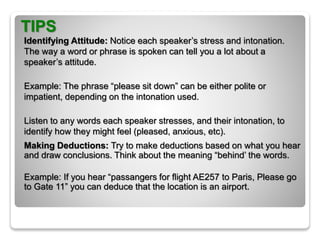
TIPS
Identifying Attitude: Notice each speaker’s stress and intonation.
The way a word or phrase is spoken can tell you a lot about a
speaker’s attitude.
Example: The phrase “please sit down” can be either polite or
impatient, depending on the intonation used.
Listen to any words each speaker stresses, and their intonation, to
identify how they might feel (pleased, anxious, etc).
Making Deductions: Try to make deductions based on what you hear
and draw conclusions. Think about the meaning “behind’ the words.
Example: If you hear “passangers for flight AE257 to Paris, Please go
to Gate 11” you can deduce that the location is an airport.
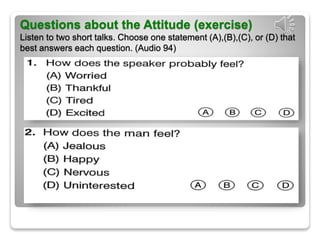
Questions about the Attitude (exercise)
Listen to two short talks. Choose one statement (A),(B),(C), or (D) that
best answers each question. (Audio 94)
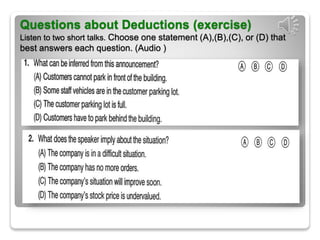
Questions about Deductions (exercise)
Listen to two short talks. Choose one statement (A),(B),(C), or (D) that
best answers each question. (Audio )
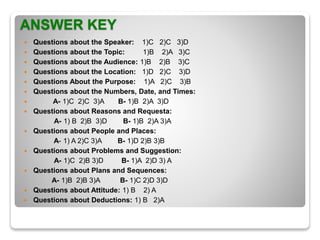
ANSWER KEY
 Questions about the Speaker: 1)C 2)C 3)D
 Questions about the Topic: 1)B 2)A 3)C
 Questions about the Audience: 1)B 2)B 3)C
 Questions about the Location: 1)D 2)C 3)D
 Questions About the Purpose: 1)A 2)C 3)B
 Questions about the Numbers, Date, and Times:
 A- 1)C 2)C 3)A B- 1)B 2)A 3)D
 Questions about Reasons and Requesta:
A- 1) B 2)B 3)D B- 1)B 2)A 3)A
 Questions about People and Places:
A- 1) A 2)C 3)A B- 1)D 2)B 3)B
 Questions about Problems and Suggestion:
A- 1)C 2)B 3)D B- 1)A 2)D 3) A
 Questions about Plans and Sequences:
A- 1)B 2)B 3)A B- 1)C 2)D 3)D
 Questions about Attitude: 1) B 2) A
 Questions about Deductions: 1) B 2)A

Listening part 4 short talks

  • 1.
  • 2.
     This partof the TOEIC test consists of ten short talks.  There are three questions for each short talk.  Each question has four answer choices.  You must choose the correct answer from the four choices.  The short talks are all given by one speaker.  You can read the question and answer choices, but not the short talks.  You Will hear each short talk only once.  After each short talk, you will hear three questions.  There is a pause of eight seconds after each question.
  • 3.
    These are theexercises that you Will cover on the TOEIC test Part 4: Short Talks  Listening for Main Ideas: Listening to short talks for overall conprehension, identifying the speaker, the topic, the audience, the location and the purpose of the short talk.  Listening for Details: Listening to short talks for specific information, identifying numbers, dates and times, reasons and requests, people and places, problems and suggestions, plans and sequences.  Making Inferences: Listening to short talks for information that is not direct stated.
  • 4.
    In the TOEICTest there are short talks on many different topics.  News bulletins  Weather forecasts  Recorded announcements  Advertisements  Public announcements  Business presentations, etc.
  • 5.
     As youwork through look back at your answers and try to identify your strenghts and weaknesses.  Notice what problems you have, and focus on the áreas you need to improve.  Don’t worry about words you miss. You do not need to understand every single word in a short talk in order to understand the main idea.  Remember: On the actual tests, you will hear but NOT see each short talk.
  • 6.
    Listening for theMain Idea In Part 4 You need to show that you have a good overall understanding of the short talks you hear. Questions that test your ability to understand main ideas in a short talk may ask about the speaker, the topic, the audience, the location and the purpose of the talk.
  • 7.
    TIPS Look for questionslike:  Who is speaking?  What is the message mainly about?  What is the purpose of the talk? As you listen ask yourself these fundamental questions:  Who is the speaker?  What is the speaker talking about?  Who is the speaker talking to?  Where is this taking place?  What is the aim of the talk?
  • 9.
    QUESTIONS ABOUT THESPEAKER These questions focus on who you hear. You need to identify the speaker’s occupation or position within a company or organization. Look for: Questions about the speaker may include. Who is the speaker? What is the speaker’s occupation?
  • 10.
    Questions about theSpeaker (exercise) Listen to three short talks. Choose one statement (A),(B),(C), or (D) that best answers each question. (Audio 80)
  • 11.
    QUESTIONS ABOUT THETOPIC These questions focus on what is the talk about. They ask you to identify the subject of the talk, which can be a person, a thing, or an activity. Look for: Questions about the topic may include. What is the topic about? What is the main topic of this talk? What is being announced?
  • 12.
    Questions about thetopic (exercise) Listen to three short talks. Choose one statement (A),(B),(C), or (D) that best answers each question. (Audio 81)
  • 13.
    QUESTIONS ABOUT THEAUDIENCE These questions focus on who is listening to the short talk. The audience may be a group of people, such as customers, employees, students, politicians, etc. Look for: Questions about the audience may include. Who is the intended audience for this talk? Who is the speaker probably addressing? Who is being addressed?
  • 14.
    Questions about theAudience (exercise) Listen to three short talks. Choose one statement (A),(B),(C), or (D) that best answers each question. (Audio 82)
  • 15.
    QUESTIONS ABOUT THELOCATION These questions focus on where the short talk is taking place. They ask you to identify the location, such as a store, a bank, and airport, etc. Look for: Questions about the location may include. Where is the speaker? Where is the speech being made? Where can this announcement be heard?
  • 16.
    Questions about theLocation (exercise) Listen to three short talks. Choose one statement (A),(B),(C), or (D) that best answers each question. (Audio 83)
  • 17.
    QUESTIONS ABOUT THEPURPOSE These questions focus on why the short talk is taking place. They ask you to identify the purpose. You sometimes need to remember several details in order to identify the purpose. Look for: Questions about the purpose may include. What is the purpose of this message? What is the main purpose of the speech?
  • 18.
    Questions about thePurpose (exercise) Listen to three short talks. Choose one statement (A),(B),(C), or (D) that best answers each question. (Audio 84)
  • 19.
    LISTENING FOR DETAILS INPART 4 you need to show that you can identify and understand important points in the short talks you hear. Questions that test your ability to understand details in a short talk may ask about numbers, dates and times, reasons and requests, people and places, problems and suggestions, as well as plans and sequences.
  • 20.
    TIPS Look for: Wh-Questions (questions beginning with What, When, Why and How, etc.). Before you listen: Make sure you know what information you need to listen for. Listen to the statement at the beginning of each short talk. This tells you what kind of short talk you will hear(an advertisement, an announcement, etc.). As you listen: identify any key words or phrases related to the information you need. Focus on the information you need to answer each question.
  • 22.
    Questions about Numbers,Dates, and Times (exercise) Listen to two short talks. Choose one statement (A),(B),(C), or (D) that best answers each question. (Audio 87) A: Listen to this News Bulletin B: Listen to this Announcement
  • 23.
    Questions about Reasonsand Requests (exercise) Listen to two short talks. Choose one statement (A),(B),(C), or (D) that best answers each question. (Audio 88) A: Listen to this Announcement B: Listen to this Radio Advertisement
  • 24.
    Questions about Peopleand Places (exercise) Listen to two short talks. Choose one statement (A),(B),(C), or (D) that best answers each question. (Audio 89) A: Listen to this Speech B: Listen to this Short Talk
  • 25.
    Questions about Problemsand Suggestions (exercise) Listen to two short talks. Choose one statement (A),(B),(C), or (D) that best answers each question. (Audio 90) A: Listen to this Short Talk B: Listen to this Voicemail Message
  • 26.
    Questions about Plansand Sequences (exercise) Listen to two short talks. Choose one statement (A),(B),(C), or (D) that best answers each question. (Audio 91) A: Listen to this Announcement B: Listen to this Short Talk
  • 27.
    MAKING INFERENCES PART 4:You occasionally need to show that you can understand things that are not directly stated in the short talks you hear. Questions that test your ability to make inferences in a short talk may ask about the speaker’s attitude, ask you ta make deductions based on what you hear. Look for questions such as What does the speaker imply about…? Which of these statements is probably true? How does the woman probably feel about…?
  • 28.
    TIPS Identifying Attitude: Noticeeach speaker’s stress and intonation. The way a word or phrase is spoken can tell you a lot about a speaker’s attitude. Example: The phrase “please sit down” can be either polite or impatient, depending on the intonation used. Listen to any words each speaker stresses, and their intonation, to identify how they might feel (pleased, anxious, etc). Making Deductions: Try to make deductions based on what you hear and draw conclusions. Think about the meaning “behind’ the words. Example: If you hear “passangers for flight AE257 to Paris, Please go to Gate 11” you can deduce that the location is an airport.
  • 30.
    Questions about theAttitude (exercise) Listen to two short talks. Choose one statement (A),(B),(C), or (D) that best answers each question. (Audio 94)
  • 31.
    Questions about Deductions(exercise) Listen to two short talks. Choose one statement (A),(B),(C), or (D) that best answers each question. (Audio )
  • 32.
    ANSWER KEY  Questionsabout the Speaker: 1)C 2)C 3)D  Questions about the Topic: 1)B 2)A 3)C  Questions about the Audience: 1)B 2)B 3)C  Questions about the Location: 1)D 2)C 3)D  Questions About the Purpose: 1)A 2)C 3)B  Questions about the Numbers, Date, and Times:  A- 1)C 2)C 3)A B- 1)B 2)A 3)D  Questions about Reasons and Requesta: A- 1) B 2)B 3)D B- 1)B 2)A 3)A  Questions about People and Places: A- 1) A 2)C 3)A B- 1)D 2)B 3)B  Questions about Problems and Suggestion: A- 1)C 2)B 3)D B- 1)A 2)D 3) A  Questions about Plans and Sequences: A- 1)B 2)B 3)A B- 1)C 2)D 3)D  Questions about Attitude: 1) B 2) A  Questions about Deductions: 1) B 2)A