Strategies for teaching
the four Language skills
Strategies for
Developing
listening Skills
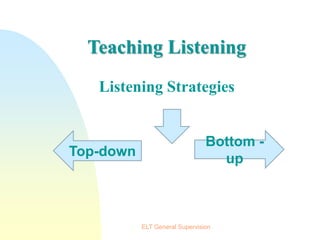
Teaching Listening
Listening Strategies
Bottom -
up
Top-down
ELT General Supervision
Top-down strategies:
Top-down strategies are listener
based; the listener taps into
background knowledge of the topic,
the situation or context, the type of
text, and the language. This
background knowledge activates a
set of expectations that help the
listener to interpret what is heard and
anticipate what will come next.
Bottom-up strategies:
Bottom-up strategies are text
based; the listener relies on
the language in the message,
that is, the combination of
sounds, words, and grammar
that creates meaning
Listening strategies:
Listening strategies are
techniques or activities that
contribute directly to the
comprehension and recall of
listening input. Listening strategies
can be classified by how the
listener processes the input.
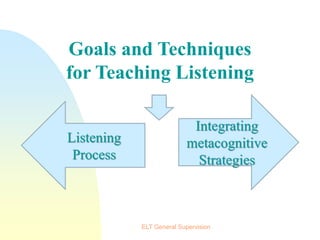
Goals and Techniques
for Teaching Listening
Integrating
metacognitive
Strategies
Listening
Process
ELT General Supervision
Metacognitive Strategies:
•Self-Management: Manage Your Own
Learning
•Determine how you learn best
•Arrange conditions that help you learn
•Seek opportunities for practice
•Focus your attention on the task.
Bottom-up strategies include:
 listening for specific details
 recognizing cognates
 recognizing word-order
patterns
Top-down strategies include:
 listening for the main idea
 predicting
 drawing inferences
 summarizing
What makes listening easy or difficult?
Three principal categories:
 the type of language we are
listening to
 our task or purpose in listening
 the context in which listening
occurs
Listening Activities
Pre-listening: Plan for the listening task
 Set a purpose or decide in advance
what to listen for
 Decide if more linguistic or background
knowledge is needed
 Determine whether to enter the text
from the top down (attend to the overall
meaning) or from the bottom up (focus
on the words and phrases)
While-listening: Monitor
comprehension
 Verify predictions and check for
inaccurate guesses
 Decide what is and is not important
to understand
 Listen/view again to check
comprehension
 Ask for help
 Match while-listening activities to the
instructional goal, the listening
purpose, and students' proficiency
level.
 Organize activities so that they guide
listeners through the text.
 Use questions to focus students' attention
on the elements of the text crucial to
comprehension
 Use predicting to encourage students to
monitor their comprehension as they
listen.
Sample while-listening activities
 listening with visuals
 filling in graphs and charts
 following a route on a map
 checking off items in a list
 listening for the gist
 searching for specific clues to
meaning
 completing cloze (fill-in) exercises
Post-listening: Evaluate
comprehension and strategy use
 Evaluate comprehension in a particular
task or area
 Evaluate overall progress in listening
and in particular types of listening tasks
 Decide if the strategies used were
appropriate for the purpose and for the
task
 Modify strategies if necessary
Post-listening activities:
The procedure may be:
 general or special questions
 wrong statements
 making a plan(key words or key sentences)
 giving a gist of the text
 written reproduction
 role-plays
 multiple-choice test
 etc
Procedure:
 Help students identify the listening goal: to
obtain specific information; to understand
most or all of the message.
 Help students outline predictable sequences
in which information may be presented: who-
what-when-where (news stories); who-flight
number-arriving/departing-gate number
(airport announcements) etc…
 Help students identify key words/phrases to
listen for
Strategies for
Developing
speaking Skills
Many language learners regard speaking ability
as the measure of knowing a language. These
learners define fluency as the ability to
converse with others, much more than the
ability to read, write, or comprehend oral
language.
Teaching Speaking
ELT General Supervision
Speaking involves three areas of knowledge:
Mechanics (pronunciation, grammar, and
vocabulary): Using the right words in the right
order with the correct pronunciation
Functions (transaction and interaction):
Knowing when clarity of message is essential
(transaction/information exchange) and when
precise understanding is not required.
Social and cultural rules and norms (turn-
taking, rate of speech, length of pauses
between speakers, relative roles of participants
ELT General Supervision
Goals and Techniques for
Teaching Speaking
The goal of teaching speaking skills is
communicative efficiency .
Learners should be able to make themselves
understood.
Instructors can use a balanced activities approach
that combines language input, structured output,
and communicative output.
ELT General Supervision
Strategies for
Developing
Reading Skills
What strategies should I teach?
 The most practical way of thinking about
teaching reading comprehension is to
organize instruction according to how you
want students to think about strategies.
For this reason, the most straightforward
way of organizing comprehension
strategies is to think about strategies that
one might use
pre- reading, while-reading, and post-
reading.
Strategies for developing Reading:
 previewing headings, surveying
pictures,
 reading introductions and
summaries,
 creating a pre-reading outline,
 creating questions that might need
to be answered,
 making predictions that need to be
confirmed, etc.
While-Reading Strategies
consist of those strategies that
students learn to use while they are
reading a text selection. These
strategies
 help the student focus on how to
determine what the author is
actually trying to say
 and match the information with
what the student already knows.
The While-Reading Strategies
include:
 questioning
 inferring
 visualizing
 Making Connections
Post-Reading Strategies
consist of those strategies that students
learn to use when they have completed
reading a text selection.
These strategies are used to help the
student
 "look back" and think about the
message of the text
 and determine the intended or possible
meanings that might be important.
These strategies are used
 to follow up and confirm what was
learned (e.g., answer questions or
confirm predictions) from the use of
before and during reading strategies.
 to focus on determining what the big,
critical, or overall idea of the author's
message was
 and how it might be used before moving
on to performance tasks or other
learning tasks.
How do you teach
comprehension strategies?
The stages of instruction that are most often cited
as being effective in helping a student learn a
strategy are:
(1) orient students to key concepts, assess, and ask
students to make a commitment to learn,
(2) describe the purpose of the strategy, the potential
benefits, and the steps of the strategy,
(3) model (thinking aloud) the behavioral and
cognitive steps/actions involved in using the
strategy,
(4) lead verbal practice and
elaboration of the key information
and steps related to the strategy,
(5) provide for guided and controlled
practice of the strategy with detailed
feedback from the teacher and/or
knowledgeable peers,
(6) gradually move to more
independent and advanced practice
of the strategy with feedback from
the teacher and/or knowledgeable
peers,
Strategies for
Developing
writing Skills
Introduction
In order to be able to select and
use appropriate procedures &
materials, as well assess their
learners’ needs and progress,
teachers need to be clear
regarding the desirable
outcomes of a writing
programme and the strategies
involved in good writing.
a- Pre-writing:
1. Stimulate the students
creativity.
2. Get them to think about
how to approach a writing
topic.
3. In this stage, the most
important thing is the flow
of ideas.
b- Drafting:
1- Students write quickly on a topic
for five or ten minutes without
worrying about correct language or
punctuation.
2- Working in groups, sharing ideas.
3- Exchanging views: Different
students choose different points of
view and think about and discuss
them.
c- Editing:
1- Ordering: organizing the notes
written. What should come
first? and why?
2- Self –editing: A good writer
must learn how to evaluate his
own
language to improve through
checking his own text, looking
for errors.
D-Peer editing & proof reading:
- The texts are exchanged /
interchanged and the
evaluation is done by other
students.
- The students are some times
asked to reduce the texts & to
edit them concentrating on the
most important information.
Useful tips on how to carry out a writing
lesson successfully.
1. Bring some energy and excitement to the
process of writing in the classroom.
2. Create a writing environment that is
authentic and purposeful.
3. Resort to group work to help decrease the
students' fear and the complexity of writing
tasks.
4- Make your tasks lively and
enjoyable and make the
atmosphere of the class less
intimidating by allowing students
to work together and hence to
assist each other.
5- Spare no pains making positive
comments to help build students'
confidence & create a good feeling
for the next writing class.
6- Implement in your students the idea
that their writing is addressed to a
person, for a reason and with an
expected response.
7- Provide a real audience for your
students by creating class magazines
or by swapping letters with other
classes.
8- Make your students know that, as
their teacher and audience, you are
interested in their ideas.
9- Train your students on the
techniques of writing: listing,
selecting and organizing.
10- Help develop your students
grammar, syntax, punctuation by
analyzing stylistic features of good
reading texts.
11- Insist on responding to the content
and how far the students have
achieved their purpose for writing.
The End
Thank
you

strategies-for-teaching-language-skills-22.ppt

  • 1.
    Strategies for teaching thefour Language skills
  • 2.
  • 3.
    Teaching Listening Listening Strategies Bottom- up Top-down ELT General Supervision
  • 4.
    Top-down strategies: Top-down strategiesare listener based; the listener taps into background knowledge of the topic, the situation or context, the type of text, and the language. This background knowledge activates a set of expectations that help the listener to interpret what is heard and anticipate what will come next.
  • 5.
    Bottom-up strategies: Bottom-up strategiesare text based; the listener relies on the language in the message, that is, the combination of sounds, words, and grammar that creates meaning
  • 6.
    Listening strategies: Listening strategiesare techniques or activities that contribute directly to the comprehension and recall of listening input. Listening strategies can be classified by how the listener processes the input.
  • 7.
    Goals and Techniques forTeaching Listening Integrating metacognitive Strategies Listening Process ELT General Supervision
  • 8.
    Metacognitive Strategies: •Self-Management: ManageYour Own Learning •Determine how you learn best •Arrange conditions that help you learn •Seek opportunities for practice •Focus your attention on the task.
  • 9.
    Bottom-up strategies include: listening for specific details  recognizing cognates  recognizing word-order patterns
  • 10.
    Top-down strategies include: listening for the main idea  predicting  drawing inferences  summarizing
  • 11.
    What makes listeningeasy or difficult? Three principal categories:  the type of language we are listening to  our task or purpose in listening  the context in which listening occurs
  • 12.
    Listening Activities Pre-listening: Planfor the listening task  Set a purpose or decide in advance what to listen for  Decide if more linguistic or background knowledge is needed  Determine whether to enter the text from the top down (attend to the overall meaning) or from the bottom up (focus on the words and phrases)
  • 13.
    While-listening: Monitor comprehension  Verifypredictions and check for inaccurate guesses  Decide what is and is not important to understand  Listen/view again to check comprehension  Ask for help
  • 14.
     Match while-listeningactivities to the instructional goal, the listening purpose, and students' proficiency level.  Organize activities so that they guide listeners through the text.  Use questions to focus students' attention on the elements of the text crucial to comprehension  Use predicting to encourage students to monitor their comprehension as they listen.
  • 15.
    Sample while-listening activities listening with visuals  filling in graphs and charts  following a route on a map  checking off items in a list  listening for the gist  searching for specific clues to meaning  completing cloze (fill-in) exercises
  • 16.
    Post-listening: Evaluate comprehension andstrategy use  Evaluate comprehension in a particular task or area  Evaluate overall progress in listening and in particular types of listening tasks  Decide if the strategies used were appropriate for the purpose and for the task  Modify strategies if necessary
  • 17.
    Post-listening activities: The proceduremay be:  general or special questions  wrong statements  making a plan(key words or key sentences)  giving a gist of the text  written reproduction  role-plays  multiple-choice test  etc
  • 18.
    Procedure:  Help studentsidentify the listening goal: to obtain specific information; to understand most or all of the message.  Help students outline predictable sequences in which information may be presented: who- what-when-where (news stories); who-flight number-arriving/departing-gate number (airport announcements) etc…  Help students identify key words/phrases to listen for
  • 19.
  • 20.
    Many language learnersregard speaking ability as the measure of knowing a language. These learners define fluency as the ability to converse with others, much more than the ability to read, write, or comprehend oral language. Teaching Speaking ELT General Supervision
  • 21.
    Speaking involves threeareas of knowledge: Mechanics (pronunciation, grammar, and vocabulary): Using the right words in the right order with the correct pronunciation Functions (transaction and interaction): Knowing when clarity of message is essential (transaction/information exchange) and when precise understanding is not required. Social and cultural rules and norms (turn- taking, rate of speech, length of pauses between speakers, relative roles of participants ELT General Supervision
  • 22.
    Goals and Techniquesfor Teaching Speaking The goal of teaching speaking skills is communicative efficiency . Learners should be able to make themselves understood. Instructors can use a balanced activities approach that combines language input, structured output, and communicative output. ELT General Supervision
  • 23.
  • 24.
    What strategies shouldI teach?  The most practical way of thinking about teaching reading comprehension is to organize instruction according to how you want students to think about strategies. For this reason, the most straightforward way of organizing comprehension strategies is to think about strategies that one might use pre- reading, while-reading, and post- reading.
  • 25.
    Strategies for developingReading:  previewing headings, surveying pictures,  reading introductions and summaries,  creating a pre-reading outline,  creating questions that might need to be answered,  making predictions that need to be confirmed, etc.
  • 26.
    While-Reading Strategies consist ofthose strategies that students learn to use while they are reading a text selection. These strategies  help the student focus on how to determine what the author is actually trying to say  and match the information with what the student already knows.
  • 27.
    The While-Reading Strategies include: questioning  inferring  visualizing  Making Connections
  • 28.
    Post-Reading Strategies consist ofthose strategies that students learn to use when they have completed reading a text selection. These strategies are used to help the student  "look back" and think about the message of the text  and determine the intended or possible meanings that might be important.
  • 29.
    These strategies areused  to follow up and confirm what was learned (e.g., answer questions or confirm predictions) from the use of before and during reading strategies.  to focus on determining what the big, critical, or overall idea of the author's message was  and how it might be used before moving on to performance tasks or other learning tasks.
  • 30.
    How do youteach comprehension strategies? The stages of instruction that are most often cited as being effective in helping a student learn a strategy are: (1) orient students to key concepts, assess, and ask students to make a commitment to learn, (2) describe the purpose of the strategy, the potential benefits, and the steps of the strategy, (3) model (thinking aloud) the behavioral and cognitive steps/actions involved in using the strategy,
  • 31.
    (4) lead verbalpractice and elaboration of the key information and steps related to the strategy, (5) provide for guided and controlled practice of the strategy with detailed feedback from the teacher and/or knowledgeable peers, (6) gradually move to more independent and advanced practice of the strategy with feedback from the teacher and/or knowledgeable peers,
  • 32.
  • 33.
    Introduction In order tobe able to select and use appropriate procedures & materials, as well assess their learners’ needs and progress, teachers need to be clear regarding the desirable outcomes of a writing programme and the strategies involved in good writing.
  • 34.
    a- Pre-writing: 1. Stimulatethe students creativity. 2. Get them to think about how to approach a writing topic. 3. In this stage, the most important thing is the flow of ideas.
  • 35.
    b- Drafting: 1- Studentswrite quickly on a topic for five or ten minutes without worrying about correct language or punctuation. 2- Working in groups, sharing ideas. 3- Exchanging views: Different students choose different points of view and think about and discuss them.
  • 36.
    c- Editing: 1- Ordering:organizing the notes written. What should come first? and why? 2- Self –editing: A good writer must learn how to evaluate his own language to improve through checking his own text, looking for errors.
  • 37.
    D-Peer editing &proof reading: - The texts are exchanged / interchanged and the evaluation is done by other students. - The students are some times asked to reduce the texts & to edit them concentrating on the most important information.
  • 38.
    Useful tips onhow to carry out a writing lesson successfully. 1. Bring some energy and excitement to the process of writing in the classroom. 2. Create a writing environment that is authentic and purposeful. 3. Resort to group work to help decrease the students' fear and the complexity of writing tasks.
  • 39.
    4- Make yourtasks lively and enjoyable and make the atmosphere of the class less intimidating by allowing students to work together and hence to assist each other. 5- Spare no pains making positive comments to help build students' confidence & create a good feeling for the next writing class.
  • 40.
    6- Implement inyour students the idea that their writing is addressed to a person, for a reason and with an expected response. 7- Provide a real audience for your students by creating class magazines or by swapping letters with other classes. 8- Make your students know that, as their teacher and audience, you are interested in their ideas.
  • 41.
    9- Train yourstudents on the techniques of writing: listing, selecting and organizing. 10- Help develop your students grammar, syntax, punctuation by analyzing stylistic features of good reading texts. 11- Insist on responding to the content and how far the students have achieved their purpose for writing.
  • 42.