Guidance For Industry
Tablet Scoring: Nomenclature,
Labeling, and Data for Evaluation
with Regulatory Requirement for Other
Regulated Market.
Vivek Singh Rathore
Senior Research Associate
R&D-Formulation
Naari Pharma Pvt. Ltd
vivekosingh_rathore@yahoo.com
9920636295
 INTRODUCTION
 BACKGROUND
 DISCUSSION
1. Guidelines and Criteria
2. Nomenclature and Product Labeling
 AS PER EUROPEAN PHARMACOPEIA
 HEALTH CANADA REQUIREMENT
 QUESTION & ANSWERS FOR SCORING AS PER GUIDANCE
 REFERENCES
TABLE OF CONTENTS
 This guidance provides recommendations to sponsors of new
drug applications (NDAs) and abbreviated new drug
applications (ANDAs) regarding what criteria should be met
when evaluating and labeling tablets that have been
scored.
 Specifically, this guidance recommends:
o Guidelines to follow, data to provide, and criteria to meet
and detail in an application to support approval of a scored
tablet.
o Nomenclature and labeling for approved scored tablets.
This guidance does not address specific finished-product release testing.
I. INTRODUCTION
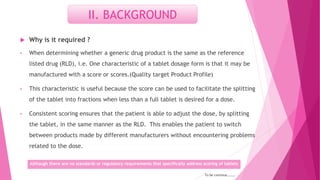
 A score is a debossed line that runs across the planar surface of the tablet, while
tablet splitting is the practice of breaking or cutting a higher-strength tablet into
smaller portions.
DEFINITION
 Why is it required ?
• When determining whether a generic drug product is the same as the reference
listed drug (RLD), i.e. One characteristic of a tablet dosage form is that it may be
manufactured with a score or scores.(Quality target Product Profile)
• This characteristic is useful because the score can be used to facilitate the splitting
of the tablet into fractions when less than a full tablet is desired for a dose.
• Consistent scoring ensures that the patient is able to adjust the dose, by splitting
the tablet, in the same manner as the RLD. This enables the patient to switch
between products made by different manufacturers without encountering problems
related to the dose.
To be continue……….
Although there are no standards or regulatory requirements that specifically address scoring of tablets
II. BACKGROUND
Quality Target Product Profile (QTPP) is “a prospective summary of the quality
characteristics of a drug product that ideally will be achieved to ensure the
desired quality, taking into account safety and efficacy of the drug product.”
A Critical Quality Attribute (CQA) is “a physical, chemical, biological, or
microbiological property or characteristic that should be within an appropriate
limit, range, or distribution to ensure the desired product quality.”
 The Agency’s concerns ?
• Agency concluded that in some cases, there are possible safety issues, especially when tablets
are not scored or evaluated for splitting.
• Splitting tablet included variations in the
i. Tablet content (Content Uniformity),
ii. Weight (Weight Variation),
iii. Disintegration, or
iv. Dissolution.
which can affect how much drug is present in a split tablet and available for absorption.
In addition, there may be stability issues with splitting tablets.
II. BACKGROUND
 Criteria for functional scoring on solid oral dosage form products to ensure the
quality of both NDA and ANDA scored tablet products can be evaluated and labeled
by:
1) Providing a harmonized approach to chemistry, manufacturing, and controls (CMC)
reviews of scored tablets.
2) Ensuring consistency in nomenclature (e.g., score versus bisect) and labeling.
3) Providing information through product labeling or other means to healthcare
providers.
To be Continue………
III. DISCUSSION
 Below are guidelines and criteria by which a scored tablet’s characteristics will be evaluated as part of
the review process:
1. The dosage amount meant to be achieved after splitting the tablet should not be below the minimum therapeutic dose
indicated on the approved labeling.
2. The split tablet should be safe to handle and not pose risk of unintended drug exposure.
3. Modified release products for which the control of drug release can be compromised by tablet splitting should not
have a scoring feature.
4. The split tablet, when stored in pharmacy dispensing containers (no seal/no desiccant), should demonstrate adequate
stability for a period of 90 days at 25º C, plus or minus 2º C/60 percent Relative Humidity (RH), plus or minus 5
percent RH.
5. The split tablet portions should meet the same finished-product testing requirements as for a whole-tablet product
with equivalent strength. A risk assessment should be provided to justify the tests and criteria for product with the
proposed functional scoring. The resulting data should be provided to the Agency for evaluation. The assessment
should be undertaken on both tablets that are split nonmechanically (by hand) and tablets that are split
mechanically (with a tablet splitter). Any recommended dissolution test data must be generated on a minimum of 12
individual split tablet portions.
To be Continue………
III. A. Guidelines and Criteria
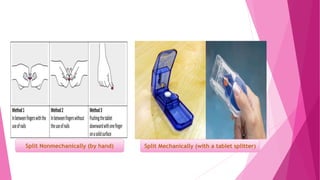
Split Nonmechanically (by hand) Split Mechanically (with a tablet splitter)
5. Below are typical criteria:
Criteria 5. a. Immediate Release Solid Oral Dosage
Forms
5. b. Modified Release Solid
Oral Dosage Forms (Using
Matrix Technology)
5. c. Modified Release Solid Oral
Dosage Forms (Using
Compressed Film Coated
Components)
USP General Chapter <905>
Uniformity of Dosage Units
Here each split portion of a whole tablet is considered
a unit of dose and should meet the uniformity of
dosage unit requirement.
Testing for Weight Variation is permitted for split tablet
portions intended to contain 25 mg or more of a drug
substance that comprises 25 percent or more (by weight)
of the split tablet portion. Otherwise, the test for
Content Uniformity should be used.
All criteria same as under section
III.A.5.a should be met.
All above criteria under sections
III.A.5.a and III.A.5.b should be met.
Tablet splitability at both ends
of the proposed hardness
range should be demonstrated
by [Tablets split
nonmechanically (by hand) and
split mechanically (with a
tablet splitter)]
1. Testing 15 tablets to ensure a loss of mass of less than
3.0 percent between the individual segments (30 for
bisected tablets, 45 for trisected tablets, etc.) when
compared to the whole tablet. The resulting data for
each tablet should be provided to the Agency for
evaluation.
2. Confirming that the split tablet portions meet the USP
Friability requirement (NMT 1%w/w)
All criteria same as under section
III.A.5.a should be met.
All above criteria under sections
III.A.5.a and III.A.5.b should be met.
Dissolution Dissolution data on split tablet portions should meet
finished-product release requirements.
1. Dissolution should be
demonstrated at both ends of
the hardness range.
2. Dissolution on whole versus
split tablet portions should
meet the similarity factor (f2)
criteria.
Dissolution profile on pre-compressed
beads versus post-compressed whole
and split tablet portions should meet
similarity factor (f2) criteria to
ascertain the integrity of beads during
compression.
III. A. Guidelines and Criteria
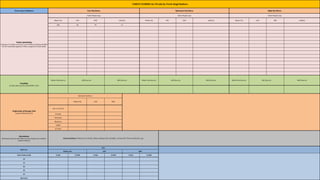
TABLET SCORING for US mkt by Vivek Singh Rathore
Test as per Guidance Low Hardness Optimum Hardness High Hardness
Tablet Splitability
(Testing of 15 tablets to ensure a Loss of Mass (LoM) should NMT
3% b/w individual segement. When compared to whole tablet.
Tablet Weight (mg) Tablet Weight (mg) Tablet Weight (mg)
Whole Tab LHS RHS LoM (%) Whole Tab LHS RHS LoM (%) Whole Tab LHS RHS LoM(%)
200 98 99 1.5
Friability
(of split tablet portion should NMT 1.0%)
Whole Tab (%w/w) LHS (%w/w) RHS (%w/w) Whole Tab (%w/w) LHS (%w/w) RHS (%w/w) Whole Tab (%w/w) LHS (%w/w) RHS (%w/w)
Uniformity of Dosage Unit
Content Uniformity (CU)
Optimum Hardness
Whole Tab LHS RHS
Tab 1 to Tab 10
Average
Minimum
Maximum
%RSD
AV Value
Dissolution
(Dissolution data on split tablet portions should meet finished-
product release)
Release Medium: 0.02% SLS in 0.1N HCL, 900ml, 100rpm, USP-I (Paddle) - Q Value NLT 70% in 60 Min (For e.g)
Batch no.
XYZ
Whole Tab LHS RHS
Time Points (min) % Rel % RSD % Rel % RSD % Rel % RSD
10
15
20
30
45
Recovery
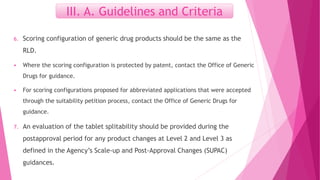
6. Scoring configuration of generic drug products should be the same as the
RLD.
 Where the scoring configuration is protected by patent, contact the Office of Generic
Drugs for guidance.
 For scoring configurations proposed for abbreviated applications that were accepted
through the suitability petition process, contact the Office of Generic Drugs for
guidance.
7. An evaluation of the tablet splitability should be provided during the
postapproval period for any product changes at Level 2 and Level 3 as
defined in the Agency’s Scale-up and Post-Approval Changes (SUPAC)
guidances.
III. A. Guidelines and Criteria
 New products that meet the above-referenced criteria can be labeled as having functional
scoring. Such labeling should appear in all of the following sections of the prescribing
information
 “Dosage Forms and Strength” section of the Highlights.
 “Dosage Forms and Strength” section of the Full Prescribing Information.
 “How Supplied” section of the Full Prescribing Information.
 For currently marketed products: manufacturers have the option to perform such an
assessment and provide data for evaluation to the drug product application. Product
labeling should be updated to state that it has functional scoring.
 Functional scoring used in the labeling can communicate to healthcare providers that the
product has been evaluated against the established criteria.
III. B. Nomenclature and Product Labeling
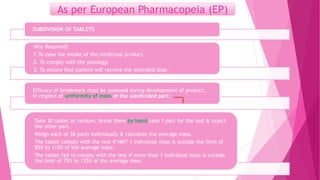
SUBDIVISION OF TABLETS
Why Required?
1.To ease the intake of the medicinal product.
2. To comply with the posology.
3. To ensure that patient will receive the intended dose.
Efficacy of breakmark must be assessed during development of product,
in respect of uniformity of mass of the subdivided part:
Take 30 tablet at random, break them by hand take 1 part for the test & reject
the other part.
Weigh each of 30 parts individually & calculate the average mass.
The tablet comply with the test if NMT 1 individual mass is outside the limit of
85% to 115% of the average mass.
The tablet fail to comply with the test if more than 1 individual mass is outside
the limit of 75% to 125% of the average mass
As per European Pharmacopeia (EP)
 Same as for “US-FDA Guidance For Industry Tablet Scoring: Nomenclature, Labeling, and Data
for Evaluation”
 Refer to “Quality (Chemistry and Manufacturing) Guidance: New Drug Submissions (NDSs) and
Abbreviated New Drug Submissions (ANDSs), Page no. 46 – 47”
HEALTH CANADA REQUIREMENT
Reference: ANDA Submissions – Refuse-to-Receive Standards: Questions and Answers
Guidance for Industry. DRAFT GUIDANCE , October 2017 , Page no. 17
Reference: Guidance for Industry ANDAs: Stability Testing of Drug Substances and
Products, Questions and Answers, May 2014 , Page no. 15
QUESTION & ANSWERS FOR SCORING AS PER GUIDANCE
1. Guidance for Industry Tablet Scoring: Nomenclature, Labeling, and Data for
Evaluation, March 2013, Page no. 1 - 5
2. Quality by Design for ANDAs: An Example for Immediate-Release Dosage
Forms, Page no. 10 - 11
3. Quality (Chemistry and Manufacturing) Guidance: New Drug Submissions
(NDSs) and Abbreviated New Drug Submissions (ANDSs), Page no. 46 – 47
4. Guidance for Industry ANDAs: Stability Testing of Drug Substances and
Products, Questions and Answers, May 2014 , Page no. 15
5. ANDA Submissions – Refuse-to-Receive Standards: Questions and Answers
Guidance for Industry. DRAFT GUIDANCE , October 2017 , Page no. 17
REFERENCES
Guidance For Industry Tablet Scoring: Nomenclature, Labeling, and Data for Evaluation with Regulatory Requirement for Other Regulated Market.

Guidance For Industry Tablet Scoring: Nomenclature, Labeling, and Data for Evaluation with Regulatory Requirement for Other Regulated Market.

  • 1.
    Guidance For Industry TabletScoring: Nomenclature, Labeling, and Data for Evaluation with Regulatory Requirement for Other Regulated Market. Vivek Singh Rathore Senior Research Associate R&D-Formulation Naari Pharma Pvt. Ltd vivekosingh_rathore@yahoo.com 9920636295
  • 2.
     INTRODUCTION  BACKGROUND DISCUSSION 1. Guidelines and Criteria 2. Nomenclature and Product Labeling  AS PER EUROPEAN PHARMACOPEIA  HEALTH CANADA REQUIREMENT  QUESTION & ANSWERS FOR SCORING AS PER GUIDANCE  REFERENCES TABLE OF CONTENTS
  • 3.
     This guidanceprovides recommendations to sponsors of new drug applications (NDAs) and abbreviated new drug applications (ANDAs) regarding what criteria should be met when evaluating and labeling tablets that have been scored.  Specifically, this guidance recommends: o Guidelines to follow, data to provide, and criteria to meet and detail in an application to support approval of a scored tablet. o Nomenclature and labeling for approved scored tablets. This guidance does not address specific finished-product release testing. I. INTRODUCTION
  • 4.
     A scoreis a debossed line that runs across the planar surface of the tablet, while tablet splitting is the practice of breaking or cutting a higher-strength tablet into smaller portions. DEFINITION
  • 5.
     Why isit required ? • When determining whether a generic drug product is the same as the reference listed drug (RLD), i.e. One characteristic of a tablet dosage form is that it may be manufactured with a score or scores.(Quality target Product Profile) • This characteristic is useful because the score can be used to facilitate the splitting of the tablet into fractions when less than a full tablet is desired for a dose. • Consistent scoring ensures that the patient is able to adjust the dose, by splitting the tablet, in the same manner as the RLD. This enables the patient to switch between products made by different manufacturers without encountering problems related to the dose. To be continue………. Although there are no standards or regulatory requirements that specifically address scoring of tablets II. BACKGROUND
  • 6.
    Quality Target ProductProfile (QTPP) is “a prospective summary of the quality characteristics of a drug product that ideally will be achieved to ensure the desired quality, taking into account safety and efficacy of the drug product.” A Critical Quality Attribute (CQA) is “a physical, chemical, biological, or microbiological property or characteristic that should be within an appropriate limit, range, or distribution to ensure the desired product quality.”
  • 7.
     The Agency’sconcerns ? • Agency concluded that in some cases, there are possible safety issues, especially when tablets are not scored or evaluated for splitting. • Splitting tablet included variations in the i. Tablet content (Content Uniformity), ii. Weight (Weight Variation), iii. Disintegration, or iv. Dissolution. which can affect how much drug is present in a split tablet and available for absorption. In addition, there may be stability issues with splitting tablets. II. BACKGROUND
  • 8.
     Criteria forfunctional scoring on solid oral dosage form products to ensure the quality of both NDA and ANDA scored tablet products can be evaluated and labeled by: 1) Providing a harmonized approach to chemistry, manufacturing, and controls (CMC) reviews of scored tablets. 2) Ensuring consistency in nomenclature (e.g., score versus bisect) and labeling. 3) Providing information through product labeling or other means to healthcare providers. To be Continue……… III. DISCUSSION
  • 9.
     Below areguidelines and criteria by which a scored tablet’s characteristics will be evaluated as part of the review process: 1. The dosage amount meant to be achieved after splitting the tablet should not be below the minimum therapeutic dose indicated on the approved labeling. 2. The split tablet should be safe to handle and not pose risk of unintended drug exposure. 3. Modified release products for which the control of drug release can be compromised by tablet splitting should not have a scoring feature. 4. The split tablet, when stored in pharmacy dispensing containers (no seal/no desiccant), should demonstrate adequate stability for a period of 90 days at 25º C, plus or minus 2º C/60 percent Relative Humidity (RH), plus or minus 5 percent RH. 5. The split tablet portions should meet the same finished-product testing requirements as for a whole-tablet product with equivalent strength. A risk assessment should be provided to justify the tests and criteria for product with the proposed functional scoring. The resulting data should be provided to the Agency for evaluation. The assessment should be undertaken on both tablets that are split nonmechanically (by hand) and tablets that are split mechanically (with a tablet splitter). Any recommended dissolution test data must be generated on a minimum of 12 individual split tablet portions. To be Continue……… III. A. Guidelines and Criteria
  • 10.
    Split Nonmechanically (byhand) Split Mechanically (with a tablet splitter)
  • 11.
    5. Below aretypical criteria: Criteria 5. a. Immediate Release Solid Oral Dosage Forms 5. b. Modified Release Solid Oral Dosage Forms (Using Matrix Technology) 5. c. Modified Release Solid Oral Dosage Forms (Using Compressed Film Coated Components) USP General Chapter <905> Uniformity of Dosage Units Here each split portion of a whole tablet is considered a unit of dose and should meet the uniformity of dosage unit requirement. Testing for Weight Variation is permitted for split tablet portions intended to contain 25 mg or more of a drug substance that comprises 25 percent or more (by weight) of the split tablet portion. Otherwise, the test for Content Uniformity should be used. All criteria same as under section III.A.5.a should be met. All above criteria under sections III.A.5.a and III.A.5.b should be met. Tablet splitability at both ends of the proposed hardness range should be demonstrated by [Tablets split nonmechanically (by hand) and split mechanically (with a tablet splitter)] 1. Testing 15 tablets to ensure a loss of mass of less than 3.0 percent between the individual segments (30 for bisected tablets, 45 for trisected tablets, etc.) when compared to the whole tablet. The resulting data for each tablet should be provided to the Agency for evaluation. 2. Confirming that the split tablet portions meet the USP Friability requirement (NMT 1%w/w) All criteria same as under section III.A.5.a should be met. All above criteria under sections III.A.5.a and III.A.5.b should be met. Dissolution Dissolution data on split tablet portions should meet finished-product release requirements. 1. Dissolution should be demonstrated at both ends of the hardness range. 2. Dissolution on whole versus split tablet portions should meet the similarity factor (f2) criteria. Dissolution profile on pre-compressed beads versus post-compressed whole and split tablet portions should meet similarity factor (f2) criteria to ascertain the integrity of beads during compression. III. A. Guidelines and Criteria
  • 12.
    TABLET SCORING forUS mkt by Vivek Singh Rathore Test as per Guidance Low Hardness Optimum Hardness High Hardness Tablet Splitability (Testing of 15 tablets to ensure a Loss of Mass (LoM) should NMT 3% b/w individual segement. When compared to whole tablet. Tablet Weight (mg) Tablet Weight (mg) Tablet Weight (mg) Whole Tab LHS RHS LoM (%) Whole Tab LHS RHS LoM (%) Whole Tab LHS RHS LoM(%) 200 98 99 1.5 Friability (of split tablet portion should NMT 1.0%) Whole Tab (%w/w) LHS (%w/w) RHS (%w/w) Whole Tab (%w/w) LHS (%w/w) RHS (%w/w) Whole Tab (%w/w) LHS (%w/w) RHS (%w/w) Uniformity of Dosage Unit Content Uniformity (CU) Optimum Hardness Whole Tab LHS RHS Tab 1 to Tab 10 Average Minimum Maximum %RSD AV Value Dissolution (Dissolution data on split tablet portions should meet finished- product release) Release Medium: 0.02% SLS in 0.1N HCL, 900ml, 100rpm, USP-I (Paddle) - Q Value NLT 70% in 60 Min (For e.g) Batch no. XYZ Whole Tab LHS RHS Time Points (min) % Rel % RSD % Rel % RSD % Rel % RSD 10 15 20 30 45 Recovery
  • 13.
    6. Scoring configurationof generic drug products should be the same as the RLD.  Where the scoring configuration is protected by patent, contact the Office of Generic Drugs for guidance.  For scoring configurations proposed for abbreviated applications that were accepted through the suitability petition process, contact the Office of Generic Drugs for guidance. 7. An evaluation of the tablet splitability should be provided during the postapproval period for any product changes at Level 2 and Level 3 as defined in the Agency’s Scale-up and Post-Approval Changes (SUPAC) guidances. III. A. Guidelines and Criteria
  • 14.
     New productsthat meet the above-referenced criteria can be labeled as having functional scoring. Such labeling should appear in all of the following sections of the prescribing information  “Dosage Forms and Strength” section of the Highlights.  “Dosage Forms and Strength” section of the Full Prescribing Information.  “How Supplied” section of the Full Prescribing Information.  For currently marketed products: manufacturers have the option to perform such an assessment and provide data for evaluation to the drug product application. Product labeling should be updated to state that it has functional scoring.  Functional scoring used in the labeling can communicate to healthcare providers that the product has been evaluated against the established criteria. III. B. Nomenclature and Product Labeling
  • 15.
    SUBDIVISION OF TABLETS WhyRequired? 1.To ease the intake of the medicinal product. 2. To comply with the posology. 3. To ensure that patient will receive the intended dose. Efficacy of breakmark must be assessed during development of product, in respect of uniformity of mass of the subdivided part: Take 30 tablet at random, break them by hand take 1 part for the test & reject the other part. Weigh each of 30 parts individually & calculate the average mass. The tablet comply with the test if NMT 1 individual mass is outside the limit of 85% to 115% of the average mass. The tablet fail to comply with the test if more than 1 individual mass is outside the limit of 75% to 125% of the average mass As per European Pharmacopeia (EP)
  • 16.
     Same asfor “US-FDA Guidance For Industry Tablet Scoring: Nomenclature, Labeling, and Data for Evaluation”  Refer to “Quality (Chemistry and Manufacturing) Guidance: New Drug Submissions (NDSs) and Abbreviated New Drug Submissions (ANDSs), Page no. 46 – 47” HEALTH CANADA REQUIREMENT
  • 17.
    Reference: ANDA Submissions– Refuse-to-Receive Standards: Questions and Answers Guidance for Industry. DRAFT GUIDANCE , October 2017 , Page no. 17 Reference: Guidance for Industry ANDAs: Stability Testing of Drug Substances and Products, Questions and Answers, May 2014 , Page no. 15 QUESTION & ANSWERS FOR SCORING AS PER GUIDANCE
  • 18.
    1. Guidance forIndustry Tablet Scoring: Nomenclature, Labeling, and Data for Evaluation, March 2013, Page no. 1 - 5 2. Quality by Design for ANDAs: An Example for Immediate-Release Dosage Forms, Page no. 10 - 11 3. Quality (Chemistry and Manufacturing) Guidance: New Drug Submissions (NDSs) and Abbreviated New Drug Submissions (ANDSs), Page no. 46 – 47 4. Guidance for Industry ANDAs: Stability Testing of Drug Substances and Products, Questions and Answers, May 2014 , Page no. 15 5. ANDA Submissions – Refuse-to-Receive Standards: Questions and Answers Guidance for Industry. DRAFT GUIDANCE , October 2017 , Page no. 17 REFERENCES