SPLITABILITY OF TABLETS
Ascoring feature facilitates the practice of tablet splitting
Based on
FDA Guidance for Industry
Tablet Scoring: Nomenclature, Labeling, and Data for Evaluation
Md. Tuhin Reza
Additional Manager, R&DA
Renata PLC
2.
Aims of Guideline
❑Guidelines to follow, data to provide, and criteria to meet and detail
in an application to support approval of a scored tablet.
❑Patients split tablets, either to adjust the patients’ dose or as
a cost-saving measure.
3.
Guidelines
1. The dosageamount meant to be achieved after splitting the tablet should not be below the
minimum therapeutic dose indicated on the approved labeling.
2. The split tablet should be safe to handle and not pose risk of unintended drug exposure.
3. Modified release products for which the control of drug release can be compromised by
tablet splitting should not have a scoring feature.
4. The split tablet, when stored in pharmacy dispensing containers (no seal/no desiccant),
should demonstrate adequate stability for a period of 90 days at 25°C(±2°C) & 60% RH
(±5% RH).
5. The split tablet portions should meet the same finished-product testing requirements as
for a whole-tablet product with equivalent strength.
4.
A. Immediate ReleaseSolid Oral Dosage Forms
1. Uniformity of Dosage Units - Testing for Weight Variation is permitted for split tablet portions intended to
contain 25 mg or more of a drug substance that comprises 25% or more (by weight) of the split tablet portion.
Otherwise, the test for Content Uniformity should be used.
2. Tablet splitability at both ends of the proposed hardness range should be demonstrated by
a. Testing 15 tablets to ensure a loss of mass of less than 3.0 percent between the individual segments (30 for
bisected tablets, 45 for trisected tablets, etc.) when compared to the whole tablet.
b. Confirming that the split tablet portions meet the USP Friability requirement.
3. Dissolution data on split tablet portions should meet finished-product release requirements
APPLICATIONS…
5.
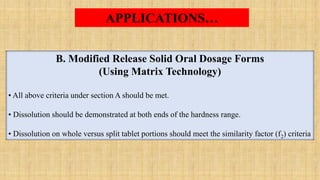
B. Modified ReleaseSolid Oral Dosage Forms
(Using Matrix Technology)
• All above criteria under section A should be met.
• Dissolution should be demonstrated at both ends of the hardness range.
• Dissolution on whole versus split tablet portions should meet the similarity factor (f2) criteria
APPLICATIONS…
6.
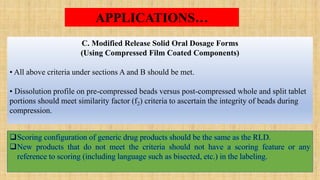
Scoring configuration ofgeneric drug products should be the same as the RLD.
New products that do not meet the criteria should not have a scoring feature or any
reference to scoring (including language such as bisected, etc.) in the labeling.
C. Modified Release Solid Oral Dosage Forms
(Using Compressed Film Coated Components)
• All above criteria under sections A and B should be met.
• Dissolution profile on pre-compressed beads versus post-compressed whole and split tablet
portions should meet similarity factor (f2) criteria to ascertain the integrity of beads during
compression.
APPLICATIONS…
7.
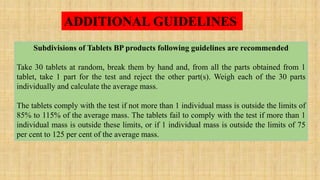
Subdivisions of TabletsBP products following guidelines are recommended
Take 30 tablets at random, break them by hand and, from all the parts obtained from 1
tablet, take 1 part for the test and reject the other part(s). Weigh each of the 30 parts
individually and calculate the average mass.
The tablets comply with the test if not more than 1 individual mass is outside the limits of
85% to 115% of the average mass. The tablets fail to comply with the test if more than 1
individual mass is outside these limits, or if 1 individual mass is outside the limits of 75
per cent to 125 per cent of the average mass.
ADDITIONAL GUIDELINES