101
Lisa Van Plew-Cid
K-5 TAB Choice Art Educator
Three Oaks, Michigan
Teaching for Artistic Behavior
Mission
The Teaching for Artistic Behavior organization is committed
to supporting and mentoring educators who would like to
provide
authentic art making opportunities
for students in schools and other programs
through the
implementation of
choice-based art education concepts
and utilizing a
studio/learning centers approach.
PERSONAL CONTEXT
Choice−based art education
regards students as artists and
offers students real choices for
responding to their own ideas
and interests through art
making.
PEDAGOGICAL CONTEXT
Choice−based art education
supports multiple modes of
learning and teaching.
CLASSROOM CONTEXT
Choice−based art education
provides resources and
opportunities to construct
knowledge and meaning in the
process of making art.
ASSESSMENT
Choice−based art education
utilizes multiple forms of
assessment to support student
and teacher growth.
There is no one “right” way to create a
TAB Choice based Art Studio.
Art educators embracing TAB have been “innovators” in
creating ways to implement the Four Practices of TAB Choice.
SPACE
• How many centers can you
accommodate?
• Can you make a
gathering/demonstration
area?
• Are there areas for displaying
menus, directions and
resources in each center?
• What sort of storage do you
have for unfinished work?
• Where is your water source?
http://pamdora.com/blog/wp-content/uploads/2008/03/artcart.jpg
SUPPLIES &
TOOLS
Materials and tools are organized for
easy access and return
• Highly organized
(containers and/or shelves)
• Labeled (color coded?)
• Placed in or near
appropriate studio
center
• Permanent or
temporary
(available or check out?)
• Grade appropriate
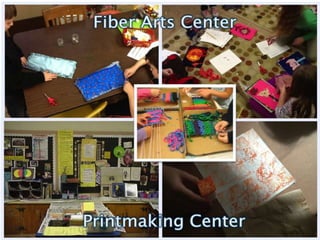
CENTERS
a “3-D Lesson Plan”
LARGE or small
PERMANENT or Temporary
O p e n or sign up
Unlimited or limited students at center
Choose appropriate centers for your room
Centers named according to teacher preference
Opened ONE at a time
as students show their teacher that they are ready
to handle more choices
• menus with set-up procedures
• directions and lists of materials and
tools
• resources include images by
student and adult artists, books,
charts and other related
references
Twenty Seven Ways to
Teach Art History in your
Choice Classroom
http://teachingforartisticbehavior.org/
studio-centers/art-history/
TAB Choice Website Art History
Class Structure
DEMO
or Mini Lesson
5 Minutes
Studio Time
Clean Up 5-7 Minutes
Reflection and
Share 5-7 Minutes
Meeting
• Plan for the day
(maybe assign jobs)
• Sketchbook (Idea book)
check or pass out
• Center Review
(for little ones)
Student Process
The idea of “Play” and
“Care” is important in the
“Constructive”
environment of a
Choice Based Art Room.
John Crowe’s idea of
“Play/Care”
TAB Website John Crowe
Art works brought to
completion can be called a
“Showcase” or a “WOW”
piece, a
“Wonderful, Original Work
of art”. Students can be
required to complete a
certain number of these
pieces a quarter.
Supporting 21st Century Learning Skills
http://teachingforartisticbehavior.org/why-tab/21st-century-skills/
*Learning & Innovation Skills *Research & Inquiry
*Collaboration * Life & Career Skills
Studio Habits “I Can”
Instruction
Contextual and Emergent
*Whole Group *Small Group *Individual *Peer to Peer
• Teaching comes in many forms: direct
and indirect (through visuals and
references), whole−group
demonstrations and discussions,
small groups of students who choose
a particular exploration, and
one−to−one teacher to student
interaction.
• Student independence is encouraged.
• The teacher's roles include
demonstrating, modeling, facilitating,
coaching, providing content, and
altering that content as a result of
observations made in class.
• Students provide much of the
instruction.
• Student "experts" who work in one
medium over time serve as coaches
and peer tutors, enjoying further
learning in the process.
• Student discoveries are shared with
classmates and teachers.
• Students form cooperative groups in
an organic manner.
• A great deal of information is
transmitted student to student.
Teacher Roles Student Roles
Demos
Mini Lessons
What’s the least amount of
information they need to get
started?
Whole group
TYPES
• new center, technique or
material
• art history
• required vocabulary or
concept to meet district,
state or national standards
Resources for Demo Ideas:
Engaging Learners Through Artmaking
(Douglas & Jaquith, 2009)
TAB Yahoo Group Files
Student Reflections
Center Records
Accountability & Where Worked by Anne Bedrick
Assessment
Artistic Behaviors Artistic behaviors are honored and noted in the ongoing daily assessment process.
. 
Choice-based art education uses multiple forms of assessment
to support student and teacher growth.
 Teacher-created documentation
captures observations of
students’ artistic behaviors, needs and accomplishments.
Some of the
Artistic Behaviors
choice teachers value
include:
• Risk-taking
• Following a line of
thought over time
• Going deep with a
preferred medium or
technique
• Playing and
experimenting
• Bringing aspects of
their life into their
art
Rubrics
• Rubrics are negotiated between students and teachers and are broad enough
to affirm diverse learning styles.
• Rubrics are generated while viewing student artwork as examples of
excellence. What does Excellence look like in Art Class?
• Examples show a range of materials.
• Some represent weeks of work while others are simple sketches done in
minutes.
Advocacy
Established in 2001, the Teaching
for Artistic Behavior TM (TAB)
organization is a grassroots
educational movement
entirely developed and
maintained by art teachers.
This concept comes directly from
choice-based art education
practices and action research in
visual art classrooms around the
United States. Our Board of
Directors is charged with
upholding TAB’s Mission, Vision
and Professional Development
offerings. Teaching for Artistic
Behavior became incorporated in
2007, in order to better serve the
needs of choice-based art
educators.
Personal Reflection and Growth
DO THE GROUNDWORK
• Read everything you can get your
hands on relating to TAB practice
and student-centered learning and
teaching.
• Look for articles on Differentiated
Learning, Constructivism and
Choice in all areas of education.
• Print out the practices, stories and
research summaries at
http://knowledgeloom.org/tab/
• Join the TAB online discussion
forums
…you’re ready to jump into
creating a TAB CHOICE art program?
Or to EVOLVE one you’ve started?? If you talk with experienced TAB Choice Art
Teachers, most will tell you that their program
the first years looks A LOT different than their
current one. As we expect our students to
reflect and grow, we do the same. Keep what
works, let go of what doesn’t. Don’t be afraid
to fail and remember to celebrate successes!!
Connect with TAB Choice colleagues…they are
irreplaceable. It is pretty incredible to
experience the authentic student growth
through the constructive pedagogy of a
CHOICE based art education!!
Additional Resources
Northeast TAB Teachers on FaceBook
Southeast TAB Teachers on FaceBook
Midwest TAB Teachers on FaceBook
TAB Book Club
TAB Slideshare
Videos by Anne Bedrick
Association for Constructivist Teaching
https://sites.google.com/site/assocforconstructte
ng
http://constructivistblog.wordpress.com
RESOURCES
Publications
TAB-ChoiceArtEd Yahoo Group
This vibrant, online art education listserv provides an active
Internet community created by the TAB professional
organization. Register at this site to share messages, read
archived posts, view photos and lesson plans.
Teaching for Artistic Behavior on Facebook
This Facebook page contains frequent updates on TAB
activities and quotes from leading authors, researchers, and
educators about learner-directed curriculum.
Books
Engaging Learners through Artmaking (Douglas & Jaquith,
2009)
The Learner-Directed Classroom (Jaquith & Hathaway, 2012)
Facebook page, for more information
Teachers College Press, for purchase
Choice Without Chaos (Bedrick, 2012) Available on the
iBookstore:
http://itunes.apple.com/us/book/choice-without-
chaos/id553083821
Adapted for
Kindle:
http://www.amazon.com/Choice-Without-Chaos-
ebook/dp/B009H292EM/ref=pd_ybh_1
Blogs
Studio-Learning
Evergreen Art
Transition to Choice Based Art Education
Self-Directed Art
Marvin Bartel
Art at the center
Elmwood’s Art.Studio
Choice Art at Bountiful Elementary
Francifularts
All the photos and resources used
in this presentation
were from some
AWESOME TAB-Choice teachers.
THANKSto all
listed!!!
Katherine Douglas
Diane Jaquith
Nan Hathaway
Julie Toole
Clyde Gaw
Joyce Moore Jaime
Candi Price
Lisa Van Plew-Cid
This little guy thinks the art and discoveries
he made in a TAB Choice art studio are pretty
“Nagic” and “Wonderful”!! (video)

Tab 101

  • 1.
    101 Lisa Van Plew-Cid K-5TAB Choice Art Educator Three Oaks, Michigan
  • 2.
    Teaching for ArtisticBehavior Mission The Teaching for Artistic Behavior organization is committed to supporting and mentoring educators who would like to provide authentic art making opportunities for students in schools and other programs
through the implementation of choice-based art education concepts and utilizing a studio/learning centers approach.
  • 3.
    PERSONAL CONTEXT Choice−based arteducation regards students as artists and offers students real choices for responding to their own ideas and interests through art making. PEDAGOGICAL CONTEXT Choice−based art education supports multiple modes of learning and teaching. CLASSROOM CONTEXT Choice−based art education provides resources and opportunities to construct knowledge and meaning in the process of making art. ASSESSMENT Choice−based art education utilizes multiple forms of assessment to support student and teacher growth.
  • 4.
    There is noone “right” way to create a TAB Choice based Art Studio. Art educators embracing TAB have been “innovators” in creating ways to implement the Four Practices of TAB Choice.
  • 5.
    SPACE • How manycenters can you accommodate? • Can you make a gathering/demonstration area? • Are there areas for displaying menus, directions and resources in each center? • What sort of storage do you have for unfinished work? • Where is your water source? http://pamdora.com/blog/wp-content/uploads/2008/03/artcart.jpg
  • 6.
    SUPPLIES & TOOLS Materials andtools are organized for easy access and return • Highly organized (containers and/or shelves) • Labeled (color coded?) • Placed in or near appropriate studio center • Permanent or temporary (available or check out?) • Grade appropriate
  • 7.
    CENTERS a “3-D LessonPlan” LARGE or small PERMANENT or Temporary O p e n or sign up Unlimited or limited students at center Choose appropriate centers for your room Centers named according to teacher preference Opened ONE at a time as students show their teacher that they are ready to handle more choices • menus with set-up procedures • directions and lists of materials and tools • resources include images by student and adult artists, books, charts and other related references
  • 12.
    Twenty Seven Waysto Teach Art History in your Choice Classroom http://teachingforartisticbehavior.org/ studio-centers/art-history/ TAB Choice Website Art History
  • 13.
    Class Structure DEMO or MiniLesson 5 Minutes Studio Time Clean Up 5-7 Minutes Reflection and Share 5-7 Minutes Meeting • Plan for the day (maybe assign jobs) • Sketchbook (Idea book) check or pass out • Center Review (for little ones)
  • 14.
    Student Process The ideaof “Play” and “Care” is important in the “Constructive” environment of a Choice Based Art Room. John Crowe’s idea of “Play/Care” TAB Website John Crowe Art works brought to completion can be called a “Showcase” or a “WOW” piece, a “Wonderful, Original Work of art”. Students can be required to complete a certain number of these pieces a quarter.
  • 15.
    Supporting 21st CenturyLearning Skills http://teachingforartisticbehavior.org/why-tab/21st-century-skills/ *Learning & Innovation Skills *Research & Inquiry *Collaboration * Life & Career Skills Studio Habits “I Can”
  • 16.
    Instruction Contextual and Emergent *WholeGroup *Small Group *Individual *Peer to Peer • Teaching comes in many forms: direct and indirect (through visuals and references), whole−group demonstrations and discussions, small groups of students who choose a particular exploration, and one−to−one teacher to student interaction. • Student independence is encouraged. • The teacher's roles include demonstrating, modeling, facilitating, coaching, providing content, and altering that content as a result of observations made in class. • Students provide much of the instruction. • Student "experts" who work in one medium over time serve as coaches and peer tutors, enjoying further learning in the process. • Student discoveries are shared with classmates and teachers. • Students form cooperative groups in an organic manner. • A great deal of information is transmitted student to student. Teacher Roles Student Roles
  • 17.
    Demos Mini Lessons What’s theleast amount of information they need to get started? Whole group TYPES • new center, technique or material • art history • required vocabulary or concept to meet district, state or national standards Resources for Demo Ideas: Engaging Learners Through Artmaking (Douglas & Jaquith, 2009) TAB Yahoo Group Files
  • 18.
  • 19.
    Assessment Artistic Behaviors Artisticbehaviors are honored and noted in the ongoing daily assessment process. . 
Choice-based art education uses multiple forms of assessment to support student and teacher growth.
 Teacher-created documentation captures observations of students’ artistic behaviors, needs and accomplishments. Some of the Artistic Behaviors choice teachers value include: • Risk-taking • Following a line of thought over time • Going deep with a preferred medium or technique • Playing and experimenting • Bringing aspects of their life into their art Rubrics • Rubrics are negotiated between students and teachers and are broad enough to affirm diverse learning styles. • Rubrics are generated while viewing student artwork as examples of excellence. What does Excellence look like in Art Class? • Examples show a range of materials. • Some represent weeks of work while others are simple sketches done in minutes.
  • 20.
    Advocacy Established in 2001,the Teaching for Artistic Behavior TM (TAB) organization is a grassroots educational movement entirely developed and maintained by art teachers. This concept comes directly from choice-based art education practices and action research in visual art classrooms around the United States. Our Board of Directors is charged with upholding TAB’s Mission, Vision and Professional Development offerings. Teaching for Artistic Behavior became incorporated in 2007, in order to better serve the needs of choice-based art educators.
  • 21.
    Personal Reflection andGrowth DO THE GROUNDWORK • Read everything you can get your hands on relating to TAB practice and student-centered learning and teaching. • Look for articles on Differentiated Learning, Constructivism and Choice in all areas of education. • Print out the practices, stories and research summaries at http://knowledgeloom.org/tab/ • Join the TAB online discussion forums …you’re ready to jump into creating a TAB CHOICE art program? Or to EVOLVE one you’ve started?? If you talk with experienced TAB Choice Art Teachers, most will tell you that their program the first years looks A LOT different than their current one. As we expect our students to reflect and grow, we do the same. Keep what works, let go of what doesn’t. Don’t be afraid to fail and remember to celebrate successes!! Connect with TAB Choice colleagues…they are irreplaceable. It is pretty incredible to experience the authentic student growth through the constructive pedagogy of a CHOICE based art education!!
  • 22.
    Additional Resources Northeast TABTeachers on FaceBook Southeast TAB Teachers on FaceBook Midwest TAB Teachers on FaceBook TAB Book Club TAB Slideshare Videos by Anne Bedrick Association for Constructivist Teaching https://sites.google.com/site/assocforconstructte ng http://constructivistblog.wordpress.com RESOURCES Publications TAB-ChoiceArtEd Yahoo Group This vibrant, online art education listserv provides an active Internet community created by the TAB professional organization. Register at this site to share messages, read archived posts, view photos and lesson plans. Teaching for Artistic Behavior on Facebook This Facebook page contains frequent updates on TAB activities and quotes from leading authors, researchers, and educators about learner-directed curriculum. Books Engaging Learners through Artmaking (Douglas & Jaquith, 2009) The Learner-Directed Classroom (Jaquith & Hathaway, 2012) Facebook page, for more information Teachers College Press, for purchase Choice Without Chaos (Bedrick, 2012) Available on the iBookstore:
http://itunes.apple.com/us/book/choice-without- chaos/id553083821
Adapted for Kindle:
http://www.amazon.com/Choice-Without-Chaos- ebook/dp/B009H292EM/ref=pd_ybh_1 Blogs Studio-Learning Evergreen Art Transition to Choice Based Art Education Self-Directed Art Marvin Bartel Art at the center Elmwood’s Art.Studio Choice Art at Bountiful Elementary Francifularts
  • 23.
    All the photosand resources used in this presentation were from some AWESOME TAB-Choice teachers. THANKSto all listed!!! Katherine Douglas Diane Jaquith Nan Hathaway Julie Toole Clyde Gaw Joyce Moore Jaime Candi Price Lisa Van Plew-Cid This little guy thinks the art and discoveries he made in a TAB Choice art studio are pretty “Nagic” and “Wonderful”!! (video)

Editor's Notes