TEACHING VISUAL
ARTS IN THE
ELEMENTARY GRADES
EDUC 306
Commission on Higher Education
GUINAYANGAN COLLEGE FOUNDATION INC.
Barangay Sisi, Guinayangan, Quezon
1st
Semester Academic Year 2024-2025
Professor: Hersey Ann A. Anajao, LPT
SETTING THE
OBJECTIVES
LEARNING OUTCOMES
• 1. Differentiate a teacher-directed approach and learner-
directed approach in teaching art.
• 2. Recognize the different purposes of an art activity in
varied settings.
• 3. Examine the factors in choosing an appropriate art
activity for students.
“ The important things is to arouse
in children a real feeling for life;
and color and form have the power
to lead right into life….
These details are essential to the
vitality of the work”
- Rudolf Steiner , 1922
The Continuum of Choice
The "continuum of choice" refers to a concept in decision-making
where choices are seen as existing on a spectrum rather than being
binary or fixed. This continuum recognizes that decisions often involve a
range of options that vary in subtle ways, allowing for more nuanced,
flexible, and dynamic choices rather than strict "either-or" outcomes.
In many contexts, this idea suggests that decision-makers weigh
multiple factors, preferences, and potential outcomes, leading to a
broader array of possibilities. It emphasizes the complexity of choice,
acknowledging that real-world decisions are often influenced by context,
constraints, and varying levels of commitment or trade-offs.
The Continuum of Choice
David Hume, an 18th-century Scottish philosopher, is well-
known for his work on empiricism, skepticism, and human
understanding. He extensively explored ideas related to causality, free
will, moral judgment, and human decision-making. Hume argued that
human choices are often influenced by emotions (or "passions") rather
than pure reason, and his ideas have laid the groundwork for many
modern theories of choice and decision-making.
The Continuum of Choice
"Teaching for Artistic Behavior (TAB)" is an educational philosophy
centered on student-directed learning in the art classroom. This
approach emphasizes that students are the artists and the classroom is
their studio. Teachers guide students in developing their personal artistic
processes, giving them the freedom to explore their own ideas and make
choices about their art-making. The approach fosters creativity, problem-
solving, and independence.
Douglas and Jaquith's 2018 book, "Engaging Learners Through
Artmaking: Choice-Based Art Education in the Classroom," is a
foundational text for TAB.
Key Points in Douglas and Jaquith’s work
. Choice-Based Art Education
The Classroom as Studio
Teacher’s Role as a Facilitator
Developing Artistic Behavior
Individualized Learning
Student-Centered Assessment
Key Points in Douglas and Jaquith’s work
1. Choice-Based Art Education
•TAB encourages students to make choices about the subject, medium, and
techniques they want to explore in their artwork.
•The idea is that authentic artistic behaviors emerge when students are given the
autonomy to follow their interests and artistic goals, rather than following a
prescribed curriculum.
Key Points in Douglas and Jaquith’s work
The Classroom as Studio
•The art classroom is set up like a professional studio, with various "centers" or
areas dedicated to different media and techniques, such as drawing, painting,
sculpture, etc.
•Students choose where to work based on their project needs, fostering a sense of
responsibility and ownership over their learning process.
Key Points in Douglas and Jaquith’s work
Teacher’s Role as a Facilitator
•The teacher’s role is to guide and support students rather than directly instructing
them. Teachers offer mini-lessons, demonstrate techniques, and provide
individualized feedback when needed.
•This approach shifts the focus from teacher-directed lessons to student-directed
exploration.

Key Points in Douglas and Jaquith’s work
Developing Artistic Behavior
•TAB is based on the idea that students should learn to think and act like artists.
This means developing skills such as idea generation, experimentation, reflection,
and perseverance.
•The approach encourages students to engage with the full cycle of art-making,
from concept development to execution, reflection, and presentation.
Key Points in Douglas and Jaquith’s work
Individualized Learning
•Because each student works on a project of their own choosing, TAB allows for
highly individualized learning experiences. Each student can progress at their own
pace, and the teacher can tailor feedback and guidance to each student's needs.
Key Points in Douglas and Jaquith’s work
Student-Centered Assessment
•Assessment in TAB is based on individual student progress, process, and personal
artistic growth rather than standardized criteria. Students are encouraged to self-
reflect and discuss their creative processes.
Approaches in
Teaching Art
Approaches in Teaching Art
Teacher- Centered Approach
Learner Centered Approach
Approaches in Teaching Art
 Teacher-Centered Approach
In a teacher-centered approach to art education, the teacher directs
and controls the learning process. This method is more structured, with the
teacher leading instruction, deciding the content, and guiding students step-
by-step through lessons.
Key Features in Teacher- Centered
Approach:
•Instructional Control: The teacher is the expert who decides the curriculum, techniques,
and content to be covered.
•Structured Lessons: Lessons are often pre-planned and delivered with clear objectives.
Students follow prescribed steps, learning specific skills and techniques.
•Demonstration-Based: The teacher typically demonstrates a skill or technique, and
students replicate it.
•Focus on Skill Acquisition: The emphasis is often on mastering foundational skills,
traditional techniques, and formal art elements (e.g., color theory, composition,
perspective).
•Uniform Outcomes: Students generally work toward the same project outcome, following
the teacher's instructions closely.
Benefits of using Teacher- Centered
Approach:
•Technical Mastery: Students learn specific skills and techniques from a professional,
ensuring they develop a solid foundation.
•Clear Expectations: Students know exactly what is expected of them, which can reduce
anxiety and confusion.
•Efficiency: This approach can cover a broad range of material in a limited time frame.
Drawbacks of using Teacher- Centered
Approach:
•Limited Creativity: Students may have less freedom to express their individuality or
explore their own ideas.
•Less Ownership: The emphasis on replicating the teacher’s model may reduce students'
sense of ownership and engagement.
•Passive Learning: Students may become passive receivers of information rather than
active participants in their learning.
Approaches in Teaching Art
 Learner-Centered Approach
In a learner-centered approach, such as the Teaching for
Artistic Behavior (TAB) model, students take an active role
in their learning. This method prioritizes student choice,
self-expression, and personal exploration in the art-making
process.
Key Features of Student- Centered
Approach:
•Student Autonomy: Students have the freedom to choose the content, materials, and
direction of their artwork, often based on their interests.
•Exploration and Experimentation: The focus is on creativity, problem-solving, and developing
unique ideas rather than mastering a specific technique or replicating a teacher’s example.
•Teacher as Facilitator: The teacher serves as a guide or mentor, offering resources, mini-
lessons, and feedback rather than dictating every step of the process.
•Personalized Learning: Lessons can be individualized, with students working on different
projects according to their needs, interests, and skill levels.
•Emphasis on Process: The learning process is valued as much as, if not more than, the final
product. Students reflect on their work, make revisions, and learn through experimentation.
Benefits of using Student- Centered
Approach:
•Fosters Creativity: Students are encouraged to think creatively, develop original ideas, and
experiment with different approaches to art-making.
•Engagement: Giving students choice and control over their projects can increase motivation
and engagement.
•Individual Growth: Each student can work at their own pace, following their interests and
abilities, leading to more personalized and meaningful learning experiences.
•Problem-Solving: Students learn to navigate challenges and solve problems independently,
skills that are valuable beyond the art classroom.
Drawbacks of using Student- Centered
Approach:
•Less Structured: Without clear, uniform goals, some students may feel lost or
unsure of what to do.
•Inconsistent Skill Development: Students might not receive as much direct
instruction in foundational techniques, leading to gaps in their skill set.
•Time Management: Because students work on individualized projects, it can be
more difficult for teachers to manage the classroom and ensure that all students are
progressing.
COMPARISON
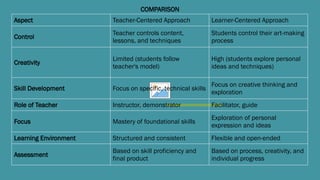
Aspect Teacher-Centered Approach Learner-Centered Approach
Control
Teacher controls content,
lessons, and techniques
Students control their art-making
process
Creativity
Limited (students follow
teacher's model)
High (students explore personal
ideas and techniques)
Skill Development Focus on specific, technical skills
Focus on creative thinking and
exploration
Role of Teacher Instructor, demonstrator Facilitator, guide
Focus Mastery of foundational skills
Exploration of personal
expression and ideas
Learning Environment Structured and consistent Flexible and open-ended
Assessment
Based on skill proficiency and
final product
Based on process, creativity, and
individual progress
Setting Objective for a
Teacher - Centered
Approach
SETTING OBJECTIVE FOR A LEARNER -
CENTERED APPROACH
When setting objectives for a teacher-centered approach in art
education, the focus is on structured learning, skill development, and
mastery of specific techniques or concepts. The teacher guides the lesson,
and students are expected to follow explicit instructions to achieve clear,
measurable outcomes. Objectives in this context are typically focused on
building foundational skills, learning art elements, and replicating
techniques taught by the teacher.
Key Principles for Teacher-Centered
Objectives:
•Skill Mastery: Objectives should aim for students to acquire specific artistic
techniques or knowledge.
•Structured Learning: The teacher provides direct instruction, and students
are expected to follow the steps to achieve the set outcome.
•Uniform Outcomes: Students work toward the same or similar results, often
following a model provided by the teacher.
•Measurable Goals: The objectives are clearly defined and assessed based
on specific criteria, such as accuracy, technique, or adherence to a process.
Sample Objectives for a Teacher-Centered
Art Classroom:
1. Mastery of Art Techniques:
•Objective: Students will learn and apply a specific art technique demonstrated by the
teacher, such as shading or perspective drawing.
•Example: "Students will use hatching and cross-hatching techniques to create a sense of
depth in their drawings, achieving at least three levels of shading."
2. Understanding Art Elements and Principles:
•Objective: Students will identify and apply the elements of art (line, shape, color, form,
etc.) and principles of design (balance, contrast, emphasis, etc.) in their work.
•Example: "Students will create a composition that demonstrates symmetrical balance
using geometric shapes and complementary colors."
Sample Objectives for a Teacher-Centered
Art Classroom:
3. Replication of a Model or Example:
•Objective: Students will replicate a teacher-provided model or example, following the
steps and guidelines given in class.
•Example: "Students will follow step-by-step instructions to recreate a still life drawing,
using pencil to accurately render light and shadow on three different objects."
4. Skill-Building Through Practice:
•Objective: Students will practice and demonstrate proficiency in a specific art skill
through repeated exercises or activities.
•Example: "Students will complete three gesture drawings of a figure, each under two
minutes, to practice capturing movement and form."
Sample Objectives for a Teacher-Centered
Art Classroom:
5. Learning a Specific Art Medium:
•Objective: Students will explore and apply techniques specific to a particular art medium,
such as watercolor, oil paints, or charcoal.
•Example: "Students will learn the wet-on-wet technique in watercolor painting and apply it to
create a landscape with at least two areas of blended color transitions."
6. Applying Art Historical Styles:
•Objective: Students will study an art historical style or movement and create a work that
replicates the characteristics of that style.
•Example: "Students will create a Cubist-inspired portrait by breaking down facial features
into geometric shapes, following the compositional methods of artists like Picasso and
Braque."
Sample Objectives for a Teacher-Centered
Art Classroom:
7. Following a Guided Art Process:
•Objective: Students will follow a guided process for creating artwork, including planning,
execution, and finishing stages.
•Example: "Students will follow a five-step process to create a linocut print, including
designing, carving, inking, and printing, with a focus on clean lines and accurate carving."
8. Demonstrating Accuracy and Precision:
•Objective: Students will demonstrate accuracy and precision in their art-making by following
specific criteria provided by the teacher.
•Example: "Students will draw a one-point perspective room, ensuring all lines recede to a
single vanishing point and that objects appear in proportion."
Assessment in Teacher-Centered
Objectives:
Since this approach emphasizes skill acquisition and structured outcomes, assessment is
often based on:
•Technical Proficiency: How well students can apply the techniques demonstrated by the
teacher.
•Adherence to Instructions: Whether students followed the process and steps outlined by the
teacher.
•Accuracy and Precision: The correctness of the final artwork, including proper use of
elements like perspective, shading, and composition.
•Final Product Quality: The aesthetic quality and craftsmanship of the final work based on
predetermined criteria.
Setting Objective for a
Learner - Centered
Approach
SETTING OBJECTIVE FOR A LEARNER -
CENTERED APPROACH
Setting objectives for a learner-centered approach in art
education requires a focus on student agency, creativity, and
individual growth rather than rigid outcomes. The objectives
should encourage personal exploration, problem-solving, and
the development of artistic behavior.
KEY PRINCIPLES FOR LEARNER-
CENTERED OBJECTIVES:
 Emphasize the Learning Process: Focus on exploration,
experimentation, and self-reflection.
 Foster Creativity and Individuality: Encourage students to develop
their own artistic ideas and styles.
 Promote Critical Thinking and Problem-Solving: Guide students in
making decisions, overcoming challenges, and evaluating their work.
 Support Personal Growth: Set goals that allow for differentiation,
respecting students’ varying abilities, interests, and pace of learning.
SAMPLE OBJECTIVES FOR A LEARNER-
CENTERED ART CLASSROOM:
1. Creative Expression:
•Objective: Students will generate and explore personal ideas for art projects, selecting
materials and techniques that align with their vision.
•Example: "Students will brainstorm multiple ideas for their artwork, sketching out at
least three concepts before selecting one to develop further."
2. Artistic Process and Reflection:
•Objective: Students will engage in the full cycle of art-making, including planning,
creating, reflecting, and revising their work.
•Example: "Students will reflect on their art-making process, documenting their progress
and challenges in a personal art journal or digital portfolio."
SAMPLE OBJECTIVES FOR A LEARNER-
CENTERED ART CLASSROOM:
3. Experimentation with Materials and Techniques:
•Objective: Students will explore various materials, media, and techniques, experimenting to
discover what best fits their creative goals.
•Example: "Students will experiment with at least two different media (e.g., watercolor and
charcoal) to create textures that express different moods in their artwork."
4. Critical Thinking and Problem-Solving:
•Objective: Students will independently identify challenges in their projects and devise
strategies to overcome them.
•Example: "Students will analyze a challenge they encountered during the creation of their
artwork and document two solutions they considered before making a final decision."
SAMPLE OBJECTIVES FOR A LEARNER-
CENTERED ART CLASSROOM:
5. Collaboration and Peer Feedback:
•Objective: Students will engage in constructive critique with their peers, offering and
receiving feedback to enhance their work.
•Example: "Students will participate in peer critique sessions, providing at least two pieces
of constructive feedback to others and incorporating feedback into their own revisions."
6. Personal Growth and Self-Assessment:
•Objective: Students will set personal artistic goals at the beginning of each project and
assess their progress based on those goals.
•Example: "Students will write a personal goal related to an aspect of their artistic
development (e.g., improving drawing skills or using color expressively) and self-assess their
progress at the end of the project."
SAMPLE OBJECTIVES FOR A LEARNER-
CENTERED ART CLASSROOM:
7. Exploration of Art History and Context:
•Objective: Students will explore historical and contemporary artists, integrating techniques,
styles, or concepts into their own work.
•Example: "Students will research an artist whose work aligns with their current project,
identifying at least one technique or theme to incorporate into their own piece."
ASSESSMENT IN LEARNER-CENTERED
OBJECTIVES:
Since learner-centered approaches prioritize individual growth and creativity, assessment
should be flexible and personalized.
• Self-assessments where students reflect on their process and evaluate their work against
their personal goals.
• Portfolios that track progress over time, showcasing development and creative
exploration.
• Process-based assessments focusing on experimentation, problem-solving, and decision-
making, rather than just the final product.
The Teaching for Artistic Behavior (TAB), Reggio Emilia, and Rudolf Steiner
(Waldorf) approaches are three distinct educational philosophies that share a
learner-centered approach, but each has unique features in how they foster
creativity, independence, and holistic development. Below is an overview of
these approaches, highlighting their core ideas, how they are applied in art
education, and how they compare.
1. Teaching for Artistic Behavior (TAB)
Approach
Core Ideas:
•Student as Artist: In TAB, students are viewed as artists, and the classroom is treated as their studio. They
have significant autonomy to choose their projects, materials, and techniques, fostering independence and
creativity.
•Choice-Based Art Education: The approach emphasizes that students should have the freedom to make
choices in their art-making, encouraging personal expression and problem-solving.
•Art Centers: The classroom is divided into different centers (e.g., drawing, painting, sculpture), each equipped
with the necessary materials and tools for students to explore various media at their own pace.
•Teacher as Facilitator: The teacher’s role is to support and guide students rather than direct them. Mini-
lessons are offered on techniques or concepts, but students are encouraged to pursue their interests.
1. Teaching for Artistic Behavior (TAB)
Approach
Application in Art Education:
•Students choose what to create, how to create it, and what materials to use,
making the art-making process highly individualized.
•The focus is on process over product, with the belief that authentic learning
occurs when students engage deeply with their creative process.
•Teachers provide resources and support to develop students’ ideas rather
than assigning specific projects.
1. Teaching for Artistic Behavior (TAB)
Approach
Strengths:
•Fosters independence, creativity, and self-expression.
•Encourages exploration, risk-taking, and experimentation in art-making.
•Highly flexible, allowing for personalized learning experiences.
2. Reggio Emilia Approach
Core Ideas:
•Child as Capable Learner: Reggio Emilia views children as strong, capable, and
full of potential, with a natural curiosity that drives their learning.
•Environment as the Third Teacher: The classroom is intentionally designed to
be inspiring and supportive of exploration, often filled with natural light, open
spaces, and materials that provoke inquiry.
•Project-Based Learning: Learning is often project-based, where children
engage in long-term investigations driven by their own questions and interests.
•Documentation and Reflection: Teachers document the children’s process
through photos, videos, and notes, and both teachers and students reflect on
the learning journey together.
2. Reggio Emilia Approach
Application in Art Education:
•Art is integrated into the learning process, often as a way for students to
explore concepts and express ideas visually.
•Materials are seen as tools for expression and inquiry, and children are
encouraged to manipulate them freely to explore their ideas.
•Teachers serve as co-learners, supporting children’s inquiries and guiding
them without prescribing the direction of the work.
2. Reggio Emilia Approach
Strengths:
•Values the artistic process as a means of inquiry and discovery, not just as a
skill to be mastered.
•Promotes deep thinking, creativity, and collaboration.
•The environment is designed to stimulate creativity and inquiry, fostering
curiosity.
3. Rudolf Steiner Approach
Core Ideas:
•Holistic Development: Steiner’s Waldorf philosophy focuses on nurturing the head, heart,
and hands—emphasizing intellectual, emotional, and physical growth equally.
•Developmental Stages: Steiner’s approach is grounded in the belief that education should
align with the child’s developmental stages, with different focuses at different ages (e.g.,
early childhood focuses on imagination and play, while older students engage in abstract
thinking).
•Imagination and Creativity: Creativity is central, with the arts integrated across the
curriculum. Waldorf education promotes activities that foster imagination, from storytelling
to artistic endeavors.
•Rhythm and Repetition: Steiner believed in the importance of rhythm in learning. Daily,
weekly, and seasonal rhythms are incorporated to create a sense of security and familiarity
for students.
3. Rudolf Steiner Approach
Application in Art Education:
•Art is woven into the broader curriculum and treated as a core aspect of learning.
•Techniques such as wet-on-wet watercolor painting and block crayon drawing are often
used in early education to encourage fluid, imaginative expression.
•As students grow, the focus shifts to more formal artistic practices, but always with an
emphasis on nurturing creativity and personal expression.
3. Rudolf Steiner Approach
Strengths:
•Nurtures a deep connection between imagination and learning, supporting emotional and
creative development.
•Integrates art into all aspects of learning, rather than treating it as a separate subject.
•Promotes a sense of balance and harmony through rhythm and structure in the learning
process.
3. Rudolf Steiner Approach
Strengths:
•Nurtures a deep connection between imagination and learning, supporting emotional and
creative development.
•Integrates art into all aspects of learning, rather than treating it as a separate subject.
•Promotes a sense of balance and harmony through rhythm and structure in the learning
process.
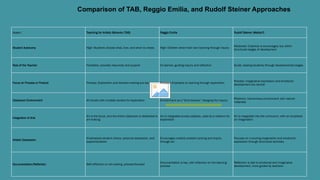
Comparison of TAB, Reggio Emilia, and Rudolf Steiner Approaches
Aspect Teaching for Artistic Behavior (TAB) Reggio Emilia Rudolf Steiner (Waldorf)
Student Autonomy High: Students choose what, how, and when to create High: Children direct their own learning through inquiry
Moderate: Creativity is encouraged, but within
structured stages of development
Role of the Teacher Facilitator, provides resources and support Co-learner, guiding inquiry and reflection Guide, leading students through developmental stages
Focus on Process or Product Process: Exploration and decision-making are key Process: Emphasis on learning through exploration
Process: Imaginative expression and emotional
development are central
Classroom Environment Art studio with multiple centers for exploration Environment as a "third teacher," designed for inquiry
Rhythmic, harmonious environment with natural
materials
Integration of Arts
Art is the focus, and the entire classroom is dedicated to
art-making
Art is integrated across subjects, used as a medium for
exploration
Art is integrated into the curriculum, with an emphasis
on imagination
Artistic Expression
Emphasizes student choice, personal expression, and
experimentation
Encourages creative problem-solving and inquiry
through art
Focuses on nurturing imagination and emotional
expression through structured activities
Documentation/Reflection Self-reflection on art-making, process-focused
Documentation is key, with reflection on the learning
process
Reflection is tied to emotional and imaginative
development, more guided by teachers
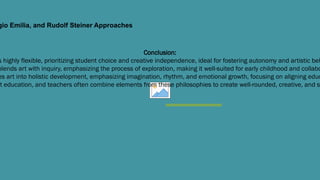
gio Emilia, and Rudolf Steiner Approaches
Conclusion:
s highly flexible, prioritizing student choice and creative independence, ideal for fostering autonomy and artistic beh
blends art with inquiry, emphasizing the process of exploration, making it well-suited for early childhood and collabo
es art into holistic development, emphasizing imagination, rhythm, and emotional growth, focusing on aligning educ
t education, and teachers often combine elements from these philosophies to create well-rounded, creative, and s

2ND TOPIC TEACHING VISUAL ARTS IN THE ELEMENTARY GRADES.pptx

  • 1.
    TEACHING VISUAL ARTS INTHE ELEMENTARY GRADES EDUC 306 Commission on Higher Education GUINAYANGAN COLLEGE FOUNDATION INC. Barangay Sisi, Guinayangan, Quezon 1st Semester Academic Year 2024-2025 Professor: Hersey Ann A. Anajao, LPT
  • 2.
  • 3.
    LEARNING OUTCOMES • 1.Differentiate a teacher-directed approach and learner- directed approach in teaching art. • 2. Recognize the different purposes of an art activity in varied settings. • 3. Examine the factors in choosing an appropriate art activity for students.
  • 4.
    “ The importantthings is to arouse in children a real feeling for life; and color and form have the power to lead right into life…. These details are essential to the vitality of the work” - Rudolf Steiner , 1922
  • 5.
    The Continuum ofChoice The "continuum of choice" refers to a concept in decision-making where choices are seen as existing on a spectrum rather than being binary or fixed. This continuum recognizes that decisions often involve a range of options that vary in subtle ways, allowing for more nuanced, flexible, and dynamic choices rather than strict "either-or" outcomes. In many contexts, this idea suggests that decision-makers weigh multiple factors, preferences, and potential outcomes, leading to a broader array of possibilities. It emphasizes the complexity of choice, acknowledging that real-world decisions are often influenced by context, constraints, and varying levels of commitment or trade-offs.
  • 6.
    The Continuum ofChoice David Hume, an 18th-century Scottish philosopher, is well- known for his work on empiricism, skepticism, and human understanding. He extensively explored ideas related to causality, free will, moral judgment, and human decision-making. Hume argued that human choices are often influenced by emotions (or "passions") rather than pure reason, and his ideas have laid the groundwork for many modern theories of choice and decision-making.
  • 7.
    The Continuum ofChoice "Teaching for Artistic Behavior (TAB)" is an educational philosophy centered on student-directed learning in the art classroom. This approach emphasizes that students are the artists and the classroom is their studio. Teachers guide students in developing their personal artistic processes, giving them the freedom to explore their own ideas and make choices about their art-making. The approach fosters creativity, problem- solving, and independence. Douglas and Jaquith's 2018 book, "Engaging Learners Through Artmaking: Choice-Based Art Education in the Classroom," is a foundational text for TAB.
  • 8.
    Key Points inDouglas and Jaquith’s work . Choice-Based Art Education The Classroom as Studio Teacher’s Role as a Facilitator Developing Artistic Behavior Individualized Learning Student-Centered Assessment
  • 9.
    Key Points inDouglas and Jaquith’s work 1. Choice-Based Art Education •TAB encourages students to make choices about the subject, medium, and techniques they want to explore in their artwork. •The idea is that authentic artistic behaviors emerge when students are given the autonomy to follow their interests and artistic goals, rather than following a prescribed curriculum.
  • 10.
    Key Points inDouglas and Jaquith’s work The Classroom as Studio •The art classroom is set up like a professional studio, with various "centers" or areas dedicated to different media and techniques, such as drawing, painting, sculpture, etc. •Students choose where to work based on their project needs, fostering a sense of responsibility and ownership over their learning process.
  • 11.
    Key Points inDouglas and Jaquith’s work Teacher’s Role as a Facilitator •The teacher’s role is to guide and support students rather than directly instructing them. Teachers offer mini-lessons, demonstrate techniques, and provide individualized feedback when needed. •This approach shifts the focus from teacher-directed lessons to student-directed exploration.
  • 12.
    Key Points inDouglas and Jaquith’s work Developing Artistic Behavior •TAB is based on the idea that students should learn to think and act like artists. This means developing skills such as idea generation, experimentation, reflection, and perseverance. •The approach encourages students to engage with the full cycle of art-making, from concept development to execution, reflection, and presentation.
  • 13.
    Key Points inDouglas and Jaquith’s work Individualized Learning •Because each student works on a project of their own choosing, TAB allows for highly individualized learning experiences. Each student can progress at their own pace, and the teacher can tailor feedback and guidance to each student's needs.
  • 14.
    Key Points inDouglas and Jaquith’s work Student-Centered Assessment •Assessment in TAB is based on individual student progress, process, and personal artistic growth rather than standardized criteria. Students are encouraged to self- reflect and discuss their creative processes.
  • 15.
  • 16.
    Approaches in TeachingArt Teacher- Centered Approach Learner Centered Approach
  • 17.
    Approaches in TeachingArt  Teacher-Centered Approach In a teacher-centered approach to art education, the teacher directs and controls the learning process. This method is more structured, with the teacher leading instruction, deciding the content, and guiding students step- by-step through lessons.
  • 18.
    Key Features inTeacher- Centered Approach: •Instructional Control: The teacher is the expert who decides the curriculum, techniques, and content to be covered. •Structured Lessons: Lessons are often pre-planned and delivered with clear objectives. Students follow prescribed steps, learning specific skills and techniques. •Demonstration-Based: The teacher typically demonstrates a skill or technique, and students replicate it. •Focus on Skill Acquisition: The emphasis is often on mastering foundational skills, traditional techniques, and formal art elements (e.g., color theory, composition, perspective). •Uniform Outcomes: Students generally work toward the same project outcome, following the teacher's instructions closely.
  • 19.
    Benefits of usingTeacher- Centered Approach: •Technical Mastery: Students learn specific skills and techniques from a professional, ensuring they develop a solid foundation. •Clear Expectations: Students know exactly what is expected of them, which can reduce anxiety and confusion. •Efficiency: This approach can cover a broad range of material in a limited time frame.
  • 20.
    Drawbacks of usingTeacher- Centered Approach: •Limited Creativity: Students may have less freedom to express their individuality or explore their own ideas. •Less Ownership: The emphasis on replicating the teacher’s model may reduce students' sense of ownership and engagement. •Passive Learning: Students may become passive receivers of information rather than active participants in their learning.
  • 21.
    Approaches in TeachingArt  Learner-Centered Approach In a learner-centered approach, such as the Teaching for Artistic Behavior (TAB) model, students take an active role in their learning. This method prioritizes student choice, self-expression, and personal exploration in the art-making process.
  • 22.
    Key Features ofStudent- Centered Approach: •Student Autonomy: Students have the freedom to choose the content, materials, and direction of their artwork, often based on their interests. •Exploration and Experimentation: The focus is on creativity, problem-solving, and developing unique ideas rather than mastering a specific technique or replicating a teacher’s example. •Teacher as Facilitator: The teacher serves as a guide or mentor, offering resources, mini- lessons, and feedback rather than dictating every step of the process. •Personalized Learning: Lessons can be individualized, with students working on different projects according to their needs, interests, and skill levels. •Emphasis on Process: The learning process is valued as much as, if not more than, the final product. Students reflect on their work, make revisions, and learn through experimentation.
  • 23.
    Benefits of usingStudent- Centered Approach: •Fosters Creativity: Students are encouraged to think creatively, develop original ideas, and experiment with different approaches to art-making. •Engagement: Giving students choice and control over their projects can increase motivation and engagement. •Individual Growth: Each student can work at their own pace, following their interests and abilities, leading to more personalized and meaningful learning experiences. •Problem-Solving: Students learn to navigate challenges and solve problems independently, skills that are valuable beyond the art classroom.
  • 24.
    Drawbacks of usingStudent- Centered Approach: •Less Structured: Without clear, uniform goals, some students may feel lost or unsure of what to do. •Inconsistent Skill Development: Students might not receive as much direct instruction in foundational techniques, leading to gaps in their skill set. •Time Management: Because students work on individualized projects, it can be more difficult for teachers to manage the classroom and ensure that all students are progressing.
  • 25.
    COMPARISON Aspect Teacher-Centered ApproachLearner-Centered Approach Control Teacher controls content, lessons, and techniques Students control their art-making process Creativity Limited (students follow teacher's model) High (students explore personal ideas and techniques) Skill Development Focus on specific, technical skills Focus on creative thinking and exploration Role of Teacher Instructor, demonstrator Facilitator, guide Focus Mastery of foundational skills Exploration of personal expression and ideas Learning Environment Structured and consistent Flexible and open-ended Assessment Based on skill proficiency and final product Based on process, creativity, and individual progress
  • 26.
    Setting Objective fora Teacher - Centered Approach
  • 27.
    SETTING OBJECTIVE FORA LEARNER - CENTERED APPROACH When setting objectives for a teacher-centered approach in art education, the focus is on structured learning, skill development, and mastery of specific techniques or concepts. The teacher guides the lesson, and students are expected to follow explicit instructions to achieve clear, measurable outcomes. Objectives in this context are typically focused on building foundational skills, learning art elements, and replicating techniques taught by the teacher.
  • 28.
    Key Principles forTeacher-Centered Objectives: •Skill Mastery: Objectives should aim for students to acquire specific artistic techniques or knowledge. •Structured Learning: The teacher provides direct instruction, and students are expected to follow the steps to achieve the set outcome. •Uniform Outcomes: Students work toward the same or similar results, often following a model provided by the teacher. •Measurable Goals: The objectives are clearly defined and assessed based on specific criteria, such as accuracy, technique, or adherence to a process.
  • 29.
    Sample Objectives fora Teacher-Centered Art Classroom: 1. Mastery of Art Techniques: •Objective: Students will learn and apply a specific art technique demonstrated by the teacher, such as shading or perspective drawing. •Example: "Students will use hatching and cross-hatching techniques to create a sense of depth in their drawings, achieving at least three levels of shading." 2. Understanding Art Elements and Principles: •Objective: Students will identify and apply the elements of art (line, shape, color, form, etc.) and principles of design (balance, contrast, emphasis, etc.) in their work. •Example: "Students will create a composition that demonstrates symmetrical balance using geometric shapes and complementary colors."
  • 30.
    Sample Objectives fora Teacher-Centered Art Classroom: 3. Replication of a Model or Example: •Objective: Students will replicate a teacher-provided model or example, following the steps and guidelines given in class. •Example: "Students will follow step-by-step instructions to recreate a still life drawing, using pencil to accurately render light and shadow on three different objects." 4. Skill-Building Through Practice: •Objective: Students will practice and demonstrate proficiency in a specific art skill through repeated exercises or activities. •Example: "Students will complete three gesture drawings of a figure, each under two minutes, to practice capturing movement and form."
  • 31.
    Sample Objectives fora Teacher-Centered Art Classroom: 5. Learning a Specific Art Medium: •Objective: Students will explore and apply techniques specific to a particular art medium, such as watercolor, oil paints, or charcoal. •Example: "Students will learn the wet-on-wet technique in watercolor painting and apply it to create a landscape with at least two areas of blended color transitions." 6. Applying Art Historical Styles: •Objective: Students will study an art historical style or movement and create a work that replicates the characteristics of that style. •Example: "Students will create a Cubist-inspired portrait by breaking down facial features into geometric shapes, following the compositional methods of artists like Picasso and Braque."
  • 32.
    Sample Objectives fora Teacher-Centered Art Classroom: 7. Following a Guided Art Process: •Objective: Students will follow a guided process for creating artwork, including planning, execution, and finishing stages. •Example: "Students will follow a five-step process to create a linocut print, including designing, carving, inking, and printing, with a focus on clean lines and accurate carving." 8. Demonstrating Accuracy and Precision: •Objective: Students will demonstrate accuracy and precision in their art-making by following specific criteria provided by the teacher. •Example: "Students will draw a one-point perspective room, ensuring all lines recede to a single vanishing point and that objects appear in proportion."
  • 33.
    Assessment in Teacher-Centered Objectives: Sincethis approach emphasizes skill acquisition and structured outcomes, assessment is often based on: •Technical Proficiency: How well students can apply the techniques demonstrated by the teacher. •Adherence to Instructions: Whether students followed the process and steps outlined by the teacher. •Accuracy and Precision: The correctness of the final artwork, including proper use of elements like perspective, shading, and composition. •Final Product Quality: The aesthetic quality and craftsmanship of the final work based on predetermined criteria.
  • 34.
    Setting Objective fora Learner - Centered Approach
  • 35.
    SETTING OBJECTIVE FORA LEARNER - CENTERED APPROACH Setting objectives for a learner-centered approach in art education requires a focus on student agency, creativity, and individual growth rather than rigid outcomes. The objectives should encourage personal exploration, problem-solving, and the development of artistic behavior.
  • 36.
    KEY PRINCIPLES FORLEARNER- CENTERED OBJECTIVES:  Emphasize the Learning Process: Focus on exploration, experimentation, and self-reflection.  Foster Creativity and Individuality: Encourage students to develop their own artistic ideas and styles.  Promote Critical Thinking and Problem-Solving: Guide students in making decisions, overcoming challenges, and evaluating their work.  Support Personal Growth: Set goals that allow for differentiation, respecting students’ varying abilities, interests, and pace of learning.
  • 37.
    SAMPLE OBJECTIVES FORA LEARNER- CENTERED ART CLASSROOM: 1. Creative Expression: •Objective: Students will generate and explore personal ideas for art projects, selecting materials and techniques that align with their vision. •Example: "Students will brainstorm multiple ideas for their artwork, sketching out at least three concepts before selecting one to develop further." 2. Artistic Process and Reflection: •Objective: Students will engage in the full cycle of art-making, including planning, creating, reflecting, and revising their work. •Example: "Students will reflect on their art-making process, documenting their progress and challenges in a personal art journal or digital portfolio."
  • 38.
    SAMPLE OBJECTIVES FORA LEARNER- CENTERED ART CLASSROOM: 3. Experimentation with Materials and Techniques: •Objective: Students will explore various materials, media, and techniques, experimenting to discover what best fits their creative goals. •Example: "Students will experiment with at least two different media (e.g., watercolor and charcoal) to create textures that express different moods in their artwork." 4. Critical Thinking and Problem-Solving: •Objective: Students will independently identify challenges in their projects and devise strategies to overcome them. •Example: "Students will analyze a challenge they encountered during the creation of their artwork and document two solutions they considered before making a final decision."
  • 39.
    SAMPLE OBJECTIVES FORA LEARNER- CENTERED ART CLASSROOM: 5. Collaboration and Peer Feedback: •Objective: Students will engage in constructive critique with their peers, offering and receiving feedback to enhance their work. •Example: "Students will participate in peer critique sessions, providing at least two pieces of constructive feedback to others and incorporating feedback into their own revisions." 6. Personal Growth and Self-Assessment: •Objective: Students will set personal artistic goals at the beginning of each project and assess their progress based on those goals. •Example: "Students will write a personal goal related to an aspect of their artistic development (e.g., improving drawing skills or using color expressively) and self-assess their progress at the end of the project."
  • 40.
    SAMPLE OBJECTIVES FORA LEARNER- CENTERED ART CLASSROOM: 7. Exploration of Art History and Context: •Objective: Students will explore historical and contemporary artists, integrating techniques, styles, or concepts into their own work. •Example: "Students will research an artist whose work aligns with their current project, identifying at least one technique or theme to incorporate into their own piece."
  • 41.
    ASSESSMENT IN LEARNER-CENTERED OBJECTIVES: Sincelearner-centered approaches prioritize individual growth and creativity, assessment should be flexible and personalized. • Self-assessments where students reflect on their process and evaluate their work against their personal goals. • Portfolios that track progress over time, showcasing development and creative exploration. • Process-based assessments focusing on experimentation, problem-solving, and decision- making, rather than just the final product.
  • 42.
    The Teaching forArtistic Behavior (TAB), Reggio Emilia, and Rudolf Steiner (Waldorf) approaches are three distinct educational philosophies that share a learner-centered approach, but each has unique features in how they foster creativity, independence, and holistic development. Below is an overview of these approaches, highlighting their core ideas, how they are applied in art education, and how they compare.
  • 43.
    1. Teaching forArtistic Behavior (TAB) Approach Core Ideas: •Student as Artist: In TAB, students are viewed as artists, and the classroom is treated as their studio. They have significant autonomy to choose their projects, materials, and techniques, fostering independence and creativity. •Choice-Based Art Education: The approach emphasizes that students should have the freedom to make choices in their art-making, encouraging personal expression and problem-solving. •Art Centers: The classroom is divided into different centers (e.g., drawing, painting, sculpture), each equipped with the necessary materials and tools for students to explore various media at their own pace. •Teacher as Facilitator: The teacher’s role is to support and guide students rather than direct them. Mini- lessons are offered on techniques or concepts, but students are encouraged to pursue their interests.
  • 44.
    1. Teaching forArtistic Behavior (TAB) Approach Application in Art Education: •Students choose what to create, how to create it, and what materials to use, making the art-making process highly individualized. •The focus is on process over product, with the belief that authentic learning occurs when students engage deeply with their creative process. •Teachers provide resources and support to develop students’ ideas rather than assigning specific projects.
  • 45.
    1. Teaching forArtistic Behavior (TAB) Approach Strengths: •Fosters independence, creativity, and self-expression. •Encourages exploration, risk-taking, and experimentation in art-making. •Highly flexible, allowing for personalized learning experiences.
  • 46.
    2. Reggio EmiliaApproach Core Ideas: •Child as Capable Learner: Reggio Emilia views children as strong, capable, and full of potential, with a natural curiosity that drives their learning. •Environment as the Third Teacher: The classroom is intentionally designed to be inspiring and supportive of exploration, often filled with natural light, open spaces, and materials that provoke inquiry. •Project-Based Learning: Learning is often project-based, where children engage in long-term investigations driven by their own questions and interests. •Documentation and Reflection: Teachers document the children’s process through photos, videos, and notes, and both teachers and students reflect on the learning journey together.
  • 47.
    2. Reggio EmiliaApproach Application in Art Education: •Art is integrated into the learning process, often as a way for students to explore concepts and express ideas visually. •Materials are seen as tools for expression and inquiry, and children are encouraged to manipulate them freely to explore their ideas. •Teachers serve as co-learners, supporting children’s inquiries and guiding them without prescribing the direction of the work.
  • 48.
    2. Reggio EmiliaApproach Strengths: •Values the artistic process as a means of inquiry and discovery, not just as a skill to be mastered. •Promotes deep thinking, creativity, and collaboration. •The environment is designed to stimulate creativity and inquiry, fostering curiosity.
  • 49.
    3. Rudolf SteinerApproach Core Ideas: •Holistic Development: Steiner’s Waldorf philosophy focuses on nurturing the head, heart, and hands—emphasizing intellectual, emotional, and physical growth equally. •Developmental Stages: Steiner’s approach is grounded in the belief that education should align with the child’s developmental stages, with different focuses at different ages (e.g., early childhood focuses on imagination and play, while older students engage in abstract thinking). •Imagination and Creativity: Creativity is central, with the arts integrated across the curriculum. Waldorf education promotes activities that foster imagination, from storytelling to artistic endeavors. •Rhythm and Repetition: Steiner believed in the importance of rhythm in learning. Daily, weekly, and seasonal rhythms are incorporated to create a sense of security and familiarity for students.
  • 50.
    3. Rudolf SteinerApproach Application in Art Education: •Art is woven into the broader curriculum and treated as a core aspect of learning. •Techniques such as wet-on-wet watercolor painting and block crayon drawing are often used in early education to encourage fluid, imaginative expression. •As students grow, the focus shifts to more formal artistic practices, but always with an emphasis on nurturing creativity and personal expression.
  • 51.
    3. Rudolf SteinerApproach Strengths: •Nurtures a deep connection between imagination and learning, supporting emotional and creative development. •Integrates art into all aspects of learning, rather than treating it as a separate subject. •Promotes a sense of balance and harmony through rhythm and structure in the learning process.
  • 52.
    3. Rudolf SteinerApproach Strengths: •Nurtures a deep connection between imagination and learning, supporting emotional and creative development. •Integrates art into all aspects of learning, rather than treating it as a separate subject. •Promotes a sense of balance and harmony through rhythm and structure in the learning process.
  • 53.
    Comparison of TAB,Reggio Emilia, and Rudolf Steiner Approaches Aspect Teaching for Artistic Behavior (TAB) Reggio Emilia Rudolf Steiner (Waldorf) Student Autonomy High: Students choose what, how, and when to create High: Children direct their own learning through inquiry Moderate: Creativity is encouraged, but within structured stages of development Role of the Teacher Facilitator, provides resources and support Co-learner, guiding inquiry and reflection Guide, leading students through developmental stages Focus on Process or Product Process: Exploration and decision-making are key Process: Emphasis on learning through exploration Process: Imaginative expression and emotional development are central Classroom Environment Art studio with multiple centers for exploration Environment as a "third teacher," designed for inquiry Rhythmic, harmonious environment with natural materials Integration of Arts Art is the focus, and the entire classroom is dedicated to art-making Art is integrated across subjects, used as a medium for exploration Art is integrated into the curriculum, with an emphasis on imagination Artistic Expression Emphasizes student choice, personal expression, and experimentation Encourages creative problem-solving and inquiry through art Focuses on nurturing imagination and emotional expression through structured activities Documentation/Reflection Self-reflection on art-making, process-focused Documentation is key, with reflection on the learning process Reflection is tied to emotional and imaginative development, more guided by teachers
  • 54.
    gio Emilia, andRudolf Steiner Approaches Conclusion: s highly flexible, prioritizing student choice and creative independence, ideal for fostering autonomy and artistic beh blends art with inquiry, emphasizing the process of exploration, making it well-suited for early childhood and collabo es art into holistic development, emphasizing imagination, rhythm, and emotional growth, focusing on aligning educ t education, and teachers often combine elements from these philosophies to create well-rounded, creative, and s

Editor's Notes

  • #41 Some methods include: Self-assessments where students reflect on their process and evaluate their work against their personal goals. Portfolios that track progress over time, showcasing development and creative exploration. Process-based assessments focusing on experimentation, problem-solving, and decision-making, rather than just the final product.