




Discipline Based Art Education
Slides mostly from two
presentations:From https://goo.gl/ywCFsv & https://goo.gl/BzQwQC
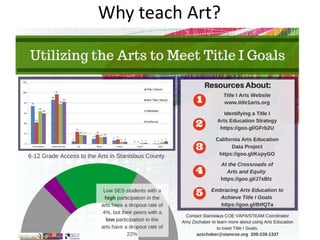
Why teach Art?
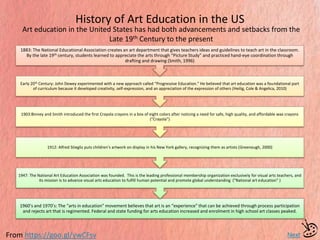
History of Art Education in the US
Next
1960’s and 1970’s: The “arts in education” movement believes that art is an “experience” that can be achieved through process participation
and rejects art that is regimented. Federal and state funding for arts education increased and enrolment in high school art classes peaked.
1947: The National Art Education Association was founded. This is the leading professional membership organization exclusively for visual arts teachers, and
its mission is to advance visual arts education to fulfill human potential and promote global understanding ("National art education" )
1912: Alfred Stiegliz puts children’s artwork on display in his New York gallery, recognizing them as artists (Greenough, 2000)
1903:Binney and Smith introduced the first Crayola crayons in a box of eight colors after noticing a need for safe, high quality, and affordable wax crayons
(“Crayola”)
Early 20th Century: John Dewey experimented with a new approach called “Progressive Education.” He believed that art education was a foundational part
of curriculum because it developed creativity, self-expression, and an appreciation of the expression of others (Heilig, Cole & Angelica, 2010)
1883: The National Educational Association creates an art department that gives teachers ideas and guidelines to teach art in the classroom.
By the late 19th century, students learned to appreciate the arts through “Picture Study” and practiced hand-eye coordination through
drafting and drawing (Smith, 1996)
Art education in the United States has had both advancements and setbacks from the
Late 19th Century to the present
From https://goo.gl/ywCFsv
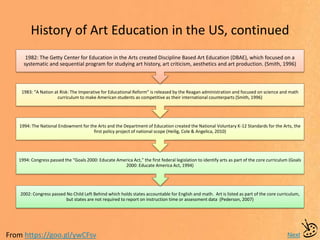
History of Art Education in the US, continued
Next
2002: Congress passed No Child Left Behind which holds states accountable for English and math. Art is listed as part of the core curriculum,
but states are not required to report on instruction time or assessment data (Pederson, 2007)
1994: Congress passed the “Goals 2000: Educate America Act,” the first federal legislation to identify arts as part of the core curriculum (Goals
2000: Educate America Act, 1994)
1994: The National Endowment for the Arts and the Department of Education created the National Voluntary K-12 Standards for the Arts, the
first policy project of national scope (Heilig, Cole & Angelica, 2010)
1983: “A Nation at Risk: The Imperative for Educational Reform” is released by the Reagan administration and focused on science and math
curriculum to make American students as competitive as their international counterparts (Smith, 1996)
1982: The Getty Center for Education in the Arts created Discipline Based Art Education (DBAE), which focused on a
systematic and sequential program for studying art history, art criticism, aesthetics and art production. (Smith, 1996)
From https://goo.gl/ywCFsv
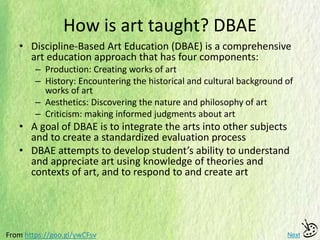
How is art taught? DBAE
• Discipline-Based Art Education (DBAE) is a comprehensive
art education approach that has four components:
– Production: Creating works of art
– History: Encountering the historical and cultural background of
works of art
– Aesthetics: Discovering the nature and philosophy of art
– Criticism: making informed judgments about art
• A goal of DBAE is to integrate the arts into other subjects
and to create a standardized evaluation process
• DBAE attempts to develop student’s ability to understand
and appreciate art using knowledge of theories and
contexts of art, and to respond to and create art
NextFrom https://goo.gl/ywCFsv
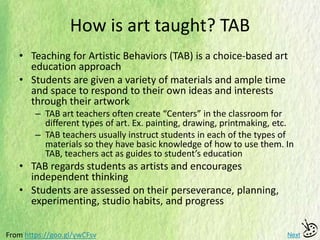
How is art taught? TAB
• Teaching for Artistic Behaviors (TAB) is a choice-based art
education approach
• Students are given a variety of materials and ample time
and space to respond to their own ideas and interests
through their artwork
– TAB art teachers often create “Centers” in the classroom for
different types of art. Ex. painting, drawing, printmaking, etc.
– TAB teachers usually instruct students in each of the types of
materials so they have basic knowledge of how to use them. In
TAB, teachers act as guides to student’s education
• TAB regards students as artists and encourages
independent thinking
• Students are assessed on their perseverance, planning,
experimenting, studio habits, and progress
NextFrom https://goo.gl/ywCFsv
How is art taught? TAB
Next
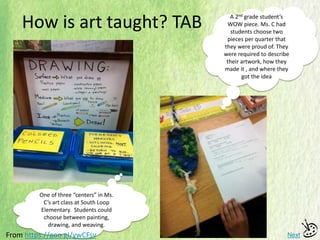
One of three “centers” in Ms.
C’s art class at South Loop
Elementary. Students could
choose between painting,
drawing, and weaving.
A 2nd grade student’s
WOW piece. Ms. C had
students choose two
pieces per quarter that
they were proud of. They
were required to describe
their artwork, how they
made it , and where they
got the idea
From https://goo.gl/ywCFsv
Art Integration
Next
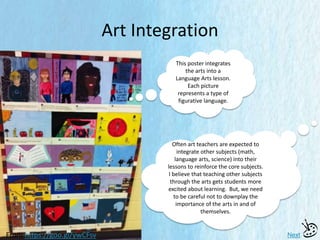
This poster integrates
the arts into a
Language Arts lesson.
Each picture
represents a type of
figurative language.
Often art teachers are expected to
integrate other subjects (math,
language arts, science) into their
lessons to reinforce the core subjects.
I believe that teaching other subjects
through the arts gets students more
excited about learning. But, we need
to be careful not to downplay the
importance of the arts in and of
themselves.
From https://goo.gl/ywCFsv
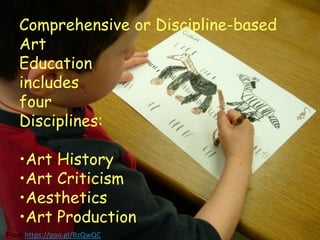
Comprehensive or Discipline-based
Art
Education
includes
four
Disciplines:
•Art History
•Art Criticism
•Aesthetics
•Art Production
From https://goo.gl/BzQwQC
Art History:
acquiring
knowledge
about the
contributions
art and
artists make
to society.
From https://goo.gl/BzQwQC
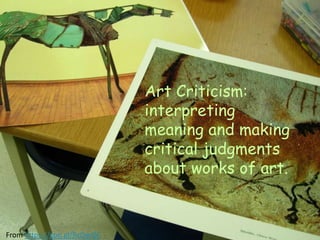
Art Criticism:
interpreting
meaning and making
critical judgments
about works of art.
From https://goo.gl/BzQwQC
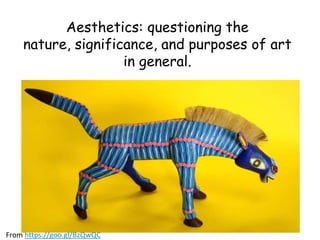
Aesthetics: questioning the
nature, significance, and purposes of art
in general.
From https://goo.gl/BzQwQC
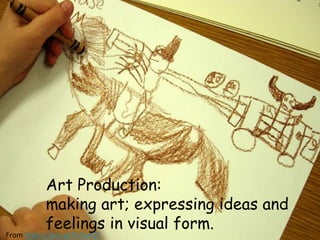
Art Production:
making art; expressing ideas and
feelings in visual form.
From https://goo.gl/BzQwQC
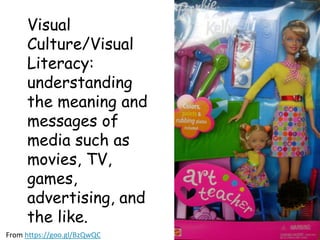
Visual
Culture/Visual
Literacy:
understanding
the meaning and
messages of
media such as
movies, TV,
games,
advertising, and
the like.
From https://goo.gl/BzQwQC
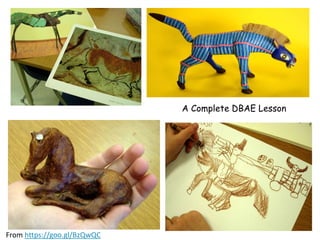
A Complete DBAE Lesson
From https://goo.gl/BzQwQC
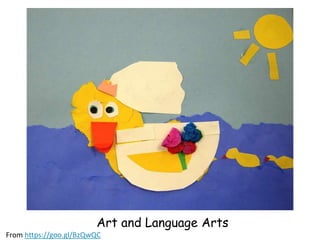
Art and Language Arts
From https://goo.gl/BzQwQC
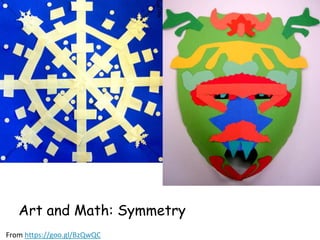
Art and Math: Symmetry
From https://goo.gl/BzQwQC
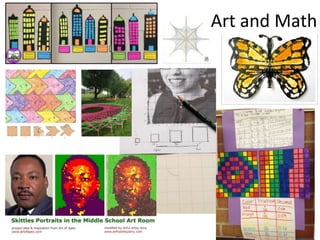
Art and Math
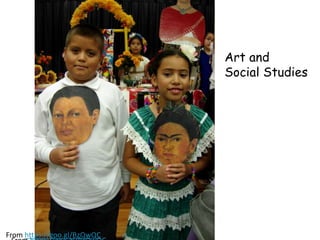
Art and
Social Studies
From https://goo.gl/BzQwQC
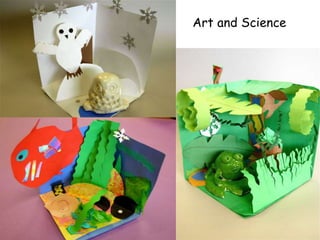
Art and Science
From https://goo.gl/BzQwQC
Art and Science
From https://goo.gl/BzQwQC
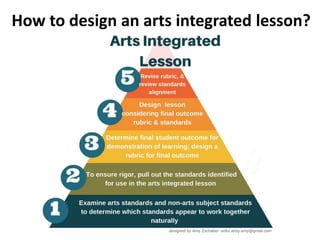
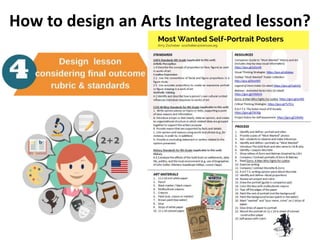
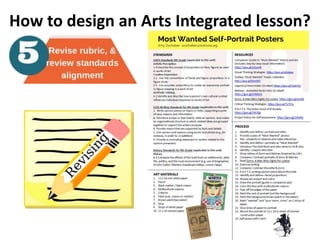
How to design an arts integrated lesson?
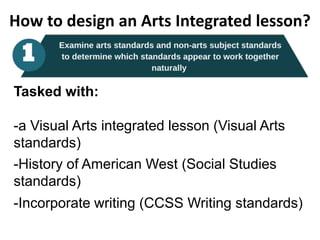
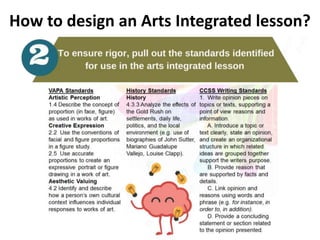
How to design an Arts Integrated lesson?
Tasked with:
-a Visual Arts integrated lesson (Visual Arts
standards)
-History of American West (Social Studies
standards)
-Incorporate writing (CCSS Writing standards)
How to design an Arts Integrated lesson?
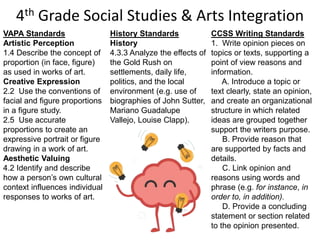
4th Grade Social Studies & Arts Integration
VAPA Standards
Artistic Perception
1.4 Describe the concept of
proportion (in face, figure)
as used in works of art.
Creative Expression
2.2 Use the conventions of
facial and figure proportions
in a figure study.
2.5 Use accurate
proportions to create an
expressive portrait or figure
drawing in a work of art.
Aesthetic Valuing
4.2 Identify and describe
how a person’s own cultural
context influences individual
responses to works of art.
CCSS Writing Standards
1. Write opinion pieces on
topics or texts, supporting a
point of view reasons and
information.
A. Introduce a topic or
text clearly, state an opinion,
and create an organizational
structure in which related
ideas are grouped together
support the writers purpose.
B. Provide reason that
are supported by facts and
details.
C. Link opinion and
reasons using words and
phrase (e.g. for instance, in
order to, in addition).
D. Provide a concluding
statement or section related
to the opinion presented.
History Standards
History
4.3.3 Analyze the effects of
the Gold Rush on
settlements, daily life,
politics, and the local
environment (e.g. use of
biographies of John Sutter,
Mariano Guadalupe
Vallejo, Louise Clapp).
How to design an Arts Integrated lesson?
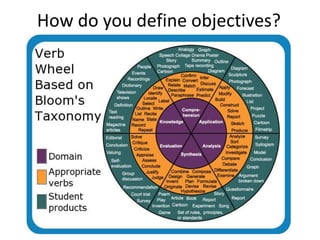
How do you define objectives?
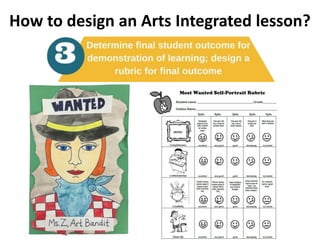
How do you make an assessment
• Reference your objective; how will you
measure what you want students to learn?
• Self-grading rubrics are helpful
– Rubistar
– Other online tools
How to design an Arts Integrated lesson?

Dbae and math

  • 1.
    Discipline Based ArtEducation Slides mostly from two presentations:From https://goo.gl/ywCFsv & https://goo.gl/BzQwQC
  • 2.
  • 3.
    History of ArtEducation in the US Next 1960’s and 1970’s: The “arts in education” movement believes that art is an “experience” that can be achieved through process participation and rejects art that is regimented. Federal and state funding for arts education increased and enrolment in high school art classes peaked. 1947: The National Art Education Association was founded. This is the leading professional membership organization exclusively for visual arts teachers, and its mission is to advance visual arts education to fulfill human potential and promote global understanding ("National art education" ) 1912: Alfred Stiegliz puts children’s artwork on display in his New York gallery, recognizing them as artists (Greenough, 2000) 1903:Binney and Smith introduced the first Crayola crayons in a box of eight colors after noticing a need for safe, high quality, and affordable wax crayons (“Crayola”) Early 20th Century: John Dewey experimented with a new approach called “Progressive Education.” He believed that art education was a foundational part of curriculum because it developed creativity, self-expression, and an appreciation of the expression of others (Heilig, Cole & Angelica, 2010) 1883: The National Educational Association creates an art department that gives teachers ideas and guidelines to teach art in the classroom. By the late 19th century, students learned to appreciate the arts through “Picture Study” and practiced hand-eye coordination through drafting and drawing (Smith, 1996) Art education in the United States has had both advancements and setbacks from the Late 19th Century to the present From https://goo.gl/ywCFsv
  • 4.
    History of ArtEducation in the US, continued Next 2002: Congress passed No Child Left Behind which holds states accountable for English and math. Art is listed as part of the core curriculum, but states are not required to report on instruction time or assessment data (Pederson, 2007) 1994: Congress passed the “Goals 2000: Educate America Act,” the first federal legislation to identify arts as part of the core curriculum (Goals 2000: Educate America Act, 1994) 1994: The National Endowment for the Arts and the Department of Education created the National Voluntary K-12 Standards for the Arts, the first policy project of national scope (Heilig, Cole & Angelica, 2010) 1983: “A Nation at Risk: The Imperative for Educational Reform” is released by the Reagan administration and focused on science and math curriculum to make American students as competitive as their international counterparts (Smith, 1996) 1982: The Getty Center for Education in the Arts created Discipline Based Art Education (DBAE), which focused on a systematic and sequential program for studying art history, art criticism, aesthetics and art production. (Smith, 1996) From https://goo.gl/ywCFsv
  • 5.
    How is arttaught? DBAE • Discipline-Based Art Education (DBAE) is a comprehensive art education approach that has four components: – Production: Creating works of art – History: Encountering the historical and cultural background of works of art – Aesthetics: Discovering the nature and philosophy of art – Criticism: making informed judgments about art • A goal of DBAE is to integrate the arts into other subjects and to create a standardized evaluation process • DBAE attempts to develop student’s ability to understand and appreciate art using knowledge of theories and contexts of art, and to respond to and create art NextFrom https://goo.gl/ywCFsv
  • 6.
    How is arttaught? TAB • Teaching for Artistic Behaviors (TAB) is a choice-based art education approach • Students are given a variety of materials and ample time and space to respond to their own ideas and interests through their artwork – TAB art teachers often create “Centers” in the classroom for different types of art. Ex. painting, drawing, printmaking, etc. – TAB teachers usually instruct students in each of the types of materials so they have basic knowledge of how to use them. In TAB, teachers act as guides to student’s education • TAB regards students as artists and encourages independent thinking • Students are assessed on their perseverance, planning, experimenting, studio habits, and progress NextFrom https://goo.gl/ywCFsv
  • 7.
    How is arttaught? TAB Next One of three “centers” in Ms. C’s art class at South Loop Elementary. Students could choose between painting, drawing, and weaving. A 2nd grade student’s WOW piece. Ms. C had students choose two pieces per quarter that they were proud of. They were required to describe their artwork, how they made it , and where they got the idea From https://goo.gl/ywCFsv
  • 8.
    Art Integration Next This posterintegrates the arts into a Language Arts lesson. Each picture represents a type of figurative language. Often art teachers are expected to integrate other subjects (math, language arts, science) into their lessons to reinforce the core subjects. I believe that teaching other subjects through the arts gets students more excited about learning. But, we need to be careful not to downplay the importance of the arts in and of themselves. From https://goo.gl/ywCFsv
  • 9.
    Comprehensive or Discipline-based Art Education includes four Disciplines: •ArtHistory •Art Criticism •Aesthetics •Art Production From https://goo.gl/BzQwQC
  • 10.
    Art History: acquiring knowledge about the contributions artand artists make to society. From https://goo.gl/BzQwQC
  • 11.
    Art Criticism: interpreting meaning andmaking critical judgments about works of art. From https://goo.gl/BzQwQC
  • 12.
    Aesthetics: questioning the nature,significance, and purposes of art in general. From https://goo.gl/BzQwQC
  • 13.
    Art Production: making art;expressing ideas and feelings in visual form. From https://goo.gl/BzQwQC
  • 14.
    Visual Culture/Visual Literacy: understanding the meaning and messagesof media such as movies, TV, games, advertising, and the like. From https://goo.gl/BzQwQC
  • 15.
    A Complete DBAELesson From https://goo.gl/BzQwQC
  • 16.
    Art and LanguageArts From https://goo.gl/BzQwQC
  • 17.
    Art and Math:Symmetry From https://goo.gl/BzQwQC
  • 18.
  • 19.
    Art and Social Studies Fromhttps://goo.gl/BzQwQC
  • 20.
  • 21.
  • 22.
  • 23.
  • 24.
  • 25.
    Art and Science Fromhttps://goo.gl/BzQwQC
  • 26.
    How to designan arts integrated lesson?
  • 27.
    How to designan Arts Integrated lesson? Tasked with: -a Visual Arts integrated lesson (Visual Arts standards) -History of American West (Social Studies standards) -Incorporate writing (CCSS Writing standards)
  • 28.
    How to designan Arts Integrated lesson?
  • 29.
    4th Grade SocialStudies & Arts Integration VAPA Standards Artistic Perception 1.4 Describe the concept of proportion (in face, figure) as used in works of art. Creative Expression 2.2 Use the conventions of facial and figure proportions in a figure study. 2.5 Use accurate proportions to create an expressive portrait or figure drawing in a work of art. Aesthetic Valuing 4.2 Identify and describe how a person’s own cultural context influences individual responses to works of art. CCSS Writing Standards 1. Write opinion pieces on topics or texts, supporting a point of view reasons and information. A. Introduce a topic or text clearly, state an opinion, and create an organizational structure in which related ideas are grouped together support the writers purpose. B. Provide reason that are supported by facts and details. C. Link opinion and reasons using words and phrase (e.g. for instance, in order to, in addition). D. Provide a concluding statement or section related to the opinion presented. History Standards History 4.3.3 Analyze the effects of the Gold Rush on settlements, daily life, politics, and the local environment (e.g. use of biographies of John Sutter, Mariano Guadalupe Vallejo, Louise Clapp).
  • 30.
    How to designan Arts Integrated lesson?
  • 31.
    How do youdefine objectives?
  • 32.
    How do youmake an assessment • Reference your objective; how will you measure what you want students to learn? • Self-grading rubrics are helpful – Rubistar – Other online tools
  • 33.
    How to designan Arts Integrated lesson?
  • 34.
    How to designan Arts Integrated lesson?