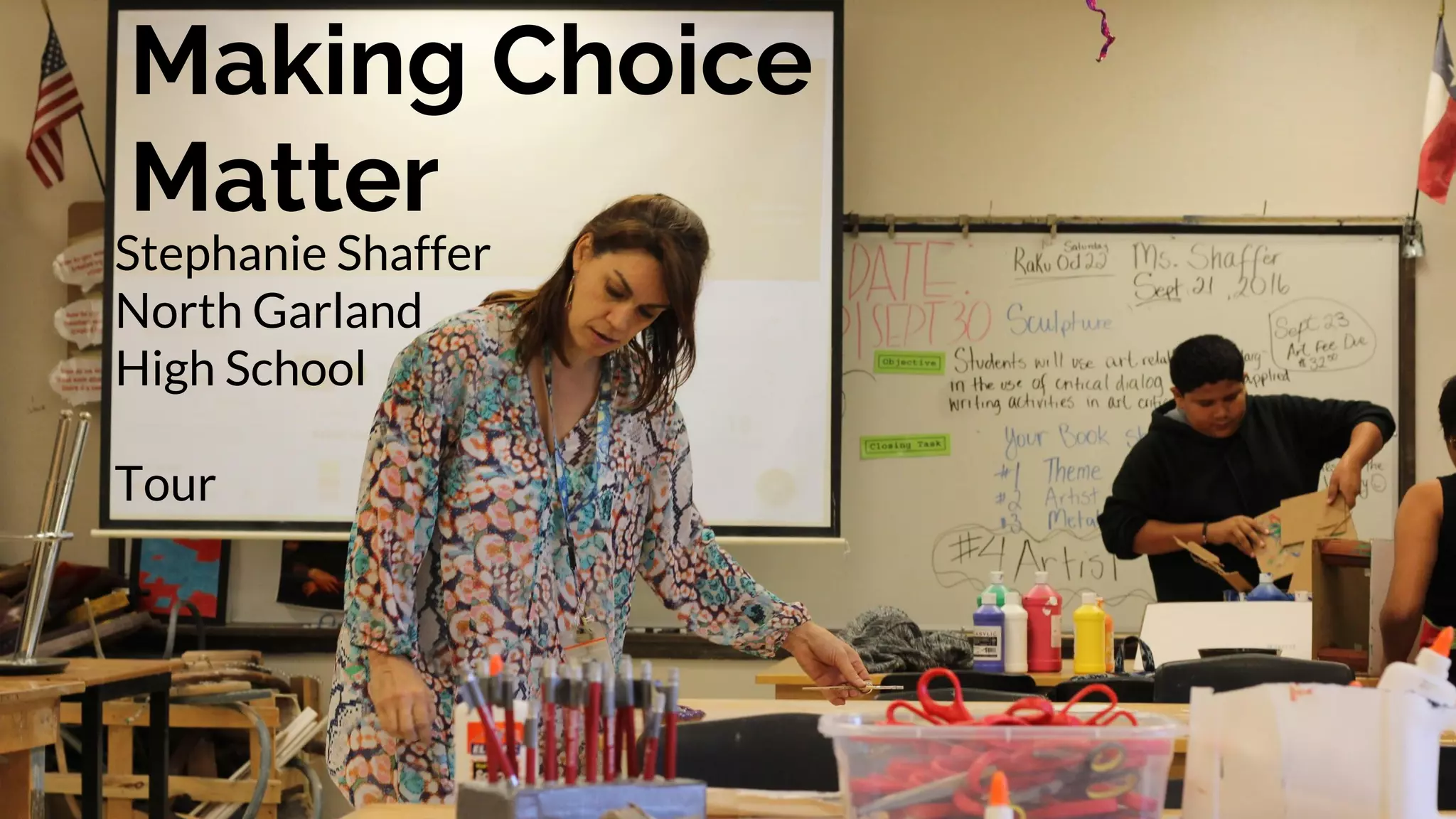
Making Choice
Matter
Stephanie Shaffer
North Garland
High School
Tour Guide
Tip
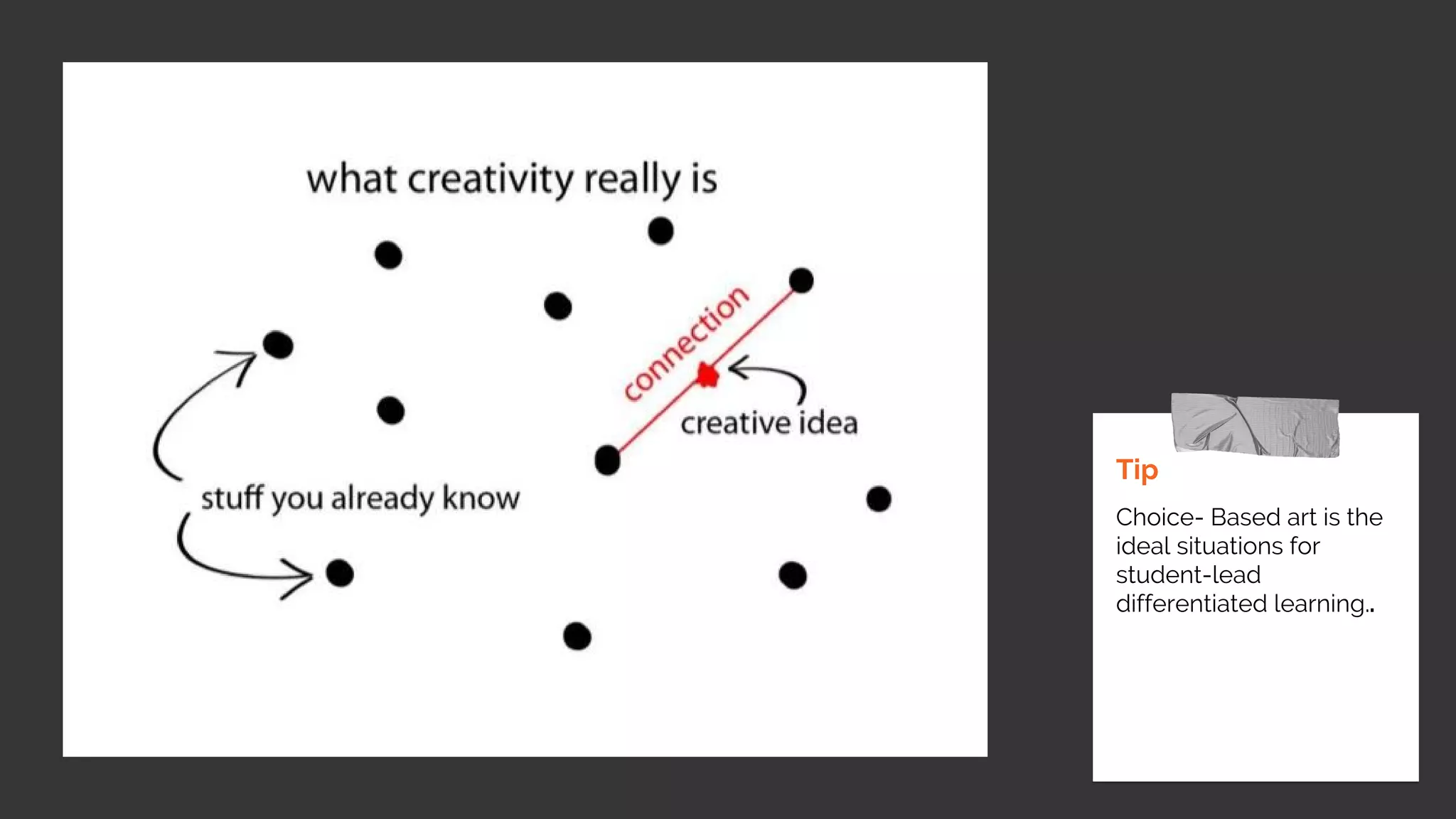
Choice- Based art is the
ideal situations for
student-lead
differentiated learning..
Selling it
I used the Choice- Based model when I taught 450
Pre-K and Kinder in a charter school in South
Dallas, on a cart.
Currently I am a learning partner at a magnet
school for Math, Science, and all things Googley.
How can Choice be modified for the high school
art room?
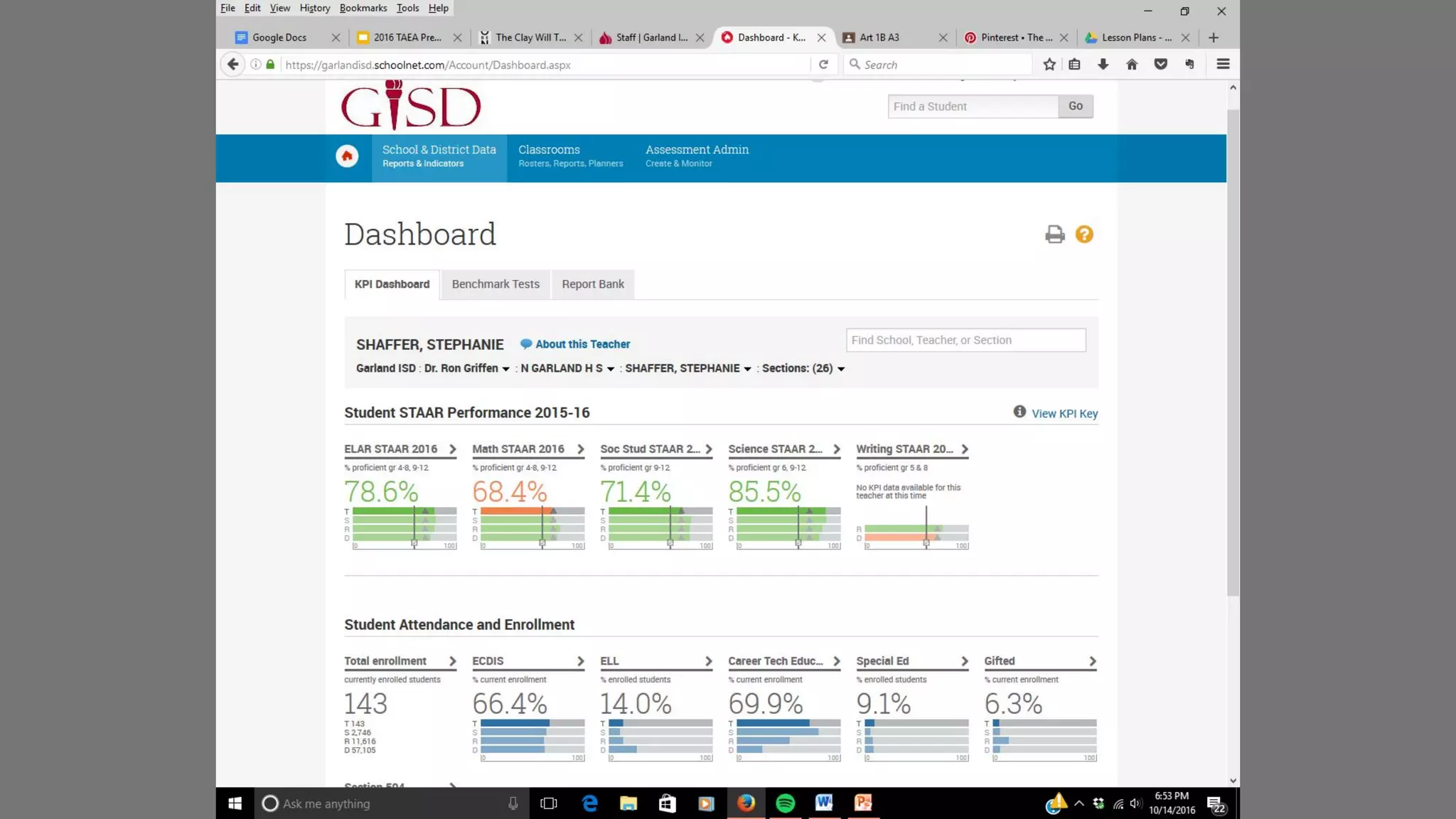
My Stats
Keep your learning
objectives precisely
measurable and vague.
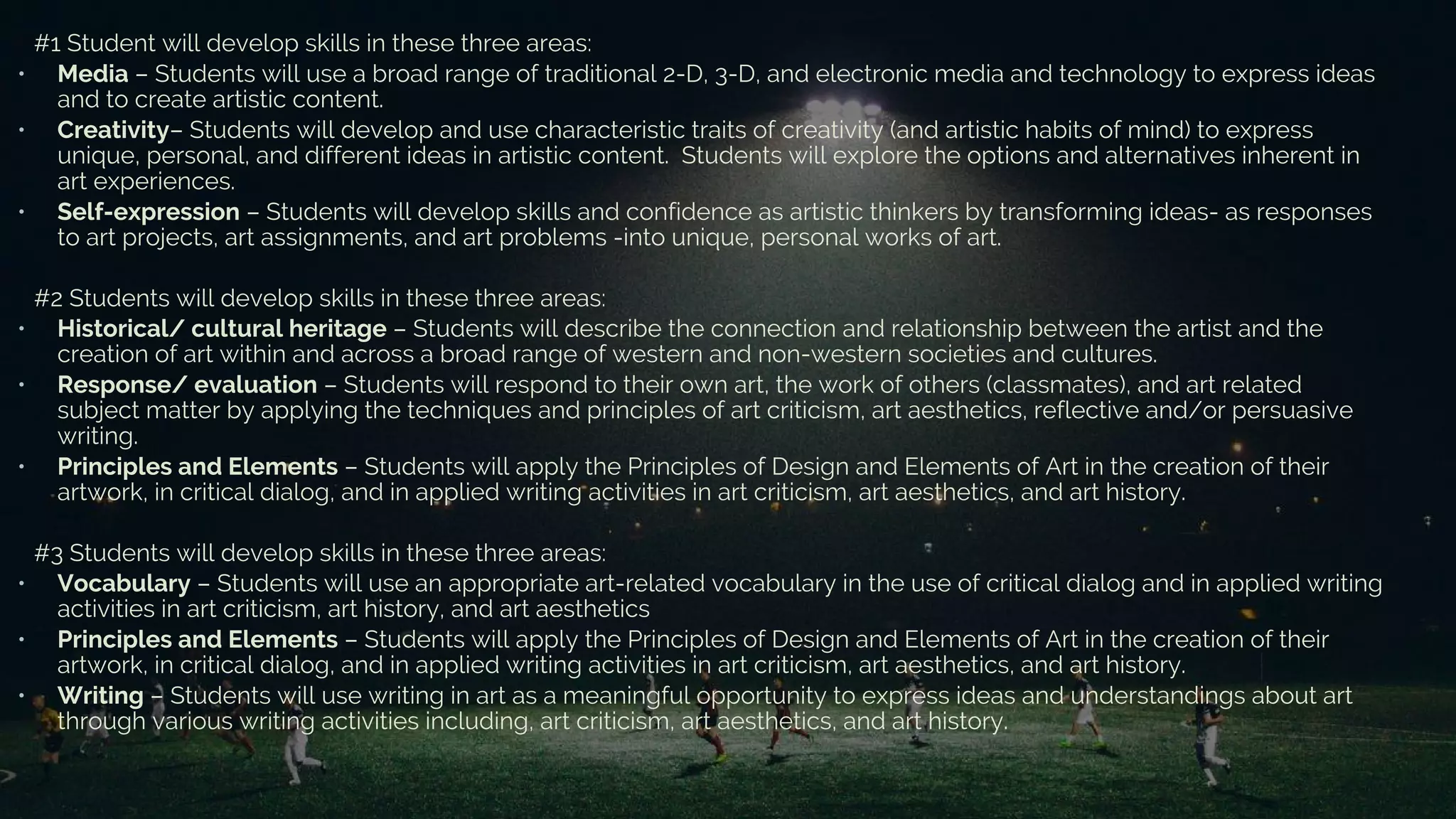
#1 Student will develop skills in these three areas:
• Media – Students will use a broad range of traditional 2-D, 3-D, and electronic media and technology to express ideas
and to create artistic content.
• Creativity– Students will develop and use characteristic traits of creativity (and artistic habits of mind) to express
unique, personal, and different ideas in artistic content.  Students will explore the options and alternatives inherent in
art experiences.
• Self-expression – Students will develop skills and confidence as artistic thinkers by transforming ideas- as responses
to art projects, art assignments, and art problems -into unique, personal works of art. 
#2 Students will develop skills in these three areas:
• Historical/ cultural heritage – Students will describe the connection and relationship between the artist and the
creation of art within and across a broad range of western and non-western societies and cultures.
• Response/ evaluation – Students will respond to their own art, the work of others (classmates), and art related
subject matter by applying the techniques and principles of art criticism, art aesthetics, reflective and/or persuasive
writing.
• Principles and Elements – Students will apply the Principles of Design and Elements of Art in the creation of their
artwork, in critical dialog, and in applied writing activities in art criticism, art aesthetics, and art history.
 
#3 Students will develop skills in these three areas:
• Vocabulary – Students will use an appropriate art-related vocabulary in the use of critical dialog and in applied writing
activities in art criticism, art history, and art aesthetics
• Principles and Elements – Students will apply the Principles of Design and Elements of Art in the creation of their
artwork, in critical dialog, and in applied writing activities in art criticism, art aesthetics, and art history.
• Writing – Students will use writing in art as a meaningful opportunity to express ideas and understandings about art
through various writing activities including, art criticism, art aesthetics, and art history.
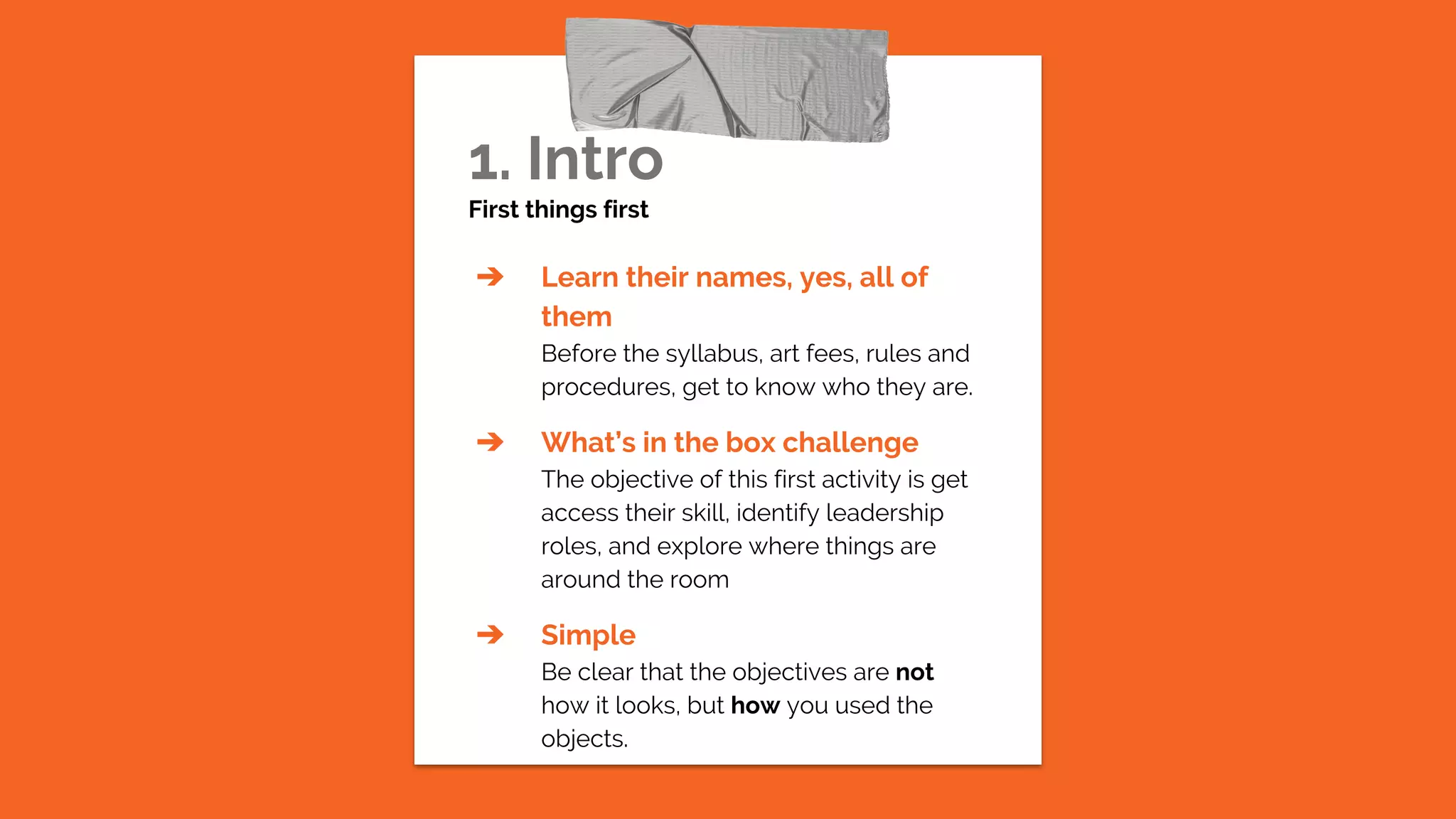
1. Intro
First things first
➔ Learn their names, yes, all of
them
Before the syllabus, art fees, rules and
procedures, get to know who they are.
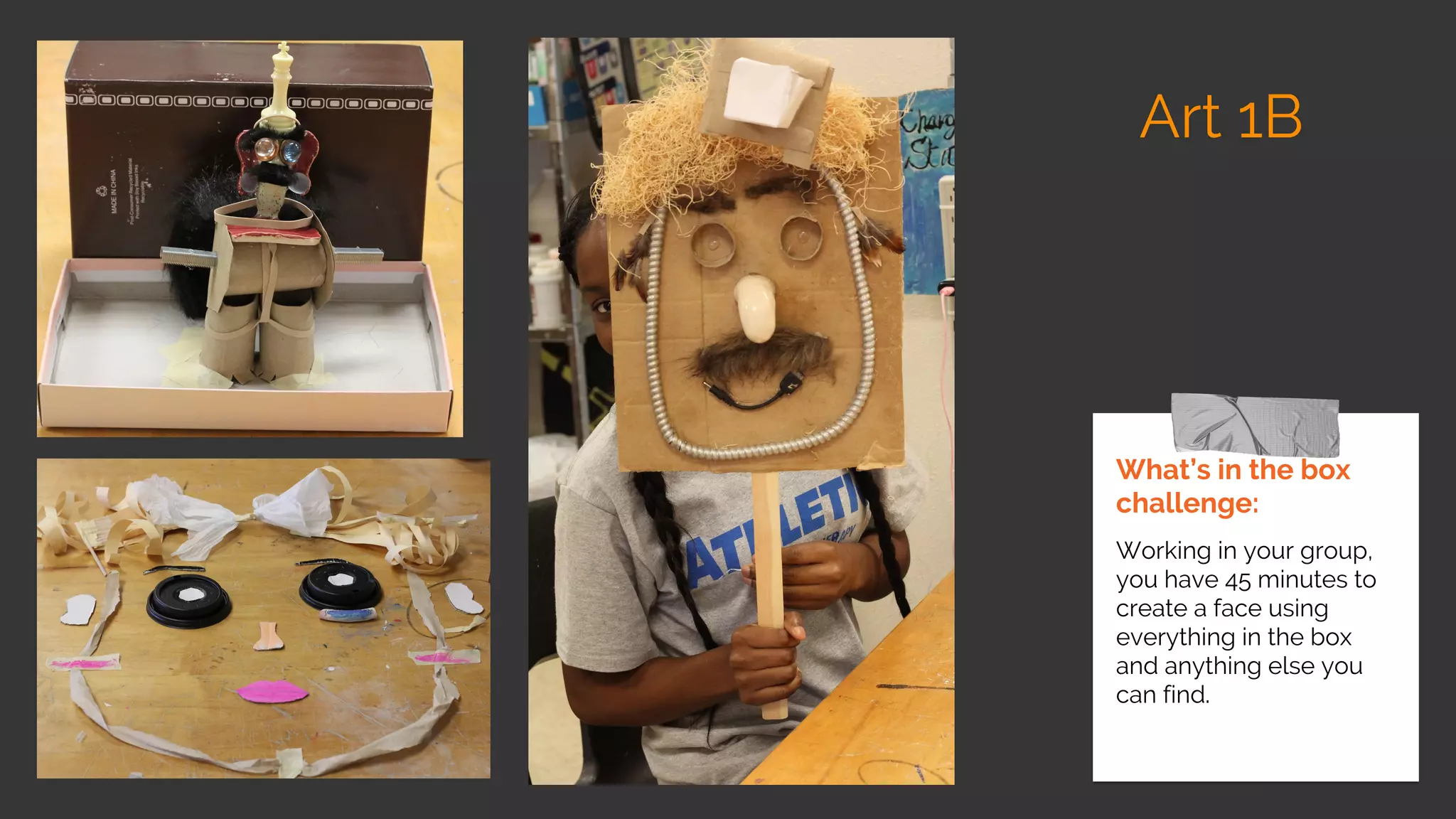
➔ What’s in the box challenge
The objective of this first activity is get
access their skill, identify leadership
roles, and explore where things are
around the room
➔ Simple
Be clear that the objectives are not
how it looks, but how you used the
objects.
What’s in the box
challenge:
Working in your group,
you have 45 minutes to
create a face using
everything in the box
and anything else you
can find.
Art 1B
2. Examples
At the beginning of the year students pick a
theme. Their chosen theme is woven in their
projects throughout the year.
➔ Artist Challenge
These are teacher lead problems for
the learner to solve. This is a way to
introduce new material, artists, or
concepts.“
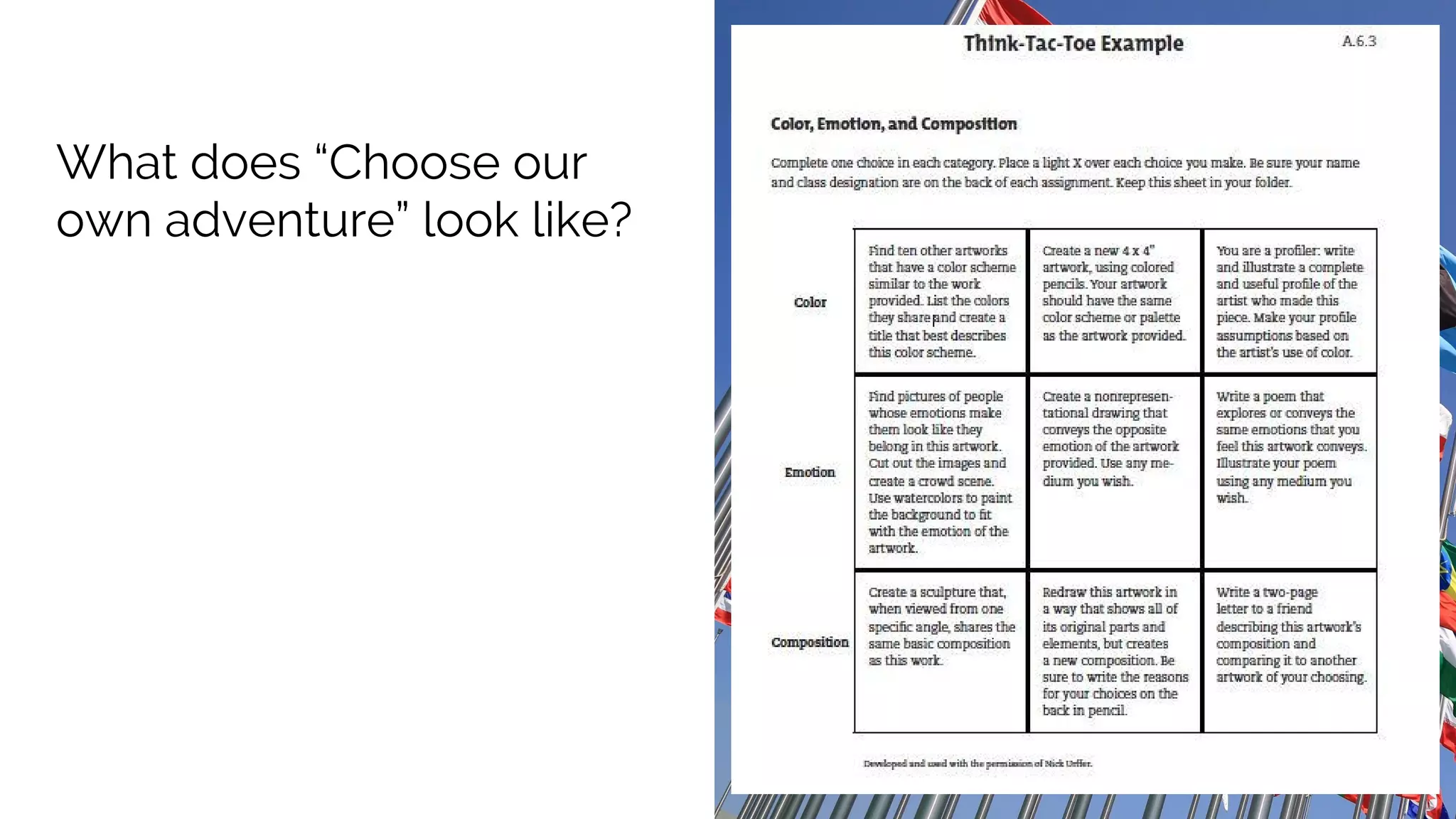
➔ Choose Your Own Adventure
Students gather points depending on
the level of difficulty of their project.
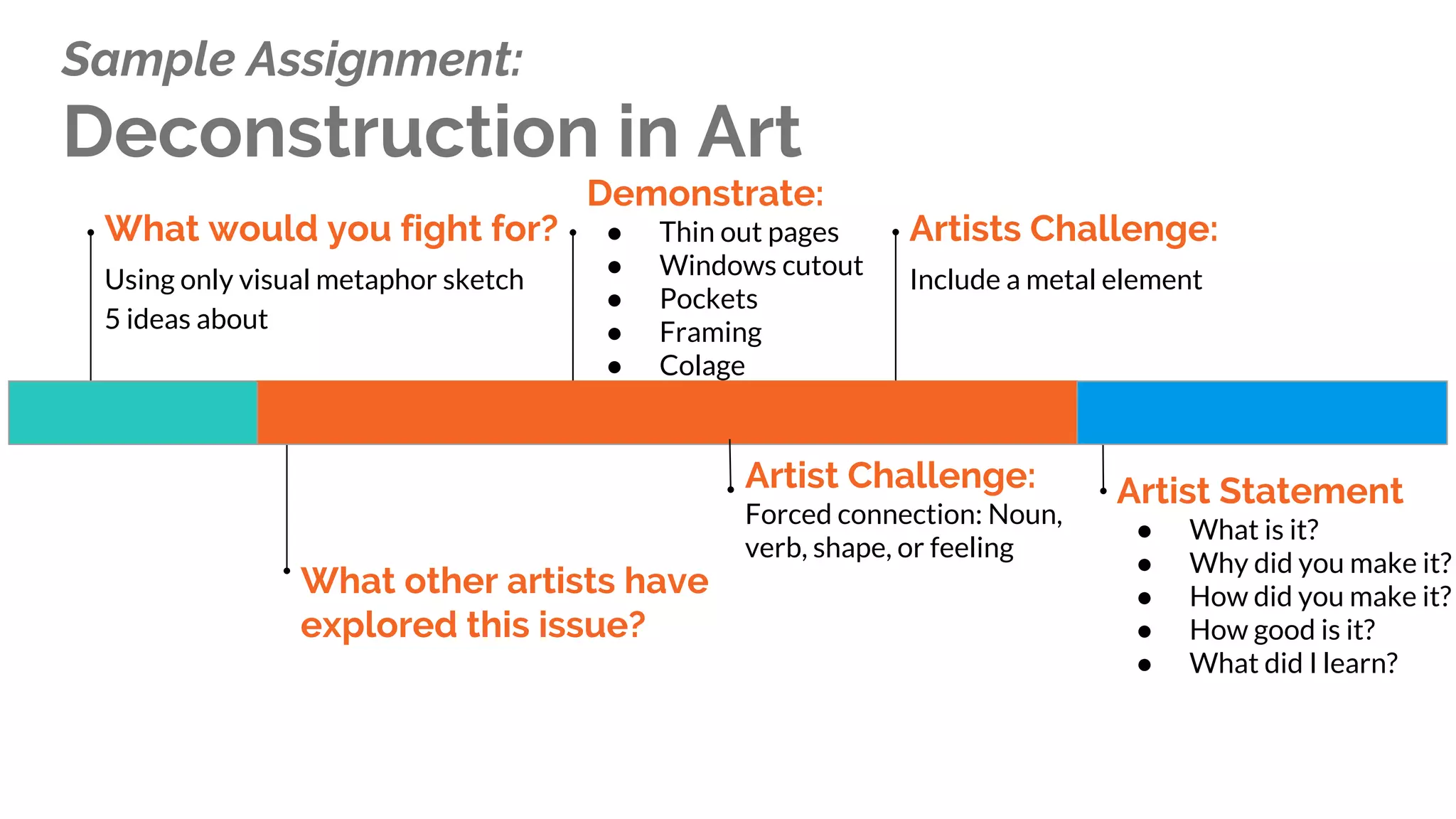
Sample Assignment:
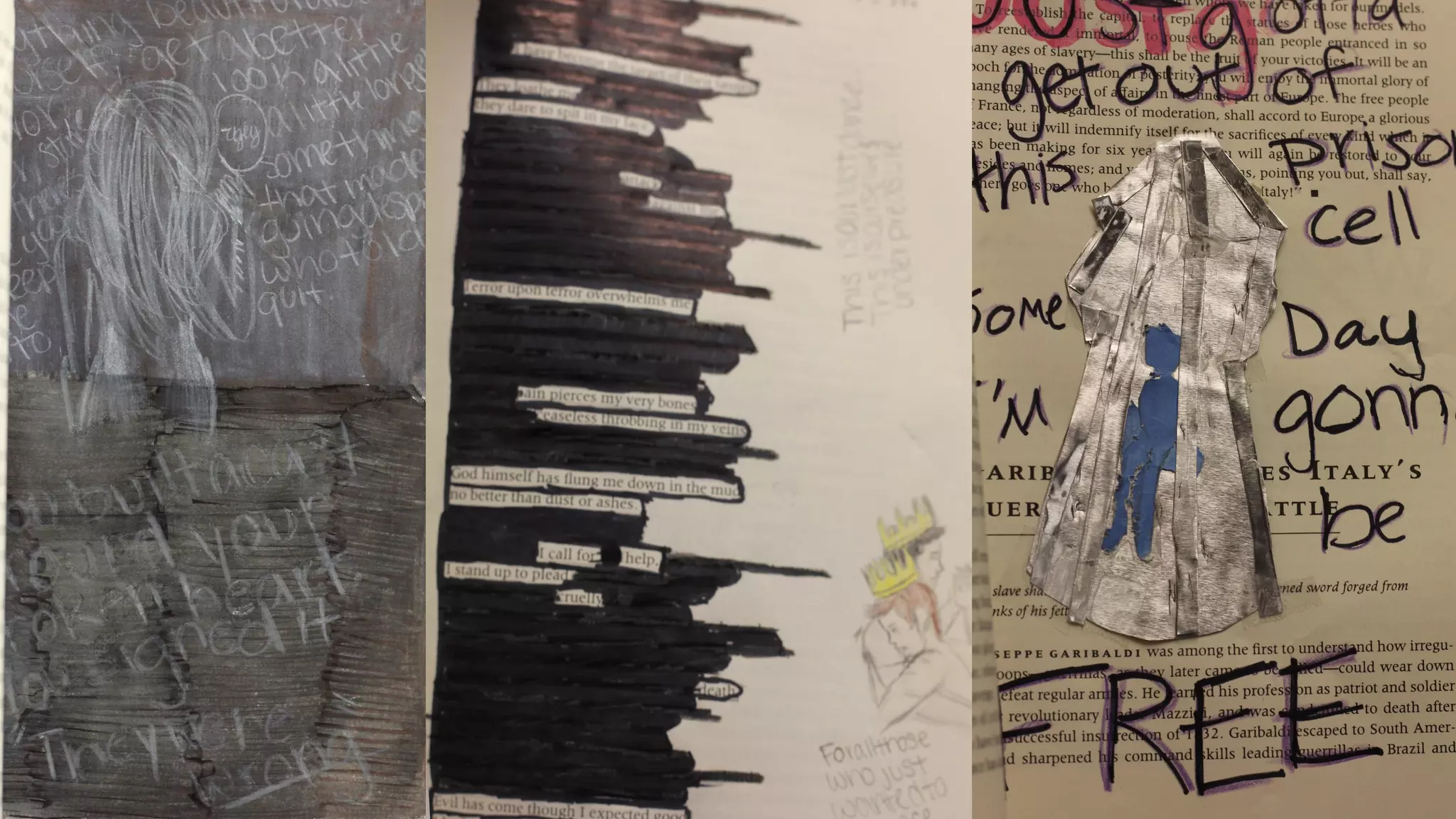
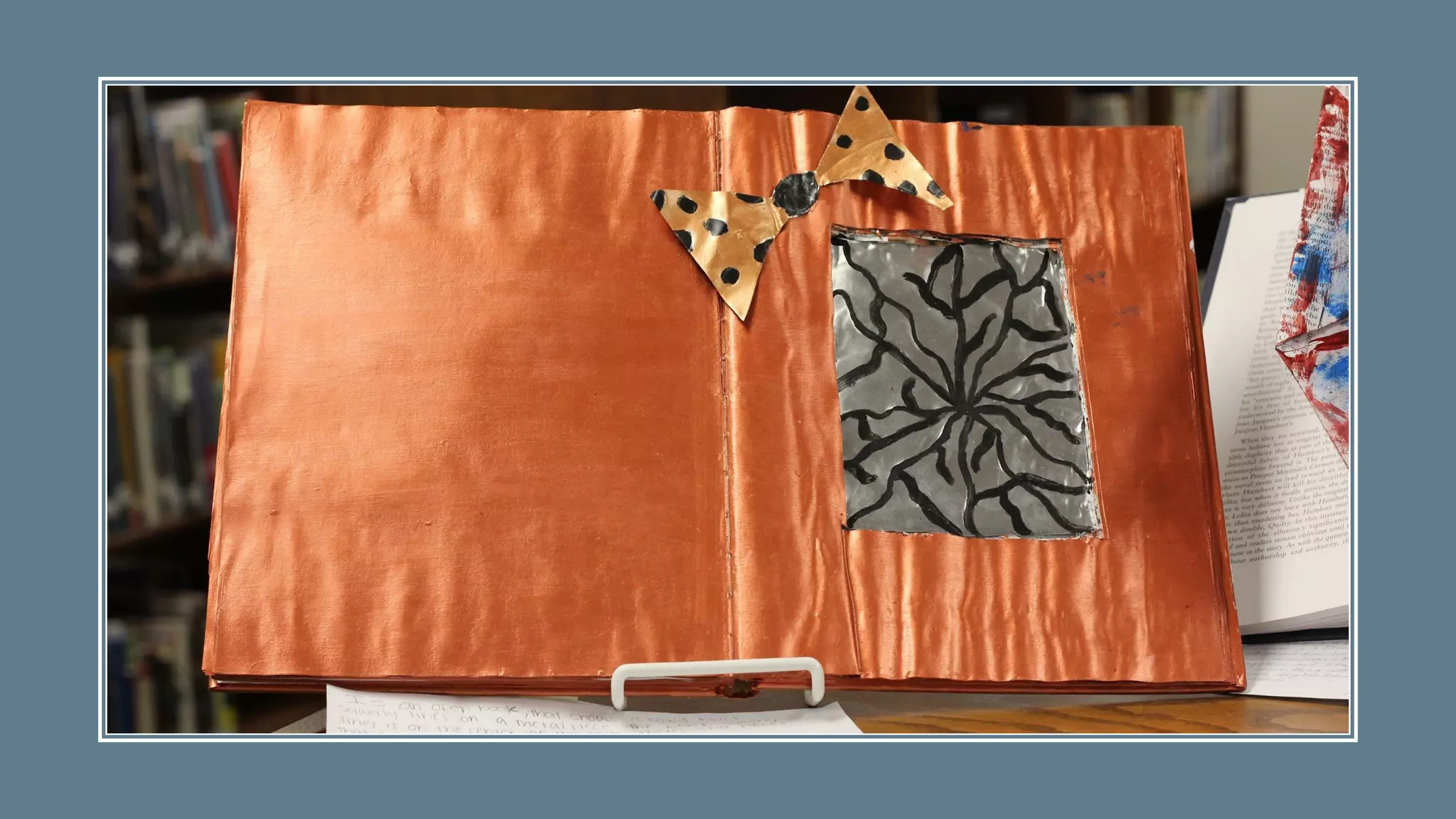
Deconstruction in Art
What would you fight for?
Using only visual metaphor sketch
5 ideas about what you lose sleep
over
What other artists have
explored this issue?
Demonstrate:
● Thin out pages
● Windows cutout
● Pockets
● Framing
● Colage
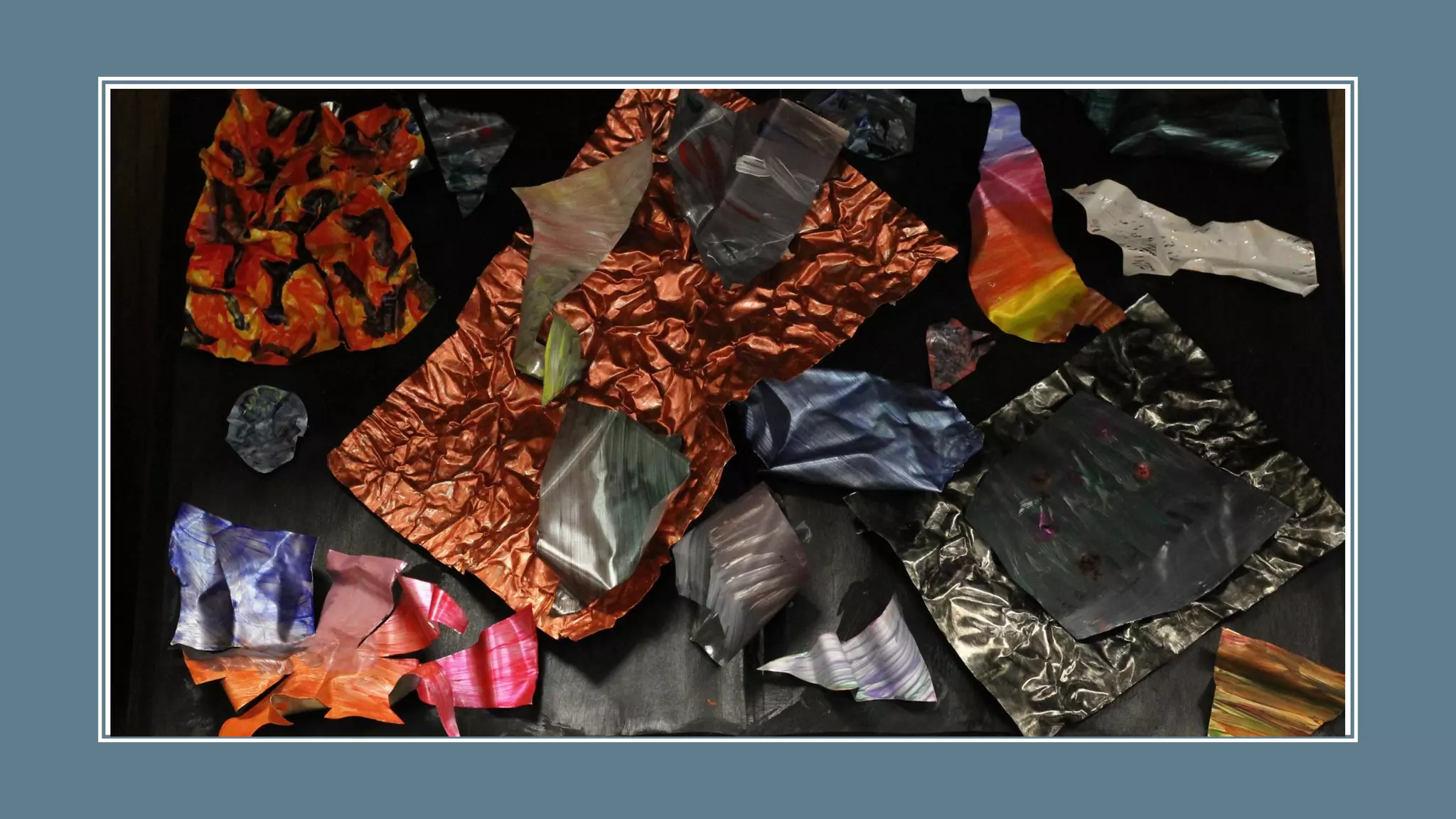
Include a metal element
Artist Statement
● What is it?
● Why did you make it?
● How did you make it?
● How good is it?
● What did I learn?
Artists Challenge:
Artist Challenge:
Forced connection: Noun,
verb, shape, or feeling
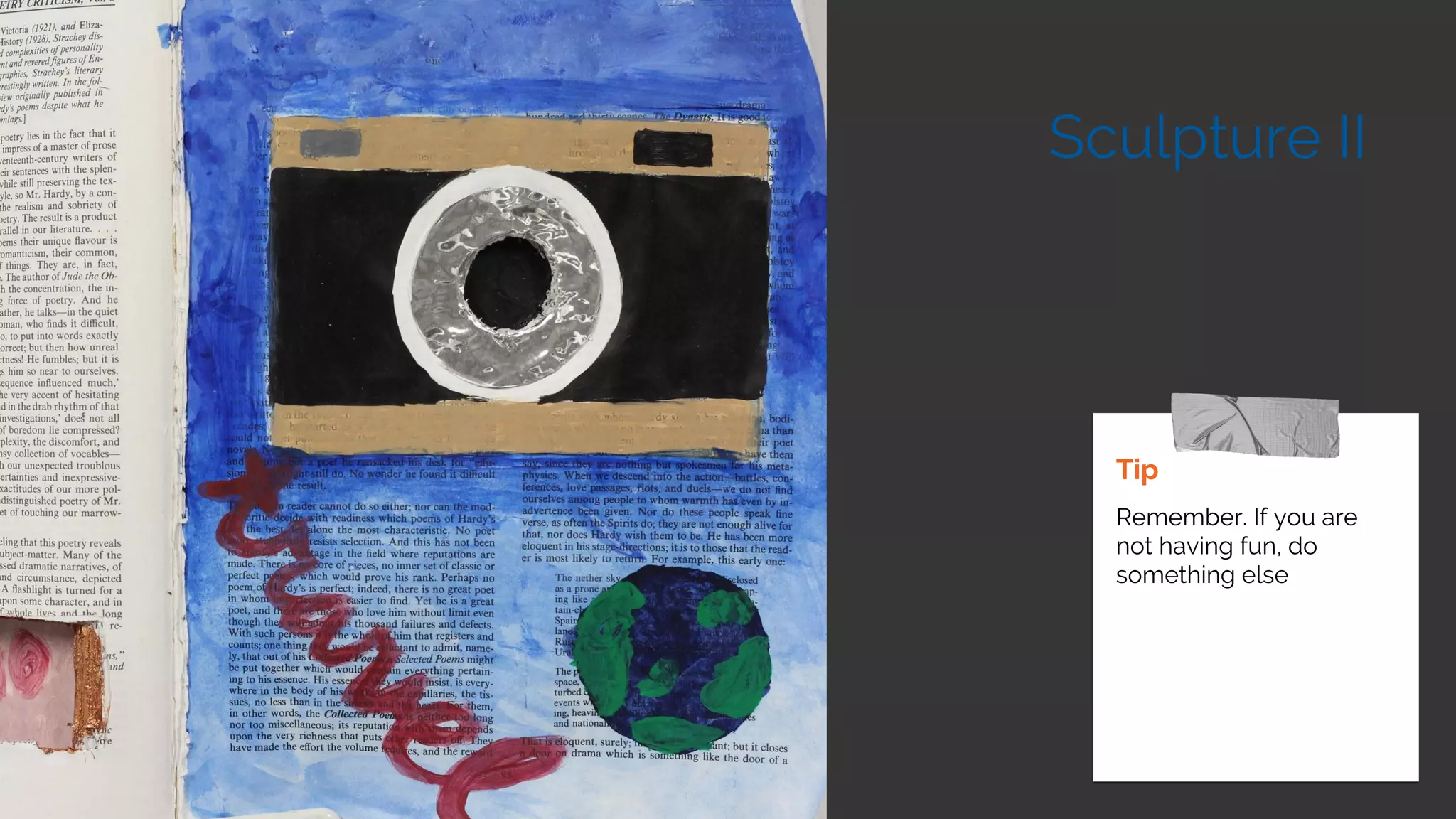
Tip
Remember. If you are
not having fun, do
something else
Sculpture II
Tip
Choice- Based art is the
ideal situations for
student-lead
differentiated learning..
What does “Choose our
own adventure” look like?
Tip
Don’t wait till the end of
the presentation to give
the bottom line.
Reveal your product or
idea (in this case a
translation app) up front.
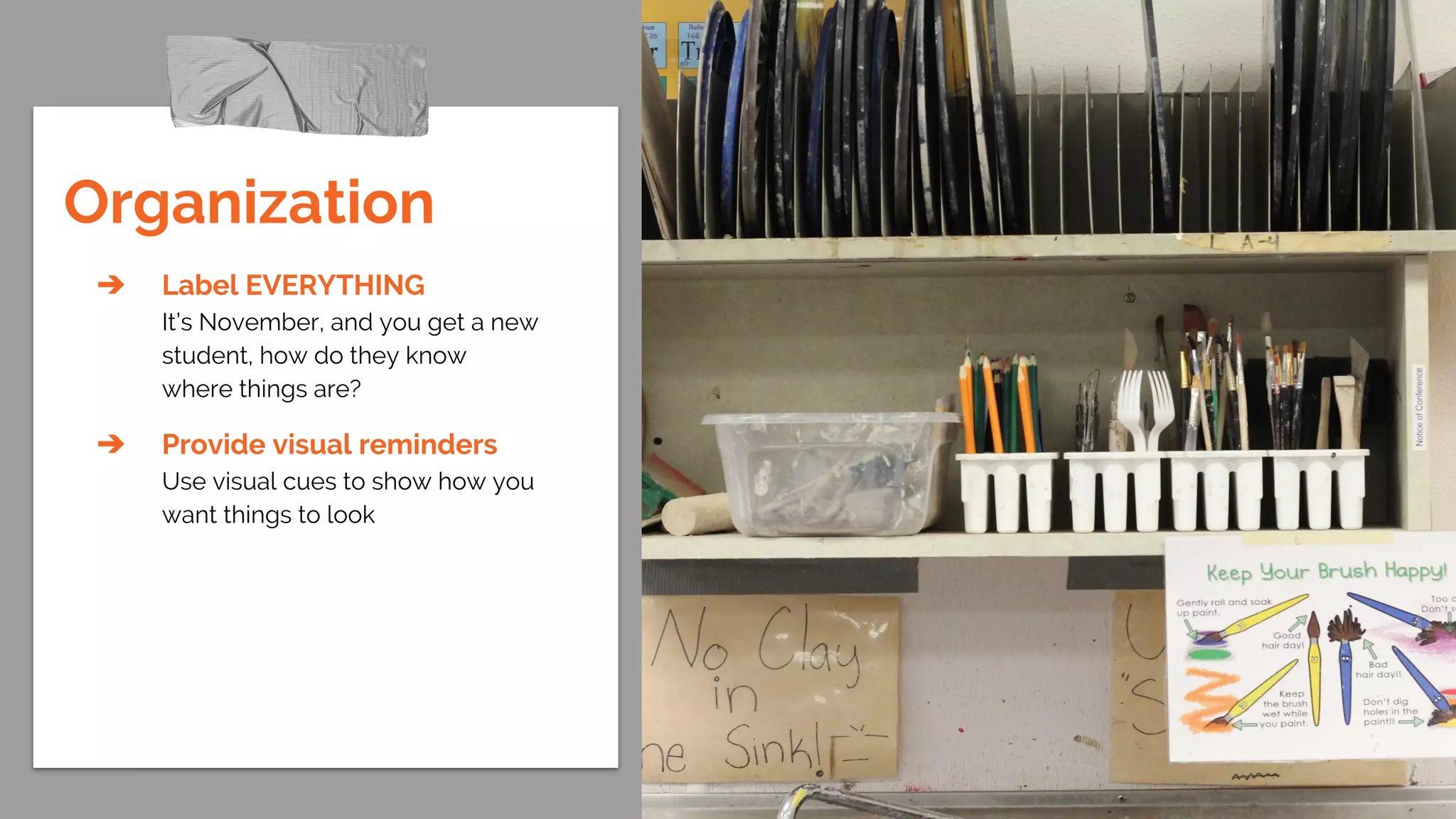
➔ Label EVERYTHING
It’s November, and you get a new
student, how do they know
where things are?
➔ Provide visual reminders
Use visual cues to show how you
want things to look
Organization
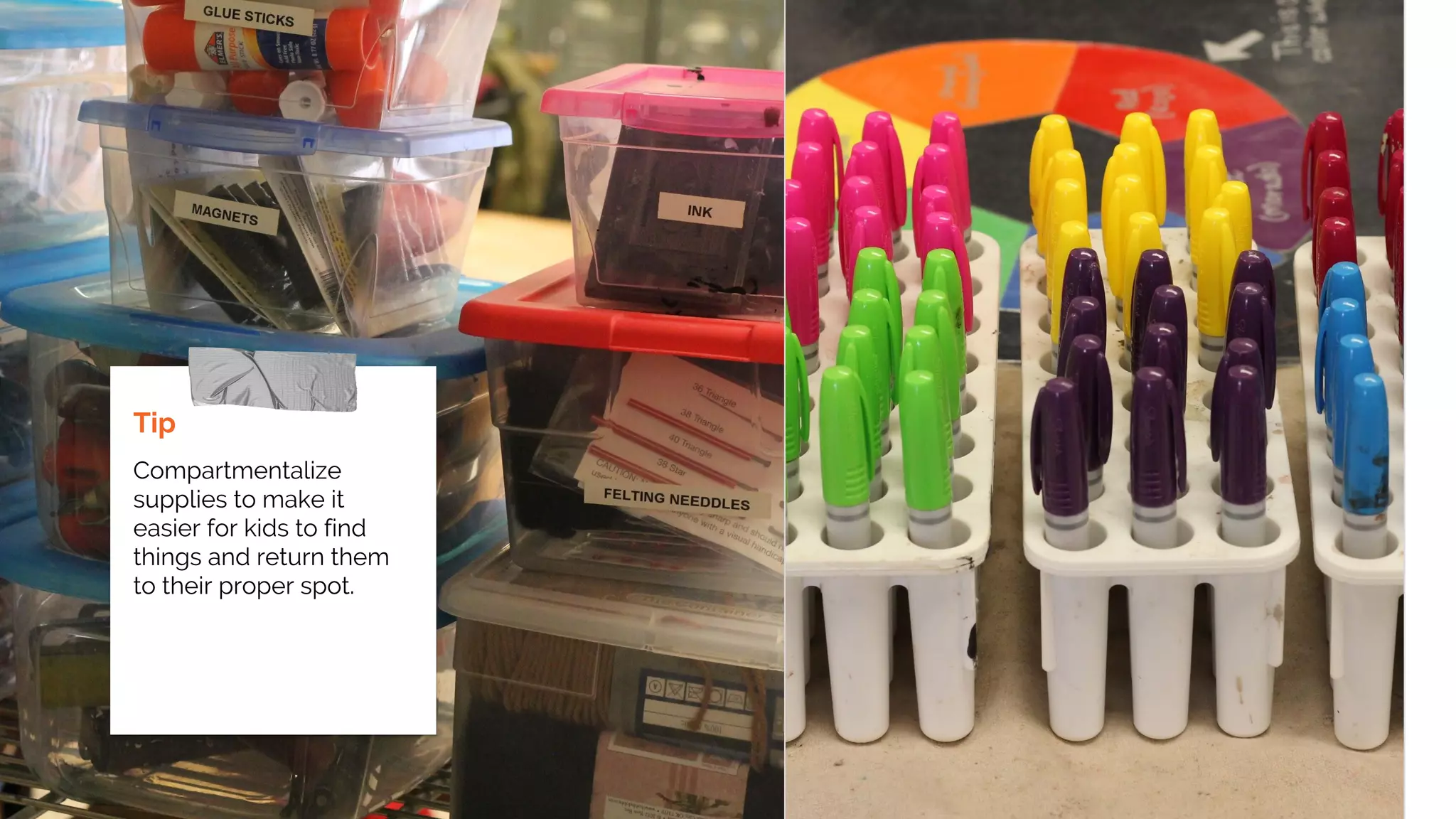
Tip
Compartmentalize
supplies to make it
easier for kids to find
things and return them
to their proper spot.
Tip
Provide LOTS of visual
Reminders!!
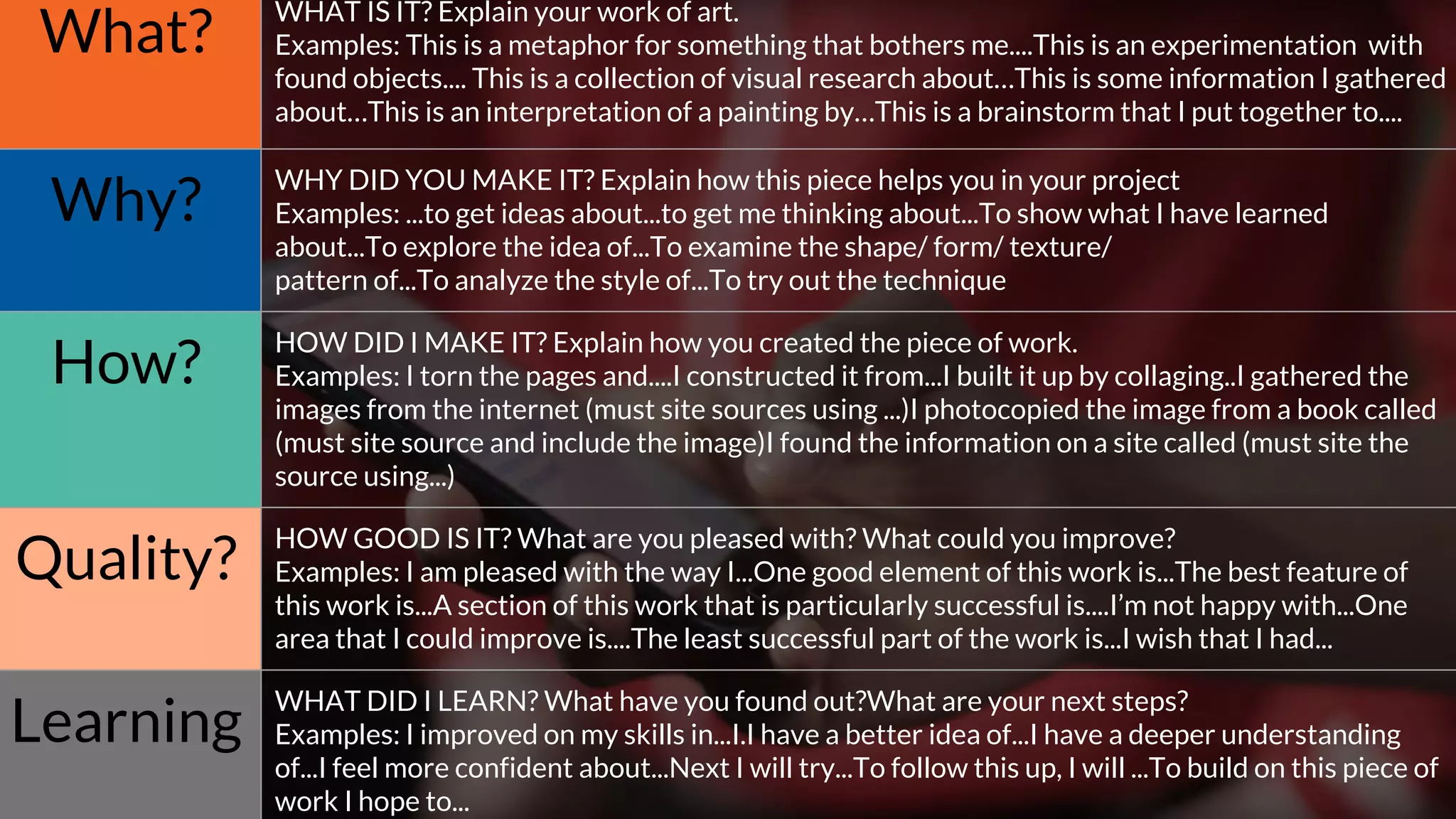
The artist statement is the golden egg of the Choice-
Based classroom. It counts as a Quiz grade.
What?
WHAT IS IT? Explain your work of art.
Examples​: This is a metaphor for something that bothers me....This is an experimentation with
found objects.... This is a collection of visual research about…This is some information I gathered
about…This is an interpretation of a painting by…This is a brainstorm that I put together to....
Why?
WHY DID YOU MAKE IT? Explain how this piece helps you in your project
Examples​: ...to get ideas about...to get me thinking about...To show what I have learned
about...To explore the idea of...To examine the shape/ form/ texture/
pattern of...To analyze the style of...To try out the technique
How?
HOW DID I MAKE IT? Explain how you created the piece of work.
Examples​: I torn the pages and....I constructed it from...I built it up by collaging..I gathered the
images from the internet (must site sources using ...)I photocopied the image from a book called
(must site source and include the image)I found the information on a site called (must site the
source using...)
Quality?
HOW GOOD IS IT? What are you pleased with? What could you improve?
Examples​: I am pleased with the way I...One good element of this work is...The best feature of
this work is...A section of this work that is particularly successful is....I’m not happy with...One
area that I could improve is....The least successful part of the work is...I wish that I had...
Learning
WHAT DID I LEARN? What have you found out?What are your next steps?
Examples​: I improved on my skills in...I.I have a better idea of...I have a deeper understanding
of...I feel more confident about...Next I will try...To follow this up, I will ...To build on this piece of
work I hope to...
Gradebook- I put a grade for everything
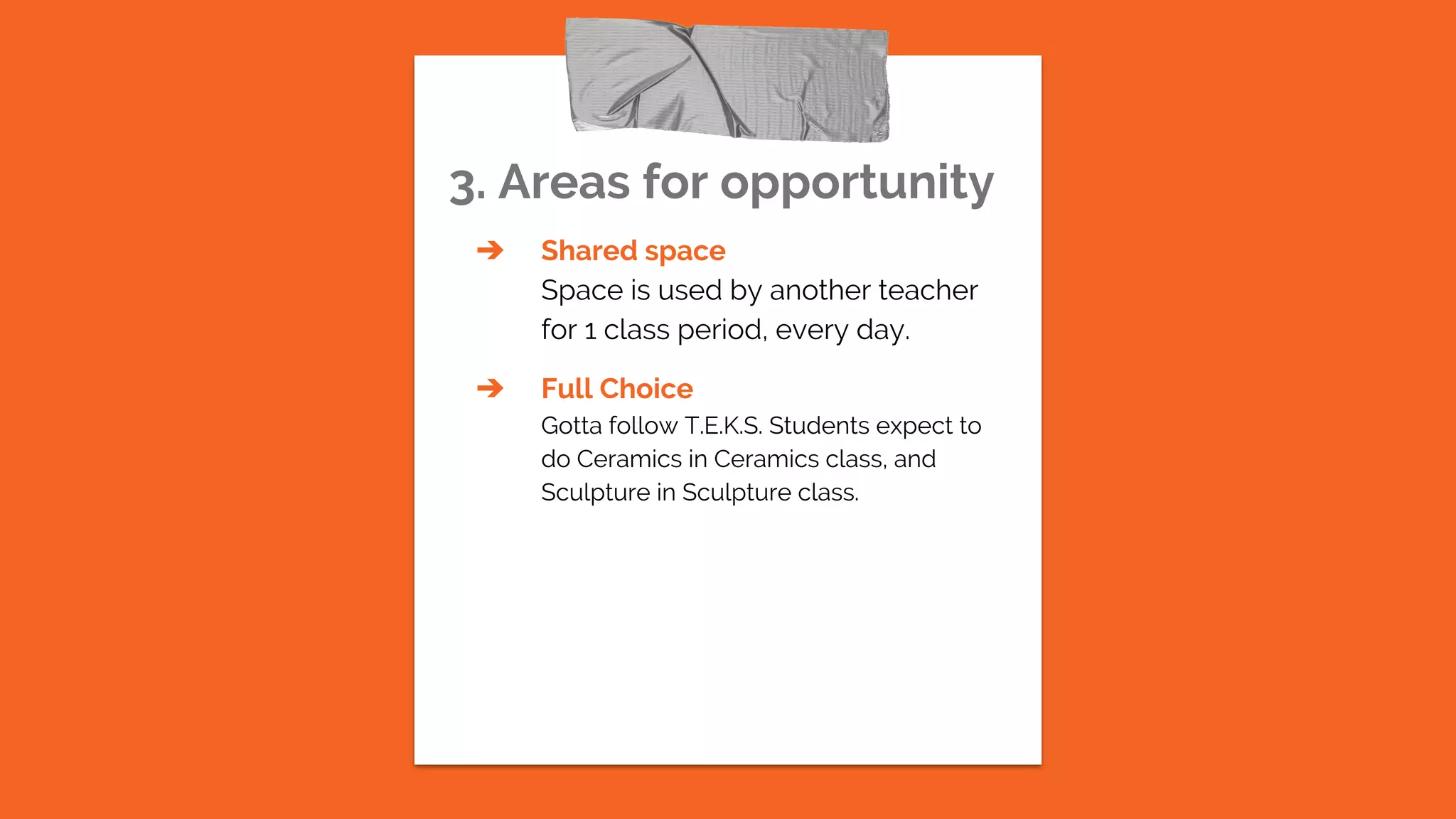
3. Areas for opportunity
➔ Shared space
Space is used by another teacher
for 1 class period, every day.
➔ Full Choice
Gotta follow T.E.K.S. Students expect to
do Ceramics in Ceramics class, and
Sculpture in Sculpture class.
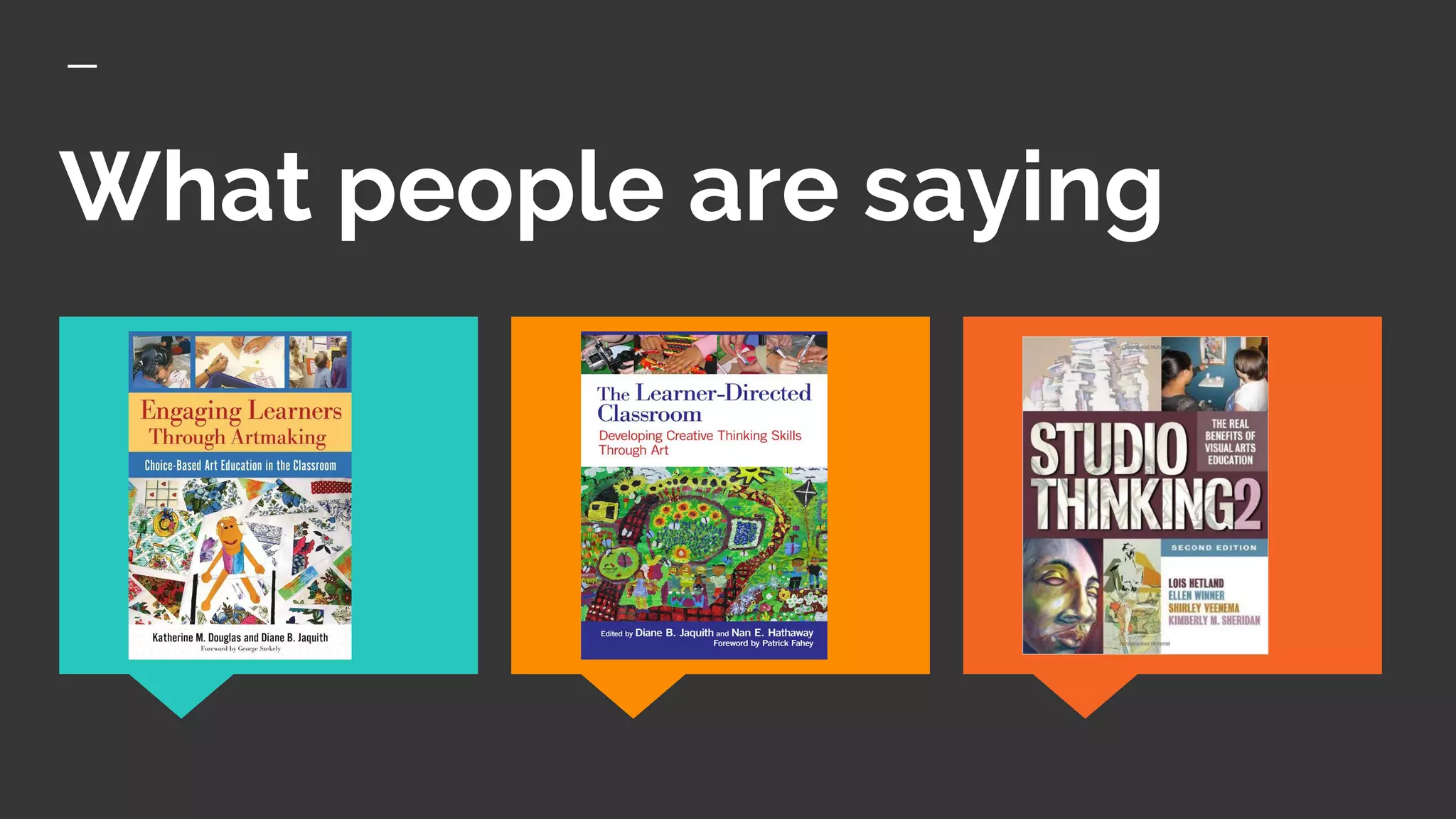
What people are saying
Good luck!
We hope you’ll use these tips to go out and
create life changing experiences for your
learners!
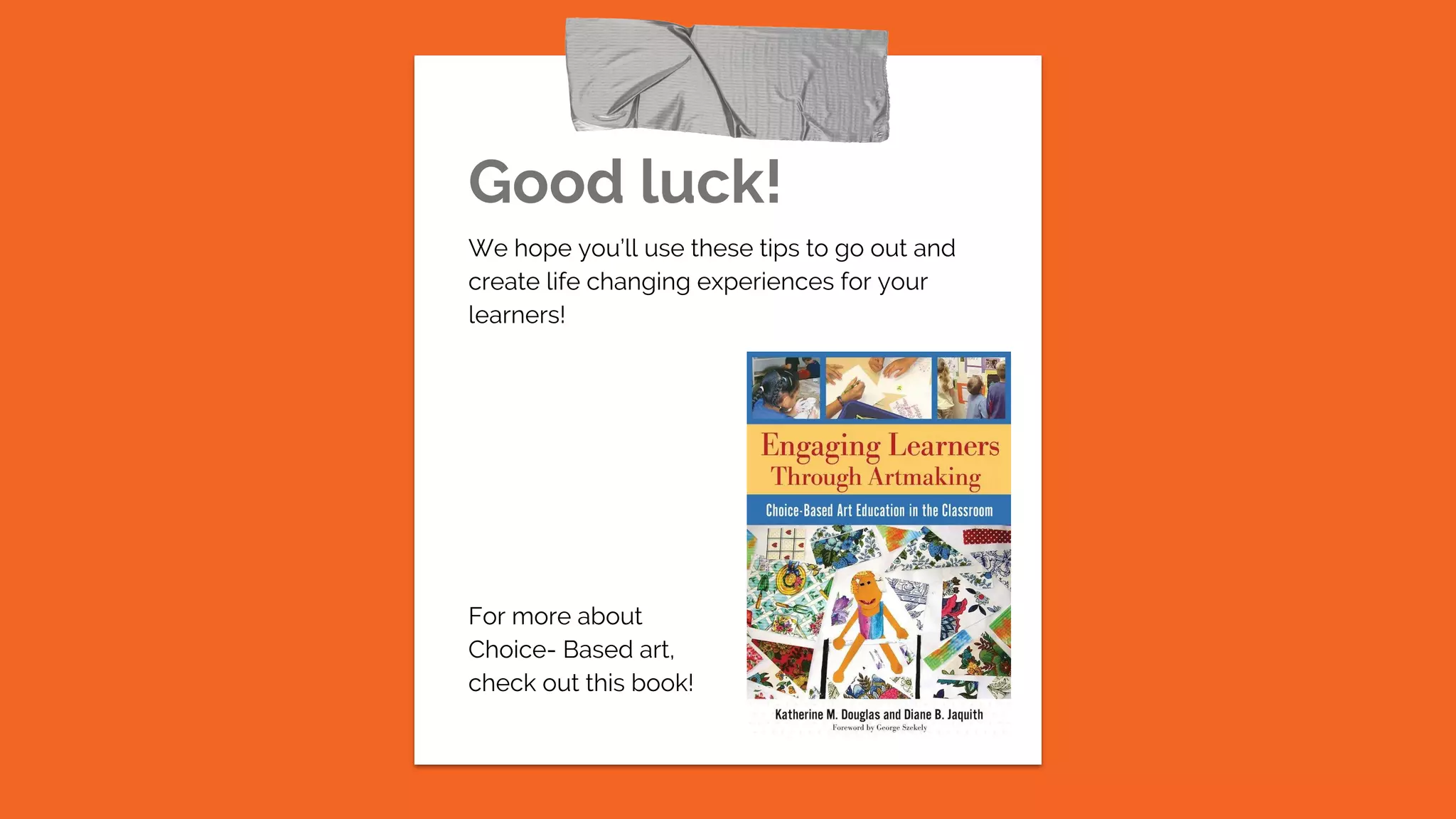
For more about
Choice- Based art,
check out this book!
Tip
“And for the love of
pizza, don’t forget their
names”
-Joanna

2016 TAEA Presentation- Making Choice Matter Stephanie Shaffer

  • 1.
    Making Choice Matter Stephanie Shaffer NorthGarland High School Tour Guide
  • 2.
    Tip Choice- Based artis the ideal situations for student-lead differentiated learning..
  • 3.
    Selling it I usedthe Choice- Based model when I taught 450 Pre-K and Kinder in a charter school in South Dallas, on a cart. Currently I am a learning partner at a magnet school for Math, Science, and all things Googley. How can Choice be modified for the high school art room?
  • 4.
  • 5.
    Keep your learning objectivesprecisely measurable and vague.
  • 6.
    #1 Student willdevelop skills in these three areas: • Media – Students will use a broad range of traditional 2-D, 3-D, and electronic media and technology to express ideas and to create artistic content. • Creativity– Students will develop and use characteristic traits of creativity (and artistic habits of mind) to express unique, personal, and different ideas in artistic content.  Students will explore the options and alternatives inherent in art experiences. • Self-expression – Students will develop skills and confidence as artistic thinkers by transforming ideas- as responses to art projects, art assignments, and art problems -into unique, personal works of art.  #2 Students will develop skills in these three areas: • Historical/ cultural heritage – Students will describe the connection and relationship between the artist and the creation of art within and across a broad range of western and non-western societies and cultures. • Response/ evaluation – Students will respond to their own art, the work of others (classmates), and art related subject matter by applying the techniques and principles of art criticism, art aesthetics, reflective and/or persuasive writing. • Principles and Elements – Students will apply the Principles of Design and Elements of Art in the creation of their artwork, in critical dialog, and in applied writing activities in art criticism, art aesthetics, and art history.   #3 Students will develop skills in these three areas: • Vocabulary – Students will use an appropriate art-related vocabulary in the use of critical dialog and in applied writing activities in art criticism, art history, and art aesthetics • Principles and Elements – Students will apply the Principles of Design and Elements of Art in the creation of their artwork, in critical dialog, and in applied writing activities in art criticism, art aesthetics, and art history. • Writing – Students will use writing in art as a meaningful opportunity to express ideas and understandings about art through various writing activities including, art criticism, art aesthetics, and art history.
  • 7.
    1. Intro First thingsfirst ➔ Learn their names, yes, all of them Before the syllabus, art fees, rules and procedures, get to know who they are. ➔ What’s in the box challenge The objective of this first activity is get access their skill, identify leadership roles, and explore where things are around the room ➔ Simple Be clear that the objectives are not how it looks, but how you used the objects.
  • 8.
    What’s in thebox challenge: Working in your group, you have 45 minutes to create a face using everything in the box and anything else you can find. Art 1B
  • 9.
    2. Examples At thebeginning of the year students pick a theme. Their chosen theme is woven in their projects throughout the year. ➔ Artist Challenge These are teacher lead problems for the learner to solve. This is a way to introduce new material, artists, or concepts.“ ➔ Choose Your Own Adventure Students gather points depending on the level of difficulty of their project.
  • 10.
    Sample Assignment: Deconstruction inArt What would you fight for? Using only visual metaphor sketch 5 ideas about what you lose sleep over What other artists have explored this issue? Demonstrate: ● Thin out pages ● Windows cutout ● Pockets ● Framing ● Colage Include a metal element Artist Statement ● What is it? ● Why did you make it? ● How did you make it? ● How good is it? ● What did I learn? Artists Challenge: Artist Challenge: Forced connection: Noun, verb, shape, or feeling
  • 11.
    Tip Remember. If youare not having fun, do something else Sculpture II
  • 15.
    Tip Choice- Based artis the ideal situations for student-lead differentiated learning..
  • 16.
    What does “Chooseour own adventure” look like? Tip Don’t wait till the end of the presentation to give the bottom line. Reveal your product or idea (in this case a translation app) up front.
  • 17.
    ➔ Label EVERYTHING It’sNovember, and you get a new student, how do they know where things are? ➔ Provide visual reminders Use visual cues to show how you want things to look Organization
  • 18.
    Tip Compartmentalize supplies to makeit easier for kids to find things and return them to their proper spot.
  • 19.
    Tip Provide LOTS ofvisual Reminders!!
  • 20.
    The artist statementis the golden egg of the Choice- Based classroom. It counts as a Quiz grade.
  • 21.
    What? WHAT IS IT?Explain your work of art. Examples​: This is a metaphor for something that bothers me....This is an experimentation with found objects.... This is a collection of visual research about…This is some information I gathered about…This is an interpretation of a painting by…This is a brainstorm that I put together to.... Why? WHY DID YOU MAKE IT? Explain how this piece helps you in your project Examples​: ...to get ideas about...to get me thinking about...To show what I have learned about...To explore the idea of...To examine the shape/ form/ texture/ pattern of...To analyze the style of...To try out the technique How? HOW DID I MAKE IT? Explain how you created the piece of work. Examples​: I torn the pages and....I constructed it from...I built it up by collaging..I gathered the images from the internet (must site sources using ...)I photocopied the image from a book called (must site source and include the image)I found the information on a site called (must site the source using...) Quality? HOW GOOD IS IT? What are you pleased with? What could you improve? Examples​: I am pleased with the way I...One good element of this work is...The best feature of this work is...A section of this work that is particularly successful is....I’m not happy with...One area that I could improve is....The least successful part of the work is...I wish that I had... Learning WHAT DID I LEARN? What have you found out?What are your next steps? Examples​: I improved on my skills in...I.I have a better idea of...I have a deeper understanding of...I feel more confident about...Next I will try...To follow this up, I will ...To build on this piece of work I hope to...
  • 22.
    Gradebook- I puta grade for everything
  • 23.
    3. Areas foropportunity ➔ Shared space Space is used by another teacher for 1 class period, every day. ➔ Full Choice Gotta follow T.E.K.S. Students expect to do Ceramics in Ceramics class, and Sculpture in Sculpture class.
  • 24.
  • 25.
    Good luck! We hopeyou’ll use these tips to go out and create life changing experiences for your learners! For more about Choice- Based art, check out this book!
  • 26.
    Tip “And for thelove of pizza, don’t forget their names” -Joanna