PROCESS
OVER
PRODUCT
IN ART EDUCATION
A STUDENT CENTERED APPROACH TO
MAKING ART
By Christine Miller
Williams High School, Plano ISD
February 2015
MAKING ART RELEVANT
TO OUR 21ST C. STUDENTS
Putting emphasis
on the end product
instead of the
process of making
art can frustrate
student and
teacher alike.
Emphasizing the
process helps light
the way for artistic
exploration.
MY OWN
“ART TEACHER SOUP”
SO MANY ART IDEAS
AND THEORIES!
Many people are
talking about ways to
heighten student
engagement in art
making. My graduate
studies and years of
classroom experience
& experimentation
have led to a lesson
plan that blends many
great ideas and
methodologies
together.
My pedagogy has
grown as I have
synthesized the
resources, ideas,
methodologies and
strategies I have
studied. The lesson
plan format I am
currently using is
intended to create
more flow in the art
making process for
both teacher and
student.
A NEW APPROACH IN
MY TEACHING - FLOW
I don’t offer up this
plan as “the” way to
teach art, but as one
approach a teacher
can use to create
more student
engagement in K-12,
community or
museum art
education programs.
THERE ARE MANY
PATHS…
This lesson plan approach
incorporates the language
and/or ideas of the
following:
• Question Formulation
Technique
• Studio Habits of Mind
• Big Ideas/Enduring Ideas
• Artful Thinking
• University of Illinois in
Chicago Spiral Workshop
• Olivia Gude (the BIG
voice in my ear!)
PRIMARY RESOURCES
QUESTION FORMULATION
TECHNIQUE
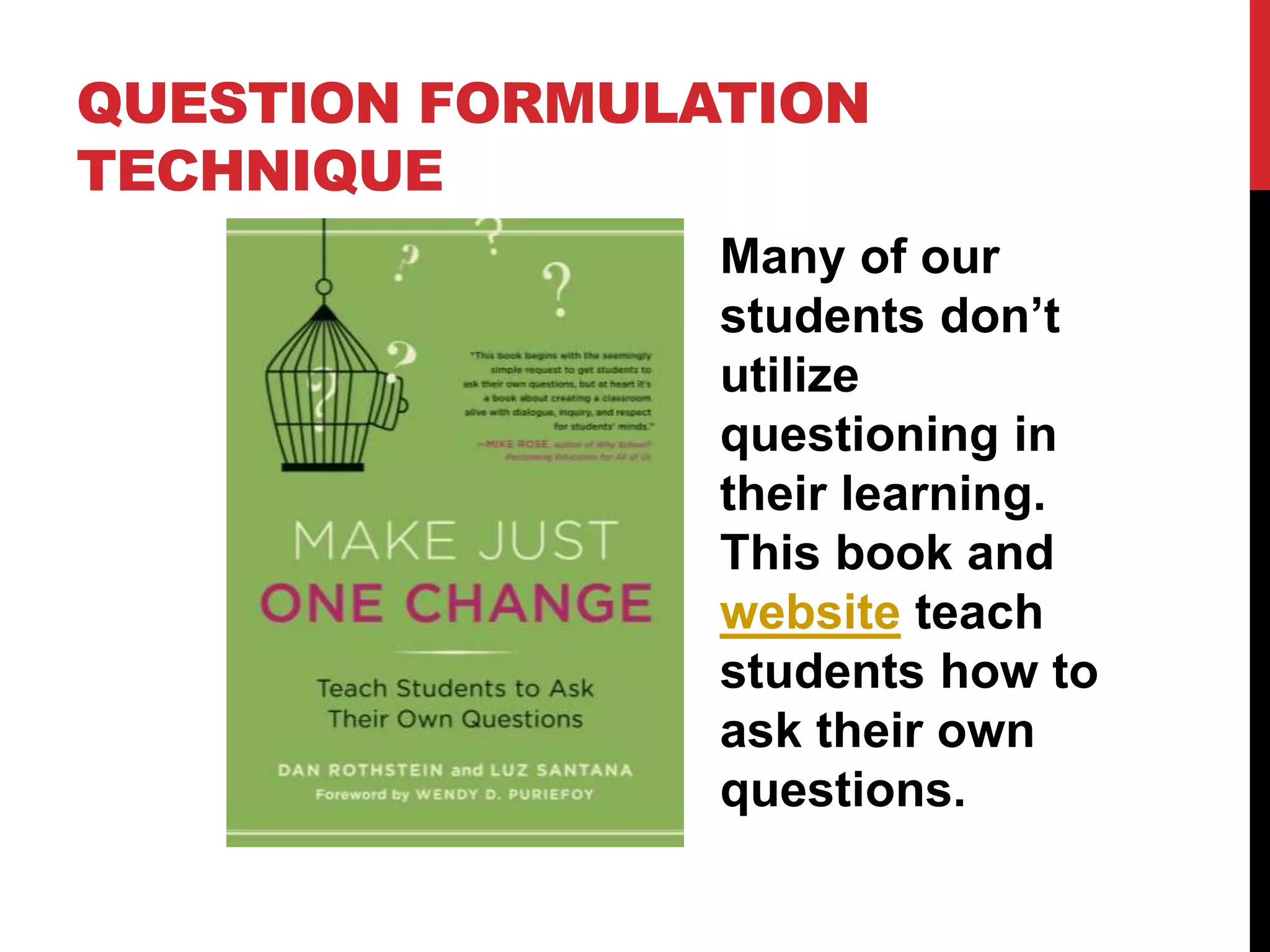
Many of our
students don’t
utilize
questioning in
their learning.
This book and
website teach
students how to
ask their own
questions.
SEE QFT IN ACTION
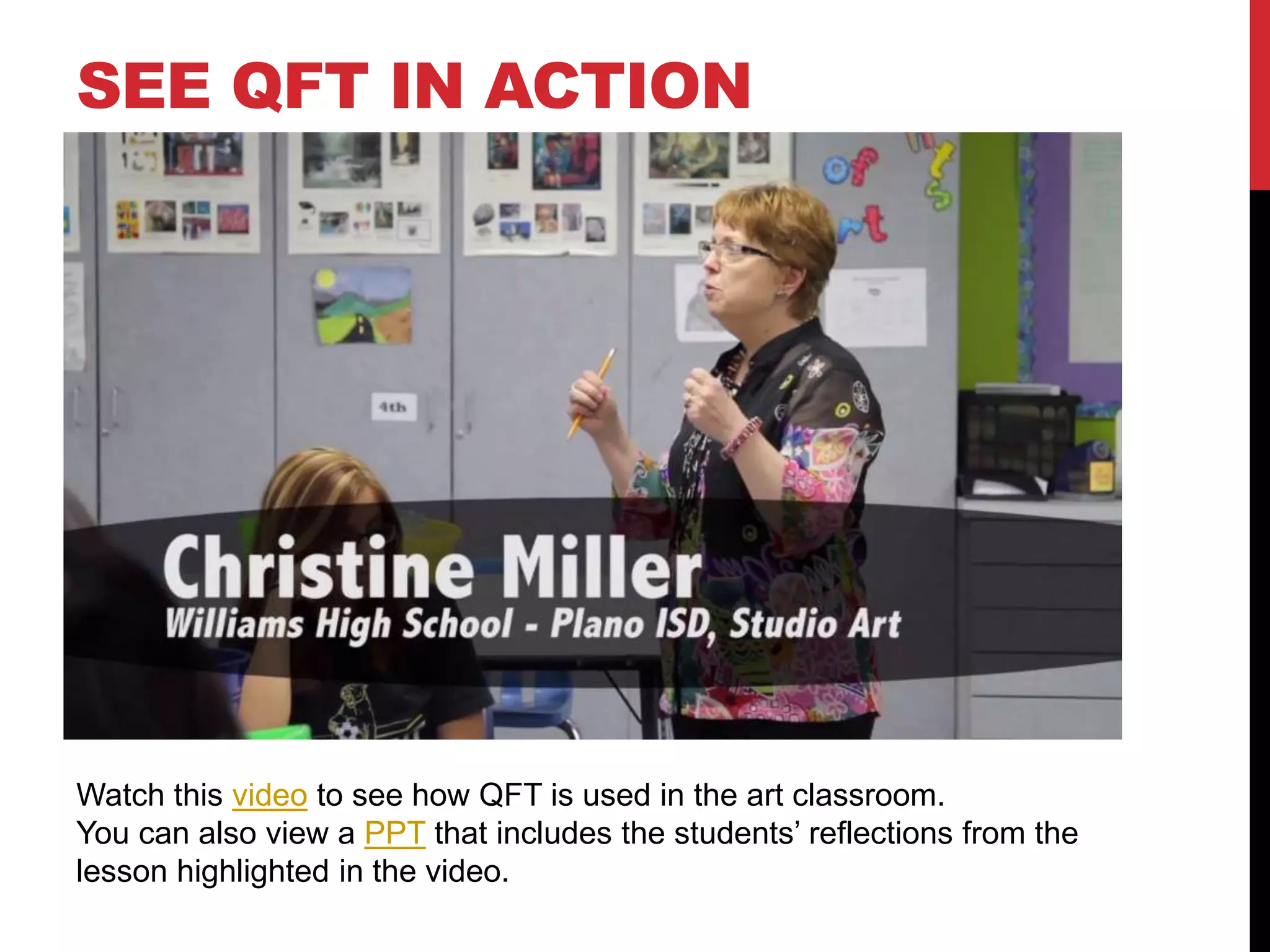
Watch this video to see how QFT is used in the art classroom.
You can also view a PPT that includes the students’ reflections from the
lesson highlighted in the video.
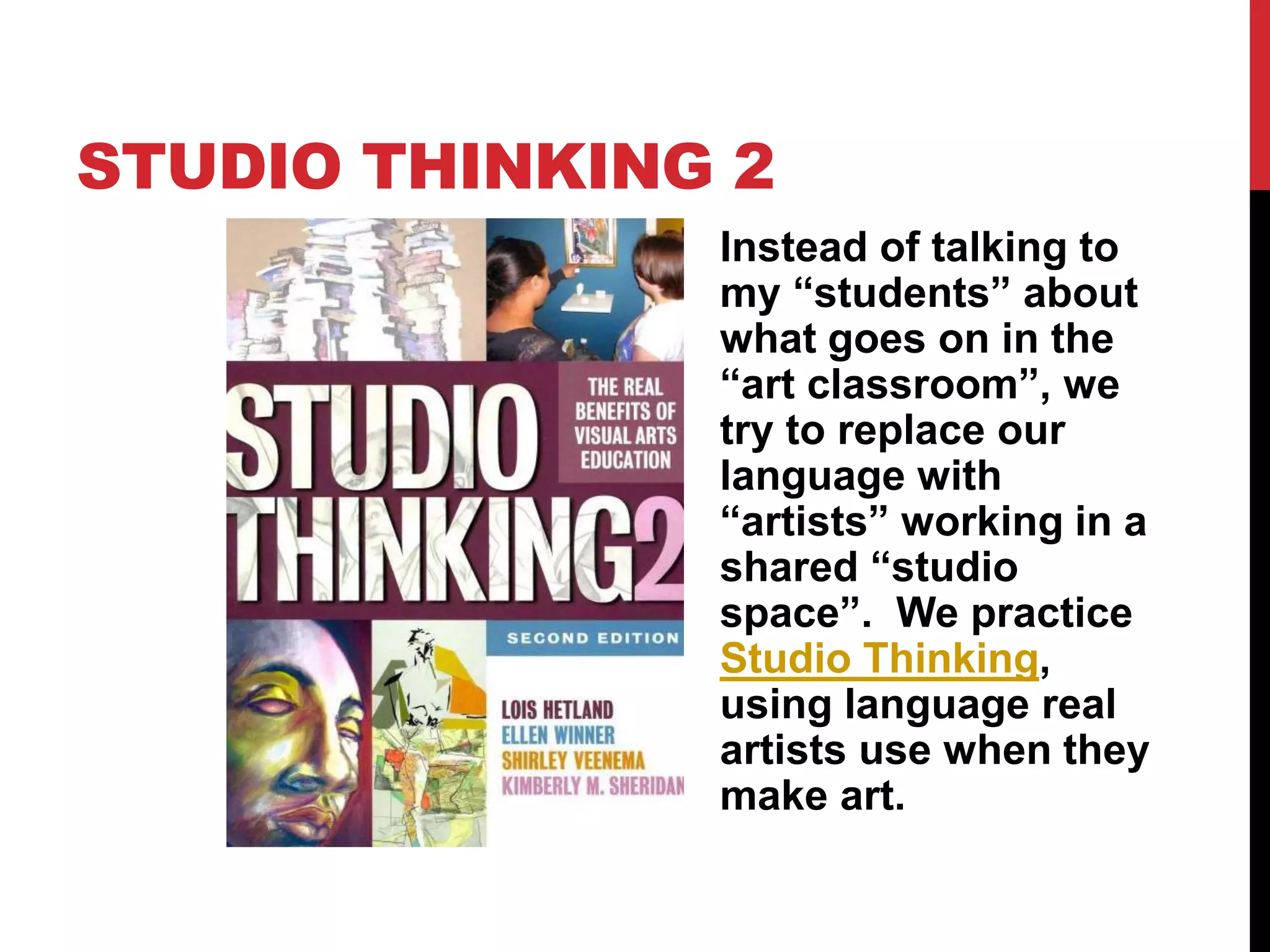
STUDIO THINKING 2
Instead of talking to
my “students” about
what goes on in the
“art classroom”, we
try to replace our
language with
“artists” working in a
shared “studio
space”. We practice
Studio Thinking,
using language real
artists use when they
make art.
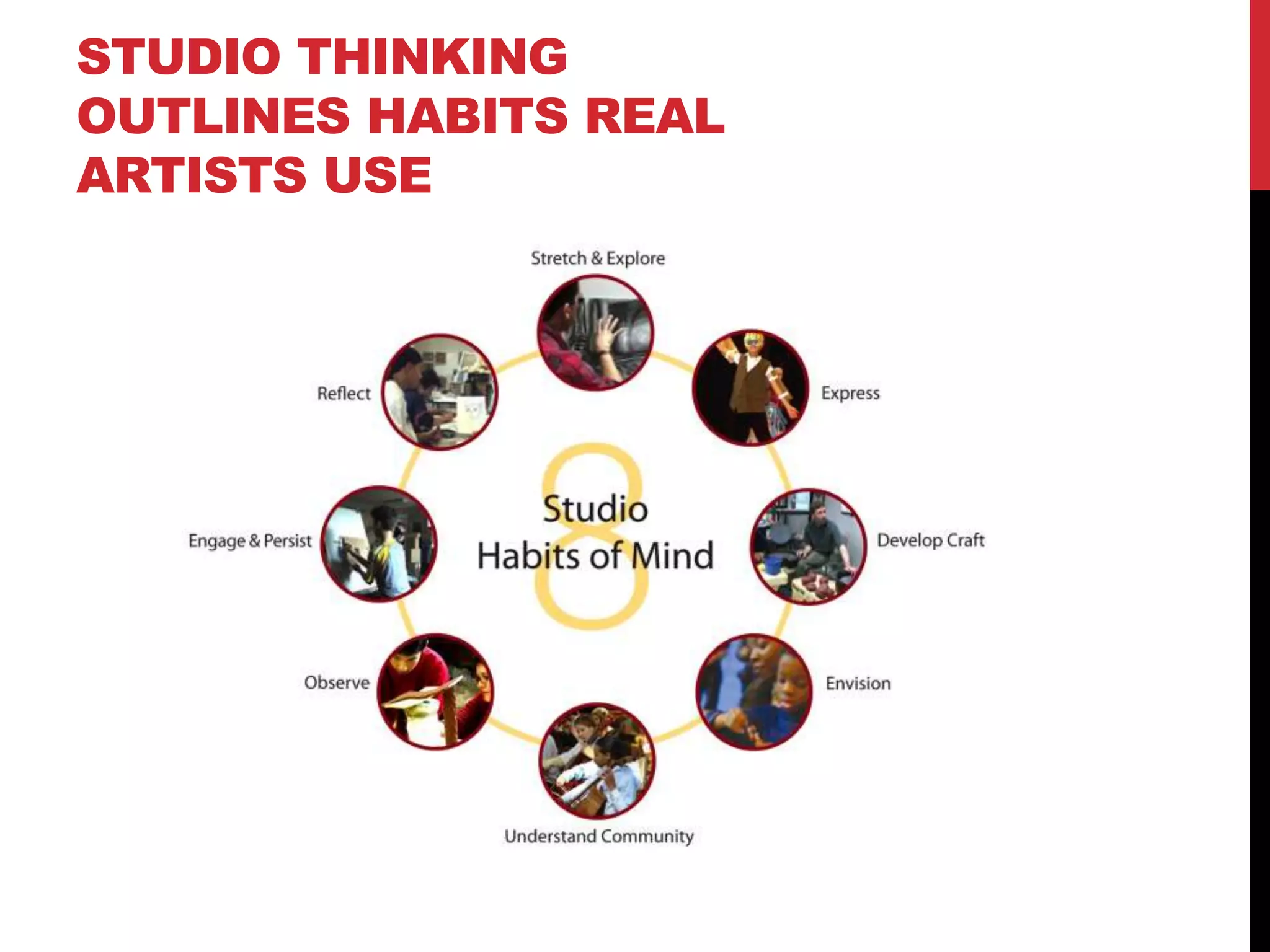
STUDIO THINKING
OUTLINES HABITS REAL
ARTISTS USE
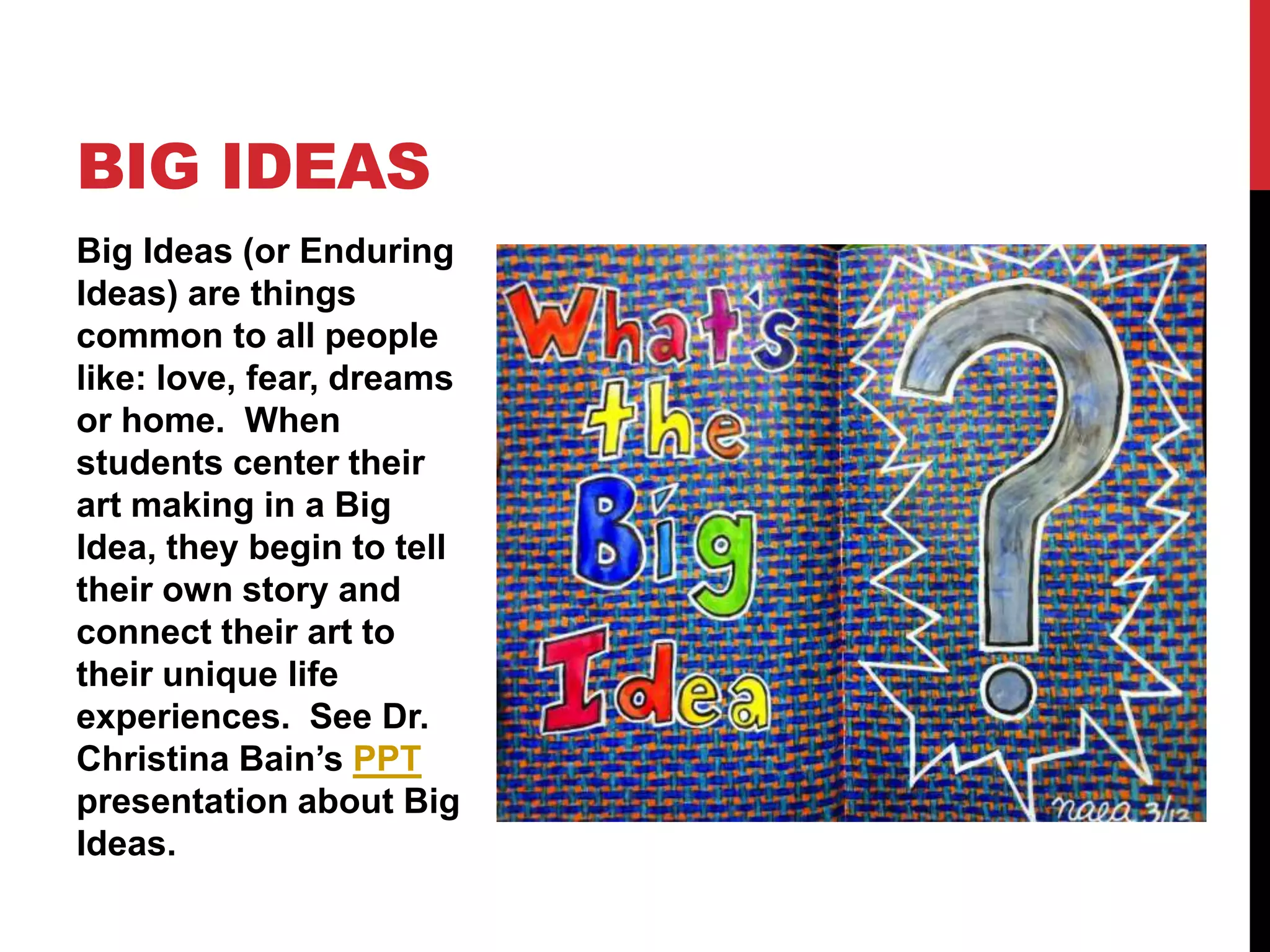
Big Ideas (or Enduring
Ideas) are things
common to all people
like: love, fear, dreams
or home. When
students center their
art making in a Big
Idea, they begin to tell
their own story and
connect their art to
their unique life
experiences. See Dr.
Christina Bain’s PPT
presentation about Big
Ideas.
BIG IDEAS
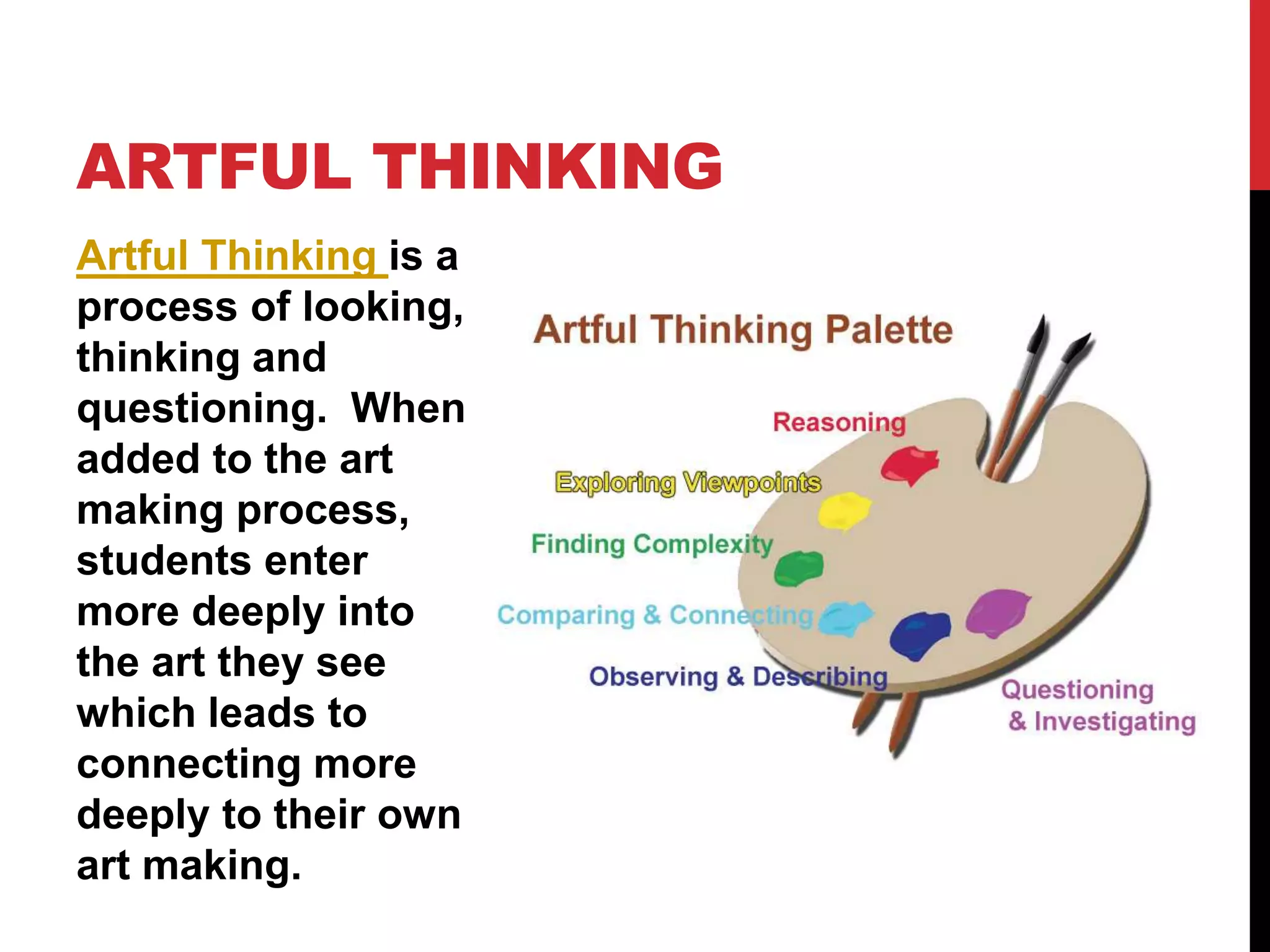
Artful Thinking is a
process of looking,
thinking and
questioning. When
added to the art
making process,
students enter
more deeply into
the art they see
which leads to
connecting more
deeply to their own
art making.
ARTFUL THINKING
The University of Illinois in
Chicago’s Spiral Art
Education workshops
encourage flow in student art
making. Edited by Olivia
Gude, this site features
examples of investigation,
questioning, thinking and
meaning making in student art
making. This resource brings
together the components
outlined in this presentation
and is one inspiration for
creating flow in my own
teaching practices and my
students’ learning
experiences.
UIC SPIRAL ART
EDUCATION
BRINGING IDEAS
TOGETHER
Objectives for the art making
process in my lesson plan:
• Create more student engagement
• Build in more play and
investigation
• Use Big Ideas, Enduring Ideas
• Incorporate language from Studio
Habits of Mind
• Use questioning strategies
• Emphasize process over product
• Build in reflection throughout art
making process, not just at the
end
INTRODUCTION
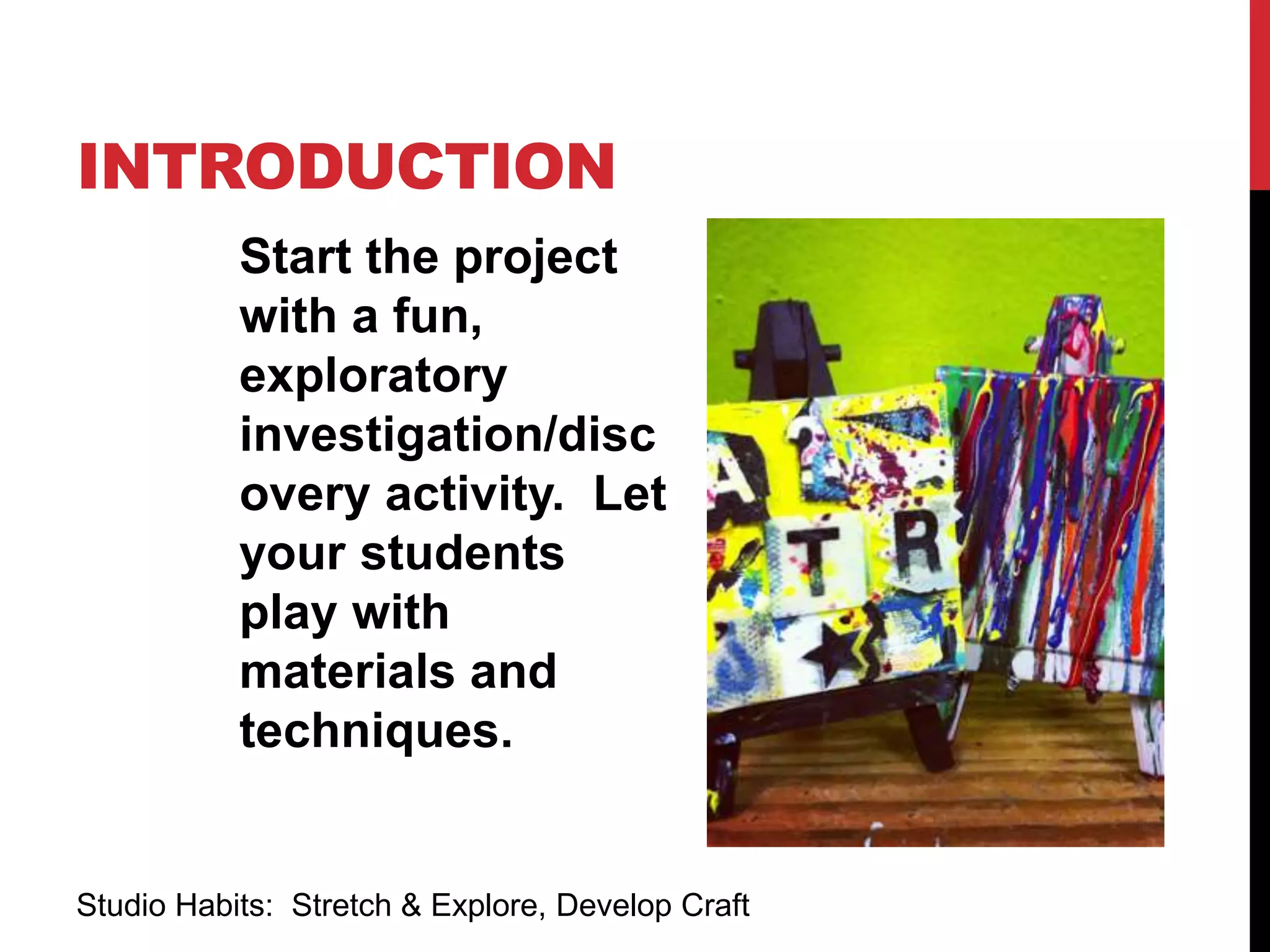
Start the project
with a fun,
exploratory
investigation/disc
overy activity. Let
your students
play with
materials and
techniques.
Studio Habits: Stretch & Explore, Develop Craft
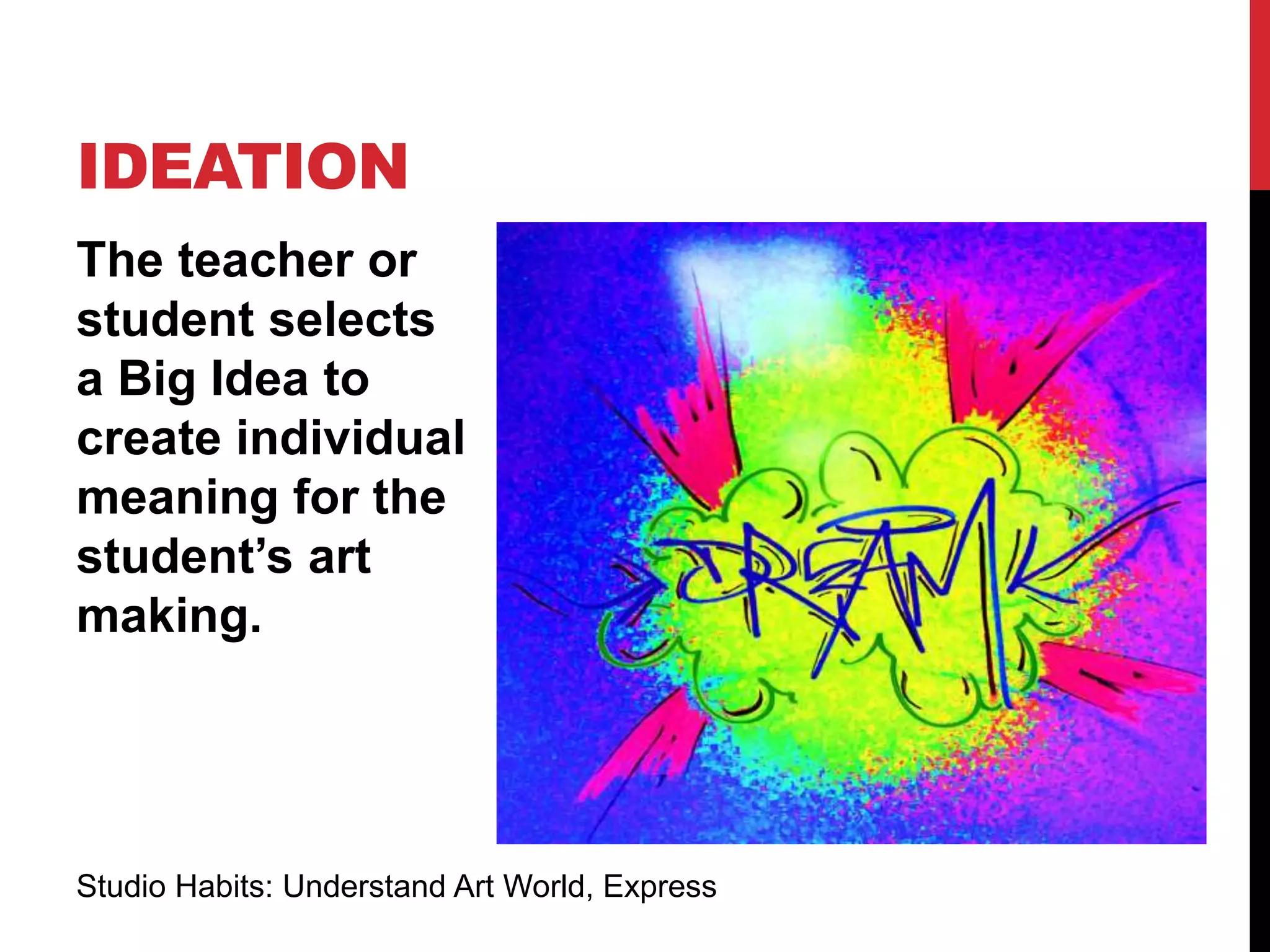
The teacher or
student selects
a Big Idea to
create individual
meaning for the
student’s art
making.
IDEATION
Studio Habits: Understand Art World, Express
RESEARCH
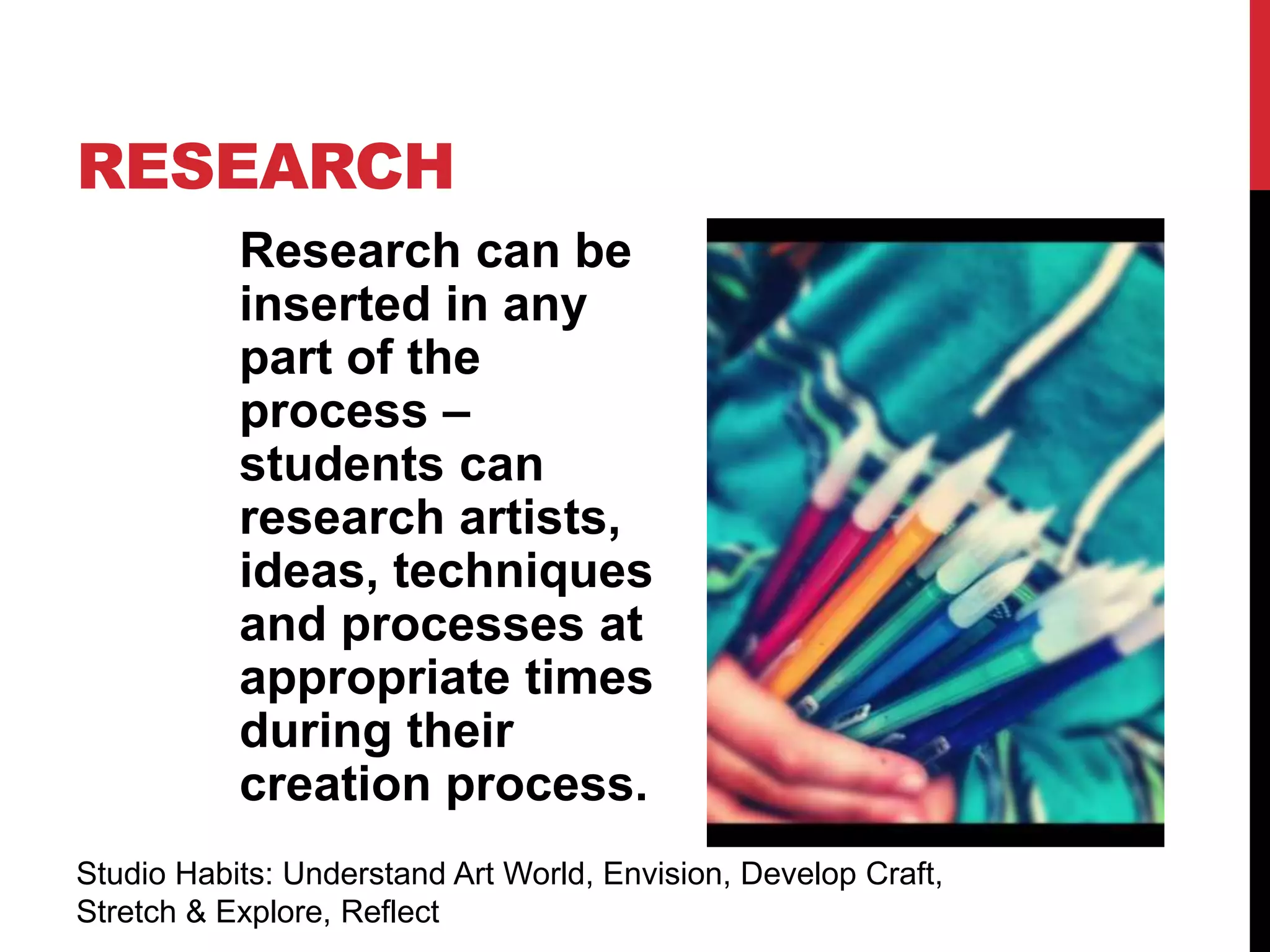
Research can be
inserted in any
part of the
process –
students can
research artists,
ideas, techniques
and processes at
appropriate times
during their
creation process.
Studio Habits: Understand Art World, Envision, Develop Craft,
Stretch & Explore, Reflect
QUESTIONING
Engage in a quick
questioning
process (QFT or
Artful Thinking)
for the
student/artist to
create the driving
questions for
their art project.
Studio Habits: Understand Art World, Reflect, Envision
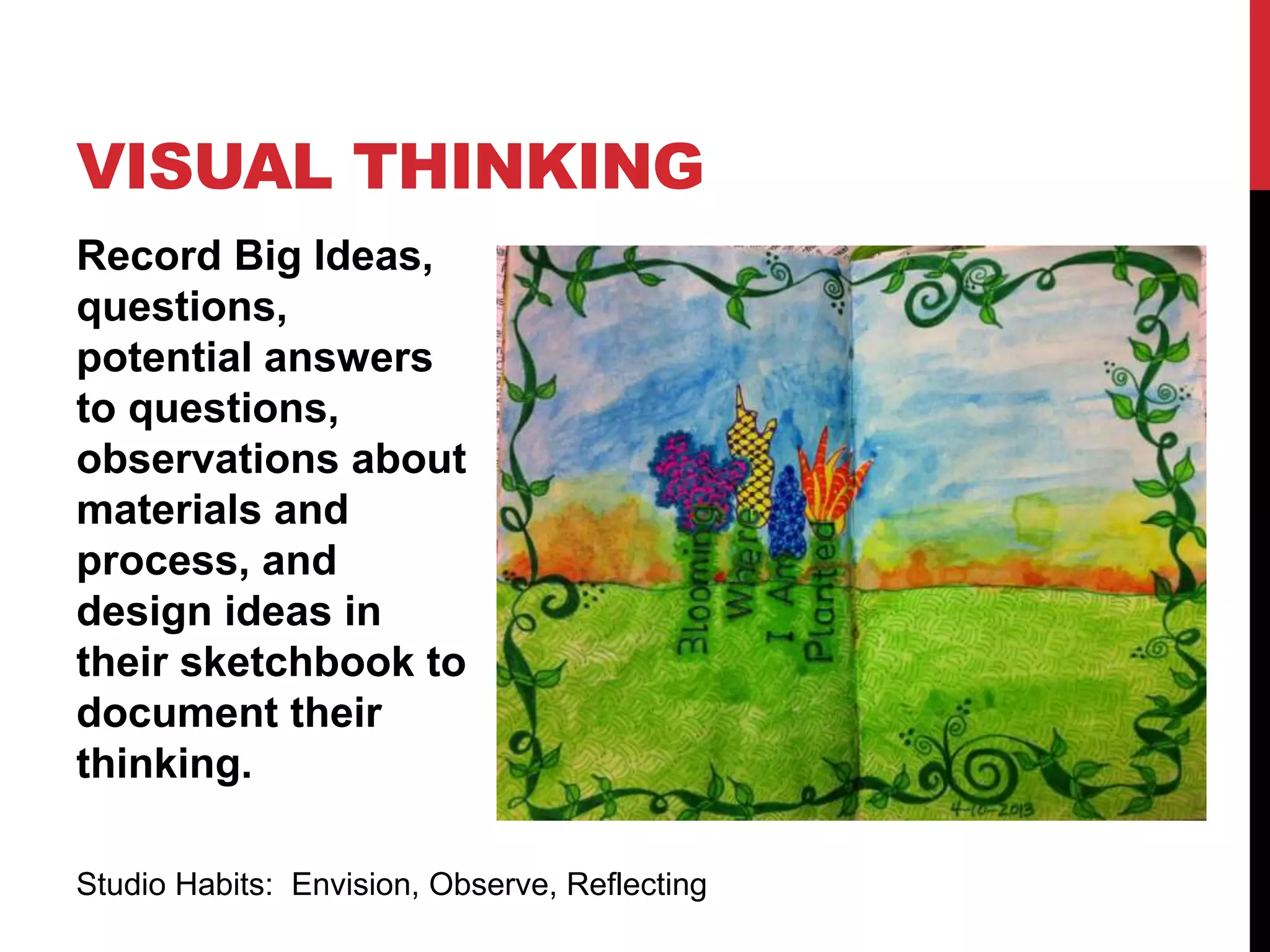
Record Big Ideas,
questions,
potential answers
to questions,
observations about
materials and
process, and
design ideas in
their sketchbook to
document their
thinking.
VISUAL THINKING
Studio Habits: Envision, Observe, Reflecting
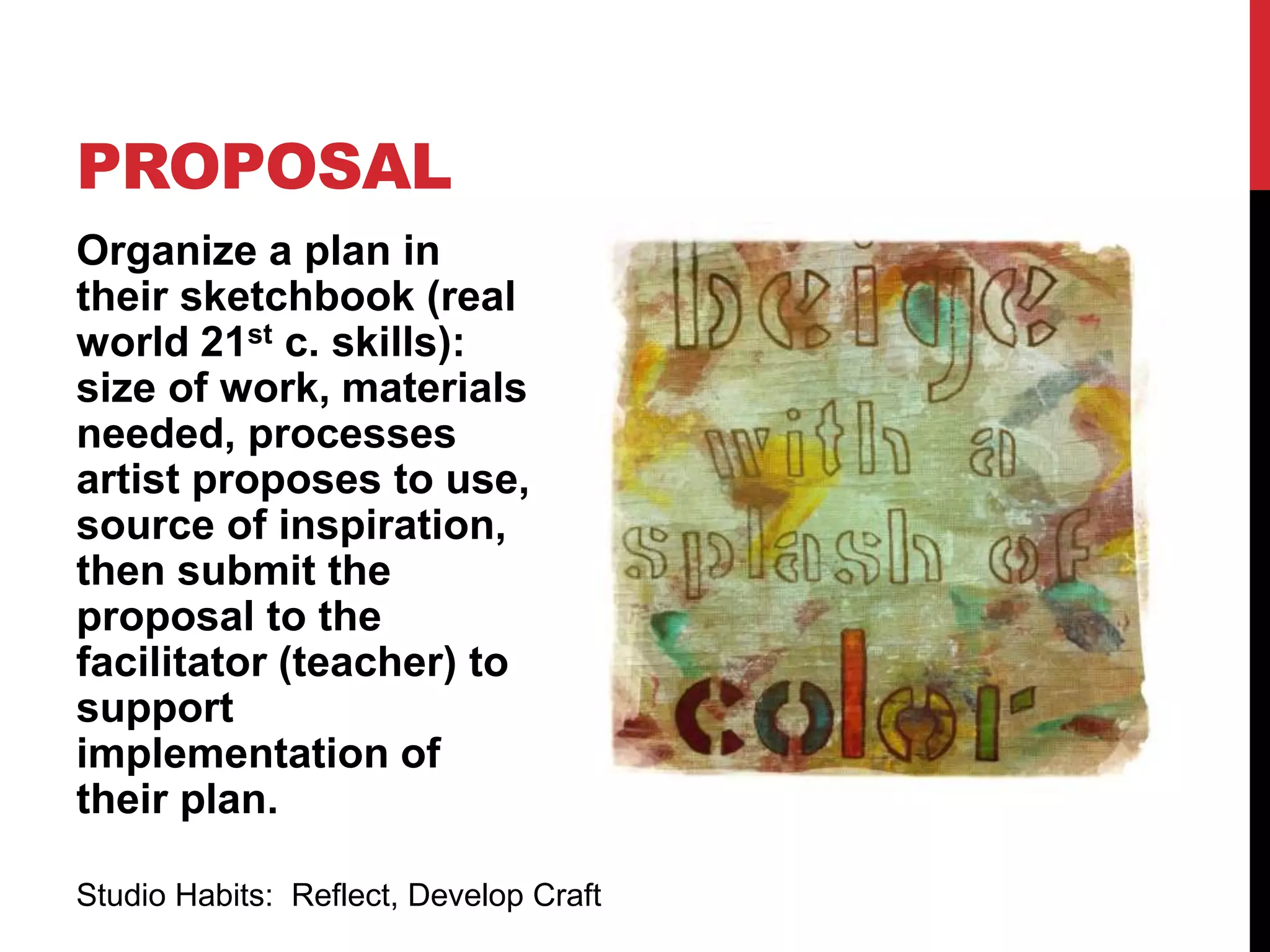
Organize a plan in
their sketchbook (real
world 21st c. skills):
size of work, materials
needed, processes
artist proposes to use,
source of inspiration,
then submit the
proposal to the
facilitator (teacher) to
support
implementation of
their plan.
PROPOSAL
Studio Habits: Reflect, Develop Craft
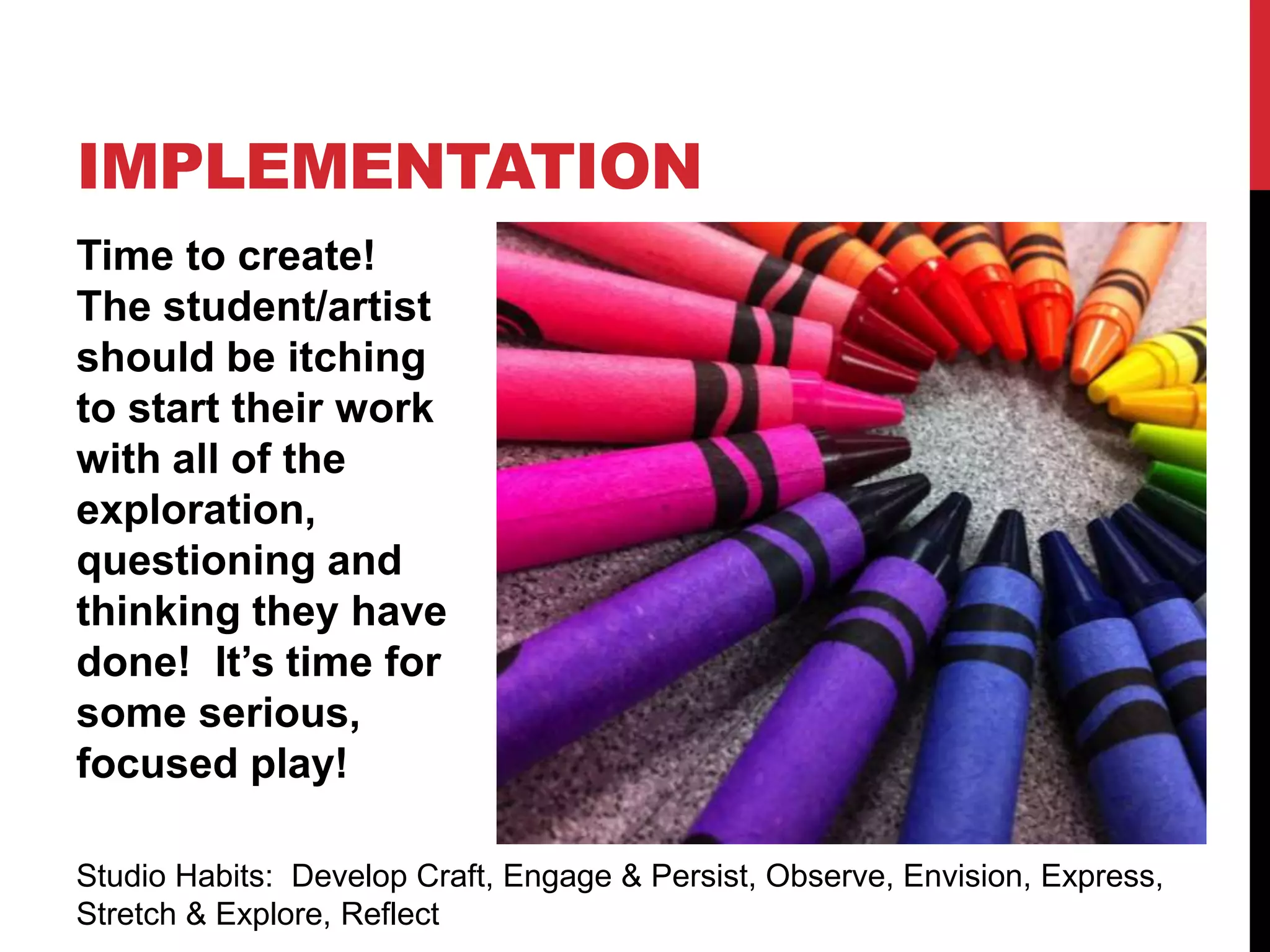
Time to create!
The student/artist
should be itching
to start their work
with all of the
exploration,
questioning and
thinking they have
done! It’s time for
some serious,
focused play!
IMPLEMENTATION
Studio Habits: Develop Craft, Engage & Persist, Observe, Envision, Express,
Stretch & Explore, Reflect
REFLECTION/ASSESS
MENT
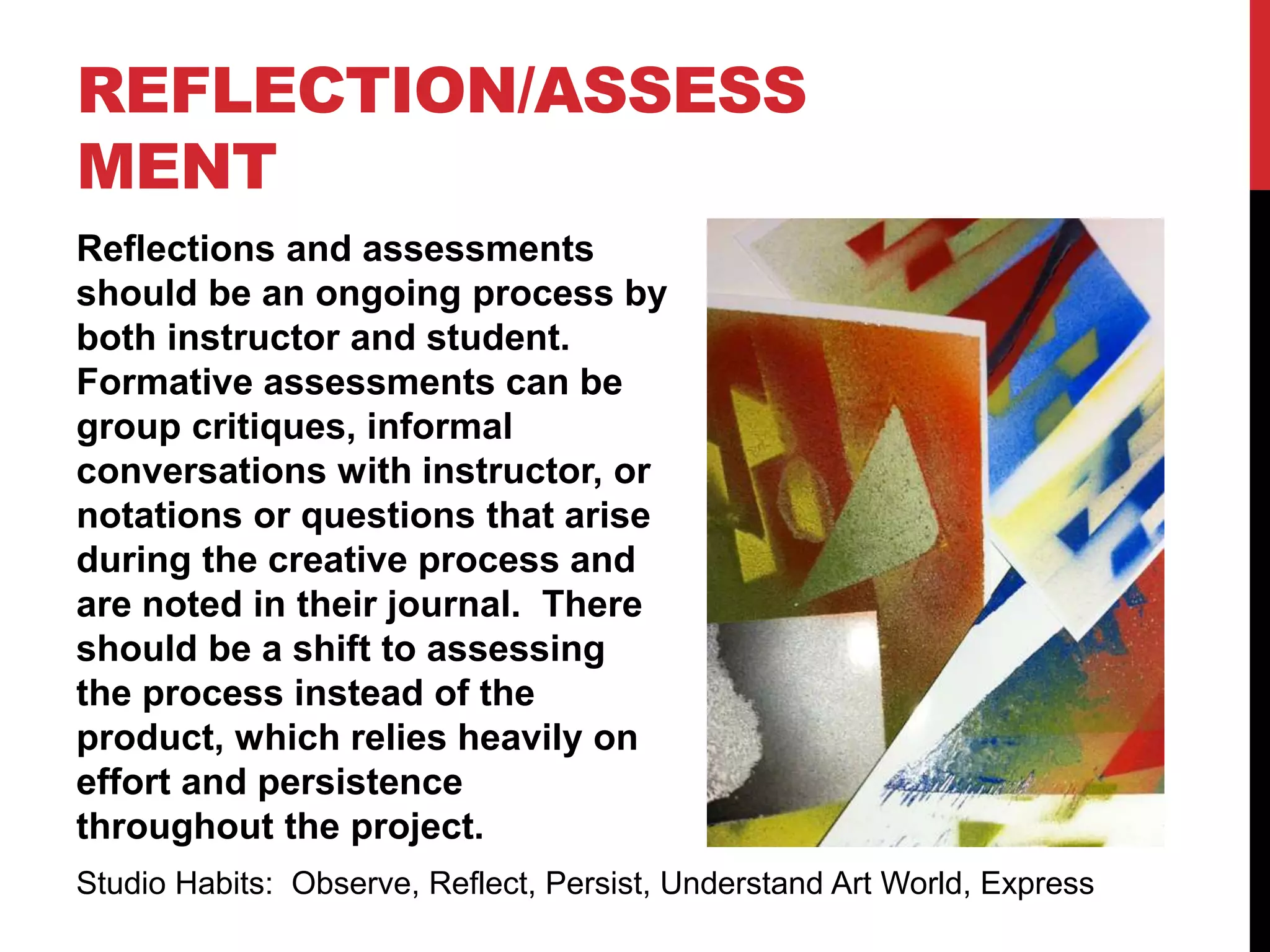
Reflections and assessments
should be an ongoing process by
both instructor and student.
Formative assessments can be
group critiques, informal
conversations with instructor, or
notations or questions that arise
during the creative process and
are noted in their journal. There
should be a shift to assessing
the process instead of the
product, which relies heavily on
effort and persistence
throughout the project.
Studio Habits: Observe, Reflect, Persist, Understand Art World, Express
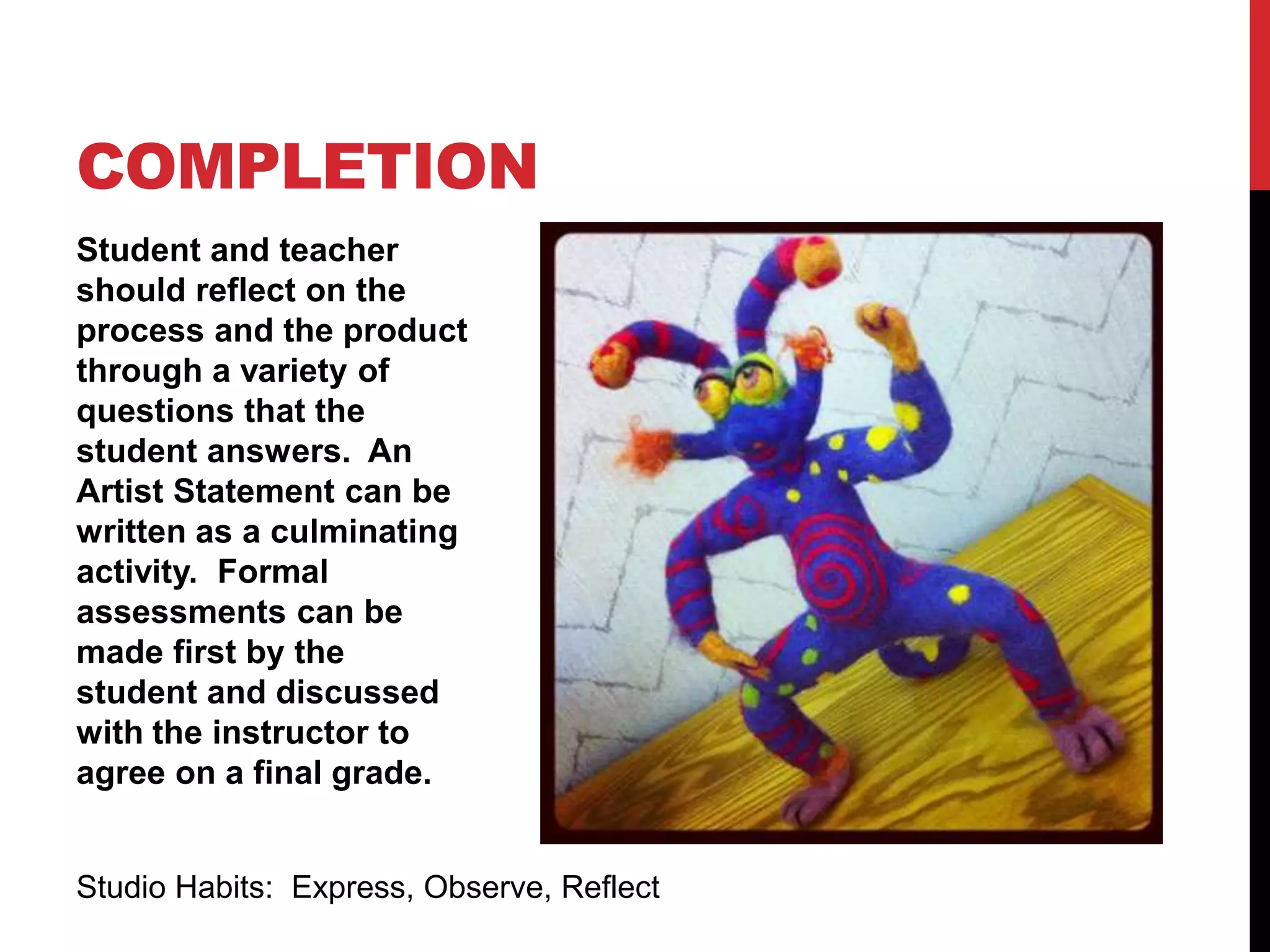
Student and teacher
should reflect on the
process and the product
through a variety of
questions that the
student answers. An
Artist Statement can be
written as a culminating
activity. Formal
assessments can be
made first by the
student and discussed
with the instructor to
agree on a final grade.
COMPLETION
Studio Habits: Express, Observe, Reflect
TIME FOR FOCUSED
PLAY
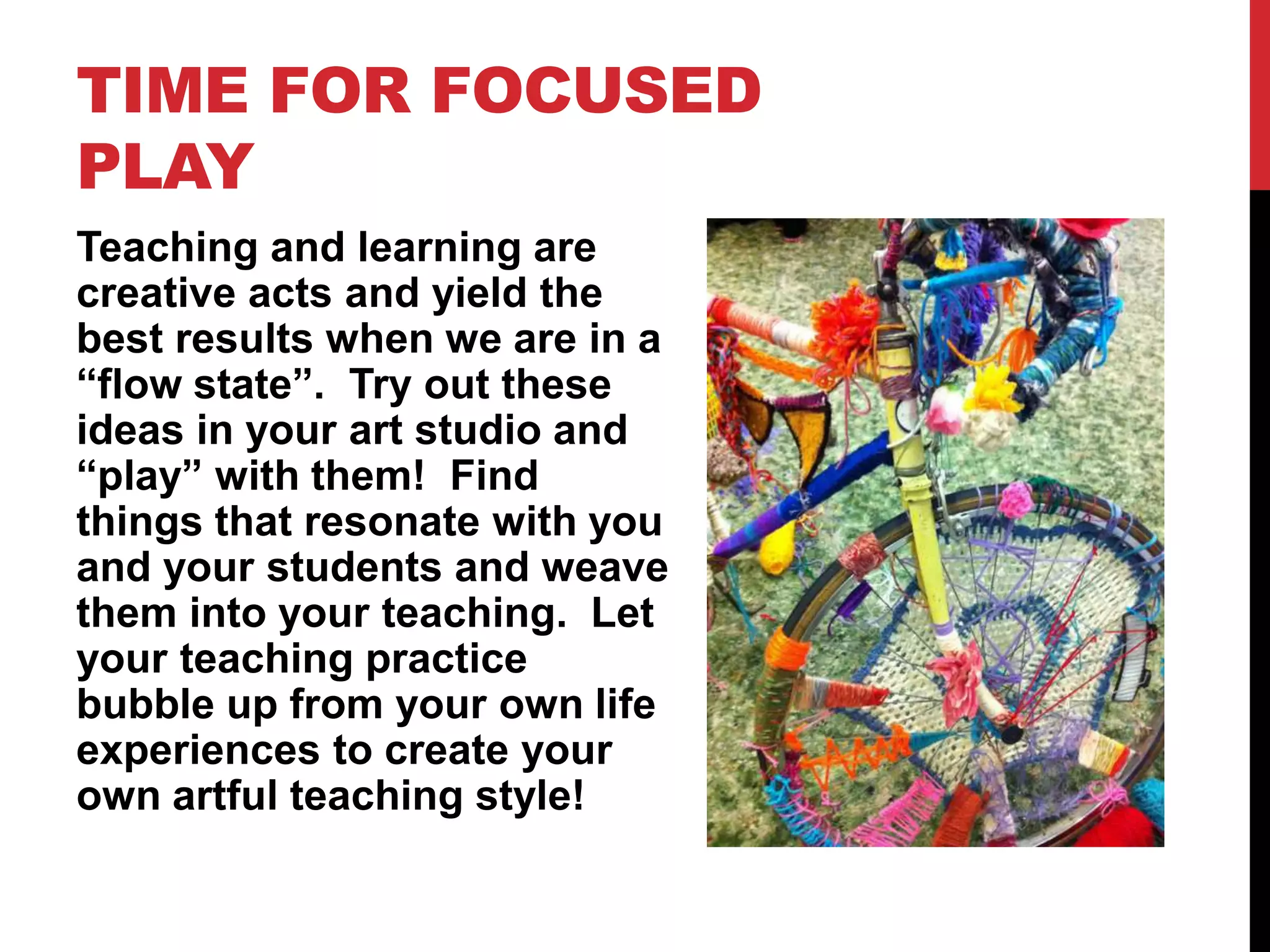
Teaching and learning are
creative acts and yield the
best results when we are in a
“flow state”. Try out these
ideas in your art studio and
“play” with them! Find
things that resonate with you
and your students and weave
them into your teaching. Let
your teaching practice
bubble up from your own life
experiences to create your
own artful teaching style!
RESOURCES
• Artful Thinking - http://www.pzartfulthinking.org/index.php
• Bain, Christina. (2008). What’s the Big Idea? Retrieved from:
http://ntieva.unt.edu/download/teaching/Curr_unit/What%27stheBigIdea.
pdf
• Miller, Christine. (October 15, 2013). Christine Miller – Question
Formulation Technique. Retrieved from: https://vimeo.com/76950785
• Miller, Christine. (April 09, 2014). Essential Question Strategies &
Question Formulation Technique. Retrieved from:
http://www.slideshare.net/tagartteacher/qft-presentation-w-o-embedded-
video-33325098
• Miller, Christine - photographs and/or artwork in this presentation
• The Right Question Institute - http://rightquestion.org/education/
• Spiral Workshop – Art Education Program, School of Art and Design,
University of Illinois in Chicago.
https://www.uic.edu/classes/ad/ad382/sites/SpiralWorkshop/SW_index.ht
ml
• Studio Thinking (8 Studio Habits of Mind). Retrieved from:
http://www.artiseducation.org/research-tools/tool/studio-thinking-8-
studio-habits-mind

Process over product in Art Education: A Student Centered Approach to Making Art

  • 1.
    PROCESS OVER PRODUCT IN ART EDUCATION ASTUDENT CENTERED APPROACH TO MAKING ART By Christine Miller Williams High School, Plano ISD February 2015
  • 2.
    MAKING ART RELEVANT TOOUR 21ST C. STUDENTS Putting emphasis on the end product instead of the process of making art can frustrate student and teacher alike. Emphasizing the process helps light the way for artistic exploration.
  • 3.
    MY OWN “ART TEACHERSOUP” SO MANY ART IDEAS AND THEORIES! Many people are talking about ways to heighten student engagement in art making. My graduate studies and years of classroom experience & experimentation have led to a lesson plan that blends many great ideas and methodologies together.
  • 4.
    My pedagogy has grownas I have synthesized the resources, ideas, methodologies and strategies I have studied. The lesson plan format I am currently using is intended to create more flow in the art making process for both teacher and student. A NEW APPROACH IN MY TEACHING - FLOW
  • 5.
    I don’t offerup this plan as “the” way to teach art, but as one approach a teacher can use to create more student engagement in K-12, community or museum art education programs. THERE ARE MANY PATHS…
  • 6.
    This lesson planapproach incorporates the language and/or ideas of the following: • Question Formulation Technique • Studio Habits of Mind • Big Ideas/Enduring Ideas • Artful Thinking • University of Illinois in Chicago Spiral Workshop • Olivia Gude (the BIG voice in my ear!) PRIMARY RESOURCES
  • 7.
    QUESTION FORMULATION TECHNIQUE Many ofour students don’t utilize questioning in their learning. This book and website teach students how to ask their own questions.
  • 8.
    SEE QFT INACTION Watch this video to see how QFT is used in the art classroom. You can also view a PPT that includes the students’ reflections from the lesson highlighted in the video.
  • 9.
    STUDIO THINKING 2 Insteadof talking to my “students” about what goes on in the “art classroom”, we try to replace our language with “artists” working in a shared “studio space”. We practice Studio Thinking, using language real artists use when they make art.
  • 10.
  • 11.
    Big Ideas (orEnduring Ideas) are things common to all people like: love, fear, dreams or home. When students center their art making in a Big Idea, they begin to tell their own story and connect their art to their unique life experiences. See Dr. Christina Bain’s PPT presentation about Big Ideas. BIG IDEAS
  • 12.
    Artful Thinking isa process of looking, thinking and questioning. When added to the art making process, students enter more deeply into the art they see which leads to connecting more deeply to their own art making. ARTFUL THINKING
  • 13.
    The University ofIllinois in Chicago’s Spiral Art Education workshops encourage flow in student art making. Edited by Olivia Gude, this site features examples of investigation, questioning, thinking and meaning making in student art making. This resource brings together the components outlined in this presentation and is one inspiration for creating flow in my own teaching practices and my students’ learning experiences. UIC SPIRAL ART EDUCATION
  • 14.
    BRINGING IDEAS TOGETHER Objectives forthe art making process in my lesson plan: • Create more student engagement • Build in more play and investigation • Use Big Ideas, Enduring Ideas • Incorporate language from Studio Habits of Mind • Use questioning strategies • Emphasize process over product • Build in reflection throughout art making process, not just at the end
  • 15.
    INTRODUCTION Start the project witha fun, exploratory investigation/disc overy activity. Let your students play with materials and techniques. Studio Habits: Stretch & Explore, Develop Craft
  • 16.
    The teacher or studentselects a Big Idea to create individual meaning for the student’s art making. IDEATION Studio Habits: Understand Art World, Express
  • 17.
    RESEARCH Research can be insertedin any part of the process – students can research artists, ideas, techniques and processes at appropriate times during their creation process. Studio Habits: Understand Art World, Envision, Develop Craft, Stretch & Explore, Reflect
  • 18.
    QUESTIONING Engage in aquick questioning process (QFT or Artful Thinking) for the student/artist to create the driving questions for their art project. Studio Habits: Understand Art World, Reflect, Envision
  • 19.
    Record Big Ideas, questions, potentialanswers to questions, observations about materials and process, and design ideas in their sketchbook to document their thinking. VISUAL THINKING Studio Habits: Envision, Observe, Reflecting
  • 20.
    Organize a planin their sketchbook (real world 21st c. skills): size of work, materials needed, processes artist proposes to use, source of inspiration, then submit the proposal to the facilitator (teacher) to support implementation of their plan. PROPOSAL Studio Habits: Reflect, Develop Craft
  • 21.
    Time to create! Thestudent/artist should be itching to start their work with all of the exploration, questioning and thinking they have done! It’s time for some serious, focused play! IMPLEMENTATION Studio Habits: Develop Craft, Engage & Persist, Observe, Envision, Express, Stretch & Explore, Reflect
  • 22.
    REFLECTION/ASSESS MENT Reflections and assessments shouldbe an ongoing process by both instructor and student. Formative assessments can be group critiques, informal conversations with instructor, or notations or questions that arise during the creative process and are noted in their journal. There should be a shift to assessing the process instead of the product, which relies heavily on effort and persistence throughout the project. Studio Habits: Observe, Reflect, Persist, Understand Art World, Express
  • 23.
    Student and teacher shouldreflect on the process and the product through a variety of questions that the student answers. An Artist Statement can be written as a culminating activity. Formal assessments can be made first by the student and discussed with the instructor to agree on a final grade. COMPLETION Studio Habits: Express, Observe, Reflect
  • 24.
    TIME FOR FOCUSED PLAY Teachingand learning are creative acts and yield the best results when we are in a “flow state”. Try out these ideas in your art studio and “play” with them! Find things that resonate with you and your students and weave them into your teaching. Let your teaching practice bubble up from your own life experiences to create your own artful teaching style!
  • 25.
    RESOURCES • Artful Thinking- http://www.pzartfulthinking.org/index.php • Bain, Christina. (2008). What’s the Big Idea? Retrieved from: http://ntieva.unt.edu/download/teaching/Curr_unit/What%27stheBigIdea. pdf • Miller, Christine. (October 15, 2013). Christine Miller – Question Formulation Technique. Retrieved from: https://vimeo.com/76950785 • Miller, Christine. (April 09, 2014). Essential Question Strategies & Question Formulation Technique. Retrieved from: http://www.slideshare.net/tagartteacher/qft-presentation-w-o-embedded- video-33325098 • Miller, Christine - photographs and/or artwork in this presentation • The Right Question Institute - http://rightquestion.org/education/ • Spiral Workshop – Art Education Program, School of Art and Design, University of Illinois in Chicago. https://www.uic.edu/classes/ad/ad382/sites/SpiralWorkshop/SW_index.ht ml • Studio Thinking (8 Studio Habits of Mind). Retrieved from: http://www.artiseducation.org/research-tools/tool/studio-thinking-8- studio-habits-mind