


Elliot W, Eisner 
National Art Education Association Conference, Dallas, Texas
INTRODUCTION 
Abstract 
This paper represents 
an effort to eliminate 
some of the confusion 
that exists in art 
education regarding 
the conception and 
practice of evaluation 
Main points: 
Distinguish between 
the meanings of 
terms; evaluation, 
measurement, testing 
and grading 
 What is Evaluation? 
Evaluation is not simply a description of 
something, nor is it an explanation. It is the 
process through which one judges the 
value of something. In education, the 
general criterion one uses for purposes of 
evaluation is one that is intimately related 
to the educational outcomes (objectives) 
one seeks to attain. 
 What is Measurement? 
 To measure is not to evaluate. 
Measurement deals with quantification. 
Not all data, especially in art, can be 
quantified.
 What is Grading? 
To grade is not to evaluate. Grading is the assignment of 
symbol to a person’s performance. One can evaluate a 
student’s work, his effort, his attitude without assigning 
him a grade. 
 What is Testing? 
 Testing is simply one procedure through which some kinds of 
evidence are obtained, to test is simply to secure a sample of a 
student’s or group’s behavior or product through a mechanism that is 
typically administered to them. To test is not necessarily to evaluate, 
although test can be and usually are used for purposes of evaluation.
Evaluating Student’s Artworks 
 Schooling is one of the major social mechanism 
through which children are educated. 
 Education is merely a process of changing 
people and a process of improving human life. 
 Teachers observed students’ work as an 
evidence of developmental skills and ability in 
producing good work.
Evaluating Student’s Artworks 
Evaluating 
student’s work 
by comparing a 
student’s 
present work 
with their peers 
Consequences in evaluating artworks through 
comparison. 
1st, it would be difficult to examine the uniqueness 
among students since comparison of one with a 
population leads us to examine those 
characteristics that are shared by all members of 
the class 
2nd , it leads to grading practices in which the 
expectation of a normal distribution yields a self-fulfilling 
prophecy. (Some teacher might feel guilty 
and make all students believed that they will get an 
A) 
3rd, the comparison of artworks among students 
also leads to labeling such as abnormal, 
subnormal, slow learner and others.
Evaluating Student’s Artworks 
 Besides that, another context of evaluation is that 
of comparing a student’s performance to a 
criterion. 
 In this procedures, art educators need to… 
 formulate an objective that he/she wanted 
their students to acquire and then; 
assess their performance or product in 
relationship to that objective 
 The recent advent of behavioral objectives into the 
thinking of art educators most naturally fits with 
this evaluation
CONT… 
 The use of objectives, (in those area 
where they are appropriate) in training 
tasks and in the development of specific 
skills such as how to stretch a canvas, to 
prepare glaze, to make a mould using 
plaster of Paris and others can facilitate 
learning and make it more efficient
MAKING INFERENCES OF STUDENT’S WORK 
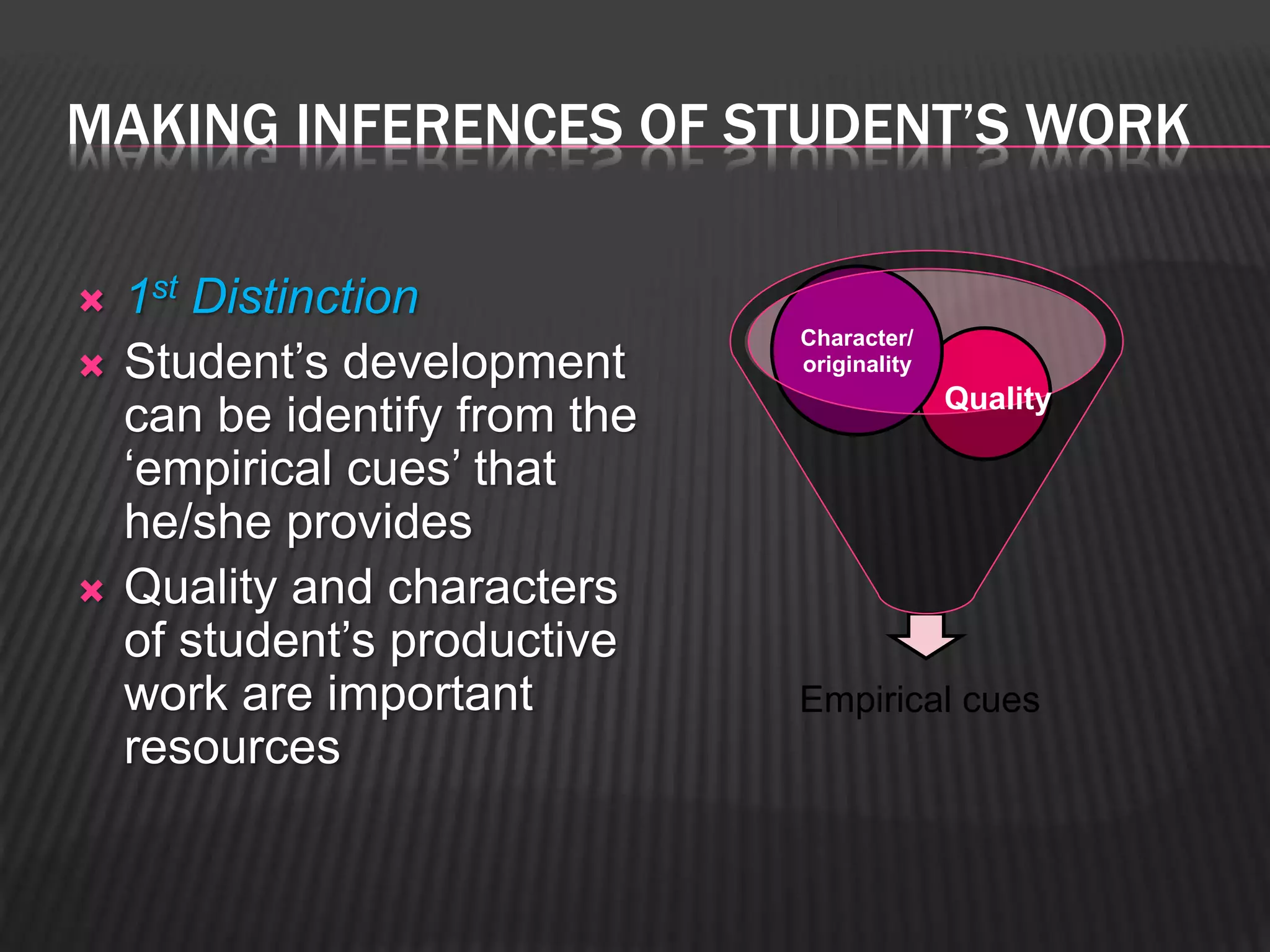
 1st Distinction 
 Student’s development 
can be identify from the 
‘empirical cues’ that 
he/she provides 
 Quality and characters 
of student’s productive 
work are important 
resources 
Character/ 
originality 
Quality 
Empirical cues
NEXT.. 
 2nd Distinction 
 Art educators should emphasis on both 
the production of art as well as the 
process of producing the work of art. 
We can have products only through 
process and can ‘know’ the processes 
only through products.
NEXT.. 
 3rd Distinction 
 Next, an art educator need to focus within 
the creative domain that deals with the 
creative or imaginative ways in which 
materials, forms and ideas are used in the 
work
SUMMARY 
 This paper concern indigenous to art education by the identification 
of the critical skills expansion, the historical as realms of artistic 
development in areas of curriculum development and also in 
evaluation. 
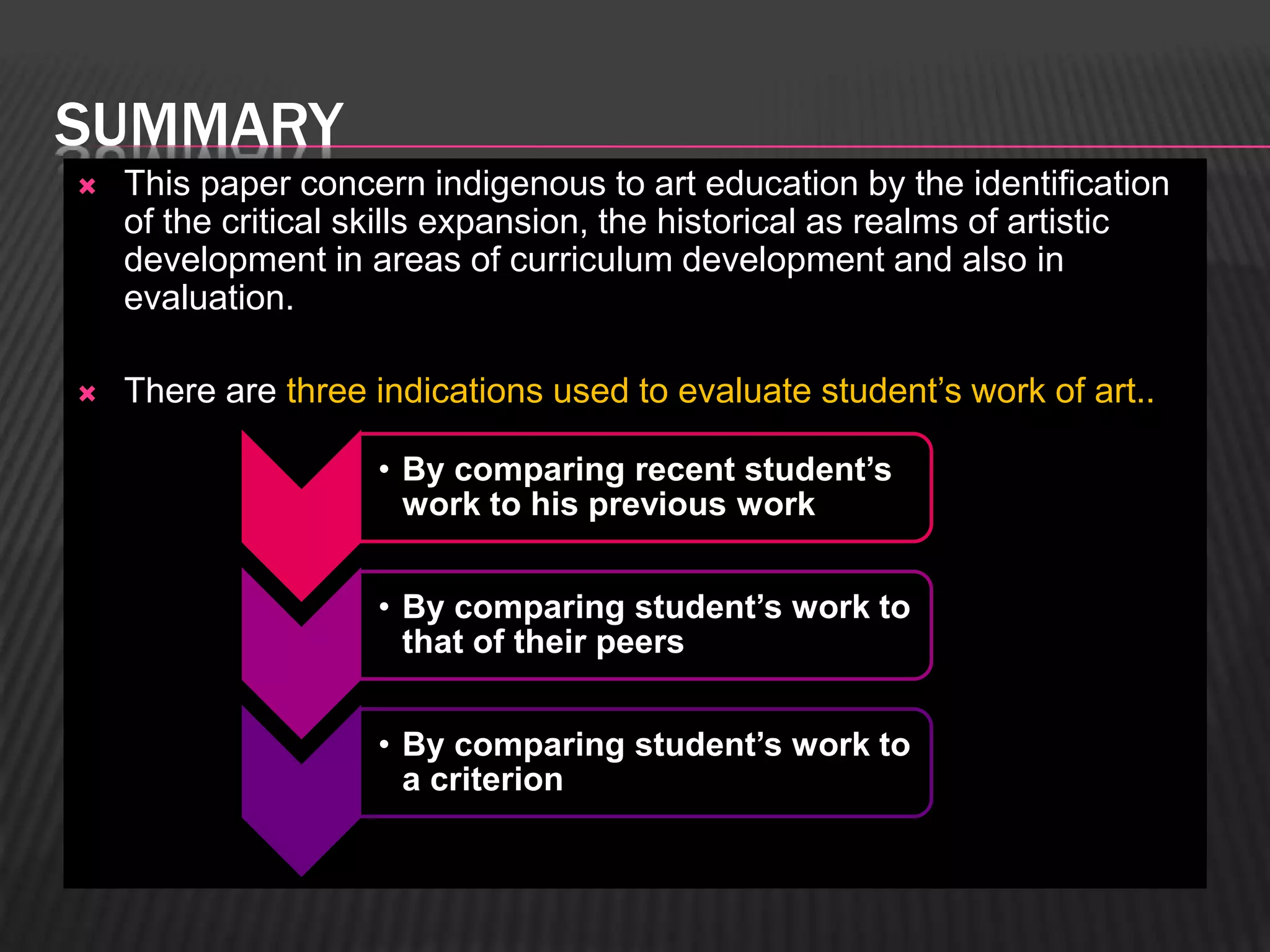
 There are three indications used to evaluate student’s work of art.. 
• By comparing recent student’s 
work to his previous work 
• By comparing student’s work to 
that of their peers 
• By comparing student’s work to 
a criterion
SUMMARY 
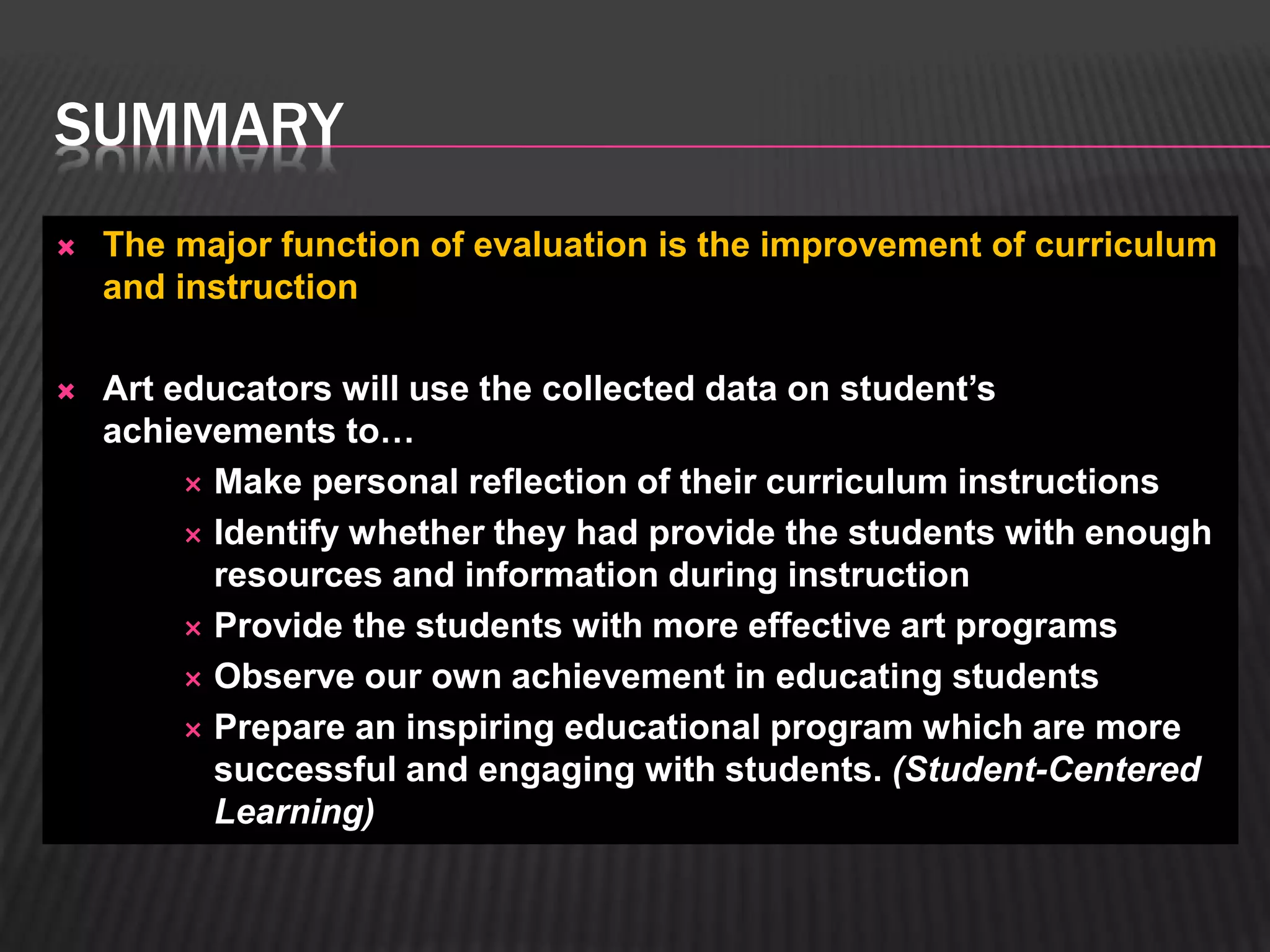
 The major function of evaluation is the improvement of curriculum 
and instruction 
 Art educators will use the collected data on student’s 
achievements to… 
 Make personal reflection of their curriculum instructions 
 Identify whether they had provide the students with enough 
resources and information during instruction 
 Provide the students with more effective art programs 
 Observe our own achievement in educating students 
 Prepare an inspiring educational program which are more 
successful and engaging with students. (Student-Centered 
Learning)

How can you measure a rainbow

  • 1.
    Elliot W, Eisner National Art Education Association Conference, Dallas, Texas
  • 2.
    INTRODUCTION Abstract Thispaper represents an effort to eliminate some of the confusion that exists in art education regarding the conception and practice of evaluation Main points: Distinguish between the meanings of terms; evaluation, measurement, testing and grading  What is Evaluation? Evaluation is not simply a description of something, nor is it an explanation. It is the process through which one judges the value of something. In education, the general criterion one uses for purposes of evaluation is one that is intimately related to the educational outcomes (objectives) one seeks to attain.  What is Measurement?  To measure is not to evaluate. Measurement deals with quantification. Not all data, especially in art, can be quantified.
  • 3.
     What isGrading? To grade is not to evaluate. Grading is the assignment of symbol to a person’s performance. One can evaluate a student’s work, his effort, his attitude without assigning him a grade.  What is Testing?  Testing is simply one procedure through which some kinds of evidence are obtained, to test is simply to secure a sample of a student’s or group’s behavior or product through a mechanism that is typically administered to them. To test is not necessarily to evaluate, although test can be and usually are used for purposes of evaluation.
  • 4.
    Evaluating Student’s Artworks  Schooling is one of the major social mechanism through which children are educated.  Education is merely a process of changing people and a process of improving human life.  Teachers observed students’ work as an evidence of developmental skills and ability in producing good work.
  • 5.
    Evaluating Student’s Artworks Evaluating student’s work by comparing a student’s present work with their peers Consequences in evaluating artworks through comparison. 1st, it would be difficult to examine the uniqueness among students since comparison of one with a population leads us to examine those characteristics that are shared by all members of the class 2nd , it leads to grading practices in which the expectation of a normal distribution yields a self-fulfilling prophecy. (Some teacher might feel guilty and make all students believed that they will get an A) 3rd, the comparison of artworks among students also leads to labeling such as abnormal, subnormal, slow learner and others.
  • 6.
    Evaluating Student’s Artworks  Besides that, another context of evaluation is that of comparing a student’s performance to a criterion.  In this procedures, art educators need to…  formulate an objective that he/she wanted their students to acquire and then; assess their performance or product in relationship to that objective  The recent advent of behavioral objectives into the thinking of art educators most naturally fits with this evaluation
  • 7.
    CONT…  Theuse of objectives, (in those area where they are appropriate) in training tasks and in the development of specific skills such as how to stretch a canvas, to prepare glaze, to make a mould using plaster of Paris and others can facilitate learning and make it more efficient
  • 8.
    MAKING INFERENCES OFSTUDENT’S WORK  1st Distinction  Student’s development can be identify from the ‘empirical cues’ that he/she provides  Quality and characters of student’s productive work are important resources Character/ originality Quality Empirical cues
  • 9.
    NEXT..  2ndDistinction  Art educators should emphasis on both the production of art as well as the process of producing the work of art. We can have products only through process and can ‘know’ the processes only through products.
  • 10.
    NEXT..  3rdDistinction  Next, an art educator need to focus within the creative domain that deals with the creative or imaginative ways in which materials, forms and ideas are used in the work
  • 11.
    SUMMARY  Thispaper concern indigenous to art education by the identification of the critical skills expansion, the historical as realms of artistic development in areas of curriculum development and also in evaluation.  There are three indications used to evaluate student’s work of art.. • By comparing recent student’s work to his previous work • By comparing student’s work to that of their peers • By comparing student’s work to a criterion
  • 12.
    SUMMARY  Themajor function of evaluation is the improvement of curriculum and instruction  Art educators will use the collected data on student’s achievements to…  Make personal reflection of their curriculum instructions  Identify whether they had provide the students with enough resources and information during instruction  Provide the students with more effective art programs  Observe our own achievement in educating students  Prepare an inspiring educational program which are more successful and engaging with students. (Student-Centered Learning)