1
Creative Exercises                                               Benoit Philippe


     © 2010 Benoit Philippe - You have the right to post this free eBook on
     blogs and websites, print it, share it with others or send it by email, as
     long as you don’t charge for it or modify it.


                                                                                   2
Creative Exercises                                   Benoit Philippe


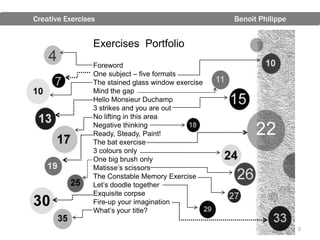
                 Exercises Portfolio
                 Foreword
                 One subject – five formats
                 The stained glass window exercise
                 Mind the gap
                 Hello Monsieur Duchamp
                 3 strikes and you are out
                 No lifting in this area
                 Negative thinking
                 Ready, Steady, Paint!
                 The bat exercise
                 3 colours only
                 One big brush only
                 Matisse’s scissors
                 The Constable Memory Exercise
                 Let’s doodle together
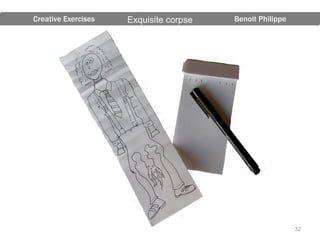
                 Exquisite corpse
                 Fire-up your imagination
                 What’s your title?

                                                                       3
Creative Exercises                                                    Benoit Philippe


       Foreword
       You said creativity?

       Creativity is a fascinating subject surrounded by many
       myths, the first one being that it is only a gift granted to
       a few at birth and therefore cannot be learnt or taught.

       It is hard to define creativity. To me, it is creating new
       combinations, displacing meaning and making ideas
       collide.

       There are excellent books on creativity, but many are
       designed for words and ideas rather than with the visual
       artist in mind.

       Creativity thrives on constraint and the exercises in this
       book are based on this principle. I learnt some of them
       years ago and I created some more to fulfil my own
       needs.
                                                                                        4
Creative Exercises                                                 Benoit Philippe


       Who is this book for?

       I  am a painter, so most of these exercises are visual
       ones. However, many of them do not require specific
       artistic skills and are suitable for anyone regardless of
       their age or level of artistic ability.

       You can use them as warm-up before you start a new
       project or as a way to explore new avenues.

       I hope teachers will use these exercises in their classes
       as they are great fun.


                                                                                     5
Creative Exercises                           Benoit Philippe


       “Much of creative thinking involves combining
       previously unrelated ideas, goods or services
       and turning them into something new. The
       printing press was created by Gutenberg, who
       combined the coin punch with the wine press.”

                        Michael Michalko – “Thinkertoys”


                                                               6
Creative Exercises                                              Benoit Philippe


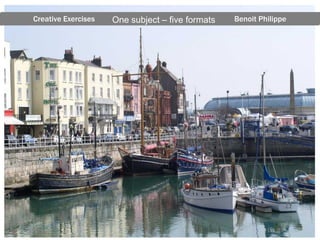
       One subject – five formats
       Instructions

       Draw 5 different compositions in the frames provided
       using the reference photograph on the next page or
       part of it.

       You don’t have to be a slave to the photograph but
       each drawing should include at least one element taken
       from it.

       Ready? Go to the next pages.


                                                                                  7
Creative Exercises   One subject – five formats   Benoit Philippe


                                                                    8
Creative Exercises   One subject – five formats   Benoit Philippe


                                                                    9
Creative Exercises                                              Benoit Philippe


       The stained glass window exercise
       Instructions

       Take a colour or a black and white photograph and a
       thick black felt pen and outline the main shapes. You
       can also do the same by using a sheet of tracing paper
       placed on top of the photograph.

       Your goal is to get down to a minimum number of
       shapes. Try to synthesise shapes by overlooking small
       details.

       This exercise will raise your awareness of different
       shapes (size, orientation) and the way they interlock.


                                                                                  10
Creative Exercises                                                 Benoit Philippe


       Mind the gap
       Instructions

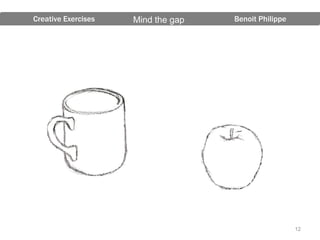
       Print the next page, which features two distant objects.
       With a pencil, draw other objects to link the two objects
       already on the page in a pleasing composition.

       This exercise will make you better at composing
       paintings.

                  “Henry James said that genius is the act of
                  perceiving similarity among disparate things. In
                  an empty room, you’re to connect the dots,
                  linking A to B to C to maybe come-up with H.”
                                          Twyla Tharp – “The Creative Habit:
                                          Learn It and Use It for Life”
                                                                                     11
Creative Exercises   Mind the gap   Benoit Philippe


                                                      12
Creative Exercises                                              Benoit Philippe


       Hello Monsieur Duchamp
       Readymades

       The French artist Marcel Duchamp (28th July 1887 – 2nd
       October 1968) is known for his “readymades”, pieces of art
       made of ordinary manufactured objects that he selected
       and then modified (sometimes by just signing them).

       He created in 1917 the most (in)famous of these artworks,
       titled Fountain, a simple ceramic urinal bearing the artist’s
       signature.

       In homage to Marcel Duchamp, you are going to use an
       ordinary manufactured object as your starting point.


                                                                                  13
Creative Exercises                                              Benoit Philippe


       Hello Monsieur Duchamp
       Instructions

       Cut out an everyday object in a photo.
       Stick it onto a piece of paper.

       Draw or paint something using the object as a starting
       point.

       The object cannot be used for what it is (for instance, if
       you use a glass, you can’t just draw someone holding
       the glass. That would be too easy…and boring).


                                                                    Can opener robot


                                                                                  14
Creative Exercises                                                Benoit Philippe


       3 strikes and you are out
       Instructions

       The following page contains 15 squares. For each
       square, you are allowed only 3 lines (or circles or
       points). You can start anywhere in the square. When
       you lift your pen from the paper, that’s the end of your
       line.
       You have to stop when you touch a side of the square.
       Repeat for each of the 15 squares. All squares should
       be different.

       Go to the next page to start


                                                                                    15
Creative Exercises   3 strikes and you are out   Benoit Philippe


                                                                   16
Creative Exercises                                                    Benoit Philippe


       No lifting in this area
       Instructions

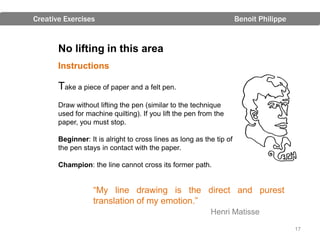
       Take a piece of paper and a felt pen.
       Draw without lifting the pen (similar to the technique
       used for machine quilting). If you lift the pen from the
       paper, you must stop.

       Beginner: It is alright to cross lines as long as the tip of
       the pen stays in contact with the paper.

       Champion: the line cannot cross its former path.


                   “My line drawing is the direct and purest
                   translation of my emotion.”
                                                           Henri Matisse

                                                                                        17
Creative Exercises                                                Benoit Philippe


       Negative thinking
       Instructions

       You   need a sheet of smooth drawing paper, one
       charcoal stick, a kneadable eraser and some fixative (if
       you want to keep the result)

       Take the piece of paper and blacken it with charcoal.

       Use an eraser to remove the charcoal to reveal the light
       areas and draw a landscape, a figure or a portrait.


                                                                                    18
Creative Exercises                                              Benoit Philippe


       Ready, Steady, Paint!
       Materials

       Kitchen timer or chronometer.
       Reference photograph.
       3 supports of the same size for your chosen medium. For oil paint
       and acrylic paint, I recommend that you use a small format (6” x 8” /
       15cm x 20cm). For watercolour, something close to an A4 will work.
       Paint (Watercolour, oil paint or acrylic paint).
       Assortment of brushes.
       Usual equipment for your chosen medium.

       Time
       2 hours (plus initial preparation of your set-up)

                                                                                  19
Creative Exercises                                                Benoit Philippe


       Ready, Steady, Paint!
       Instructions
       In this exercise, you are going to work against the clock. You
       will paint the same subject three times. Each painting must be
       completed in a shorter time than the previous painting. This is
       the artist’s equivalent of runners’ interval training.

       First interval: Take your first small support, set a timer to 45
       minutes, and aim to complete the painting within that time. Stop
       painting when the alarm goes off.

       Rest for 15 minutes – put the first painting away, out of sight,
       and go make some coffee or get some fresh air with a short
       walk.


                                                                                    20
Creative Exercises                                               Benoit Philippe


       Ready, Steady, Paint!
       Instructions
       Second interval: Same as before but with the timer set to 30
       minutes. Although the time available is shorter, you already
       know the subject as you painted it once before. When the alarm
       goes off, stop and put the second painting away.

       Relax for 15 minutes.

       Third interval: Same as before but with the timer set to 15
       minutes. No real time to think or fiddle here. Paint with your
       instinct.

       When you are finished, put all three paintings side by side.
       Which one do you prefer? Why?


                                                                                   21
Creative Exercises                                 Benoit Philippe


       The bat exercise


       “One day, I saw Lewis-Brown turn upside down
       a Hunting Party painting he had just finished.
       He told me: It is the best way to judge a
       painting because this way you only see
       values.”
          Ambroise Vollard – “Recollections of a Picture Dealer”


                                                                     22
Creative Exercises                                            Benoit Philippe


       The bat exercise
       Instructions
       Trace a grid on your reference photograph (or on a protective
       plastic sleeve where you insert the photograph) and a similar one
       on your support, then place the photograph upside down and
       make a rough design of the shapes on the support using the grid
       for accurate placement.

       Paint the subject while keeping both your work and your model
       upside down.

       Only turn over your painting and your reference photograph when
       you consider that your work is finished.


                                                                                23
Creative Exercises                                                Benoit Philippe


       3 colours only
       Instructions

       Create a painting using only 3 colours (if you use
       watercolour). You can add white if you are painting with
       oil or acrylic paint.

       Beginner: pick 1 blue, 1 red and 1 yellow.

       Champion: pick 3 tubes of colours at random out of
       your paint box.

                  “One works with a few colours; what gives the
                  illusion of their number is that they have been
                  put in their right place.”
                                                        Pablo Picasso


                                                                                    24
Creative Exercises                                                 Benoit Philippe


       One big brush only
       Instructions

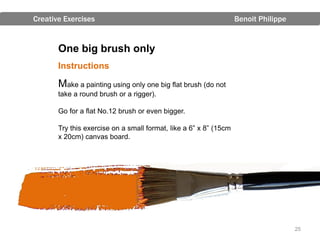
       Make a painting using only one big flat brush (do not
       take a round brush or a rigger).

       Go for a flat No.12 brush or even bigger.

       Try this exercise on a small format, like a 6” x 8” (15cm
       x 20cm) canvas board.


                                                                                     25
Creative Exercises                                               Benoit Philippe


       Matisse’s scissors
       Instructions

       You need several sheets of medium weight paper, a
       selection of gouache, acrylic or watercolour paints,
       some glue and a pair of scissors.

       Paint several sheets of paper with flat colours (or use
       coloured paper).

       When they are dry, cut out coloured shapes using the
       scissors and compose your work by gluing them on a
       white sheet of paper.

                  “Cutting in the quick of a colour reminds me of
                  the sculptor’s direct carving.”
                                                         Henri Matisse

                                                                                   26
Creative Exercises                                        Benoit Philippe


       The Constable Memory Exercise

       “It now became apparent to Constable’s friends that his
       health was declining. It was, I believe, at this time that Sir
       George Beaumont undertook to be his physician, and
       prescribed for him that he should copy a picture entirely from
       memory. He was to walk every day to Sir George’s house in
       Grosvenor Square, look at the picture as long as he
       pleased, then return home and paint as much of it as he had
       retained in his recollection, until the copy was finished. The
       regular exercise and the change of scene, combined with an
       agreeable and not too arduous employment were to work
       the cure. The picture selected was a landscape by Wilson,
       and the experiment was tried, but the malady under which
       Constable laboured was not to be easily removed.”
                     CR Leslie - “Memoirs of the life of John Constable”
                                                                            27
Creative Exercises                                                 Benoit Philippe


       The Constable Memory Exercise
       Instructions
       Select a painting you like by an artist you like. Life is too short
       to paint something you don’t have feeling for.

       If you live close to an art museum (and the entry is free or you
       hold an annual pass), select the painting to work from in the
       museum’s gallery. Working from an original painting will bring
       you more benefits.

       If you work from a reproduction, keep your model outside of
       your studio (in your office or in a different room).

       Take all the time you need to observe the painting you are
       copying. Then, paint only a portion of the painting each day
       from memory. Building-up the mental image of the model over
       time is part of the exercise. This image should become clearer
       and clearer as time passes.

                                                                                     28
Creative Exercises                                              Benoit Philippe


       Let’s doodle together
       Instructions
       Number of participants: two or more. You need a piece of
       paper and pens of different colours (one per participant).

       The first person draws something in the middle of the page.

       The second person takes over and creates another drawing
       using part of the previous one and transforming it into
       something new, often totally unrelated. The drawing is then
       passed to the next person.

       Each person must use an element already in the drawing. You
       cannot start an independent drawing.

       You can turn the paper around. This helps to see shapes in new
       ways.


                                                                                  29
Creative Exercises                                               Benoit Philippe


       Exquisite corpse

       This is a collective exercise for 2 to 4 people. You just need 1
       strip of paper and 1 pen or pencil.

       The group is going to draw a person (in a broad sense, as it
       could end-up being part animal, robot, monster or whatever
       your imagination tells you).


       «EXQUISITE CORPSE. – Game using a folded
       paper that consists in having several persons
       composing a sentence or a drawing, without any of
       them being able to take into account the preceding
       contributions.»
                                   Abridged Dictionary of Surrealism


                                                                                   30
Creative Exercises                                              Benoit Philippe


       Exquisite corpse
       Instructions
       The first person draws the head and then folds the strip of paper
       several times, only leaving visible two marks to indicate the base of the
       neck.

       The second person draws the torso and both arms and folds the paper
       in the same way. Six small lines should be visible below the fold (two
       for the left wrist, two for the waist and two for the right wrist).

       The next person draws the body from the waist to the knees as well as
       both hands (or claws or mechanical parts, etc.).

       The last person draws the lower part of the legs (from the knees) and
       the feet.

       At the end the paper strip is unfolded to reveal the strange creature
       born from the collaborative imagination of the players.

                                                                                   31
Creative Exercises   Exquisite corpse   Benoit Philippe


                                                          32
Creative Exercises                            Benoit Philippe


       Fire-up your imagination

       “I have in the past seen in clouds and walls
       stains which have inspired me to beautiful
       inventions of many things. These stains, while
       wholly in themselves deprived of perfection in
       any part, did not lack perfection in regard to
       their movements or other actions.”

                                  Leonardo da Vinci


                                                                33
Creative Exercises                                                Benoit Philippe


       Fire-up your imagination
       Instructions

       Who as a kid has not found animals, faces or people
       in clouds? Get into the habit of using random shapes to
       get your imagination started. Abstract shapes are seeds
       to grow your creativity from. The key is to keep an open
       mind and “question” the shape you discover.

       Find objects, animals and people in clouds, peeled bark
       on trees, moss, lichen, negative shapes in foliage,
       stains on old walls and geometric patterns on carpets or
       wallpapers.


                                                                                    34
Creative Exercises                                                Benoit Philippe


       What’s your title?
       Instructions
       Go to a museum or an art gallery.

       Look at the art first and don’t read the label.

       Try to come-up with one or two good titles for a work
       that inspires you.

       Then, read the label and see which title you prefer (the
       official one or yours).


                                                                                    35
Creative Exercises                                             Benoit Philippe


       About the author

       Benoit PHILIPPE is a French artist who now lives in
       England. He paints with oil, watercolour and pastels.

       You can see his work, sign-up for his free monthly newsletter
       and read more of his articles on his website and his blog:

       Website: http://www.benoitphilippe.com/

       Blog: http://myfrencheasel.blogspot.com/


       I would love to hear your feedback on this book. Please
       leave a comment on my blog.


                                                                                 36

Creative Exercises For Artists

  • 1.
  • 2.
    Creative Exercises Benoit Philippe © 2010 Benoit Philippe - You have the right to post this free eBook on blogs and websites, print it, share it with others or send it by email, as long as you don’t charge for it or modify it. 2
  • 3.
    Creative Exercises Benoit Philippe Exercises Portfolio Foreword One subject – five formats The stained glass window exercise Mind the gap Hello Monsieur Duchamp 3 strikes and you are out No lifting in this area Negative thinking Ready, Steady, Paint! The bat exercise 3 colours only One big brush only Matisse’s scissors The Constable Memory Exercise Let’s doodle together Exquisite corpse Fire-up your imagination What’s your title? 3
  • 4.
    Creative Exercises Benoit Philippe Foreword You said creativity? Creativity is a fascinating subject surrounded by many myths, the first one being that it is only a gift granted to a few at birth and therefore cannot be learnt or taught. It is hard to define creativity. To me, it is creating new combinations, displacing meaning and making ideas collide. There are excellent books on creativity, but many are designed for words and ideas rather than with the visual artist in mind. Creativity thrives on constraint and the exercises in this book are based on this principle. I learnt some of them years ago and I created some more to fulfil my own needs. 4
  • 5.
    Creative Exercises Benoit Philippe Who is this book for? I am a painter, so most of these exercises are visual ones. However, many of them do not require specific artistic skills and are suitable for anyone regardless of their age or level of artistic ability. You can use them as warm-up before you start a new project or as a way to explore new avenues. I hope teachers will use these exercises in their classes as they are great fun. 5
  • 6.
    Creative Exercises Benoit Philippe “Much of creative thinking involves combining previously unrelated ideas, goods or services and turning them into something new. The printing press was created by Gutenberg, who combined the coin punch with the wine press.” Michael Michalko – “Thinkertoys” 6
  • 7.
    Creative Exercises Benoit Philippe One subject – five formats Instructions Draw 5 different compositions in the frames provided using the reference photograph on the next page or part of it. You don’t have to be a slave to the photograph but each drawing should include at least one element taken from it. Ready? Go to the next pages. 7
  • 8.
    Creative Exercises One subject – five formats Benoit Philippe 8
  • 9.
    Creative Exercises One subject – five formats Benoit Philippe 9
  • 10.
    Creative Exercises Benoit Philippe The stained glass window exercise Instructions Take a colour or a black and white photograph and a thick black felt pen and outline the main shapes. You can also do the same by using a sheet of tracing paper placed on top of the photograph. Your goal is to get down to a minimum number of shapes. Try to synthesise shapes by overlooking small details. This exercise will raise your awareness of different shapes (size, orientation) and the way they interlock. 10
  • 11.
    Creative Exercises Benoit Philippe Mind the gap Instructions Print the next page, which features two distant objects. With a pencil, draw other objects to link the two objects already on the page in a pleasing composition. This exercise will make you better at composing paintings. “Henry James said that genius is the act of perceiving similarity among disparate things. In an empty room, you’re to connect the dots, linking A to B to C to maybe come-up with H.” Twyla Tharp – “The Creative Habit: Learn It and Use It for Life” 11
  • 12.
    Creative Exercises Mind the gap Benoit Philippe 12
  • 13.
    Creative Exercises Benoit Philippe Hello Monsieur Duchamp Readymades The French artist Marcel Duchamp (28th July 1887 – 2nd October 1968) is known for his “readymades”, pieces of art made of ordinary manufactured objects that he selected and then modified (sometimes by just signing them). He created in 1917 the most (in)famous of these artworks, titled Fountain, a simple ceramic urinal bearing the artist’s signature. In homage to Marcel Duchamp, you are going to use an ordinary manufactured object as your starting point. 13
  • 14.
    Creative Exercises Benoit Philippe Hello Monsieur Duchamp Instructions Cut out an everyday object in a photo. Stick it onto a piece of paper. Draw or paint something using the object as a starting point. The object cannot be used for what it is (for instance, if you use a glass, you can’t just draw someone holding the glass. That would be too easy…and boring). Can opener robot 14
  • 15.
    Creative Exercises Benoit Philippe 3 strikes and you are out Instructions The following page contains 15 squares. For each square, you are allowed only 3 lines (or circles or points). You can start anywhere in the square. When you lift your pen from the paper, that’s the end of your line. You have to stop when you touch a side of the square. Repeat for each of the 15 squares. All squares should be different. Go to the next page to start 15
  • 16.
    Creative Exercises 3 strikes and you are out Benoit Philippe 16
  • 17.
    Creative Exercises Benoit Philippe No lifting in this area Instructions Take a piece of paper and a felt pen. Draw without lifting the pen (similar to the technique used for machine quilting). If you lift the pen from the paper, you must stop. Beginner: It is alright to cross lines as long as the tip of the pen stays in contact with the paper. Champion: the line cannot cross its former path. “My line drawing is the direct and purest translation of my emotion.” Henri Matisse 17
  • 18.
    Creative Exercises Benoit Philippe Negative thinking Instructions You need a sheet of smooth drawing paper, one charcoal stick, a kneadable eraser and some fixative (if you want to keep the result) Take the piece of paper and blacken it with charcoal. Use an eraser to remove the charcoal to reveal the light areas and draw a landscape, a figure or a portrait. 18
  • 19.
    Creative Exercises Benoit Philippe Ready, Steady, Paint! Materials Kitchen timer or chronometer. Reference photograph. 3 supports of the same size for your chosen medium. For oil paint and acrylic paint, I recommend that you use a small format (6” x 8” / 15cm x 20cm). For watercolour, something close to an A4 will work. Paint (Watercolour, oil paint or acrylic paint). Assortment of brushes. Usual equipment for your chosen medium. Time 2 hours (plus initial preparation of your set-up) 19
  • 20.
    Creative Exercises Benoit Philippe Ready, Steady, Paint! Instructions In this exercise, you are going to work against the clock. You will paint the same subject three times. Each painting must be completed in a shorter time than the previous painting. This is the artist’s equivalent of runners’ interval training. First interval: Take your first small support, set a timer to 45 minutes, and aim to complete the painting within that time. Stop painting when the alarm goes off. Rest for 15 minutes – put the first painting away, out of sight, and go make some coffee or get some fresh air with a short walk. 20
  • 21.
    Creative Exercises Benoit Philippe Ready, Steady, Paint! Instructions Second interval: Same as before but with the timer set to 30 minutes. Although the time available is shorter, you already know the subject as you painted it once before. When the alarm goes off, stop and put the second painting away. Relax for 15 minutes. Third interval: Same as before but with the timer set to 15 minutes. No real time to think or fiddle here. Paint with your instinct. When you are finished, put all three paintings side by side. Which one do you prefer? Why? 21
  • 22.
    Creative Exercises Benoit Philippe The bat exercise “One day, I saw Lewis-Brown turn upside down a Hunting Party painting he had just finished. He told me: It is the best way to judge a painting because this way you only see values.” Ambroise Vollard – “Recollections of a Picture Dealer” 22
  • 23.
    Creative Exercises Benoit Philippe The bat exercise Instructions Trace a grid on your reference photograph (or on a protective plastic sleeve where you insert the photograph) and a similar one on your support, then place the photograph upside down and make a rough design of the shapes on the support using the grid for accurate placement. Paint the subject while keeping both your work and your model upside down. Only turn over your painting and your reference photograph when you consider that your work is finished. 23
  • 24.
    Creative Exercises Benoit Philippe 3 colours only Instructions Create a painting using only 3 colours (if you use watercolour). You can add white if you are painting with oil or acrylic paint. Beginner: pick 1 blue, 1 red and 1 yellow. Champion: pick 3 tubes of colours at random out of your paint box. “One works with a few colours; what gives the illusion of their number is that they have been put in their right place.” Pablo Picasso 24
  • 25.
    Creative Exercises Benoit Philippe One big brush only Instructions Make a painting using only one big flat brush (do not take a round brush or a rigger). Go for a flat No.12 brush or even bigger. Try this exercise on a small format, like a 6” x 8” (15cm x 20cm) canvas board. 25
  • 26.
    Creative Exercises Benoit Philippe Matisse’s scissors Instructions You need several sheets of medium weight paper, a selection of gouache, acrylic or watercolour paints, some glue and a pair of scissors. Paint several sheets of paper with flat colours (or use coloured paper). When they are dry, cut out coloured shapes using the scissors and compose your work by gluing them on a white sheet of paper. “Cutting in the quick of a colour reminds me of the sculptor’s direct carving.” Henri Matisse 26
  • 27.
    Creative Exercises Benoit Philippe The Constable Memory Exercise “It now became apparent to Constable’s friends that his health was declining. It was, I believe, at this time that Sir George Beaumont undertook to be his physician, and prescribed for him that he should copy a picture entirely from memory. He was to walk every day to Sir George’s house in Grosvenor Square, look at the picture as long as he pleased, then return home and paint as much of it as he had retained in his recollection, until the copy was finished. The regular exercise and the change of scene, combined with an agreeable and not too arduous employment were to work the cure. The picture selected was a landscape by Wilson, and the experiment was tried, but the malady under which Constable laboured was not to be easily removed.” CR Leslie - “Memoirs of the life of John Constable” 27
  • 28.
    Creative Exercises Benoit Philippe The Constable Memory Exercise Instructions Select a painting you like by an artist you like. Life is too short to paint something you don’t have feeling for. If you live close to an art museum (and the entry is free or you hold an annual pass), select the painting to work from in the museum’s gallery. Working from an original painting will bring you more benefits. If you work from a reproduction, keep your model outside of your studio (in your office or in a different room). Take all the time you need to observe the painting you are copying. Then, paint only a portion of the painting each day from memory. Building-up the mental image of the model over time is part of the exercise. This image should become clearer and clearer as time passes. 28
  • 29.
    Creative Exercises Benoit Philippe Let’s doodle together Instructions Number of participants: two or more. You need a piece of paper and pens of different colours (one per participant). The first person draws something in the middle of the page. The second person takes over and creates another drawing using part of the previous one and transforming it into something new, often totally unrelated. The drawing is then passed to the next person. Each person must use an element already in the drawing. You cannot start an independent drawing. You can turn the paper around. This helps to see shapes in new ways. 29
  • 30.
    Creative Exercises Benoit Philippe Exquisite corpse This is a collective exercise for 2 to 4 people. You just need 1 strip of paper and 1 pen or pencil. The group is going to draw a person (in a broad sense, as it could end-up being part animal, robot, monster or whatever your imagination tells you). «EXQUISITE CORPSE. – Game using a folded paper that consists in having several persons composing a sentence or a drawing, without any of them being able to take into account the preceding contributions.» Abridged Dictionary of Surrealism 30
  • 31.
    Creative Exercises Benoit Philippe Exquisite corpse Instructions The first person draws the head and then folds the strip of paper several times, only leaving visible two marks to indicate the base of the neck. The second person draws the torso and both arms and folds the paper in the same way. Six small lines should be visible below the fold (two for the left wrist, two for the waist and two for the right wrist). The next person draws the body from the waist to the knees as well as both hands (or claws or mechanical parts, etc.). The last person draws the lower part of the legs (from the knees) and the feet. At the end the paper strip is unfolded to reveal the strange creature born from the collaborative imagination of the players. 31
  • 32.
    Creative Exercises Exquisite corpse Benoit Philippe 32
  • 33.
    Creative Exercises Benoit Philippe Fire-up your imagination “I have in the past seen in clouds and walls stains which have inspired me to beautiful inventions of many things. These stains, while wholly in themselves deprived of perfection in any part, did not lack perfection in regard to their movements or other actions.” Leonardo da Vinci 33
  • 34.
    Creative Exercises Benoit Philippe Fire-up your imagination Instructions Who as a kid has not found animals, faces or people in clouds? Get into the habit of using random shapes to get your imagination started. Abstract shapes are seeds to grow your creativity from. The key is to keep an open mind and “question” the shape you discover. Find objects, animals and people in clouds, peeled bark on trees, moss, lichen, negative shapes in foliage, stains on old walls and geometric patterns on carpets or wallpapers. 34
  • 35.
    Creative Exercises Benoit Philippe What’s your title? Instructions Go to a museum or an art gallery. Look at the art first and don’t read the label. Try to come-up with one or two good titles for a work that inspires you. Then, read the label and see which title you prefer (the official one or yours). 35
  • 36.
    Creative Exercises Benoit Philippe About the author Benoit PHILIPPE is a French artist who now lives in England. He paints with oil, watercolour and pastels. You can see his work, sign-up for his free monthly newsletter and read more of his articles on his website and his blog: Website: http://www.benoitphilippe.com/ Blog: http://myfrencheasel.blogspot.com/ I would love to hear your feedback on this book. Please leave a comment on my blog. 36