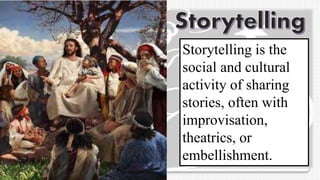
Storytelling is the
social and cultural
activity of sharing
stories, often with
improvisation,
theatrics, or
embellishment.
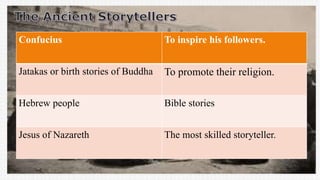
Confucius To inspire his followers.
Jatakas or birth stories of Buddha To promote their religion.
Hebrew people Bible stories
Jesus of Nazareth The most skilled storyteller.
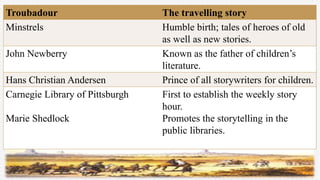
Troubadour The travelling story
Minstrels Humble birth; tales of heroes of old
as well as new stories.
John Newberry Known as the father of children’s
literature.
Hans Christian Andersen Prince of all storywriters for children.
Carnegie Library of Pittsburgh
Marie Shedlock
First to establish the weekly story
hour.
Promotes the storytelling in the
public libraries.
Intellectual values
 A story....
- Bring life.
- Attractive.
- Language must be suited.
- Pointed out that people of the same age with
different interests
- The moral influence is positive
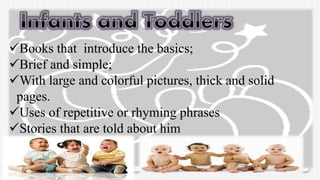
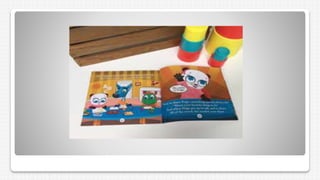
Books that introduce the basics;
Brief and simple;
With large and colorful pictures, thick and solid
pages.
Uses of repetitive or rhyming phrases
Stories that are told about him
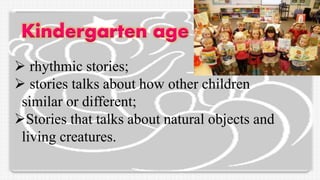
Kindergarten age
 rhythmic stories;
 stories talks about how other children
similar or different;
Stories that talks about natural objects and
living creatures.
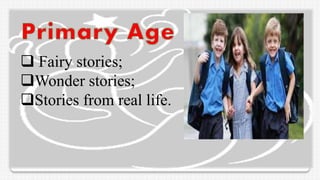
 Fairy stories;
Wonder stories;
Stories from real life.
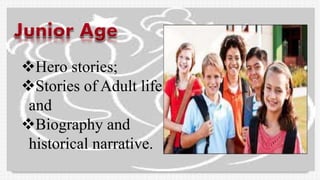
Hero stories;
Stories of Adult life
and
Biography and
historical narrative.
oRomance stories;
oHigh idealism;
oLoyalty to principle
-Selecting books to read aloud
-Learn the plot of the story;
-Live with the characters;
-Envision of the environment;
-Analyze the story;
-Practice makes perfect
-Interest;
-Try them out several times on your own
first;
-Try a bit of dramatic;
-The children can join with;
-Skip the unnecessary.
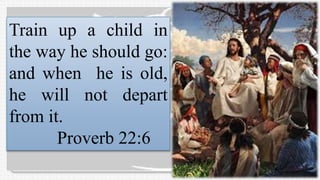
Train up a child in
the way he should go:
and when he is old,
he will not depart
from it.
Proverb 22:6
References:
1. Royal, Claudia. (1955) Storytelling Broadman Press:
Nashville, Tennessee.
2. Retrieved from URL http://oureverydaylife.com/criteria-
used-select-story-children-13101.html
National Trust () Storytelling tips.
Bruce Potts () Storytelling tips for primary teachers Retrieved
from URL
http://www.teachprimary.com/learning_resources/view/storytelli
ng-tips-for-primary-teachers
Stoytelling

Stoytelling

  • 2.
    Storytelling is the socialand cultural activity of sharing stories, often with improvisation, theatrics, or embellishment.
  • 3.
    Confucius To inspirehis followers. Jatakas or birth stories of Buddha To promote their religion. Hebrew people Bible stories Jesus of Nazareth The most skilled storyteller.
  • 4.
    Troubadour The travellingstory Minstrels Humble birth; tales of heroes of old as well as new stories. John Newberry Known as the father of children’s literature. Hans Christian Andersen Prince of all storywriters for children. Carnegie Library of Pittsburgh Marie Shedlock First to establish the weekly story hour. Promotes the storytelling in the public libraries.
  • 6.
  • 8.
     A story.... -Bring life. - Attractive. - Language must be suited. - Pointed out that people of the same age with different interests - The moral influence is positive
  • 9.
    Books that introducethe basics; Brief and simple; With large and colorful pictures, thick and solid pages. Uses of repetitive or rhyming phrases Stories that are told about him
  • 11.
    Kindergarten age  rhythmicstories;  stories talks about how other children similar or different; Stories that talks about natural objects and living creatures.
  • 13.
     Fairy stories; Wonderstories; Stories from real life.
  • 15.
    Hero stories; Stories ofAdult life and Biography and historical narrative.
  • 17.
  • 20.
    -Selecting books toread aloud -Learn the plot of the story; -Live with the characters; -Envision of the environment; -Analyze the story;
  • 21.
    -Practice makes perfect -Interest; -Trythem out several times on your own first; -Try a bit of dramatic; -The children can join with; -Skip the unnecessary.
  • 24.
    Train up achild in the way he should go: and when he is old, he will not depart from it. Proverb 22:6
  • 25.
    References: 1. Royal, Claudia.(1955) Storytelling Broadman Press: Nashville, Tennessee. 2. Retrieved from URL http://oureverydaylife.com/criteria- used-select-story-children-13101.html National Trust () Storytelling tips. Bruce Potts () Storytelling tips for primary teachers Retrieved from URL http://www.teachprimary.com/learning_resources/view/storytelli ng-tips-for-primary-teachers

Editor's Notes

  • #3 In man’s earliest times, before there was even picture, drawings or written words, there was a storytelling. For centuries, stories were passed on by word of mouth, from one another. Stories or narratives have been shared in every culture as a means of entertainment, education, cultural preservation and installing more values
  • #4 According to Moulton “ stories are the oldest transmitted culture and the most formative. with his religion and morals. These are the stories which Buddha is pictured in his earlier incarnations in the bodies of the animals. He illustrated his spiritual truths and principles of right living with stories from everyday life. The Far East, the cradle civilization, is considered the original home of the fable and the fairytale.
  • #5 Received his board and keep as well as many favors in exchange for the entertainment. He was given the tenth place of honor from the king. 2. They told stories in exchange for a warm meal and night’s lodging. 3. The firs man recognize the lack in children’s literature and the need for stories to be delight and pleasure to children.. He opened a bookshop for children in the heart of London. ‘Juvenile Library. 4. He satisfied one of the needs of the childhood- that of giving life to the inanimate world. For example the Alice in Wonderland. Make-believe in spirit. 5. She bring her listeners under the magic spell of her tales.
  • #6 The evil tendencies can be controlled and bad habits can be corrected. When this cheerful attitude is present, the life of the spirit grows and vital powers are added to the soul. The story causes contentment and satisfaction to take the place of restlessness and disorder. 5. It enters into the experience of others thus a kindled sympathy and an understanding of life outside his own. 6. The story is unifying art and draws people together just as singing does.
  • #7 It teaches truth in concrete from. Little children cannot understand abstract or symbolic information. They do understand childife stories about people and things that they are related. Children may become acquainted with the great characters of literature which all well-informed people should know and for which there is so little time in later years. In repeating the stories may lose his self-consciousness an his personality has a chance to grow.
  • #10 Sing Sing accompanied by movement of fingers, lullabies and nursery rhymes
  • #12 Not only in phrases or sounds but also in stories
  • #19 In Choosing a story , we need to consider the following: - The ages of the children •  Their prior experience •  The level of language used in your story •  The children’s conceptual understanding of the subject matter •  The length of the story •  Whether they’ve heard it before
  • #21 Read and think until it familiarize Imprint the image of the character in your mind The geography and the customs Introduction- direct and it creates the atmosphere. ACCORDING TO Margaret Eggleston it anwers the question, Who, When and where Body of the Story- contains a series of closely connected events leading to a climax. There should be no digression (iba) or regression (binawasan) climax- makes the deepest impression. The surprise element and dramatically untold. Conclusion- the storyteller must never give the moral lesson. If the story is well told, the listeners already will have received their moral.