Studio Habits
of Mind
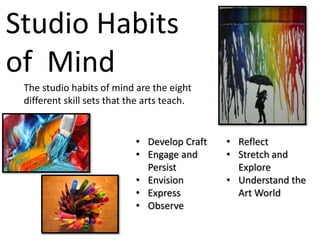
The studio habits of mind are the eight
different skill sets that the arts teach.
• Develop Craft
• Engage and
Persist
• Envision
• Express
• Observe
• Reflect
• Stretch and
Explore
• Understand the
Art World
Develop Craft
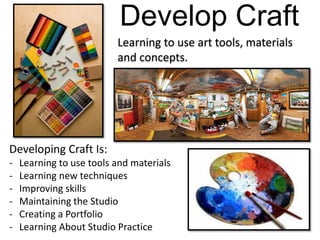
Learning to use art tools, materials
and concepts.
Developing Craft Is:
- Learning to use tools and materials
- Learning new techniques
- Improving skills
- Maintaining the Studio
- Creating a Portfolio
- Learning About Studio Practice
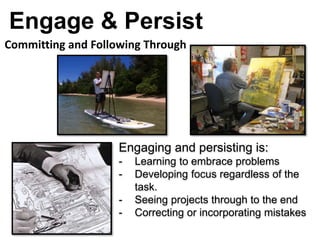
Engage & Persist
Engaging and persisting is:
- Learning to embrace problems
- Developing focus regardless of the
task.
- Seeing projects through to the end
- Correcting or incorporating mistakes
Committing and Following Through
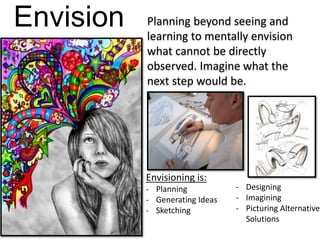
Envision Planning beyond seeing and
learning to mentally envision
what cannot be directly
observed. Imagine what the
next step would be.
Envisioning is:
- Planning
- Generating Ideas
- Sketching
- Designing
- Imagining
- Picturing Alternative
Solutions
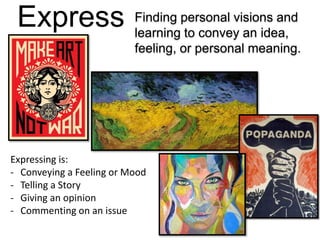
Express Finding personal visions and
learning to convey an idea,
feeling, or personal meaning.
Expressing is:
- Conveying a Feeling or Mood
- Telling a Story
- Giving an opinion
- Commenting on an issue
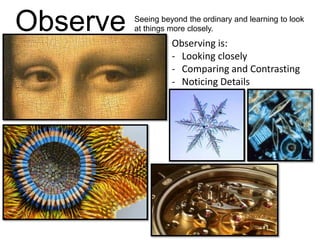
Observe Seeing beyond the ordinary and learning to look
at things more closely.
Observing is:
- Looking closely
- Comparing and Contrasting
- Noticing Details
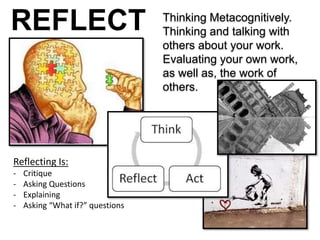
REFLECT Thinking Metacognitively.
Thinking and talking with
others about your work.
Evaluating your own work,
as well as, the work of
others.
Reflecting Is:
- Critique
- Asking Questions
- Explaining
- Asking “What if?” questions
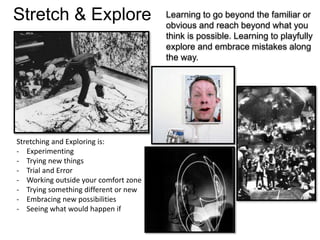
Stretch & Explore Learning to go beyond the familiar or
obvious and reach beyond what you
think is possible. Learning to playfully
explore and embrace mistakes along
the way.
Stretching and Exploring is:
- Experimenting
- Trying new things
- Trial and Error
- Working outside your comfort zone
- Trying something different or new
- Embracing new possibilities
- Seeing what would happen if
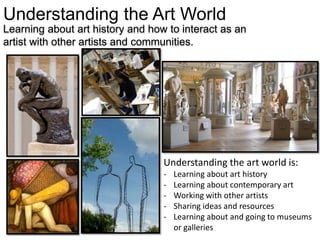
Understanding the Art World
Learning about art history and how to interact as an
artist with other artists and communities.
Understanding the art world is:
- Learning about art history
- Learning about contemporary art
- Working with other artists
- Sharing ideas and resources
- Learning about and going to museums
or galleries
Engage&Persist
Sentence Starters
• What helped me stay focused was…
• The hardest part was…
• When I had difficulty, the way I solved the
problem was…
Follow a task through to completion.
Be able to learn from others.
Envision
Be able to generate alternatives, consider other options.
Sentence Starters
• First, I pictured…
• I imagined that if
I…
• My plan for the
project unfolded
like this…
DevelopCraft
Sentence Starters
• I improved my technique of…
• I showed great care with…
•My works look polished and well crafted
because…
Express
Sentence Starters
• One thing that is unique about my work is…
• This work is an expression of my feelings
because…
Observe
Gather data through all
senses: taste, touch,
smell, hearing, and
sight.
Sentence Starters
•The detail that captured my
imagination was...
•I never noticed before
that…
•I practiced the ability to
observe closely by…
Reflect
Sentence Starters
• As I reflect on my work, I think…
• What I think makes this a strong piece is…
•What I would do differently next time is…
Stretch&Explore
Sentence Starters
• I tried something that I had never done before
when I…
• The unexpected thing that happened in this
work was…
• My mistake helped me to…
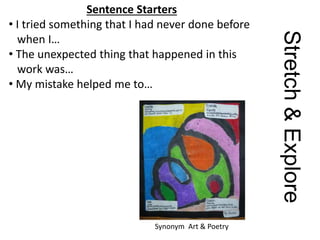
Synonym Art & Poetry
UnderstandingtheArt
World
Sentence Starters
• I was influenced by studying the art of…
• My classmates on this project helped me
realize that…
• I collaborated effectively with others when I…
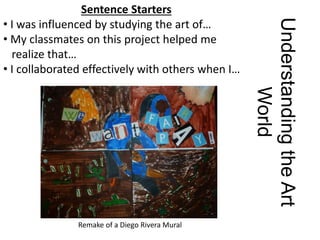
Remake of a Diego Rivera Mural

Studio habits slideshow

  • 1.
    Studio Habits of Mind Thestudio habits of mind are the eight different skill sets that the arts teach. • Develop Craft • Engage and Persist • Envision • Express • Observe • Reflect • Stretch and Explore • Understand the Art World
  • 2.
    Develop Craft Learning touse art tools, materials and concepts. Developing Craft Is: - Learning to use tools and materials - Learning new techniques - Improving skills - Maintaining the Studio - Creating a Portfolio - Learning About Studio Practice
  • 3.
    Engage & Persist Engagingand persisting is: - Learning to embrace problems - Developing focus regardless of the task. - Seeing projects through to the end - Correcting or incorporating mistakes Committing and Following Through
  • 4.
    Envision Planning beyondseeing and learning to mentally envision what cannot be directly observed. Imagine what the next step would be. Envisioning is: - Planning - Generating Ideas - Sketching - Designing - Imagining - Picturing Alternative Solutions
  • 5.
    Express Finding personalvisions and learning to convey an idea, feeling, or personal meaning. Expressing is: - Conveying a Feeling or Mood - Telling a Story - Giving an opinion - Commenting on an issue
  • 6.
    Observe Seeing beyondthe ordinary and learning to look at things more closely. Observing is: - Looking closely - Comparing and Contrasting - Noticing Details
  • 7.
    REFLECT Thinking Metacognitively. Thinkingand talking with others about your work. Evaluating your own work, as well as, the work of others. Reflecting Is: - Critique - Asking Questions - Explaining - Asking “What if?” questions
  • 8.
    Stretch & ExploreLearning to go beyond the familiar or obvious and reach beyond what you think is possible. Learning to playfully explore and embrace mistakes along the way. Stretching and Exploring is: - Experimenting - Trying new things - Trial and Error - Working outside your comfort zone - Trying something different or new - Embracing new possibilities - Seeing what would happen if
  • 9.
    Understanding the ArtWorld Learning about art history and how to interact as an artist with other artists and communities. Understanding the art world is: - Learning about art history - Learning about contemporary art - Working with other artists - Sharing ideas and resources - Learning about and going to museums or galleries
  • 10.
    Engage&Persist Sentence Starters • Whathelped me stay focused was… • The hardest part was… • When I had difficulty, the way I solved the problem was… Follow a task through to completion. Be able to learn from others.
  • 11.
    Envision Be able togenerate alternatives, consider other options. Sentence Starters • First, I pictured… • I imagined that if I… • My plan for the project unfolded like this…
  • 12.
    DevelopCraft Sentence Starters • Iimproved my technique of… • I showed great care with… •My works look polished and well crafted because…
  • 13.
    Express Sentence Starters • Onething that is unique about my work is… • This work is an expression of my feelings because…
  • 14.
    Observe Gather data throughall senses: taste, touch, smell, hearing, and sight. Sentence Starters •The detail that captured my imagination was... •I never noticed before that… •I practiced the ability to observe closely by…
  • 15.
    Reflect Sentence Starters • AsI reflect on my work, I think… • What I think makes this a strong piece is… •What I would do differently next time is…
  • 16.
    Stretch&Explore Sentence Starters • Itried something that I had never done before when I… • The unexpected thing that happened in this work was… • My mistake helped me to… Synonym Art & Poetry
  • 17.
    UnderstandingtheArt World Sentence Starters • Iwas influenced by studying the art of… • My classmates on this project helped me realize that… • I collaborated effectively with others when I… Remake of a Diego Rivera Mural