International Journal of Science and Research (IJSR) 
ISSN (Online): 2319-7064 
Impact Factor (2012): 3.358 
Advanced Technique for Comprehensive Data 
Security 
Pramendra Kumar1, Vijay Kumar Sharma2 
1M.Tech Scholar, Department of Computer Science, RIET, Bhankrota, Jaipur, Rajasthan, India 
2Asst. Prof., Department of Computer Science, RIET, Bhankrota, Jaipur, Rajasthan, India 
Abstract: In any communication, security is the most important task. With the advancement of technology and the wide use of World 
Wide Web for communication increase the challenges of security. Most of the classical security method are based on cryptography and 
stegnography techniques, but every time these technologies may not be reliable for communication of secrete information over a long 
distance. Where cipher text may easily arouse attackers‘suspicion, the biggest concern in the field of steganography is the rapid 
advancement of research in steganalysis, the counter-technology of steganography. This merely means that steganography needs to add 
security services to its current repertoire, while not increasing the number of problems. However, in recent years, a lot of research has 
taken place in direction to trim down the security issues by contributing various approaches but different terrains pose separate 
challenges. These inadequacies of modern as well as traditional security methods, motivates to design a novel security system that 
improve the level of security. In this context, this paper has proposed a novel two layer security mechanism by combining the concepts of 
both, cryptography and stegnography techniques. 
Keywords: Cryptography, Stegnography, Security, Data hiding, Encryption 
1. Introduction 
From the past few decades, because of no boundary barriers 
of distance, easy accessing and the fast delivery of 
information the online web based system is more popular as 
a new communication media in between the end users. 
However, these online systems are vulnerable to a variety of 
well-known cyber-attacks. Cyber world needs high level of 
safeguard for expensive data during transmission over the 
open communication channel. The typical idea of security 
clearly assumes disjointing of users and attackers to provide 
safeguard against unauthorized access of secrete 
information. This need of security produce explosive growth 
of the field of information hiding which covers applications 
such as copyright protection for digital media, Cryptography, 
Steganography, Digital Watermarking and finger printing. 
All these applications of information hiding are quite 
diverse. However, the secrete information might be secure 
with the modern security techniques but most of the security 
methods are based on the cryptographic techniques. The aim 
of cryptography is to provide secure solutions to a set of 
parties who wish to carry out a distributed task and either do 
not trust each other or fear an external adversarial threat. The 
security method of cryptography encrypt plain text to 
generate cipher text, where the cyber attacker easily arouse 
these text and intercepts the communication between two 
separate users to modify, inject, or drop any communication 
packet [1, 2, 3]. The cryptography has several problems 
like; 
 The information that has been encrypted might be 
accidently utilized on something that was not meant to be 
encrypted, and the person who was meant to obtain the 
message may not be able to read the message sent to them 
at all. 
 Sometimes encryption may not be strong enough, and 
therefore, others may be able to easily intercept and 
interpret information. 
 The encryption might be used in order for criminals to be 
able to easily and effortlessly perform crimes. 
 Another drawback of cryptography is the limitations that 
have been enforced by certain governments, 
 Many governments have created laws to either limit the 
strength of cryptographic systems or to prohibit it 
altogether and sometimes even the possession of a 
cryptographic algorithm - is illegal in certain countries. 
To improve these limitations and to reduce the issues of 
cryptographic methods an alternative mechanism, the 
steganography has use widely. This is a powerful security 
tool that provides a high level of security, particularly when 
it is combined with encryption [4].Generally the concepts of 
this techniques differ from the cryptography, where the 
cryptography method converted the information in a 
encrypted form that an eavesdropper and cannot be 
understand, the Steganography technique embeds hidden 
content in unremarkable cover media so as not to arouse an 
eavesdropper’s suspicion in some cases, sending encrypted 
information may draw attention, while invisible information 
will not. 
Traditional steganography techniques rely on the encoding 
system’s secrecy to secure the information. The system able 
to provide security but have a problem that if attacker known 
than it is simple enough to expose the entire received media 
passing by to check for hidden messages ultimately, such a 
steganographic system fails. Beside this problem in 
steganography the image and video codec are block-based 
and possible bit-errors usually destroy the data only in a 
single block or even all the blocks in the rest of the row of 
macro blocks (slice). These block errors decrease the visual 
quality drastically. Hence, the concealment of such block 
losses is a realistic situation in many cases, except for the 
damage of some header information. On the other hand, the 
majority of steganographic systems uses images as cover 
media because people often transmit digital pictures over 
email and other Internet communication but this techniques 
in same case may produce the same results as previous one 
that shows the single security technique either cryptography 
Volume 3 Issue 10, October 2014 
www.ijsr.net 
Paper ID: OCT14465 1319 
Licensed Under Creative Commons Attribution CC BY
International Journal of Science and Research (IJSR) 
ISSN (Online): 2319-7064 
Impact Factor (2012): 3.358 
or steganography is not a turnkey solution to secure the 
secrete information over the open system. For a strong 
system it is always better to use both cryptography and 
steganography together. In this context, this paper has 
proposed a novel two layer security mechanism by 
combining the concepts of both, cryptography and 
stegnography technique. 
2. Related Work 
A novel image adaptive stegnographic technique have 
proposed in [5], in which the integer wavelet transform 
domain called as the Robust Image Adaptive Steganography 
using Integer Wavelet Transform. According to information 
theoretic prescriptions for parallel Gaussian models of 
images, data should be hidden in low and mid frequencies 
ranges of the host image, which have large energies.[6] 
worked out the specific design principles and elements of 
steganographic schemes for the JPEG format and their 
security. The detect ability is evaluated experimentally using 
a state of art blind steganalyser. 
A novel approach has been proposed a combination of three 
different LSB insertion algorithms [7] on GIF image through 
stegcure system. The unique feature about the stegcure is 
being able to integrate three algorithms in one 
Steganography system. By implementing public key 
infrastructure, unauthorized user is forbidden from 
intercepting the transmission of the covert data during a 
communication because the stego key is only known by the 
sender and the receiver. [8] Proposed a work which deals 
with public- key Steganography in presence of passive 
warden. The main aim is to hide the secret information 
within cover documents without giving the warden any clue 
and without any preliminary secret key sharing. This work 
explores the use of trellis coded quantization technique to 
design more efficient public key scheme. 
LSB based steganography algorithm presented [9] with high 
data hiding capacity as four LSB’s are used to hide data, 
high confidentiality as distortions which can cause 
suspicions for the intruders, are removed through filtering 
techniques and two level high security is applied. A security 
model is proposed which imposes the concept of secrecy 
over privacy for text messages [10]. The proposed model 
combines cryptography; steganography and along with an 
extra layer of security has been imposed in between them. A 
noval approach has been proposed a scheme embeds a 
larger-sized secret image while maintaining acceptable 
image quality of the stego-image [11] and also improved 
image hiding scheme for gray scale images based on wet 
paper coding. 
Author describe in [12], a steganographic model which 
utilizes cover video files to conceal the presence of other 
sensitive data regardless of its format. The model presented 
is based on pixel-wise manipulation of colored raw video 
files to embed the secret data. The paper also presents a 
quantitative evaluation of the model using four types of 
secret data. The model is evaluated in terms of both the 
average reduction in Peak Signal to Noise Ratio (PSNR) 
compared to the original cover video; as well as the Mean 
Square Error (MSE) measured between the original and 
steganographic files averaged over all video frames. 
The paper [13] proposes a new method for the real-time 
hiding of information used in compressed video Bit streams. 
The method is based on the real-time hiding of information 
in audio steganography. This method of steganography is 
very similar to the two discussions of image steganography 
and video steganography. A new compressed video secure 
steganography (CVSS) algorithm is proposed. In this 
algorithm, embedding and detection operations are both 
executed entirely in the compressed domain, with no need 
for the decompression process. In order to make faithful and 
secure communication, a dual layer hiding technique [14] 
proposed. 
The paper [15] presents hiding the data behind the image 
then encrypts the image byusing hyper-chaos encryption 
algorithm. In this algorithm, shuffling matrix and diffusing 
matrix are generated based on Chen’s hyper-chaotic system. 
Firstly, the Chen’s hyper-chaotic system is used to shuffle 
the position of the image pixels, and then use Chen’s hyper-chaotic 
system to confuse the relationship between the 
original image and the cipher image. 
A novel steganography technique mainly based on joint 
photographic expert group (JPEG) is proposed in [16]. This 
technique is based on 2-D Block-DCT, where DCT is used 
to transform original image (cover image) blocks from 
spatial domain to frequency domain. The proposed method 
provides acceptable image quality and a large message 
capacity. Overall, the proposed method matches the 
requirement of steganography with a larger message capacity 
and good image quality. The method has larger message 
capacity than Jpeg-Jsteg method. To ensure the security 
against the steganalysis attack, a new steganographic 
algorithm for 8bit(grayscale) or 24 bit (color image) is 
presented in paper [17], based on Logical operation. 
Algorithm embedded MSB of secret image in to LSB of 
cover image. In this n LSB of cover image, from a byte is 
replaced by n MSB of secret image. The image quality of the 
stego-image can be greatly improved with low extra 
computational complexity. The worst case mean-square-error 
between the stego-image and the cover-image is 
derived. A steganography technique which embeds the secret 
messages in frequency domain proposed in [18].Unlike the 
space domain approaches, secret messages are embedded in 
the high frequency coefficients resulted from Discrete 
Wavelet Transform. In proposed method cryptography 
algorithm is used to convert the secret messages to an 
unreadable form before embedding. Algorithms keep the 
messages from stealing, destroying from unintended users on 
the internet and hence provide satisfactory security. 
Blowfish algorithm is used for encryption and decryption of 
text message using a secret-key block cipher. Designed to 
increase security and to improve performance algorithm uses 
a variable key size up to 448 bits. 
A practical steganographic implementation ST-FMM [19] 
proposed to hide text inside grey scale images. Using the 
Five Modulus Method secret message is hidden inside the 
cover image. FMM consists of transforming all the pixels 
Volume 3 Issue 10, October 2014 
www.ijsr.net 
Paper ID: OCT14465 1320 
Licensed Under Creative Commons Attribution CC BY
International Journal of Science and Research (IJSR) 
ISSN (Online): 2319-7064 
Impact Factor (2012): 3.358 
within the 55 window size into its corresponding multiples 
of 5. After that, the secret message is hidden inside the 55 
window as a non-multiples of 5. Since the modulus of non-multiples 
of 5 are 1,2,3 and 4, therefore; if the reminder is 
one of these, then this pixel represents a secret character. 
The secret key that has to be sent is the window size. The 
main advantage of this novel algorithm is to keep the size of 
the cover image constant while the secret message increased 
in size. Peak signal-to-noise ratio is captured for each of the 
images tested. Based on the PSNR value of each images, the 
stego image has high PSNR value. Hence this new 
steganography algorithm is very efficient to hide the data 
inside the image. 
3. Proposed Work 
To apply the security for important data at the time of 
communication over unsecured channels the proposed 
approach provide two layer of security by combining the 
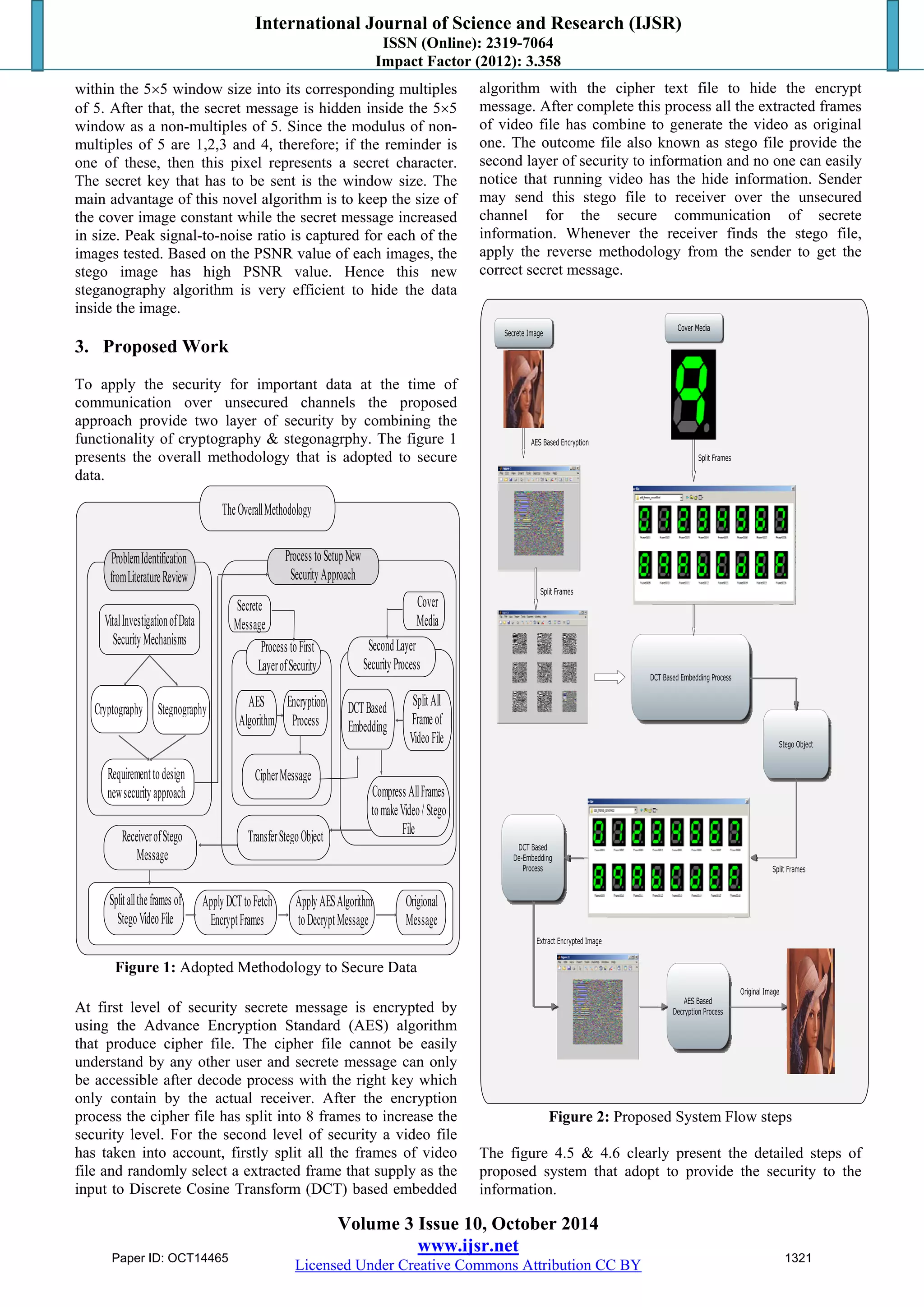
functionality of cryptography & stegonagrphy. The figure 1 
presents the overall methodology that is adopted to secure 
data. 
Figure 1: Adopted Methodology to Secure Data 
At first level of security secrete message is encrypted by 
using the Advance Encryption Standard (AES) algorithm 
that produce cipher file. The cipher file cannot be easily 
understand by any other user and secrete message can only 
be accessible after decode process with the right key which 
only contain by the actual receiver. After the encryption 
process the cipher file has split into 8 frames to increase the 
security level. For the second level of security a video file 
has taken into account, firstly split all the frames of video 
file and randomly select a extracted frame that supply as the 
input to Discrete Cosine Transform (DCT) based embedded 
algorithm with the cipher text file to hide the encrypt 
message. After complete this process all the extracted frames 
of video file has combine to generate the video as original 
one. The outcome file also known as stego file provide the 
second layer of security to information and no one can easily 
notice that running video has the hide information. Sender 
may send this stego file to receiver over the unsecured 
channel for the secure communication of secrete 
information. Whenever the receiver finds the stego file, 
apply the reverse methodology from the sender to get the 
correct secret message. 
Figure 2: Proposed System Flow steps 
The figure 4.5 & 4.6 clearly present the detailed steps of 
proposed system that adopt to provide the security to the 
information. 
Volume 3 Issue 10, October 2014 
www.ijsr.net 
Paper ID: OCT14465 1321 
Licensed Under Creative Commons Attribution CC BY
International Journal of Science and Research (IJSR) 
ISSN (Online): 2319-7064 
Impact Factor (2012): 3.358 
4. Experimental Results 
Experiments are carried out using the MATLAB to evaluate 
the performance of the proposed approach. Numerous 
experiments are performed to ensure the quality 
measurement between the cover frame (original frame) and 
the stego frame (Frame that hide the secrete message). The 
frame quality parameters peak signal to noise ratio (PSNR) 
is used to examine the quality of the proposed approach. 
4.1 Peak Signal to Noise Ratio (PSNR) 
PSNR is one of metrics to determine the degradation in the 
embedded image with respect to the host image. It shows the 
quality of image after hiding the data. For the quality 
measurement between the cover image (original image) and 
the stego image the ratio of difference between image quality 
parameters (PSNR) are often used. For the better quality of 
the stego image the higher value of the PSNR between 
original image and the stego image shows better quality of 
the image and also indicate lower error. To compute the 
value of the image quality parameter PSNR, first of all the 
block calculates the value of MSE (Mean Square Error) by 
using the following the mathematical equation 
Volume 3 Issue 10, October 2014 
www.ijsr.net 
Licensed Under Creative Commons Attribution CC BY 
Where 
MAXI=Maximum value of pixel in Original image 
m=No. of Row in Original image 
n= No. of Column in Original image 
In comparative analysis, proposed approach has executed 
with the same parameter as taken by [20]. Two video has 
taken in consideration (drop.avi, flame.avi) to evaluate 
results. 
Figure 3: Drop.avi 
Table 1 Present the comparative PSNR result of proposed 
approach against the techniques has been used in [20]. 
Table 1: PSNR Value of Frames 
Name of 
the 
video file 
Results obtained using 
Proposed Approach 
Results obtained using 
HLSB [60] 
Drop 46.2912 44.34 
Flame 50.2615 42.66 
Figure 4: Comparative Result of Proposed Approach 
The investigated approach has also not change its sizes as 
approach proposed in the [21], shown in following figures. 
Figure 5: Size based comparative results 
The results clearly indicated the superiority of the proposed 
approach over the other that has been indicated in the [20, 
21]. 
5. Conclusion and Future Work 
In current scenario technology face various challenges. 
Security of secrete message in one of the most challenging 
face in current scenario. In this term to provide more security 
Paper ID: OCT14465 1322
International Journal of Science and Research (IJSR) 
ISSN (Online): 2319-7064 
Impact Factor (2012): 3.358 
to the information at the time of communication over 
unsecured channel a novel advance technique for data 
security is proposed in this paper. The approach proposed 
two layer of security to the information by combining the 
cryptography and steganography technique. If a level of the 
proposed approach will fail to secure the information, 
message will be safe with the second level of security 
mechanism of proposed approach that is the key contribution 
of this work. 
For the future work the work can be done in direction to 
improve the time efficiency that proposed approach has 
taken into account to secure and retrieve the original 
information from the cover media. Apart from the time 
proposed way can be implemented with the audio file instead 
to video file to improve the hiding quality of the secrete 
message. 
References 
[1] Jefferson, D. et al. “Analyzing internet voting security”, 
Volume 3 Issue 10, October 2014 
www.ijsr.net 
Licensed Under Creative Commons Attribution CC BY 
2004. ACM, 47(10):59-64. 
[2] Schneier, B. “Secrets & Lies: Digital Security in a 
Networked World”. Wiley Computer Publishing. . 
[3] Xia, H. &Brustoloni, J.C. 2005. Hardening web 
browsers against main-in-the-middle and 
eavesdropping attacks. Proceedings of the International 
Conference on World Wide Web, 489-498. 
[4] Neil F. Johnson and SushilJajodia, “Steganalysis: The 
Investigation of Hidden Information,” IEEE conference 
on Information Technology, pp. 113-116, 1998. 
[5] Currie, D.L. & Irvine, C.E., “Surmounting the effects of 
lossy compression on Steganography”, 19thNational 
Information Systems Security Conference, 1996 
[6] Fabien A. P. Petitcolas, Ross J. Anderson and Markus 
G. Kuhn. “Information Hiding – A Survey”, 
Proceedings of the IEEE, special issue on protection of 
multimedia content, July 1999, pp. 1062 – 1078. 
[7] Monika Agarwal “TEXT STEGANOGRAPHIC 
APPROACHES: ACOMPARISON” International 
Journal of Network Security & Its Applications 
(IJNSA), Vol.5, No.1, January 2013 
[8] Arvind Kumar, Km. Pooja, “Steganography-A Data 
Hiding Technique” InternationalJournal of Computer 
Applications ISSN 0975– 8887, Volume 9– No.7, 
November 2010. 
[9] Wang, H. & Wang, S. 2004. Cyber warfare: 
Steganography vs. steganalysis. Communications of the 
ACM, 47(10):76-82. 
[10] Lisa M.Marvel and Charles T. Retter, “A Methodology 
for Data Hiding using Images,” IEEE conference on 
Military communication, vol. 3, Issue. 18-21, pp. 1044- 
1047, 1998. 
[11] Giuseppe Mastronardi, Marcello Castellano, 
Francescomaria Marino, “Steganography Effects in 
Various Formats of Images. A Preliminary Study,” 
International Workshop on Intelligent data Acquisition 
and Advanced Computing Systems: Technology and 
Applications, pp. 116-119, 2001. 
[12] LIU Tong, QIU Zheng-ding “A DWT-based color 
Images Steganography Scheme” IEEE International 
Conference on Signal Processing, vol. 2, pp.1568-1571, 
2002. 
[13] Jessica Fridrich, MiroslavGoijan and David Soukal, 
“Higher-order statistical steganalysis of palette images” 
Proceeding of SPIE, Electronic Imaging, Security, 
Steganography, and Watermarking of Multimedia 
ContentsV, vol. 5020, pp. 178-190, 2003. 
[14] Jessica Fridrich and David Soukal, “Matrix Embedding 
for Large Payloads” SPIE, Electronic Imaging, 
Security, Steganography, and Watermarking of 
Multimedia Contents, vol. 6072, pp. 727-738. 2006. 
[15] Yuan-Yu Tsai, Chung-Ming Wang “A novel data 
hiding scheme for color images using a BSP tree” 
Journal of systems and software, vol.80, pp. 429-437, 
2007. 
[16] Shilpa P. Hivrale, S. D. Sawarkar, Vijay Bhosale, and 
SeemaKoregaonkar “Statistical Method forHiding 
Detection in LSB of Digital Images: An Overview 
World Academy of Science, Engineeringand 
Technology, vol. 32, pp. 658-661, 2008. 
[17] K. B. Raja, S. Sindhu, T. D. Mahalakshmi, S. Akshatha, 
B. K. Nithin, M. Sarvajith, K. R. Venugopal,L. M. 
Patnaik, “Robust Image Adaptive Steganography using 
Integer Wavelets” International conference on 
Communication Systems Software, pp. 614-621, 2008. 
[18] Jan Kodovsky, Jessica Fridrich “Influence of 
Embedding Strategies on Security of Steganographic 
Methods in the JPEG Domain” Proceedings of SPIE, 
the International Society for OpticalEngineering, vol. 
6819, pp. 681902.1-681902.13, 2008. 
[19] L. Y. Por, W. K. Lai, Z. Alireza, T. F. Ang, M. T. Su, 
B. Delina, “StegCure: A Comprehensive 
Steganographic Tool using Enhanced LSB Scheme,” 
Journal of WSEAS Transctions on Computers, vol. 8, 
pp. 1309-1318, 2008. 
[20] Kousik Dasgupta, J.K. Mandal and Paramartha Dutta 
"Hash Based Least Significant Bit Technique For 
Video Steganography(Hlsb)",International Journal of 
Security, Privacy and Trust Management ( IJSPTM), 
Vol. 1, No 2, April 2012 
[21] Harshitha K M, Dr. P. A. Vijaya "Secure Data Hiding 
Algorithm Using Encrypted Secret Message", 
International Journal of Scientific and Research 
Publications, Volume 2, Issue 6, June 2012 
Paper ID: OCT14465 1323

T0 numtq0nju=

  • 1.
    International Journal ofScience and Research (IJSR) ISSN (Online): 2319-7064 Impact Factor (2012): 3.358 Advanced Technique for Comprehensive Data Security Pramendra Kumar1, Vijay Kumar Sharma2 1M.Tech Scholar, Department of Computer Science, RIET, Bhankrota, Jaipur, Rajasthan, India 2Asst. Prof., Department of Computer Science, RIET, Bhankrota, Jaipur, Rajasthan, India Abstract: In any communication, security is the most important task. With the advancement of technology and the wide use of World Wide Web for communication increase the challenges of security. Most of the classical security method are based on cryptography and stegnography techniques, but every time these technologies may not be reliable for communication of secrete information over a long distance. Where cipher text may easily arouse attackers‘suspicion, the biggest concern in the field of steganography is the rapid advancement of research in steganalysis, the counter-technology of steganography. This merely means that steganography needs to add security services to its current repertoire, while not increasing the number of problems. However, in recent years, a lot of research has taken place in direction to trim down the security issues by contributing various approaches but different terrains pose separate challenges. These inadequacies of modern as well as traditional security methods, motivates to design a novel security system that improve the level of security. In this context, this paper has proposed a novel two layer security mechanism by combining the concepts of both, cryptography and stegnography techniques. Keywords: Cryptography, Stegnography, Security, Data hiding, Encryption 1. Introduction From the past few decades, because of no boundary barriers of distance, easy accessing and the fast delivery of information the online web based system is more popular as a new communication media in between the end users. However, these online systems are vulnerable to a variety of well-known cyber-attacks. Cyber world needs high level of safeguard for expensive data during transmission over the open communication channel. The typical idea of security clearly assumes disjointing of users and attackers to provide safeguard against unauthorized access of secrete information. This need of security produce explosive growth of the field of information hiding which covers applications such as copyright protection for digital media, Cryptography, Steganography, Digital Watermarking and finger printing. All these applications of information hiding are quite diverse. However, the secrete information might be secure with the modern security techniques but most of the security methods are based on the cryptographic techniques. The aim of cryptography is to provide secure solutions to a set of parties who wish to carry out a distributed task and either do not trust each other or fear an external adversarial threat. The security method of cryptography encrypt plain text to generate cipher text, where the cyber attacker easily arouse these text and intercepts the communication between two separate users to modify, inject, or drop any communication packet [1, 2, 3]. The cryptography has several problems like;  The information that has been encrypted might be accidently utilized on something that was not meant to be encrypted, and the person who was meant to obtain the message may not be able to read the message sent to them at all.  Sometimes encryption may not be strong enough, and therefore, others may be able to easily intercept and interpret information.  The encryption might be used in order for criminals to be able to easily and effortlessly perform crimes.  Another drawback of cryptography is the limitations that have been enforced by certain governments,  Many governments have created laws to either limit the strength of cryptographic systems or to prohibit it altogether and sometimes even the possession of a cryptographic algorithm - is illegal in certain countries. To improve these limitations and to reduce the issues of cryptographic methods an alternative mechanism, the steganography has use widely. This is a powerful security tool that provides a high level of security, particularly when it is combined with encryption [4].Generally the concepts of this techniques differ from the cryptography, where the cryptography method converted the information in a encrypted form that an eavesdropper and cannot be understand, the Steganography technique embeds hidden content in unremarkable cover media so as not to arouse an eavesdropper’s suspicion in some cases, sending encrypted information may draw attention, while invisible information will not. Traditional steganography techniques rely on the encoding system’s secrecy to secure the information. The system able to provide security but have a problem that if attacker known than it is simple enough to expose the entire received media passing by to check for hidden messages ultimately, such a steganographic system fails. Beside this problem in steganography the image and video codec are block-based and possible bit-errors usually destroy the data only in a single block or even all the blocks in the rest of the row of macro blocks (slice). These block errors decrease the visual quality drastically. Hence, the concealment of such block losses is a realistic situation in many cases, except for the damage of some header information. On the other hand, the majority of steganographic systems uses images as cover media because people often transmit digital pictures over email and other Internet communication but this techniques in same case may produce the same results as previous one that shows the single security technique either cryptography Volume 3 Issue 10, October 2014 www.ijsr.net Paper ID: OCT14465 1319 Licensed Under Creative Commons Attribution CC BY
  • 2.
    International Journal ofScience and Research (IJSR) ISSN (Online): 2319-7064 Impact Factor (2012): 3.358 or steganography is not a turnkey solution to secure the secrete information over the open system. For a strong system it is always better to use both cryptography and steganography together. In this context, this paper has proposed a novel two layer security mechanism by combining the concepts of both, cryptography and stegnography technique. 2. Related Work A novel image adaptive stegnographic technique have proposed in [5], in which the integer wavelet transform domain called as the Robust Image Adaptive Steganography using Integer Wavelet Transform. According to information theoretic prescriptions for parallel Gaussian models of images, data should be hidden in low and mid frequencies ranges of the host image, which have large energies.[6] worked out the specific design principles and elements of steganographic schemes for the JPEG format and their security. The detect ability is evaluated experimentally using a state of art blind steganalyser. A novel approach has been proposed a combination of three different LSB insertion algorithms [7] on GIF image through stegcure system. The unique feature about the stegcure is being able to integrate three algorithms in one Steganography system. By implementing public key infrastructure, unauthorized user is forbidden from intercepting the transmission of the covert data during a communication because the stego key is only known by the sender and the receiver. [8] Proposed a work which deals with public- key Steganography in presence of passive warden. The main aim is to hide the secret information within cover documents without giving the warden any clue and without any preliminary secret key sharing. This work explores the use of trellis coded quantization technique to design more efficient public key scheme. LSB based steganography algorithm presented [9] with high data hiding capacity as four LSB’s are used to hide data, high confidentiality as distortions which can cause suspicions for the intruders, are removed through filtering techniques and two level high security is applied. A security model is proposed which imposes the concept of secrecy over privacy for text messages [10]. The proposed model combines cryptography; steganography and along with an extra layer of security has been imposed in between them. A noval approach has been proposed a scheme embeds a larger-sized secret image while maintaining acceptable image quality of the stego-image [11] and also improved image hiding scheme for gray scale images based on wet paper coding. Author describe in [12], a steganographic model which utilizes cover video files to conceal the presence of other sensitive data regardless of its format. The model presented is based on pixel-wise manipulation of colored raw video files to embed the secret data. The paper also presents a quantitative evaluation of the model using four types of secret data. The model is evaluated in terms of both the average reduction in Peak Signal to Noise Ratio (PSNR) compared to the original cover video; as well as the Mean Square Error (MSE) measured between the original and steganographic files averaged over all video frames. The paper [13] proposes a new method for the real-time hiding of information used in compressed video Bit streams. The method is based on the real-time hiding of information in audio steganography. This method of steganography is very similar to the two discussions of image steganography and video steganography. A new compressed video secure steganography (CVSS) algorithm is proposed. In this algorithm, embedding and detection operations are both executed entirely in the compressed domain, with no need for the decompression process. In order to make faithful and secure communication, a dual layer hiding technique [14] proposed. The paper [15] presents hiding the data behind the image then encrypts the image byusing hyper-chaos encryption algorithm. In this algorithm, shuffling matrix and diffusing matrix are generated based on Chen’s hyper-chaotic system. Firstly, the Chen’s hyper-chaotic system is used to shuffle the position of the image pixels, and then use Chen’s hyper-chaotic system to confuse the relationship between the original image and the cipher image. A novel steganography technique mainly based on joint photographic expert group (JPEG) is proposed in [16]. This technique is based on 2-D Block-DCT, where DCT is used to transform original image (cover image) blocks from spatial domain to frequency domain. The proposed method provides acceptable image quality and a large message capacity. Overall, the proposed method matches the requirement of steganography with a larger message capacity and good image quality. The method has larger message capacity than Jpeg-Jsteg method. To ensure the security against the steganalysis attack, a new steganographic algorithm for 8bit(grayscale) or 24 bit (color image) is presented in paper [17], based on Logical operation. Algorithm embedded MSB of secret image in to LSB of cover image. In this n LSB of cover image, from a byte is replaced by n MSB of secret image. The image quality of the stego-image can be greatly improved with low extra computational complexity. The worst case mean-square-error between the stego-image and the cover-image is derived. A steganography technique which embeds the secret messages in frequency domain proposed in [18].Unlike the space domain approaches, secret messages are embedded in the high frequency coefficients resulted from Discrete Wavelet Transform. In proposed method cryptography algorithm is used to convert the secret messages to an unreadable form before embedding. Algorithms keep the messages from stealing, destroying from unintended users on the internet and hence provide satisfactory security. Blowfish algorithm is used for encryption and decryption of text message using a secret-key block cipher. Designed to increase security and to improve performance algorithm uses a variable key size up to 448 bits. A practical steganographic implementation ST-FMM [19] proposed to hide text inside grey scale images. Using the Five Modulus Method secret message is hidden inside the cover image. FMM consists of transforming all the pixels Volume 3 Issue 10, October 2014 www.ijsr.net Paper ID: OCT14465 1320 Licensed Under Creative Commons Attribution CC BY
  • 3.
    International Journal ofScience and Research (IJSR) ISSN (Online): 2319-7064 Impact Factor (2012): 3.358 within the 55 window size into its corresponding multiples of 5. After that, the secret message is hidden inside the 55 window as a non-multiples of 5. Since the modulus of non-multiples of 5 are 1,2,3 and 4, therefore; if the reminder is one of these, then this pixel represents a secret character. The secret key that has to be sent is the window size. The main advantage of this novel algorithm is to keep the size of the cover image constant while the secret message increased in size. Peak signal-to-noise ratio is captured for each of the images tested. Based on the PSNR value of each images, the stego image has high PSNR value. Hence this new steganography algorithm is very efficient to hide the data inside the image. 3. Proposed Work To apply the security for important data at the time of communication over unsecured channels the proposed approach provide two layer of security by combining the functionality of cryptography & stegonagrphy. The figure 1 presents the overall methodology that is adopted to secure data. Figure 1: Adopted Methodology to Secure Data At first level of security secrete message is encrypted by using the Advance Encryption Standard (AES) algorithm that produce cipher file. The cipher file cannot be easily understand by any other user and secrete message can only be accessible after decode process with the right key which only contain by the actual receiver. After the encryption process the cipher file has split into 8 frames to increase the security level. For the second level of security a video file has taken into account, firstly split all the frames of video file and randomly select a extracted frame that supply as the input to Discrete Cosine Transform (DCT) based embedded algorithm with the cipher text file to hide the encrypt message. After complete this process all the extracted frames of video file has combine to generate the video as original one. The outcome file also known as stego file provide the second layer of security to information and no one can easily notice that running video has the hide information. Sender may send this stego file to receiver over the unsecured channel for the secure communication of secrete information. Whenever the receiver finds the stego file, apply the reverse methodology from the sender to get the correct secret message. Figure 2: Proposed System Flow steps The figure 4.5 & 4.6 clearly present the detailed steps of proposed system that adopt to provide the security to the information. Volume 3 Issue 10, October 2014 www.ijsr.net Paper ID: OCT14465 1321 Licensed Under Creative Commons Attribution CC BY
  • 4.
    International Journal ofScience and Research (IJSR) ISSN (Online): 2319-7064 Impact Factor (2012): 3.358 4. Experimental Results Experiments are carried out using the MATLAB to evaluate the performance of the proposed approach. Numerous experiments are performed to ensure the quality measurement between the cover frame (original frame) and the stego frame (Frame that hide the secrete message). The frame quality parameters peak signal to noise ratio (PSNR) is used to examine the quality of the proposed approach. 4.1 Peak Signal to Noise Ratio (PSNR) PSNR is one of metrics to determine the degradation in the embedded image with respect to the host image. It shows the quality of image after hiding the data. For the quality measurement between the cover image (original image) and the stego image the ratio of difference between image quality parameters (PSNR) are often used. For the better quality of the stego image the higher value of the PSNR between original image and the stego image shows better quality of the image and also indicate lower error. To compute the value of the image quality parameter PSNR, first of all the block calculates the value of MSE (Mean Square Error) by using the following the mathematical equation Volume 3 Issue 10, October 2014 www.ijsr.net Licensed Under Creative Commons Attribution CC BY Where MAXI=Maximum value of pixel in Original image m=No. of Row in Original image n= No. of Column in Original image In comparative analysis, proposed approach has executed with the same parameter as taken by [20]. Two video has taken in consideration (drop.avi, flame.avi) to evaluate results. Figure 3: Drop.avi Table 1 Present the comparative PSNR result of proposed approach against the techniques has been used in [20]. Table 1: PSNR Value of Frames Name of the video file Results obtained using Proposed Approach Results obtained using HLSB [60] Drop 46.2912 44.34 Flame 50.2615 42.66 Figure 4: Comparative Result of Proposed Approach The investigated approach has also not change its sizes as approach proposed in the [21], shown in following figures. Figure 5: Size based comparative results The results clearly indicated the superiority of the proposed approach over the other that has been indicated in the [20, 21]. 5. Conclusion and Future Work In current scenario technology face various challenges. Security of secrete message in one of the most challenging face in current scenario. In this term to provide more security Paper ID: OCT14465 1322
  • 5.
    International Journal ofScience and Research (IJSR) ISSN (Online): 2319-7064 Impact Factor (2012): 3.358 to the information at the time of communication over unsecured channel a novel advance technique for data security is proposed in this paper. The approach proposed two layer of security to the information by combining the cryptography and steganography technique. If a level of the proposed approach will fail to secure the information, message will be safe with the second level of security mechanism of proposed approach that is the key contribution of this work. For the future work the work can be done in direction to improve the time efficiency that proposed approach has taken into account to secure and retrieve the original information from the cover media. Apart from the time proposed way can be implemented with the audio file instead to video file to improve the hiding quality of the secrete message. References [1] Jefferson, D. et al. “Analyzing internet voting security”, Volume 3 Issue 10, October 2014 www.ijsr.net Licensed Under Creative Commons Attribution CC BY 2004. ACM, 47(10):59-64. [2] Schneier, B. “Secrets & Lies: Digital Security in a Networked World”. Wiley Computer Publishing. . [3] Xia, H. &Brustoloni, J.C. 2005. Hardening web browsers against main-in-the-middle and eavesdropping attacks. Proceedings of the International Conference on World Wide Web, 489-498. [4] Neil F. Johnson and SushilJajodia, “Steganalysis: The Investigation of Hidden Information,” IEEE conference on Information Technology, pp. 113-116, 1998. [5] Currie, D.L. & Irvine, C.E., “Surmounting the effects of lossy compression on Steganography”, 19thNational Information Systems Security Conference, 1996 [6] Fabien A. P. Petitcolas, Ross J. Anderson and Markus G. Kuhn. “Information Hiding – A Survey”, Proceedings of the IEEE, special issue on protection of multimedia content, July 1999, pp. 1062 – 1078. [7] Monika Agarwal “TEXT STEGANOGRAPHIC APPROACHES: ACOMPARISON” International Journal of Network Security & Its Applications (IJNSA), Vol.5, No.1, January 2013 [8] Arvind Kumar, Km. Pooja, “Steganography-A Data Hiding Technique” InternationalJournal of Computer Applications ISSN 0975– 8887, Volume 9– No.7, November 2010. [9] Wang, H. & Wang, S. 2004. Cyber warfare: Steganography vs. steganalysis. Communications of the ACM, 47(10):76-82. [10] Lisa M.Marvel and Charles T. Retter, “A Methodology for Data Hiding using Images,” IEEE conference on Military communication, vol. 3, Issue. 18-21, pp. 1044- 1047, 1998. [11] Giuseppe Mastronardi, Marcello Castellano, Francescomaria Marino, “Steganography Effects in Various Formats of Images. A Preliminary Study,” International Workshop on Intelligent data Acquisition and Advanced Computing Systems: Technology and Applications, pp. 116-119, 2001. [12] LIU Tong, QIU Zheng-ding “A DWT-based color Images Steganography Scheme” IEEE International Conference on Signal Processing, vol. 2, pp.1568-1571, 2002. [13] Jessica Fridrich, MiroslavGoijan and David Soukal, “Higher-order statistical steganalysis of palette images” Proceeding of SPIE, Electronic Imaging, Security, Steganography, and Watermarking of Multimedia ContentsV, vol. 5020, pp. 178-190, 2003. [14] Jessica Fridrich and David Soukal, “Matrix Embedding for Large Payloads” SPIE, Electronic Imaging, Security, Steganography, and Watermarking of Multimedia Contents, vol. 6072, pp. 727-738. 2006. [15] Yuan-Yu Tsai, Chung-Ming Wang “A novel data hiding scheme for color images using a BSP tree” Journal of systems and software, vol.80, pp. 429-437, 2007. [16] Shilpa P. Hivrale, S. D. Sawarkar, Vijay Bhosale, and SeemaKoregaonkar “Statistical Method forHiding Detection in LSB of Digital Images: An Overview World Academy of Science, Engineeringand Technology, vol. 32, pp. 658-661, 2008. [17] K. B. Raja, S. Sindhu, T. D. Mahalakshmi, S. Akshatha, B. K. Nithin, M. Sarvajith, K. R. Venugopal,L. M. Patnaik, “Robust Image Adaptive Steganography using Integer Wavelets” International conference on Communication Systems Software, pp. 614-621, 2008. [18] Jan Kodovsky, Jessica Fridrich “Influence of Embedding Strategies on Security of Steganographic Methods in the JPEG Domain” Proceedings of SPIE, the International Society for OpticalEngineering, vol. 6819, pp. 681902.1-681902.13, 2008. [19] L. Y. Por, W. K. Lai, Z. Alireza, T. F. Ang, M. T. Su, B. Delina, “StegCure: A Comprehensive Steganographic Tool using Enhanced LSB Scheme,” Journal of WSEAS Transctions on Computers, vol. 8, pp. 1309-1318, 2008. [20] Kousik Dasgupta, J.K. Mandal and Paramartha Dutta "Hash Based Least Significant Bit Technique For Video Steganography(Hlsb)",International Journal of Security, Privacy and Trust Management ( IJSPTM), Vol. 1, No 2, April 2012 [21] Harshitha K M, Dr. P. A. Vijaya "Secure Data Hiding Algorithm Using Encrypted Secret Message", International Journal of Scientific and Research Publications, Volume 2, Issue 6, June 2012 Paper ID: OCT14465 1323