STEGANOGRAPHY USING GENETIC ALGORITHM
ALONG WITH VISUAL CRYPTOGRAPHY FOR
WIRELESS NETWORK APPLICATION
Seminar Report
Submitted in partial fulfillment of the requirements
For the award of the Degree in
Master of Computer Applications
From
University of Kerala
By
APARNA N K
DEPARTMENT OF COMPUTER APPLICATIONS
MOHANDAS COLLEGE OF ENGINEERING & TECHNOLOGY
Anad, Nedumangadu, Thiruvananthapuram-695544
2014
Steganography
2
Dept.of ComputerApplications
MOHANDAS COLLEGE OF ENGINEERING & TECHNOLOGY
Anad, Nedumangadu, Thiruvananthapuram-695544
This is to certify that this is a bonafide report of the seminar presented
by Ms. Aparna N K (Roll No. 1) in partial fulfillment of the requirements for the
award of the degree in MASTER OF COMPUTER APPLICATIONS by the
University of Kerala.
Date……………… Staff In charge
Ms. JeejaG.S
Asst.professor
Dept of Computer Applications
Steganography
3
Dept.of ComputerApplications
ACKNOWLEDGEMENT
I am greatly thankful to Ms. Sreeja K.( Head of the Department) and
Ms. Jeeja G S (Asst.professor, Department of Computer Applications) for their
kind co-operation for presenting the seminar.
I also extend my sincere thanks to all other faculty members of
Department of Computer Applications and my friends for their co-operation
and encouragements.
Last but not the least I would like the GOD almighty for helping me to
complete my seminar on time.
APARNA N K
Steganography
4
Dept.of ComputerApplications
CONTENTS
Synopsis 5
1. Introduction 6
2. Concepts and principles 7
2.1 Aboutgoogle 7
2.2 Virtual reality 7
2.3 Augmentedreality 7
2.4 ProjectGlass 8
2.5 Android 8
3. Technologies used 9
3.1 Wearable Computing 9
3.2 AmbientIntelligence 9
3.3 Smart Clothing 9
3.4 Eye Tap Technology 10
3.5 Smart GridTechnology 10
3.6 4G Technology 10
4. How it Works? 11
4.1Design 11
4.2Working 12
5. Advantages and Disadvantages 13
5.1 Advantages 13
5.2 Disadvantages 13
6. Future Scope 14
7. Conclusion 15
8. Bibliography 16
Steganography
5
Dept.of ComputerApplications
Synopsis
Image steganography is an emerging field of research for secure data hiding and
transmission over networks. The proposed systemprovides the best approach for Least
SignificantBit (LSB) based steganography using Genetic Algorithm (GA)along with Visual
Cryptography (VC). Original message isconverted into cipher text by using secret key and
then hiddeninto the LSB of original image. Genetic Algorithm and VisualCryptography has
been used for enhancing the security. GeneticAlgorithm is used to modify the pixel location
of stego image andthe detection of this message is complex. Visual Cryptography isused to
encrypt the visual information. It is achieved by breakingthe image into two shares based on
a threshold.The main aim is to design theenhanced secure algorithm which uses both
steganography using Genetic Algorithm and Visual Cryptography to ensure improved
security and reliability.
Steganography
6
Dept.of ComputerApplications
1. Introduction
Hiding information by embedding secret data into aninnocuous medium is often
referred to as steganography.Steganography can be applied electronically by taking
amessage (a binary file) and some sort of cover (often a soundor image file) and combining
both to obtain a “stego-object”. The rapid development of data transfer through internet
made it easier to send the data accurate and faster to the destination. One of the most
important factors of information technology and communication has been the security of
the information. For security purpose the concept of Steganography is being used.
Steganography is art and science of invisible communication.The steganalysis algorithm
which we used here has the potential to detect thehidden message by the statistic analysis
of pixel values . The use of steganography in combination visual cryptographyis a sturdy
model and adds a lot of challenges to identifyingsuch hidden and encrypted data.
Steganography
7
Dept.of ComputerApplications
2. Concepts and principles
2.1 Steganography
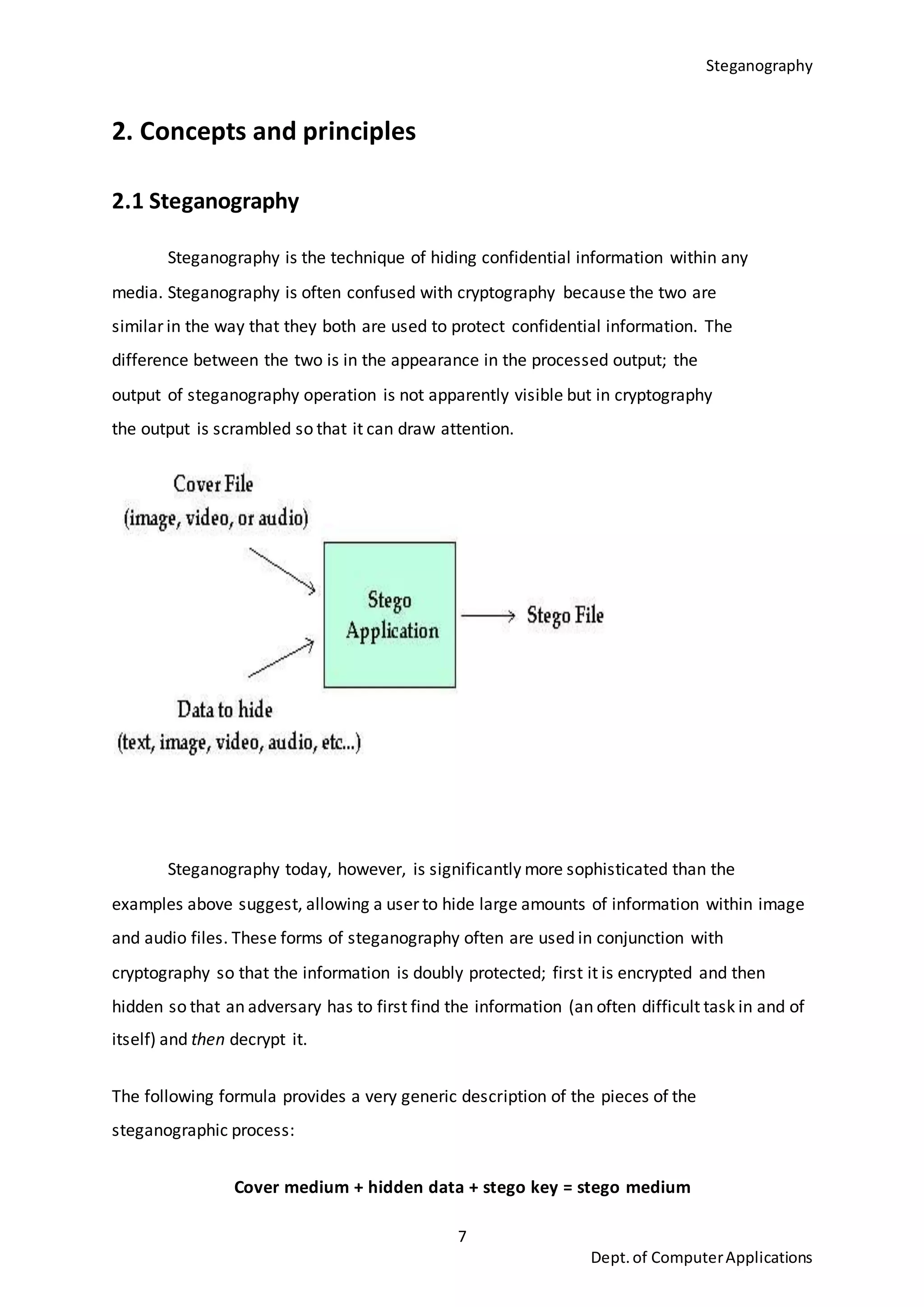
Steganography is the technique of hiding confidential information within any
media. Steganography is often confused with cryptography because the two are
similar in the way that they both are used to protect confidential information. The
difference between the two is in the appearance in the processed output; the
output of steganography operation is not apparently visible but in cryptography
the output is scrambled so that it can draw attention.
Steganography today, however, is significantly more sophisticated than the
examples above suggest, allowing a user to hide large amounts of information within image
and audio files. These forms of steganography often are used in conjunction with
cryptography so that the information is doubly protected; first it is encrypted and then
hidden so that an adversary has to first find the information (an often difficult task in and of
itself) and then decrypt it.
The following formula provides a very generic description of the pieces of the
steganographic process:
Cover medium + hidden data + stego key = stego medium
Steganography
8
Dept.of ComputerApplications
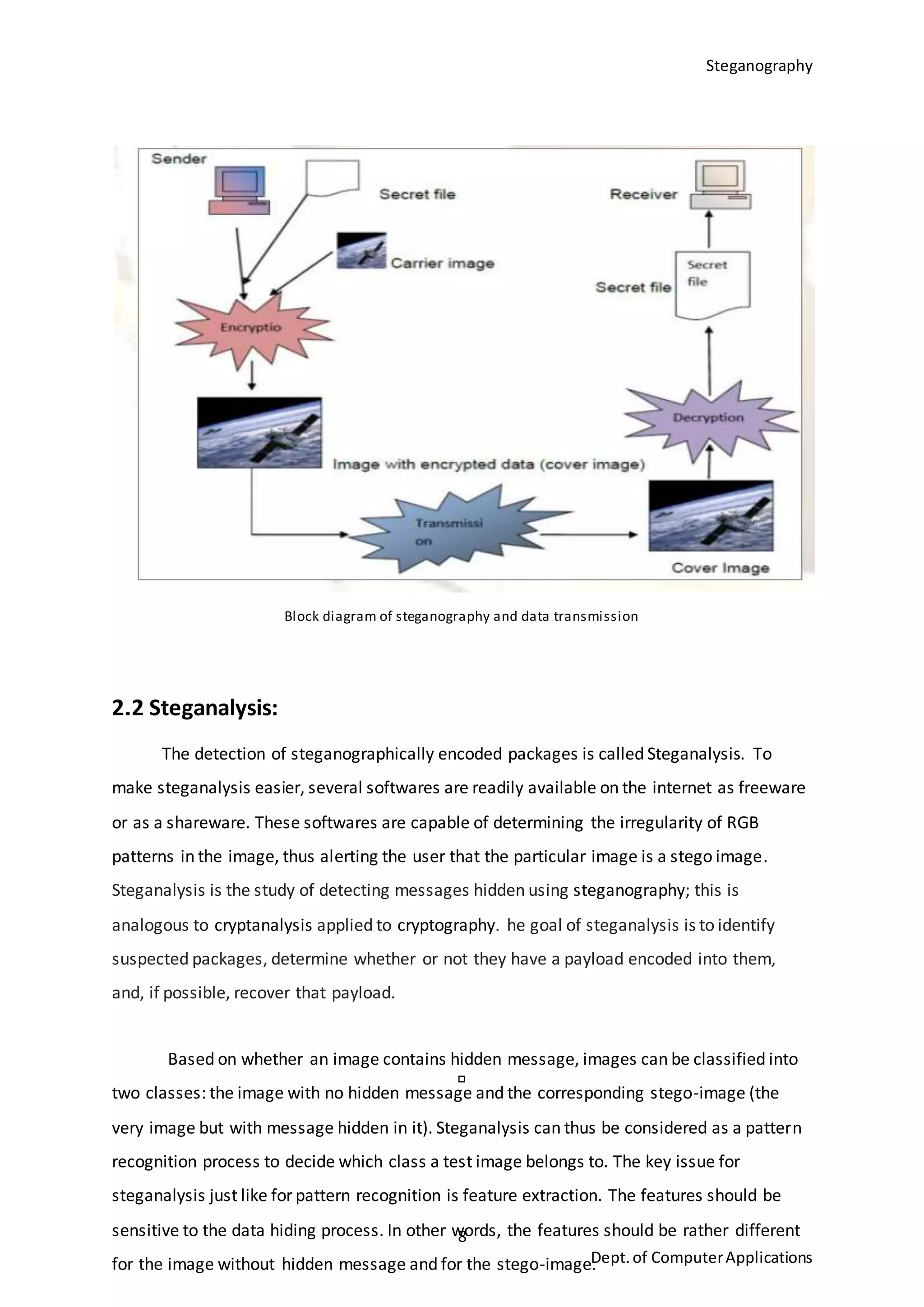
Block diagram of steganography and data transmission
2.2 Steganalysis:
The detection of steganographically encoded packages is called Steganalysis. To
make steganalysis easier, several softwares are readily available on the internet as freeware
or as a shareware. These softwares are capable of determining the irregularity of RGB
patterns in the image, thus alerting the user that the particular image is a stego image.
Steganalysis is the study of detecting messages hidden using steganography; this is
analogous to cryptanalysis applied to cryptography. he goal of steganalysis is to identify
suspected packages, determine whether or not they have a payload encoded into them,
and, if possible, recover that payload.
Based on whether an image contains hidden message, images can be classified into
two classes: the image with no hidden message and the corresponding stego-image (the
very image but with message hidden in it). Steganalysis can thus be considered as a pattern
recognition process to decide which class a test image belongs to. The key issue for
steganalysis just like for pattern recognition is feature extraction. The features should be
sensitive to the data hiding process. In other words, the features should be rather different
for the image without hidden message and for the stego-image.
Steganography
9
Dept.of ComputerApplications
2.3 Cryptography
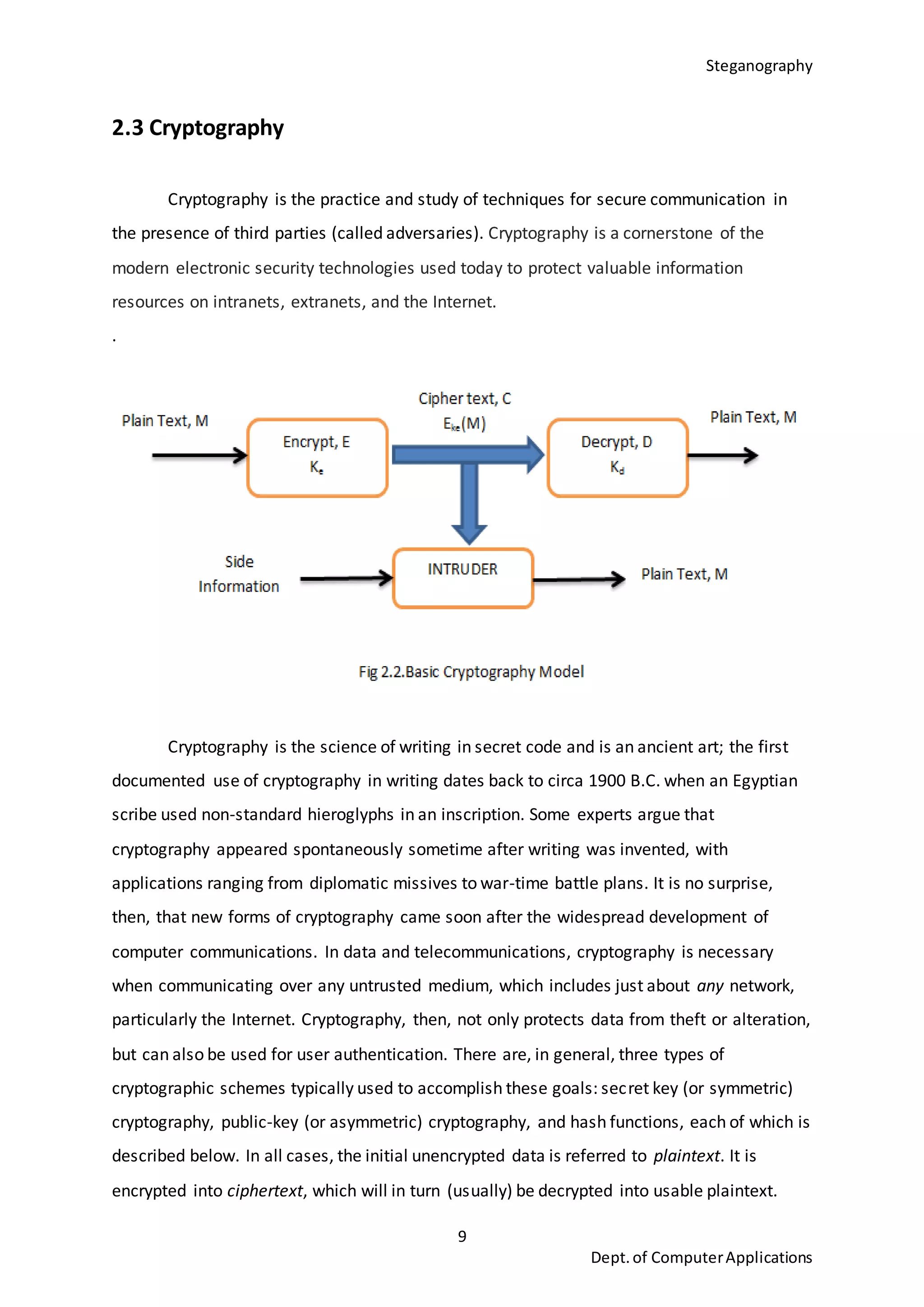
Cryptography is the practice and study of techniques for secure communication in
the presence of third parties (called adversaries). Cryptography is a cornerstone of the
modern electronic security technologies used today to protect valuable information
resources on intranets, extranets, and the Internet.
.
Cryptography is the science of writing in secret code and is an ancient art; the first
documented use of cryptography in writing dates back to circa 1900 B.C. when an Egyptian
scribe used non-standard hieroglyphs in an inscription. Some experts argue that
cryptography appeared spontaneously sometime after writing was invented, with
applications ranging from diplomatic missives to war-time battle plans. It is no surprise,
then, that new forms of cryptography came soon after the widespread development of
computer communications. In data and telecommunications, cryptography is necessary
when communicating over any untrusted medium, which includes just about any network,
particularly the Internet. Cryptography, then, not only protects data from theft or alteration,
but can also be used for user authentication. There are, in general, three types of
cryptographic schemes typically used to accomplish these goals: secret key (or symmetric)
cryptography, public-key (or asymmetric) cryptography, and hash functions, each of which is
described below. In all cases, the initial unencrypted data is referred to plaintext. It is
encrypted into ciphertext, which will in turn (usually) be decrypted into usable plaintext.
Steganography
10
Dept.of ComputerApplications
2.4 Genetic Algorithm
In the computer science field of artificial intelligence, a genetic algorithm (GA) is a
search heuristic that mimics the process of natural selection. This heuristic (also sometimes
called a metaheuristic) is routinely used to generate useful solutions to optimization and
search problems. A genetic algorithm is one of a class of algorithms that searches a
solution space for the optimal solution to a problem. This search is done in a fashion that
mimics the operation of evolution - a "population" of possible solutions is formed, and
new solutions are formed by "breeding" the best solutions from the population's
members to form a new generation. The population evolves for many generations; when
the algorithm finishes the best solution is returned. Genetic algorithms are particularly
useful for problems where it is extremely difficult or impossible to get an exact solution,
or for difficult problems where an exact solution may not be required. They offer an
interesting alternative to the typical algorithmic solution methods, and are highly
customizable, which make them an interesting challenge for students.
Steganography
11
Dept.of ComputerApplications
2. LSB algorithm
2.1 About LSB algorithm
The proposed scheme uses RSA or Diffie Hellman algorithm to encrypt secret
information. To provide higher security the secret information is encrypted first and
encrypted ASCII value is converted in binary form. In this method the least significant bits of
some or all of the bytes inside an image is replaced with a bits of the secret message.
The image is now used as a cover to embed the encrypted information. The Least Significant
Bit algorithm is faster and reliable and compression ratio is moderate compared to other
algorithms.
Sender Side ::
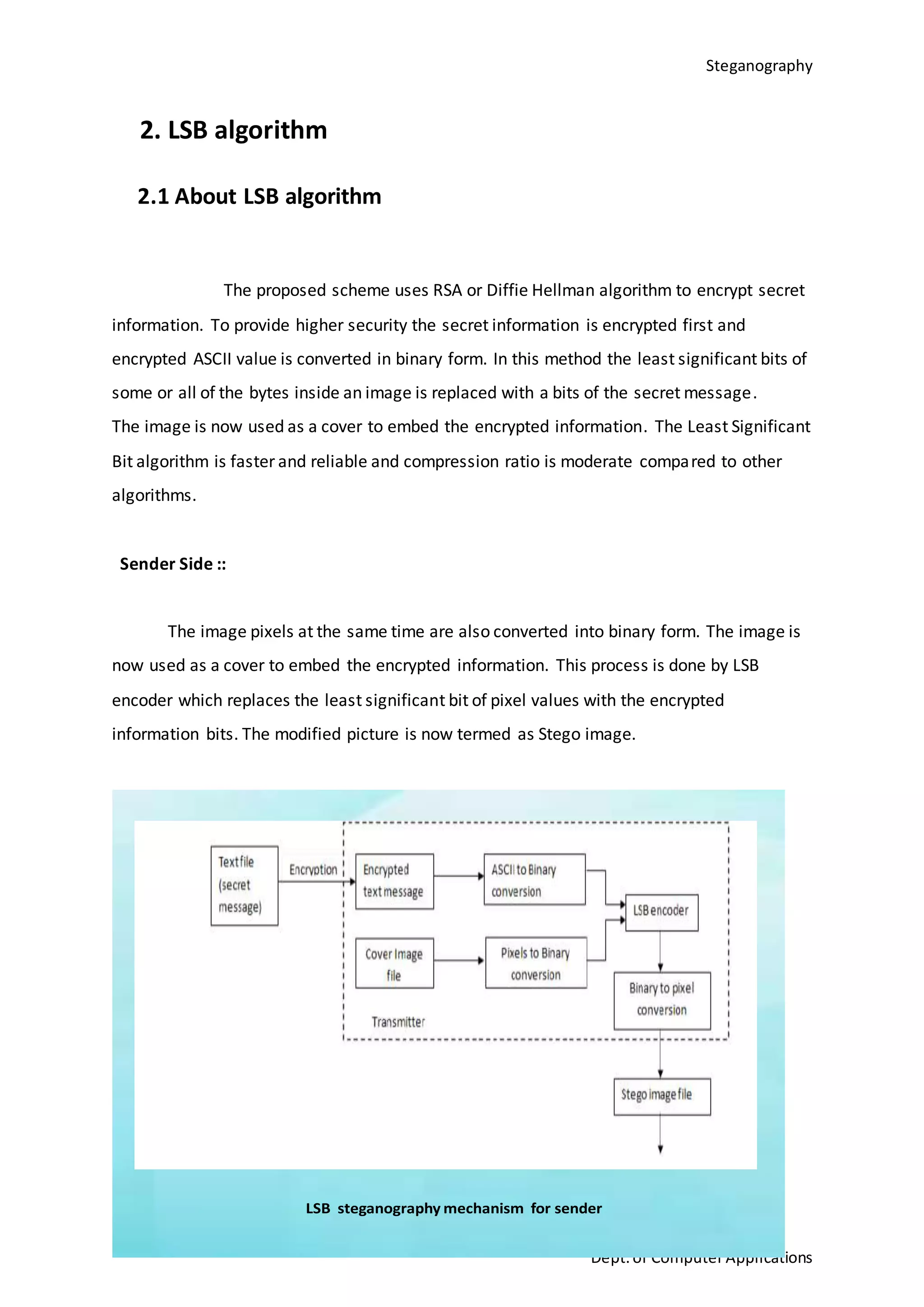
The image pixels at the same time are also converted into binary form. The image is
now used as a cover to embed the encrypted information. This process is done by LSB
encoder which replaces the least significant bit of pixel values with the encrypted
information bits. The modified picture is now termed as Stego image.
LSB steganography mechanism for sender
Steganography
12
Dept.of ComputerApplications
Reciever side ::
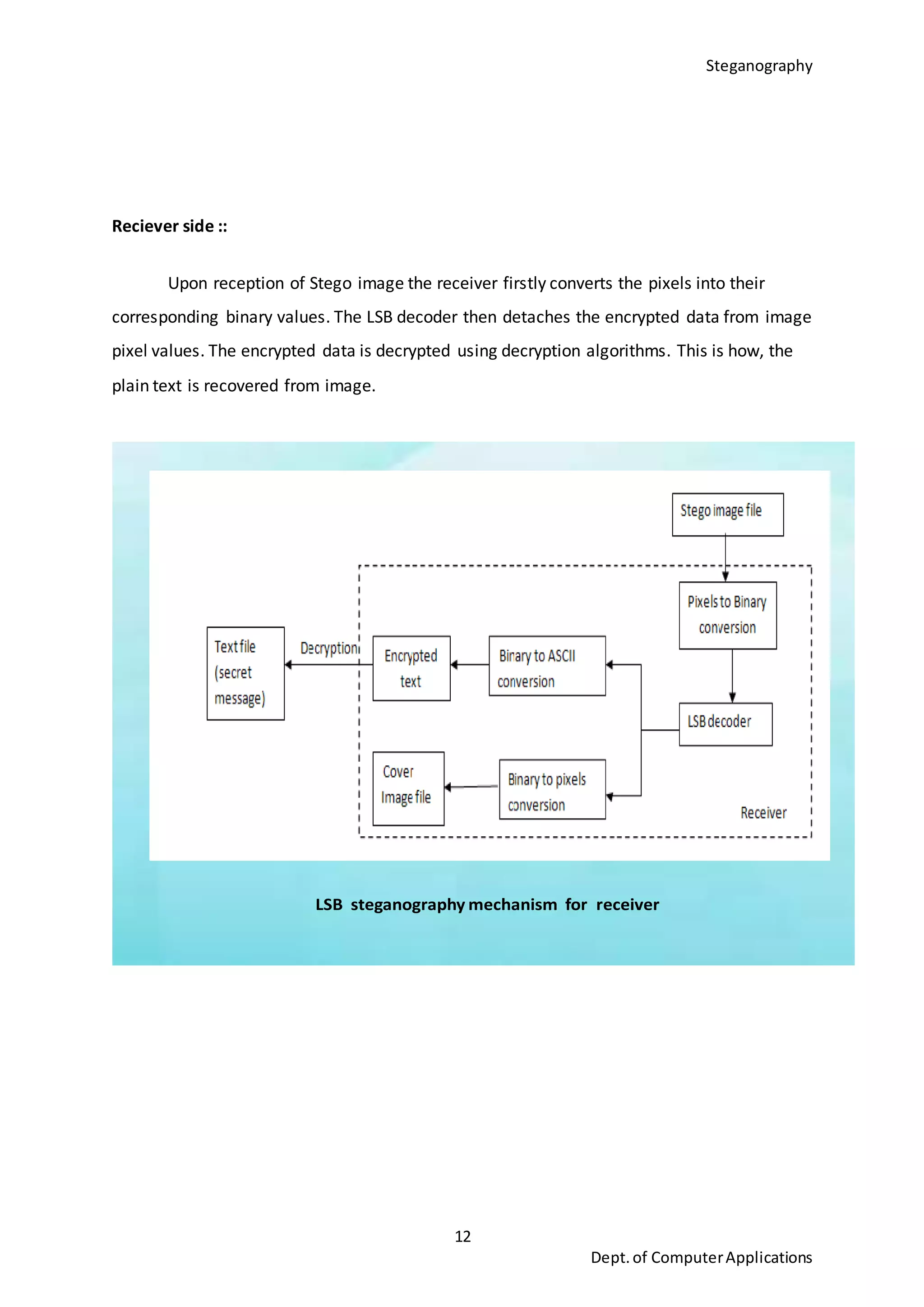
Upon reception of Stego image the receiver firstly converts the pixels into their
corresponding binary values. The LSB decoder then detaches the encrypted data from image
pixel values. The encrypted data is decrypted using decryption algorithms. This is how, the
plain text is recovered from image.
LSB steganography mechanism for receiver
Steganography
13
Dept.of ComputerApplications
2.2 Theory of LSB algorithm
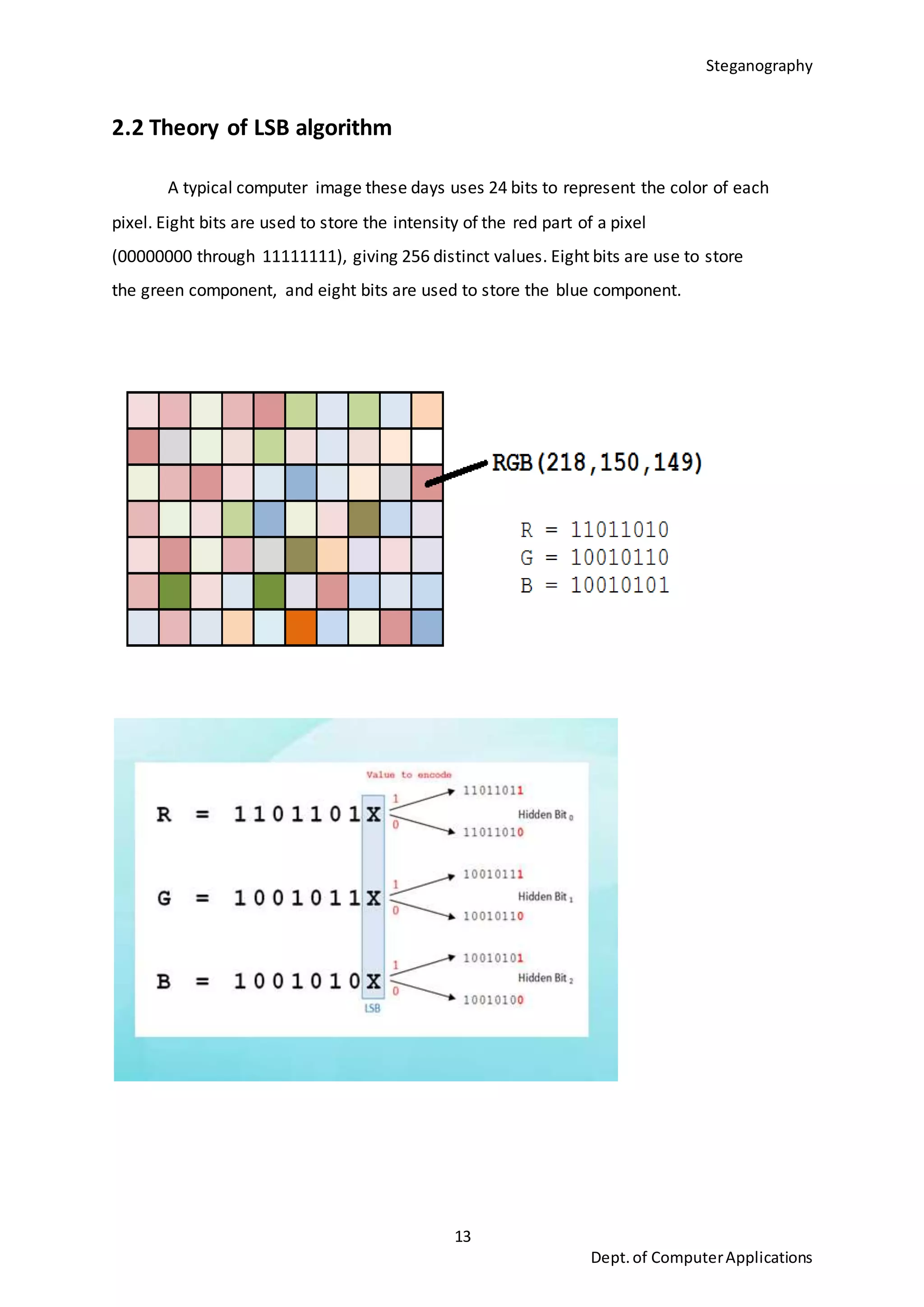
A typical computer image these days uses 24 bits to represent the color of each
pixel. Eight bits are used to store the intensity of the red part of a pixel
(00000000 through 11111111), giving 256 distinct values. Eight bits are use to store
the green component, and eight bits are used to store the blue component.
Steganography
14
Dept.of ComputerApplications
2.3 Example
EXAMPLE
Before applying LSB algorithm
11010010
01001010
10010111
10001100
00010101
01010111
00100110
01000011
After applying LSB algorithm
11010011
01001010
10010110
10001100
00010100
01010110
00100111
01000011.
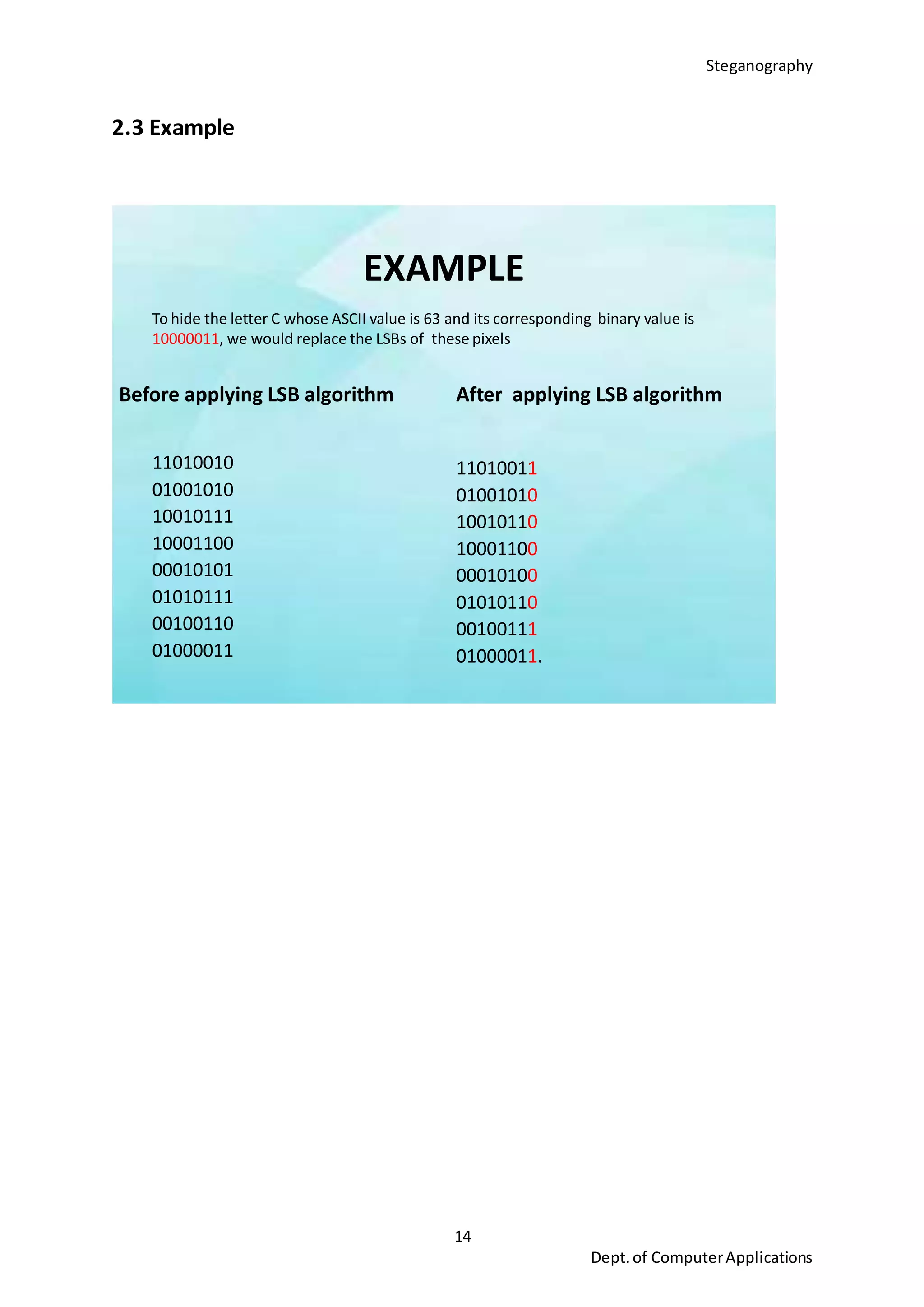
To hide the letter C whose ASCII value is 63 and its corresponding binary value is
10000011, we would replace the LSBs of these pixels
Steganography
15
Dept.of ComputerApplications
5. Proposed System
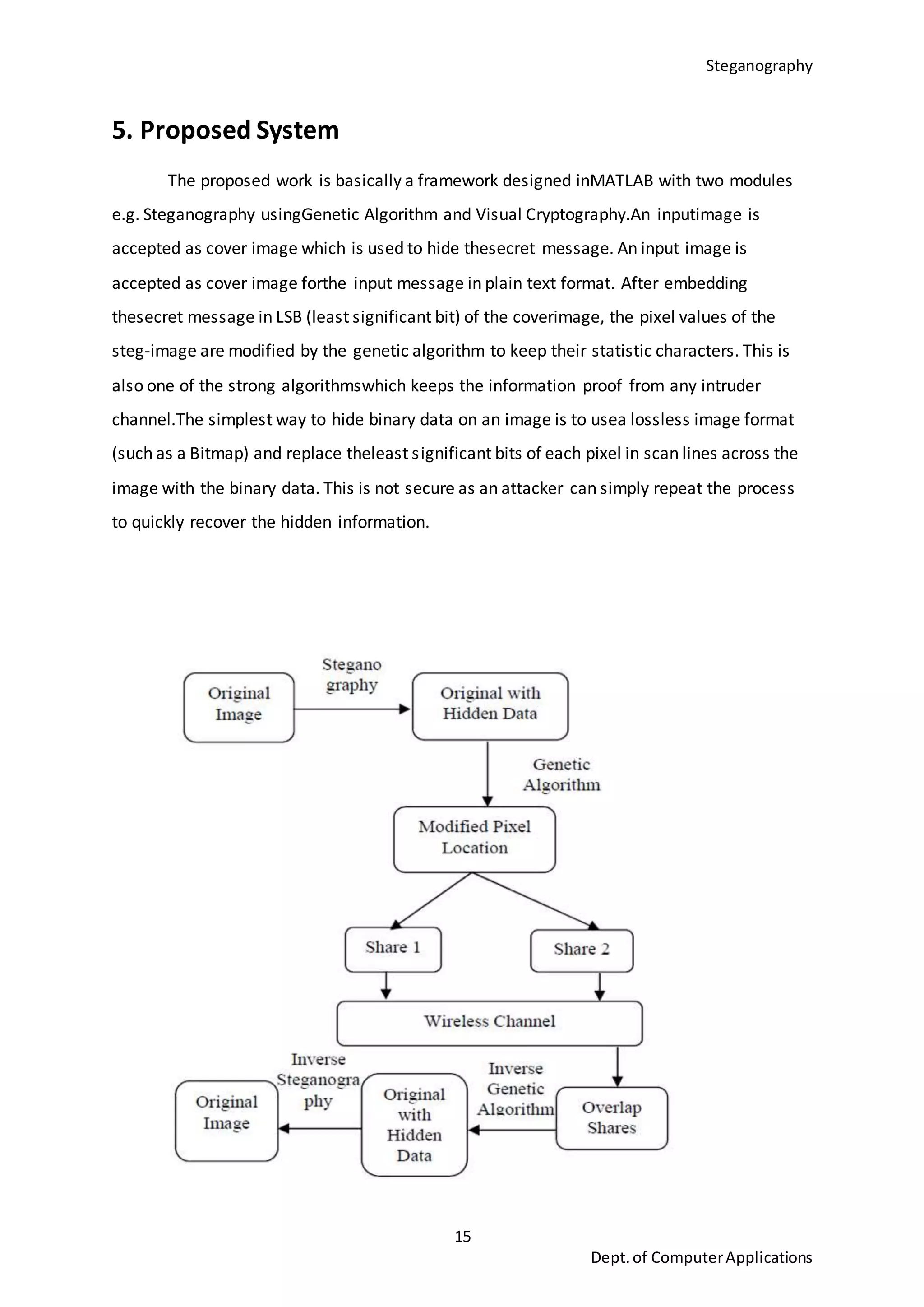
The proposed work is basically a framework designed inMATLAB with two modules
e.g. Steganography usingGenetic Algorithm and Visual Cryptography.An inputimage is
accepted as cover image which is used to hide thesecret message. An input image is
accepted as cover image forthe input message in plain text format. After embedding
thesecret message in LSB (least significant bit) of the coverimage, the pixel values of the
steg-image are modified by the genetic algorithm to keep their statistic characters. This is
also one of the strong algorithmswhich keeps the information proof from any intruder
channel.The simplest way to hide binary data on an image is to usea lossless image format
(such as a Bitmap) and replace theleast significant bits of each pixel in scan lines across the
image with the binary data. This is not secure as an attacker can simply repeat the process
to quickly recover the hidden information.
Steganography
16
Dept.of ComputerApplications
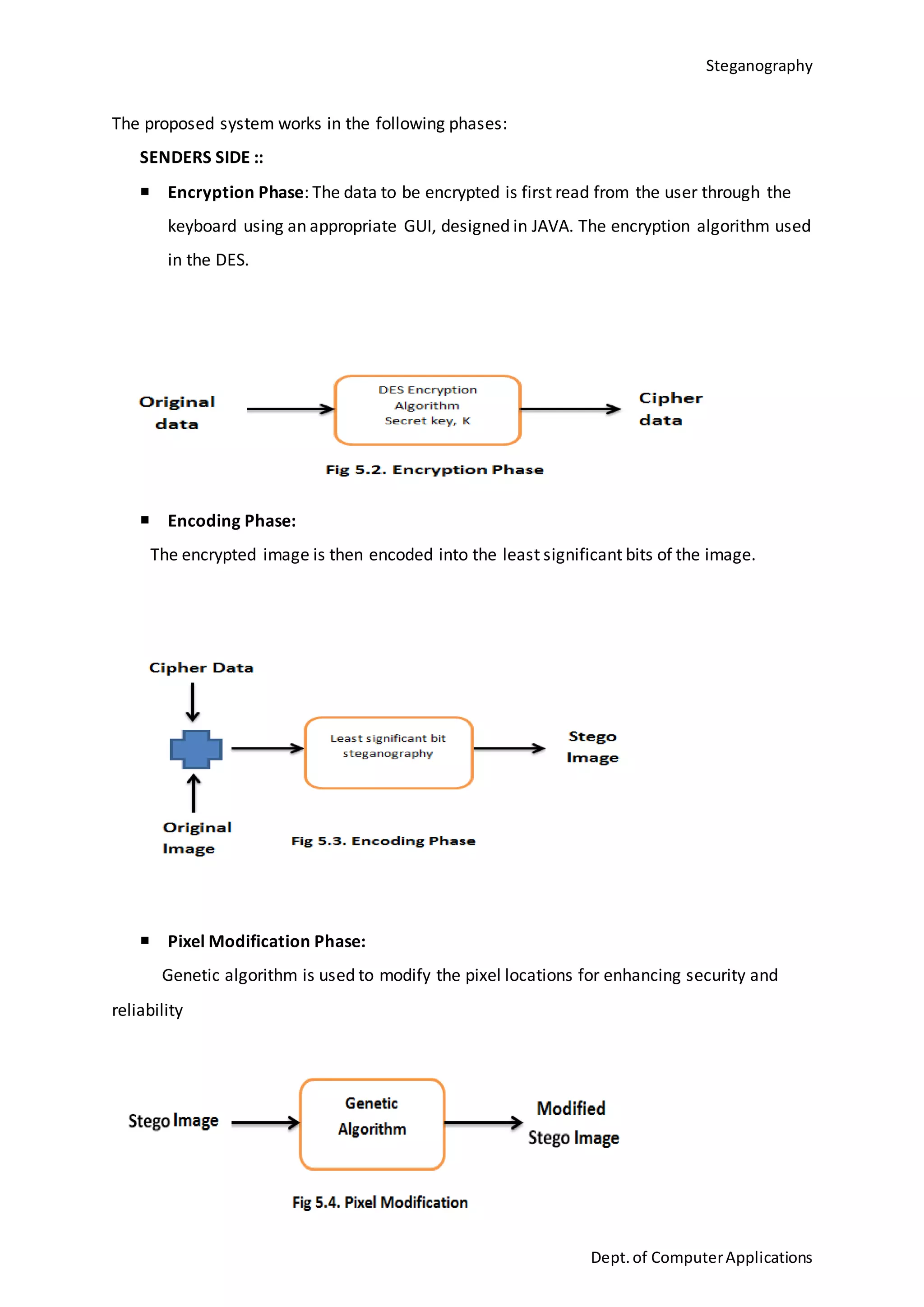
The proposed system works in the following phases:
SENDERS SIDE ::
 Encryption Phase: The data to be encrypted is first read from the user through the
keyboard using an appropriate GUI, designed in JAVA. The encryption algorithm used
in the DES.
 Encoding Phase:
The encrypted image is then encoded into the least significant bits of the image.
 Pixel Modification Phase:
Genetic algorithm is used to modify the pixel locations for enhancing security and
reliability
Steganography
17
Dept.of ComputerApplications
RECEIVERS SIDE::
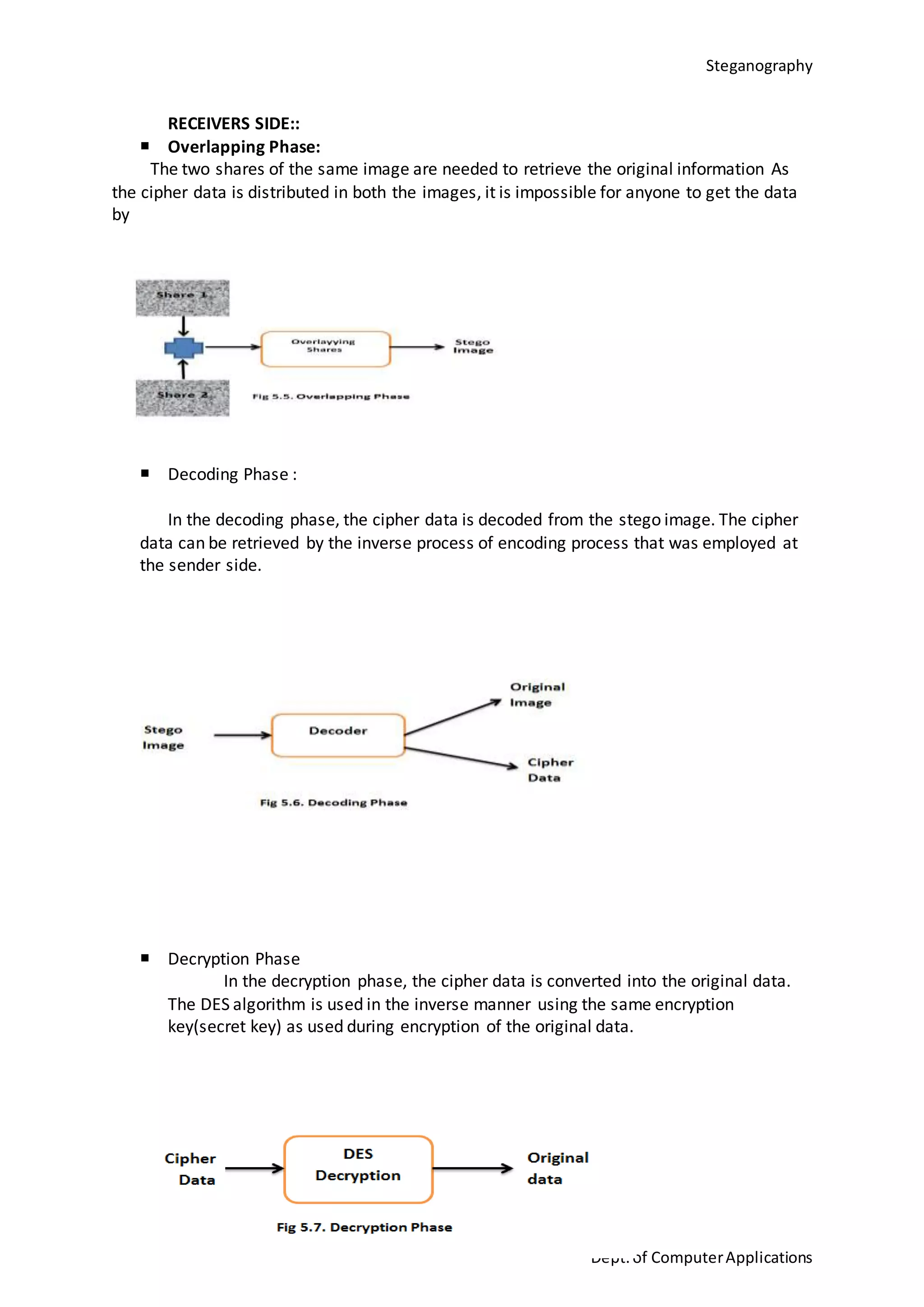
 Overlapping Phase:
The two shares of the same image are needed to retrieve the original information As
the cipher data is distributed in both the images, it is impossible for anyone to get the data
by
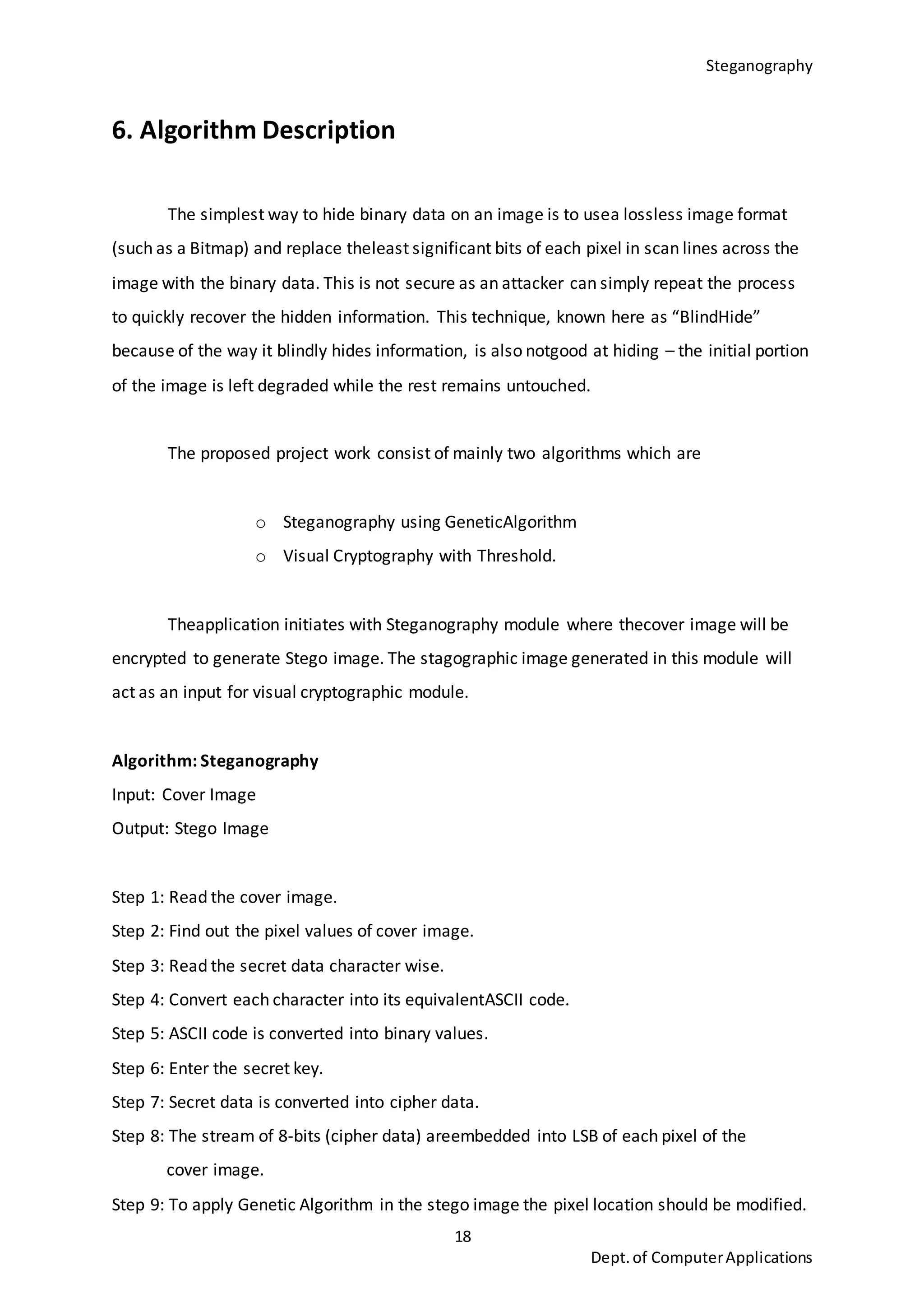
 Decoding Phase :
In the decoding phase, the cipher data is decoded from the stego image. The cipher
data can be retrieved by the inverse process of encoding process that was employed at
the sender side.
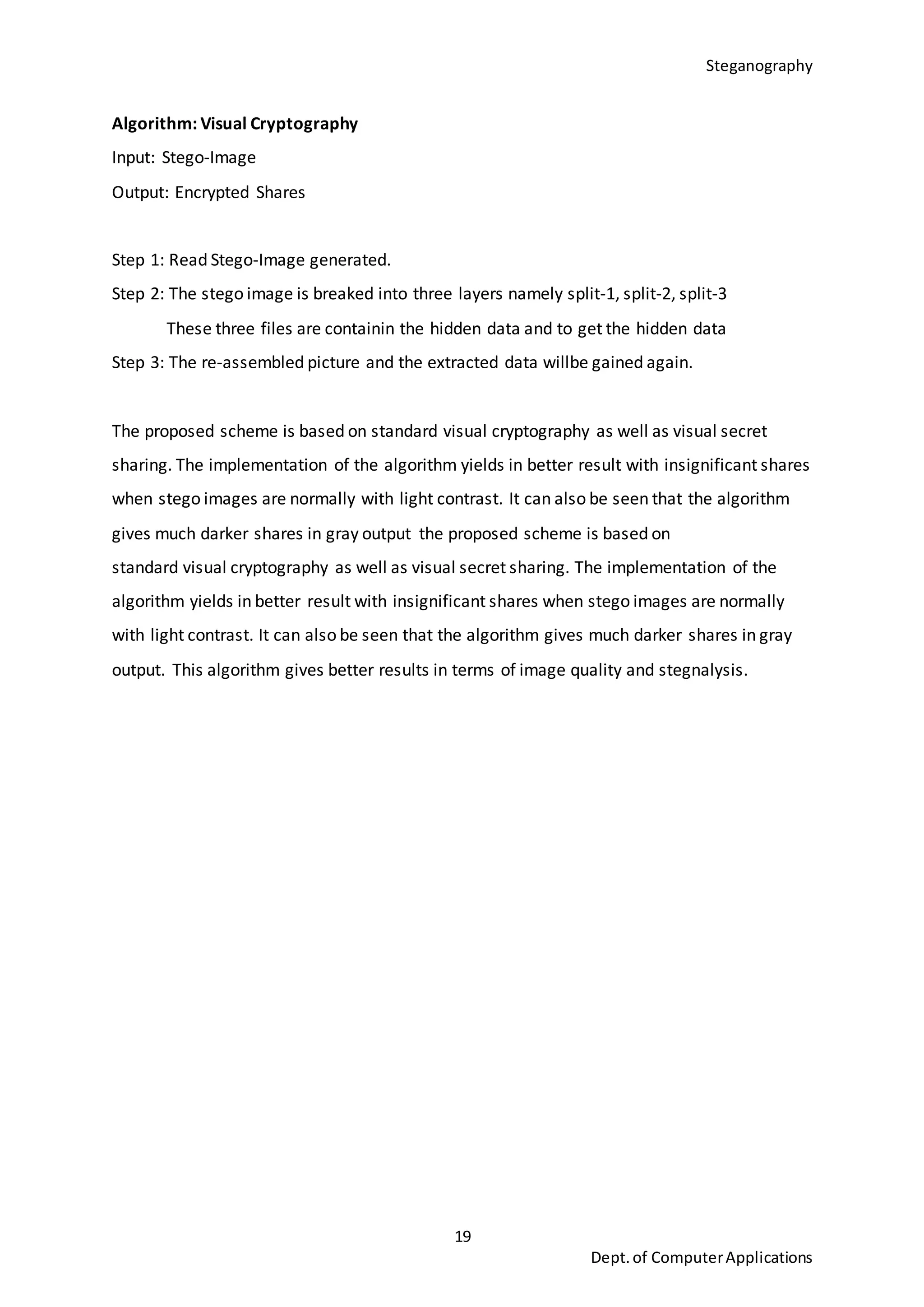
 Decryption Phase
In the decryption phase, the cipher data is converted into the original data.
The DES algorithm is used in the inverse manner using the same encryption
key(secret key) as used during encryption of the original data.
Steganography
18
Dept.of ComputerApplications
6. Algorithm Description
The simplest way to hide binary data on an image is to usea lossless image format
(such as a Bitmap) and replace theleast significant bits of each pixel in scan lines across the
image with the binary data. This is not secure as an attacker can simply repeat the process
to quickly recover the hidden information. This technique, known here as “BlindHide”
because of the way it blindly hides information, is also notgood at hiding – the initial portion
of the image is left degraded while the rest remains untouched.
The proposed project work consist of mainly two algorithms which are
o Steganography using GeneticAlgorithm
o Visual Cryptography with Threshold.
Theapplication initiates with Steganography module where thecover image will be
encrypted to generate Stego image. The stagographic image generated in this module will
act as an input for visual cryptographic module.
Algorithm: Steganography
Input: Cover Image
Output: Stego Image
Step 1: Read the cover image.
Step 2: Find out the pixel values of cover image.
Step 3: Read the secret data character wise.
Step 4: Convert each character into its equivalentASCII code.
Step 5: ASCII code is converted into binary values.
Step 6: Enter the secret key.
Step 7: Secret data is converted into cipher data.
Step 8: The stream of 8-bits (cipher data) areembedded into LSB of each pixel of the
cover image.
Step 9: To apply Genetic Algorithm in the stego image the pixel location should be modified.
Steganography
19
Dept.of ComputerApplications
Algorithm: Visual Cryptography
Input: Stego-Image
Output: Encrypted Shares
Step 1: Read Stego-Image generated.
Step 2: The stego image is breaked into three layers namely split-1, split-2, split-3
These three files are containin the hidden data and to get the hidden data
Step 3: The re-assembled picture and the extracted data willbe gained again.
The proposed scheme is based on standard visual cryptography as well as visual secret
sharing. The implementation of the algorithm yields in better result with insignificant shares
when stego images are normally with light contrast. It can also be seen that the algorithm
gives much darker shares in gray output the proposed scheme is based on
standard visual cryptography as well as visual secret sharing. The implementation of the
algorithm yields in better result with insignificant shares when stego images are normally
with light contrast. It can also be seen that the algorithm gives much darker shares in gray
output. This algorithm gives better results in terms of image quality and stegnalysis.
Steganography
20
Dept.of ComputerApplications
7. PerformanceAnalysis
The performance of the proposed systemis experimented by performing stegnalysis
and conducting benchmarking test for analysing parameters like Mean Squared Error (MSE)
and Peak Signal to Noise Ratio.
o Cover image : rice.png
o Size : 256*256
o Mean Square Error (MSE) : 0.0678
o Peak Signal-to-Noise Ratio (PSNR) : 59.8188db
After applying Genetic Algorithm the measured performance is shown in below
o Mean Square Error (MSE) : 0.794
o Peak Signal-to-Noise Ratio (PSNR) : 39.4011db
After applying genetic algorithm all the pixel location are altered. Due to the change the
pixel location MSE and PSNR values are increased.
Steganography
21
Dept.of ComputerApplications
8. Results
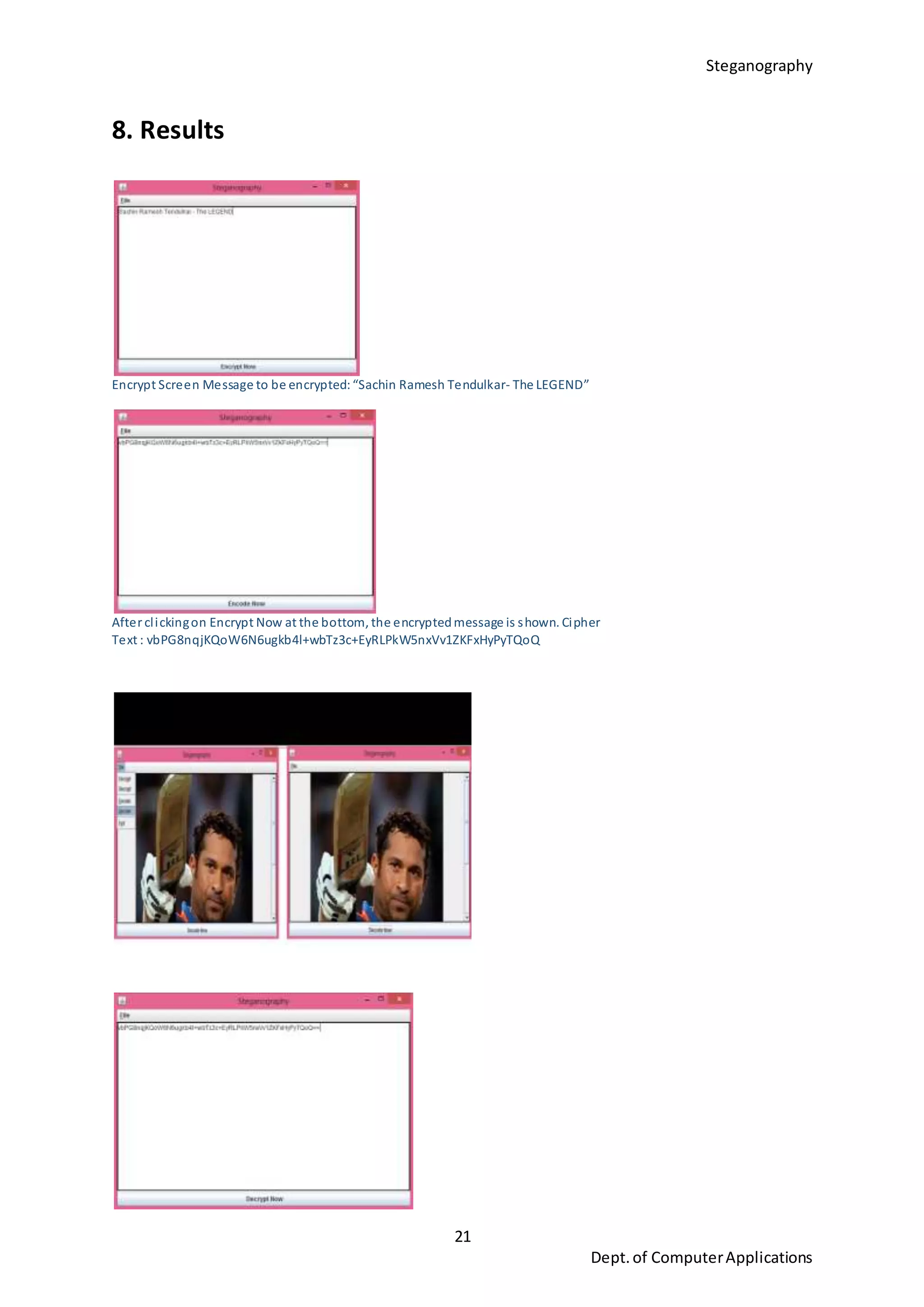
Encrypt Screen Message to be encrypted:“Sachin Ramesh Tendulkar- The LEGEND”
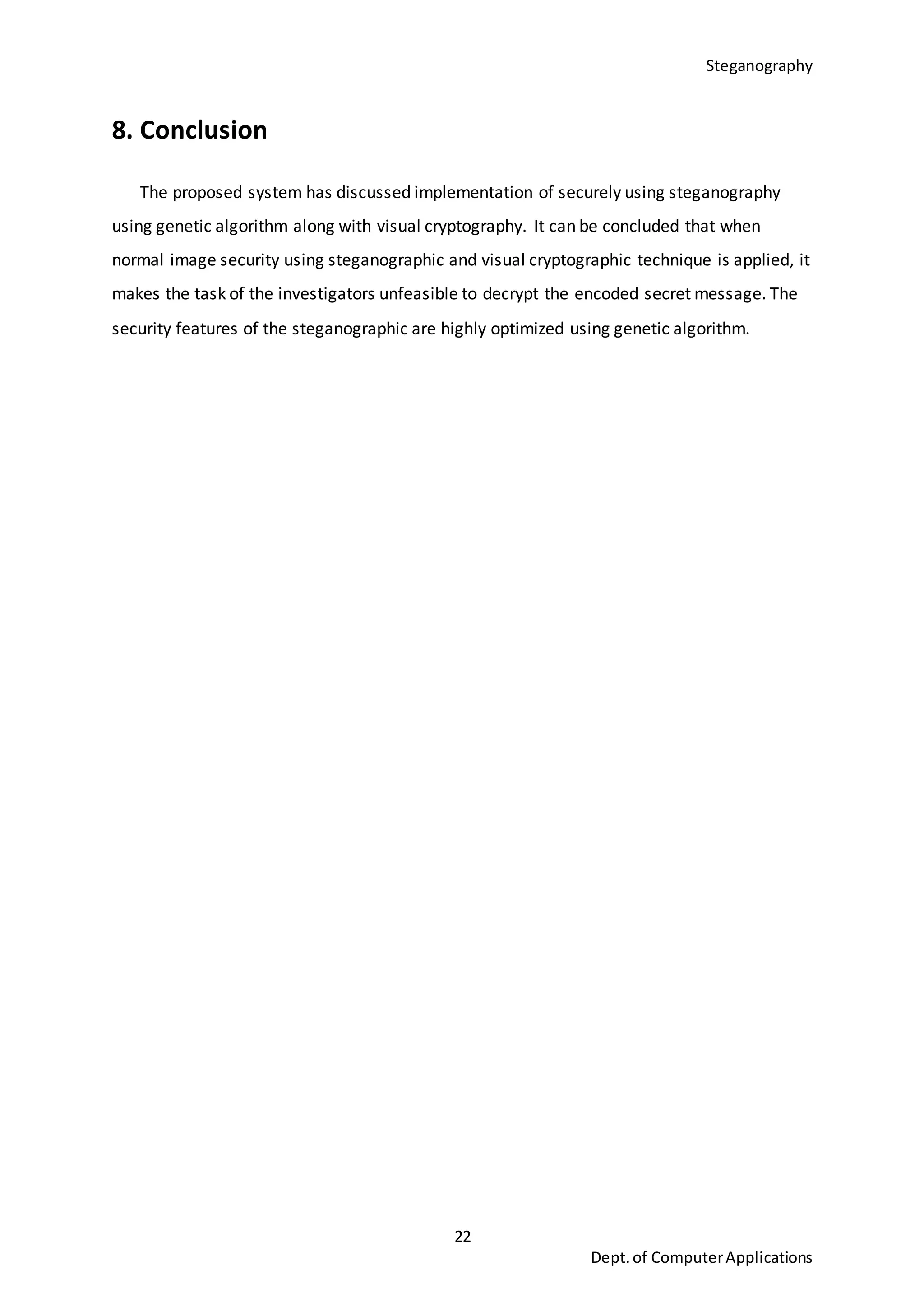
After clickingon Encrypt Now at the bottom, the encryptedmessage is shown. Cipher
Text : vbPG8nqjKQoW6N6ugkb4l+wbTz3c+EyRLPkW5nxVv1ZKFxHyPyTQoQ
Steganography
22
Dept.of ComputerApplications
8. Conclusion
The proposed system has discussed implementation of securely using steganography
using genetic algorithm along with visual cryptography. It can be concluded that when
normal image security using steganographic and visual cryptographic technique is applied, it
makes the task of the investigators unfeasible to decrypt the encoded secret message. The
security features of the steganographic are highly optimized using genetic algorithm.
Steganography
23
Dept.of ComputerApplications
9.Bibilography
1) http://en.wikipedia.org/wiki/Stegano_graphy
2) http://www.infoit.org/benefits-/image_hiding
3) http://en.wikipedia.org/wiki/steganalysis
4) http://www.techpark.net/2012/02/29/cryptography
5) http:// ieeexplore.ieee.org/
6) http://en.wikipedia.org/wiki/image _ hiding
7) http://www.webmd.boots.com/hiding /news/20120411/lsb_alg

Steganography using visual cryptography: Report

  • 1.
    STEGANOGRAPHY USING GENETICALGORITHM ALONG WITH VISUAL CRYPTOGRAPHY FOR WIRELESS NETWORK APPLICATION Seminar Report Submitted in partial fulfillment of the requirements For the award of the Degree in Master of Computer Applications From University of Kerala By APARNA N K DEPARTMENT OF COMPUTER APPLICATIONS MOHANDAS COLLEGE OF ENGINEERING & TECHNOLOGY Anad, Nedumangadu, Thiruvananthapuram-695544 2014
  • 2.
    Steganography 2 Dept.of ComputerApplications MOHANDAS COLLEGEOF ENGINEERING & TECHNOLOGY Anad, Nedumangadu, Thiruvananthapuram-695544 This is to certify that this is a bonafide report of the seminar presented by Ms. Aparna N K (Roll No. 1) in partial fulfillment of the requirements for the award of the degree in MASTER OF COMPUTER APPLICATIONS by the University of Kerala. Date……………… Staff In charge Ms. JeejaG.S Asst.professor Dept of Computer Applications
  • 3.
    Steganography 3 Dept.of ComputerApplications ACKNOWLEDGEMENT I amgreatly thankful to Ms. Sreeja K.( Head of the Department) and Ms. Jeeja G S (Asst.professor, Department of Computer Applications) for their kind co-operation for presenting the seminar. I also extend my sincere thanks to all other faculty members of Department of Computer Applications and my friends for their co-operation and encouragements. Last but not the least I would like the GOD almighty for helping me to complete my seminar on time. APARNA N K
  • 4.
    Steganography 4 Dept.of ComputerApplications CONTENTS Synopsis 5 1.Introduction 6 2. Concepts and principles 7 2.1 Aboutgoogle 7 2.2 Virtual reality 7 2.3 Augmentedreality 7 2.4 ProjectGlass 8 2.5 Android 8 3. Technologies used 9 3.1 Wearable Computing 9 3.2 AmbientIntelligence 9 3.3 Smart Clothing 9 3.4 Eye Tap Technology 10 3.5 Smart GridTechnology 10 3.6 4G Technology 10 4. How it Works? 11 4.1Design 11 4.2Working 12 5. Advantages and Disadvantages 13 5.1 Advantages 13 5.2 Disadvantages 13 6. Future Scope 14 7. Conclusion 15 8. Bibliography 16
  • 5.
    Steganography 5 Dept.of ComputerApplications Synopsis Image steganographyis an emerging field of research for secure data hiding and transmission over networks. The proposed systemprovides the best approach for Least SignificantBit (LSB) based steganography using Genetic Algorithm (GA)along with Visual Cryptography (VC). Original message isconverted into cipher text by using secret key and then hiddeninto the LSB of original image. Genetic Algorithm and VisualCryptography has been used for enhancing the security. GeneticAlgorithm is used to modify the pixel location of stego image andthe detection of this message is complex. Visual Cryptography isused to encrypt the visual information. It is achieved by breakingthe image into two shares based on a threshold.The main aim is to design theenhanced secure algorithm which uses both steganography using Genetic Algorithm and Visual Cryptography to ensure improved security and reliability.
  • 6.
    Steganography 6 Dept.of ComputerApplications 1. Introduction Hidinginformation by embedding secret data into aninnocuous medium is often referred to as steganography.Steganography can be applied electronically by taking amessage (a binary file) and some sort of cover (often a soundor image file) and combining both to obtain a “stego-object”. The rapid development of data transfer through internet made it easier to send the data accurate and faster to the destination. One of the most important factors of information technology and communication has been the security of the information. For security purpose the concept of Steganography is being used. Steganography is art and science of invisible communication.The steganalysis algorithm which we used here has the potential to detect thehidden message by the statistic analysis of pixel values . The use of steganography in combination visual cryptographyis a sturdy model and adds a lot of challenges to identifyingsuch hidden and encrypted data.
  • 7.
    Steganography 7 Dept.of ComputerApplications 2. Conceptsand principles 2.1 Steganography Steganography is the technique of hiding confidential information within any media. Steganography is often confused with cryptography because the two are similar in the way that they both are used to protect confidential information. The difference between the two is in the appearance in the processed output; the output of steganography operation is not apparently visible but in cryptography the output is scrambled so that it can draw attention. Steganography today, however, is significantly more sophisticated than the examples above suggest, allowing a user to hide large amounts of information within image and audio files. These forms of steganography often are used in conjunction with cryptography so that the information is doubly protected; first it is encrypted and then hidden so that an adversary has to first find the information (an often difficult task in and of itself) and then decrypt it. The following formula provides a very generic description of the pieces of the steganographic process: Cover medium + hidden data + stego key = stego medium
  • 8.
    Steganography 8 Dept.of ComputerApplications Block diagramof steganography and data transmission 2.2 Steganalysis: The detection of steganographically encoded packages is called Steganalysis. To make steganalysis easier, several softwares are readily available on the internet as freeware or as a shareware. These softwares are capable of determining the irregularity of RGB patterns in the image, thus alerting the user that the particular image is a stego image. Steganalysis is the study of detecting messages hidden using steganography; this is analogous to cryptanalysis applied to cryptography. he goal of steganalysis is to identify suspected packages, determine whether or not they have a payload encoded into them, and, if possible, recover that payload. Based on whether an image contains hidden message, images can be classified into two classes: the image with no hidden message and the corresponding stego-image (the very image but with message hidden in it). Steganalysis can thus be considered as a pattern recognition process to decide which class a test image belongs to. The key issue for steganalysis just like for pattern recognition is feature extraction. The features should be sensitive to the data hiding process. In other words, the features should be rather different for the image without hidden message and for the stego-image.
  • 9.
    Steganography 9 Dept.of ComputerApplications 2.3 Cryptography Cryptographyis the practice and study of techniques for secure communication in the presence of third parties (called adversaries). Cryptography is a cornerstone of the modern electronic security technologies used today to protect valuable information resources on intranets, extranets, and the Internet. . Cryptography is the science of writing in secret code and is an ancient art; the first documented use of cryptography in writing dates back to circa 1900 B.C. when an Egyptian scribe used non-standard hieroglyphs in an inscription. Some experts argue that cryptography appeared spontaneously sometime after writing was invented, with applications ranging from diplomatic missives to war-time battle plans. It is no surprise, then, that new forms of cryptography came soon after the widespread development of computer communications. In data and telecommunications, cryptography is necessary when communicating over any untrusted medium, which includes just about any network, particularly the Internet. Cryptography, then, not only protects data from theft or alteration, but can also be used for user authentication. There are, in general, three types of cryptographic schemes typically used to accomplish these goals: secret key (or symmetric) cryptography, public-key (or asymmetric) cryptography, and hash functions, each of which is described below. In all cases, the initial unencrypted data is referred to plaintext. It is encrypted into ciphertext, which will in turn (usually) be decrypted into usable plaintext.
  • 10.
    Steganography 10 Dept.of ComputerApplications 2.4 GeneticAlgorithm In the computer science field of artificial intelligence, a genetic algorithm (GA) is a search heuristic that mimics the process of natural selection. This heuristic (also sometimes called a metaheuristic) is routinely used to generate useful solutions to optimization and search problems. A genetic algorithm is one of a class of algorithms that searches a solution space for the optimal solution to a problem. This search is done in a fashion that mimics the operation of evolution - a "population" of possible solutions is formed, and new solutions are formed by "breeding" the best solutions from the population's members to form a new generation. The population evolves for many generations; when the algorithm finishes the best solution is returned. Genetic algorithms are particularly useful for problems where it is extremely difficult or impossible to get an exact solution, or for difficult problems where an exact solution may not be required. They offer an interesting alternative to the typical algorithmic solution methods, and are highly customizable, which make them an interesting challenge for students.
  • 11.
    Steganography 11 Dept.of ComputerApplications 2. LSBalgorithm 2.1 About LSB algorithm The proposed scheme uses RSA or Diffie Hellman algorithm to encrypt secret information. To provide higher security the secret information is encrypted first and encrypted ASCII value is converted in binary form. In this method the least significant bits of some or all of the bytes inside an image is replaced with a bits of the secret message. The image is now used as a cover to embed the encrypted information. The Least Significant Bit algorithm is faster and reliable and compression ratio is moderate compared to other algorithms. Sender Side :: The image pixels at the same time are also converted into binary form. The image is now used as a cover to embed the encrypted information. This process is done by LSB encoder which replaces the least significant bit of pixel values with the encrypted information bits. The modified picture is now termed as Stego image. LSB steganography mechanism for sender
  • 12.
    Steganography 12 Dept.of ComputerApplications Reciever side:: Upon reception of Stego image the receiver firstly converts the pixels into their corresponding binary values. The LSB decoder then detaches the encrypted data from image pixel values. The encrypted data is decrypted using decryption algorithms. This is how, the plain text is recovered from image. LSB steganography mechanism for receiver
  • 13.
    Steganography 13 Dept.of ComputerApplications 2.2 Theoryof LSB algorithm A typical computer image these days uses 24 bits to represent the color of each pixel. Eight bits are used to store the intensity of the red part of a pixel (00000000 through 11111111), giving 256 distinct values. Eight bits are use to store the green component, and eight bits are used to store the blue component.
  • 14.
    Steganography 14 Dept.of ComputerApplications 2.3 Example EXAMPLE Beforeapplying LSB algorithm 11010010 01001010 10010111 10001100 00010101 01010111 00100110 01000011 After applying LSB algorithm 11010011 01001010 10010110 10001100 00010100 01010110 00100111 01000011. To hide the letter C whose ASCII value is 63 and its corresponding binary value is 10000011, we would replace the LSBs of these pixels
  • 15.
    Steganography 15 Dept.of ComputerApplications 5. ProposedSystem The proposed work is basically a framework designed inMATLAB with two modules e.g. Steganography usingGenetic Algorithm and Visual Cryptography.An inputimage is accepted as cover image which is used to hide thesecret message. An input image is accepted as cover image forthe input message in plain text format. After embedding thesecret message in LSB (least significant bit) of the coverimage, the pixel values of the steg-image are modified by the genetic algorithm to keep their statistic characters. This is also one of the strong algorithmswhich keeps the information proof from any intruder channel.The simplest way to hide binary data on an image is to usea lossless image format (such as a Bitmap) and replace theleast significant bits of each pixel in scan lines across the image with the binary data. This is not secure as an attacker can simply repeat the process to quickly recover the hidden information.
  • 16.
    Steganography 16 Dept.of ComputerApplications The proposedsystem works in the following phases: SENDERS SIDE ::  Encryption Phase: The data to be encrypted is first read from the user through the keyboard using an appropriate GUI, designed in JAVA. The encryption algorithm used in the DES.  Encoding Phase: The encrypted image is then encoded into the least significant bits of the image.  Pixel Modification Phase: Genetic algorithm is used to modify the pixel locations for enhancing security and reliability
  • 17.
    Steganography 17 Dept.of ComputerApplications RECEIVERS SIDE:: Overlapping Phase: The two shares of the same image are needed to retrieve the original information As the cipher data is distributed in both the images, it is impossible for anyone to get the data by  Decoding Phase : In the decoding phase, the cipher data is decoded from the stego image. The cipher data can be retrieved by the inverse process of encoding process that was employed at the sender side.  Decryption Phase In the decryption phase, the cipher data is converted into the original data. The DES algorithm is used in the inverse manner using the same encryption key(secret key) as used during encryption of the original data.
  • 18.
    Steganography 18 Dept.of ComputerApplications 6. AlgorithmDescription The simplest way to hide binary data on an image is to usea lossless image format (such as a Bitmap) and replace theleast significant bits of each pixel in scan lines across the image with the binary data. This is not secure as an attacker can simply repeat the process to quickly recover the hidden information. This technique, known here as “BlindHide” because of the way it blindly hides information, is also notgood at hiding – the initial portion of the image is left degraded while the rest remains untouched. The proposed project work consist of mainly two algorithms which are o Steganography using GeneticAlgorithm o Visual Cryptography with Threshold. Theapplication initiates with Steganography module where thecover image will be encrypted to generate Stego image. The stagographic image generated in this module will act as an input for visual cryptographic module. Algorithm: Steganography Input: Cover Image Output: Stego Image Step 1: Read the cover image. Step 2: Find out the pixel values of cover image. Step 3: Read the secret data character wise. Step 4: Convert each character into its equivalentASCII code. Step 5: ASCII code is converted into binary values. Step 6: Enter the secret key. Step 7: Secret data is converted into cipher data. Step 8: The stream of 8-bits (cipher data) areembedded into LSB of each pixel of the cover image. Step 9: To apply Genetic Algorithm in the stego image the pixel location should be modified.
  • 19.
    Steganography 19 Dept.of ComputerApplications Algorithm: VisualCryptography Input: Stego-Image Output: Encrypted Shares Step 1: Read Stego-Image generated. Step 2: The stego image is breaked into three layers namely split-1, split-2, split-3 These three files are containin the hidden data and to get the hidden data Step 3: The re-assembled picture and the extracted data willbe gained again. The proposed scheme is based on standard visual cryptography as well as visual secret sharing. The implementation of the algorithm yields in better result with insignificant shares when stego images are normally with light contrast. It can also be seen that the algorithm gives much darker shares in gray output the proposed scheme is based on standard visual cryptography as well as visual secret sharing. The implementation of the algorithm yields in better result with insignificant shares when stego images are normally with light contrast. It can also be seen that the algorithm gives much darker shares in gray output. This algorithm gives better results in terms of image quality and stegnalysis.
  • 20.
    Steganography 20 Dept.of ComputerApplications 7. PerformanceAnalysis Theperformance of the proposed systemis experimented by performing stegnalysis and conducting benchmarking test for analysing parameters like Mean Squared Error (MSE) and Peak Signal to Noise Ratio. o Cover image : rice.png o Size : 256*256 o Mean Square Error (MSE) : 0.0678 o Peak Signal-to-Noise Ratio (PSNR) : 59.8188db After applying Genetic Algorithm the measured performance is shown in below o Mean Square Error (MSE) : 0.794 o Peak Signal-to-Noise Ratio (PSNR) : 39.4011db After applying genetic algorithm all the pixel location are altered. Due to the change the pixel location MSE and PSNR values are increased.
  • 21.
    Steganography 21 Dept.of ComputerApplications 8. Results EncryptScreen Message to be encrypted:“Sachin Ramesh Tendulkar- The LEGEND” After clickingon Encrypt Now at the bottom, the encryptedmessage is shown. Cipher Text : vbPG8nqjKQoW6N6ugkb4l+wbTz3c+EyRLPkW5nxVv1ZKFxHyPyTQoQ
  • 22.
    Steganography 22 Dept.of ComputerApplications 8. Conclusion Theproposed system has discussed implementation of securely using steganography using genetic algorithm along with visual cryptography. It can be concluded that when normal image security using steganographic and visual cryptographic technique is applied, it makes the task of the investigators unfeasible to decrypt the encoded secret message. The security features of the steganographic are highly optimized using genetic algorithm.
  • 23.
    Steganography 23 Dept.of ComputerApplications 9.Bibilography 1) http://en.wikipedia.org/wiki/Stegano_graphy 2)http://www.infoit.org/benefits-/image_hiding 3) http://en.wikipedia.org/wiki/steganalysis 4) http://www.techpark.net/2012/02/29/cryptography 5) http:// ieeexplore.ieee.org/ 6) http://en.wikipedia.org/wiki/image _ hiding 7) http://www.webmd.boots.com/hiding /news/20120411/lsb_alg