© 2017 MapR Technologies 1
Update on t-digest
© 2017 MapR Technologies 2
Contact Information
Ted Dunning, PhD
Chief Application Architect, MapR Technologies
Board member, Apache Software Foundation
O’Reilly author
Email tdunning@mapr.com tdunning@apache.org
Twitter @ted_dunning
© 2017 MapR Technologies 3
Who We Are
• MapR echnologies
– We make a kick-ass platform for big data computing
– Support many workloads including Hadoop / Spark / HPC / Other
– Extended to allow streams and tables in basic platform
– Free for academic research / training
• Apache Software Foundation
– Culture hub for building open source communities
– Shared values around openness for contribution as well as use
– Many major projects are part of Apache
– Even more minor ones!
© 2017 MapR Technologies 4
Basic Outline
• Why we should measure distributions
• Basic Ideas
• How t-digest works
• Recent results
• Applications
© 2017 MapR Technologies 5
Why Is This Practically Important
• The novice came to the master and says “something is broken”
© 2017 MapR Technologies 6
Why Is This Practically Important
• The novice came to the master and says “something is broken”
• The master replied “What has changed?”
© 2017 MapR Technologies 7
Why Is This Practically Important
• The novice came to the master and says “something is broken”
• The master replied “What has changed?”
• And the student was enlightened
© 2017 MapR Technologies 8
Finding change is key
but what kind?
© 2017 MapR Technologies 9
Last Night’s Latencies
• These are ping latencies from my hotel
• Looks pretty good, right?
• But what about longer term?
208.302
198.571
185.099
191.258
201.392
214.738
197.389
187.749
201.693
186.762
185.296
186.390
183.960
188.060
190.763
> mean(y$t[i])
[1] 198.6047
> sd(y$t[i])
[1] 71.43965
© 2017 MapR Technologies 10
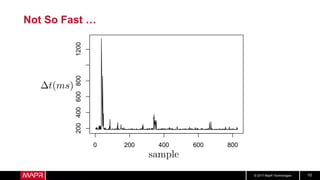
Not So Fast …
© 2017 MapR Technologies 11
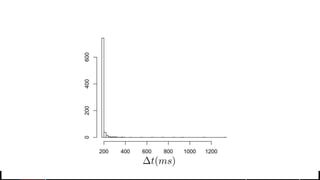
This is long-tailed land
© 2017 MapR Technologies 12
This is long-tailed land
You have to know the distribution
of values
© 2017 MapR Technologies 13
© 2017 MapR Technologies 14
A single number
is simply not enough
© 2017 MapR Technologies 15
What We Really Need Here
• I want to be able to compute the distribution from any time
period
• From any subset of measurements
• With lots of keys and filters
• And not a lot of space
• Basically, any OLAP kind of query
select distribution(x) from … where … group by y,z
© 2017 MapR Technologies 16
Idea 0 – Pre-defined bins
• So let’s assume we have bins
– Upper, lower bound, constant width
• Get a measurement, pick a bin, increment count
• Works great if you know the data
– And you have limited dynamic range (too many bins)
– And the distribution is fixed
• Useful, but not general enough
© 2017 MapR Technologies 17
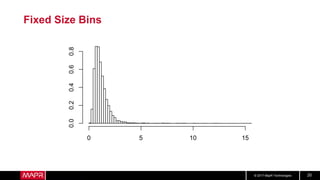
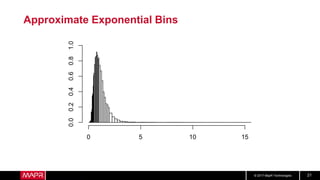
Idea 1 – Exponential Bins
• Suppose we want relative accuracy in measurement space
• Latencies are positive and only matter within a few percent
– 1.1 ms versus 1.0 ms
– 1100 ms versus 1000 ms
• We can cheat by using floating point representations
– Compute bin using magic
– Count
© 2017 MapR Technologies 18
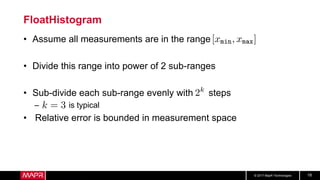
FloatHistogram
• Assume all measurements are in the range
• Divide this range into power of 2 sub-ranges
• Sub-divide each sub-range evenly with steps
– is typical
• Relative error is bounded in measurement space
© 2017 MapR Technologies 19
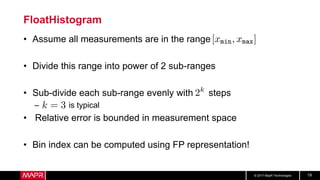
FloatHistogram
• Assume all measurements are in the range
• Divide this range into power of 2 sub-ranges
• Sub-divide each sub-range evenly with steps
– is typical
• Relative error is bounded in measurement space
• Bin index can be computed using FP representation!
© 2017 MapR Technologies 20
Fixed Size Bins
© 2017 MapR Technologies 21
Approximate Exponential Bins
© 2017 MapR Technologies 22
Non-linear bins are better
(sometimes)
Still not general enough
© 2017 MapR Technologies 23
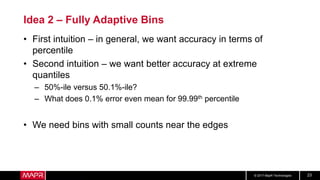
Idea 2 – Fully Adaptive Bins
• First intuition – in general, we want accuracy in terms of
percentile
• Second intuition – we want better accuracy at extreme
quantiles
– 50%-ile versus 50.1%-ile?
– What does 0.1% error even mean for 99.99th percentile
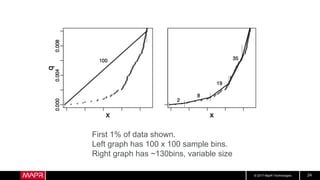
• We need bins with small counts near the edges
© 2017 MapR Technologies 24
First 1% of data shown.
Left graph has 100 x 100 sample bins.
Right graph has ~130bins, variable size
© 2017 MapR Technologies 25
The Basic t-digest
• Take a bunch of data
• Sort it
• Group into bins
– But make the bins be smaller at the beginning and end
• Remember the centroid and count of each bin
• That’s a t-digest
© 2017 MapR Technologies 26
But Wait, You Need a Bit More
• Take a bunch of new data, old t-digest
• Sort the data and the old bins together
• Group into bins
– Note that existing bins have bigger weights
– So they might survive … or might clump
• Remember the centroid and count of each new bin
• That’s an updated t-digest
© 2017 MapR Technologies 27
Oh … and Merging
• Take a bunch of old t-digests
• Sort the bins
• Group into mega-bins
– Respect the size constraint
• Remember the centroid and count of each new bin
• That’s a merged t-digest
© 2017 MapR Technologies 28
Adaptive non-linear bins are good
and general
And can be grouped
and regrouped
© 2017 MapR Technologies 29
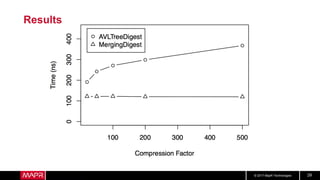
Results
© 2017 MapR Technologies 30
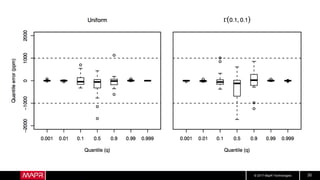
© 2017 MapR Technologies 31
Status
• Current release
– Small accuracy bugs in corner cases
– Best overall is still AVLTreeDigest
© 2017 MapR Technologies 32
Status
• Current release (3.x)
– Small accuracy bugs in corner cases
– Best overall is still AVLTreeDigest
• Upcoming release (4.0)
– Better accuracy in pathological cases
– Strictly bounded size
– No dynamic allocation (with MergingDigest)
– Good speed (100ns for MergingDigest, 5ns for FloatHistogram)
– Real Soon Now
© 2017 MapR Technologies 33
Example Application
• The data:
– ~ 1 million machines
– Even more services
– Each producing thousands of measurements per second
• Store t-digest for each 5 minute period for each measurement
• Want to query any combination of keys, produce t-digest result
“what was the distribution of launch times yesterday?”
“what about last month?”
“in Europe versus in North America versus in Asia?”
© 2017 MapR Technologies 34
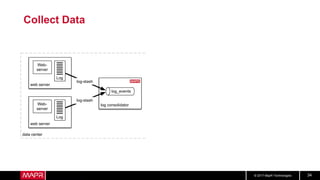
Collect Data
log consolidator
web server
web server
Web-
server
Log
Web-
server
Log
log_events
log-stash
log-stash
data center
© 2017 MapR Technologies 35
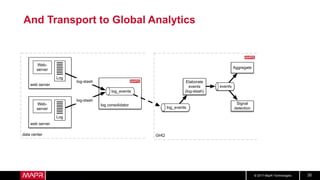
And Transport to Global Analytics
log consolidator
web server
web server
Web-
server
Log
Web-
server
Log
log_events
log-stash
log-stash
data center GHQ
log_events
events
Elaborate
events
(log-stash)
Aggregate
Signal
detection
© 2017 MapR Technologies 36
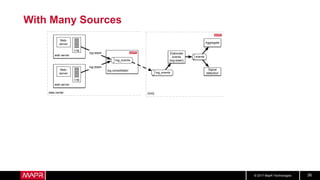
With Many Sources
log consolidator
web server
web server
Web-
server
Log
Web-
server
Log
log_events
log-stash
log-stash
data center GHQ
log_events
events
Elaborate
events
(log-stash)
Aggregate
Signal
detection
© 2017 MapR Technologies 37
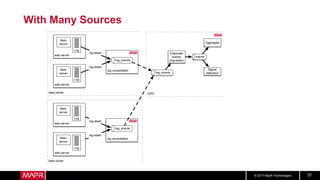
With Many Sources
log consolidator
web server
web server
Web-
server
Log
Web-
server
Log
log_events
log-stash
log-stash
data center GHQ
log_events
events
Elaborate
events
(log-stash)
Aggregate
Signal
detection
log consolidator
web server
Web-
server
Log
web server
Web-
server
Log
log_events
log-stash
log-stash
data center
© 2017 MapR Technologies 38
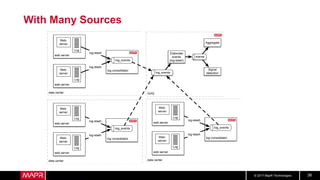
With Many Sources
log consolidator
web server
web server
Web-
server
Log
Web-
server
Log
log_events
log-stash
log-stash
data center GHQ
log_events
events
Elaborate
events
(log-stash)
Aggregate
Signal
detection
log consolidator
web server
Web-
server
Log
web server
Web-
server
Log
log_events
log-stash
log-stash
data center
log consolidator
web server
Web-
server
Log
web server
Web-
server
Log
log_events
log-stash
log-stash
data center
© 2017 MapR Technologies 39
What about visualization?
© 2017 MapR Technologies 40
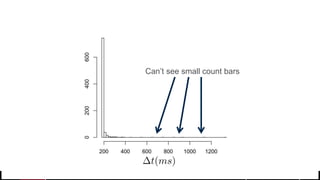
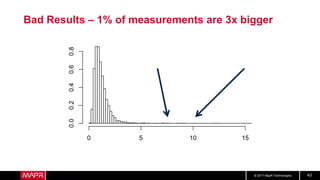
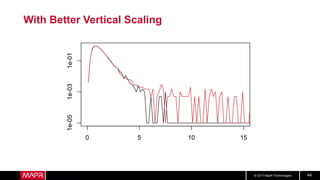
Can’t see small count bars
© 2017 MapR Technologies 41
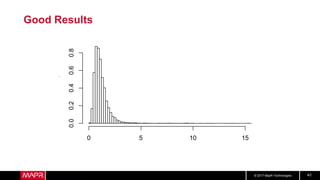
Good Results
© 2017 MapR Technologies 42
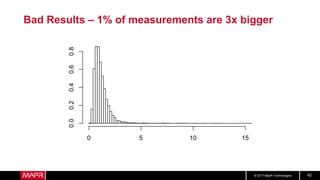
Bad Results – 1% of measurements are 3x bigger
© 2017 MapR Technologies 43
Bad Results – 1% of measurements are 3x bigger
© 2017 MapR Technologies 44
With Better Vertical Scaling
© 2017 MapR Technologies 45
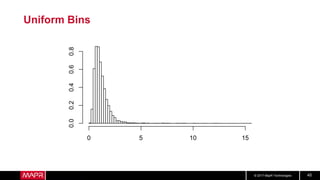
Uniform Bins
© 2017 MapR Technologies 46
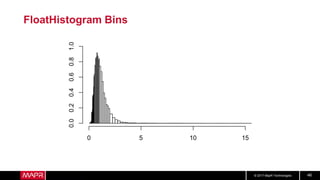
FloatHistogram Bins
© 2017 MapR Technologies 47
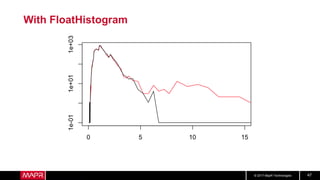
With FloatHistogram
© 2017 MapR Technologies 48
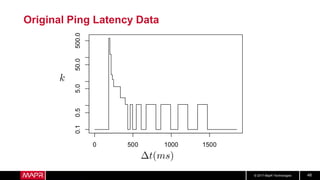
Original Ping Latency Data
© 2017 MapR Technologies 49
Summary
• Single measurements insufficient, need distributions
• Uniform binned histograms not good
• FloatHistogram for some cases
• T-digest for general cases
• Upcoming release has super-
fast and accurate versions
• Good visualization also key
0.0 0.2 0.4 0.6 0.8 1.0
q
0246810
k
© 2017 MapR Technologies 50
Q & A
© 2017 MapR Technologies 51
Contact Information
Ted Dunning, PhD
Chief Application Architect, MapR Technologies
Board member, Apache Software Foundation
O’Reilly author
Email tdunning@mapr.com tdunning@apache.org
Twitter @ted_dunning
© 2017 MapR Technologies 52
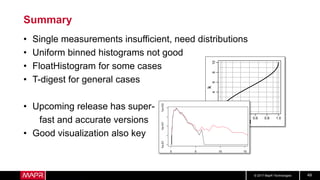
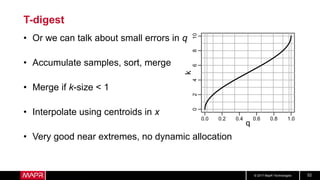
T-digest
• Or we can talk about small errors in q
• Accumulate samples, sort, merge
• Merge if k-size < 1
• Interpolate using centroids in x
• Very good near extremes, no dynamic allocation
0.0 0.2 0.4 0.6 0.8 1.0
q
0246810
k

T digest-update

  • 1.
    © 2017 MapRTechnologies 1 Update on t-digest
  • 2.
    © 2017 MapRTechnologies 2 Contact Information Ted Dunning, PhD Chief Application Architect, MapR Technologies Board member, Apache Software Foundation O’Reilly author Email tdunning@mapr.com tdunning@apache.org Twitter @ted_dunning
  • 3.
    © 2017 MapRTechnologies 3 Who We Are • MapR echnologies – We make a kick-ass platform for big data computing – Support many workloads including Hadoop / Spark / HPC / Other – Extended to allow streams and tables in basic platform – Free for academic research / training • Apache Software Foundation – Culture hub for building open source communities – Shared values around openness for contribution as well as use – Many major projects are part of Apache – Even more minor ones!
  • 4.
    © 2017 MapRTechnologies 4 Basic Outline • Why we should measure distributions • Basic Ideas • How t-digest works • Recent results • Applications
  • 5.
    © 2017 MapRTechnologies 5 Why Is This Practically Important • The novice came to the master and says “something is broken”
  • 6.
    © 2017 MapRTechnologies 6 Why Is This Practically Important • The novice came to the master and says “something is broken” • The master replied “What has changed?”
  • 7.
    © 2017 MapRTechnologies 7 Why Is This Practically Important • The novice came to the master and says “something is broken” • The master replied “What has changed?” • And the student was enlightened
  • 8.
    © 2017 MapRTechnologies 8 Finding change is key but what kind?
  • 9.
    © 2017 MapRTechnologies 9 Last Night’s Latencies • These are ping latencies from my hotel • Looks pretty good, right? • But what about longer term? 208.302 198.571 185.099 191.258 201.392 214.738 197.389 187.749 201.693 186.762 185.296 186.390 183.960 188.060 190.763 > mean(y$t[i]) [1] 198.6047 > sd(y$t[i]) [1] 71.43965
  • 10.
    © 2017 MapRTechnologies 10 Not So Fast …
  • 11.
    © 2017 MapRTechnologies 11 This is long-tailed land
  • 12.
    © 2017 MapRTechnologies 12 This is long-tailed land You have to know the distribution of values
  • 13.
    © 2017 MapRTechnologies 13
  • 14.
    © 2017 MapRTechnologies 14 A single number is simply not enough
  • 15.
    © 2017 MapRTechnologies 15 What We Really Need Here • I want to be able to compute the distribution from any time period • From any subset of measurements • With lots of keys and filters • And not a lot of space • Basically, any OLAP kind of query select distribution(x) from … where … group by y,z
  • 16.
    © 2017 MapRTechnologies 16 Idea 0 – Pre-defined bins • So let’s assume we have bins – Upper, lower bound, constant width • Get a measurement, pick a bin, increment count • Works great if you know the data – And you have limited dynamic range (too many bins) – And the distribution is fixed • Useful, but not general enough
  • 17.
    © 2017 MapRTechnologies 17 Idea 1 – Exponential Bins • Suppose we want relative accuracy in measurement space • Latencies are positive and only matter within a few percent – 1.1 ms versus 1.0 ms – 1100 ms versus 1000 ms • We can cheat by using floating point representations – Compute bin using magic – Count
  • 18.
    © 2017 MapRTechnologies 18 FloatHistogram • Assume all measurements are in the range • Divide this range into power of 2 sub-ranges • Sub-divide each sub-range evenly with steps – is typical • Relative error is bounded in measurement space
  • 19.
    © 2017 MapRTechnologies 19 FloatHistogram • Assume all measurements are in the range • Divide this range into power of 2 sub-ranges • Sub-divide each sub-range evenly with steps – is typical • Relative error is bounded in measurement space • Bin index can be computed using FP representation!
  • 20.
    © 2017 MapRTechnologies 20 Fixed Size Bins
  • 21.
    © 2017 MapRTechnologies 21 Approximate Exponential Bins
  • 22.
    © 2017 MapRTechnologies 22 Non-linear bins are better (sometimes) Still not general enough
  • 23.
    © 2017 MapRTechnologies 23 Idea 2 – Fully Adaptive Bins • First intuition – in general, we want accuracy in terms of percentile • Second intuition – we want better accuracy at extreme quantiles – 50%-ile versus 50.1%-ile? – What does 0.1% error even mean for 99.99th percentile • We need bins with small counts near the edges
  • 24.
    © 2017 MapRTechnologies 24 First 1% of data shown. Left graph has 100 x 100 sample bins. Right graph has ~130bins, variable size
  • 25.
    © 2017 MapRTechnologies 25 The Basic t-digest • Take a bunch of data • Sort it • Group into bins – But make the bins be smaller at the beginning and end • Remember the centroid and count of each bin • That’s a t-digest
  • 26.
    © 2017 MapRTechnologies 26 But Wait, You Need a Bit More • Take a bunch of new data, old t-digest • Sort the data and the old bins together • Group into bins – Note that existing bins have bigger weights – So they might survive … or might clump • Remember the centroid and count of each new bin • That’s an updated t-digest
  • 27.
    © 2017 MapRTechnologies 27 Oh … and Merging • Take a bunch of old t-digests • Sort the bins • Group into mega-bins – Respect the size constraint • Remember the centroid and count of each new bin • That’s a merged t-digest
  • 28.
    © 2017 MapRTechnologies 28 Adaptive non-linear bins are good and general And can be grouped and regrouped
  • 29.
    © 2017 MapRTechnologies 29 Results
  • 30.
    © 2017 MapRTechnologies 30
  • 31.
    © 2017 MapRTechnologies 31 Status • Current release – Small accuracy bugs in corner cases – Best overall is still AVLTreeDigest
  • 32.
    © 2017 MapRTechnologies 32 Status • Current release (3.x) – Small accuracy bugs in corner cases – Best overall is still AVLTreeDigest • Upcoming release (4.0) – Better accuracy in pathological cases – Strictly bounded size – No dynamic allocation (with MergingDigest) – Good speed (100ns for MergingDigest, 5ns for FloatHistogram) – Real Soon Now
  • 33.
    © 2017 MapRTechnologies 33 Example Application • The data: – ~ 1 million machines – Even more services – Each producing thousands of measurements per second • Store t-digest for each 5 minute period for each measurement • Want to query any combination of keys, produce t-digest result “what was the distribution of launch times yesterday?” “what about last month?” “in Europe versus in North America versus in Asia?”
  • 34.
    © 2017 MapRTechnologies 34 Collect Data log consolidator web server web server Web- server Log Web- server Log log_events log-stash log-stash data center
  • 35.
    © 2017 MapRTechnologies 35 And Transport to Global Analytics log consolidator web server web server Web- server Log Web- server Log log_events log-stash log-stash data center GHQ log_events events Elaborate events (log-stash) Aggregate Signal detection
  • 36.
    © 2017 MapRTechnologies 36 With Many Sources log consolidator web server web server Web- server Log Web- server Log log_events log-stash log-stash data center GHQ log_events events Elaborate events (log-stash) Aggregate Signal detection
  • 37.
    © 2017 MapRTechnologies 37 With Many Sources log consolidator web server web server Web- server Log Web- server Log log_events log-stash log-stash data center GHQ log_events events Elaborate events (log-stash) Aggregate Signal detection log consolidator web server Web- server Log web server Web- server Log log_events log-stash log-stash data center
  • 38.
    © 2017 MapRTechnologies 38 With Many Sources log consolidator web server web server Web- server Log Web- server Log log_events log-stash log-stash data center GHQ log_events events Elaborate events (log-stash) Aggregate Signal detection log consolidator web server Web- server Log web server Web- server Log log_events log-stash log-stash data center log consolidator web server Web- server Log web server Web- server Log log_events log-stash log-stash data center
  • 39.
    © 2017 MapRTechnologies 39 What about visualization?
  • 40.
    © 2017 MapRTechnologies 40 Can’t see small count bars
  • 41.
    © 2017 MapRTechnologies 41 Good Results
  • 42.
    © 2017 MapRTechnologies 42 Bad Results – 1% of measurements are 3x bigger
  • 43.
    © 2017 MapRTechnologies 43 Bad Results – 1% of measurements are 3x bigger
  • 44.
    © 2017 MapRTechnologies 44 With Better Vertical Scaling
  • 45.
    © 2017 MapRTechnologies 45 Uniform Bins
  • 46.
    © 2017 MapRTechnologies 46 FloatHistogram Bins
  • 47.
    © 2017 MapRTechnologies 47 With FloatHistogram
  • 48.
    © 2017 MapRTechnologies 48 Original Ping Latency Data
  • 49.
    © 2017 MapRTechnologies 49 Summary • Single measurements insufficient, need distributions • Uniform binned histograms not good • FloatHistogram for some cases • T-digest for general cases • Upcoming release has super- fast and accurate versions • Good visualization also key 0.0 0.2 0.4 0.6 0.8 1.0 q 0246810 k
  • 50.
    © 2017 MapRTechnologies 50 Q & A
  • 51.
    © 2017 MapRTechnologies 51 Contact Information Ted Dunning, PhD Chief Application Architect, MapR Technologies Board member, Apache Software Foundation O’Reilly author Email tdunning@mapr.com tdunning@apache.org Twitter @ted_dunning
  • 52.
    © 2017 MapRTechnologies 52 T-digest • Or we can talk about small errors in q • Accumulate samples, sort, merge • Merge if k-size < 1 • Interpolate using centroids in x • Very good near extremes, no dynamic allocation 0.0 0.2 0.4 0.6 0.8 1.0 q 0246810 k