© 2017 MapR TechnologiesMapR Confidential 1
Tensor Abuse
In the Workplace
© 2017 MapR TechnologiesMapR Confidential 2
Agenda
• What are tensors?
• How modern tensor systems work
• It's not just machine learning
• It’s also not magic
• Machine learning as optimization
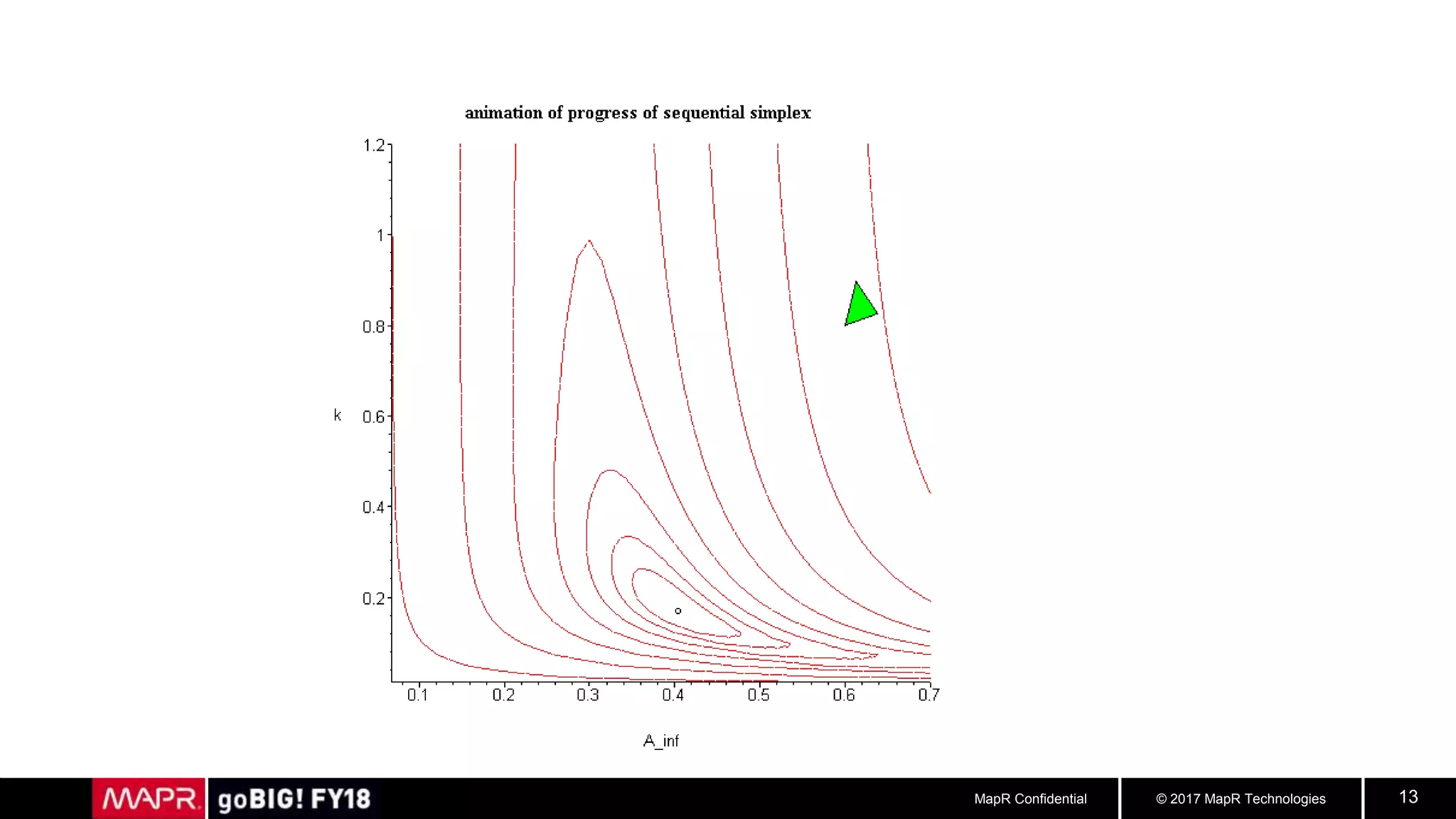
• Animation of optimization algorithm
© 2017 MapR TechnologiesMapR Confidential 3
Spoilers
• Trigger warning: Greek letters ahead
– AND lots of animations for developing intuitions
• Tensors have a history in physics
• We don’t use them that way in machine learning
• Tensors are cool because they make it easier to code
numerical algorithms
• But auto-derivatives are as big a deal
• And we can abuse this machinery
© 2017 MapR TechnologiesMapR Confidential 4
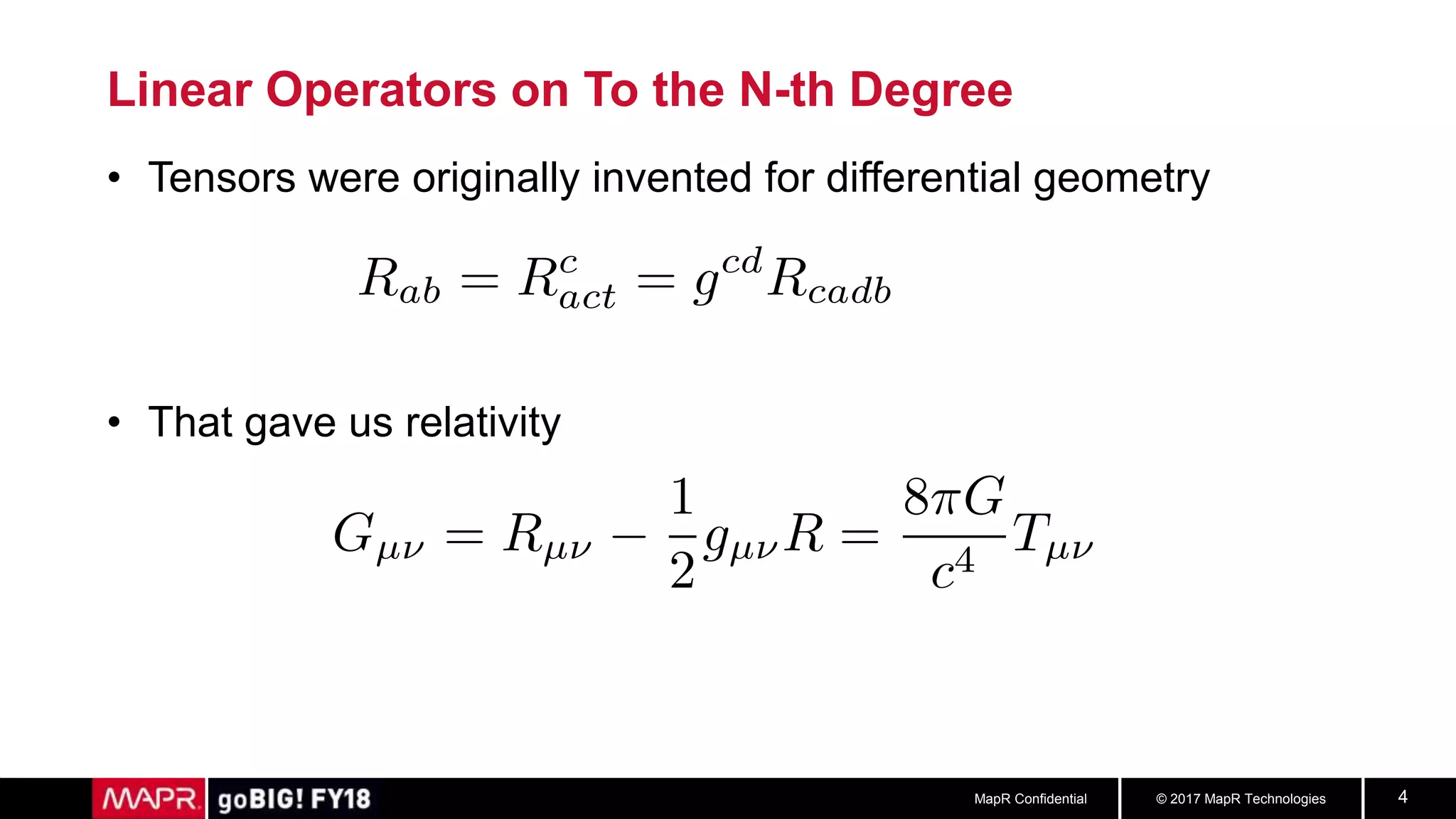
Linear Operators on To the N-th Degree
• Tensors were originally invented for differential geometry
• That gave us relativity
© 2017 MapR TechnologiesMapR Confidential 5
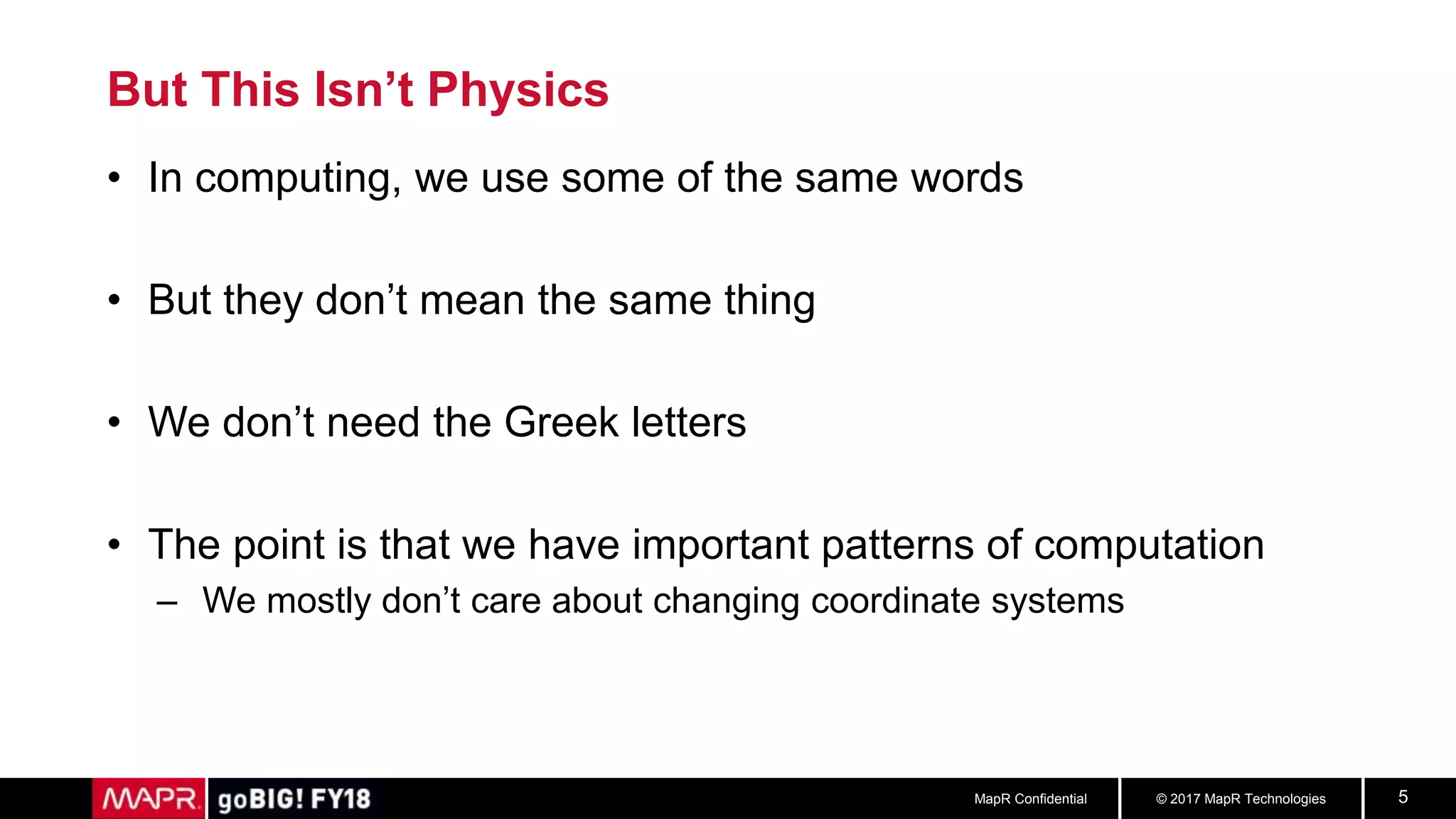
But This Isn’t Physics
• In computing, we use some of the same words
• But they don’t mean the same thing
• We don’t need the Greek letters
• The point is that we have important patterns of computation
– We mostly don’t care about changing coordinate systems
© 2017 MapR TechnologiesMapR Confidential 6
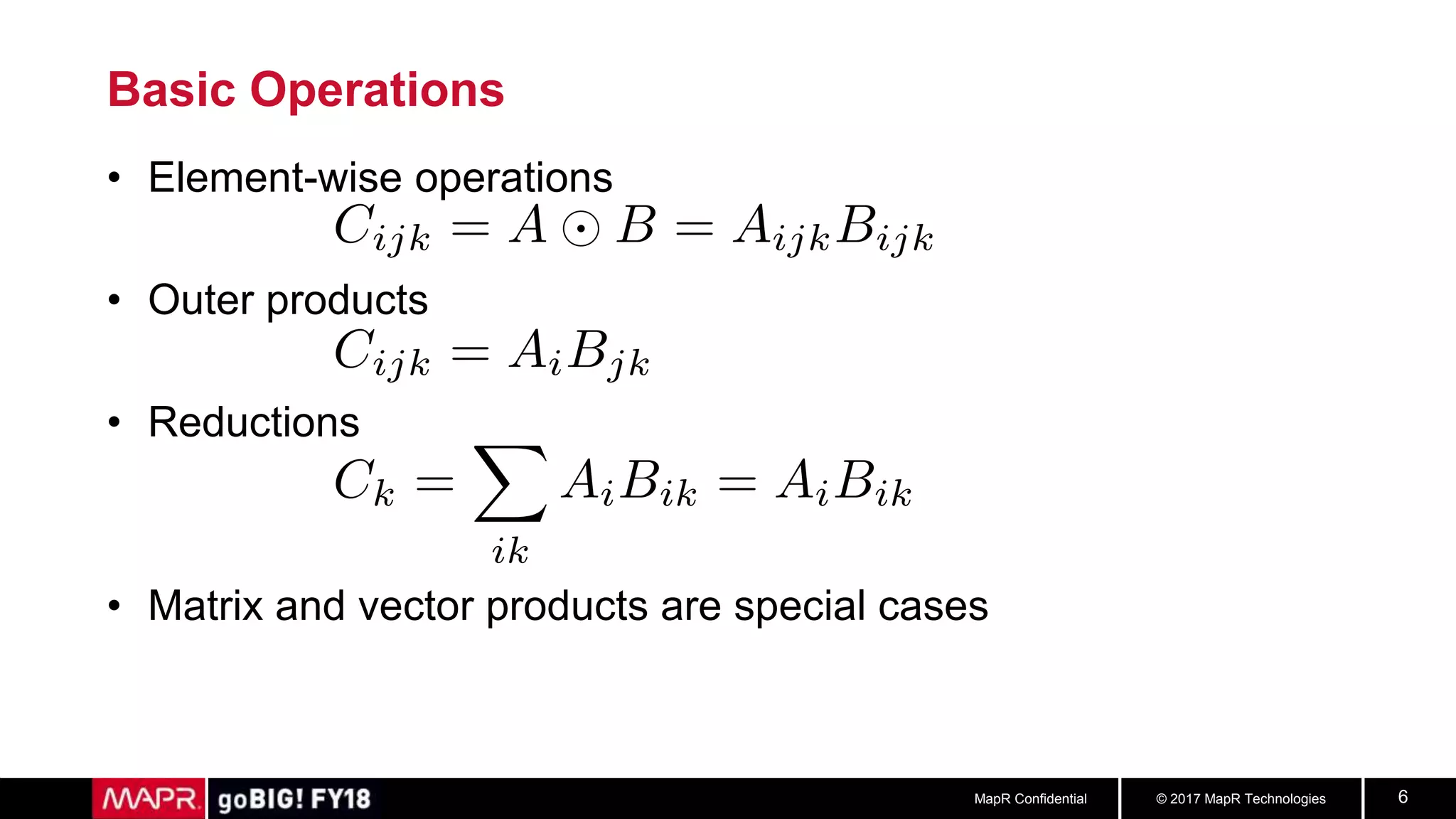
Basic Operations
• Element-wise operations
• Outer products
• Reductions
• Matrix and vector products are special cases
© 2017 MapR TechnologiesMapR Confidential 7
This is news?!?
© 2017 MapR TechnologiesMapR Confidential 8
This is news?!?
Sounds like APL in sheep’s clothing
© 2017 MapR TechnologiesMapR Confidential 9
But it really is important
because
loop structuring is critical
© 2017 MapR TechnologiesMapR Confidential 10
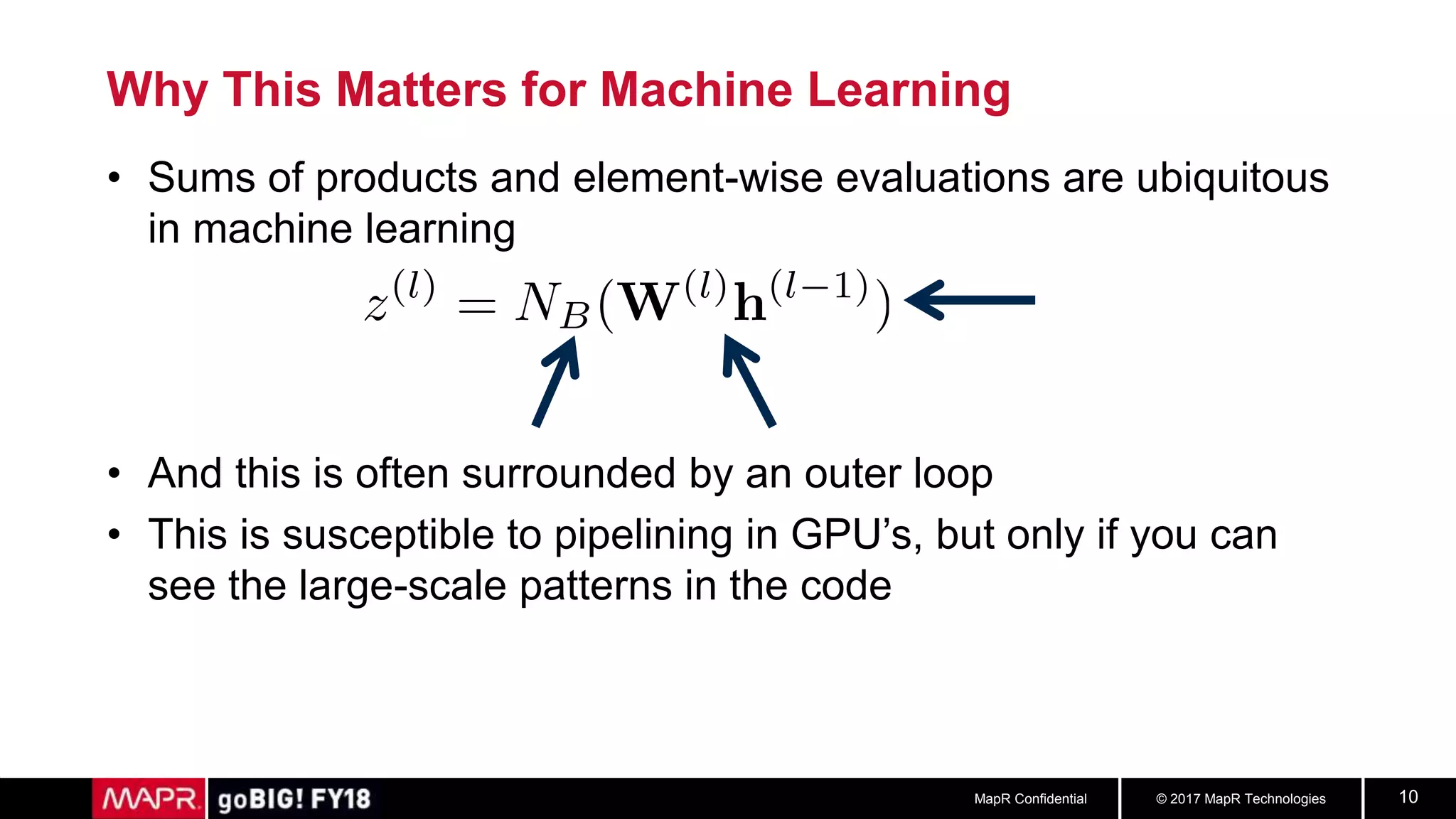
Why This Matters for Machine Learning
• Sums of products and element-wise evaluations are ubiquitous
in machine learning
• And this is often surrounded by an outer loop
• This is susceptible to pipelining in GPU’s, but only if you can
see the large-scale patterns in the code
© 2017 MapR TechnologiesMapR Confidential 11
But, tensors are only
half of the story
© 2017 MapR TechnologiesMapR Confidential 12
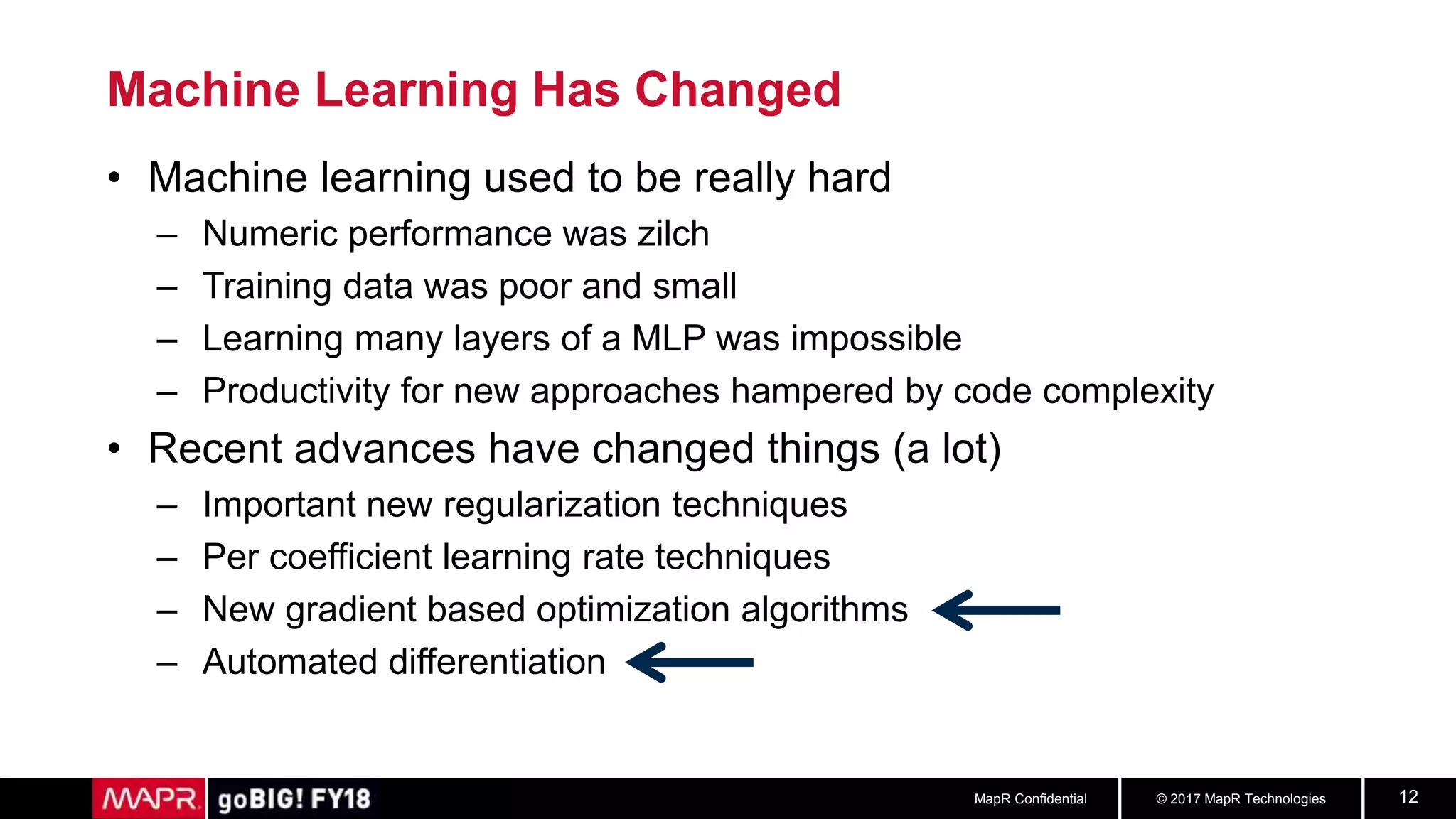
Machine Learning Has Changed
• Machine learning used to be really hard
– Numeric performance was zilch
– Training data was poor and small
– Learning many layers of a MLP was impossible
– Productivity for new approaches hampered by code complexity
• Recent advances have changed things (a lot)
– Important new regularization techniques
– Per coefficient learning rate techniques
– New gradient based optimization algorithms
– Automated differentiation
© 2017 MapR TechnologiesMapR Confidential 13
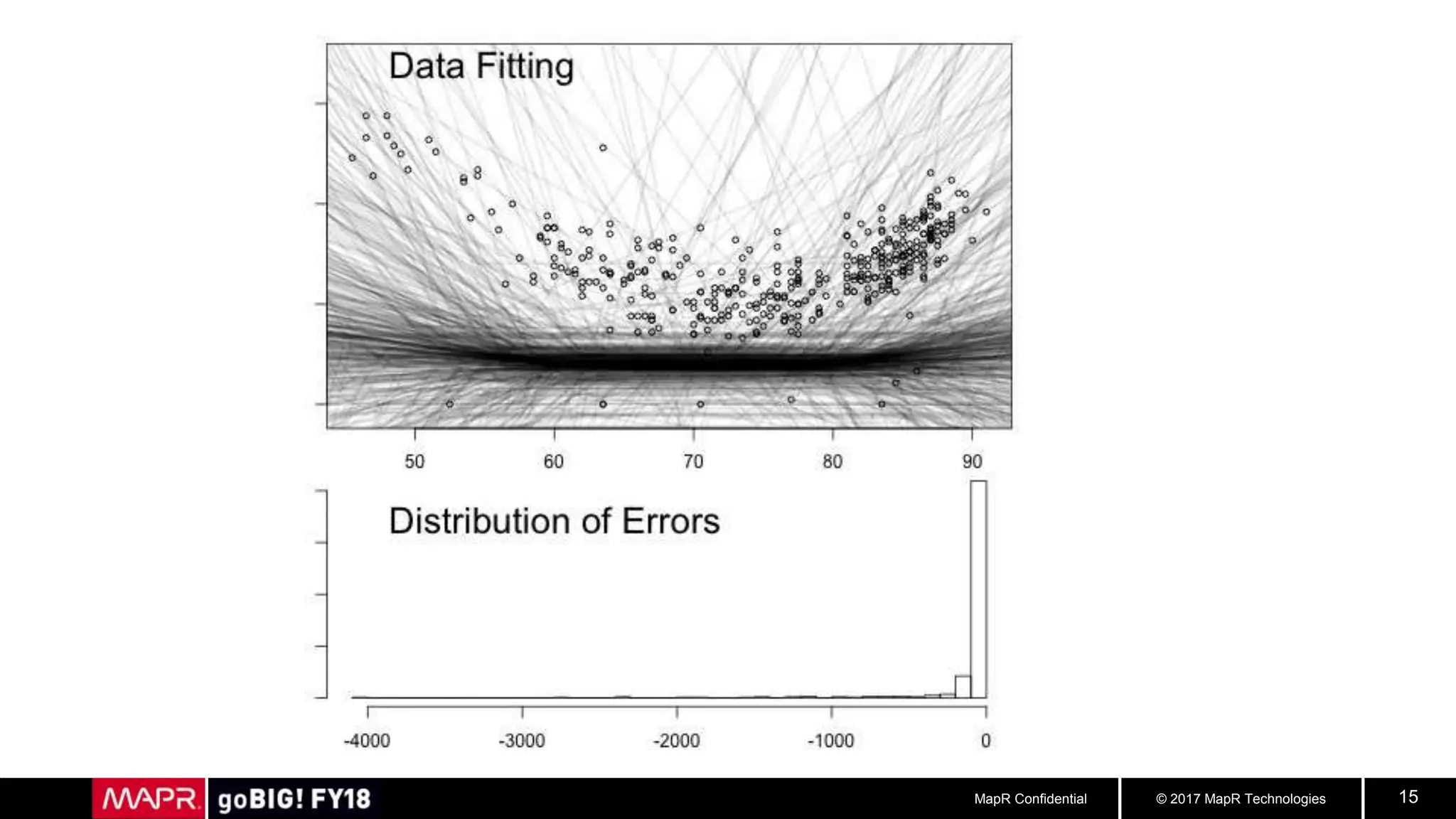
© 2017 MapR TechnologiesMapR Confidential 14
© 2017 MapR TechnologiesMapR Confidential 15
© 2017 MapR TechnologiesMapR Confidential 17
Gradients are a Big Deal
• In low dimensions, simple search techniques work well
– Line search, evolutionary processes, polyhedron warping all work
• It’s different in high dimensions
– Need some guide about which direction to go
– Too many ways to get sideways
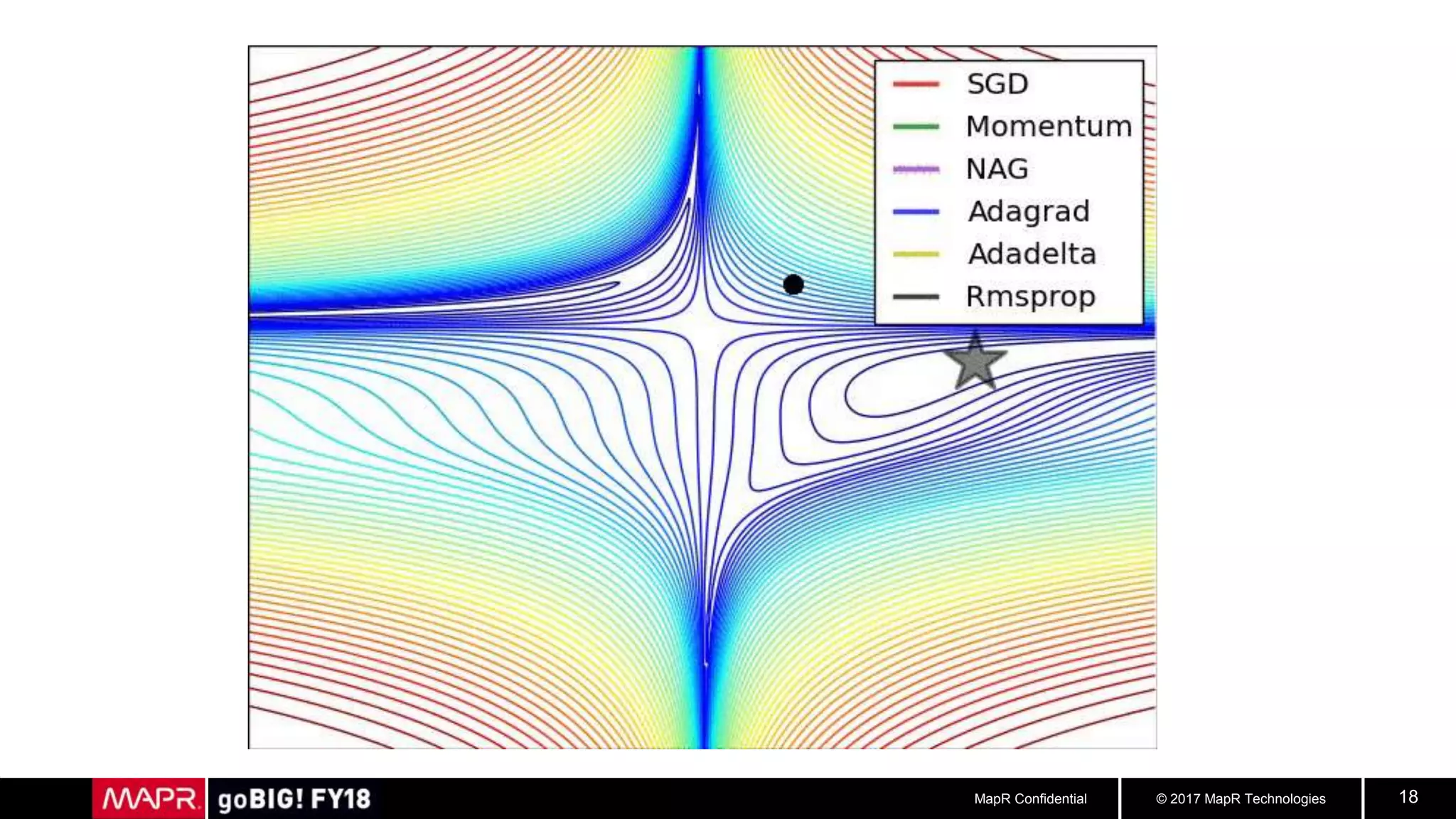
© 2017 MapR TechnologiesMapR Confidential 18
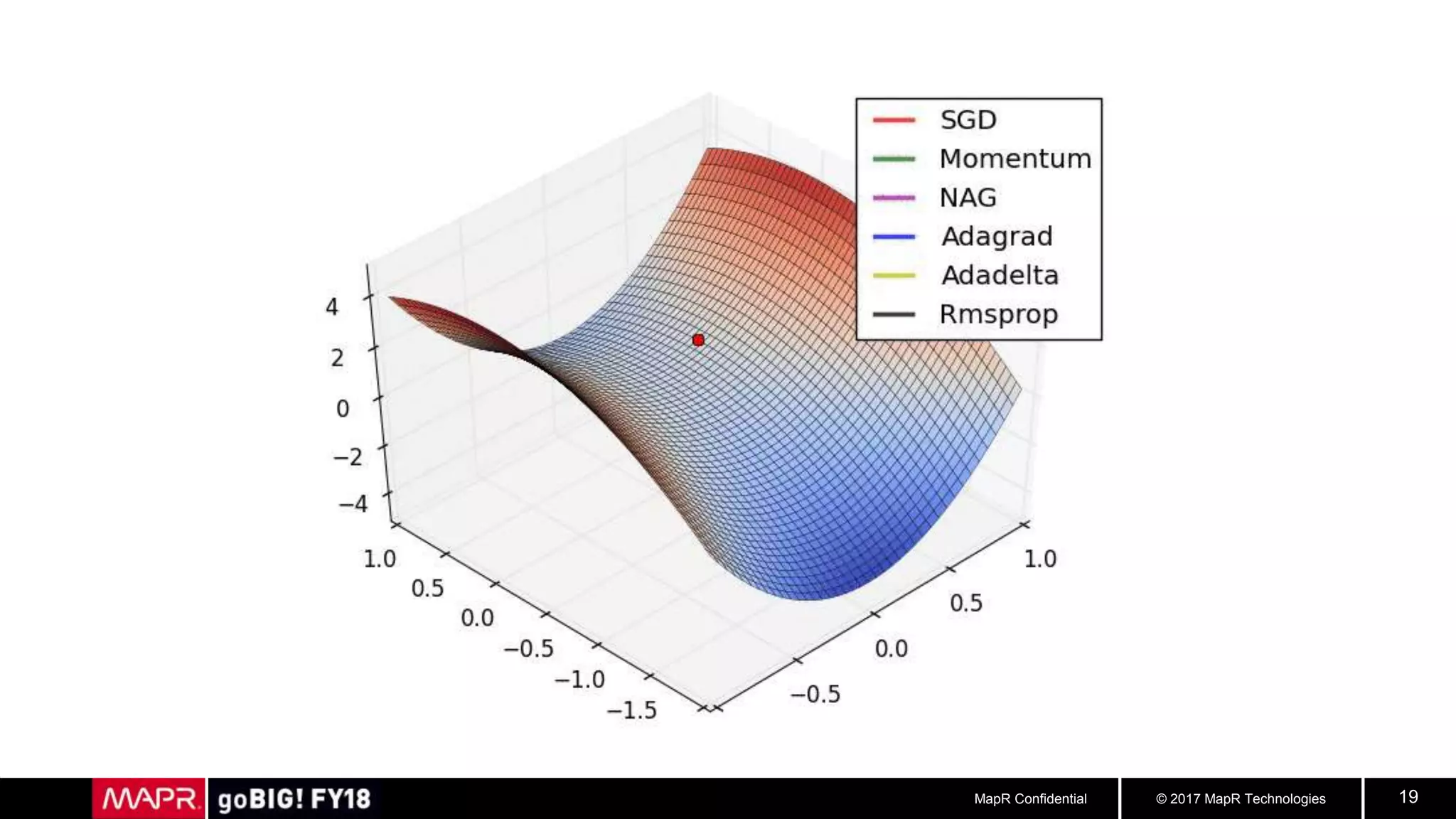
© 2017 MapR TechnologiesMapR Confidential 19
© 2017 MapR TechnologiesMapR Confidential 20
Yeah, But …
• Gradients are also a pain in the ***
– Traditionally you needed to derive them by hand
– For some problems like robot kinematics or astrodynamics, equations
would cover many pages
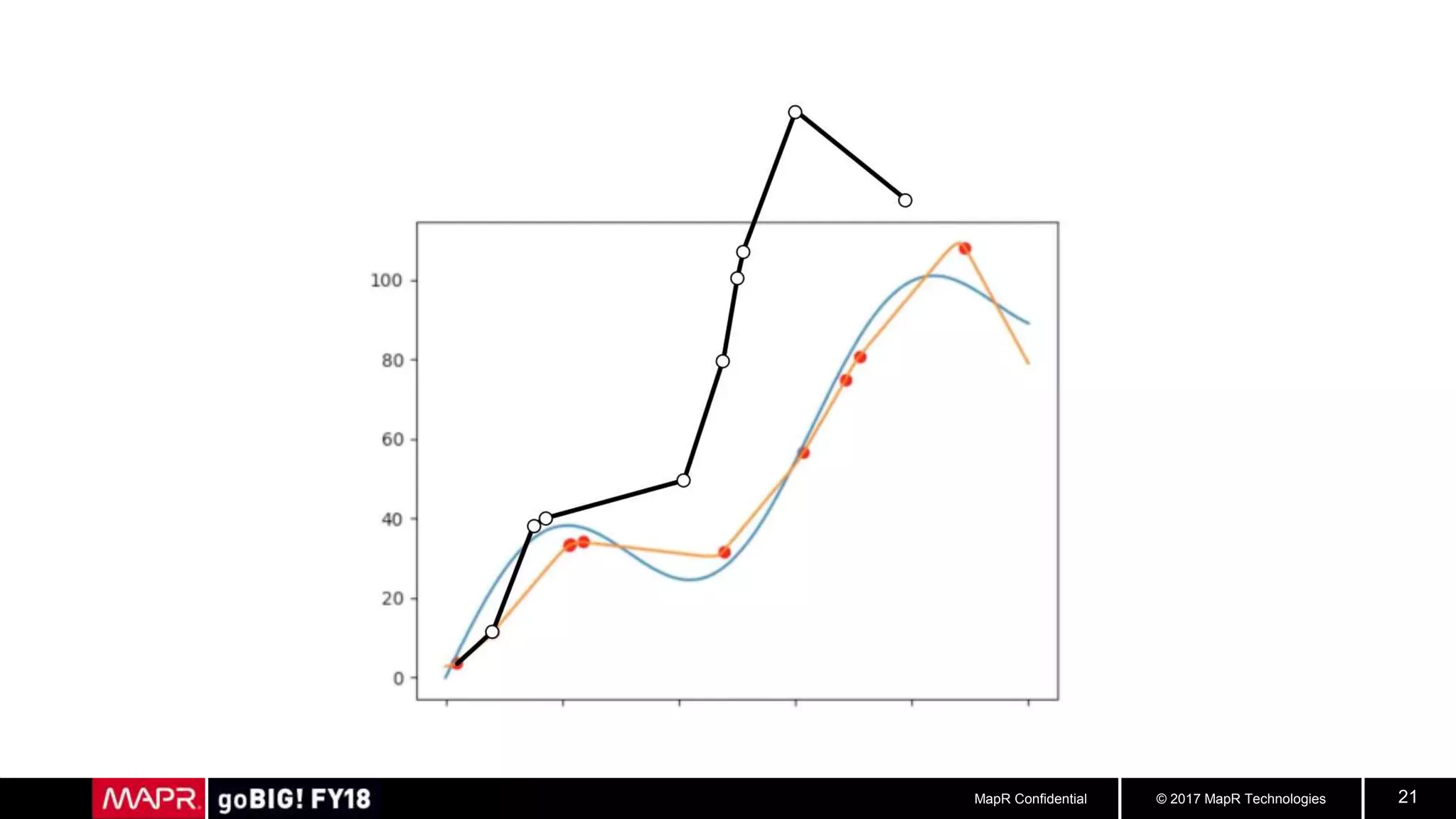
• The big change in recent years is automatic differentiation
– Some limits on how problems are formulated
– But pretty complicated forms can be allowed easily
© 2017 MapR TechnologiesMapR Confidential 21
© 2017 MapR TechnologiesMapR Confidential 22
© 2017 MapR TechnologiesMapR Confidential 23
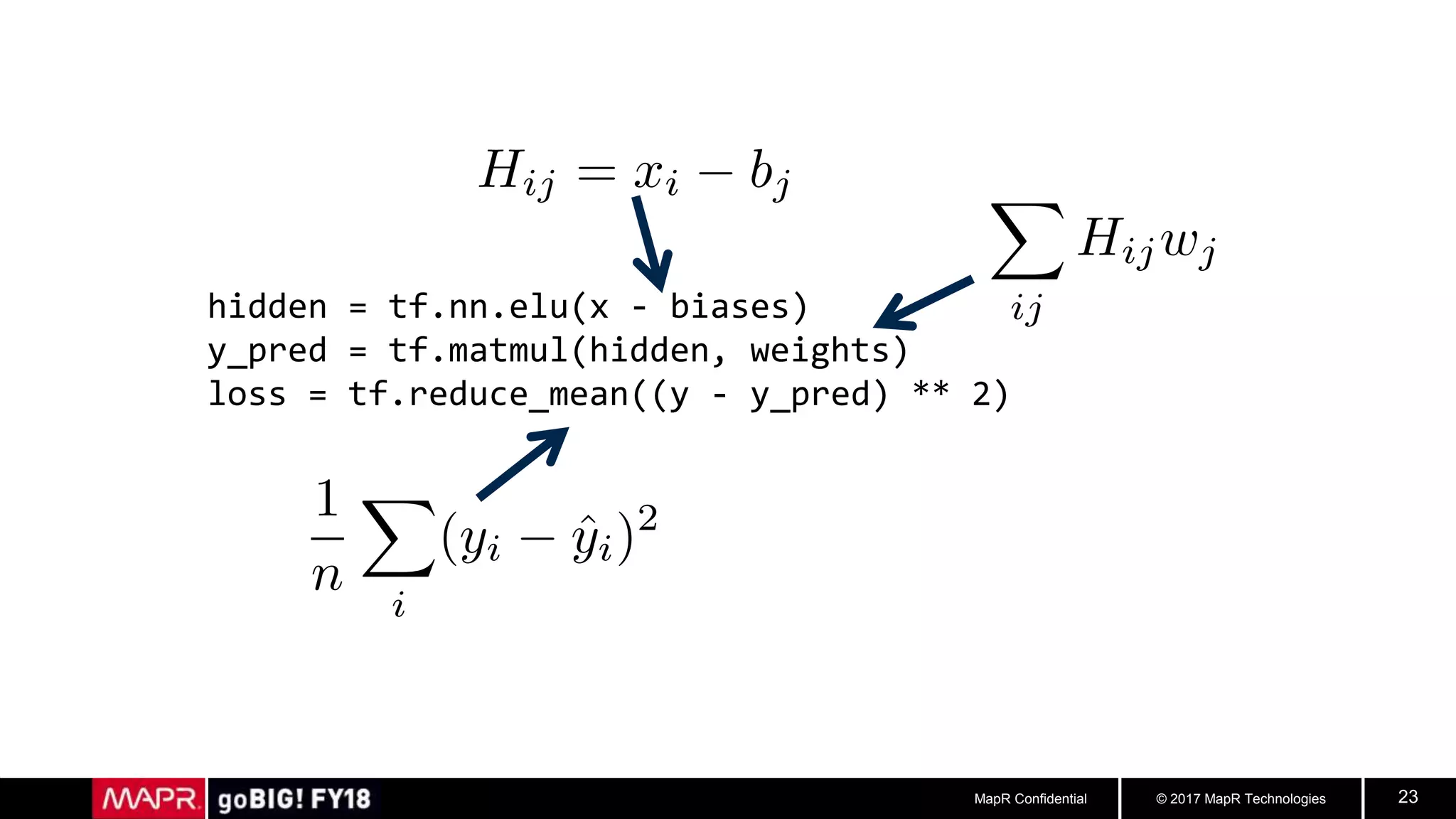
hidden = tf.nn.elu(x - biases)
y_pred = tf.matmul(hidden, weights)
loss = tf.reduce_mean((y - y_pred) ** 2)
© 2017 MapR TechnologiesMapR Confidential 24
The Lessons to Learn
• These new systems are astounding
– Tensors allow us to encode very complex algorithms
– Auto-differentiation allows us to use gradients
– New optimizers solve very nasty problems
– The same code can drive CPU, GPU or clusters
– The code is strange and abstract, but not that hard
• Not just for breakfast any more
– Machine learning isn’t the only thing you can do with these systems
– Go for it!
© 2017 MapR TechnologiesMapR Confidential 25
Q&A
@mapr
maprtechnologies
yourname@mapr.com
ENGAGE WITH US

Tensor Abuse - how to reuse machine learning frameworks

  • 1.
    © 2017 MapRTechnologiesMapR Confidential 1 Tensor Abuse In the Workplace
  • 2.
    © 2017 MapRTechnologiesMapR Confidential 2 Agenda • What are tensors? • How modern tensor systems work • It's not just machine learning • It’s also not magic • Machine learning as optimization • Animation of optimization algorithm
  • 3.
    © 2017 MapRTechnologiesMapR Confidential 3 Spoilers • Trigger warning: Greek letters ahead – AND lots of animations for developing intuitions • Tensors have a history in physics • We don’t use them that way in machine learning • Tensors are cool because they make it easier to code numerical algorithms • But auto-derivatives are as big a deal • And we can abuse this machinery
  • 4.
    © 2017 MapRTechnologiesMapR Confidential 4 Linear Operators on To the N-th Degree • Tensors were originally invented for differential geometry • That gave us relativity
  • 5.
    © 2017 MapRTechnologiesMapR Confidential 5 But This Isn’t Physics • In computing, we use some of the same words • But they don’t mean the same thing • We don’t need the Greek letters • The point is that we have important patterns of computation – We mostly don’t care about changing coordinate systems
  • 6.
    © 2017 MapRTechnologiesMapR Confidential 6 Basic Operations • Element-wise operations • Outer products • Reductions • Matrix and vector products are special cases
  • 7.
    © 2017 MapRTechnologiesMapR Confidential 7 This is news?!?
  • 8.
    © 2017 MapRTechnologiesMapR Confidential 8 This is news?!? Sounds like APL in sheep’s clothing
  • 9.
    © 2017 MapRTechnologiesMapR Confidential 9 But it really is important because loop structuring is critical
  • 10.
    © 2017 MapRTechnologiesMapR Confidential 10 Why This Matters for Machine Learning • Sums of products and element-wise evaluations are ubiquitous in machine learning • And this is often surrounded by an outer loop • This is susceptible to pipelining in GPU’s, but only if you can see the large-scale patterns in the code
  • 11.
    © 2017 MapRTechnologiesMapR Confidential 11 But, tensors are only half of the story
  • 12.
    © 2017 MapRTechnologiesMapR Confidential 12 Machine Learning Has Changed • Machine learning used to be really hard – Numeric performance was zilch – Training data was poor and small – Learning many layers of a MLP was impossible – Productivity for new approaches hampered by code complexity • Recent advances have changed things (a lot) – Important new regularization techniques – Per coefficient learning rate techniques – New gradient based optimization algorithms – Automated differentiation
  • 13.
    © 2017 MapRTechnologiesMapR Confidential 13
  • 14.
    © 2017 MapRTechnologiesMapR Confidential 14
  • 15.
    © 2017 MapRTechnologiesMapR Confidential 15
  • 16.
    © 2017 MapRTechnologiesMapR Confidential 17 Gradients are a Big Deal • In low dimensions, simple search techniques work well – Line search, evolutionary processes, polyhedron warping all work • It’s different in high dimensions – Need some guide about which direction to go – Too many ways to get sideways
  • 17.
    © 2017 MapRTechnologiesMapR Confidential 18
  • 18.
    © 2017 MapRTechnologiesMapR Confidential 19
  • 19.
    © 2017 MapRTechnologiesMapR Confidential 20 Yeah, But … • Gradients are also a pain in the *** – Traditionally you needed to derive them by hand – For some problems like robot kinematics or astrodynamics, equations would cover many pages • The big change in recent years is automatic differentiation – Some limits on how problems are formulated – But pretty complicated forms can be allowed easily
  • 20.
    © 2017 MapRTechnologiesMapR Confidential 21
  • 21.
    © 2017 MapRTechnologiesMapR Confidential 22
  • 22.
    © 2017 MapRTechnologiesMapR Confidential 23 hidden = tf.nn.elu(x - biases) y_pred = tf.matmul(hidden, weights) loss = tf.reduce_mean((y - y_pred) ** 2)
  • 23.
    © 2017 MapRTechnologiesMapR Confidential 24 The Lessons to Learn • These new systems are astounding – Tensors allow us to encode very complex algorithms – Auto-differentiation allows us to use gradients – New optimizers solve very nasty problems – The same code can drive CPU, GPU or clusters – The code is strange and abstract, but not that hard • Not just for breakfast any more – Machine learning isn’t the only thing you can do with these systems – Go for it!
  • 24.
    © 2017 MapRTechnologiesMapR Confidential 25 Q&A @mapr maprtechnologies yourname@mapr.com ENGAGE WITH US