Delivering More for Less Through Systems Thinking
Leeds Breakfast Seminar: 22nd October 2010

James Llewellyn, Atkins Limited
22/10/2010   Delivering More for Less


Words of Wisdom
“We cannot solve our problems with the same thinking that we
  used to create them”

“A person who has never made a mistake has never tried
  anything new”

(Albert Einstein)
22/10/2010   Delivering More for Less


Context (CSR)
• Cut of 28% to local government grant over next 4 years
• 15% reduction (in real terms) in DfT budget in the same period
• Emphasis on “efficiency” including:
   o Performance monitoring group and re-structuring for the HA
   o New contracts and commercial management
   o National framework for commodity purchase
   o Administration of concessionary travel scheme
• And plenty of cuts:
   o Kirklees street lighting PFI
   o A1 Leeming to Barton
22/10/2010   Delivering More for Less


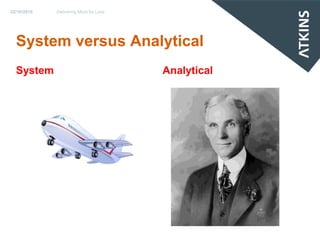
  System versus Analytical
  System                                Analytical
22/10/2010   Delivering More For Less


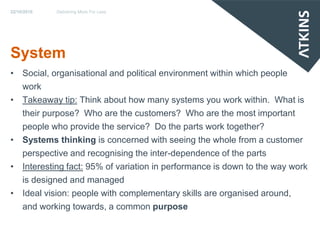
System
• Social, organisational and political environment within which people
  work
• Takeaway tip: Think about how many systems you work within. What is
  their purpose? Who are the customers? Who are the most important
  people who provide the service? Do the parts work together?
• Systems thinking is concerned with seeing the whole from a customer
  perspective and recognising the inter-dependence of the parts
• Interesting fact: 95% of variation in performance is down to the way work
  is designed and managed
• Ideal vision: people with complementary skills are organised around,
  and working towards, a common purpose
22/10/2010   Delivering More for Less


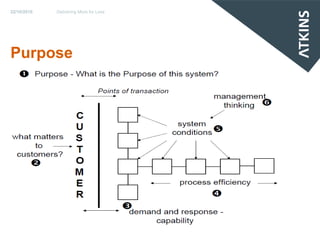
Purpose
22/10/2010   Delivering More for Less


Flow
22/10/2010   Delivering More for Less


Flow
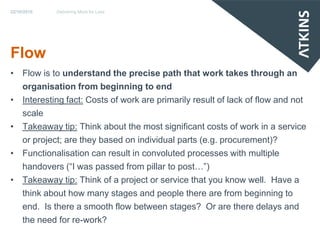
• Flow is to understand the precise path that work takes through an
  organisation from beginning to end
• Interesting fact: Costs of work are primarily result of lack of flow and not
  scale
• Takeaway tip: Think about the most significant costs of work in a service
  or project; are they based on individual parts (e.g. procurement)?
• Functionalisation can result in convoluted processes with multiple
  handovers (“I was passed from pillar to post…”)
• Takeaway tip: Think of a project or service that you know well. Have a
  think about how many stages and people there are from beginning to
  end. Is there a smooth flow between stages? Or are there delays and
  the need for re-work?
22/10/2010   Delivering More for Less


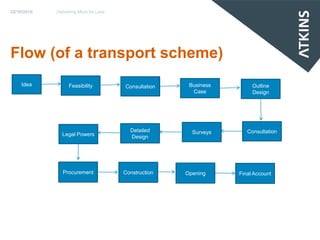
Flow (of a transport scheme)
    Idea           Feasibility          Consultation    Business        Outline
                                                         Case           Design


                                          Detailed       Surveys      Consultation
               Legal Powers               Design


                Procurement             Construction   Opening     Final Account
22/10/2010   Delivering More for Less


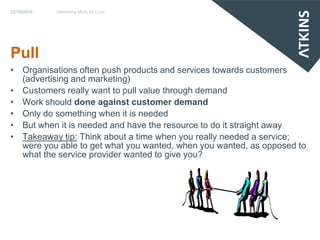
Pull
• Organisations often push products and services towards customers
  (advertising and marketing)
• Customers really want to pull value through demand
• Work should done against customer demand
• Only do something when it is needed
• But when it is needed and have the resource to do it straight away
• Takeaway tip: Think about a time when you really needed a service;
  were you able to get what you wanted, when you wanted, as opposed to
  what the service provider wanted to give you?
22/10/2010   Delivering More for Less


Waste
• Any activity that does not add value to the purpose of work from the
  customer perspective
• Examples include: inspection, complaints, re-work, abortive work
• Takeaway tip: Go and ask some front line members of staff where they
  believe waste is occurring; you may well be surprised about how much
  they know
• Waste should either designed out or separated from the value work (if it
  cannot be avoided)
22/10/2010   Delivering More for Less


Customer Demand
• Value demand – what the customer wants
• Failure demand - caused by failure to do something or do something
  right for the customer
• Consequence of failure demand is more work and waste
• Takeaway tip: Go and listen in a call centre for a few hours; note how
  many calls are failure demand
• Interesting fact: Failure demand is between 20-80% of total demand
• Reducing failure demand reduces costs and improves service
22/10/2010   Delivering More for Less


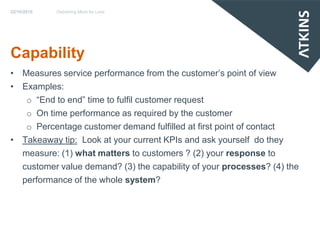
Capability
• Measures service performance from the customer’s point of view
• Examples:
   o “End to end” time to fulfil customer request
   o On time performance as required by the customer
   o Percentage customer demand fulfilled at first point of contact
• Takeaway tip: Look at your current KPIs and ask yourself do they
  measure: (1) what matters to customers ? (2) your response to
  customer value demand? (3) the capability of your processes? (4) the
  performance of the whole system?
22/10/2010   Delivering More for Less


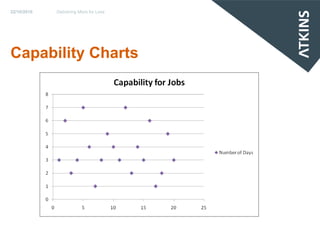
Capability Charts
22/10/2010         Delivering More for Less


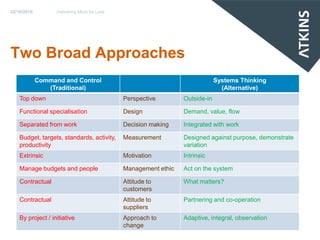
Two Broad Approaches
             Command and Control                                              Systems Thinking
                (Traditional)                                                   (Alternative)
    Top down                                  Perspective        Outside-in

    Functional specialisation                 Design             Demand, value, flow

    Separated from work                       Decision making    Integrated with work

    Budget, targets, standards, activity,     Measurement        Designed against purpose, demonstrate
    productivity                                                 variation
    Extrinsic                                 Motivation         Intrinsic

    Manage budgets and people                 Management ethic   Act on the system

    Contractual                               Attitude to        What matters?
                                              customers
    Contractual                               Attitude to        Partnering and co-operation
                                              suppliers
    By project / initiative                   Approach to        Adaptive, integral, observation
                                              change
22/10/2010   Delivering More for Less


Case Study (City of Edinburgh)
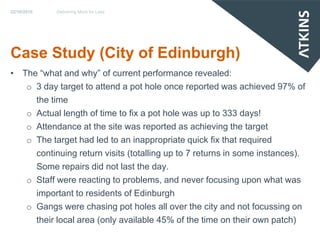
• The “what and why” of current performance revealed:
   o 3 day target to attend a pot hole once reported was achieved 97% of
     the time
   o Actual length of time to fix a pot hole was up to 333 days!
   o Attendance at the site was reported as achieving the target
   o The target had led to an inappropriate quick fix that required
     continuing return visits (totalling up to 7 returns in some instances).
     Some repairs did not last the day.
   o Staff were reacting to problems, and never focusing upon what was
     important to residents of Edinburgh
   o Gangs were chasing pot holes all over the city and not focussing on
     their local area (only available 45% of the time on their own patch)
22/10/2010   Delivering More for Less


Case Study (City of Edinburgh)
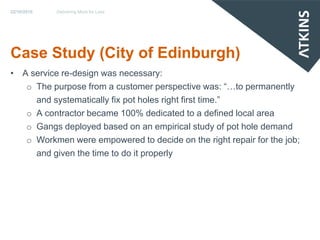
• A service re-design was necessary:
   o The purpose from a customer perspective was: “…to permanently
     and systematically fix pot holes right first time.”
   o A contractor became 100% dedicated to a defined local area
   o Gangs deployed based on an empirical study of pot hole demand
   o Workmen were empowered to decide on the right repair for the job;
     and given the time to do it properly
22/10/2010    Delivering More for Less


Case Study (City of Edinburgh)
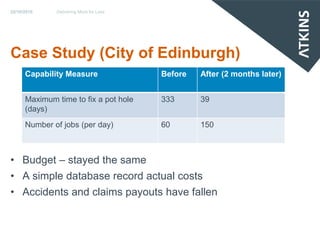
      Capability Measure                 Before   After (2 months later)


      Maximum time to fix a pot hole     333      39
      (days)
      Number of jobs (per day)           60       150


• Budget – stayed the same
• A simple database record actual costs
• Accidents and claims payouts have fallen
22/10/2010   Delivering More for Less


Getting Started…
22/10/2010   Delivering More for Less


Getting Started…
22/10/2010   Dellvering More for Less


Further Reading
Web Sites
www.systemsthinking.co.uk
www.thesystemsthinkingreview.co.uk
www.deming.org.uk

Books
• Middleton (ed), Delivering Public Services That Work, Triarchy Press,
  Axminster, 2010
• Seddon, John, Freedom from Command and Control: a better way to
  make the work, Vanguard Education, Buckingham, 2nd edition, 2005
• Ackhoff, Russell, Systems Thinking for Curious Managers, Triarchy
  Press, 2010
22/10/2010   Delivering More for Less


Contact
James Llewellyn
Local Authority Advisor
Atkins Transport Planning and Management
Rock House
Llanddewi
Llandrindod Wells
Powys
LD1 6SD
Tel: 01597 850069 or 07713 644798
E-mail: james.llewellyn@atkinsglobal.com

Systems thinking presentation leeds

  • 1.
    Delivering More forLess Through Systems Thinking Leeds Breakfast Seminar: 22nd October 2010 James Llewellyn, Atkins Limited
  • 2.
    22/10/2010 Delivering More for Less Words of Wisdom “We cannot solve our problems with the same thinking that we used to create them” “A person who has never made a mistake has never tried anything new” (Albert Einstein)
  • 3.
    22/10/2010 Delivering More for Less Context (CSR) • Cut of 28% to local government grant over next 4 years • 15% reduction (in real terms) in DfT budget in the same period • Emphasis on “efficiency” including: o Performance monitoring group and re-structuring for the HA o New contracts and commercial management o National framework for commodity purchase o Administration of concessionary travel scheme • And plenty of cuts: o Kirklees street lighting PFI o A1 Leeming to Barton
  • 4.
    22/10/2010 Delivering More for Less System versus Analytical System Analytical
  • 5.
    22/10/2010 Delivering More For Less System • Social, organisational and political environment within which people work • Takeaway tip: Think about how many systems you work within. What is their purpose? Who are the customers? Who are the most important people who provide the service? Do the parts work together? • Systems thinking is concerned with seeing the whole from a customer perspective and recognising the inter-dependence of the parts • Interesting fact: 95% of variation in performance is down to the way work is designed and managed • Ideal vision: people with complementary skills are organised around, and working towards, a common purpose
  • 6.
    22/10/2010 Delivering More for Less Purpose
  • 7.
    22/10/2010 Delivering More for Less Flow
  • 8.
    22/10/2010 Delivering More for Less Flow • Flow is to understand the precise path that work takes through an organisation from beginning to end • Interesting fact: Costs of work are primarily result of lack of flow and not scale • Takeaway tip: Think about the most significant costs of work in a service or project; are they based on individual parts (e.g. procurement)? • Functionalisation can result in convoluted processes with multiple handovers (“I was passed from pillar to post…”) • Takeaway tip: Think of a project or service that you know well. Have a think about how many stages and people there are from beginning to end. Is there a smooth flow between stages? Or are there delays and the need for re-work?
  • 9.
    22/10/2010 Delivering More for Less Flow (of a transport scheme) Idea Feasibility Consultation Business Outline Case Design Detailed Surveys Consultation Legal Powers Design Procurement Construction Opening Final Account
  • 10.
    22/10/2010 Delivering More for Less Pull • Organisations often push products and services towards customers (advertising and marketing) • Customers really want to pull value through demand • Work should done against customer demand • Only do something when it is needed • But when it is needed and have the resource to do it straight away • Takeaway tip: Think about a time when you really needed a service; were you able to get what you wanted, when you wanted, as opposed to what the service provider wanted to give you?
  • 11.
    22/10/2010 Delivering More for Less Waste • Any activity that does not add value to the purpose of work from the customer perspective • Examples include: inspection, complaints, re-work, abortive work • Takeaway tip: Go and ask some front line members of staff where they believe waste is occurring; you may well be surprised about how much they know • Waste should either designed out or separated from the value work (if it cannot be avoided)
  • 12.
    22/10/2010 Delivering More for Less Customer Demand • Value demand – what the customer wants • Failure demand - caused by failure to do something or do something right for the customer • Consequence of failure demand is more work and waste • Takeaway tip: Go and listen in a call centre for a few hours; note how many calls are failure demand • Interesting fact: Failure demand is between 20-80% of total demand • Reducing failure demand reduces costs and improves service
  • 13.
    22/10/2010 Delivering More for Less Capability • Measures service performance from the customer’s point of view • Examples: o “End to end” time to fulfil customer request o On time performance as required by the customer o Percentage customer demand fulfilled at first point of contact • Takeaway tip: Look at your current KPIs and ask yourself do they measure: (1) what matters to customers ? (2) your response to customer value demand? (3) the capability of your processes? (4) the performance of the whole system?
  • 14.
    22/10/2010 Delivering More for Less Capability Charts
  • 15.
    22/10/2010 Delivering More for Less Two Broad Approaches Command and Control Systems Thinking (Traditional) (Alternative) Top down Perspective Outside-in Functional specialisation Design Demand, value, flow Separated from work Decision making Integrated with work Budget, targets, standards, activity, Measurement Designed against purpose, demonstrate productivity variation Extrinsic Motivation Intrinsic Manage budgets and people Management ethic Act on the system Contractual Attitude to What matters? customers Contractual Attitude to Partnering and co-operation suppliers By project / initiative Approach to Adaptive, integral, observation change
  • 16.
    22/10/2010 Delivering More for Less Case Study (City of Edinburgh) • The “what and why” of current performance revealed: o 3 day target to attend a pot hole once reported was achieved 97% of the time o Actual length of time to fix a pot hole was up to 333 days! o Attendance at the site was reported as achieving the target o The target had led to an inappropriate quick fix that required continuing return visits (totalling up to 7 returns in some instances). Some repairs did not last the day. o Staff were reacting to problems, and never focusing upon what was important to residents of Edinburgh o Gangs were chasing pot holes all over the city and not focussing on their local area (only available 45% of the time on their own patch)
  • 17.
    22/10/2010 Delivering More for Less Case Study (City of Edinburgh) • A service re-design was necessary: o The purpose from a customer perspective was: “…to permanently and systematically fix pot holes right first time.” o A contractor became 100% dedicated to a defined local area o Gangs deployed based on an empirical study of pot hole demand o Workmen were empowered to decide on the right repair for the job; and given the time to do it properly
  • 18.
    22/10/2010 Delivering More for Less Case Study (City of Edinburgh) Capability Measure Before After (2 months later) Maximum time to fix a pot hole 333 39 (days) Number of jobs (per day) 60 150 • Budget – stayed the same • A simple database record actual costs • Accidents and claims payouts have fallen
  • 19.
    22/10/2010 Delivering More for Less Getting Started…
  • 20.
    22/10/2010 Delivering More for Less Getting Started…
  • 21.
    22/10/2010 Dellvering More for Less Further Reading Web Sites www.systemsthinking.co.uk www.thesystemsthinkingreview.co.uk www.deming.org.uk Books • Middleton (ed), Delivering Public Services That Work, Triarchy Press, Axminster, 2010 • Seddon, John, Freedom from Command and Control: a better way to make the work, Vanguard Education, Buckingham, 2nd edition, 2005 • Ackhoff, Russell, Systems Thinking for Curious Managers, Triarchy Press, 2010
  • 22.
    22/10/2010 Delivering More for Less Contact James Llewellyn Local Authority Advisor Atkins Transport Planning and Management Rock House Llanddewi Llandrindod Wells Powys LD1 6SD Tel: 01597 850069 or 07713 644798 E-mail: james.llewellyn@atkinsglobal.com