Built to Change:
            Management Reset Needed


NHDRN Conference                                Edward E. Lawler III
                                                Marshall School of Business
November 17, 2011
                                                Center for Effective Organizations
Bangalore, India                                University of Southern California


     © 2011 University of Southern California
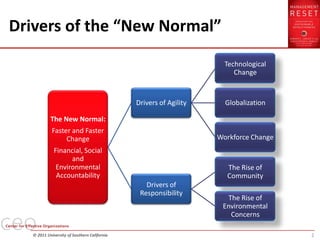
Drivers of the “New Normal”
                                                                     Technological
                                                                        Change


                                              Drivers of Agility     Globalization

            The New Normal:
             Faster and Faster
                  Change                                           Workforce Change
              Financial, Social
                    and
               Environmental                                         The Rise of
               Accountability                                        Community
                                                 Drivers of
                                               Responsibility
                                                                     The Rise of
                                                                    Environmental
                                                                      Concerns

   © 2011 University of Southern California                                           2
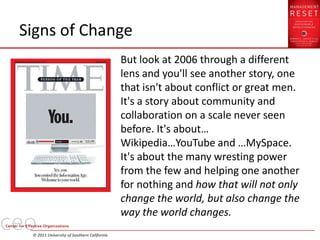
Signs of Change
                                            But look at 2006 through a different
                                            lens and you'll see another story, one
                                            that isn't about conflict or great men.
                                            It's a story about community and
                                            collaboration on a scale never seen
                                            before. It's about…
                                            Wikipedia…YouTube and …MySpace.
                                            It's about the many wresting power
                                            from the few and helping one another
                                            for nothing and how that will not only
                                            change the world, but also change the
                                            way the world changes.
 © 2011 University of Southern California
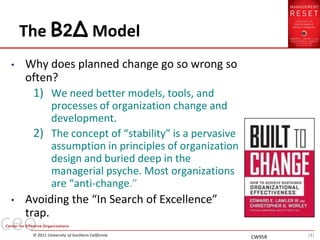
The B2∆ Model
•   Why does planned change go so wrong so
    often?
     1) We need better models, tools, and
        processes of organization change and
        development.
     2) The concept of “stability” is a pervasive
        assumption in principles of organization
        design and buried deep in the
        managerial psyche. Most organizations
        are “anti-change.”
•   Avoiding the “In Search of Excellence”
    trap.
     © 2011 University of Southern California       CW95R   (4)
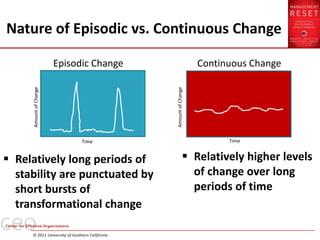
Nature of Episodic vs. Continuous Change

                        Episodic Change                            Continuous Change
     Amount of Change


                                                Amount of Change
                               Time                                      Time


 Relatively long periods of                                 Relatively higher levels
  stability are punctuated by                                 of change over long
  short bursts of                                             periods of time
  transformational change

     © 2011 University of Southern California
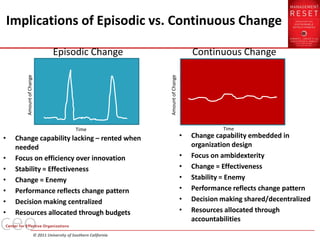
Implications of Episodic vs. Continuous Change

                                     Episodic Change                                         Continuous Change
        Amount of Change


                                                                      Amount of Change
                                                 Time                                                 Time
•    Change capability lacking – rented when                                             •   Change capability embedded in
     needed                                                                                  organization design
•    Focus on efficiency over innovation                                                 •   Focus on ambidexterity
•    Stability = Effectiveness                                                           •   Change = Effectiveness
•    Change = Enemy                                                                      •   Stability = Enemy
•    Performance reflects change pattern                                                 •   Performance reflects change pattern
•    Decision making centralized                                                         •   Decision making shared/decentralized
•    Resources allocated through budgets                                                 •   Resources allocated through
                                                                                             accountabilities

                           © 2011 University of Southern California
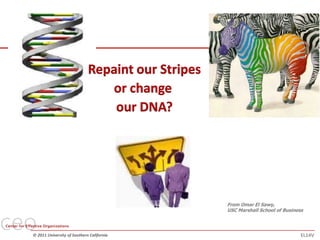
From Omar El Sawy,
                                           USC Marshall School of Business


© 2011 University of Southern California                                 EL14V
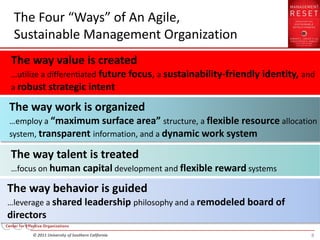
The Four “Ways” of An Agile,
 Sustainable Management Organization
The way value is created
…utilize a differentiated future focus, a sustainability-friendly identity, and
a robust strategic intent

The way work is organized
…employ a “maximum surface area” structure, a flexible resource allocation
system, transparent information, and a dynamic work system

The way talent is treated
…focus on human capital development and flexible reward systems

The way behavior is guided
…leverage a shared leadership philosophy and a remodeled board of
directors
     © 2011 University of Southern California                                 8
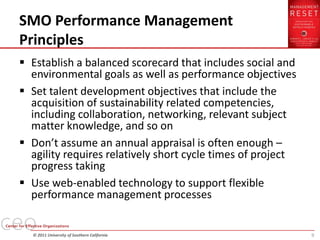
SMO Performance Management
Principles
 Establish a balanced scorecard that includes social and
  environmental goals as well as performance objectives
 Set talent development objectives that include the
  acquisition of sustainability related competencies,
  including collaboration, networking, relevant subject
  matter knowledge, and so on
 Don’t assume an annual appraisal is often enough –
  agility requires relatively short cycle times of project
  progress taking
 Use web-enabled technology to support flexible
  performance management processes


  © 2011 University of Southern California                   9
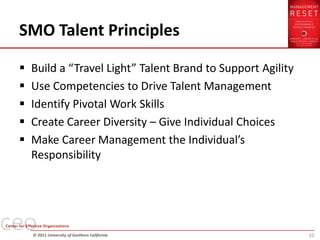
SMO Talent Principles

   Build a “Travel Light” Talent Brand to Support Agility
   Use Competencies to Drive Talent Management
   Identify Pivotal Work Skills
   Create Career Diversity – Give Individual Choices
   Make Career Management the Individual’s
    Responsibility


    © 2011 University of Southern California                 10
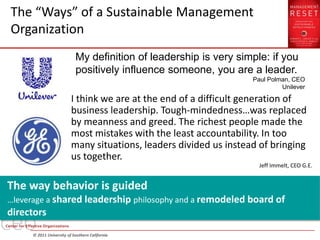
The “Ways” of a Sustainable Management
Organization
                           My definition of leadership is very simple: if you
                           positively influence someone, you are a leader.
                                                                   Paul Polman, CEO
                                                                            Unilever

                         I think we are at the end of a difficult generation of
                         business leadership. Tough-mindedness…was replaced
                         by meanness and greed. The richest people made the
                         most mistakes with the least accountability. In too
                         many situations, leaders divided us instead of bringing
                         us together.
                                                                     Jeff Immelt, CEO G.E.


The way behavior is guided
…leverage a shared leadership philosophy and a remodeled board of
directors
     © 2011 University of Southern California
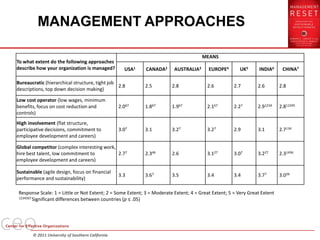
MANAGEMENT APPROACHES

                                                                                     MEANS
To what extent do the following approaches
describe how your organization is managed?          USA1   CANADA2      AUSTRALIA3      EUROPE4        UK5      INDIA6     CHINA7

Bureaucratic (hierarchical structure, tight job
                                                2.8        2.5         2.8             2.6          2.7        2.6        2.8
descriptions, top down decision making)

Low cost operator (low wages, minimum
benefits, focus on cost reduction and             2.067    1.867       1.967           2.167        2.27       2.91234    2.812345
controls)
High involvement (flat structure,
participative decisions, commitment to            3.07     3.1         3.27            3.27         2.9        3.1        2.7134
employee development and careers)

Global competitor (complex interesting work,
hire best talent, low commitment to          2.77          2.346       2.6             3.127        3.07       3.227      2.31456
employee development and careers)

Sustainable (agile design, focus on financial
                                                  3.3      3.67        3.5             3.4          3.4        3.77       3.026
performance and sustainability)

Response Scale: 1 = Little or Not Extent; 2 = Some Extent; 3 = Moderate Extent; 4 = Great Extent; 5 = Very Great Extent
1234567 Significant differences between countries (p ≤ .05)


       © 2011 University of Southern California
“There is nothing wrong with change,
                 if it is in the right direction.”
                        – Winston Churchill

© 2011 University of Southern California

E dward law built to change - mgmt reset needed

  • 1.
    Built to Change: Management Reset Needed NHDRN Conference Edward E. Lawler III Marshall School of Business November 17, 2011 Center for Effective Organizations Bangalore, India University of Southern California © 2011 University of Southern California
  • 2.
    Drivers of the“New Normal” Technological Change Drivers of Agility Globalization The New Normal: Faster and Faster Change Workforce Change Financial, Social and Environmental The Rise of Accountability Community Drivers of Responsibility The Rise of Environmental Concerns © 2011 University of Southern California 2
  • 3.
    Signs of Change But look at 2006 through a different lens and you'll see another story, one that isn't about conflict or great men. It's a story about community and collaboration on a scale never seen before. It's about… Wikipedia…YouTube and …MySpace. It's about the many wresting power from the few and helping one another for nothing and how that will not only change the world, but also change the way the world changes. © 2011 University of Southern California
  • 4.
    The B2∆ Model • Why does planned change go so wrong so often? 1) We need better models, tools, and processes of organization change and development. 2) The concept of “stability” is a pervasive assumption in principles of organization design and buried deep in the managerial psyche. Most organizations are “anti-change.” • Avoiding the “In Search of Excellence” trap. © 2011 University of Southern California CW95R (4)
  • 5.
    Nature of Episodicvs. Continuous Change Episodic Change Continuous Change Amount of Change Amount of Change Time Time  Relatively long periods of  Relatively higher levels stability are punctuated by of change over long short bursts of periods of time transformational change © 2011 University of Southern California
  • 6.
    Implications of Episodicvs. Continuous Change Episodic Change Continuous Change Amount of Change Amount of Change Time Time • Change capability lacking – rented when • Change capability embedded in needed organization design • Focus on efficiency over innovation • Focus on ambidexterity • Stability = Effectiveness • Change = Effectiveness • Change = Enemy • Stability = Enemy • Performance reflects change pattern • Performance reflects change pattern • Decision making centralized • Decision making shared/decentralized • Resources allocated through budgets • Resources allocated through accountabilities © 2011 University of Southern California
  • 7.
    From Omar ElSawy, USC Marshall School of Business © 2011 University of Southern California EL14V
  • 8.
    The Four “Ways”of An Agile, Sustainable Management Organization The way value is created …utilize a differentiated future focus, a sustainability-friendly identity, and a robust strategic intent The way work is organized …employ a “maximum surface area” structure, a flexible resource allocation system, transparent information, and a dynamic work system The way talent is treated …focus on human capital development and flexible reward systems The way behavior is guided …leverage a shared leadership philosophy and a remodeled board of directors © 2011 University of Southern California 8
  • 9.
    SMO Performance Management Principles Establish a balanced scorecard that includes social and environmental goals as well as performance objectives  Set talent development objectives that include the acquisition of sustainability related competencies, including collaboration, networking, relevant subject matter knowledge, and so on  Don’t assume an annual appraisal is often enough – agility requires relatively short cycle times of project progress taking  Use web-enabled technology to support flexible performance management processes © 2011 University of Southern California 9
  • 10.
    SMO Talent Principles  Build a “Travel Light” Talent Brand to Support Agility  Use Competencies to Drive Talent Management  Identify Pivotal Work Skills  Create Career Diversity – Give Individual Choices  Make Career Management the Individual’s Responsibility © 2011 University of Southern California 10
  • 11.
    The “Ways” ofa Sustainable Management Organization My definition of leadership is very simple: if you positively influence someone, you are a leader. Paul Polman, CEO Unilever I think we are at the end of a difficult generation of business leadership. Tough-mindedness…was replaced by meanness and greed. The richest people made the most mistakes with the least accountability. In too many situations, leaders divided us instead of bringing us together. Jeff Immelt, CEO G.E. The way behavior is guided …leverage a shared leadership philosophy and a remodeled board of directors © 2011 University of Southern California
  • 12.
    MANAGEMENT APPROACHES MEANS To what extent do the following approaches describe how your organization is managed? USA1 CANADA2 AUSTRALIA3 EUROPE4 UK5 INDIA6 CHINA7 Bureaucratic (hierarchical structure, tight job 2.8 2.5 2.8 2.6 2.7 2.6 2.8 descriptions, top down decision making) Low cost operator (low wages, minimum benefits, focus on cost reduction and 2.067 1.867 1.967 2.167 2.27 2.91234 2.812345 controls) High involvement (flat structure, participative decisions, commitment to 3.07 3.1 3.27 3.27 2.9 3.1 2.7134 employee development and careers) Global competitor (complex interesting work, hire best talent, low commitment to 2.77 2.346 2.6 3.127 3.07 3.227 2.31456 employee development and careers) Sustainable (agile design, focus on financial 3.3 3.67 3.5 3.4 3.4 3.77 3.026 performance and sustainability) Response Scale: 1 = Little or Not Extent; 2 = Some Extent; 3 = Moderate Extent; 4 = Great Extent; 5 = Very Great Extent 1234567 Significant differences between countries (p ≤ .05) © 2011 University of Southern California
  • 13.
    “There is nothingwrong with change, if it is in the right direction.” – Winston Churchill © 2011 University of Southern California

Editor's Notes

  • #4 Notes______________________________________________________________________________________________________________________________________________________________________________________________________________________________________________________________________________________________________________________________________________________________________________________________________________________________________________________________________________________________________________________________________________________________________________________________________________________________________________________________________________________________________________________________________________________________________________________________________________________________________________________________________________________________________________________________________________________________________________________________________________________________________________________________________________________________________________________________________________________________________________________________________________________________________________________________________________________________________________________________________________________________________________________________________________________________________________________________________________________________________________________________________________