Improving Change Impact Analysis
Visit us: www.itinvolve.com
Follow and engage with us on Twitter: @ITinvolve
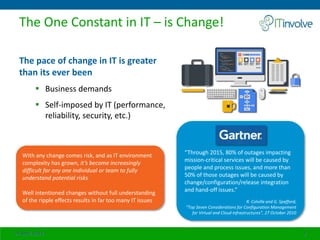
The pace of change in IT is greater
than its ever been
 Business demands
 Self-imposed by IT (performance,
reliability, security, etc.)
The One Constant in IT – is Change!
24 April 2014 2
With any change comes risk, and as IT environment
complexity has grown, it’s become increasingly
difficult for any one individual or team to fully
understand potential risks
Well intentioned changes without full understanding
of the ripple effects results in far too many IT issues
“Through 2015, 80% of outages impacting
mission-critical services will be caused by
people and process issues, and more than
50% of those outages will be caused by
change/configuration/release integration
and hand-off issues.”
R. Colville and G. Spafford,
"Top Seven Considerations for Configuration Management
for Virtual and Cloud Infrastructures”, 27 October 2010
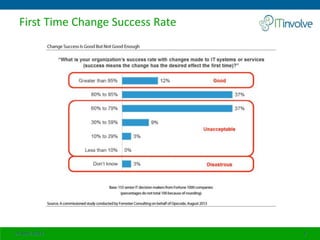
First Time Change Success Rate
24 April 2014 3
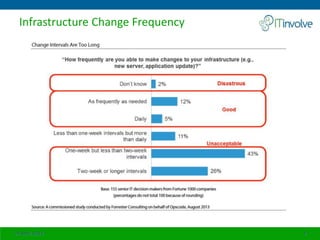
Infrastructure Change Frequency
24 April 2014 4
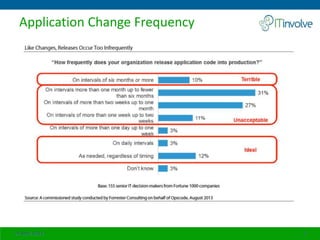
Application Change Frequency
24 April 2014 5
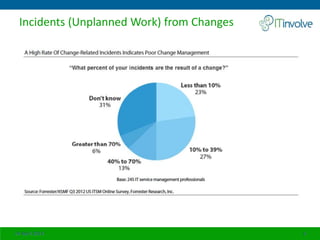
Incidents (Unplanned Work) from Changes
24 April 2014 6
In Our Experience…
• We have seen many different
approaches to address change velocity
 CMDBs and Discovery tools in an effort to
better understand dependencies and
relationships to predict potential impacts
 Heavy process workflows and change
advisory committees in an effort to ensure
everyone has provided their input
24 April 2014 7
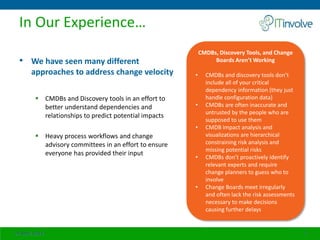
CMDBs, Discovery Tools, and Change
Boards Aren’t Working
• CMDBs and discovery tools don’t
include all of your critical
dependency information (they just
handle configuration data)
• CMDBs are often inaccurate and
untrusted by the people who are
supposed to use them
• CMDB impact analysis and
visualizations are hierarchical
constraining risk analysis and
missing potential risks
• CMDBs don’t proactively identify
relevant experts and require
change planners to guess who to
involve
• Change Boards meet irregularly
and often lack the risk assessments
necessary to make decisions
causing further delays
Change Agility With Stability
① Deliver all critical dependency information in
context of the change being planned
 Including policies, tribal knowledge,
automations, key settings, and more – not just
configuration data
② Provide rich visualization of potential
upstream and downstream impacts
③ Proactively identify and engage the right
experts to give their risk assessment –
arming them with 100% of what they need
④ Streamline and virtualize approvals to
accelerate change velocity
24 April 2014 8
“I’ve been using manual change
management approaches and ITIL
processes for twenty years and
found ITinvolve’s approach to be
fresh with an appealing SaaS model
that helped us get up and running
fast and cost effectively.”
-- Dave Colesante,
SVP, Product Development and CTO
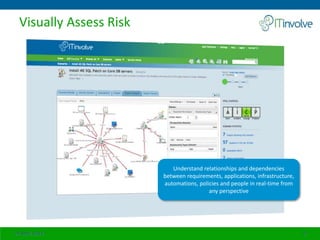
Visually Assess Risk
24 April 2014 9
Understand relationships and dependencies
between requirements, applications, infrastructure,
automations, policies and people in real-time from
any perspective
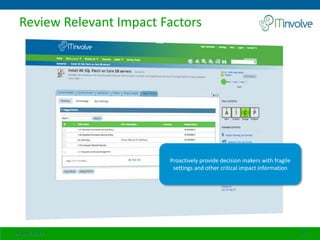
Review Relevant Impact Factors
24 April 2014 10
Proactively provide decision makers with fragile
settings and other critical impact information
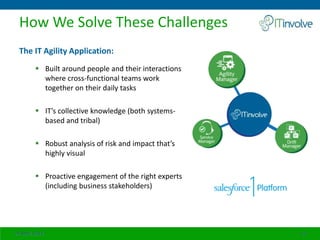
The IT Agility Application:
 Built around people and their interactions
where cross-functional teams work
together on their daily tasks
 IT’s collective knowledge (both systems-
based and tribal)
 Robust analysis of risk and impact that’s
highly visual
 Proactive engagement of the right experts
(including business stakeholders)
How We Solve These Challenges
24 April 2014 11

Improving Change Impact Analysis

  • 1.
    Improving Change ImpactAnalysis Visit us: www.itinvolve.com Follow and engage with us on Twitter: @ITinvolve
  • 2.
    The pace ofchange in IT is greater than its ever been  Business demands  Self-imposed by IT (performance, reliability, security, etc.) The One Constant in IT – is Change! 24 April 2014 2 With any change comes risk, and as IT environment complexity has grown, it’s become increasingly difficult for any one individual or team to fully understand potential risks Well intentioned changes without full understanding of the ripple effects results in far too many IT issues “Through 2015, 80% of outages impacting mission-critical services will be caused by people and process issues, and more than 50% of those outages will be caused by change/configuration/release integration and hand-off issues.” R. Colville and G. Spafford, "Top Seven Considerations for Configuration Management for Virtual and Cloud Infrastructures”, 27 October 2010
  • 3.
    First Time ChangeSuccess Rate 24 April 2014 3
  • 4.
  • 5.
  • 6.
    Incidents (Unplanned Work)from Changes 24 April 2014 6
  • 7.
    In Our Experience… •We have seen many different approaches to address change velocity  CMDBs and Discovery tools in an effort to better understand dependencies and relationships to predict potential impacts  Heavy process workflows and change advisory committees in an effort to ensure everyone has provided their input 24 April 2014 7 CMDBs, Discovery Tools, and Change Boards Aren’t Working • CMDBs and discovery tools don’t include all of your critical dependency information (they just handle configuration data) • CMDBs are often inaccurate and untrusted by the people who are supposed to use them • CMDB impact analysis and visualizations are hierarchical constraining risk analysis and missing potential risks • CMDBs don’t proactively identify relevant experts and require change planners to guess who to involve • Change Boards meet irregularly and often lack the risk assessments necessary to make decisions causing further delays
  • 8.
    Change Agility WithStability ① Deliver all critical dependency information in context of the change being planned  Including policies, tribal knowledge, automations, key settings, and more – not just configuration data ② Provide rich visualization of potential upstream and downstream impacts ③ Proactively identify and engage the right experts to give their risk assessment – arming them with 100% of what they need ④ Streamline and virtualize approvals to accelerate change velocity 24 April 2014 8 “I’ve been using manual change management approaches and ITIL processes for twenty years and found ITinvolve’s approach to be fresh with an appealing SaaS model that helped us get up and running fast and cost effectively.” -- Dave Colesante, SVP, Product Development and CTO
  • 9.
    Visually Assess Risk 24April 2014 9 Understand relationships and dependencies between requirements, applications, infrastructure, automations, policies and people in real-time from any perspective
  • 10.
    Review Relevant ImpactFactors 24 April 2014 10 Proactively provide decision makers with fragile settings and other critical impact information
  • 11.
    The IT AgilityApplication:  Built around people and their interactions where cross-functional teams work together on their daily tasks  IT’s collective knowledge (both systems- based and tribal)  Robust analysis of risk and impact that’s highly visual  Proactive engagement of the right experts (including business stakeholders) How We Solve These Challenges 24 April 2014 11