Escape Analysis Paralysis Critical Thinking in Action
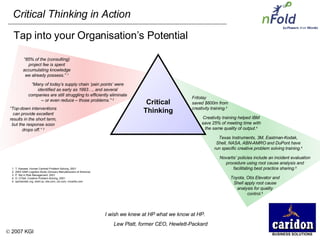
Tap into your Organisation’s Potential I wish we knew at HP what we know at HP. Lew Platt, former CEO, Hewlett-Packard Fritolay  saved $600m from creativity training. 4 Creativity training helped IBM save 25% of meeting time with the same quality of output. 4 “ 85% of the (consulting) project fee is spent accumulating knowledge we already possess.”   1 Texas Instruments, 3M, Eastman-Kodak, Shell, NASA, ABN-AMRO and DuPont have run specific creative problem solving training. 4 Critical Thinking Novartis’ policies include an incident evaluation procedure using root cause analysis and facilitating best practice sharing. 5 “ Top-down interventions can provide excellent results in the short term, but the response soon drops off.”  3 “ Many of today’s supply chain ‘pain points’ were identified as early as 1993…, and several companies are still struggling to efficiently eliminate – or even reduce – those problems.”  2 T. Kawase, Human Centred Problem-Solving, 2001 2003 GMA Logistics Study (Grocery Manufacturers of America) P. Nel in Risk Management, 2001 D. O’Dell, Creative Problem-Solving, 2001 sachamber.org, shell.ca, otis.com, utc.com, novartis.com Toyota, Otis Elevator and Shell apply root cause analysis for quality control. 5
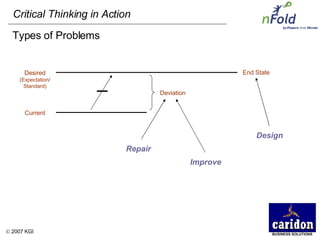
Types of Problems Desired (Expectation/ Standard) Current Deviation End State Design Repair Improve
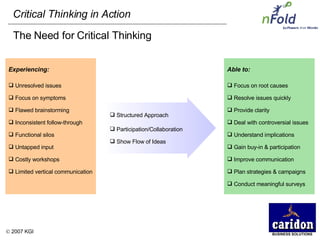
The Need for Critical Thinking Experiencing: Unresolved issues Focus on symptoms Flawed brainstorming  Inconsistent follow-through Functional silos Untapped input Costly workshops Limited vertical communication Able to: Focus on root causes Resolve issues quickly Provide clarity Deal with controversial issues  Understand implications Gain buy-in & participation Improve communication Plan strategies & campaigns Conduct meaningful surveys Structured Approach Participation/Collaboration Show Flow of Ideas
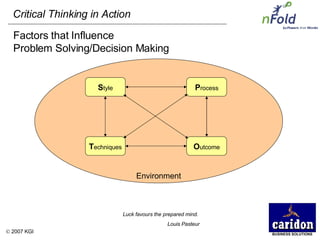
Factors that Influence  Problem Solving/Decision Making Luck favours the prepared mind.  Louis Pasteur Environment S tyle O utcome P rocess T echniques
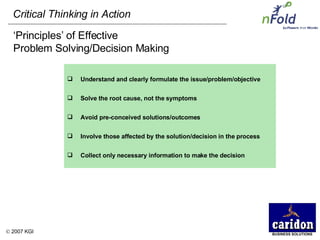
‘ Principles’ of Effective Problem Solving/Decision Making Understand and clearly formulate the issue/problem/objective Solve the root cause, not the symptoms Avoid pre-conceived solutions/outcomes Involve those affected by the solution/decision in the process Collect only necessary information to make the decision
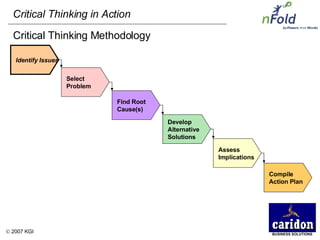
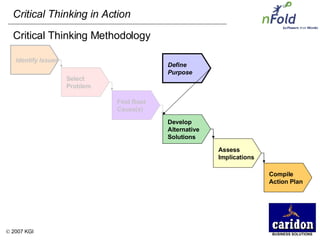
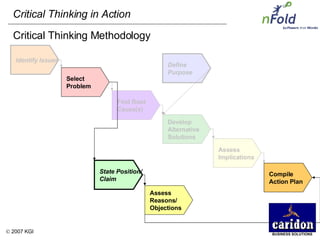
Critical Thinking Methodology Develop Alternative Solutions Assess Implications Compile Action Plan Find Root Cause(s) Select Problem Identify Issues
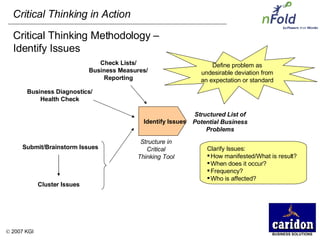
Identify Issues Critical Thinking Methodology –  Identify Issues Define problem as undesirable deviation from an expectation or standard Clarify Issues: How manifested/What is result? When does it occur? Frequency? Who is affected? Business Diagnostics/ Health Check Submit/Brainstorm Issues Cluster Issues Check Lists/ Business Measures/ Reporting Structured List of Potential Business Problems Structure in Critical Thinking Tool
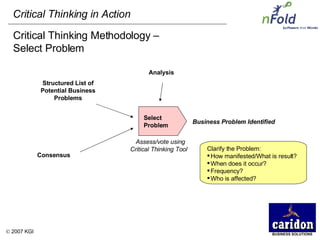
Critical Thinking Methodology –  Select Problem Clarify the Problem: How manifested/What is result? When does it occur? Frequency? Who is affected? Select Problem Business Problem Identified Assess/vote using Critical Thinking Tool Structured List of Potential Business Problems Consensus Analysis
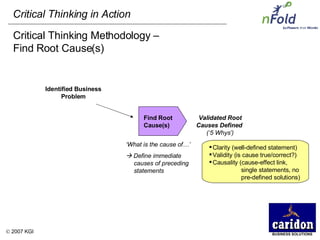
Critical Thinking Methodology –  Find Root Cause(s) Find Root Cause(s) Clarity (well-defined statement) Validity (is cause true/correct?) Causality (cause-effect link,  single statements, no  pre-defined solutions) Validated Root Causes Defined  (‘5 Whys’) ‘ What is the cause of…’    Define immediate causes of preceding statements Identified Business Problem
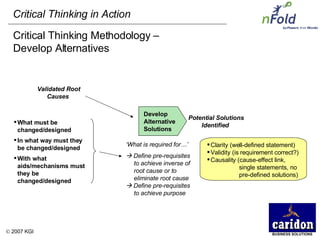
Critical Thinking Methodology –  Develop Alternatives Develop Alternative Solutions Clarity (well-defined statement) Validity (is requirement correct?) Causality (cause-effect link,  single statements, no  pre-defined solutions) Potential Solutions Identified  ‘ What is required for…’    Define pre-requisites to achieve inverse of root cause or to eliminate root cause    Define pre-requisites to achieve purpose Validated Root Causes  What must be changed/designed In what way must they be changed/designed With what aids/mechanisms must they be changed/designed
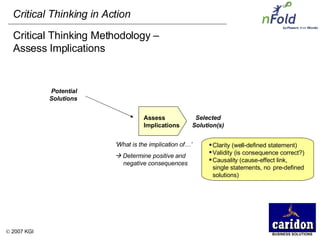
Assess Implications Critical Thinking Methodology –  Assess Implications Clarity (well-defined statement) Validity (is consequence correct?) Causality (cause-effect link,  single statements, no  pre-defined solutions) Selected Solution(s) ‘ What is the implication of…’    Determine positive and negative consequences Potential Solutions
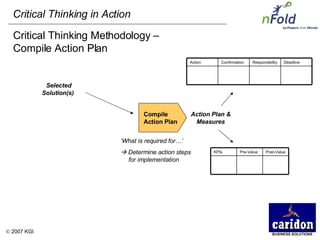
Compile Action Plan Critical Thinking Methodology –  Compile Action Plan Action Plan & Measures ‘ What is required for…’    Determine action steps for implementation Selected Solution(s)  Deadline Responsibility Confirmation Action Post-Value Pre-Value KPIs
Critical Thinking Methodology Develop Alternative Solutions Assess Implications Compile Action Plan Find Root Cause(s) Select Problem Identify Issues Define Purpose
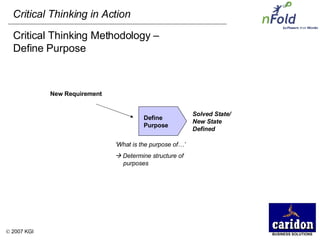
Critical Thinking Methodology –  Define Purpose Define Purpose Solved State/ New State Defined New Requirement ‘ What is the purpose of…’     Determine structure of purposes
Critical Thinking Methodology Develop Alternative Solutions Assess Implications Compile Action Plan Find Root Cause(s) Select Problem Identify Issues Define Purpose State Position/ Claim Assess Reasons/ Objections
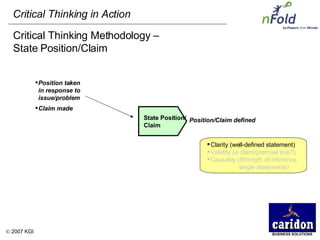
Critical Thinking Methodology –  State Position/Claim State Position/ Claim Position/Claim defined Position taken in response to issue/problem Claim made Clarity (well-defined statement) Validity (is claim/premise true?) Causality (Strength of inference,  single statements)
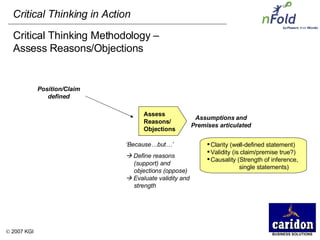
Critical Thinking Methodology –  Assess Reasons/Objections Assess Reasons/ Objections Clarity (well-defined statement) Validity (is claim/premise true?) Causality (Strength of inference,  single statements) Assumptions and Premises articulated ‘ Because…but…’    Define reasons (support) and objections (oppose)    Evaluate validity and strength Position/Claim defined
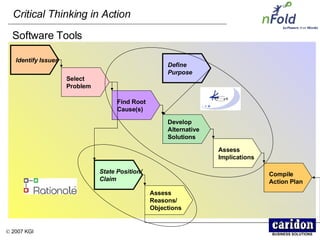
Software Tools Develop Alternative Solutions Assess Implications Compile Action Plan Find Root Cause(s) Select Problem Identify Issues Define Purpose State Position/ Claim Assess Reasons/ Objections
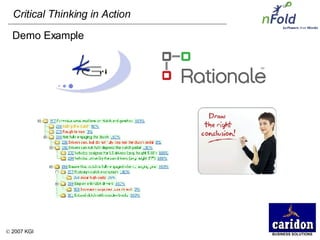
Demo Example
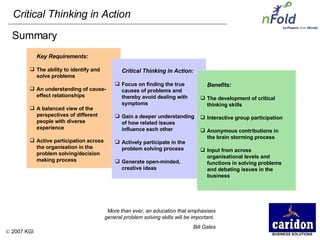
Key Requirements:  The ability to identify and solve problems An understanding of cause-effect relationships  A balanced view of the perspectives of different people with diverse experience Active participation across the organisation in the problem solving/decision making process Summary Critical Thinking in Action:  Focus on finding the true causes of problems and thereby avoid dealing with symptoms Gain a deeper understanding of how related issues influence each other Actively participate in the problem solving process Generate open-minded, creative ideas Benefits:  The development of critical thinking skills Interactive group participation  Anonymous contributions in the brain storming process Input from across organisational levels and functions in solving problems and debating issues in the business More than ever, an education that emphasises general problem solving skills will be important.  Bill Gates
Escape Analysis Paralysis Critical Thinking in Action 2 day Seminar 28-29 May [email_address]

Escape Analysis Paralysis

  • 1.
    Escape Analysis ParalysisCritical Thinking in Action
  • 2.
    Tap into yourOrganisation’s Potential I wish we knew at HP what we know at HP. Lew Platt, former CEO, Hewlett-Packard Fritolay saved $600m from creativity training. 4 Creativity training helped IBM save 25% of meeting time with the same quality of output. 4 “ 85% of the (consulting) project fee is spent accumulating knowledge we already possess.” 1 Texas Instruments, 3M, Eastman-Kodak, Shell, NASA, ABN-AMRO and DuPont have run specific creative problem solving training. 4 Critical Thinking Novartis’ policies include an incident evaluation procedure using root cause analysis and facilitating best practice sharing. 5 “ Top-down interventions can provide excellent results in the short term, but the response soon drops off.” 3 “ Many of today’s supply chain ‘pain points’ were identified as early as 1993…, and several companies are still struggling to efficiently eliminate – or even reduce – those problems.” 2 T. Kawase, Human Centred Problem-Solving, 2001 2003 GMA Logistics Study (Grocery Manufacturers of America) P. Nel in Risk Management, 2001 D. O’Dell, Creative Problem-Solving, 2001 sachamber.org, shell.ca, otis.com, utc.com, novartis.com Toyota, Otis Elevator and Shell apply root cause analysis for quality control. 5
  • 3.
    Types of ProblemsDesired (Expectation/ Standard) Current Deviation End State Design Repair Improve
  • 4.
    The Need forCritical Thinking Experiencing: Unresolved issues Focus on symptoms Flawed brainstorming Inconsistent follow-through Functional silos Untapped input Costly workshops Limited vertical communication Able to: Focus on root causes Resolve issues quickly Provide clarity Deal with controversial issues Understand implications Gain buy-in & participation Improve communication Plan strategies & campaigns Conduct meaningful surveys Structured Approach Participation/Collaboration Show Flow of Ideas
  • 5.
    Factors that Influence Problem Solving/Decision Making Luck favours the prepared mind. Louis Pasteur Environment S tyle O utcome P rocess T echniques
  • 6.
    ‘ Principles’ ofEffective Problem Solving/Decision Making Understand and clearly formulate the issue/problem/objective Solve the root cause, not the symptoms Avoid pre-conceived solutions/outcomes Involve those affected by the solution/decision in the process Collect only necessary information to make the decision
  • 7.
    Critical Thinking MethodologyDevelop Alternative Solutions Assess Implications Compile Action Plan Find Root Cause(s) Select Problem Identify Issues
  • 8.
    Identify Issues CriticalThinking Methodology – Identify Issues Define problem as undesirable deviation from an expectation or standard Clarify Issues: How manifested/What is result? When does it occur? Frequency? Who is affected? Business Diagnostics/ Health Check Submit/Brainstorm Issues Cluster Issues Check Lists/ Business Measures/ Reporting Structured List of Potential Business Problems Structure in Critical Thinking Tool
  • 9.
    Critical Thinking Methodology– Select Problem Clarify the Problem: How manifested/What is result? When does it occur? Frequency? Who is affected? Select Problem Business Problem Identified Assess/vote using Critical Thinking Tool Structured List of Potential Business Problems Consensus Analysis
  • 10.
    Critical Thinking Methodology– Find Root Cause(s) Find Root Cause(s) Clarity (well-defined statement) Validity (is cause true/correct?) Causality (cause-effect link, single statements, no pre-defined solutions) Validated Root Causes Defined (‘5 Whys’) ‘ What is the cause of…’  Define immediate causes of preceding statements Identified Business Problem
  • 11.
    Critical Thinking Methodology– Develop Alternatives Develop Alternative Solutions Clarity (well-defined statement) Validity (is requirement correct?) Causality (cause-effect link, single statements, no pre-defined solutions) Potential Solutions Identified ‘ What is required for…’  Define pre-requisites to achieve inverse of root cause or to eliminate root cause  Define pre-requisites to achieve purpose Validated Root Causes What must be changed/designed In what way must they be changed/designed With what aids/mechanisms must they be changed/designed
  • 12.
    Assess Implications CriticalThinking Methodology – Assess Implications Clarity (well-defined statement) Validity (is consequence correct?) Causality (cause-effect link, single statements, no pre-defined solutions) Selected Solution(s) ‘ What is the implication of…’  Determine positive and negative consequences Potential Solutions
  • 13.
    Compile Action PlanCritical Thinking Methodology – Compile Action Plan Action Plan & Measures ‘ What is required for…’  Determine action steps for implementation Selected Solution(s) Deadline Responsibility Confirmation Action Post-Value Pre-Value KPIs
  • 14.
    Critical Thinking MethodologyDevelop Alternative Solutions Assess Implications Compile Action Plan Find Root Cause(s) Select Problem Identify Issues Define Purpose
  • 15.
    Critical Thinking Methodology– Define Purpose Define Purpose Solved State/ New State Defined New Requirement ‘ What is the purpose of…’  Determine structure of purposes
  • 16.
    Critical Thinking MethodologyDevelop Alternative Solutions Assess Implications Compile Action Plan Find Root Cause(s) Select Problem Identify Issues Define Purpose State Position/ Claim Assess Reasons/ Objections
  • 17.
    Critical Thinking Methodology– State Position/Claim State Position/ Claim Position/Claim defined Position taken in response to issue/problem Claim made Clarity (well-defined statement) Validity (is claim/premise true?) Causality (Strength of inference, single statements)
  • 18.
    Critical Thinking Methodology– Assess Reasons/Objections Assess Reasons/ Objections Clarity (well-defined statement) Validity (is claim/premise true?) Causality (Strength of inference, single statements) Assumptions and Premises articulated ‘ Because…but…’  Define reasons (support) and objections (oppose)  Evaluate validity and strength Position/Claim defined
  • 19.
    Software Tools DevelopAlternative Solutions Assess Implications Compile Action Plan Find Root Cause(s) Select Problem Identify Issues Define Purpose State Position/ Claim Assess Reasons/ Objections
  • 20.
  • 21.
    Key Requirements: The ability to identify and solve problems An understanding of cause-effect relationships A balanced view of the perspectives of different people with diverse experience Active participation across the organisation in the problem solving/decision making process Summary Critical Thinking in Action: Focus on finding the true causes of problems and thereby avoid dealing with symptoms Gain a deeper understanding of how related issues influence each other Actively participate in the problem solving process Generate open-minded, creative ideas Benefits: The development of critical thinking skills Interactive group participation Anonymous contributions in the brain storming process Input from across organisational levels and functions in solving problems and debating issues in the business More than ever, an education that emphasises general problem solving skills will be important. Bill Gates
  • 22.
    Escape Analysis ParalysisCritical Thinking in Action 2 day Seminar 28-29 May [email_address]

Editor's Notes

  • #2 Objective: Give overview & establish Critical Thinking Approach as good business practice. Three comments, by way of introduction: The approach does not preclude gut feel and experience Vertical vs lateral thinking We will refer to real examples of problem solving from all spheres of human endeavour, including business. In explaining the methodology and describing the functionality of the Critical Thinking Tool, we will use generic examples.