1.2 Systems and models
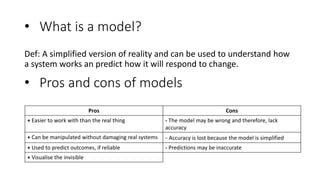
• What is a model?
Def: A simplified version of reality and can be used to understand how
a system works an predict how it will respond to change.
• Pros and cons of models
Pros Cons
+ Easier to work with than the real thing - The model may be wrong and therefore, lack
accuracy
+ Can be manipulated without damaging real systems - Accuracy is lost because the model is simplified
+ Used to predict outcomes, if reliable - Predictions may be inaccurate
+ Visualise the invisible
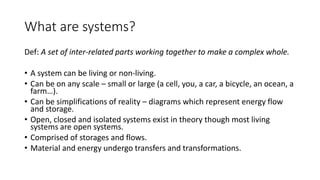
What are systems?
Def: A set of inter-related parts working together to make a complex whole.
• A system can be living or non-living.
• Can be on any scale – small or large (a cell, you, a car, a bicycle, an ocean, a
farm…).
• Can be simplifications of reality – diagrams which represent energy flow
and storage.
• Open, closed and isolated systems exist in theory though most living
systems are open systems.
• Comprised of storages and flows.
• Material and energy undergo transfers and transformations.
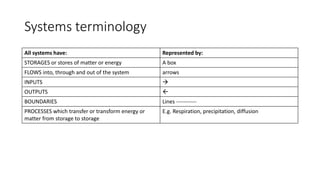
Systems terminology
All systems have: Represented by:
STORAGES or stores of matter or energy A box
FLOWS into, through and out of the system arrows
INPUTS 
OUTPUTS 
BOUNDARIES Lines -----------
PROCESSES which transfer or transform energy or
matter from storage to storage
E.g. Respiration, precipitation, diffusion
Types of Systems
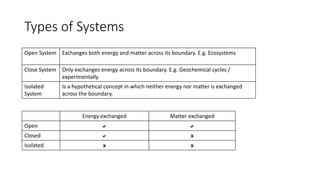
Open System Exchanges both energy and matter across its boundary. E.g. Ecosystems
Close System Only exchanges energy across its boundary. E.g. Geochemical cycles /
experimentally
Isolated
System
Is a hypothetical concept in which neither energy nor matter is exchanged
across the boundary.
Energy exchanged Matter exchanged
Open a a
Closed a x
Isolated x x
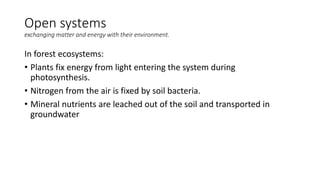
Open systems
exchanging matter and energy with their environment.
In forest ecosystems:
• Plants fix energy from light entering the system during
photosynthesis.
• Nitrogen from the air is fixed by soil bacteria.
• Mineral nutrients are leached out of the soil and transported in
groundwater
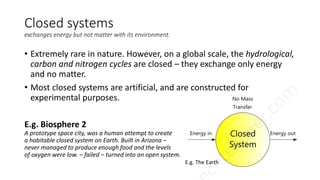
Closed systems
exchanges energy but not matter with its environment.
• Extremely rare in nature. However, on a global scale, the hydrological,
carbon and nitrogen cycles are closed – they exchange only energy
and no matter.
• Most closed systems are artificial, and are constructed for
experimental purposes.
E.g. Biosphere 2
A prototype space city, was a human attempt to create
a habitable closed system on Earth. Built in Arizona –
never managed to produce enough food and the levels
of oxygen were low. – failed – turned into an open system.
E.g. The Earth
Isolated systems
exchanges neither matter nor energy with its environment.
• Do not exist naturally though it is possible to think of the entire
universe as an isolated system.
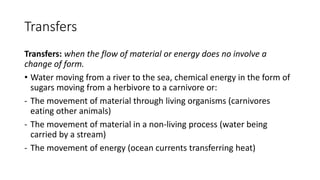
Transfers
Transfers: when the flow of material or energy does no involve a
change of form.
• Water moving from a river to the sea, chemical energy in the form of
sugars moving from a herbivore to a carnivore or:
- The movement of material through living organisms (carnivores
eating other animals)
- The movement of material in a non-living process (water being
carried by a stream)
- The movement of energy (ocean currents transferring heat)
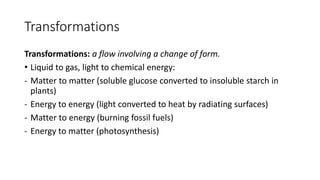
Transformations
Transformations: a flow involving a change of form.
• Liquid to gas, light to chemical energy:
- Matter to matter (soluble glucose converted to insoluble starch in
plants)
- Energy to energy (light converted to heat by radiating surfaces)
- Matter to energy (burning fossil fuels)
- Energy to matter (photosynthesis)
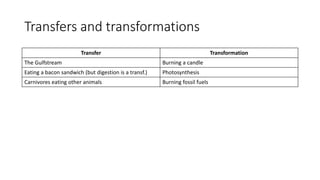
Transfers and transformations
Transfer Transformation
The Gulfstream Burning a candle
Eating a bacon sandwich (but digestion is a transf.) Photosynthesis
Carnivores eating other animals Burning fossil fuels

Systems and models

  • 1.
  • 2.
    • What isa model? Def: A simplified version of reality and can be used to understand how a system works an predict how it will respond to change. • Pros and cons of models Pros Cons + Easier to work with than the real thing - The model may be wrong and therefore, lack accuracy + Can be manipulated without damaging real systems - Accuracy is lost because the model is simplified + Used to predict outcomes, if reliable - Predictions may be inaccurate + Visualise the invisible
  • 3.
    What are systems? Def:A set of inter-related parts working together to make a complex whole. • A system can be living or non-living. • Can be on any scale – small or large (a cell, you, a car, a bicycle, an ocean, a farm…). • Can be simplifications of reality – diagrams which represent energy flow and storage. • Open, closed and isolated systems exist in theory though most living systems are open systems. • Comprised of storages and flows. • Material and energy undergo transfers and transformations.
  • 4.
    Systems terminology All systemshave: Represented by: STORAGES or stores of matter or energy A box FLOWS into, through and out of the system arrows INPUTS  OUTPUTS  BOUNDARIES Lines ----------- PROCESSES which transfer or transform energy or matter from storage to storage E.g. Respiration, precipitation, diffusion
  • 5.
    Types of Systems OpenSystem Exchanges both energy and matter across its boundary. E.g. Ecosystems Close System Only exchanges energy across its boundary. E.g. Geochemical cycles / experimentally Isolated System Is a hypothetical concept in which neither energy nor matter is exchanged across the boundary. Energy exchanged Matter exchanged Open a a Closed a x Isolated x x
  • 6.
    Open systems exchanging matterand energy with their environment. In forest ecosystems: • Plants fix energy from light entering the system during photosynthesis. • Nitrogen from the air is fixed by soil bacteria. • Mineral nutrients are leached out of the soil and transported in groundwater
  • 7.
    Closed systems exchanges energybut not matter with its environment. • Extremely rare in nature. However, on a global scale, the hydrological, carbon and nitrogen cycles are closed – they exchange only energy and no matter. • Most closed systems are artificial, and are constructed for experimental purposes. E.g. Biosphere 2 A prototype space city, was a human attempt to create a habitable closed system on Earth. Built in Arizona – never managed to produce enough food and the levels of oxygen were low. – failed – turned into an open system. E.g. The Earth
  • 8.
    Isolated systems exchanges neithermatter nor energy with its environment. • Do not exist naturally though it is possible to think of the entire universe as an isolated system.
  • 9.
    Transfers Transfers: when theflow of material or energy does no involve a change of form. • Water moving from a river to the sea, chemical energy in the form of sugars moving from a herbivore to a carnivore or: - The movement of material through living organisms (carnivores eating other animals) - The movement of material in a non-living process (water being carried by a stream) - The movement of energy (ocean currents transferring heat)
  • 10.
    Transformations Transformations: a flowinvolving a change of form. • Liquid to gas, light to chemical energy: - Matter to matter (soluble glucose converted to insoluble starch in plants) - Energy to energy (light converted to heat by radiating surfaces) - Matter to energy (burning fossil fuels) - Energy to matter (photosynthesis)
  • 11.
    Transfers and transformations TransferTransformation The Gulfstream Burning a candle Eating a bacon sandwich (but digestion is a transf.) Photosynthesis Carnivores eating other animals Burning fossil fuels