1
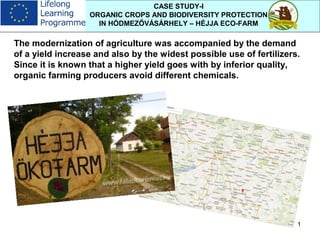
The modernization of agriculture was accompanied by the demand
of a yield increase and also by the widest possible use of fertilizers.
Since it is known that a higher yield goes with by inferior quality,
organic farming producers avoid different chemicals.
CASE STUDY-I
ORGANIC CROPS AND BIODIVERSITY PROTECTION
IN HÓDMEZŐVÁSÁRHELY – HÉJJA ECO-FARM
2
ORGANIC CROPS AND BIODIVERSITY
PROTECTION IN HÓDMEZŐVÁSÁRHELY –
HÉJJA ECO-FARM
The results of the survey of the Gödöllő Agricultural University
(1966-1990) in Hungary
Micro-nutrient* content
* Micro-nutrient: minerals and trace elements
Decrease Same level
Wheat 50,0% 50,0%
Barley 62,3% 37,7%
Corn 81,4% 18,6%
Beet 25,0% 75,0%
Potato 14,3% 86,7%
3
ORGANIC CROPS AND BIODIVERSITY
PROTECTION IN HÓDMEZŐVÁSÁRHELY –
HÉJJA ECO-FARM
Experiments confirm that the nitrate contents of the vegetables
treated with slower but more balanced compost is well below that of
the plants treated with nitrogen fertilizer.
The presence of some amount of nitrate is natural in plants, however,
its quantity largely depends on the method of fertilization. The
nitrogenous fertilizers in the soil endanger not only our food but our
drinking water bases as well. Nitrates that find their way into the body
reduce the oxygen carrying capacity of the blood, which can cause
the death of infant children. Compounds of nitrites with proteins may
cause cancer.
Beyond its negative effects on living organisms, fertilization may lead
to soil acidification.
4
ORGANIC CROPS AND BIODIVERSITY
PROTECTION IN HÓDMEZŐVÁSÁRHELY –
HÉJJA ECO-FARM
Since conventional fertilizers ingest only few micro-nutrients
(nitrogen, potassium and phosphorus) into the loam soil, which are
needed for the development of quality plants, thus providing a one-
sided micro nutrient supply.
The soil abounds with materials introduced by fertilizers, and the
equally important materials (e. g. Selenium) are lacking because there
is no supply.
So no wonder, then, that plants from the acidic, looted soil have a
very low vitamin mineral content, so they can hardly fill their
nutritious health protective role.
5
ORGANIC CROPS AND BIODIVERSITY
PROTECTION IN HÓDMEZŐVÁSÁRHELY –
HÉJJA ECO-FARM
The Héjja eco-farm is a family business in Hódmezövásárhely.
The family farm consists of two neighbouring farmsteads and the
surrounding land of 20 hectares. Controlled eco / organic production
is going on in the total area. In the homesteads, kitchen garden
plants, including a variety of vegetables, fruits are produced and
native animals are kept. The arable fields are cultivated with eco
methods. On the 20 hectares, spice paprika and pumpkin are
produced on 1 hectare each. Winter wheat is grown on 10 hectares;
horse beans on three hectares; corn on 2 hectares and alfalfa is
grown on 5 hectares.
6
ORGANIC CROPS AND BIODIVERSITY
PROTECTION IN HÓDMEZŐVÁSÁRHELY –
HÉJJA ECO-FARM
Their soil nutrient management is remarkable, because only organic
manure is applied as a fertilizer without any soil nutrient
supplementation. Depending on the green crop, they plough 30-35 cm
deep, or loosen the soil surface with plate. When the cultivator that
effects middle depth soil can be mounted on the tillage device, then
loosening is carried out in all cases. The biological result of the
loosening is that soil bacteria live and reproduce in a favourable
microclimate. Another advantage is that the ground water regime
significantly improves, the water is delivered in the developing soil
„capillaries” to the depth or near the surface as needed. So, on the
farm, surface water stagnation is unknown, and a short period of dry
weather does not jeopardize the growth of the plants either.
7
ORGANIC CROPS AND BIODIVERSITY
PROTECTION IN HÓDMEZŐVÁSÁRHELY –
HÉJJA ECO-FARM
The crop protection consists of two parts: if weeding is necessary, a
weed comb is used for early weed control, while the weed sprouts or
is in a barely visible condition. Later, when the weeds grow on the
surface, only the hoe can help to eliminate weeds.
In the interests of healthy plant flora a variety of foliar fertilizer is
often used, which replaces the missing macro- and micro-elements.
The so-called conditioning agents tend to maintain a high level of
resistance of the plants. Plants may need the use of conditioning
agents up to every two weeks. This is the way paprika or wheat are
kept free from diseases. However, if a disease develops (e. g. wheat
leaf rust infection), only copper-based sprays can be used. The
conditioning and copper based agents can be sprayed only during the
evening twilight when the wind stops and the insects living in the
vicinity of the plants are not on the plants.
8
ORGANIC CROPS AND BIODIVERSITY
PROTECTION IN HÓDMEZŐVÁSÁRHELY –
HÉJJA ECO-FARM
It is a rule on the farm that the same plant cannot be grown directly
after the same plant!
Winter wheat: a part of the crop is sold abroad, and the other part is
made into whole grain flour. A part of the flour is used to bake
additive-free bread for themselves, the rest is sold in 1 kg packages.
Broad bean: due to the collection of N in the soil it is a better green
crop than even alfalfa. The broad beans have a high protein content, a
perfect substitute for soy beans (and not GMO type), so they are
essential in poultry and cattle feed.
Maize: they sell their own product, and they purchase the amount
needed for feeding animals! The certified organic corn is made into
flour by the customer and use it as an additive (infant formula, food
industry, etc.).
9
ORGANIC CROPS AND BIODIVERSITY
PROTECTION IN HÓDMEZŐVÁSÁRHELY –
HÉJJA ECO-FARM
Lucerne: is used to feed own farm animals. As it is sown in a
loosened soil, it provides 5-6 mowing for 5 - 6 years, and the
continuous improvement of the N content of the soil.
Paprika: is grown with traditional techniques but organic technology.
The greater amount of the crop is exported raw, the rest is dried and
ground by the family. The meal is made into various additive-free
paste formulations (sweet and spicy) or just used in cooking as a
spice. The meal and pastes are sold packaged in large quantities. The
use of organic paprika powder provides a special flavour for several
kinds of Hungarian stews / paprika dishes.
10
ORGANIC CROPS AND BIODIVERSITY
PROTECTION IN HÓDMEZŐVÁSÁRHELY –
HÉJJA ECO-FARM
Pumpkin: After experimenting with 10 - 15 types, they have selected
the type which provides the best flavour and homogeneity when fried
ripe. The „orange” varieties are the best suited and most marketable
for this purpose. The excess amount is consumed by animals. The
pumpkin usually does not want any protection, it only requires the
weed discharge.
Husbandry: The farm provides all feed – except for the purchased
organic corn - for poultry and cattle. Thus, the manure of the animals
is certified organic and highly suitable to develop an optimized
structure of the soil, and to meet the nutritional needs of the plants.
The Héjja eco-farm is a for-profit enterprise, with the ability not only to
supply food for the family but also to gain an income which allows the
possibility of expanded reproduction.
11
ORGANIC CROPS AND BIODIVERSITY
PROTECTION IN HÓDMEZŐVÁSÁRHELY –
HÉJJA ECO-FARM
12
ORGANIC CROPS AND BIODIVERSITY
PROTECTION IN HÓDMEZŐVÁSÁRHELY –
HÉJJA ECO-FARM
13
ORGANIC CROPS AND BIODIVERSITY
PROTECTION IN HÓDMEZŐVÁSÁRHELY –
HÉJJA ECO-FARM
14
HÉJJA ECO-FARM
FARM DESCRIPTION
DATA & FIGURES OVERVIEW
PROPERTY EXTENT
20 ha
16 arable land
2 orchard
1 horticulture
1 house and yard
10 cows
1000 chicken
22 bee colonies
AGRICULTURAL PRODUCTS
Wheat, horsebean, maize, lucerne, spice paprika, pumpkin,
carrots, onion, garlic, potato, etc.
FOOD PRODUCTS
Honey, propolis, wholemeal flour, jam, paprika powder,
fried pumpkin, milk, cottage cheese, sour cream,
bio chicken meat
15
HÉJJA ECO-FARM
FARM DESCRIPTION
DATA & FIGURES OVERVIEW
ACTIVITIES
Agriculture (organic ICEA certification)
Didactic farm
COMMERCIALISATION
Organic shop (Héjja Farm)
Local market (Hódmezővásárhely)
16
HÉJJA ECO-FARM
PROCESS GRAPHIC REPRESENTATION
MARKETING
&
COMMERCIALISATION
ADMINISTRATION
DIDACTIC FARM
ORGANIC CROPS AND
BIODIVERSITY
KEY PROCESSES
SUPPORT PROCESSES
17
HÉJJA ECO-FARM
KEY PROCESS DESCRIPTION
ORGANIC CROPS AND BIODIVERSITY
Process Description Competence Description Level
Knowledge on basic organic
farming laws and certification
procedures
To be able to respect the procedures
for organic farming certification
2
Seasonal works (tilling, digging,
weeding, mowing-cutting) and
crop rotation
To be able to perform sustainable
mechanical operations according to
the organic procedures and rational
crop rotation
3
Use of biomass for composting To be able to use biomass (pruning,
grass mowing, animal manure, cut
straw) for composting
4
Enrichment with organic fertilizers
without use of synthetic chemicals
To be able to perform a rational
fertilization for planned cultivations
4
Plant sowing based on planned
organic cultivations
To be able to plan and perform plant
sowing for planned organic crops
3
18
Process Description Competence Description Level
Pests and parasites control based
on organic farming protection (list
of authorized technical means)
To be able to recognise and control
pests and parasites and use the
correct organic protection means
3
Harvest and transport to the farm
storage and conditioning centre
To be able to organise and perform
harvest and transport to the farm
storage and conditioning centre
3
Cleaning, separating, selecting the
products
To be able to perform cleaning,
separation and selection of the
products
3
Processing by mill the cereals for
flour (wheat, paprika)
To be able to perform cereal meal
supply chain
3
Technical management and
control of all the organic farming
and processing competences
To be able to manage the complete
organic farming and processing issues
4
HÉJJA ECO-FARM
KEY PROCESS DESCRIPTION
ORGANIC CROPS AND BIODIVERSITY
19
HÉJJA ECO-FARM
KEY PROCESS DESCRIPTION
DIDACTIC FARM
Process Description Competence Description Level
Guided visits and didactic
teaching on natural and
agricultural issues
To be able to manage guided visits
and didactic programs of learning for
schools and groups
3
20
Process Description Competence Description Level
Bookkeeping and administration
(pay slips in outsourcing)
To be able to manage bookkeeping
and farm administration
3
Organic certification procedures
(linked to external control)
To be able to manage the organic
certification procedures
3
Didactic farm procedure
documents
To be able to manage the didactic
farm procedure documents
3
HACCP produre documents To be able to manage the food
production and restaurant produre
documents
3
HÉJJA ECO-FARM
SUPPORT PROCESS DESCRIPTION
ADMINISTRATION
21
HÉJJA ECO-FARM
SUPPORT PROCESS DESCRIPTION
MARKETING & COMMERCIALISATION
Process Description Competence Description Level
Marketing of organic farming
products
To be able to lead the marketing of the
organic farming products
4
Management supervision and
commercial organisation of buying
goods and selling products
To be able to supervise and manage
the commercial organisation
4
22
HÉJJA ECO-FARM
INNOVATION & SWOT ANALYSIS
KIND OF INNOVATION STRENGTHS &
OPPORTUNITIES
WEAKS &
THREATS
The production of crops
and horticultural
products carried out
without synthetic
chemicals. Plant
protection with
traditional herbal
products and useful
insects. Soil strength
enforced with manure
from cows kept with
organic methods. To
eliminate inland waters,
soil loosening carried
out each year.
Production of food
ingredients for a healthy
metabolism. Growing
individual sensitivity
terminating products.
Presentations for
different age groups
(children and adults).
The commercialisation
is still underdeveloped
and the organic shops
are still not so largely
common in Csongrád
county and close
regions.
Increasing the organic
farmland. Increasing
crop yields. Further
development of the
method of product
sales.
In Hungary, the demand
for organic products is
still low, and real quality
cannot be validated in
the prices.
23
ORGANIC CROPS AND BIODIVERSITY
PROTECTION IN HÓDMEZŐVÁSÁRHELY –
HÉJJA ECO-FARM
More information:
http://www.bekesibio.hu/2012/07/vi-bionap-hejja-kalman-tanyajaban/
http://www.federto.eu/hu/node/1412
http://www.vitaminsziget.com/cikk.php?id=308
Address: Héjja-Ökofarm
6800 Hódmezővásárhely
Kútvölgy – Tanya1132/A
Tel.: +36 62 229238

CASE STUDY: HÉJJA ECO-FARM

  • 1.
    1 The modernization ofagriculture was accompanied by the demand of a yield increase and also by the widest possible use of fertilizers. Since it is known that a higher yield goes with by inferior quality, organic farming producers avoid different chemicals. CASE STUDY-I ORGANIC CROPS AND BIODIVERSITY PROTECTION IN HÓDMEZŐVÁSÁRHELY – HÉJJA ECO-FARM
  • 2.
    2 ORGANIC CROPS ANDBIODIVERSITY PROTECTION IN HÓDMEZŐVÁSÁRHELY – HÉJJA ECO-FARM The results of the survey of the Gödöllő Agricultural University (1966-1990) in Hungary Micro-nutrient* content * Micro-nutrient: minerals and trace elements Decrease Same level Wheat 50,0% 50,0% Barley 62,3% 37,7% Corn 81,4% 18,6% Beet 25,0% 75,0% Potato 14,3% 86,7%
  • 3.
    3 ORGANIC CROPS ANDBIODIVERSITY PROTECTION IN HÓDMEZŐVÁSÁRHELY – HÉJJA ECO-FARM Experiments confirm that the nitrate contents of the vegetables treated with slower but more balanced compost is well below that of the plants treated with nitrogen fertilizer. The presence of some amount of nitrate is natural in plants, however, its quantity largely depends on the method of fertilization. The nitrogenous fertilizers in the soil endanger not only our food but our drinking water bases as well. Nitrates that find their way into the body reduce the oxygen carrying capacity of the blood, which can cause the death of infant children. Compounds of nitrites with proteins may cause cancer. Beyond its negative effects on living organisms, fertilization may lead to soil acidification.
  • 4.
    4 ORGANIC CROPS ANDBIODIVERSITY PROTECTION IN HÓDMEZŐVÁSÁRHELY – HÉJJA ECO-FARM Since conventional fertilizers ingest only few micro-nutrients (nitrogen, potassium and phosphorus) into the loam soil, which are needed for the development of quality plants, thus providing a one- sided micro nutrient supply. The soil abounds with materials introduced by fertilizers, and the equally important materials (e. g. Selenium) are lacking because there is no supply. So no wonder, then, that plants from the acidic, looted soil have a very low vitamin mineral content, so they can hardly fill their nutritious health protective role.
  • 5.
    5 ORGANIC CROPS ANDBIODIVERSITY PROTECTION IN HÓDMEZŐVÁSÁRHELY – HÉJJA ECO-FARM The Héjja eco-farm is a family business in Hódmezövásárhely. The family farm consists of two neighbouring farmsteads and the surrounding land of 20 hectares. Controlled eco / organic production is going on in the total area. In the homesteads, kitchen garden plants, including a variety of vegetables, fruits are produced and native animals are kept. The arable fields are cultivated with eco methods. On the 20 hectares, spice paprika and pumpkin are produced on 1 hectare each. Winter wheat is grown on 10 hectares; horse beans on three hectares; corn on 2 hectares and alfalfa is grown on 5 hectares.
  • 6.
    6 ORGANIC CROPS ANDBIODIVERSITY PROTECTION IN HÓDMEZŐVÁSÁRHELY – HÉJJA ECO-FARM Their soil nutrient management is remarkable, because only organic manure is applied as a fertilizer without any soil nutrient supplementation. Depending on the green crop, they plough 30-35 cm deep, or loosen the soil surface with plate. When the cultivator that effects middle depth soil can be mounted on the tillage device, then loosening is carried out in all cases. The biological result of the loosening is that soil bacteria live and reproduce in a favourable microclimate. Another advantage is that the ground water regime significantly improves, the water is delivered in the developing soil „capillaries” to the depth or near the surface as needed. So, on the farm, surface water stagnation is unknown, and a short period of dry weather does not jeopardize the growth of the plants either.
  • 7.
    7 ORGANIC CROPS ANDBIODIVERSITY PROTECTION IN HÓDMEZŐVÁSÁRHELY – HÉJJA ECO-FARM The crop protection consists of two parts: if weeding is necessary, a weed comb is used for early weed control, while the weed sprouts or is in a barely visible condition. Later, when the weeds grow on the surface, only the hoe can help to eliminate weeds. In the interests of healthy plant flora a variety of foliar fertilizer is often used, which replaces the missing macro- and micro-elements. The so-called conditioning agents tend to maintain a high level of resistance of the plants. Plants may need the use of conditioning agents up to every two weeks. This is the way paprika or wheat are kept free from diseases. However, if a disease develops (e. g. wheat leaf rust infection), only copper-based sprays can be used. The conditioning and copper based agents can be sprayed only during the evening twilight when the wind stops and the insects living in the vicinity of the plants are not on the plants.
  • 8.
    8 ORGANIC CROPS ANDBIODIVERSITY PROTECTION IN HÓDMEZŐVÁSÁRHELY – HÉJJA ECO-FARM It is a rule on the farm that the same plant cannot be grown directly after the same plant! Winter wheat: a part of the crop is sold abroad, and the other part is made into whole grain flour. A part of the flour is used to bake additive-free bread for themselves, the rest is sold in 1 kg packages. Broad bean: due to the collection of N in the soil it is a better green crop than even alfalfa. The broad beans have a high protein content, a perfect substitute for soy beans (and not GMO type), so they are essential in poultry and cattle feed. Maize: they sell their own product, and they purchase the amount needed for feeding animals! The certified organic corn is made into flour by the customer and use it as an additive (infant formula, food industry, etc.).
  • 9.
    9 ORGANIC CROPS ANDBIODIVERSITY PROTECTION IN HÓDMEZŐVÁSÁRHELY – HÉJJA ECO-FARM Lucerne: is used to feed own farm animals. As it is sown in a loosened soil, it provides 5-6 mowing for 5 - 6 years, and the continuous improvement of the N content of the soil. Paprika: is grown with traditional techniques but organic technology. The greater amount of the crop is exported raw, the rest is dried and ground by the family. The meal is made into various additive-free paste formulations (sweet and spicy) or just used in cooking as a spice. The meal and pastes are sold packaged in large quantities. The use of organic paprika powder provides a special flavour for several kinds of Hungarian stews / paprika dishes.
  • 10.
    10 ORGANIC CROPS ANDBIODIVERSITY PROTECTION IN HÓDMEZŐVÁSÁRHELY – HÉJJA ECO-FARM Pumpkin: After experimenting with 10 - 15 types, they have selected the type which provides the best flavour and homogeneity when fried ripe. The „orange” varieties are the best suited and most marketable for this purpose. The excess amount is consumed by animals. The pumpkin usually does not want any protection, it only requires the weed discharge. Husbandry: The farm provides all feed – except for the purchased organic corn - for poultry and cattle. Thus, the manure of the animals is certified organic and highly suitable to develop an optimized structure of the soil, and to meet the nutritional needs of the plants. The Héjja eco-farm is a for-profit enterprise, with the ability not only to supply food for the family but also to gain an income which allows the possibility of expanded reproduction.
  • 11.
    11 ORGANIC CROPS ANDBIODIVERSITY PROTECTION IN HÓDMEZŐVÁSÁRHELY – HÉJJA ECO-FARM
  • 12.
    12 ORGANIC CROPS ANDBIODIVERSITY PROTECTION IN HÓDMEZŐVÁSÁRHELY – HÉJJA ECO-FARM
  • 13.
    13 ORGANIC CROPS ANDBIODIVERSITY PROTECTION IN HÓDMEZŐVÁSÁRHELY – HÉJJA ECO-FARM
  • 14.
    14 HÉJJA ECO-FARM FARM DESCRIPTION DATA& FIGURES OVERVIEW PROPERTY EXTENT 20 ha 16 arable land 2 orchard 1 horticulture 1 house and yard 10 cows 1000 chicken 22 bee colonies AGRICULTURAL PRODUCTS Wheat, horsebean, maize, lucerne, spice paprika, pumpkin, carrots, onion, garlic, potato, etc. FOOD PRODUCTS Honey, propolis, wholemeal flour, jam, paprika powder, fried pumpkin, milk, cottage cheese, sour cream, bio chicken meat
  • 15.
    15 HÉJJA ECO-FARM FARM DESCRIPTION DATA& FIGURES OVERVIEW ACTIVITIES Agriculture (organic ICEA certification) Didactic farm COMMERCIALISATION Organic shop (Héjja Farm) Local market (Hódmezővásárhely)
  • 16.
    16 HÉJJA ECO-FARM PROCESS GRAPHICREPRESENTATION MARKETING & COMMERCIALISATION ADMINISTRATION DIDACTIC FARM ORGANIC CROPS AND BIODIVERSITY KEY PROCESSES SUPPORT PROCESSES
  • 17.
    17 HÉJJA ECO-FARM KEY PROCESSDESCRIPTION ORGANIC CROPS AND BIODIVERSITY Process Description Competence Description Level Knowledge on basic organic farming laws and certification procedures To be able to respect the procedures for organic farming certification 2 Seasonal works (tilling, digging, weeding, mowing-cutting) and crop rotation To be able to perform sustainable mechanical operations according to the organic procedures and rational crop rotation 3 Use of biomass for composting To be able to use biomass (pruning, grass mowing, animal manure, cut straw) for composting 4 Enrichment with organic fertilizers without use of synthetic chemicals To be able to perform a rational fertilization for planned cultivations 4 Plant sowing based on planned organic cultivations To be able to plan and perform plant sowing for planned organic crops 3
  • 18.
    18 Process Description CompetenceDescription Level Pests and parasites control based on organic farming protection (list of authorized technical means) To be able to recognise and control pests and parasites and use the correct organic protection means 3 Harvest and transport to the farm storage and conditioning centre To be able to organise and perform harvest and transport to the farm storage and conditioning centre 3 Cleaning, separating, selecting the products To be able to perform cleaning, separation and selection of the products 3 Processing by mill the cereals for flour (wheat, paprika) To be able to perform cereal meal supply chain 3 Technical management and control of all the organic farming and processing competences To be able to manage the complete organic farming and processing issues 4 HÉJJA ECO-FARM KEY PROCESS DESCRIPTION ORGANIC CROPS AND BIODIVERSITY
  • 19.
    19 HÉJJA ECO-FARM KEY PROCESSDESCRIPTION DIDACTIC FARM Process Description Competence Description Level Guided visits and didactic teaching on natural and agricultural issues To be able to manage guided visits and didactic programs of learning for schools and groups 3
  • 20.
    20 Process Description CompetenceDescription Level Bookkeeping and administration (pay slips in outsourcing) To be able to manage bookkeeping and farm administration 3 Organic certification procedures (linked to external control) To be able to manage the organic certification procedures 3 Didactic farm procedure documents To be able to manage the didactic farm procedure documents 3 HACCP produre documents To be able to manage the food production and restaurant produre documents 3 HÉJJA ECO-FARM SUPPORT PROCESS DESCRIPTION ADMINISTRATION
  • 21.
    21 HÉJJA ECO-FARM SUPPORT PROCESSDESCRIPTION MARKETING & COMMERCIALISATION Process Description Competence Description Level Marketing of organic farming products To be able to lead the marketing of the organic farming products 4 Management supervision and commercial organisation of buying goods and selling products To be able to supervise and manage the commercial organisation 4
  • 22.
    22 HÉJJA ECO-FARM INNOVATION &SWOT ANALYSIS KIND OF INNOVATION STRENGTHS & OPPORTUNITIES WEAKS & THREATS The production of crops and horticultural products carried out without synthetic chemicals. Plant protection with traditional herbal products and useful insects. Soil strength enforced with manure from cows kept with organic methods. To eliminate inland waters, soil loosening carried out each year. Production of food ingredients for a healthy metabolism. Growing individual sensitivity terminating products. Presentations for different age groups (children and adults). The commercialisation is still underdeveloped and the organic shops are still not so largely common in Csongrád county and close regions. Increasing the organic farmland. Increasing crop yields. Further development of the method of product sales. In Hungary, the demand for organic products is still low, and real quality cannot be validated in the prices.
  • 23.
    23 ORGANIC CROPS ANDBIODIVERSITY PROTECTION IN HÓDMEZŐVÁSÁRHELY – HÉJJA ECO-FARM More information: http://www.bekesibio.hu/2012/07/vi-bionap-hejja-kalman-tanyajaban/ http://www.federto.eu/hu/node/1412 http://www.vitaminsziget.com/cikk.php?id=308 Address: Héjja-Ökofarm 6800 Hódmezővásárhely Kútvölgy – Tanya1132/A Tel.: +36 62 229238