Systems and
  Models
What is a system? What is a model?
      Feedback Mechanisms
      Transfer vs. Transform
    Laws of Thermodynamics
Systems
• A system is a collection of well-organised and
  well-integrated elements with perceptible
  attributes which establish relationships
  among them within a defined space delimited
  by a boundary which necessarily transforms
  energy for its own functioning.
A Natural System - Ecosytem
• An ecosystem is a system whose organized and integrated
  elements (parts) transform (change) energy which is used
  in the transformation process and recycling of matter in an
  attempt to preserve its structure and guarantee the survival
  of all its biotic and abiotic characteristics.

• Although we tend to isolate systems by deleting/merging
  the boundaries, in reality such boundaries may not be exact
  or even real. Furthermore, one systems is always in
  connection with another system with which it exchanges
  both matter and energy.

• Question: How does this hold true for the universe?
Types of Systems
There are three types of systems based on
whether they exchange energy and/or matter:
                Isolated System

                 System

      It exchanges neither energy nor matter
Closed System


Energy       System           Energy


         It only exchanges energy.
Open System

Energy                       Energy
                System
Matter                        Matter

 It exchanges both energy and matter.
Equilibria
• The steady state is a common property of most open systems in
  nature whereby the system state fluctuates around a certain point
  without much change of its fundamental identity.

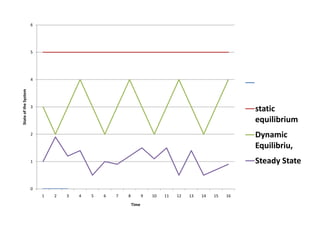
• Static equilibrium = no change at all.

• Dynamic equilibrium = a continuous move from one point to
  another with the same magnitude, so no net change really
  happens.

• Living systems (e.g. the human body, a plant, a population of
  termites, a community of plants, animals and decomposers in the
  Tropical Rainforest) neither remain static nor undergo harmonic
  fluctuations, instead living systems fluctuate almost unpredictably
  but always around a mid value which is called the “steady state”.
6


                      5


                      4
State of the System


                      3
                                                                                                        static
                                                                                                        equilibrium
                      2                                                                                 Dynamic
                                                                                                        Equilibriu,
                      1                                                                                 Steady State


                      0
                          1   2   3   4   5   6   7   8          9   10   11   12   13   14   15   16
                                                          Time
Feedback Mechanisms (+/-)
The reaction of particular component elements
  of the systems againts disturbing agents is
  consider a feedback mechanism.

Two Types of Feedback Mechanisms:
  Positive and Negative
Positive Feedback
• Positive feedback leads to increasing change
  in a system.
• Positive feedback amplifies or increases
  change; it leads to exponential deviation away
  from an equilibrium.
  – For example, due to Global Warming high
    temperatures increase evaporation leading to
    more water vapour in the atmosphere. Water
    vapour is a greenhouse gas which traps more heat
    worsening Global Warming.
  – In positive feedback, changes are reinforced. This
    takes ecosystems to new positions.
Negative Feedback
• Negative feedback is a self-regulating method of control
  leading to the maintenance of a steady state equilibrium.
• Negative feedback counteracts deviations from the steady
  state equilibrium point.
• Negative feedback tends to damp down, neutralise or
  counteract any deviation from an equilibrium, and promotes
  stability.
   – In this example, when the Hare population increases, the Lynx
     population increases too in response to the increase in food offer
     which illustrates both Bottom-Up regulation and Positive
     Feedback.
   – However, when the Lynx population increases too much, the large
     number of lynxes will pray more hares reducing the number of
     hares. As hares become fewer, some lynxes will die of starvation
     regulating the number of lynx in the population. This illustrates
     both Top-Down and negative Feedback regulation.
Transfer vs. Transformations
• Transfers normally flow through a system from one
  compartment to another and involve a change in
  location.
  – For example, precipitation involves the change in location of
    water from clouds to sea or ground. Similarly, liquid water in
    the soil is transferred into the plant body through roots in
    the same liquid form.
• Transformations lead to an interaction within a
  system in the formation of a new end product, or
  involve a change of state.
  – For example, the evaporation of sea water involves
    the absorption of heat energy from the air so it can
    change into water vapour.
  – In cell respiration, carbon in glucose changes to
    carbon in carbon dioxide. Ammonia (NH3) in the soil
    are absorbed by plant roots and in the plant nitrates
    are transformed into Amino acids. During
    photosynthesis carbon in the form of CO2 is changed
    into carbon in the form of Glucose (C6H12O6).These are
    just some example of transformations.
Laws of Thermodynamics
Two laws:
1st -
Models
• A model is an artificial construction designed
  to represent the properties, behavior or
  relationships between individual parts of the
  whole being studied or the order in which to
  study it under controlled conditions and to
  make predictions about its functioning when
  one or more elements and/or conditions are
  changed.
• A model is a representation of a part of the
  real world which helps us understand
  complexities large and small.
Limitations of Models
• Models are simplifications of real systems. They can be used as tools to better
  understand a system and to make predictions of what will happen to all of the
  system components following a disturbance or a change in any one of them.
   – The human brain cannot keep track of an array of complex interactions all at
      one time, but it can easily understand individual interactions one at a time.
   – Models are proposed representations of how a system is structured, which can
      be rejected in light of contradictory evidence. (hypothesis)

• No model is a 'perfect' representation of the system because, as mentioned
  above, all models are simplifications and in some cases over simplified.
   – human subjectivity may lead to humans to make models biased by scholar
     background, disregard of the relevance of some components or simply by a
     limited perception or understanding of the reality which is to be modeled.

Apibess -systems_and_models

  • 1.
    Systems and Models What is a system? What is a model? Feedback Mechanisms Transfer vs. Transform Laws of Thermodynamics
  • 2.
    Systems • A systemis a collection of well-organised and well-integrated elements with perceptible attributes which establish relationships among them within a defined space delimited by a boundary which necessarily transforms energy for its own functioning.
  • 3.
    A Natural System- Ecosytem
  • 4.
    • An ecosystemis a system whose organized and integrated elements (parts) transform (change) energy which is used in the transformation process and recycling of matter in an attempt to preserve its structure and guarantee the survival of all its biotic and abiotic characteristics. • Although we tend to isolate systems by deleting/merging the boundaries, in reality such boundaries may not be exact or even real. Furthermore, one systems is always in connection with another system with which it exchanges both matter and energy. • Question: How does this hold true for the universe?
  • 5.
    Types of Systems Thereare three types of systems based on whether they exchange energy and/or matter: Isolated System System It exchanges neither energy nor matter
  • 6.
    Closed System Energy System Energy It only exchanges energy.
  • 7.
    Open System Energy Energy System Matter Matter It exchanges both energy and matter.
  • 8.
    Equilibria • The steadystate is a common property of most open systems in nature whereby the system state fluctuates around a certain point without much change of its fundamental identity. • Static equilibrium = no change at all. • Dynamic equilibrium = a continuous move from one point to another with the same magnitude, so no net change really happens. • Living systems (e.g. the human body, a plant, a population of termites, a community of plants, animals and decomposers in the Tropical Rainforest) neither remain static nor undergo harmonic fluctuations, instead living systems fluctuate almost unpredictably but always around a mid value which is called the “steady state”.
  • 9.
    6 5 4 State of the System 3 static equilibrium 2 Dynamic Equilibriu, 1 Steady State 0 1 2 3 4 5 6 7 8 9 10 11 12 13 14 15 16 Time
  • 10.
    Feedback Mechanisms (+/-) Thereaction of particular component elements of the systems againts disturbing agents is consider a feedback mechanism. Two Types of Feedback Mechanisms: Positive and Negative
  • 11.
    Positive Feedback • Positivefeedback leads to increasing change in a system. • Positive feedback amplifies or increases change; it leads to exponential deviation away from an equilibrium. – For example, due to Global Warming high temperatures increase evaporation leading to more water vapour in the atmosphere. Water vapour is a greenhouse gas which traps more heat worsening Global Warming. – In positive feedback, changes are reinforced. This takes ecosystems to new positions.
  • 12.
    Negative Feedback • Negativefeedback is a self-regulating method of control leading to the maintenance of a steady state equilibrium. • Negative feedback counteracts deviations from the steady state equilibrium point. • Negative feedback tends to damp down, neutralise or counteract any deviation from an equilibrium, and promotes stability. – In this example, when the Hare population increases, the Lynx population increases too in response to the increase in food offer which illustrates both Bottom-Up regulation and Positive Feedback. – However, when the Lynx population increases too much, the large number of lynxes will pray more hares reducing the number of hares. As hares become fewer, some lynxes will die of starvation regulating the number of lynx in the population. This illustrates both Top-Down and negative Feedback regulation.
  • 13.
    Transfer vs. Transformations •Transfers normally flow through a system from one compartment to another and involve a change in location. – For example, precipitation involves the change in location of water from clouds to sea or ground. Similarly, liquid water in the soil is transferred into the plant body through roots in the same liquid form.
  • 16.
    • Transformations leadto an interaction within a system in the formation of a new end product, or involve a change of state. – For example, the evaporation of sea water involves the absorption of heat energy from the air so it can change into water vapour. – In cell respiration, carbon in glucose changes to carbon in carbon dioxide. Ammonia (NH3) in the soil are absorbed by plant roots and in the plant nitrates are transformed into Amino acids. During photosynthesis carbon in the form of CO2 is changed into carbon in the form of Glucose (C6H12O6).These are just some example of transformations.
  • 18.
  • 19.
    Models • A modelis an artificial construction designed to represent the properties, behavior or relationships between individual parts of the whole being studied or the order in which to study it under controlled conditions and to make predictions about its functioning when one or more elements and/or conditions are changed. • A model is a representation of a part of the real world which helps us understand complexities large and small.
  • 20.
    Limitations of Models •Models are simplifications of real systems. They can be used as tools to better understand a system and to make predictions of what will happen to all of the system components following a disturbance or a change in any one of them. – The human brain cannot keep track of an array of complex interactions all at one time, but it can easily understand individual interactions one at a time. – Models are proposed representations of how a system is structured, which can be rejected in light of contradictory evidence. (hypothesis) • No model is a 'perfect' representation of the system because, as mentioned above, all models are simplifications and in some cases over simplified. – human subjectivity may lead to humans to make models biased by scholar background, disregard of the relevance of some components or simply by a limited perception or understanding of the reality which is to be modeled.