 1.Introduction
 2.History
 3.Single Queues
 4.Traffic Intensity
 5.Networks of Queues
 6.Expressiveness

 Oueueing is a model in which jobs departing from one
queue arrive at another queue (or possibly the same
queue)
 In other words, A network consisting of several
interconnected queues
 Examples:
• Machine-shop, Communication Network, Computer
System
• Customers go from one queue to another in post office,
bank, supermarket etc
• Data packets traverse a network moving from a queue in a
router to the queue in another router
1.Introduction

Classification of Queueing Networks
 Open Networks
 Closed Networks
 Mixed Networks
1.1.Classification
External arrivals and departures
 " Number of jobs in the system varies with
time.
 " Throughput = arrival rate
 " Goal: To characterize the distribution of
number of jobs in the system.
If the network has multiple job classes then it
must be open for each class of jobs
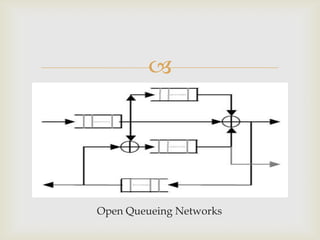
Open Networks

Open Queueing Networks

 No external arrivals or departures
o Total number of jobs in the system is constant
o `OUT' is connected back to `IN.'
o Throughput = flow of jobs in the OUT-to-IN link
Number of jobs is given, determine the throughput
 If the network has multiple job classes then it must
be closed for each class of jobs.
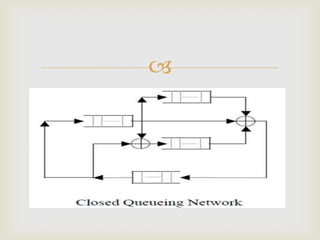
Closed Networks


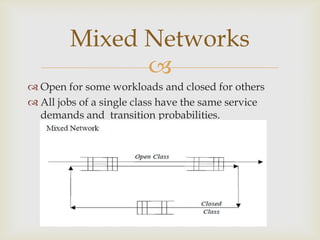
 Open for some workloads and closed for others
 All jobs of a single class have the same service
demands and transition probabilities.
Mixed Networks

 Burke’s theorem, Burke (1957), Reich (1957)
 Jackson (1957, 1963): open queueing networks,
product form solution
 Gordon and Newell (1967): closed queueing
networks
 Baskett, Chandy, Muntz, Palacios (1975):
generalizations of the types of queues
 Reiser and Lavenberg (1980, 1982): mean value
analysis, MVA
2.History

 The basic scenario for a single queue is that
customers, who belong to some population arrive at
the service facility.
 If a customer cannot gain access to a server it must
join a queue, in a buffer, until a server is available.
When service is complete the customer departs, and
the server selects the next customer from the buffer
according to the service discipline.
3.Single Queues
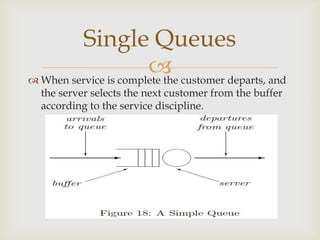
 When service is complete the customer departs, and
the server selects the next customer from the buffer
according to the service discipline.
Single Queues

 Arrival Pattern of Customers
 Service Time Distribution
 Number of Servers
 Buffer Capacity
 Population
 Service Discipline
Need to Know Details

 The ability of the service facility to provide service
for an arriving stream of customers depends not only
on the mean arrival rate , but also on the pattern in
which they arrive, i.e. the distribution function of the
inter-arrival times.
Arrival Pattern of Customers

 The service time is the time which a server spends
satisfying a customer.
 As with the inter-arrival stream, the important
characteristics of this time will be both its average
duration and the distribution function.
Service Time Distribution

 If there is more than one server in the service facility
the processing of customers can go on concurrently:
one customer at each server. It is assumed that the
servers are indistinguishable from each other, so that
it does not matter which server actually serves a
customer—the results, and the service
characteristics,will be the same.
Number of Servers

 Customers who cannot receive service immediately
that they require it must wait in the buffer and wait
for a server to become available.
 Clearly the number of customers waiting may grow,
filling the places of the buffer.
Buffer Capacity

 The characteristic of the population which we are
interested in is usually the size.
 Clearly, if the size of the population is fixed, at some
value N, no more than N customers will ever be
requiring service at any time. When the population is
finite the arrival rate of customers will be affected by
the number who are already in the service facility
Population

 When more than one customer is waiting for service there
has to be a rule for selecting which of the waiting
customers will be the next one to gain access to a server.
 The commonly used service disciplines are
• FCFS first-come-first-serve (or FIFO first-in-first-out).
• LCFS last-come-first-serve (or LIFO last-in-first-out).
• RSS random-selection-for-service.
• PRI priority.
The assignment of different priorities to elements of a
population is one way in which classes are formed.
Service Discipline

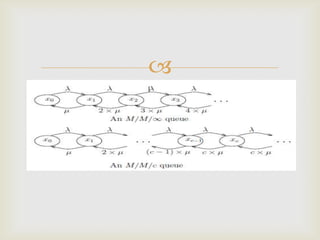
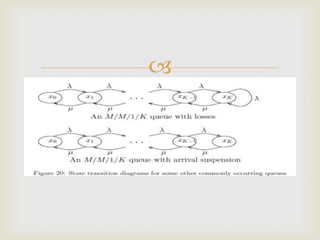
 The two most important features of a single queue
are the arrival rate of customers λ, and the service
rate of the server(s), μ. These are combined into a
single parameter which
 characterises a single or multiple server system2, the
traffic intensity.
 Traffic intensity, ρ = λ /c × μ
4.Traffic Intensity



 If we view a computer as an interaction of devices,
which jobs visit sequentially, then it is natural to
model the system as a queueing network. Each
device or resource of the system is represented by a
separate service facility, now termed a service centre.
5.Networks of Queues

 The characteristics of each service centre are
analogous to the single queue case, i.e. the arrival
rate, the service rate, the number of servers, the
buffer capacity, the population and the service
discipline. However, note that these characteristics
are not completely independent for the service
centres within a queueing network.
5.Networks of Queues

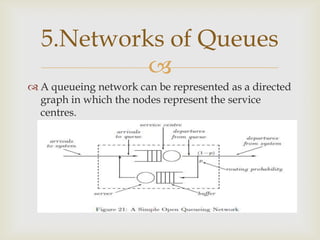
 A queueing network can be represented as a directed
graph in which the nodes represent the service
centres.
5.Networks of Queues

 A network may be closed, open or mixed depending
on whether a fixed population of customers remain
within the system; customers may arrive from, or
depart to, some external environment; or there are
classes of customers within the system exhibiting
open and closed patterns of behaviour respectively.
5.Networks of Queues

 As mentioned in the Introduction, contemporary
computer and communication systems often have
features which are not easily represented by
queueing networks. Some of the most important of
these features are listed below.
 Simultaneous resource possession
 Fork and Join
 Bulk and train arrivals
 Load dependent arrivals
 Defections from the queue
6. Expressiveness

 Simultaneous resource possession In a computer
system a job may continue to compute while its I/O
requests are progressing in parallel. Thus, the job
may be simultaneously using two or more resources
of the system.
 Fork and Join primitives are used in computer
systems to create and synchronise subprocesses. This
causes the number of jobs in the system to change
and also invalidates the assumption of independence
among jobs.
6. Expressiveness

 Bulk and train arrivals In communication networks
the arrival of packets may occur in batches (bulk
arrivals) or in quick succession (train arrivals). Such
situations do not fit assumptions of independence
between customers, nor exponential interarrival
times.
 Load dependent arrivals Computer networks and
distributed systems have intelligent load-balancing
policies that cause new jobs or packets to go to one of
a number of devices depending upon the load
observed in the recent past.
6. Expressiveness

 Defections from the queue Communication systems
sometimes set a maximum limit on the time that a
packet or request is able to stay in a queue.
Thus, the packets that have been in the queue for a
long time are dropped from the queue on the
assumption that they may have already been
retransmitted by higher protocol layers.
6. Expressiveness

System modeling and simulations

  • 2.
     1.Introduction  2.History 3.Single Queues  4.Traffic Intensity  5.Networks of Queues  6.Expressiveness
  • 3.
      Oueueing isa model in which jobs departing from one queue arrive at another queue (or possibly the same queue)  In other words, A network consisting of several interconnected queues  Examples: • Machine-shop, Communication Network, Computer System • Customers go from one queue to another in post office, bank, supermarket etc • Data packets traverse a network moving from a queue in a router to the queue in another router 1.Introduction
  • 4.
     Classification of QueueingNetworks  Open Networks  Closed Networks  Mixed Networks 1.1.Classification
  • 5.
    External arrivals anddepartures  " Number of jobs in the system varies with time.  " Throughput = arrival rate  " Goal: To characterize the distribution of number of jobs in the system. If the network has multiple job classes then it must be open for each class of jobs Open Networks
  • 6.
  • 7.
      No externalarrivals or departures o Total number of jobs in the system is constant o `OUT' is connected back to `IN.' o Throughput = flow of jobs in the OUT-to-IN link Number of jobs is given, determine the throughput  If the network has multiple job classes then it must be closed for each class of jobs. Closed Networks
  • 8.
  • 9.
      Open forsome workloads and closed for others  All jobs of a single class have the same service demands and transition probabilities. Mixed Networks
  • 10.
      Burke’s theorem,Burke (1957), Reich (1957)  Jackson (1957, 1963): open queueing networks, product form solution  Gordon and Newell (1967): closed queueing networks  Baskett, Chandy, Muntz, Palacios (1975): generalizations of the types of queues  Reiser and Lavenberg (1980, 1982): mean value analysis, MVA 2.History
  • 11.
      The basicscenario for a single queue is that customers, who belong to some population arrive at the service facility.  If a customer cannot gain access to a server it must join a queue, in a buffer, until a server is available. When service is complete the customer departs, and the server selects the next customer from the buffer according to the service discipline. 3.Single Queues
  • 12.
     When serviceis complete the customer departs, and the server selects the next customer from the buffer according to the service discipline. Single Queues
  • 13.
      Arrival Patternof Customers  Service Time Distribution  Number of Servers  Buffer Capacity  Population  Service Discipline Need to Know Details
  • 14.
      The abilityof the service facility to provide service for an arriving stream of customers depends not only on the mean arrival rate , but also on the pattern in which they arrive, i.e. the distribution function of the inter-arrival times. Arrival Pattern of Customers
  • 15.
      The servicetime is the time which a server spends satisfying a customer.  As with the inter-arrival stream, the important characteristics of this time will be both its average duration and the distribution function. Service Time Distribution
  • 16.
      If thereis more than one server in the service facility the processing of customers can go on concurrently: one customer at each server. It is assumed that the servers are indistinguishable from each other, so that it does not matter which server actually serves a customer—the results, and the service characteristics,will be the same. Number of Servers
  • 17.
      Customers whocannot receive service immediately that they require it must wait in the buffer and wait for a server to become available.  Clearly the number of customers waiting may grow, filling the places of the buffer. Buffer Capacity
  • 18.
      The characteristicof the population which we are interested in is usually the size.  Clearly, if the size of the population is fixed, at some value N, no more than N customers will ever be requiring service at any time. When the population is finite the arrival rate of customers will be affected by the number who are already in the service facility Population
  • 19.
      When morethan one customer is waiting for service there has to be a rule for selecting which of the waiting customers will be the next one to gain access to a server.  The commonly used service disciplines are • FCFS first-come-first-serve (or FIFO first-in-first-out). • LCFS last-come-first-serve (or LIFO last-in-first-out). • RSS random-selection-for-service. • PRI priority. The assignment of different priorities to elements of a population is one way in which classes are formed. Service Discipline
  • 20.
      The twomost important features of a single queue are the arrival rate of customers λ, and the service rate of the server(s), μ. These are combined into a single parameter which  characterises a single or multiple server system2, the traffic intensity.  Traffic intensity, ρ = λ /c × μ 4.Traffic Intensity
  • 21.
  • 22.
  • 23.
      If weview a computer as an interaction of devices, which jobs visit sequentially, then it is natural to model the system as a queueing network. Each device or resource of the system is represented by a separate service facility, now termed a service centre. 5.Networks of Queues
  • 24.
      The characteristicsof each service centre are analogous to the single queue case, i.e. the arrival rate, the service rate, the number of servers, the buffer capacity, the population and the service discipline. However, note that these characteristics are not completely independent for the service centres within a queueing network. 5.Networks of Queues
  • 25.
      A queueingnetwork can be represented as a directed graph in which the nodes represent the service centres. 5.Networks of Queues
  • 26.
      A networkmay be closed, open or mixed depending on whether a fixed population of customers remain within the system; customers may arrive from, or depart to, some external environment; or there are classes of customers within the system exhibiting open and closed patterns of behaviour respectively. 5.Networks of Queues
  • 27.
      As mentionedin the Introduction, contemporary computer and communication systems often have features which are not easily represented by queueing networks. Some of the most important of these features are listed below.  Simultaneous resource possession  Fork and Join  Bulk and train arrivals  Load dependent arrivals  Defections from the queue 6. Expressiveness
  • 28.
      Simultaneous resourcepossession In a computer system a job may continue to compute while its I/O requests are progressing in parallel. Thus, the job may be simultaneously using two or more resources of the system.  Fork and Join primitives are used in computer systems to create and synchronise subprocesses. This causes the number of jobs in the system to change and also invalidates the assumption of independence among jobs. 6. Expressiveness
  • 29.
      Bulk andtrain arrivals In communication networks the arrival of packets may occur in batches (bulk arrivals) or in quick succession (train arrivals). Such situations do not fit assumptions of independence between customers, nor exponential interarrival times.  Load dependent arrivals Computer networks and distributed systems have intelligent load-balancing policies that cause new jobs or packets to go to one of a number of devices depending upon the load observed in the recent past. 6. Expressiveness
  • 30.
      Defections fromthe queue Communication systems sometimes set a maximum limit on the time that a packet or request is able to stay in a queue. Thus, the packets that have been in the queue for a long time are dropped from the queue on the assumption that they may have already been retransmitted by higher protocol layers. 6. Expressiveness