Traffic profiles, Congestion & N/W
Performance
Raj Parekh
raj.parekh07@gmail.com
@_rp07
1498023
Contents
CongestionTraffic Profiles N/W Performance
Traffic Profiles
Traffic Profiles
Constant Bit rate Variable Bit rate Bursty
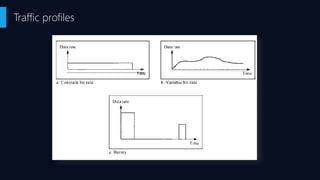
•This traffic model has a data rate that does not change.
•The avg data rate and the peak data rate are the same.
•The maximum burst size is not applicable.
• Traffic is very easy for a network to handle since it is
predictable.
•The network knows in advance how much bandwidth to
allocate for this type of flow.
Constant Bit rate
• The rate of the data flow changes in time.
• The changes are smooth instead of sudden and sharp.
• The average data rate and the peak data rate are different.
• Traffic is more difficult to handle than previous traffic.
Variable Bit rate
• The data rate changes suddenly in a very short time.
• It may also remain at this value for a while.
• The average bit rate and the peak bit rate are very different
values in this type of flow.
• The maximum burst size is significant.
• The profile is very unpredictable hence it is difficult to handle.
Bursty
Traffic profiles
Congestion
Congestion
•Congestion in a network may occur if load exceeds capacity.
•In other words the number of packets sent to the network is
greater the number of packets a network can handle.
•This occurs because routers and switches have buffers and
packets are stored into them.
Congestion
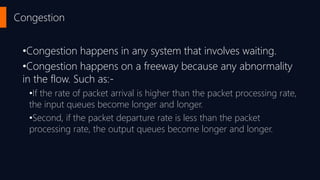
•Congestion happens in any system that involves waiting.
•Congestion happens on a freeway because any abnormality
in the flow. Such as:-
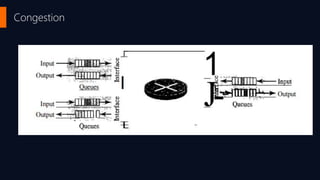
•If the rate of packet arrival is higher than the packet processing rate,
the input queues become longer and longer.
•Second, if the packet departure rate is less than the packet
processing rate, the output queues become longer and longer.
Congestion
Network Performance
Network Performance
Delay Throughput
Delay
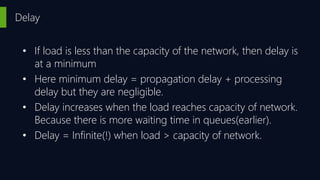
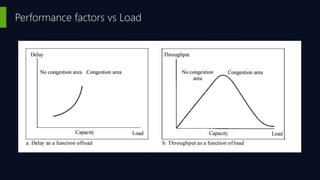
• If load is less than the capacity of the network, then delay is
at a minimum
• Here minimum delay = propagation delay + processing
delay but they are negligible.
• Delay increases when the load reaches capacity of network.
Because there is more waiting time in queues(earlier).
• Delay = Infinite(!) when load > capacity of network.
Throughput
• It is the number of packets passing through the network in
a unit of time.
• If load is below then capacity of the network, the
throughput increases proportionally w/load.
• When load reaches the capacity, the throughput declines
sharply.
• The reason is the discarding of packets by the routers and it
leads to retransmission.
Performance factors vs Load
Acknowledgements
McGraw
Hill Tutorialspoint
Behrouz A. Forouzan
HowStuffWorks
Microsoft
Thank you

Traffic profiles, congestion and network performance

  • 1.
    Traffic profiles, Congestion& N/W Performance Raj Parekh raj.parekh07@gmail.com @_rp07 1498023
  • 2.
  • 3.
  • 4.
    Traffic Profiles Constant Bitrate Variable Bit rate Bursty
  • 5.
    •This traffic modelhas a data rate that does not change. •The avg data rate and the peak data rate are the same. •The maximum burst size is not applicable. • Traffic is very easy for a network to handle since it is predictable. •The network knows in advance how much bandwidth to allocate for this type of flow. Constant Bit rate
  • 6.
    • The rateof the data flow changes in time. • The changes are smooth instead of sudden and sharp. • The average data rate and the peak data rate are different. • Traffic is more difficult to handle than previous traffic. Variable Bit rate
  • 7.
    • The datarate changes suddenly in a very short time. • It may also remain at this value for a while. • The average bit rate and the peak bit rate are very different values in this type of flow. • The maximum burst size is significant. • The profile is very unpredictable hence it is difficult to handle. Bursty
  • 8.
  • 9.
  • 10.
    Congestion •Congestion in anetwork may occur if load exceeds capacity. •In other words the number of packets sent to the network is greater the number of packets a network can handle. •This occurs because routers and switches have buffers and packets are stored into them.
  • 11.
    Congestion •Congestion happens inany system that involves waiting. •Congestion happens on a freeway because any abnormality in the flow. Such as:- •If the rate of packet arrival is higher than the packet processing rate, the input queues become longer and longer. •Second, if the packet departure rate is less than the packet processing rate, the output queues become longer and longer.
  • 12.
  • 13.
  • 14.
  • 15.
    Delay • If loadis less than the capacity of the network, then delay is at a minimum • Here minimum delay = propagation delay + processing delay but they are negligible. • Delay increases when the load reaches capacity of network. Because there is more waiting time in queues(earlier). • Delay = Infinite(!) when load > capacity of network.
  • 16.
    Throughput • It isthe number of packets passing through the network in a unit of time. • If load is below then capacity of the network, the throughput increases proportionally w/load. • When load reaches the capacity, the throughput declines sharply. • The reason is the discarding of packets by the routers and it leads to retransmission.
  • 17.
  • 18.
  • 19.