PROTECTION FOR THE AMINE
GROUP
PRESENTED BY- INDRAJIT SAMANTA
M.PHARM ( PHARMACEUTICAL CHEMISTRY), 1ST SEM, 1ST YEAR
DEPARTMENT OF PHARMACEUTICAL CHEMISTRY,
SPER, JAMIA HAMDARD, NEW DELHI
CONTENTS
INTRODUCTION
Qualities of a Good Protecting Group
Protecting Groups for Amino Groups
Carbamates as Protecting Groups for Amines
Amides as Protecting groups for Amines
Cyclic Imides As Protecting Group
REFERENCE:
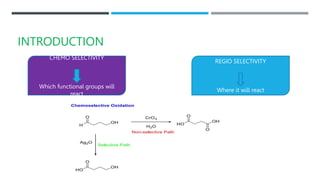
INTRODUCTION
CHEMO SELECTIVITY
Which functional groups will
react
REGIO SELECTIVITY
Where it will react
INTRODUCTION
 Which functional group reacts first 1. Reaction
2. Condition
3. reagents
INTRODUCTION
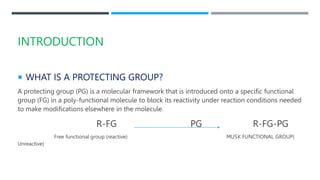
 WHAT IS A PROTECTING GROUP?
A protecting group (PG) is a molecular framework that is introduced onto a specific functional
group (FG) in a poly-functional molecule to block its reactivity under reaction conditions needed
to make modifications elsewhere in the molecule.
R-FG PG R-FG-PG
Free functional group (reactive) MUSK FUNCTIONAL GROUP(
Unreactive)
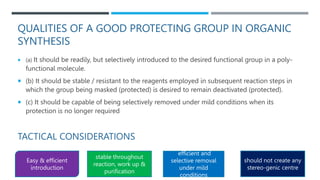
QUALITIES OF A GOOD PROTECTING GROUP IN ORGANIC
SYNTHESIS
 (a) It should be readily, but selectively introduced to the desired functional group in a poly-
functional molecule.
 (b) It should be stable / resistant to the reagents employed in subsequent reaction steps in
which the group being masked (protected) is desired to remain deactivated (protected).
 (c) It should be capable of being selectively removed under mild conditions when its
protection is no longer required
TACTICAL CONSIDERATIONS
Easy & efficient
introduction
stable throughout
reaction, work up &
purification
efficient and
selective removal
under mild
conditions
should not create any
stereo-genic centre
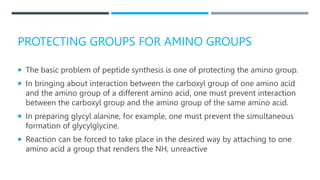
PROTECTING GROUPS FOR AMINO GROUPS
 The basic problem of peptide synthesis is one of protecting the amino group.
 In bringing about interaction between the carboxyl group of one amino acid
and the amino group of a different amino acid, one must prevent interaction
between the carboxyl group and the amino group of the same amino acid.
 In preparing glycyl alanine, for example, one must prevent the simultaneous
formation of glycylglycine.
 Reaction can be forced to take place in the desired way by attaching to one
amino acid a group that renders the NH, unreactive
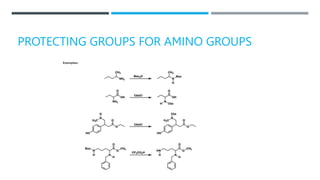
PROTECTING GROUPS FOR AMINO GROUPS
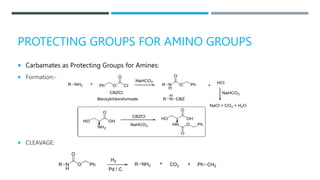
 Carbamates as Protecting Groups for Amines:
 Formation:-
 CLEAVAGE:
CARBAMATES AS PROTECTING GROUPS FOR AMINES:
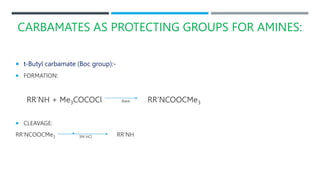
 t-Butyl carbamate (Boc group):-
 FORMATION:
RR’NH + Me3COCOCl Base RR’NCOOCMe3
 CLEAVAGE:
RR’NCOOCMe3 3M HCl RR’NH
CARBAMATES AS PROTECTING GROUPS FOR AMINES:
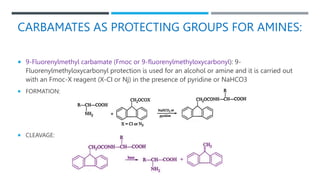
 9-Fluorenylmethyl carbamate (Fmoc or 9-fluorenylmethyloxycarbonyl): 9-
Fluorenylmethyloxycarbonyl protection is used for an alcohol or amine and it is carried out
with an Fmoc-X reagent (X-CI or Nj) in the presence of pyridine or NaHCO3
 FORMATION:
 CLEAVAGE:
BENZYL CARBAMATE [BENZYLOXY-CARBONYL OR
CBZ GROUP (RRNCOOCH2PH)]:-
FORMATION:
CLEAVAGES:
AMIDES AS PROTECTING GROUPS FOR AMINES:-
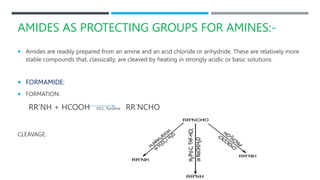
 Amides are readily prepared from an amine and an acid chloride or anhydride. These are relatively more
stable compounds that, classically, are cleaved by heating in strongly acidic or basic solutions.
 FORMAMIDE:
 FORMATION:
RR’NH + HCOOH DCC, Pyridine RR’NCHO
CLEAVAGE:
AMIDES
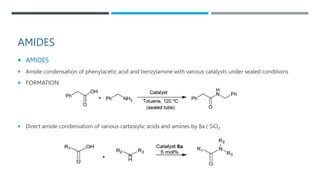
 AMIDES
 Amide condensation of phenylacetic acid and benzylamine with various catalysts under sealed conditions
 FORMATION
 Direct amide condensation of various carboxylic acids and amines by 8a ( SiO2
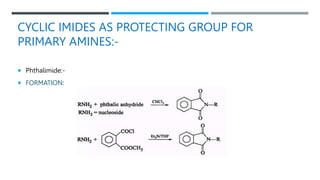
CYCLIC IMIDES AS PROTECTING GROUP FOR
PRIMARY AMINES:-
 Phthalimide:-
 FORMATION:
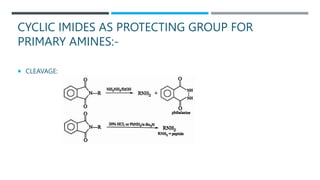
CYCLIC IMIDES AS PROTECTING GROUP FOR
PRIMARY AMINES:-
 CLEAVAGE:
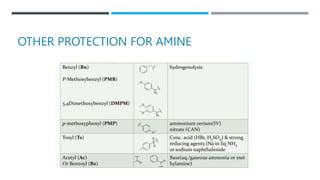
OTHER PROTECTION FOR AMINE
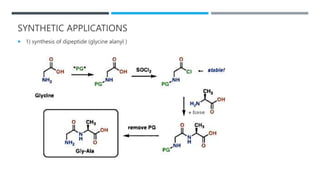
SYNTHETIC APPLICATIONS
 1) synthesis of dipeptide (glycine alanyl )
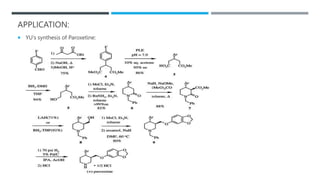
APPLICATION:
 YU’s synthesis of Paroxetine:
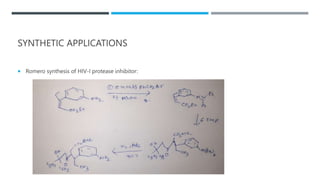
SYNTHETIC APPLICATIONS
 Romero synthesis of HIV-I protease inhibitor:
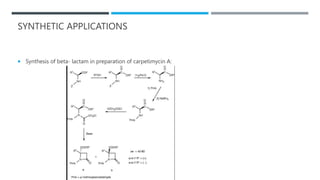
SYNTHETIC APPLICATIONS
 Synthesis of beta- lactam in preparation of carpetimycin A:
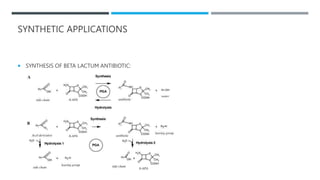
SYNTHETIC APPLICATIONS
 SYNTHESIS OF BETA LACTUM ANTIBIOTIC:
SYNTHETIC APPLICATIONS
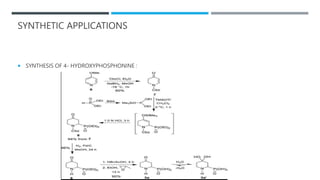
 SYNTHESIS OF 4- HYDROXYPHOSPHONINE :
SYNTHETIC APPLICATIONS
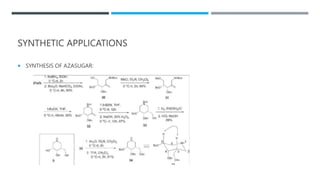
 SYNTHESIS OF AZASUGAR:
SYNTHETIC APPLICATIONS
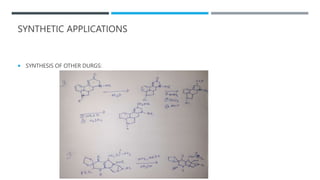
 SYNTHESIS OF OTHER DURGS:
REFERENCES:
 Hanson, J.R.; Protecting Groups in Organic Synthesis; Sheffield Academic Press; pp 8-80.
 Morrison, R.T.; Boyd R.N.; Organic Chemistry; Prentice-Hall of India Private Limited; Sixth Edition- 2002;
pp. 1147.
 2,2,6,6-Tetramethylpiperidin-1-yloxycarbonyl: A Protecting Group for Primary, Secondary, and Heterocyclic Amines,
Joseph R. Lizza, Maximilian Bremerich, Stephanie R. McCabe, Peter Wipf,
Org. Lett. 2018. https://doi.org/10.1021/acs.orglett.8b02874
Protection for the AMINE.pptx

Protection for the AMINE.pptx

  • 1.
    PROTECTION FOR THEAMINE GROUP PRESENTED BY- INDRAJIT SAMANTA M.PHARM ( PHARMACEUTICAL CHEMISTRY), 1ST SEM, 1ST YEAR DEPARTMENT OF PHARMACEUTICAL CHEMISTRY, SPER, JAMIA HAMDARD, NEW DELHI
  • 2.
    CONTENTS INTRODUCTION Qualities of aGood Protecting Group Protecting Groups for Amino Groups Carbamates as Protecting Groups for Amines Amides as Protecting groups for Amines Cyclic Imides As Protecting Group REFERENCE:
  • 3.
    INTRODUCTION CHEMO SELECTIVITY Which functionalgroups will react REGIO SELECTIVITY Where it will react
  • 4.
    INTRODUCTION  Which functionalgroup reacts first 1. Reaction 2. Condition 3. reagents
  • 5.
    INTRODUCTION  WHAT ISA PROTECTING GROUP? A protecting group (PG) is a molecular framework that is introduced onto a specific functional group (FG) in a poly-functional molecule to block its reactivity under reaction conditions needed to make modifications elsewhere in the molecule. R-FG PG R-FG-PG Free functional group (reactive) MUSK FUNCTIONAL GROUP( Unreactive)
  • 6.
    QUALITIES OF AGOOD PROTECTING GROUP IN ORGANIC SYNTHESIS  (a) It should be readily, but selectively introduced to the desired functional group in a poly- functional molecule.  (b) It should be stable / resistant to the reagents employed in subsequent reaction steps in which the group being masked (protected) is desired to remain deactivated (protected).  (c) It should be capable of being selectively removed under mild conditions when its protection is no longer required TACTICAL CONSIDERATIONS Easy & efficient introduction stable throughout reaction, work up & purification efficient and selective removal under mild conditions should not create any stereo-genic centre
  • 7.
    PROTECTING GROUPS FORAMINO GROUPS  The basic problem of peptide synthesis is one of protecting the amino group.  In bringing about interaction between the carboxyl group of one amino acid and the amino group of a different amino acid, one must prevent interaction between the carboxyl group and the amino group of the same amino acid.  In preparing glycyl alanine, for example, one must prevent the simultaneous formation of glycylglycine.  Reaction can be forced to take place in the desired way by attaching to one amino acid a group that renders the NH, unreactive
  • 8.
  • 9.
    PROTECTING GROUPS FORAMINO GROUPS  Carbamates as Protecting Groups for Amines:  Formation:-  CLEAVAGE:
  • 10.
    CARBAMATES AS PROTECTINGGROUPS FOR AMINES:  t-Butyl carbamate (Boc group):-  FORMATION: RR’NH + Me3COCOCl Base RR’NCOOCMe3  CLEAVAGE: RR’NCOOCMe3 3M HCl RR’NH
  • 11.
    CARBAMATES AS PROTECTINGGROUPS FOR AMINES:  9-Fluorenylmethyl carbamate (Fmoc or 9-fluorenylmethyloxycarbonyl): 9- Fluorenylmethyloxycarbonyl protection is used for an alcohol or amine and it is carried out with an Fmoc-X reagent (X-CI or Nj) in the presence of pyridine or NaHCO3  FORMATION:  CLEAVAGE:
  • 12.
    BENZYL CARBAMATE [BENZYLOXY-CARBONYLOR CBZ GROUP (RRNCOOCH2PH)]:- FORMATION: CLEAVAGES:
  • 13.
    AMIDES AS PROTECTINGGROUPS FOR AMINES:-  Amides are readily prepared from an amine and an acid chloride or anhydride. These are relatively more stable compounds that, classically, are cleaved by heating in strongly acidic or basic solutions.  FORMAMIDE:  FORMATION: RR’NH + HCOOH DCC, Pyridine RR’NCHO CLEAVAGE:
  • 14.
    AMIDES  AMIDES  Amidecondensation of phenylacetic acid and benzylamine with various catalysts under sealed conditions  FORMATION  Direct amide condensation of various carboxylic acids and amines by 8a ( SiO2
  • 15.
    CYCLIC IMIDES ASPROTECTING GROUP FOR PRIMARY AMINES:-  Phthalimide:-  FORMATION:
  • 16.
    CYCLIC IMIDES ASPROTECTING GROUP FOR PRIMARY AMINES:-  CLEAVAGE:
  • 17.
  • 18.
    SYNTHETIC APPLICATIONS  1)synthesis of dipeptide (glycine alanyl )
  • 19.
  • 20.
    SYNTHETIC APPLICATIONS  Romerosynthesis of HIV-I protease inhibitor:
  • 21.
    SYNTHETIC APPLICATIONS  Synthesisof beta- lactam in preparation of carpetimycin A:
  • 22.
    SYNTHETIC APPLICATIONS  SYNTHESISOF BETA LACTUM ANTIBIOTIC:
  • 23.
    SYNTHETIC APPLICATIONS  SYNTHESISOF 4- HYDROXYPHOSPHONINE :
  • 24.
  • 25.
  • 26.
    REFERENCES:  Hanson, J.R.;Protecting Groups in Organic Synthesis; Sheffield Academic Press; pp 8-80.  Morrison, R.T.; Boyd R.N.; Organic Chemistry; Prentice-Hall of India Private Limited; Sixth Edition- 2002; pp. 1147.  2,2,6,6-Tetramethylpiperidin-1-yloxycarbonyl: A Protecting Group for Primary, Secondary, and Heterocyclic Amines, Joseph R. Lizza, Maximilian Bremerich, Stephanie R. McCabe, Peter Wipf, Org. Lett. 2018. https://doi.org/10.1021/acs.orglett.8b02874