Syntax-Directed Translation into Three
Address Code
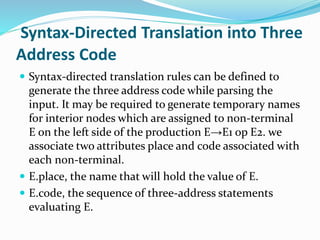
 Syntax-directed translation rules can be defined to
generate the three address code while parsing the
input. It may be required to generate temporary names
for interior nodes which are assigned to non-terminal
E on the left side of the production E→E1 op E2. we
associate two attributes place and code associated with
each non-terminal.
 E.place, the name that will hold the value of E.
 E.code, the sequence of three-address statements
evaluating E.
Syntax-Directed Translation into
Three Address Code
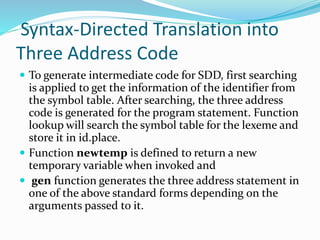
 To generate intermediate code for SDD, first searching
is applied to get the information of the identifier from
the symbol table. After searching, the three address
code is generated for the program statement. Function
lookup will search the symbol table for the lexeme and
store it in id.place.
 Function newtemp is defined to return a new
temporary variable when invoked and
 gen function generates the three address statement in
one of the above standard forms depending on the
arguments passed to it.
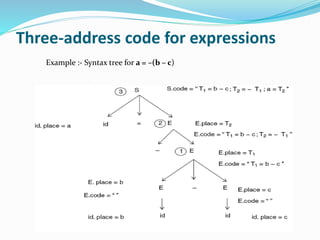
Three-address code for expressions
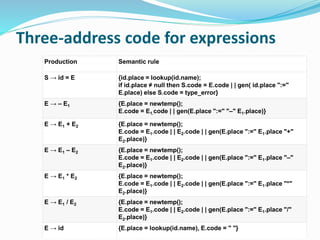
Production Semantic rule
S → id = E {id.place = lookup(id.name);
if id.place ≠ null then S.code = E.code | | gen( id.place ":="
E.place) else S.code = type_error}
E → – E1 {E.place = newtemp();
E.code = E1.code | | gen(E.place ":=" "–" E1.place)}
E → E1 + E2 {E.place = newtemp();
E.code = E1.code | | E2.code | | gen(E.place ":=" E1.place "+"
E2.place)}
E → E1 – E2 {E.place = newtemp();
E.code = E1.code | | E2.code | | gen(E.place ":=" E1.place "–"
E2.place)}
E → E1 * E2 {E.place = newtemp();
E.code = E1.code | | E2.code | | gen(E.place ":=" E1.place "*"
E2.place)}
E → E1 / E2 {E.place = newtemp();
E.code = E1.code | | E2.code | | gen(E.place ":=" E1.place "/"
E2.place)}
E → id {E.place = lookup(id.name), E.code = " "}
Three-address code for expressions
Example :- Syntax tree for a = –(b – c)
Translation of Boolean Expression
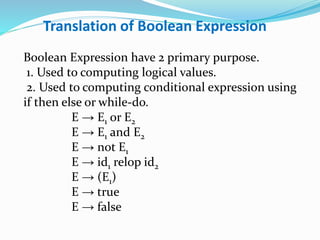
Boolean Expression have 2 primary purpose.
1. Used to computing logical values.
2. Used to computing conditional expression using
if then else or while-do.
E → E1 or E2
E → E1 and E2
E → not E1
E → id1 relop id2
E → (E1)
E → true
E → false
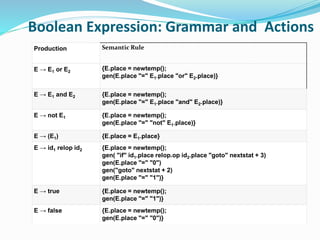
Boolean Expression: Grammar and Actions
Production Semantic Rule
E → E1 or E2
{E.place = newtemp();
gen(E.place "=" E1.place "or" E2.place)}
E → E1 and E2 {E.place = newtemp();
gen(E.place "=" E1.place "and" E2.place)}
E → not E1 {E.place = newtemp();
gen(E.place "=" "not" E1.place)}
E → (E1) {E.place = E1.place}
E → id1 relop id2 {E.place = newtemp();
gen( "if" id1.place relop.op id2.place "goto" nextstat + 3)
gen(E.place "=" "0")
gen("goto" nextstat + 2)
gen(E.place "=" "1")}
E → true {E.place = newtemp();
gen(E.place "=" "1")}
E → false {E.place = newtemp();
gen(E.place "=" "0")}
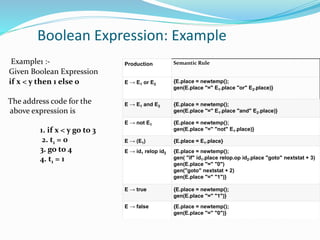
Boolean Expression: Example
Example1 :-
Given Boolean Expression
if x < y then 1 else 0
The address code for the
above expression is
1. if x < y go to 3
2. t1 = 0
3. go to 4
4. t1 = 1
Production Semantic Rule
E → E1 or E2
{E.place = newtemp();
gen(E.place "=" E1.place "or" E2.place)}
E → E1 and E2 {E.place = newtemp();
gen(E.place "=" E1.place "and" E2.place)}
E → not E1 {E.place = newtemp();
gen(E.place "=" "not" E1.place)}
E → (E1) {E.place = E1.place}
E → id1 relop id2 {E.place = newtemp();
gen( "if" id1.place relop.op id2.place "goto" nextstat + 3)
gen(E.place "=" "0")
gen("goto" nextstat + 2)
gen(E.place "=" "1")}
E → true {E.place = newtemp();
gen(E.place "=" "1")}
E → false {E.place = newtemp();
gen(E.place "=" "0")}
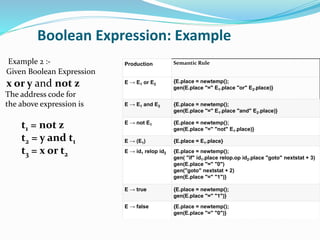
Boolean Expression: Example
Example 2 :-
Given Boolean Expression
x or y and not z
The address code for
the above expression is
t1 = not z
t2 = y and t1
t3 = x or t2
Production Semantic Rule
E → E1 or E2
{E.place = newtemp();
gen(E.place "=" E1.place "or" E2.place)}
E → E1 and E2 {E.place = newtemp();
gen(E.place "=" E1.place "and" E2.place)}
E → not E1 {E.place = newtemp();
gen(E.place "=" "not" E1.place)}
E → (E1) {E.place = E1.place}
E → id1 relop id2 {E.place = newtemp();
gen( "if" id1.place relop.op id2.place "goto" nextstat + 3)
gen(E.place "=" "0")
gen("goto" nextstat + 2)
gen(E.place "=" "1")}
E → true {E.place = newtemp();
gen(E.place "=" "1")}
E → false {E.place = newtemp();
gen(E.place "=" "0")}
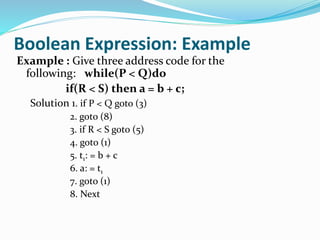
Boolean Expression: Example
Example : Give three address code for the
following: while(P < Q)do
if(R < S) then a = b + c;
Solution 1. if P < Q goto (3)
2. goto (8)
3. if R < S goto (5)
4. goto (1)
5. t1: = b + c
6. a: = t1
7. goto (1)
8. Next
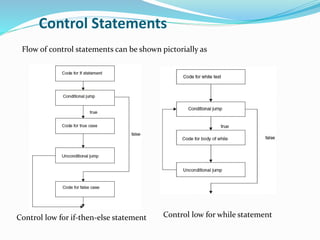
Control Statements
Flow of control statements can be shown pictorially as
Control low for if-then-else statement Control low for while statement
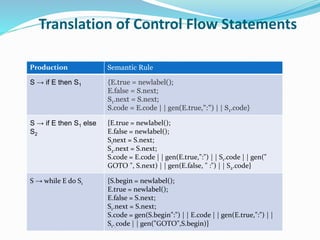
Translation of Control Flow Statements
Production Semantic Rule
S → if E then S1 {E.true = newlabel();
E.false = S.next;
S1.next = S.next;
S.code = E.code | | gen(E.true,":") | | S1.code}
S → if E then S1 else
S2
{E.true = newlabel();
E.false = newlabel();
S1next = S.next;
S2.next = S.next;
S.code = E.code | | gen(E.true,":") | | S1.code | | gen("
GOTO ", S.next) | | gen(E.false, " :") | | S2.code}
S → while E do S1 {S.begin = newlabel();
E.true = newlabel();
E.false = S.next;
S1.next = S.next;
S.code = gen(S.begin":") | | E.code | | gen(E.true,":") | |
S1..code | | gen("GOTO",S.begin)}
Control Flow Statements
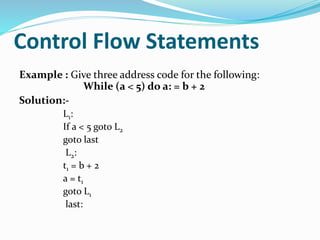
Example : Give three address code for the following:
While (a < 5) do a: = b + 2
Solution:-
L1:
If a < 5 goto L2
goto last
L2:
t1 = b + 2
a = t1
goto L1
last:
Control Flow Statements
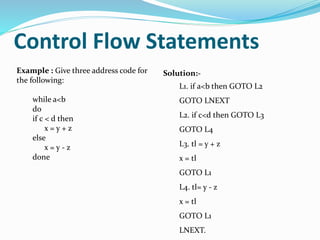
Example : Give three address code for
the following:
while a<b
do
if c < d then
x = y + z
else
x = y - z
done
Solution:-
L1. if a<b then GOTO L2
GOTO LNEXT
L2. if c<d then GOTO L3
GOTO L4
L3. tl = y + z
x = tl
GOTO L1
L4. tl= y - z
x = tl
GOTO L1
LNEXT.
Backpatching
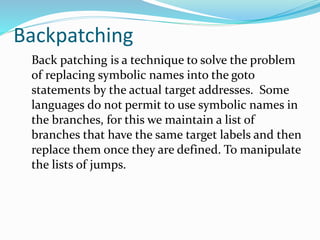
Back patching is a technique to solve the problem
of replacing symbolic names into the goto
statements by the actual target addresses. Some
languages do not permit to use symbolic names in
the branches, for this we maintain a list of
branches that have the same target labels and then
replace them once they are defined. To manipulate
the lists of jumps.
Backpatching
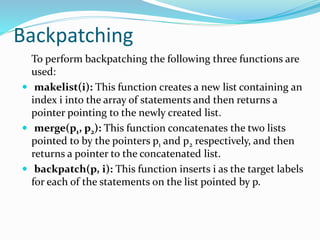
To perform backpatching the following three functions are
used:
 makelist(i): This function creates a new list containing an
index i into the array of statements and then returns a
pointer pointing to the newly created list.
 merge(p1, p2): This function concatenates the two lists
pointed to by the pointers p1 and p2 respectively, and then
returns a pointer to the concatenated list.
 backpatch(p, i): This function inserts i as the target labels
for each of the statements on the list pointed by p.
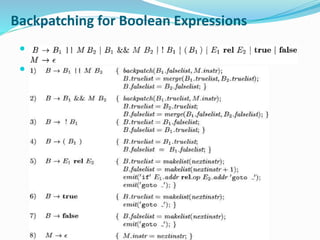
Backpatching for Boolean Expressions


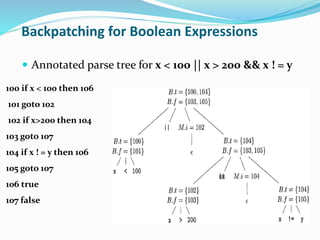
Backpatching for Boolean Expressions
 Annotated parse tree for x < 100 || x > 200 && x ! = y
100 if x < 100 then 106
101 goto 102
102 if x>200 then 104
103 goto 107
104 if x ! = y then 106
105 goto 107
106 true
107 false

Syntax-Directed Translation into Three Address Code

  • 2.
    Syntax-Directed Translation intoThree Address Code  Syntax-directed translation rules can be defined to generate the three address code while parsing the input. It may be required to generate temporary names for interior nodes which are assigned to non-terminal E on the left side of the production E→E1 op E2. we associate two attributes place and code associated with each non-terminal.  E.place, the name that will hold the value of E.  E.code, the sequence of three-address statements evaluating E.
  • 3.
    Syntax-Directed Translation into ThreeAddress Code  To generate intermediate code for SDD, first searching is applied to get the information of the identifier from the symbol table. After searching, the three address code is generated for the program statement. Function lookup will search the symbol table for the lexeme and store it in id.place.  Function newtemp is defined to return a new temporary variable when invoked and  gen function generates the three address statement in one of the above standard forms depending on the arguments passed to it.
  • 4.
    Three-address code forexpressions Production Semantic rule S → id = E {id.place = lookup(id.name); if id.place ≠ null then S.code = E.code | | gen( id.place ":=" E.place) else S.code = type_error} E → – E1 {E.place = newtemp(); E.code = E1.code | | gen(E.place ":=" "–" E1.place)} E → E1 + E2 {E.place = newtemp(); E.code = E1.code | | E2.code | | gen(E.place ":=" E1.place "+" E2.place)} E → E1 – E2 {E.place = newtemp(); E.code = E1.code | | E2.code | | gen(E.place ":=" E1.place "–" E2.place)} E → E1 * E2 {E.place = newtemp(); E.code = E1.code | | E2.code | | gen(E.place ":=" E1.place "*" E2.place)} E → E1 / E2 {E.place = newtemp(); E.code = E1.code | | E2.code | | gen(E.place ":=" E1.place "/" E2.place)} E → id {E.place = lookup(id.name), E.code = " "}
  • 5.
    Three-address code forexpressions Example :- Syntax tree for a = –(b – c)
  • 6.
    Translation of BooleanExpression Boolean Expression have 2 primary purpose. 1. Used to computing logical values. 2. Used to computing conditional expression using if then else or while-do. E → E1 or E2 E → E1 and E2 E → not E1 E → id1 relop id2 E → (E1) E → true E → false
  • 7.
    Boolean Expression: Grammarand Actions Production Semantic Rule E → E1 or E2 {E.place = newtemp(); gen(E.place "=" E1.place "or" E2.place)} E → E1 and E2 {E.place = newtemp(); gen(E.place "=" E1.place "and" E2.place)} E → not E1 {E.place = newtemp(); gen(E.place "=" "not" E1.place)} E → (E1) {E.place = E1.place} E → id1 relop id2 {E.place = newtemp(); gen( "if" id1.place relop.op id2.place "goto" nextstat + 3) gen(E.place "=" "0") gen("goto" nextstat + 2) gen(E.place "=" "1")} E → true {E.place = newtemp(); gen(E.place "=" "1")} E → false {E.place = newtemp(); gen(E.place "=" "0")}
  • 8.
    Boolean Expression: Example Example1:- Given Boolean Expression if x < y then 1 else 0 The address code for the above expression is 1. if x < y go to 3 2. t1 = 0 3. go to 4 4. t1 = 1 Production Semantic Rule E → E1 or E2 {E.place = newtemp(); gen(E.place "=" E1.place "or" E2.place)} E → E1 and E2 {E.place = newtemp(); gen(E.place "=" E1.place "and" E2.place)} E → not E1 {E.place = newtemp(); gen(E.place "=" "not" E1.place)} E → (E1) {E.place = E1.place} E → id1 relop id2 {E.place = newtemp(); gen( "if" id1.place relop.op id2.place "goto" nextstat + 3) gen(E.place "=" "0") gen("goto" nextstat + 2) gen(E.place "=" "1")} E → true {E.place = newtemp(); gen(E.place "=" "1")} E → false {E.place = newtemp(); gen(E.place "=" "0")}
  • 9.
    Boolean Expression: Example Example2 :- Given Boolean Expression x or y and not z The address code for the above expression is t1 = not z t2 = y and t1 t3 = x or t2 Production Semantic Rule E → E1 or E2 {E.place = newtemp(); gen(E.place "=" E1.place "or" E2.place)} E → E1 and E2 {E.place = newtemp(); gen(E.place "=" E1.place "and" E2.place)} E → not E1 {E.place = newtemp(); gen(E.place "=" "not" E1.place)} E → (E1) {E.place = E1.place} E → id1 relop id2 {E.place = newtemp(); gen( "if" id1.place relop.op id2.place "goto" nextstat + 3) gen(E.place "=" "0") gen("goto" nextstat + 2) gen(E.place "=" "1")} E → true {E.place = newtemp(); gen(E.place "=" "1")} E → false {E.place = newtemp(); gen(E.place "=" "0")}
  • 10.
    Boolean Expression: Example Example: Give three address code for the following: while(P < Q)do if(R < S) then a = b + c; Solution 1. if P < Q goto (3) 2. goto (8) 3. if R < S goto (5) 4. goto (1) 5. t1: = b + c 6. a: = t1 7. goto (1) 8. Next
  • 11.
    Control Statements Flow ofcontrol statements can be shown pictorially as Control low for if-then-else statement Control low for while statement
  • 12.
    Translation of ControlFlow Statements Production Semantic Rule S → if E then S1 {E.true = newlabel(); E.false = S.next; S1.next = S.next; S.code = E.code | | gen(E.true,":") | | S1.code} S → if E then S1 else S2 {E.true = newlabel(); E.false = newlabel(); S1next = S.next; S2.next = S.next; S.code = E.code | | gen(E.true,":") | | S1.code | | gen(" GOTO ", S.next) | | gen(E.false, " :") | | S2.code} S → while E do S1 {S.begin = newlabel(); E.true = newlabel(); E.false = S.next; S1.next = S.next; S.code = gen(S.begin":") | | E.code | | gen(E.true,":") | | S1..code | | gen("GOTO",S.begin)}
  • 13.
    Control Flow Statements Example: Give three address code for the following: While (a < 5) do a: = b + 2 Solution:- L1: If a < 5 goto L2 goto last L2: t1 = b + 2 a = t1 goto L1 last:
  • 14.
    Control Flow Statements Example: Give three address code for the following: while a<b do if c < d then x = y + z else x = y - z done Solution:- L1. if a<b then GOTO L2 GOTO LNEXT L2. if c<d then GOTO L3 GOTO L4 L3. tl = y + z x = tl GOTO L1 L4. tl= y - z x = tl GOTO L1 LNEXT.
  • 15.
    Backpatching Back patching isa technique to solve the problem of replacing symbolic names into the goto statements by the actual target addresses. Some languages do not permit to use symbolic names in the branches, for this we maintain a list of branches that have the same target labels and then replace them once they are defined. To manipulate the lists of jumps.
  • 16.
    Backpatching To perform backpatchingthe following three functions are used:  makelist(i): This function creates a new list containing an index i into the array of statements and then returns a pointer pointing to the newly created list.  merge(p1, p2): This function concatenates the two lists pointed to by the pointers p1 and p2 respectively, and then returns a pointer to the concatenated list.  backpatch(p, i): This function inserts i as the target labels for each of the statements on the list pointed by p.
  • 17.
    Backpatching for BooleanExpressions  
  • 18.
    Backpatching for BooleanExpressions  Annotated parse tree for x < 100 || x > 200 && x ! = y 100 if x < 100 then 106 101 goto 102 102 if x>200 then 104 103 goto 107 104 if x ! = y then 106 105 goto 107 106 true 107 false