INTERMEDIATE CODES
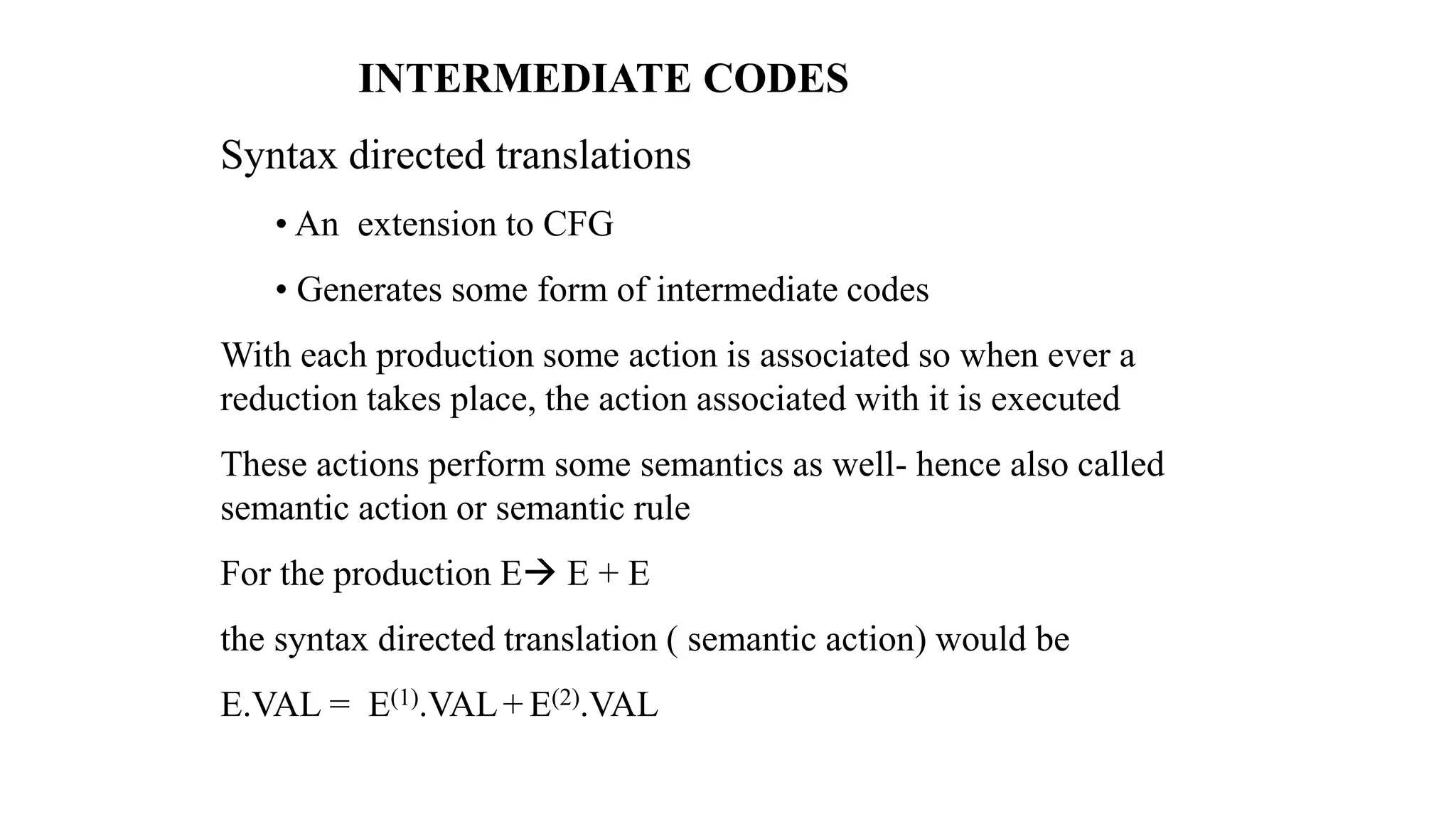
Syntax directed translations
• An extension to CFG
• Generates some form of intermediate codes
With each production some action is associated so when ever a
reduction takes place, the action associated with it is executed
These actions perform some semantics as well- hence also called
semantic action or semantic rule
For the production E→ E + E
the syntax directed translation ( semantic action) would be
E.VAL = E(1).VAL+ E(2).VAL
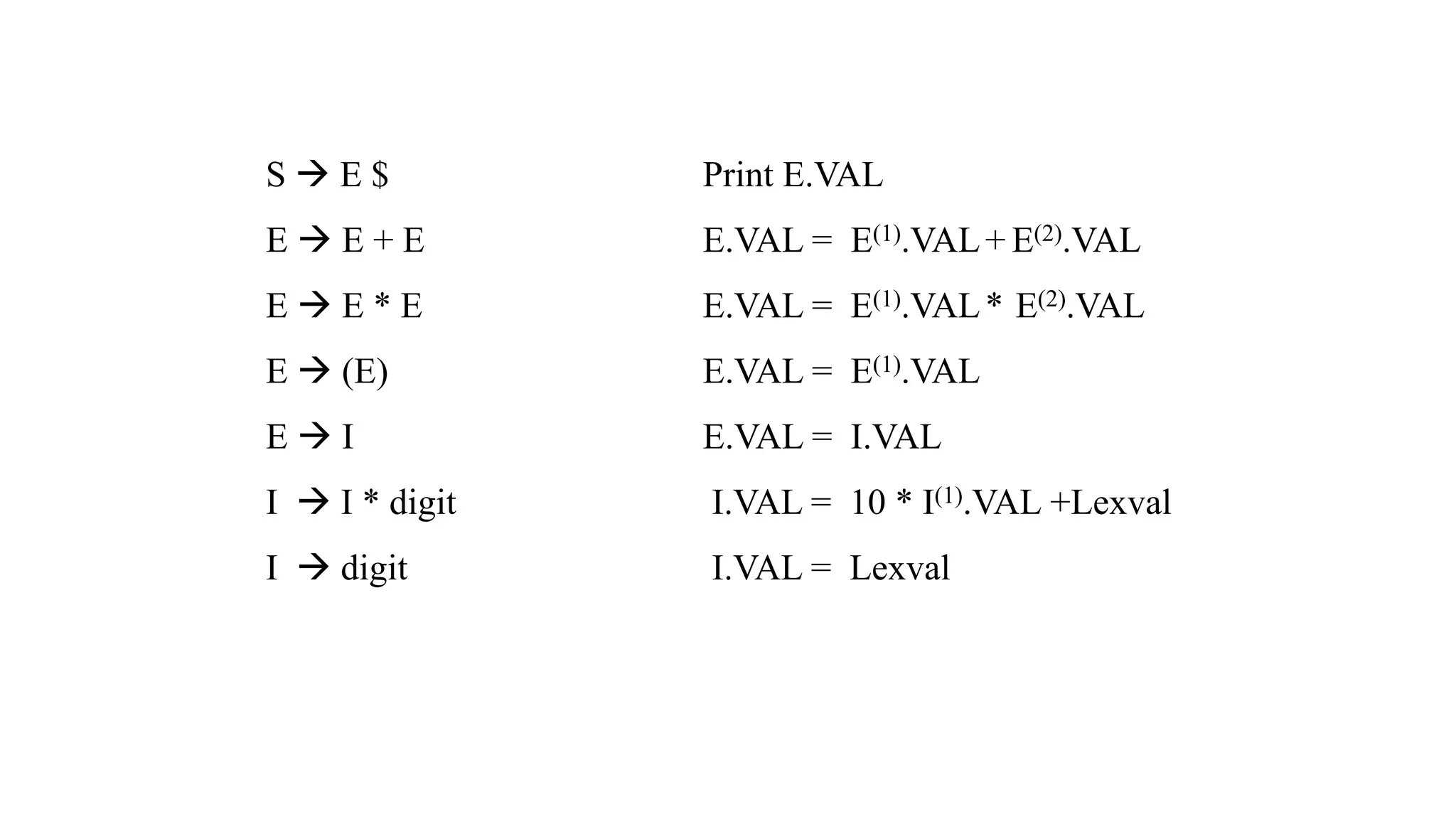
S → E $
E → E + E
E → E * E
E → (E)
E → I
I → I * digit
I → digit
Print E.VAL
E.VAL = E(1).VAL+ E(2).VAL
E.VAL = E(1).VAL* E(2).VAL
E.VAL = E(1).VAL
E.VAL = I.VAL
I.VAL = 10 * I(1).VAL +Lexval
I.VAL = Lexval
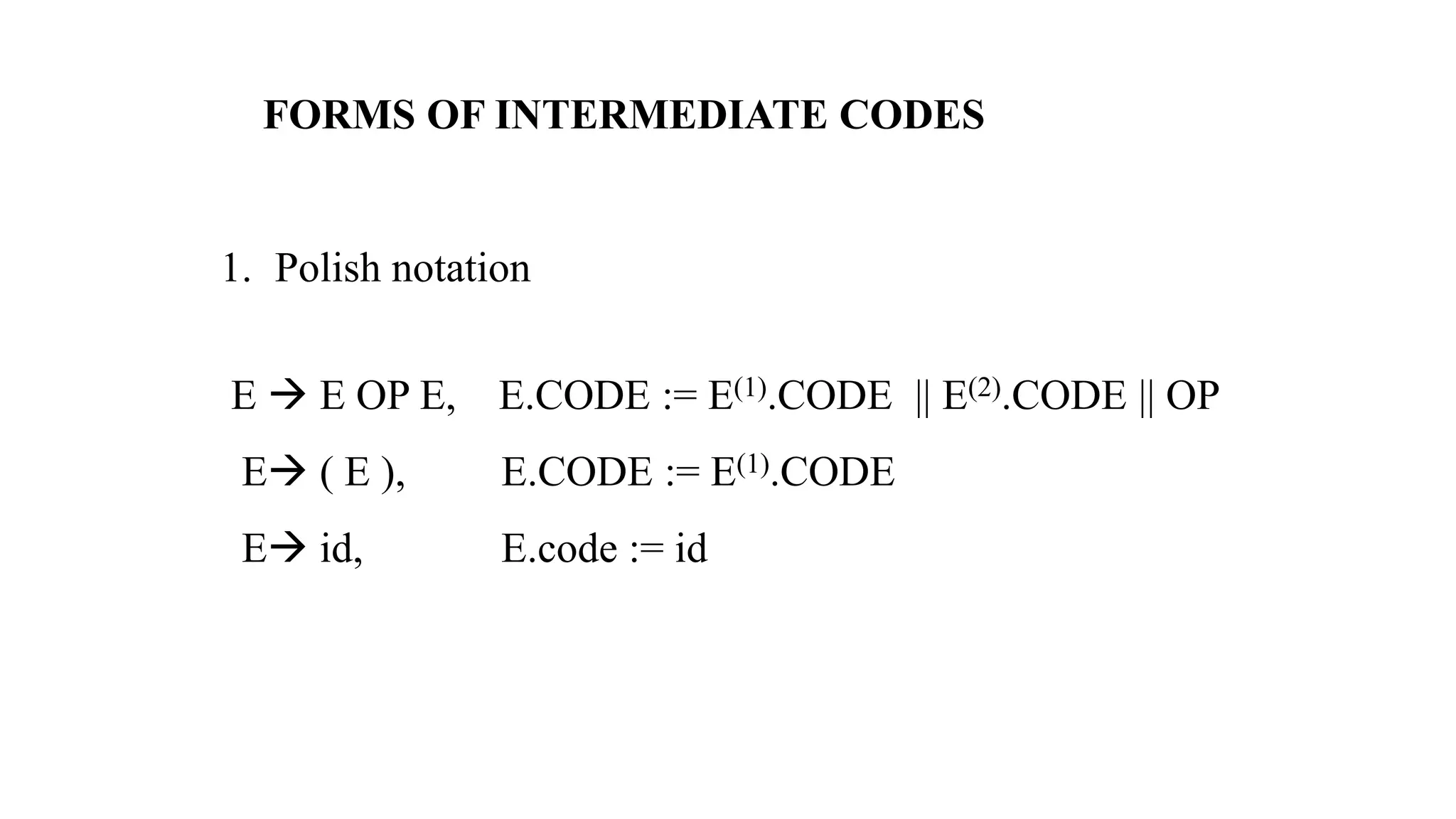
FORMS OF INTERMEDIATE CODES
1. Polish notation
E → E OP E, E.CODE := E(1).CODE || E(2).CODE || OP
E→ ( E ), E.CODE := E(1).CODE
E→ id, E.code := id
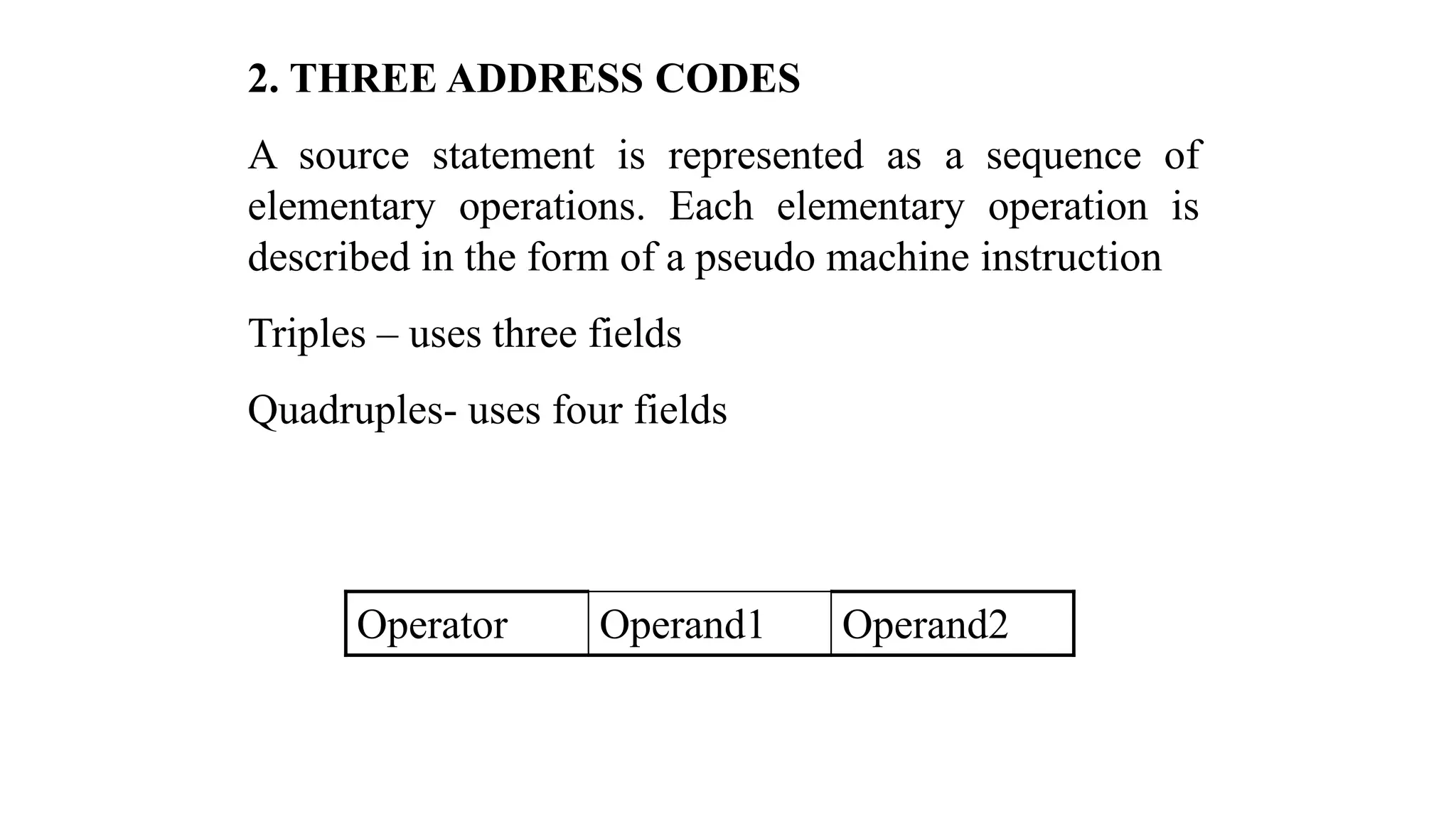
2. THREE ADDRESS CODES
A source statement is represented as a sequence of
elementary operations. Each elementary operation is
described in the form of a pseudo machine instruction
Triples – uses three fields
Quadruples- uses four fields
Operator Operand1 Operand2
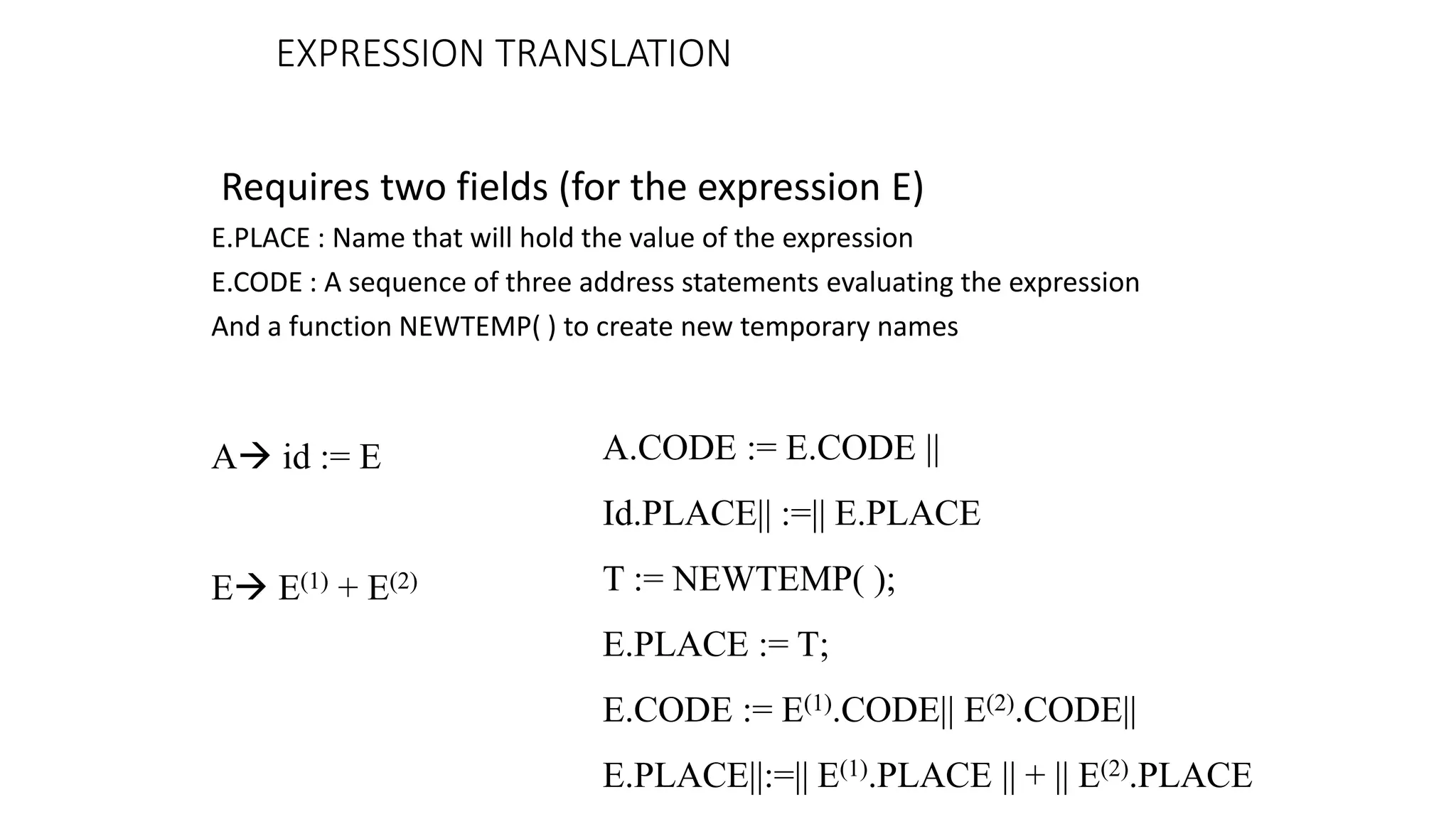
EXPRESSION TRANSLATION
Requires two fields (for the expression E)
E.PLACE : Name that will hold the value of the expression
E.CODE : A sequence of three address statements evaluating the expression
And a function NEWTEMP( ) to create new temporary names
A→ id := E
E→ E(1) + E(2)
A.CODE := E.CODE ||
Id.PLACE|| :=|| E.PLACE
T := NEWTEMP( );
E.PLACE := T;
E.CODE := E(1).CODE|| E(2).CODE||
E.PLACE||:=|| E(1).PLACE || + || E(2).PLACE
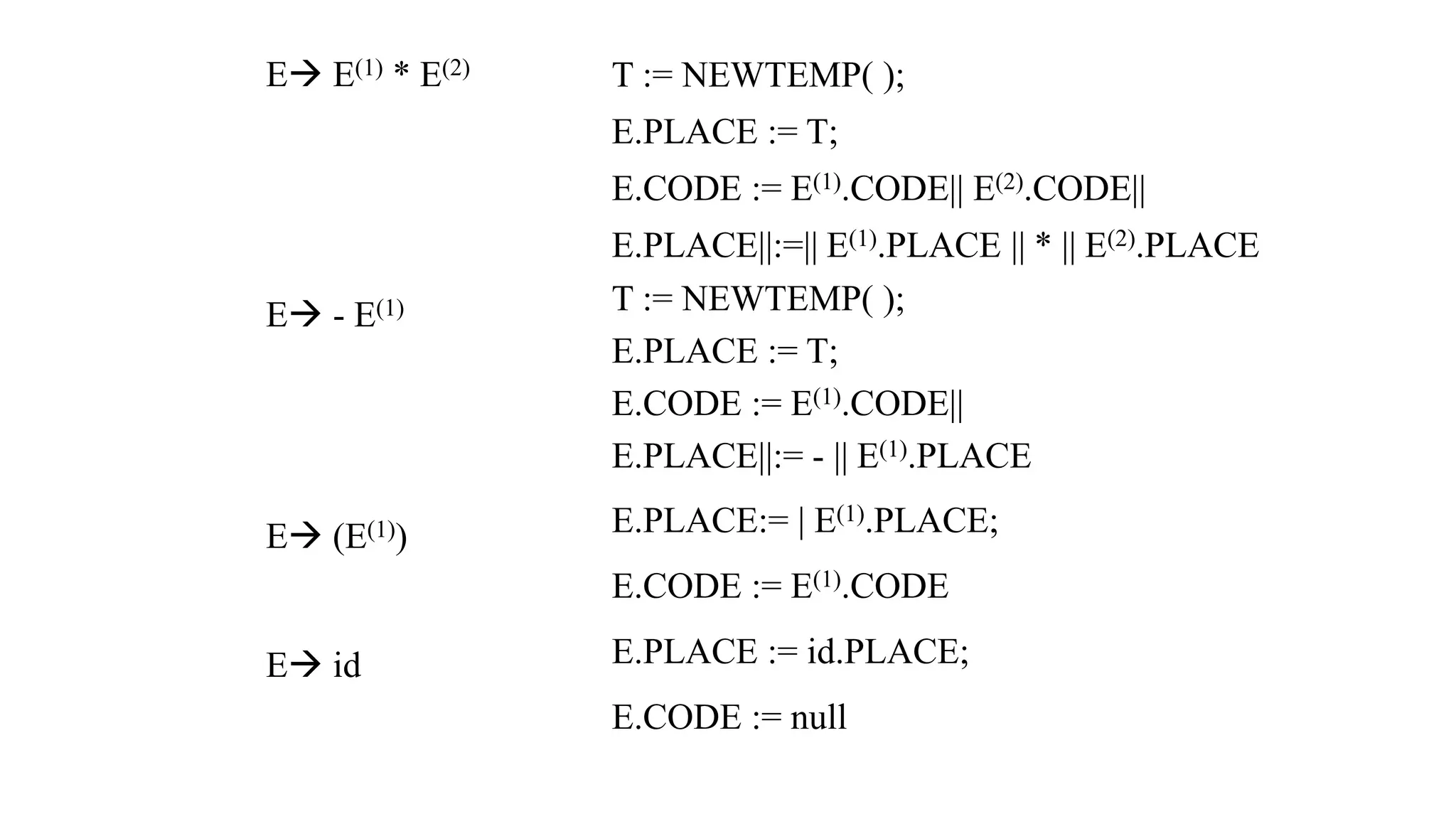
E→ E(1) * E(2)
E→ - E(1)
E→ (E(1))
E→ id
T := NEWTEMP( );
E.PLACE := T;
E.CODE := E(1).CODE|| E(2).CODE||
E.PLACE||:=|| E(1).PLACE || * || E(2).PLACE
T := NEWTEMP( );
E.PLACE := T;
E.CODE := E(1).CODE||
E.PLACE||:= - || E(1).PLACE
E.PLACE:= | E(1).PLACE;
E.CODE := E(1).CODE
E.PLACE := id.PLACE;
E.CODE := null
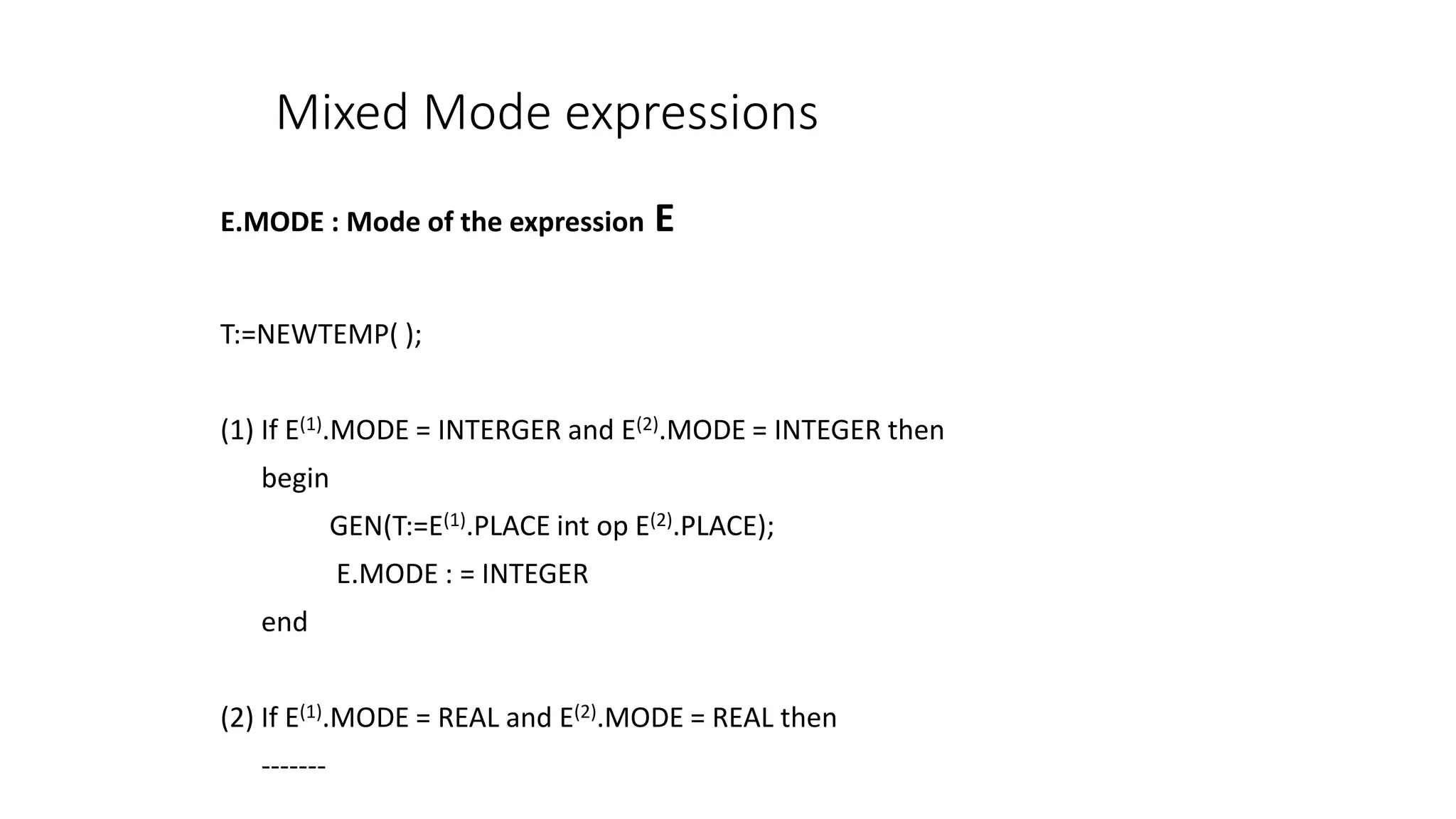
Mixed Mode expressions
E.MODE : Mode of the expression E
T:=NEWTEMP( );
(1) If E(1).MODE = INTERGER and E(2).MODE = INTEGER then
begin
GEN(T:=E(1).PLACE int op E(2).PLACE);
E.MODE : = INTEGER
end
(2) If E(1).MODE = REAL and E(2).MODE = REAL then
-------
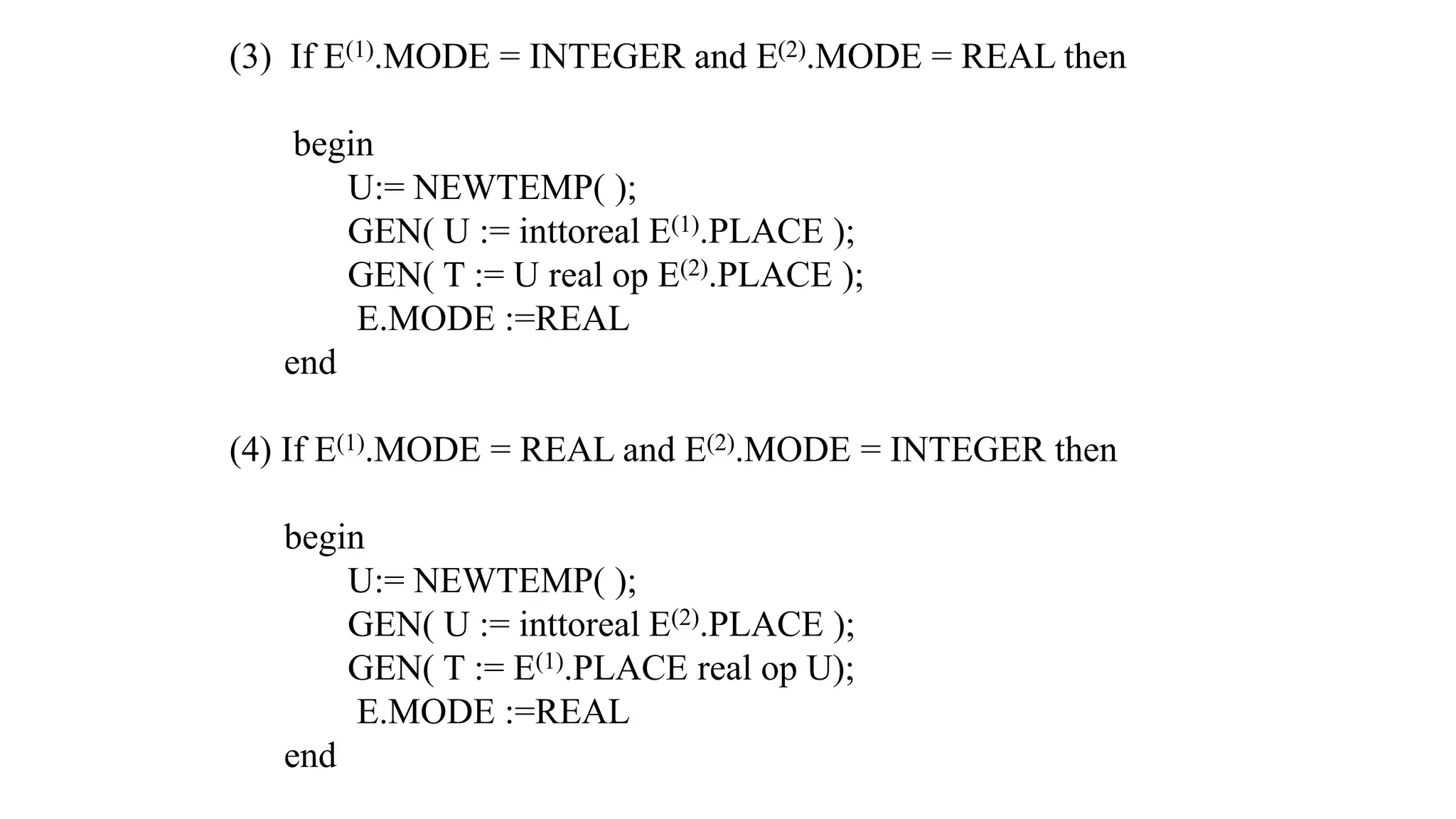
(3) If E(1).MODE = INTEGER and E(2).MODE = REAL then
begin
U:= NEWTEMP( );
GEN( U := inttoreal E(1).PLACE );
GEN( T := U real op E(2).PLACE );
E.MODE :=REAL
end
(4) If E(1).MODE = REAL and E(2).MODE = INTEGER then
begin
U:= NEWTEMP( );
GEN( U := inttoreal E(2).PLACE );
GEN( T := E(1).PLACE real op U);
E.MODE :=REAL
end
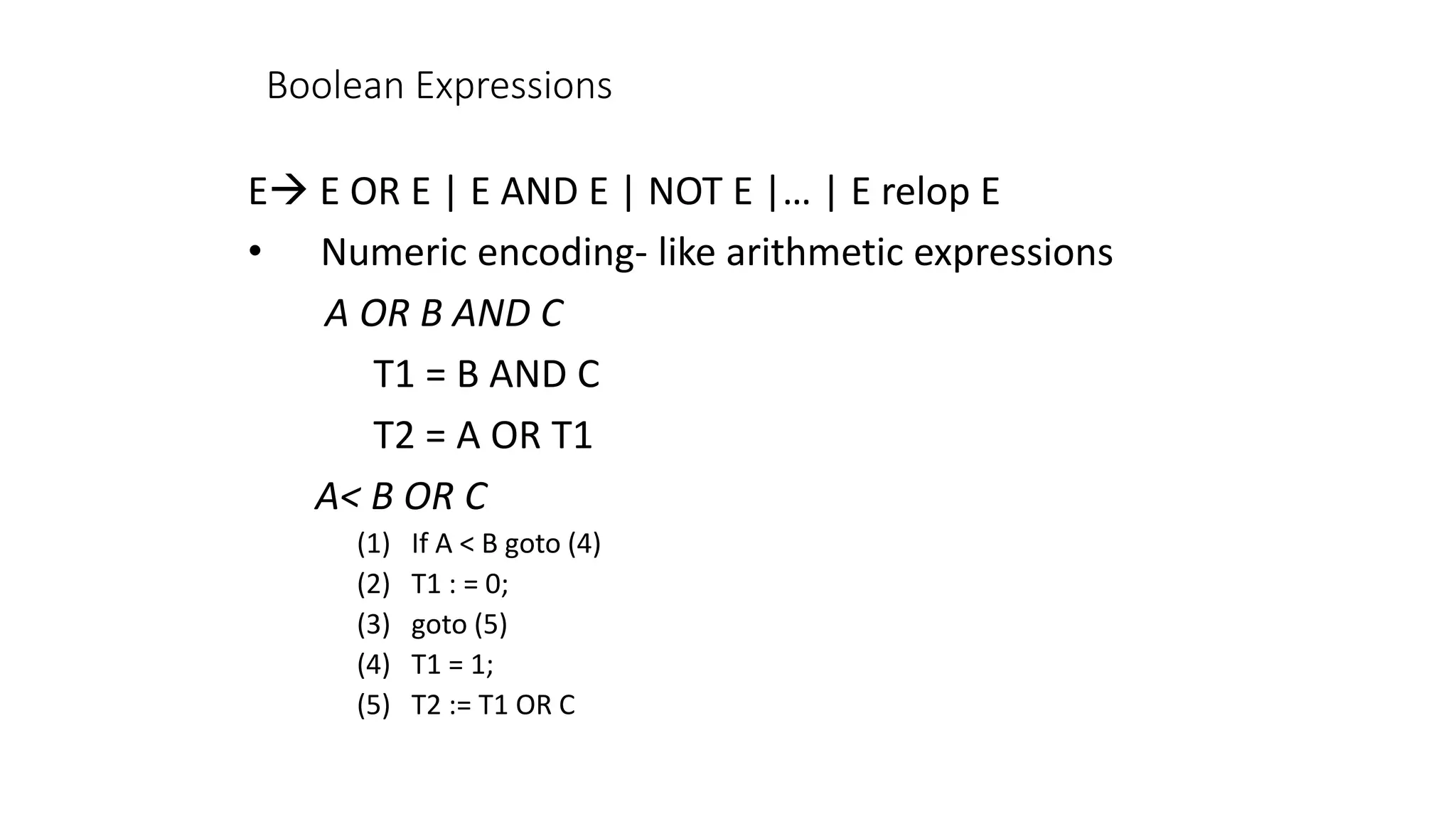
Boolean Expressions
E→ E OR E | E AND E | NOT E |… | E relop E
• Numeric encoding- like arithmetic expressions
A OR B AND C
T1 = B AND C
T2 = A OR T1
A< B OR C
(1) If A < B goto (4)
(2) T1 : = 0;
(3) goto (5)
(4) T1 = 1;
(5) T2 := T1 OR C
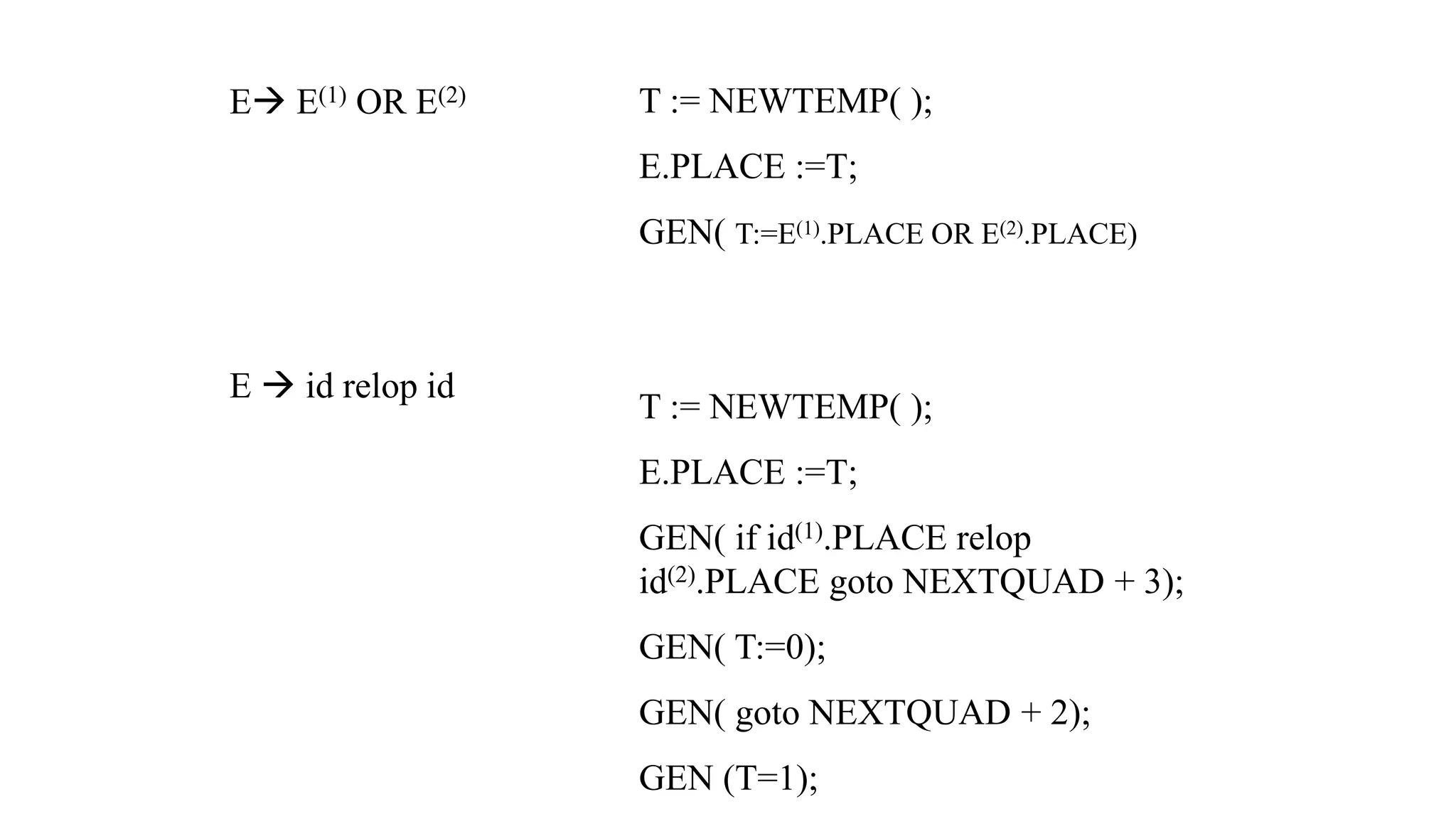
E→ E(1) OR E(2)
E → id relop id
T := NEWTEMP( );
E.PLACE :=T;
GEN( T:=E(1).PLACE OR E(2).PLACE)
T := NEWTEMP( );
E.PLACE :=T;
GEN( if id(1).PLACE relop
id(2).PLACE goto NEXTQUAD + 3);
GEN( T:=0);
GEN( goto NEXTQUAD + 2);
GEN (T=1);
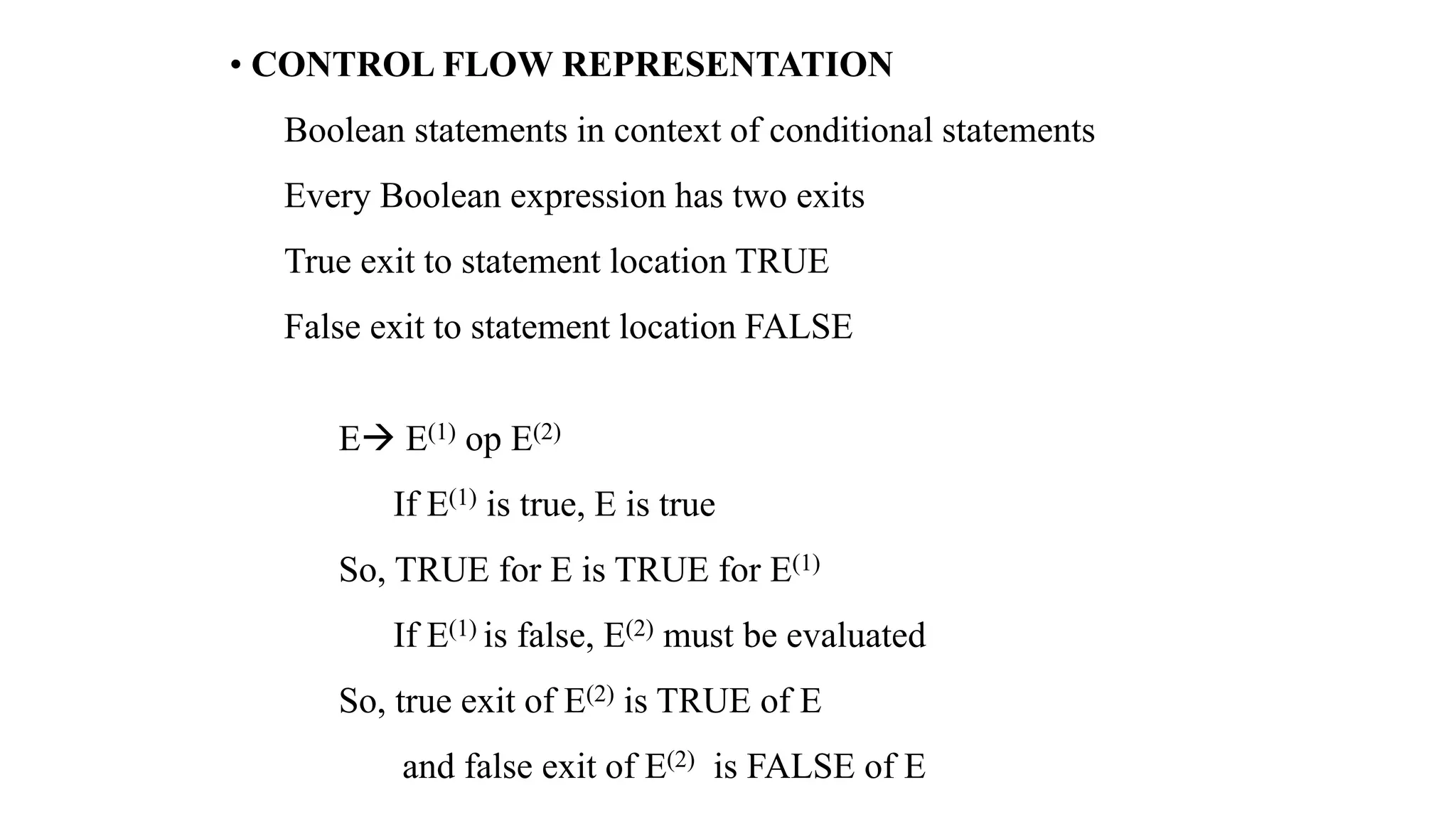
• CONTROL FLOW REPRESENTATION
Boolean statements in context of conditional statements
Every Boolean expression has two exits
True exit to statement location TRUE
False exit to statement location FALSE
E→ E(1) op E(2)
If E(1) is true, E is true
So, TRUE for E is TRUE for E(1)
If E(1) is false, E(2) must be evaluated
So, true exit of E(2) is TRUE of E
and false exit of E(2) is FALSE of E
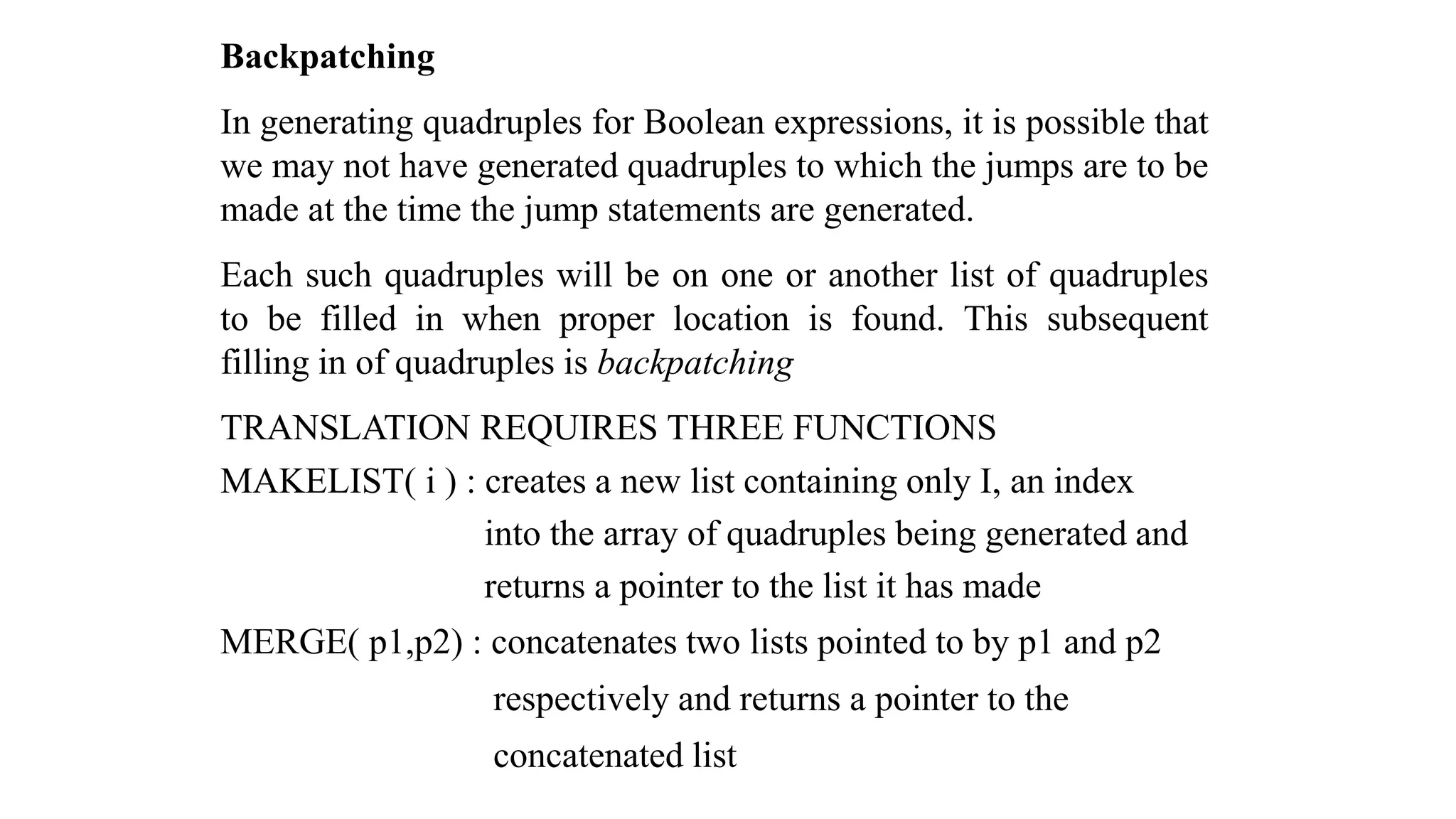
Backpatching
In generating quadruples for Boolean expressions, it is possible that
we may not have generated quadruples to which the jumps are to be
made at the time the jump statements are generated.
Each such quadruples will be on one or another list of quadruples
to be filled in when proper location is found. This subsequent
filling in of quadruples is backpatching
TRANSLATION REQUIRES THREE FUNCTIONS
MAKELIST( i ) : creates a new list containing only I, an index
into the array of quadruples being generated and
returns a pointer to the list it has made
MERGE( p1,p2) : concatenates two lists pointed to by p1 and p2
respectively and returns a pointer to the
concatenated list
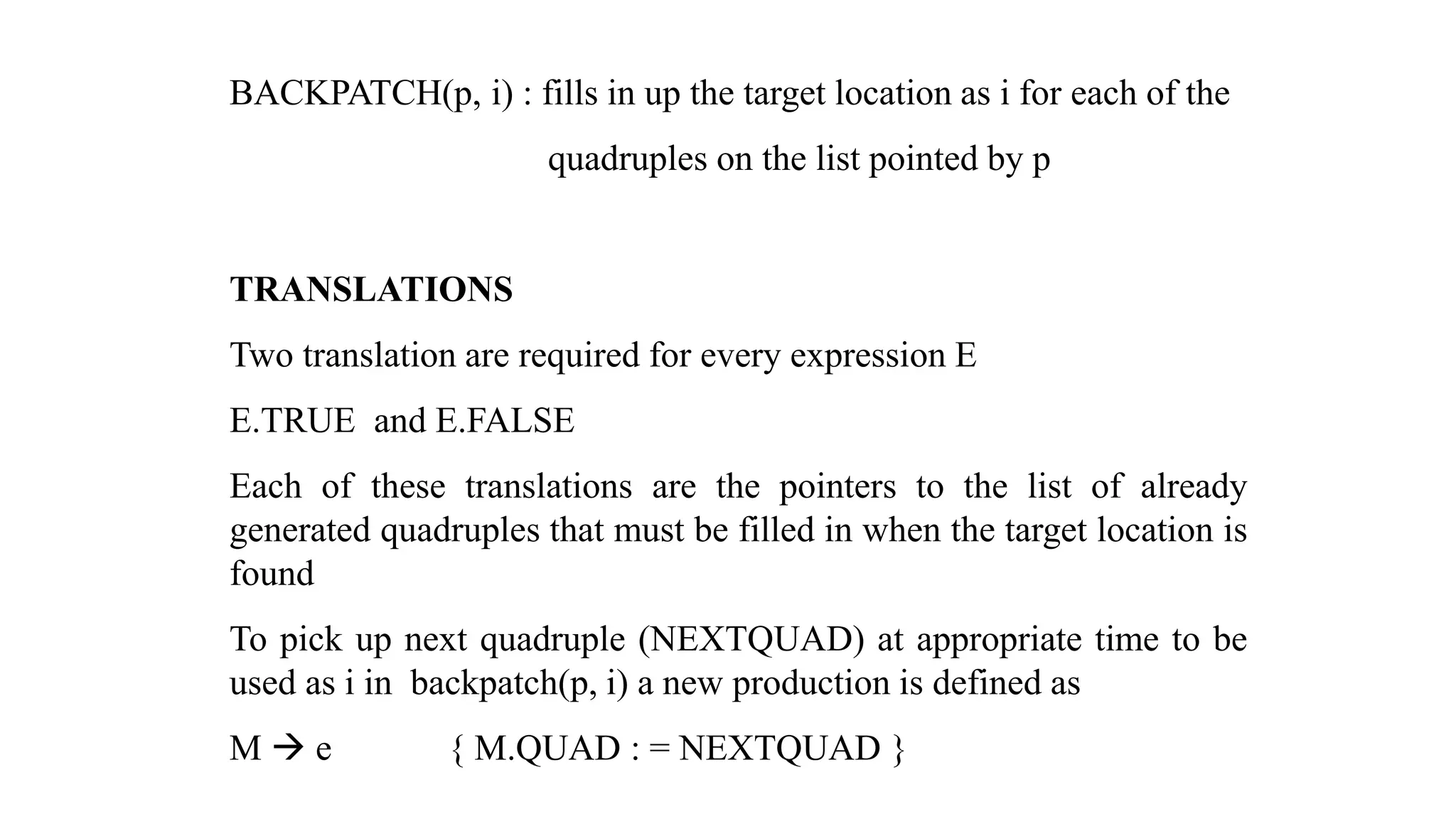
BACKPATCH(p, i) : fills in up the target location as i for each of the
quadruples on the list pointed by p
TRANSLATIONS
Two translation are required for every expression E
E.TRUE and E.FALSE
Each of these translations are the pointers to the list of already
generated quadruples that must be filled in when the target location is
found
To pick up next quadruple (NEXTQUAD) at appropriate time to be
used as i in backpatch(p, i) a new production is defined as
M → e { M.QUAD : = NEXTQUAD }
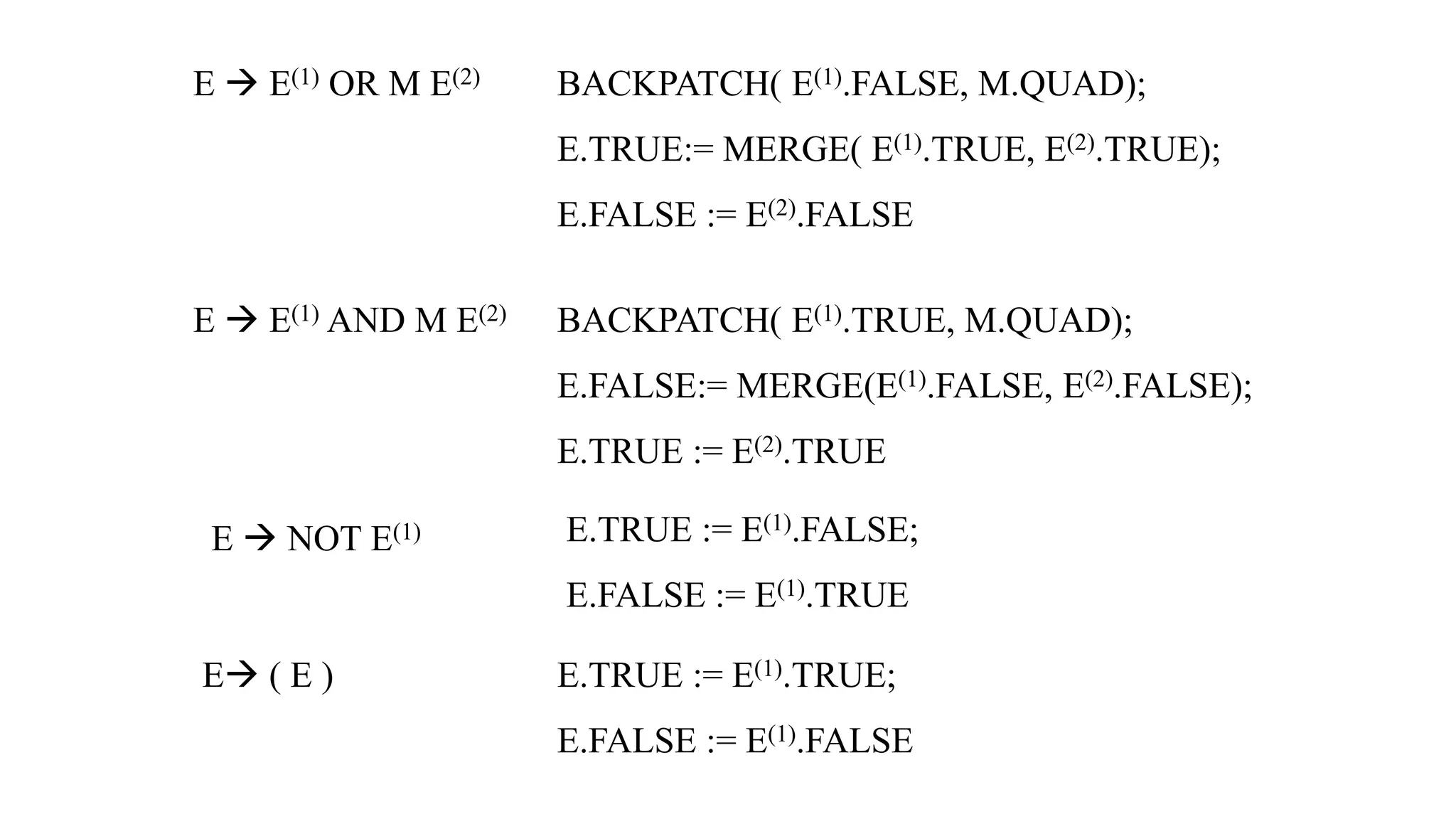
E → E(1) OR M E(2) BACKPATCH( E(1).FALSE, M.QUAD);
E.TRUE:= MERGE( E(1).TRUE, E(2).TRUE);
E.FALSE := E(2).FALSE
E → E(1) AND M E(2) BACKPATCH( E(1).TRUE, M.QUAD);
E.FALSE:= MERGE(E(1).FALSE, E(2).FALSE);
E.TRUE := E(2).TRUE
E → NOT E(1) E.TRUE := E(1).FALSE;
E.FALSE := E(1).TRUE
E→ ( E ) E.TRUE := E(1).TRUE;
E.FALSE := E(1).FALSE
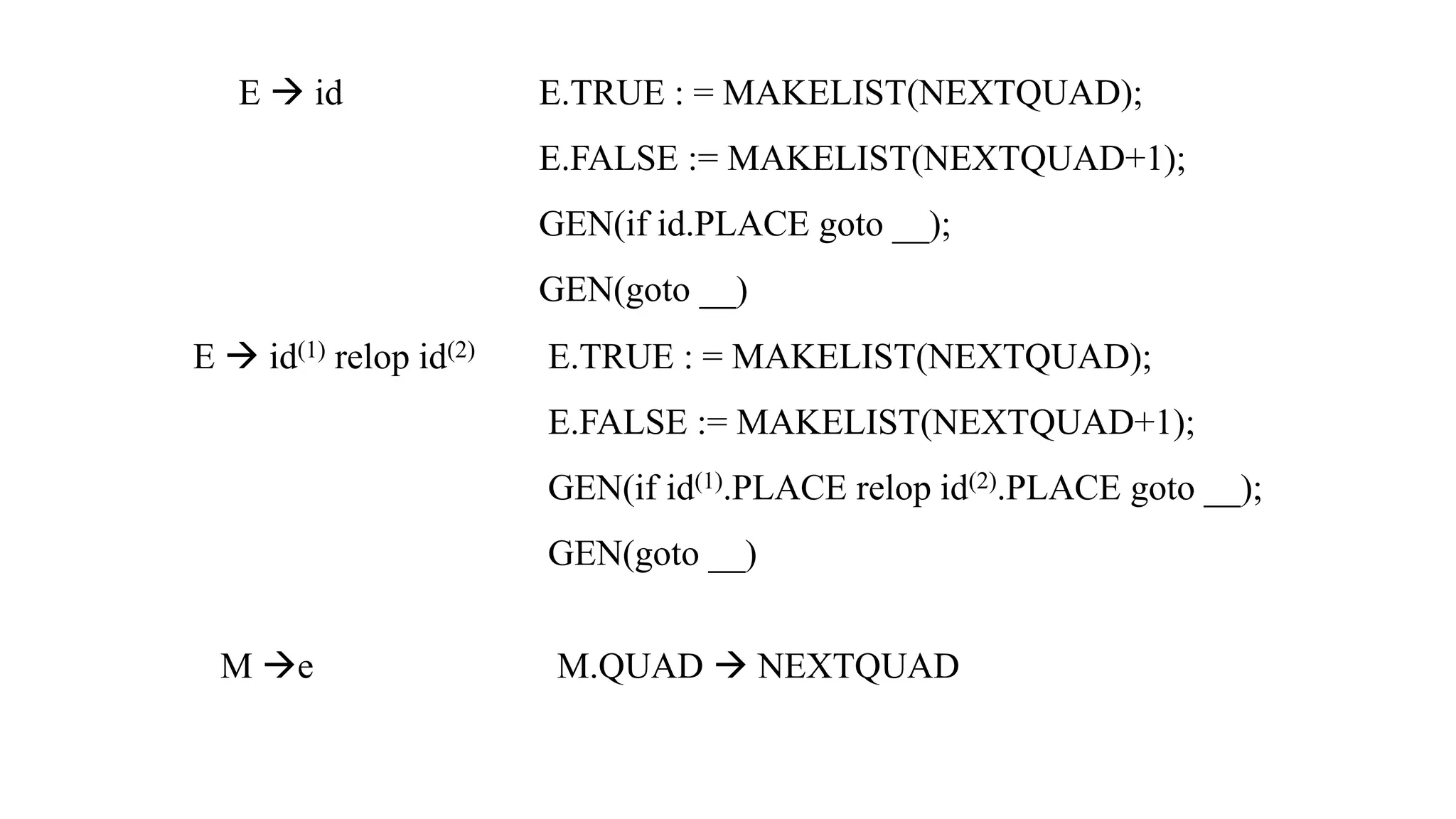
E → id E.TRUE : = MAKELIST(NEXTQUAD);
E.FALSE := MAKELIST(NEXTQUAD+1);
GEN(if id.PLACE goto __);
GEN(goto __)
E → id(1) relop id(2) E.TRUE : = MAKELIST(NEXTQUAD);
E.FALSE := MAKELIST(NEXTQUAD+1);
GEN(if id(1).PLACE relop id(2).PLACE goto __);
GEN(goto __)
M →e M.QUAD → NEXTQUAD
TRANSLATION OF ARRAY REFERENCES
Grammar for array references
A → L := E L is l-value of array
E → E + E | ( E ) | L
L → elist ]
L → id
elist → elist, E
elist → id[E
Generating three address code for array references
For a two dimensional array A[10*20]
and for a word organized memory
The array A will need 200 words (row major order)
if a be the location of the first word of the block, A[i,j] will be
computed as
a + 20(i-1) + j-1
ie, (a-21) + 20*i + j
computed in index register
Offset computed in base register
T1 := i
T2 := 20*T1
T3 := j
T4 : =T2 + T3
T5 := a-21
T := T5[T4]
Translations needed
elist.ARRAY : denotes the symbol table entry for the ARRAY name
elist.NDIM : records the no. of dimensions(i.e. index expression E) in the elist
elist.PLACE : denotes symbol table entry for a name whose value is computed by
the three address code generated for elist
LIMIT( ARRAY,i) : returns the upper limit along the ith dimension
L.PLACE : Pointer to symbol table location for name in case L is not array
L.OFFSET : null in case L is not an array
A → L := E
{ If(L.OFFSET =null) then
GEN( L.PLACE := E.PLACE);
else
GEN( L.PLACE[L.OFFSET] := E.PLACE) }
E → L
{ if (L.OFFSET = null) then
E.PLACE = L.PLACE
else begin
T := NEWTEMP( );
GEN( T := L.PLACE[L.OFFSET]);
E.PLACE := T
end }
L → elist ]
{ T := NEWTEMP( );
U := NEWTEMP( );
GEN( T := elist.ARRAY –C); C is a constant
GEN( U := bpw * elist.PLACE);
L.PLACE := T;
L.OFFSET := U; }
L → id
{ L.PLACE := id.PLACE
L.OFFSET := null }
elist → elist(1), E
{ T := NEWTEMP( );
GEN( T := elist.PLACE * LIMIT(elist(1).ARRAY, elist.NDIM+1);
GEN( T := T + E.PLACE);
elist.ARRAY := elist(1).ARRAY;
elist.PLACE := T;
elist.NDIM := elist(1).NDIM + 1 }
elist → id[E
elist.PLACE := E.PLACE;
elist.NDIM := 1;
elist.ARRAY := id.PLACE

Presentation1.pdf

  • 1.
    INTERMEDIATE CODES Syntax directedtranslations • An extension to CFG • Generates some form of intermediate codes With each production some action is associated so when ever a reduction takes place, the action associated with it is executed These actions perform some semantics as well- hence also called semantic action or semantic rule For the production E→ E + E the syntax directed translation ( semantic action) would be E.VAL = E(1).VAL+ E(2).VAL
  • 2.
    S → E$ E → E + E E → E * E E → (E) E → I I → I * digit I → digit Print E.VAL E.VAL = E(1).VAL+ E(2).VAL E.VAL = E(1).VAL* E(2).VAL E.VAL = E(1).VAL E.VAL = I.VAL I.VAL = 10 * I(1).VAL +Lexval I.VAL = Lexval
  • 3.
    FORMS OF INTERMEDIATECODES 1. Polish notation E → E OP E, E.CODE := E(1).CODE || E(2).CODE || OP E→ ( E ), E.CODE := E(1).CODE E→ id, E.code := id
  • 4.
    2. THREE ADDRESSCODES A source statement is represented as a sequence of elementary operations. Each elementary operation is described in the form of a pseudo machine instruction Triples – uses three fields Quadruples- uses four fields Operator Operand1 Operand2
  • 5.
    EXPRESSION TRANSLATION Requires twofields (for the expression E) E.PLACE : Name that will hold the value of the expression E.CODE : A sequence of three address statements evaluating the expression And a function NEWTEMP( ) to create new temporary names A→ id := E E→ E(1) + E(2) A.CODE := E.CODE || Id.PLACE|| :=|| E.PLACE T := NEWTEMP( ); E.PLACE := T; E.CODE := E(1).CODE|| E(2).CODE|| E.PLACE||:=|| E(1).PLACE || + || E(2).PLACE
  • 6.
    E→ E(1) *E(2) E→ - E(1) E→ (E(1)) E→ id T := NEWTEMP( ); E.PLACE := T; E.CODE := E(1).CODE|| E(2).CODE|| E.PLACE||:=|| E(1).PLACE || * || E(2).PLACE T := NEWTEMP( ); E.PLACE := T; E.CODE := E(1).CODE|| E.PLACE||:= - || E(1).PLACE E.PLACE:= | E(1).PLACE; E.CODE := E(1).CODE E.PLACE := id.PLACE; E.CODE := null
  • 7.
    Mixed Mode expressions E.MODE: Mode of the expression E T:=NEWTEMP( ); (1) If E(1).MODE = INTERGER and E(2).MODE = INTEGER then begin GEN(T:=E(1).PLACE int op E(2).PLACE); E.MODE : = INTEGER end (2) If E(1).MODE = REAL and E(2).MODE = REAL then -------
  • 8.
    (3) If E(1).MODE= INTEGER and E(2).MODE = REAL then begin U:= NEWTEMP( ); GEN( U := inttoreal E(1).PLACE ); GEN( T := U real op E(2).PLACE ); E.MODE :=REAL end (4) If E(1).MODE = REAL and E(2).MODE = INTEGER then begin U:= NEWTEMP( ); GEN( U := inttoreal E(2).PLACE ); GEN( T := E(1).PLACE real op U); E.MODE :=REAL end
  • 9.
    Boolean Expressions E→ EOR E | E AND E | NOT E |… | E relop E • Numeric encoding- like arithmetic expressions A OR B AND C T1 = B AND C T2 = A OR T1 A< B OR C (1) If A < B goto (4) (2) T1 : = 0; (3) goto (5) (4) T1 = 1; (5) T2 := T1 OR C
  • 10.
    E→ E(1) ORE(2) E → id relop id T := NEWTEMP( ); E.PLACE :=T; GEN( T:=E(1).PLACE OR E(2).PLACE) T := NEWTEMP( ); E.PLACE :=T; GEN( if id(1).PLACE relop id(2).PLACE goto NEXTQUAD + 3); GEN( T:=0); GEN( goto NEXTQUAD + 2); GEN (T=1);
  • 11.
    • CONTROL FLOWREPRESENTATION Boolean statements in context of conditional statements Every Boolean expression has two exits True exit to statement location TRUE False exit to statement location FALSE E→ E(1) op E(2) If E(1) is true, E is true So, TRUE for E is TRUE for E(1) If E(1) is false, E(2) must be evaluated So, true exit of E(2) is TRUE of E and false exit of E(2) is FALSE of E
  • 12.
    Backpatching In generating quadruplesfor Boolean expressions, it is possible that we may not have generated quadruples to which the jumps are to be made at the time the jump statements are generated. Each such quadruples will be on one or another list of quadruples to be filled in when proper location is found. This subsequent filling in of quadruples is backpatching TRANSLATION REQUIRES THREE FUNCTIONS MAKELIST( i ) : creates a new list containing only I, an index into the array of quadruples being generated and returns a pointer to the list it has made MERGE( p1,p2) : concatenates two lists pointed to by p1 and p2 respectively and returns a pointer to the concatenated list
  • 13.
    BACKPATCH(p, i) :fills in up the target location as i for each of the quadruples on the list pointed by p TRANSLATIONS Two translation are required for every expression E E.TRUE and E.FALSE Each of these translations are the pointers to the list of already generated quadruples that must be filled in when the target location is found To pick up next quadruple (NEXTQUAD) at appropriate time to be used as i in backpatch(p, i) a new production is defined as M → e { M.QUAD : = NEXTQUAD }
  • 14.
    E → E(1)OR M E(2) BACKPATCH( E(1).FALSE, M.QUAD); E.TRUE:= MERGE( E(1).TRUE, E(2).TRUE); E.FALSE := E(2).FALSE E → E(1) AND M E(2) BACKPATCH( E(1).TRUE, M.QUAD); E.FALSE:= MERGE(E(1).FALSE, E(2).FALSE); E.TRUE := E(2).TRUE E → NOT E(1) E.TRUE := E(1).FALSE; E.FALSE := E(1).TRUE E→ ( E ) E.TRUE := E(1).TRUE; E.FALSE := E(1).FALSE
  • 15.
    E → idE.TRUE : = MAKELIST(NEXTQUAD); E.FALSE := MAKELIST(NEXTQUAD+1); GEN(if id.PLACE goto __); GEN(goto __) E → id(1) relop id(2) E.TRUE : = MAKELIST(NEXTQUAD); E.FALSE := MAKELIST(NEXTQUAD+1); GEN(if id(1).PLACE relop id(2).PLACE goto __); GEN(goto __) M →e M.QUAD → NEXTQUAD
  • 16.
    TRANSLATION OF ARRAYREFERENCES Grammar for array references A → L := E L is l-value of array E → E + E | ( E ) | L L → elist ] L → id elist → elist, E elist → id[E
  • 17.
    Generating three addresscode for array references For a two dimensional array A[10*20] and for a word organized memory The array A will need 200 words (row major order) if a be the location of the first word of the block, A[i,j] will be computed as a + 20(i-1) + j-1 ie, (a-21) + 20*i + j computed in index register Offset computed in base register
  • 18.
    T1 := i T2:= 20*T1 T3 := j T4 : =T2 + T3 T5 := a-21 T := T5[T4] Translations needed elist.ARRAY : denotes the symbol table entry for the ARRAY name elist.NDIM : records the no. of dimensions(i.e. index expression E) in the elist elist.PLACE : denotes symbol table entry for a name whose value is computed by the three address code generated for elist LIMIT( ARRAY,i) : returns the upper limit along the ith dimension L.PLACE : Pointer to symbol table location for name in case L is not array L.OFFSET : null in case L is not an array
  • 19.
    A → L:= E { If(L.OFFSET =null) then GEN( L.PLACE := E.PLACE); else GEN( L.PLACE[L.OFFSET] := E.PLACE) } E → L { if (L.OFFSET = null) then E.PLACE = L.PLACE else begin T := NEWTEMP( ); GEN( T := L.PLACE[L.OFFSET]); E.PLACE := T end }
  • 20.
    L → elist] { T := NEWTEMP( ); U := NEWTEMP( ); GEN( T := elist.ARRAY –C); C is a constant GEN( U := bpw * elist.PLACE); L.PLACE := T; L.OFFSET := U; } L → id { L.PLACE := id.PLACE L.OFFSET := null }
  • 21.
    elist → elist(1),E { T := NEWTEMP( ); GEN( T := elist.PLACE * LIMIT(elist(1).ARRAY, elist.NDIM+1); GEN( T := T + E.PLACE); elist.ARRAY := elist(1).ARRAY; elist.PLACE := T; elist.NDIM := elist(1).NDIM + 1 } elist → id[E elist.PLACE := E.PLACE; elist.NDIM := 1; elist.ARRAY := id.PLACE