Structural
and
Transformational
Grammars
Structural Grammar
(means of analyzing written and spoken language)
• Sentence structure
- was represented in terms of immediate
constituent analysis
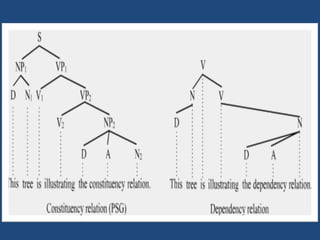
- the constituency relation derives from the
subject-predicate division of Latin and Greek
grammars that is based on term logic. Basic
clause structure is understood in terms of a
binary division of the clause into subject (noun
phrase NP) and predicate (verb phrase VP).
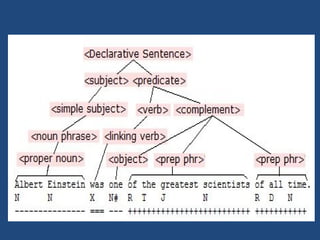
• the binary cutting of sentences and their
phrasal constituents into ICs (Immediate
constituent), the first and the most important
cut being between the group of the Subject
and the group of the Predicate – was implicit
in the “parsing” and analysis of traditional
grammar
• However,
in N. Chomsky’s estimation, also modern structural
linguistics, provides little insight into the
processes of formation and interpretation of
sentences; therefore, there has been renewed
interest in the formalization and use of techniques
and devices.
The method developed by N. Chomsky has now
become widely known as
TRANSFORMATIONAL GENERATIVE GRAMMAR.
• Transformational Grammar
- is an approach to the use of grammar in
communications that involves a logical and
analytical process to fully grasp the meaning
behind the words selected.
- From this perspective, it goes beyond the process
of structural grammar, which tends to focus on
the proper construction of sentences as the
device for communication. Along with sentence
structure, this type of grammar will also attempt
to explore the thought behind the words.
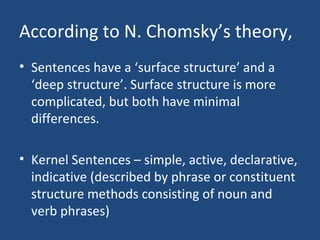
According to N. Chomsky’s theory,
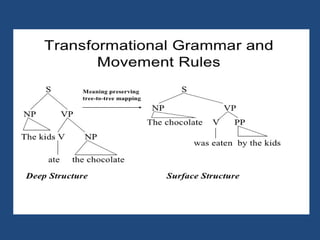
• Sentences have a ‘surface structure’ and a
‘deep structure’. Surface structure is more
complicated, but both have minimal
differences.
• Kernel Sentences – simple, active, declarative,
indicative (described by phrase or constituent
structure methods consisting of noun and
verb phrases)
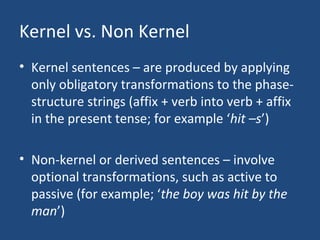
Kernel vs. Non Kernel
• Kernel sentences – are produced by applying
only obligatory transformations to the phase-
structure strings (affix + verb into verb + affix
in the present tense; for example ‘hit –s’)
• Non-kernel or derived sentences – involve
optional transformations, such as active to
passive (for example; ‘the boy was hit by the
man’)
But later,
• Interpretations of the transformational theory
have made less use of the previous
distinction. These operations consist in
rearrangement, addition, deletion and
combination of linguistic elements.
Structural & Transformational Grammars

Structural & Transformational Grammars

  • 1.
  • 2.
    Structural Grammar (means ofanalyzing written and spoken language) • Sentence structure - was represented in terms of immediate constituent analysis - the constituency relation derives from the subject-predicate division of Latin and Greek grammars that is based on term logic. Basic clause structure is understood in terms of a binary division of the clause into subject (noun phrase NP) and predicate (verb phrase VP).
  • 4.
    • the binarycutting of sentences and their phrasal constituents into ICs (Immediate constituent), the first and the most important cut being between the group of the Subject and the group of the Predicate – was implicit in the “parsing” and analysis of traditional grammar
  • 6.
    • However, in N.Chomsky’s estimation, also modern structural linguistics, provides little insight into the processes of formation and interpretation of sentences; therefore, there has been renewed interest in the formalization and use of techniques and devices. The method developed by N. Chomsky has now become widely known as TRANSFORMATIONAL GENERATIVE GRAMMAR.
  • 7.
    • Transformational Grammar -is an approach to the use of grammar in communications that involves a logical and analytical process to fully grasp the meaning behind the words selected. - From this perspective, it goes beyond the process of structural grammar, which tends to focus on the proper construction of sentences as the device for communication. Along with sentence structure, this type of grammar will also attempt to explore the thought behind the words.
  • 8.
    According to N.Chomsky’s theory, • Sentences have a ‘surface structure’ and a ‘deep structure’. Surface structure is more complicated, but both have minimal differences. • Kernel Sentences – simple, active, declarative, indicative (described by phrase or constituent structure methods consisting of noun and verb phrases)
  • 9.
    Kernel vs. NonKernel • Kernel sentences – are produced by applying only obligatory transformations to the phase- structure strings (affix + verb into verb + affix in the present tense; for example ‘hit –s’) • Non-kernel or derived sentences – involve optional transformations, such as active to passive (for example; ‘the boy was hit by the man’)
  • 10.
    But later, • Interpretationsof the transformational theory have made less use of the previous distinction. These operations consist in rearrangement, addition, deletion and combination of linguistic elements.