International Journal of Trend in Scientific Research and Development, Volume 1(4), ISSN: 2456-6470
www.ijtsrd.com
68
IJTSRD | May-Jun 2017
Available Online @www.ijtsrd.com
Symmetric Key Generation Algorithm in Linear Block Cipher Over
LU Decomposition Method
P.Sundarayya
Department of Mathematics,
GITAM University, Visakhapatnam,
Andhra Pradesh, India
M.G.Vara Prasad
Department of Mathematics,
NSRIT, Visakhapatnam,
Andhra Pradesh, India
ABSTRACT
In symmetric key algorithm in linear block cipher to
encrypt and decrypt the messages using matrix and
inverse matrix. In this proposed technique generate
lower and upper triangular matrices from square
matrix using decomposition. In encryption process,
the key is lower triangular matrix and decryption
process, the key is upper triangular matrix under
modulation of prime number. We illustrate the
proposed technique with help of examples.
Keywords: liner block cipher, symmetric matrix key,
encryption, and decryption, lower and upper
triangular decomposition
1. INTRODUCTION
Cryptography is the science of making messages in
secret code and having lived art. Cipher is
mathematical function which is used in encryption
and decryption process. Cryptography systems can be
divided into two cryptosystems.
 Symmetric
 Asymmetric.
Symmetric key cryptography is classical cryptography
is divided into four parts.
 The encryption algorithm
 The encryption key
 The decryption algorithm
 The decryption key
Symmetric cryptosystems use the secret keyto encrypt
and decrypt message, and asymmetric cryptosystems
use the public key to encrypt a message and the
private key to decrypt it .Symmetric encryption is
described to as conventional encryption or single key
encryption. Conventional encryption can be divided
into two categories.
 Classical techniques
 Modern techniques
The hallmark of Symmetric key encryption is that the
cipher or key to the algorithm is shared. Linear block
Cipher is one of the basic components of classical
ciphers. A Liner block cipher is a method of
encryption by which units of plaintext are substituted
with cipher text according to a regular system; the
units maybe pairs
of letters, triplets of letters, poly of letters and
mixtures of the above. The receiver deciphers the text
by performing an inverse function [2]. Hill cipher is a
block cipher that has several advantages such as
disguising
letter frequencies of the plaintext, its simplicity
because of using matrix multiplication for enciphering
and deciphering, its high speed, and high throughput
[4].In this proposed work, Instead of matrix and
inverse matrix, idea of generate the symmetric key
generation can be decomposed matrix into lower and
upper triangular matrices. In encryption process using
lower triangular matrix and decryption process the
cipher text convert into plain text using upper
triangular matrix under modulation of prime number.
In this proposed technique overcome of known plain
text attack when the order of the key matrix known.
International Journal of Trend in Scientific Research and Development, Volume 1(4), ISSN: 2456-6470
www.ijtsrd.com
69
IJTSRD | May-Jun 2017
Available Online @www.ijtsrd.com
2. The Hill cipher
The Hill cipher algorithm takes m successive plaintext
letters and substitute’s m cipher text letters for them.
The substitution is determined by m where m is a
positive integer, the idea is to take m linear
combinationsof the m alphabetic characters in one
plaintext elementand produce m alphabetic characters
in onecipher text element. Then, an m×mmatrix K is
used asa key of the system such that K is invertible
modulo n (Peterson, 2000; Lerma, 2005) andg.c.d((det
K)mod n, n)=1. Let kijbe the entryof K. For the
plaintext block R=(x1, x2,..,xm) (thenumerical
equivalents of m letters) and a key matrix K,the
corresponding cipher text block S=(y1, y2, …, ym)
Encryption: The cipher text is obtained from the
plaintext by means of a linear transformation.
S=
⋯
⋯
… … ⋯ ⋯
⋯
(mod n)
Decryption: The reverse process, deciphering, is
computed by
R=
⋯
⋯
… … ⋯ ⋯
⋯
( mod n)
There might be some complications with the
procedure outlined above due to the fact that not all
the matrices K have an inverse K−1
over Zn. In fact,
those matrices K with determinant 0, or with a
determinant that has common factors with the
modulus n, will be singular over Zn, and therefore
they will not be eligible as key matrices in the Hill
cipher scheme (Overbeyet al., 2005)[1]. Furthermore,
due to its linear nature, the basic Hill cipher succumbs
to known-plaintext attacks. Indeed, it is easy to show
that an opponent able to obtain mplaintext/cipher text
character pairs has a high probability of completely
breaking the system, i.e., he/she can obtain the matrix
K by solving the linear system of equations.
3. Cryptanalysis of known plain-text attack when
m is known of Hillcipher
Despite Hill cipher being difficult to break with a
cipher text-only attack, it succumbs to a known
plaintext attack assuming that the opponent has
determined the value of the m being used. Let mbe
distinct plaintext-cipher text pairs, say, xj=(x1j, x2j,
…,xmj) and yj=(y1j, y2j, …, ymj), 1≤j≤m, such that
yj=ek(xj),Define two m× m matrices R=(xij) and
S=(yij).Whenever K is invertible in the encryption
equation S=RK, the opponent can compute the
unknown key of ciphering as K=R−1
S and thereby
break the cipher (Barr, 2002). If R is not invertible,
then it will be necessary to try other sets of m
plaintext-cipher text pairs. When m is unknown,
assuming that m is not too large, the opponent could
simply try m=2, 3, …, until the key is found. If the
guessed value of m was incorrect, the obtained key
matrix would be not agree with further plaintext-
cipher text pairs (Stinson,2002).[1]
4. The Proposed Technique
The proposed technique takes m successive plaintext
letters and substitute’s m cipher text letters for them.
The substitution is determined by m where m is a
positive integer, the idea is to take m linear
combinationsof the m alphabetic characters in one
plaintext elementand produce m× constant matrix
B. In this proposed technique has generation of key
matrices using LU Decomposition method, i.e A=LU
and g.c.d((det A)mod q, q)=1 . Now constant matrix
B=AP ⟹ = . In encryption process LC=B⟹
C=L-1
B and decryption process UP=C⟹ P=U-1
B
where P is plain text and C is cipher text.
International Journal of Trend in Scientific Research and Development, Volume 1(4), ISSN: 2456-6470
www.ijtsrd.com
70
IJTSRD | May-Jun 2017
Available Online @www.ijtsrd.com
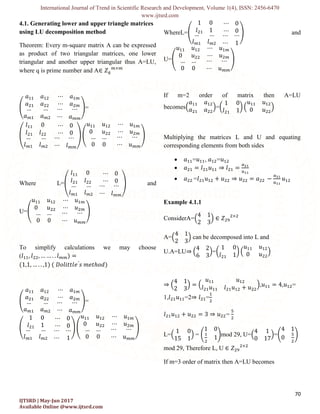
4.1. Generating lower and upper triangle matrices
using LU decomposition method
Theorem: Every m-square matrix A can be expressed
as product of two triangular matrices, one lower
triangular and another upper triangular thus A=LU,
where q is prime number and A∈ ×
⋯
⋯
… … ⋯ ⋯
⋯
=
0 ⋯ 0
⋯ 0
… … ⋯ ⋯
⋯
0
⋯
⋯
… …
0 0
⋯ ⋯
⋯
Where L=
0 ⋯ 0
⋯ 0
… … ⋯ ⋯
⋯
and
U=
0
⋯
⋯
… …
0 0
⋯ ⋯
⋯
To simplify calculations we may choose
( , , … … . . ) =
(1,1, … . . ,1) ( ′
ℎ )
⋯
⋯
… … ⋯ ⋯
⋯
=
1 0
1
⋯ 0
⋯ 0
… … ⋯ ⋯
⋯ 1
0
⋯
⋯
… …
0 0
⋯ ⋯
⋯
WhereL=
1 0
1
⋯ 0
⋯ 0
… … ⋯ ⋯
⋯ 1
and
U=
0
⋯
⋯
… …
0 0
⋯ ⋯
⋯
If m=2 order of matrix then A=LU
becomes =
1 0
1 0
Multiplying the matrices L and U and equating
corresponding elements from both sides
 = , =
 = ⇒ =
 = + ⇒ = −
Example 4.1.1
ConsiderA=
4 1
2 3
∈ ×
A=
4 1
2 3
can be decomposed into L and
U.A=LU⇒
4 2
6 3
=
1 0
1 0
⇒
4 1
2 3
= + , = 4, =
1, =2⇒ =
+ = 3 ⇒ =
L=
1 0
15 1
=
1 0
1 mod 29, U=
4 1
0 17
=
4 1
0
mod 29, Therefore L, U ∈ ×
If m=3 order of matrix then A=LU becomes
International Journal of Trend in Scientific Research and Development, Volume 1(4), ISSN: 2456-6470
www.ijtsrd.com
71
IJTSRD | May-Jun 2017
Available Online @www.ijtsrd.com
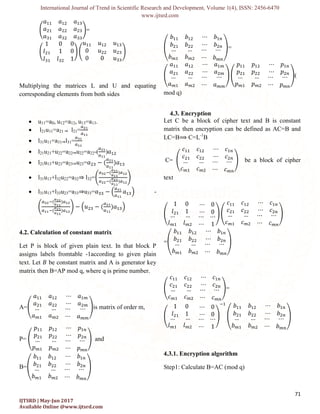
=
1 0 0
1 0
1
0
0 0
Multiplying the matrices L and U and equating
corresponding elements from both sides
 u11=all, u12=a12, u13=a13.
 l21u11=a21 ⇒ l21=
 l31u11=a31⇒l31=
 l21u21+u22=a22⇒u22=a22-( )
 l21u13+u23=a23⇒u23= − ( )
 l31u13+l32u22=a32⇒ l32=
( )
( )
 l31u13+l33u23=a33⇒u33= − -
( )
( )
− − ( )
4.2. Calculation of constant matrix
Let P is block of given plain text. In that block P
assigns labels fromtable -1according to given plain
text. Let be constant matrix and A is generator key
matrix then B=AP mod q, where q is prime number.
A=
⋯
⋯
… … ⋯ ⋯
⋯
is matrix of order m,
P=
⋯
⋯
… … ⋯ ⋯
⋯
and
B=
⋯
⋯
… … ⋯ ⋯
⋯
⋯
⋯
… … ⋯ ⋯
⋯
=
⋯
⋯
… … ⋯ ⋯
⋯
⋯
⋯
… … ⋯ ⋯
⋯
(
mod q)
4.3. Encryption
Let C be a block of cipher text and B is constant
matrix then encryption can be defined as AC=B and
LC=B⟹ C=L-1
B
C=
⋯
⋯
… … ⋯ ⋯
⋯
be a block of cipher
text
1 0
1
⋯ 0
⋯ 0
… … ⋯ ⋯
⋯ 1
⋯
⋯
… … ⋯ ⋯
⋯
=
⋯
⋯
… … ⋯ ⋯
⋯
⋯
⋯
… … ⋯ ⋯
⋯
=
1 0
1
⋯ 0
⋯ 0
… … ⋯ ⋯
⋯ 1
⋯
⋯
… … ⋯ ⋯
⋯
4.3.1. Encryption algorithm
Step1: Calculate B=AC (mod q)
International Journal of Trend in Scientific Research and Development, Volume 1(4), ISSN: 2456-6470
www.ijtsrd.com
72
IJTSRD | May-Jun 2017
Available Online @www.ijtsrd.com
Step2: Select Key L as square matrix order m from
A=LU.
Step3: Calculate C=L-1
B
Step4:Calculate C= C (mod q)
4.4. Decryption
Let P be a block of plain text and C be a block of
cipher text thenUP=C⟹ P=U-1
C
0
⋯
⋯
… …
0 0
⋯ ⋯
⋯
⋯
⋯
… … ⋯ ⋯
⋯
=
⋯
⋯
… … ⋯ ⋯
⋯
⋯
⋯
… … ⋯ ⋯
⋯
=
0
⋯
⋯
… …
0 0
⋯ ⋯
⋯
⋯
⋯
… … ⋯ ⋯
⋯
4.4.1. Decryption algorithm
Step1: Select Key U as square matrix order m from
A=LU.
Step2: Calculate P= U-1
C
Step3: Calculate P= P (mod q)
5. Example of proposed technique
Consider the plain text P=’GOOGLE’, is
block of plain text.
In the 29-letter alphabet in which A-Z have numerical
equivalent 1-26,?=27,space=28
P=
6 14 11
14 6 4
is block of plain text
TakingFrom Example4.1.1
A=
4 1
2 3
can be decomposed into L and
U.A=LU⇒
4 1
2 3
=
1 0
15 1
4 1
0 17
Encryption:
B= AP mod 29
B=
4 1
2 3
6 14 11
14 6 4
(mod 29)
B=
9 4 19
25 17 5
(mod 29)
Let C= be a block of cipher text.
Encryption key L=
1 0
15 1
LC=B⟹ C=L-1
B mod 29
C=
1 0
15 1
9 4 19
25 17 5
( mod 29)
C=
9 4 19
14 15 10
=
This gives Cipher text C=’JOEPTK’
Decryption:
Decryption key U=
4 1
0 17
UP=C⟹ P=U-1
C mod 29
P=
4 1
0 17
9 4 19
14 15 10
(mod 29)
P=
6 14 11
14 6 4
Which gives Plain text =’GOOGLE’
International Journal of Trend in Scientific Research and Development, Volume 1(4), ISSN: 2456-6470
www.ijtsrd.com
73
IJTSRD | May-Jun 2017
Available Online @www.ijtsrd.com
6. Cryptanalysis of proposed technique
The block cipher can be difficult to break with a
cipher text only attack. In this section, we discuss
Cryptanalysis of known plain-text attack. We
assumed that K is key matrix is an element of ×
6.1.Algorithm for known plain-text attack when m
is known
Step1: Let P= (P1,P2,……,Pn) be a block of plain text.
Where Pi= ⋮ Let C= (C1,C2,……,Cn) be a
block of cipher text. Where
Ci= ⋮ and select randomly pairs of plaintext and
corresponding cipher text are
(Pi,Ci)for i=1,2,3…….n.
Step2: The known plaintext – cipher text pairs
gives us a system of equations of the form
[Ci- Cj]=K[Pi- Pj] for 1≤ i≠j≤m , we
get general equation C=KP
Step 3: Determine K=P-1
C mod q
6.2. Example for cryptanalysis of proposed
technique when m=2 is known
Taking from 6.Example we get plaintext blocks
P1=
6
14
, P2=
14
6
,P3=
11
4
, cipher text
blocksC1=
9
6
, C2=
4
15
,C3=
19
10
then( − − ) = K( − − )
5 −15
−9 5
=K
−8 3
−8 2
⇒K=
5 −15
−9 5
−8 3
−8 2
=
4 1
0 17
(mod 29)
Conclusion
In the proposed work the symmetric key matrix of
classical Hill cipher is to make changes in order to
make greatest security of communication text. In this
paper symmetric key generation is more secure due to
the decomposition of the matrix into lower and upper
triangle matrices to encrypt and decrypt the messages
.The Proposed Cryptosystem to get better the plaintext
attack and also to get better cipher text attack, since
the lower triangle matrix is using for encryption
process and upper triangle matrix is using for
decryption process over residue modulo prime
number
References
[1] Douglas R. Stinson,Cryptography Theory and
practice ,third edition (2006)by chapman & Hall/CRC
Taylor &Francis Group.
[2] Koblitz, N. A Course in Number Theory and
Cryptography, 2nd ed. New York: Springer-Verlag,
1994.
[3]A. Menezes, P. van Oorschot, and S. Vanstone,
Handbook of Applied Cryptography, CRC Press,
1996
[4]G.R. Blakley, Twenty years of cryptography in the
open literature, Security and Privacy 1999
Proceedings of the IEEE Symposium, 9-12 May1999
[5]J. Overbey, W. Traves, J. Wojdylo, On the key
space of the Hill cipher. Cryptologia, 29(1), 2005, 59-
72
[6]Introduction to Analytic Number Theory, fifth
edition. T. Apostol .Undergraduate Texts in
Mathematics, Springer-Verlag, New York, 1995
[7]Higher engineering mathematics khanna publishers
by Dr. B.S. Grewal 40th edition
International Journal of Trend in Scientific Research and Development, Volume 1(4), ISSN: 2456-6470
www.ijtsrd.com
74
IJTSRD | May-Jun 2017
Available Online @www.ijtsrd.com
[8]P.B. Bhattachary SK Jain S.R. Nagpaul First
course in Linear Algebra 1983
[9] W. H.; Flannery, B. P.; Teukolsky, S. A.; and
Vetterling, W. T. "LU Decomposition and Its
Applications." §2.3 in Numerical Recipes in
FORTRAN: The Art of Scientific Computing, 2nd ed.
Cambridge, England: Cambridge University Press, pp.
34-42, 1992.
[10] Bunch, James R.; Hopcroft, John (1974),
"Triangular factorization and inversion by fast matrix
multiplication", Mathematics of Computation, 28
(125): 231–236
[11]Cormen, Thomas H.; Leiserson, Charles E.;
Rivest, Ronald L.; Stein, Clifford (2001), Introduction
to Algorithms, MIT Press and McGraw-Hill,
[12]Okunev, Pavel; Johnson, Charles R. (1997),
Necessary And Sufficient Conditions For Existence of
the LU Factorization of an Arbitrary Matrix,
[13]ress, WH; Teukolsky, SA; Vetterling, WT;
Flannery, BP (2007), "Section 2.3", Numerical
Recipes: The Art of Scientific Computing (3rd ed.),
New York: Cambridge University Press, ISBN 978-0-
521-88068-8.
[14] SurajoAbubakarWadaInt. Journal of Engineering
Research and Applications Vol. 6, Issue 2, February
2016

Symmetric Key Generation Algorithm in Linear Block Cipher Over LU Decomposition Method

  • 1.
    International Journal ofTrend in Scientific Research and Development, Volume 1(4), ISSN: 2456-6470 www.ijtsrd.com 68 IJTSRD | May-Jun 2017 Available Online @www.ijtsrd.com Symmetric Key Generation Algorithm in Linear Block Cipher Over LU Decomposition Method P.Sundarayya Department of Mathematics, GITAM University, Visakhapatnam, Andhra Pradesh, India M.G.Vara Prasad Department of Mathematics, NSRIT, Visakhapatnam, Andhra Pradesh, India ABSTRACT In symmetric key algorithm in linear block cipher to encrypt and decrypt the messages using matrix and inverse matrix. In this proposed technique generate lower and upper triangular matrices from square matrix using decomposition. In encryption process, the key is lower triangular matrix and decryption process, the key is upper triangular matrix under modulation of prime number. We illustrate the proposed technique with help of examples. Keywords: liner block cipher, symmetric matrix key, encryption, and decryption, lower and upper triangular decomposition 1. INTRODUCTION Cryptography is the science of making messages in secret code and having lived art. Cipher is mathematical function which is used in encryption and decryption process. Cryptography systems can be divided into two cryptosystems.  Symmetric  Asymmetric. Symmetric key cryptography is classical cryptography is divided into four parts.  The encryption algorithm  The encryption key  The decryption algorithm  The decryption key Symmetric cryptosystems use the secret keyto encrypt and decrypt message, and asymmetric cryptosystems use the public key to encrypt a message and the private key to decrypt it .Symmetric encryption is described to as conventional encryption or single key encryption. Conventional encryption can be divided into two categories.  Classical techniques  Modern techniques The hallmark of Symmetric key encryption is that the cipher or key to the algorithm is shared. Linear block Cipher is one of the basic components of classical ciphers. A Liner block cipher is a method of encryption by which units of plaintext are substituted with cipher text according to a regular system; the units maybe pairs of letters, triplets of letters, poly of letters and mixtures of the above. The receiver deciphers the text by performing an inverse function [2]. Hill cipher is a block cipher that has several advantages such as disguising letter frequencies of the plaintext, its simplicity because of using matrix multiplication for enciphering and deciphering, its high speed, and high throughput [4].In this proposed work, Instead of matrix and inverse matrix, idea of generate the symmetric key generation can be decomposed matrix into lower and upper triangular matrices. In encryption process using lower triangular matrix and decryption process the cipher text convert into plain text using upper triangular matrix under modulation of prime number. In this proposed technique overcome of known plain text attack when the order of the key matrix known.
  • 2.
    International Journal ofTrend in Scientific Research and Development, Volume 1(4), ISSN: 2456-6470 www.ijtsrd.com 69 IJTSRD | May-Jun 2017 Available Online @www.ijtsrd.com 2. The Hill cipher The Hill cipher algorithm takes m successive plaintext letters and substitute’s m cipher text letters for them. The substitution is determined by m where m is a positive integer, the idea is to take m linear combinationsof the m alphabetic characters in one plaintext elementand produce m alphabetic characters in onecipher text element. Then, an m×mmatrix K is used asa key of the system such that K is invertible modulo n (Peterson, 2000; Lerma, 2005) andg.c.d((det K)mod n, n)=1. Let kijbe the entryof K. For the plaintext block R=(x1, x2,..,xm) (thenumerical equivalents of m letters) and a key matrix K,the corresponding cipher text block S=(y1, y2, …, ym) Encryption: The cipher text is obtained from the plaintext by means of a linear transformation. S= ⋯ ⋯ … … ⋯ ⋯ ⋯ (mod n) Decryption: The reverse process, deciphering, is computed by R= ⋯ ⋯ … … ⋯ ⋯ ⋯ ( mod n) There might be some complications with the procedure outlined above due to the fact that not all the matrices K have an inverse K−1 over Zn. In fact, those matrices K with determinant 0, or with a determinant that has common factors with the modulus n, will be singular over Zn, and therefore they will not be eligible as key matrices in the Hill cipher scheme (Overbeyet al., 2005)[1]. Furthermore, due to its linear nature, the basic Hill cipher succumbs to known-plaintext attacks. Indeed, it is easy to show that an opponent able to obtain mplaintext/cipher text character pairs has a high probability of completely breaking the system, i.e., he/she can obtain the matrix K by solving the linear system of equations. 3. Cryptanalysis of known plain-text attack when m is known of Hillcipher Despite Hill cipher being difficult to break with a cipher text-only attack, it succumbs to a known plaintext attack assuming that the opponent has determined the value of the m being used. Let mbe distinct plaintext-cipher text pairs, say, xj=(x1j, x2j, …,xmj) and yj=(y1j, y2j, …, ymj), 1≤j≤m, such that yj=ek(xj),Define two m× m matrices R=(xij) and S=(yij).Whenever K is invertible in the encryption equation S=RK, the opponent can compute the unknown key of ciphering as K=R−1 S and thereby break the cipher (Barr, 2002). If R is not invertible, then it will be necessary to try other sets of m plaintext-cipher text pairs. When m is unknown, assuming that m is not too large, the opponent could simply try m=2, 3, …, until the key is found. If the guessed value of m was incorrect, the obtained key matrix would be not agree with further plaintext- cipher text pairs (Stinson,2002).[1] 4. The Proposed Technique The proposed technique takes m successive plaintext letters and substitute’s m cipher text letters for them. The substitution is determined by m where m is a positive integer, the idea is to take m linear combinationsof the m alphabetic characters in one plaintext elementand produce m× constant matrix B. In this proposed technique has generation of key matrices using LU Decomposition method, i.e A=LU and g.c.d((det A)mod q, q)=1 . Now constant matrix B=AP ⟹ = . In encryption process LC=B⟹ C=L-1 B and decryption process UP=C⟹ P=U-1 B where P is plain text and C is cipher text.
  • 3.
    International Journal ofTrend in Scientific Research and Development, Volume 1(4), ISSN: 2456-6470 www.ijtsrd.com 70 IJTSRD | May-Jun 2017 Available Online @www.ijtsrd.com 4.1. Generating lower and upper triangle matrices using LU decomposition method Theorem: Every m-square matrix A can be expressed as product of two triangular matrices, one lower triangular and another upper triangular thus A=LU, where q is prime number and A∈ × ⋯ ⋯ … … ⋯ ⋯ ⋯ = 0 ⋯ 0 ⋯ 0 … … ⋯ ⋯ ⋯ 0 ⋯ ⋯ … … 0 0 ⋯ ⋯ ⋯ Where L= 0 ⋯ 0 ⋯ 0 … … ⋯ ⋯ ⋯ and U= 0 ⋯ ⋯ … … 0 0 ⋯ ⋯ ⋯ To simplify calculations we may choose ( , , … … . . ) = (1,1, … . . ,1) ( ′ ℎ ) ⋯ ⋯ … … ⋯ ⋯ ⋯ = 1 0 1 ⋯ 0 ⋯ 0 … … ⋯ ⋯ ⋯ 1 0 ⋯ ⋯ … … 0 0 ⋯ ⋯ ⋯ WhereL= 1 0 1 ⋯ 0 ⋯ 0 … … ⋯ ⋯ ⋯ 1 and U= 0 ⋯ ⋯ … … 0 0 ⋯ ⋯ ⋯ If m=2 order of matrix then A=LU becomes = 1 0 1 0 Multiplying the matrices L and U and equating corresponding elements from both sides  = , =  = ⇒ =  = + ⇒ = − Example 4.1.1 ConsiderA= 4 1 2 3 ∈ × A= 4 1 2 3 can be decomposed into L and U.A=LU⇒ 4 2 6 3 = 1 0 1 0 ⇒ 4 1 2 3 = + , = 4, = 1, =2⇒ = + = 3 ⇒ = L= 1 0 15 1 = 1 0 1 mod 29, U= 4 1 0 17 = 4 1 0 mod 29, Therefore L, U ∈ × If m=3 order of matrix then A=LU becomes
  • 4.
    International Journal ofTrend in Scientific Research and Development, Volume 1(4), ISSN: 2456-6470 www.ijtsrd.com 71 IJTSRD | May-Jun 2017 Available Online @www.ijtsrd.com = 1 0 0 1 0 1 0 0 0 Multiplying the matrices L and U and equating corresponding elements from both sides  u11=all, u12=a12, u13=a13.  l21u11=a21 ⇒ l21=  l31u11=a31⇒l31=  l21u21+u22=a22⇒u22=a22-( )  l21u13+u23=a23⇒u23= − ( )  l31u13+l32u22=a32⇒ l32= ( ) ( )  l31u13+l33u23=a33⇒u33= − - ( ) ( ) − − ( ) 4.2. Calculation of constant matrix Let P is block of given plain text. In that block P assigns labels fromtable -1according to given plain text. Let be constant matrix and A is generator key matrix then B=AP mod q, where q is prime number. A= ⋯ ⋯ … … ⋯ ⋯ ⋯ is matrix of order m, P= ⋯ ⋯ … … ⋯ ⋯ ⋯ and B= ⋯ ⋯ … … ⋯ ⋯ ⋯ ⋯ ⋯ … … ⋯ ⋯ ⋯ = ⋯ ⋯ … … ⋯ ⋯ ⋯ ⋯ ⋯ … … ⋯ ⋯ ⋯ ( mod q) 4.3. Encryption Let C be a block of cipher text and B is constant matrix then encryption can be defined as AC=B and LC=B⟹ C=L-1 B C= ⋯ ⋯ … … ⋯ ⋯ ⋯ be a block of cipher text 1 0 1 ⋯ 0 ⋯ 0 … … ⋯ ⋯ ⋯ 1 ⋯ ⋯ … … ⋯ ⋯ ⋯ = ⋯ ⋯ … … ⋯ ⋯ ⋯ ⋯ ⋯ … … ⋯ ⋯ ⋯ = 1 0 1 ⋯ 0 ⋯ 0 … … ⋯ ⋯ ⋯ 1 ⋯ ⋯ … … ⋯ ⋯ ⋯ 4.3.1. Encryption algorithm Step1: Calculate B=AC (mod q)
  • 5.
    International Journal ofTrend in Scientific Research and Development, Volume 1(4), ISSN: 2456-6470 www.ijtsrd.com 72 IJTSRD | May-Jun 2017 Available Online @www.ijtsrd.com Step2: Select Key L as square matrix order m from A=LU. Step3: Calculate C=L-1 B Step4:Calculate C= C (mod q) 4.4. Decryption Let P be a block of plain text and C be a block of cipher text thenUP=C⟹ P=U-1 C 0 ⋯ ⋯ … … 0 0 ⋯ ⋯ ⋯ ⋯ ⋯ … … ⋯ ⋯ ⋯ = ⋯ ⋯ … … ⋯ ⋯ ⋯ ⋯ ⋯ … … ⋯ ⋯ ⋯ = 0 ⋯ ⋯ … … 0 0 ⋯ ⋯ ⋯ ⋯ ⋯ … … ⋯ ⋯ ⋯ 4.4.1. Decryption algorithm Step1: Select Key U as square matrix order m from A=LU. Step2: Calculate P= U-1 C Step3: Calculate P= P (mod q) 5. Example of proposed technique Consider the plain text P=’GOOGLE’, is block of plain text. In the 29-letter alphabet in which A-Z have numerical equivalent 1-26,?=27,space=28 P= 6 14 11 14 6 4 is block of plain text TakingFrom Example4.1.1 A= 4 1 2 3 can be decomposed into L and U.A=LU⇒ 4 1 2 3 = 1 0 15 1 4 1 0 17 Encryption: B= AP mod 29 B= 4 1 2 3 6 14 11 14 6 4 (mod 29) B= 9 4 19 25 17 5 (mod 29) Let C= be a block of cipher text. Encryption key L= 1 0 15 1 LC=B⟹ C=L-1 B mod 29 C= 1 0 15 1 9 4 19 25 17 5 ( mod 29) C= 9 4 19 14 15 10 = This gives Cipher text C=’JOEPTK’ Decryption: Decryption key U= 4 1 0 17 UP=C⟹ P=U-1 C mod 29 P= 4 1 0 17 9 4 19 14 15 10 (mod 29) P= 6 14 11 14 6 4 Which gives Plain text =’GOOGLE’
  • 6.
    International Journal ofTrend in Scientific Research and Development, Volume 1(4), ISSN: 2456-6470 www.ijtsrd.com 73 IJTSRD | May-Jun 2017 Available Online @www.ijtsrd.com 6. Cryptanalysis of proposed technique The block cipher can be difficult to break with a cipher text only attack. In this section, we discuss Cryptanalysis of known plain-text attack. We assumed that K is key matrix is an element of × 6.1.Algorithm for known plain-text attack when m is known Step1: Let P= (P1,P2,……,Pn) be a block of plain text. Where Pi= ⋮ Let C= (C1,C2,……,Cn) be a block of cipher text. Where Ci= ⋮ and select randomly pairs of plaintext and corresponding cipher text are (Pi,Ci)for i=1,2,3…….n. Step2: The known plaintext – cipher text pairs gives us a system of equations of the form [Ci- Cj]=K[Pi- Pj] for 1≤ i≠j≤m , we get general equation C=KP Step 3: Determine K=P-1 C mod q 6.2. Example for cryptanalysis of proposed technique when m=2 is known Taking from 6.Example we get plaintext blocks P1= 6 14 , P2= 14 6 ,P3= 11 4 , cipher text blocksC1= 9 6 , C2= 4 15 ,C3= 19 10 then( − − ) = K( − − ) 5 −15 −9 5 =K −8 3 −8 2 ⇒K= 5 −15 −9 5 −8 3 −8 2 = 4 1 0 17 (mod 29) Conclusion In the proposed work the symmetric key matrix of classical Hill cipher is to make changes in order to make greatest security of communication text. In this paper symmetric key generation is more secure due to the decomposition of the matrix into lower and upper triangle matrices to encrypt and decrypt the messages .The Proposed Cryptosystem to get better the plaintext attack and also to get better cipher text attack, since the lower triangle matrix is using for encryption process and upper triangle matrix is using for decryption process over residue modulo prime number References [1] Douglas R. Stinson,Cryptography Theory and practice ,third edition (2006)by chapman & Hall/CRC Taylor &Francis Group. [2] Koblitz, N. A Course in Number Theory and Cryptography, 2nd ed. New York: Springer-Verlag, 1994. [3]A. Menezes, P. van Oorschot, and S. Vanstone, Handbook of Applied Cryptography, CRC Press, 1996 [4]G.R. Blakley, Twenty years of cryptography in the open literature, Security and Privacy 1999 Proceedings of the IEEE Symposium, 9-12 May1999 [5]J. Overbey, W. Traves, J. Wojdylo, On the key space of the Hill cipher. Cryptologia, 29(1), 2005, 59- 72 [6]Introduction to Analytic Number Theory, fifth edition. T. Apostol .Undergraduate Texts in Mathematics, Springer-Verlag, New York, 1995 [7]Higher engineering mathematics khanna publishers by Dr. B.S. Grewal 40th edition
  • 7.
    International Journal ofTrend in Scientific Research and Development, Volume 1(4), ISSN: 2456-6470 www.ijtsrd.com 74 IJTSRD | May-Jun 2017 Available Online @www.ijtsrd.com [8]P.B. Bhattachary SK Jain S.R. Nagpaul First course in Linear Algebra 1983 [9] W. H.; Flannery, B. P.; Teukolsky, S. A.; and Vetterling, W. T. "LU Decomposition and Its Applications." §2.3 in Numerical Recipes in FORTRAN: The Art of Scientific Computing, 2nd ed. Cambridge, England: Cambridge University Press, pp. 34-42, 1992. [10] Bunch, James R.; Hopcroft, John (1974), "Triangular factorization and inversion by fast matrix multiplication", Mathematics of Computation, 28 (125): 231–236 [11]Cormen, Thomas H.; Leiserson, Charles E.; Rivest, Ronald L.; Stein, Clifford (2001), Introduction to Algorithms, MIT Press and McGraw-Hill, [12]Okunev, Pavel; Johnson, Charles R. (1997), Necessary And Sufficient Conditions For Existence of the LU Factorization of an Arbitrary Matrix, [13]ress, WH; Teukolsky, SA; Vetterling, WT; Flannery, BP (2007), "Section 2.3", Numerical Recipes: The Art of Scientific Computing (3rd ed.), New York: Cambridge University Press, ISBN 978-0- 521-88068-8. [14] SurajoAbubakarWadaInt. Journal of Engineering Research and Applications Vol. 6, Issue 2, February 2016