Kolmogorov Complexity, Art, and all that
Aleksandar Bradic
CTO, Supplyframe
April 19 2017
Definition
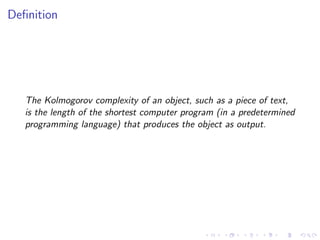
The Kolmogorov complexity of an object, such as a piece of text,
is the length of the shortest computer program (in a predetermined
programming language) that produces the object as output.
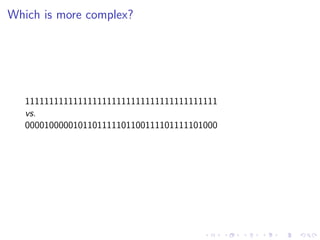
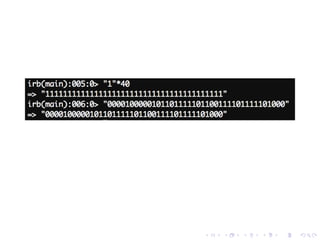
Which is more complex?
1111111111111111111111111111111111111111
vs.
0000100000101101111101100111101111101000
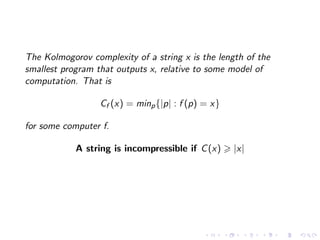
The Kolmogorov complexity of a string x is the length of the
smallest program that outputs x, relative to some model of
computation. That is
Cf (x) = minp{|p| : f (p) = x}
for some computer f.
A string is incompressible if C(x) |x|
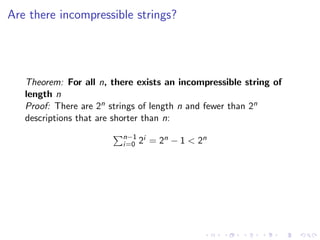
Are there incompressible strings?
Theorem: For all n, there exists an incompressible string of
length n
Proof: There are 2n strings of length n and fewer than 2n
descriptions that are shorter than n:
n−1
i=0 2i = 2n − 1 < 2n
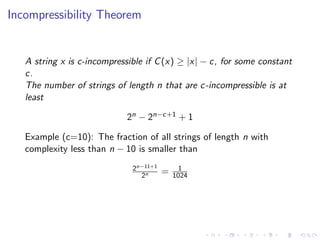
Incompressibility Theorem
A string x is c-incompressible if C(x) ≥ |x| − c, for some constant
c.
The number of strings of length n that are c-incompressible is at
least
2n − 2n−c+1 + 1
Example (c=10): The fraction of all strings of length n with
complexity less than n − 10 is smaller than
2n−11+1
2n = 1
1024
Uncomputability of Kolmogorov complexity
Theorem: There exists strings of arbitrary large Kolmogorov
complexity. Formally, for each n ∈ N, there is a string s with
C(s) ≥ n.
Proof: Otherwise all of the infinitely many possible finite strings
could be generated by the finitely many programs with a
complexity below n bits.
Uncomputability of Kolmogorov complexity
C(s) is not a computable function
Low-Complexity Art
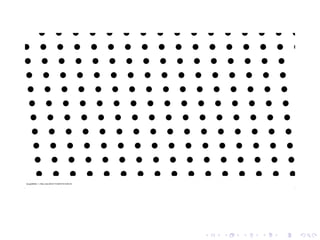
Schmidhuber characterizes low-complexity art as the computer age
equivalent of minimal art. He also describes an algorithmic theory
of beauty and aesthetics based on the principles of algorithmic
information theory and minimum description length. It explicitly
addresses the subjectivity of the observer and postulates that
among several input data classified as comparable by a given
subjective observer, the most pleasing one has the shortest
description, given the observers previous knowledge and his or her
particular method for encoding the data.
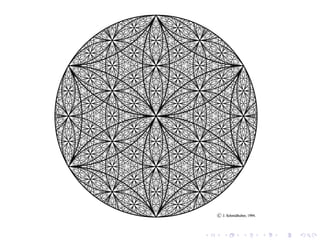
Example
Initialization: Draw a circle of arbitrary radius and center
position. Arbitrary select a point on the first circle and use it as a
center of a second circle and use it as the center of a second circle
with equal radius. The first two circles are defined as legal circles.
Rule 1: Whenever two legal circles of equal radius touch or
intersect, draw another legal circle of equal radius with the
intersection point as its center.
Rule 2: Within every legal circle with center point p and radius r,
draw another legal circle whose center point is also p but whose
radius is r/2.
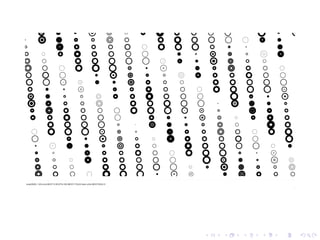
Schmidhuber explicitly distinguishes between beauty and
interestingness. He assumes that any observer continually tries to
improve the predictability and compressibility of the observations
by discovering regularities such as repetitions and symmetries and
fractal self-similarity. When the observer’s learning process (which
may be a predictive neural network) leads to improved data
compression the number of bits required to describe the data
decreases. The temporary interestingness of the data corresponds
to the number of saved bits, and thus (in the continuum limit) to
the first derivative of subjectively perceived beauty.
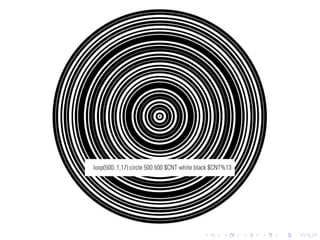
Lightpen: Simple (repl-friendly) DSL for SVG
Thanks!

Kolmogorov Complexity, Art, and all that

  • 1.
    Kolmogorov Complexity, Art,and all that Aleksandar Bradic CTO, Supplyframe April 19 2017
  • 2.
    Definition The Kolmogorov complexityof an object, such as a piece of text, is the length of the shortest computer program (in a predetermined programming language) that produces the object as output.
  • 3.
    Which is morecomplex? 1111111111111111111111111111111111111111 vs. 0000100000101101111101100111101111101000
  • 5.
    The Kolmogorov complexityof a string x is the length of the smallest program that outputs x, relative to some model of computation. That is Cf (x) = minp{|p| : f (p) = x} for some computer f. A string is incompressible if C(x) |x|
  • 6.
    Are there incompressiblestrings? Theorem: For all n, there exists an incompressible string of length n Proof: There are 2n strings of length n and fewer than 2n descriptions that are shorter than n: n−1 i=0 2i = 2n − 1 < 2n
  • 7.
    Incompressibility Theorem A stringx is c-incompressible if C(x) ≥ |x| − c, for some constant c. The number of strings of length n that are c-incompressible is at least 2n − 2n−c+1 + 1 Example (c=10): The fraction of all strings of length n with complexity less than n − 10 is smaller than 2n−11+1 2n = 1 1024
  • 8.
    Uncomputability of Kolmogorovcomplexity Theorem: There exists strings of arbitrary large Kolmogorov complexity. Formally, for each n ∈ N, there is a string s with C(s) ≥ n. Proof: Otherwise all of the infinitely many possible finite strings could be generated by the finitely many programs with a complexity below n bits.
  • 9.
    Uncomputability of Kolmogorovcomplexity C(s) is not a computable function
  • 10.
    Low-Complexity Art Schmidhuber characterizeslow-complexity art as the computer age equivalent of minimal art. He also describes an algorithmic theory of beauty and aesthetics based on the principles of algorithmic information theory and minimum description length. It explicitly addresses the subjectivity of the observer and postulates that among several input data classified as comparable by a given subjective observer, the most pleasing one has the shortest description, given the observers previous knowledge and his or her particular method for encoding the data.
  • 12.
    Example Initialization: Draw acircle of arbitrary radius and center position. Arbitrary select a point on the first circle and use it as a center of a second circle and use it as the center of a second circle with equal radius. The first two circles are defined as legal circles. Rule 1: Whenever two legal circles of equal radius touch or intersect, draw another legal circle of equal radius with the intersection point as its center. Rule 2: Within every legal circle with center point p and radius r, draw another legal circle whose center point is also p but whose radius is r/2.
  • 13.
    Schmidhuber explicitly distinguishesbetween beauty and interestingness. He assumes that any observer continually tries to improve the predictability and compressibility of the observations by discovering regularities such as repetitions and symmetries and fractal self-similarity. When the observer’s learning process (which may be a predictive neural network) leads to improved data compression the number of bits required to describe the data decreases. The temporary interestingness of the data corresponds to the number of saved bits, and thus (in the continuum limit) to the first derivative of subjectively perceived beauty.
  • 14.
  • 19.