Download to read offline
![6
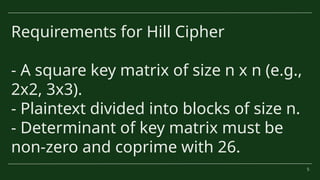
Step 1: Assign Numerical Values
to the Letters
● Convert the letters of the word 'Hope' into their numerical equivalents:
● H = 7, O = 14, P = 15, E = 4
● Plaintext: [7, 14, 15, 4]
● Split into pairs:
● (H, O) → [7, 14]
● (P, E) → [15, 4]](https://image.slidesharecdn.com/hillcipher-241215144710-43c388aa/85/Understanding-the-Hill-Cipher-with-Matrix-6-320.jpg)
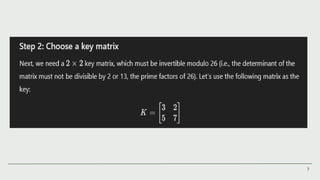
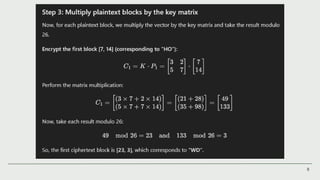
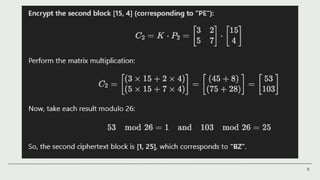
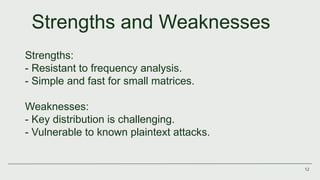


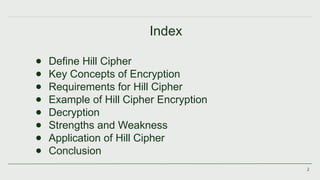
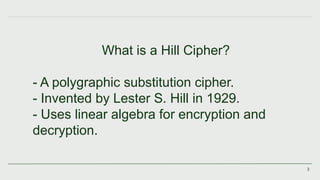
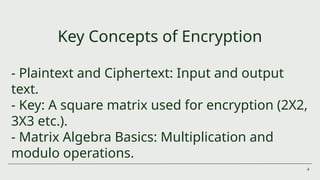
The Hill cipher is a polygraphic substitution cipher that employs linear algebra for encryption and decryption, invented by Lester S. Hill in 1929. It requires a square key matrix and involves processes like assigning numerical values to letters and performing matrix operations. While it has strengths against frequency analysis, it also has weaknesses, such as key distribution challenges and vulnerabilities to known plaintext attacks.


![[DSC Europe 25] Marcos Heidemann - Beyond the Hype: Making AI Coding Assistan...](https://cdn.slidesharecdn.com/ss_thumbnails/eexkhvldrjsopspdjbur-marcos-heidemann-beyond-the-hype-getting-real-value-out-of-ai-assisted-coding-260121115910-7e9d41ec-thumbnail.jpg?width=640&height=640&fit=bounds)
![[DSC Europe 25] Borko Kozomora - Optimizing business workflows with advances ...](https://cdn.slidesharecdn.com/ss_thumbnails/hbgekyb0txw0xpo4yfml-borko-kozomora-leading-ai-transformation-260122103838-cc29ee38-thumbnail.jpg?width=640&height=640&fit=bounds)
![[DSC Europe 25] Srdj Stanisic - Local and Private AI in UX.pdf](https://cdn.slidesharecdn.com/ss_thumbnails/vwmetykqmztgmokmmkfa-3-srdjan-stanisic-local-and-small-ai-in-ux-260120105855-55a31869-thumbnail.jpg?width=640&height=640&fit=bounds)

![[DSC Europe 25] Paula Garcia Esteban -Building the Future: The Role of Data S...](https://cdn.slidesharecdn.com/ss_thumbnails/9ld1r1bsqpwve8qfvphy-paula-garcia-esteban-building-the-future-260122103838-4171f5cb-thumbnail.jpg?width=640&height=640&fit=bounds)

![[DSC Europe 25] Tali Fulman - Guild Meetings, Then What? Building Data Commun...](https://cdn.slidesharecdn.com/ss_thumbnails/fgohhi33rwmhqdowdj5k-tali-fulman-guild-meetings-then-what-building-data-communities-that-actually-ch-260120105855-528492c3-thumbnail.jpg?width=640&height=640&fit=bounds)


