Int. J. Advanced Networking and Applications
Volume: 07 Issue: 06 Pages: 2944-2948 (2016) ISSN: 0975-0290
2944
Nearest Prime Cipher for Data Confidentiality and
Integrity
Dr. S. Kiran
Assistant Professor, Dept of CSE, YSREC of YV University, Proddatur, India
Email: rkirans125@gmail.com
N. Subramanyan
Teaching Assistant, Dept of CSE, YSREC of YV University, Proddatur, India
Email: subramanyam.neelam@gmail.com
Y. Suma
Student, III B.Tech CSE, YSREC of YV University, Proddatur, India
Email: sumachinni097@gmail.com
K. Haripriya
Student, III B.Tech CSE, YSREC of YV University, Proddatur, India
Email: haripriyakancherla7@gmail.com
-------------------------------------------------------------------ABSTRACT---------------------------------------------------------------
Communication is the process of transmitting information from source to destination. The information
exchanged between sender and receiver through the proper channel. The information should not be stolen by
unauthorized parties like hackers while sending or receiving via channel. To avoid this stealing of the information
cryptography techniques are used. The key is playing prominent role in cryptography. This paper proposes a
novel method for key generation by using nearest primes. Further 2’s complement and logical operations are
used in encryption and decryption process. The final cipher text is generated by representing the intermediate
cipher in matrix form and then read by column wise.
Keywords - 2’s complement, Ciphertext, Cryptography, Nearest prime number, Plaintext, XOR
operation.
--------------------------------------------------------------------------------------------------------------------------------------------------
Date of Submission: May 08, 2016 Date of Acceptance: May 25, 2016
--------------------------------------------------------------------------------------------------------------------------------------------------
I. INTRODUCTION
Cryptography[1] is used to constrain the potential sender
and/or receiver of a message. Cryptography is based on
secret key. The sender can encode its message so that it
can only decode with suitable key.
Cipher[1] is the algorithm that is used to transform
plaintext into cipher text, this method is called encryption,
in other words, it’s a mechanism of converting readable
and understandable data into “meaningless” data, and it is
done as follows:
= � � (1)
Where � is the encryption algorithm using key k, C is a
cipher text and P is a plain text. Symmetric and
asymmetric are two types of encryption algorithms.
The opposite of cipher mechanism is called decipher that
is the algorithm which recovers the plain text from cipher
text, this is called decryption, in other words, it’s a
mechanism of converting “meaningless” data into readable
data, and it is done as follows:
� = �−1 (2)
Where �−1 is the decryption algorithm using key k.
Fig 1. Conventional Encryption Model
Security services: Here are some of the services that are
provided by the security[2].
 Confidentiality(privacy)
 Authentication(who created or sent the data)
 Data integrity(has not been altered)
 Non-repudiation(the order is final)
 Access control(prevent misuse of resources)
 Availability (permanence, non-erasure).
If we are protecting confidential information then
cryptography is provide high level of privacy of individuals
and group.
There are a number of cryptographic primitives-basic
building blocks, such as block ciphers, stream ciphers and
Int. J. Advanced Networking and Applications
Volume: 07 Issue: 06 Pages: 2944-2948 (2016) ISSN: 0975-0290
2945
hash functions. Cryptography has being used for millennia
to safeguard military and diplomatic communications.
Data encryption standard adopted by the National institute
of standards is the most commonly used symmetric
encryption algorithm. Black-box transformations are some
of the transformations that are hidden in the algorithm.
The proposed work/algorithm follows symmetric
cryptographic system.
II. HISTORY
The word cryptography[1] comes from the Greek Word
‘Kryptos’ and ‘Graphein’. For the past 20 years, the most
commonly used symmetric encryption algorithm in United
States for civilian applications. In 2001, NTST adopted a
new application algorithm called the advanced encryption
standard (AES) to replace DES. AES is another symmetric
block cipher which uses key lengths of 128,192 and 356
bits and works on 128 bit blocks. Generally, the algorithm
is compact and efficient. There are several symmetric
block encryption algorithms in use today. One is Twofish
algorithm and the other is RC5.The Twofish algorithm is
fast, compact and easy to implement. RC5 can vary in key
length, number of transformations and block size. In 1970,
one “Crypto group” was developed by IBM named as
Horst-Festal. RC4 is the most common stream cipher
which is designed to encrypt and decrypt a stream of bytes
or bits rather than a block. RC4 as used in WEP (IEEE
standard 802.11) has been found to be breakable in
amount of computer time which itself has vulnerabilities.
III. EXISTING WORK
The existing method[3] generates a 64 bit random
sequence for key generation. Key generation consists of
two parts. One is raster scan method and the other is store
and forward method. The existing method has various
stages of encryption and decryption. In the first stage,
caeser cipher[4] substitution method is used, which is
computed by using the key, generated from raster scan
method. In the second stage, using lookup table, the
decimal equivalent of intermediate ciphertext is taken and
then XOR operation is performed between intermediate
cipher binary value and the key generated from store and
forward method. In the third stage, column wise retrieval
and nibble grouping is applied.
Limitations:
1. It is applicable only for 94 characters. It is not
providing full support for ASCII characters.
2. Look up table is necessary.
3. Only column wise retrieval process is proposed.
IV. PROPOSED WORK
The proposed work generates a 8-bit random sequence for
key generation. Key is obtained by performing subtraction
between plain text values and its nearest prime values.
Several stages are involved in encryption and decryption
uses arithmetic and logical operations[5][6].
A. Key Generation
Each character of plain text converted into ASCII value.
Further, find nearest prime of it. For key generation find
the difference between nearest prime and plain text ASCII.
Consider the difference value as key, it is continued for
each character of plain text.
Key generation algorithm steps:-
Step1: Initially, the given plain text is converted into its
equivalent ASCII values.
Step2: Find nearest prime values for ASCII values.
Step3: The key values are obtained from finding
difference between ASCII and nearest prime values.
Step4: Perform 2’s complement for generated value.
Fig 2. Flow chart showing key generation process
Example for key generation:
Plain text is: NETWORKSECURITY
ASCII values are: 78 69 84 87 79 82 75 83 69 67 85 82
73 84 89
Nearest primes values are: 79 71 89 89 83 83 79 89 71 71
89 83 79 89 97
Key values are: 1 2 5 2 4 1 4 6 2 4 4 1 6 5 8
Table 1. Key generation process
Key Value Binary code 2’s complement
1 00000001 11111111
2 00000010 11111110
5 00000101 11111011
2 00000010 11111110
4 00000100 11111100
1 00000001 11111111
4 00000100 11111100
6 00000110 11111010
2 00000010 11111110
4 00000100 11111100
4 00000100 11111100
1 00000001 11111111
6 00000110 11111010
5 00000101 11111011
8 00001000 11111000
Int. J. Advanced Networking and Applications
Volume: 07 Issue: 06 Pages: 2944-2948 (2016) ISSN: 0975-0290
2946
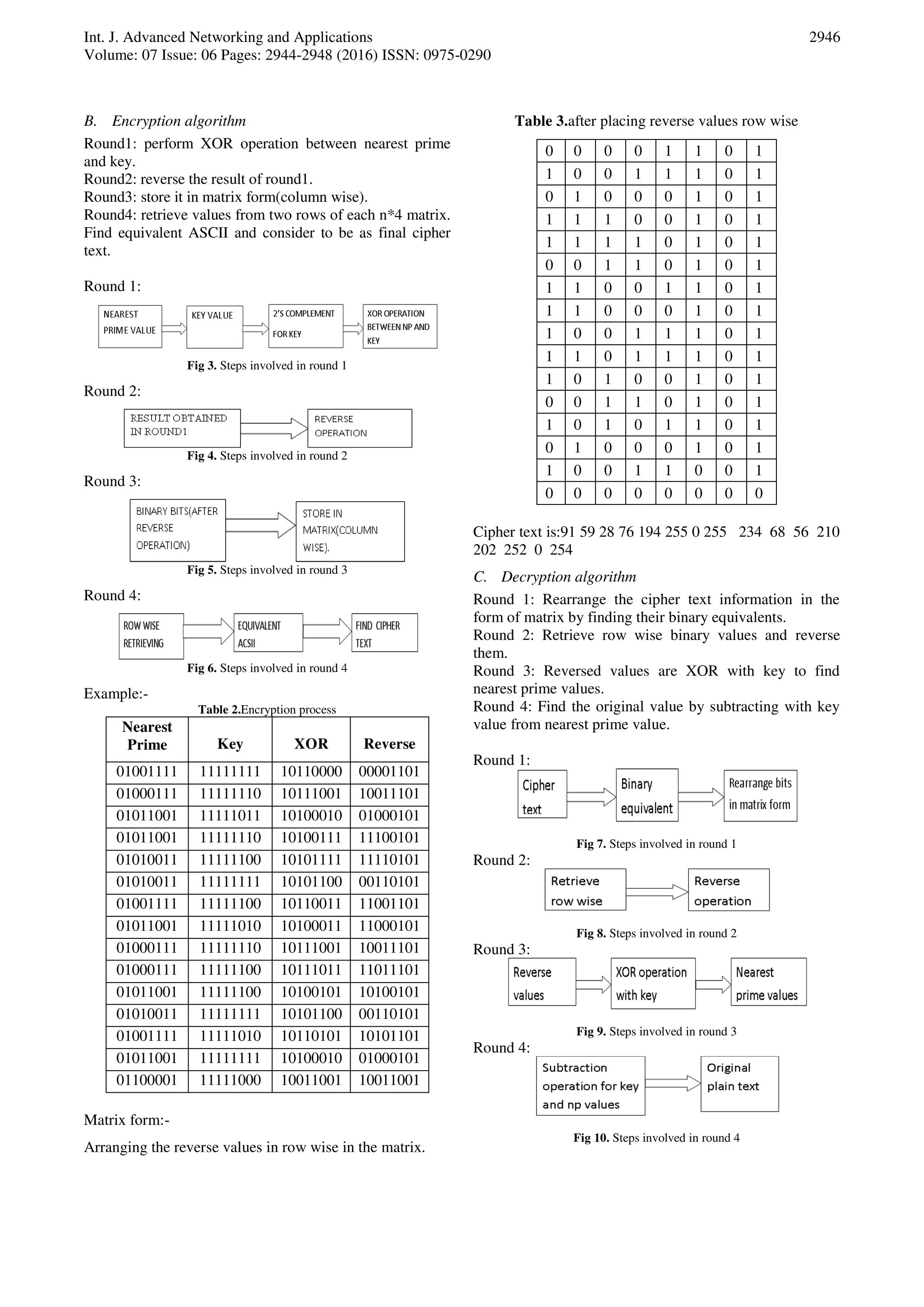
B. Encryption algorithm
Round1: perform XOR operation between nearest prime
and key.
Round2: reverse the result of round1.
Round3: store it in matrix form(column wise).
Round4: retrieve values from two rows of each n*4 matrix.
Find equivalent ASCII and consider to be as final cipher
text.
Round 1:
Fig 3. Steps involved in round 1
Round 2:
Fig 4. Steps involved in round 2
Round 3:
Fig 5. Steps involved in round 3
Round 4:
Fig 6. Steps involved in round 4
Example:-
Table 2.Encryption process
Nearest
Prime Key XOR Reverse
01001111 11111111 10110000 00001101
01000111 11111110 10111001 10011101
01011001 11111011 10100010 01000101
01011001 11111110 10100111 11100101
01010011 11111100 10101111 11110101
01010011 11111111 10101100 00110101
01001111 11111100 10110011 11001101
01011001 11111010 10100011 11000101
01000111 11111110 10111001 10011101
01000111 11111100 10111011 11011101
01011001 11111100 10100101 10100101
01010011 11111111 10101100 00110101
01001111 11111010 10110101 10101101
01011001 11111111 10100010 01000101
01100001 11111000 10011001 10011001
Matrix form:-
Arranging the reverse values in row wise in the matrix.
Table 3.after placing reverse values row wise
0 0 0 0 1 1 0 1
1 0 0 1 1 1 0 1
0 1 0 0 0 1 0 1
1 1 1 0 0 1 0 1
1 1 1 1 0 1 0 1
0 0 1 1 0 1 0 1
1 1 0 0 1 1 0 1
1 1 0 0 0 1 0 1
1 0 0 1 1 1 0 1
1 1 0 1 1 1 0 1
1 0 1 0 0 1 0 1
0 0 1 1 0 1 0 1
1 0 1 0 1 1 0 1
0 1 0 0 0 1 0 1
1 0 0 1 1 0 0 1
0 0 0 0 0 0 0 0
Cipher text is:91 59 28 76 194 255 0 255 234 68 56 210
202 252 0 254
C. Decryption algorithm
Round 1: Rearrange the cipher text information in the
form of matrix by finding their binary equivalents.
Round 2: Retrieve row wise binary values and reverse
them.
Round 3: Reversed values are XOR with key to find
nearest prime values.
Round 4: Find the original value by subtracting with key
value from nearest prime value.
Round 1:
Fig 7. Steps involved in round 1
Round 2:
Fig 8. Steps involved in round 2
Round 3:
Fig 9. Steps involved in round 3
Round 4:
Fig 10. Steps involved in round 4
Int. J. Advanced Networking and Applications
Volume: 07 Issue: 06 Pages: 2944-2948 (2016) ISSN: 0975-0290
2947
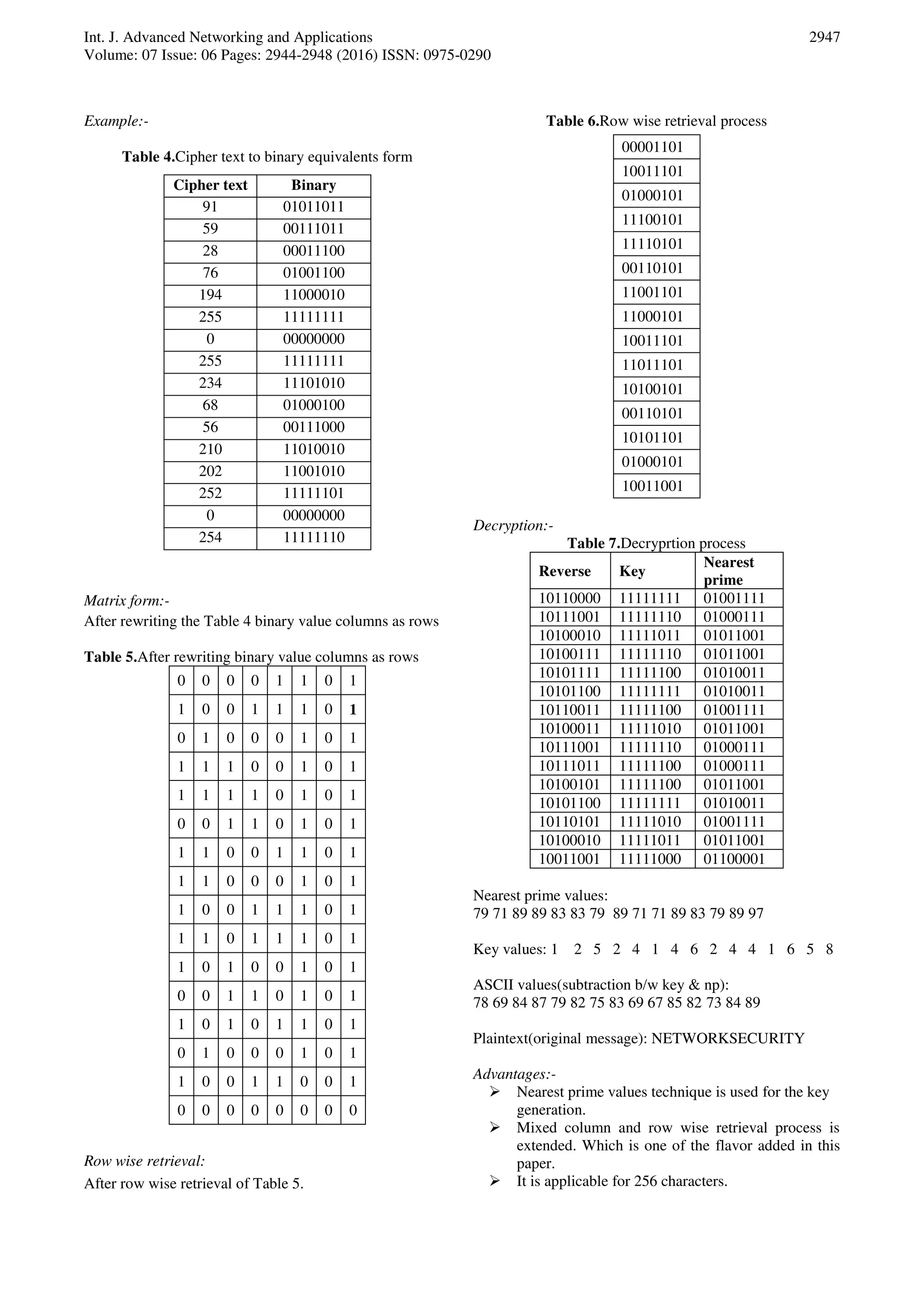
Example:-
Table 4.Cipher text to binary equivalents form
Cipher text Binary
equivalents91 01011011
59 00111011
28 00011100
76 01001100
194 11000010
255 11111111
0 00000000
255 11111111
234 11101010
68 01000100
56 00111000
210 11010010
202 11001010
252 11111101
0 00000000
254 11111110
Matrix form:-
After rewriting the Table 4 binary value columns as rows
Table 5.After rewriting binary value columns as rows
0 0 0 0 1 1 0 1
1 0 0 1 1 1 0 1
0 1 0 0 0 1 0 1
1 1 1 0 0 1 0 1
1 1 1 1 0 1 0 1
0 0 1 1 0 1 0 1
1 1 0 0 1 1 0 1
1 1 0 0 0 1 0 1
1 0 0 1 1 1 0 1
1 1 0 1 1 1 0 1
1 0 1 0 0 1 0 1
0 0 1 1 0 1 0 1
1 0 1 0 1 1 0 1
0 1 0 0 0 1 0 1
1 0 0 1 1 0 0 1
0 0 0 0 0 0 0 0
Row wise retrieval:
After row wise retrieval of Table 5.
Table 6.Row wise retrieval process
00001101
10011101
01000101
11100101
11110101
00110101
11001101
11000101
10011101
11011101
10100101
00110101
10101101
01000101
10011001
Decryption:-
Table 7.Decryprtion process
Reverse Key
Nearest
prime
10110000 11111111 01001111
10111001 11111110 01000111
10100010 11111011 01011001
10100111 11111110 01011001
10101111 11111100 01010011
10101100 11111111 01010011
10110011 11111100 01001111
10100011 11111010 01011001
10111001 11111110 01000111
10111011 11111100 01000111
10100101 11111100 01011001
10101100 11111111 01010011
10110101 11111010 01001111
10100010 11111011 01011001
10011001 11111000 01100001
Nearest prime values:
79 71 89 89 83 83 79 89 71 71 89 83 79 89 97
Key values: 1 2 5 2 4 1 4 6 2 4 4 1 6 5 8
ASCII values(subtraction b/w key & np):
78 69 84 87 79 82 75 83 69 67 85 82 73 84 89
Plaintext(original message): NETWORKSECURITY
Advantages:-
 Nearest prime values technique is used for the key
generation.
 Mixed column and row wise retrieval process is
extended. Which is one of the flavor added in this
paper.
 It is applicable for 256 characters.
Int. J. Advanced Networking and Applications
Volume: 07 Issue: 06 Pages: 2944-2948 (2016) ISSN: 0975-0290
2948
V. CONCLUSION
A passive attack attempts to learn or make use of
information from the system. Data confidentiality is a
measure of ability of the system to protect its data from a
kind of passive attacks. Data integrity refers to maintain
accuracy and consistency of data. The proposed algorithm
nearest primes cipher provides data confidentiality and
integrity to the system. The cipher text is generated using a
step by step encryption algorithm based on nearest primes
and logical operations. The result of the above operations
is stored in a matrix row wise and retrieves in column wise
to obtain more security.
The future work can be extended to implementation of
secure key exchange mechanism, reducing the time
complexity in key generation using data structures, the
size of data to be encrypted can be increased by increasing
key length. Supplementing authentication security service
to the nearest prime encryption algorithm.
REFERENCES
[1] William Stallings, "Cryptography and Network
Security: Principles and Practices", 4th Edition,
Prentice Hall, 2006, page numbers 30-39.
[2] Hans Delfs and Helmut Knebl, "Introduction to
Cryptography: Principles and Applications", Springer,
first edition, 2002, page numbers 11- 14.
[3] S. Kiran, R. Pradeep Kumar Reddy, “Multi-Stage
encryption using Seeded SDES” International Journal
of Advanced Networking and Applications Volume:
07 Issue: 02 Pages: 2694-2699 (2015) ISSN: 0975-
0290.
[4] B.Bazith Mohammed, “automatic key generation
of Caesar cipher”, international journal of
engineering trends and technology (IJETT),
vol.6,no.6,pp.337-339,dec.2013.
[5] S.G.Srikantaswamy and Dr.H.D.phaneendra,“A
cipher design using the combined effect of arithmetic
and logic operations with substitutions and
transposition techniques“, International Journal of
Computer Applications (0975-
8887),vol.29,no.8,pp.34-36.
Author’s profile
Dr.S.Kiran is assistant
Professor in the
department of Computer
Science and Engineering at
Yogivemana University,
Proddatur. He acquired
M.Tech Degree from
Nagarjuna University,
Guntur. He completed
Ph.D in computer Science in Computer Science from
S. K. University. He has been continuously imparting
his knowledge to several students in research
activities. He published many articles National and
International journals. His research areas are image
processing, Cryptography and Network Security,
Software Engineering and Data mining and Data ware
house.
N.Subramanyan received his
B.Tech degree in Computer
Science and Engineering from
Annamacharya Institute of
Technology & Sciences
,Rajampeta. M.Tech. degree in
Information Technology from
RGM College of Engineering
and Technology, Nandyal.
Currently he is working as Academic Consultant in
the Department of CSE at YSR Engineering College
of Yogi Vemana University,Proddatur. He has got 6
years of teaching experience. He has attended 2
workshops.
Y. Suma is a student in the
department of Computer
Science and Engineering at
Y.S.R Engineering college of
Yogivemana University,
Proddatur. She is studying
3rd B.Tech in CSE. She
attended many workshops ,seminars and published
papers in national and International journals.
K. Hari priya is a student
in the department of
Computer Science and
Engineering at Y.S.R
Engineering college of
Yogivemana University,
Proddatur. She is studying
3rd B.Tech in CSE. She
attended many workshops,seminars and published
papers in national and International journals.

Nearest Prime Cipher for Data Confidentiality and Integrity

  • 1.
    Int. J. AdvancedNetworking and Applications Volume: 07 Issue: 06 Pages: 2944-2948 (2016) ISSN: 0975-0290 2944 Nearest Prime Cipher for Data Confidentiality and Integrity Dr. S. Kiran Assistant Professor, Dept of CSE, YSREC of YV University, Proddatur, India Email: rkirans125@gmail.com N. Subramanyan Teaching Assistant, Dept of CSE, YSREC of YV University, Proddatur, India Email: subramanyam.neelam@gmail.com Y. Suma Student, III B.Tech CSE, YSREC of YV University, Proddatur, India Email: sumachinni097@gmail.com K. Haripriya Student, III B.Tech CSE, YSREC of YV University, Proddatur, India Email: haripriyakancherla7@gmail.com -------------------------------------------------------------------ABSTRACT--------------------------------------------------------------- Communication is the process of transmitting information from source to destination. The information exchanged between sender and receiver through the proper channel. The information should not be stolen by unauthorized parties like hackers while sending or receiving via channel. To avoid this stealing of the information cryptography techniques are used. The key is playing prominent role in cryptography. This paper proposes a novel method for key generation by using nearest primes. Further 2’s complement and logical operations are used in encryption and decryption process. The final cipher text is generated by representing the intermediate cipher in matrix form and then read by column wise. Keywords - 2’s complement, Ciphertext, Cryptography, Nearest prime number, Plaintext, XOR operation. -------------------------------------------------------------------------------------------------------------------------------------------------- Date of Submission: May 08, 2016 Date of Acceptance: May 25, 2016 -------------------------------------------------------------------------------------------------------------------------------------------------- I. INTRODUCTION Cryptography[1] is used to constrain the potential sender and/or receiver of a message. Cryptography is based on secret key. The sender can encode its message so that it can only decode with suitable key. Cipher[1] is the algorithm that is used to transform plaintext into cipher text, this method is called encryption, in other words, it’s a mechanism of converting readable and understandable data into “meaningless” data, and it is done as follows: = � � (1) Where � is the encryption algorithm using key k, C is a cipher text and P is a plain text. Symmetric and asymmetric are two types of encryption algorithms. The opposite of cipher mechanism is called decipher that is the algorithm which recovers the plain text from cipher text, this is called decryption, in other words, it’s a mechanism of converting “meaningless” data into readable data, and it is done as follows: � = �−1 (2) Where �−1 is the decryption algorithm using key k. Fig 1. Conventional Encryption Model Security services: Here are some of the services that are provided by the security[2].  Confidentiality(privacy)  Authentication(who created or sent the data)  Data integrity(has not been altered)  Non-repudiation(the order is final)  Access control(prevent misuse of resources)  Availability (permanence, non-erasure). If we are protecting confidential information then cryptography is provide high level of privacy of individuals and group. There are a number of cryptographic primitives-basic building blocks, such as block ciphers, stream ciphers and
  • 2.
    Int. J. AdvancedNetworking and Applications Volume: 07 Issue: 06 Pages: 2944-2948 (2016) ISSN: 0975-0290 2945 hash functions. Cryptography has being used for millennia to safeguard military and diplomatic communications. Data encryption standard adopted by the National institute of standards is the most commonly used symmetric encryption algorithm. Black-box transformations are some of the transformations that are hidden in the algorithm. The proposed work/algorithm follows symmetric cryptographic system. II. HISTORY The word cryptography[1] comes from the Greek Word ‘Kryptos’ and ‘Graphein’. For the past 20 years, the most commonly used symmetric encryption algorithm in United States for civilian applications. In 2001, NTST adopted a new application algorithm called the advanced encryption standard (AES) to replace DES. AES is another symmetric block cipher which uses key lengths of 128,192 and 356 bits and works on 128 bit blocks. Generally, the algorithm is compact and efficient. There are several symmetric block encryption algorithms in use today. One is Twofish algorithm and the other is RC5.The Twofish algorithm is fast, compact and easy to implement. RC5 can vary in key length, number of transformations and block size. In 1970, one “Crypto group” was developed by IBM named as Horst-Festal. RC4 is the most common stream cipher which is designed to encrypt and decrypt a stream of bytes or bits rather than a block. RC4 as used in WEP (IEEE standard 802.11) has been found to be breakable in amount of computer time which itself has vulnerabilities. III. EXISTING WORK The existing method[3] generates a 64 bit random sequence for key generation. Key generation consists of two parts. One is raster scan method and the other is store and forward method. The existing method has various stages of encryption and decryption. In the first stage, caeser cipher[4] substitution method is used, which is computed by using the key, generated from raster scan method. In the second stage, using lookup table, the decimal equivalent of intermediate ciphertext is taken and then XOR operation is performed between intermediate cipher binary value and the key generated from store and forward method. In the third stage, column wise retrieval and nibble grouping is applied. Limitations: 1. It is applicable only for 94 characters. It is not providing full support for ASCII characters. 2. Look up table is necessary. 3. Only column wise retrieval process is proposed. IV. PROPOSED WORK The proposed work generates a 8-bit random sequence for key generation. Key is obtained by performing subtraction between plain text values and its nearest prime values. Several stages are involved in encryption and decryption uses arithmetic and logical operations[5][6]. A. Key Generation Each character of plain text converted into ASCII value. Further, find nearest prime of it. For key generation find the difference between nearest prime and plain text ASCII. Consider the difference value as key, it is continued for each character of plain text. Key generation algorithm steps:- Step1: Initially, the given plain text is converted into its equivalent ASCII values. Step2: Find nearest prime values for ASCII values. Step3: The key values are obtained from finding difference between ASCII and nearest prime values. Step4: Perform 2’s complement for generated value. Fig 2. Flow chart showing key generation process Example for key generation: Plain text is: NETWORKSECURITY ASCII values are: 78 69 84 87 79 82 75 83 69 67 85 82 73 84 89 Nearest primes values are: 79 71 89 89 83 83 79 89 71 71 89 83 79 89 97 Key values are: 1 2 5 2 4 1 4 6 2 4 4 1 6 5 8 Table 1. Key generation process Key Value Binary code 2’s complement 1 00000001 11111111 2 00000010 11111110 5 00000101 11111011 2 00000010 11111110 4 00000100 11111100 1 00000001 11111111 4 00000100 11111100 6 00000110 11111010 2 00000010 11111110 4 00000100 11111100 4 00000100 11111100 1 00000001 11111111 6 00000110 11111010 5 00000101 11111011 8 00001000 11111000
  • 3.
    Int. J. AdvancedNetworking and Applications Volume: 07 Issue: 06 Pages: 2944-2948 (2016) ISSN: 0975-0290 2946 B. Encryption algorithm Round1: perform XOR operation between nearest prime and key. Round2: reverse the result of round1. Round3: store it in matrix form(column wise). Round4: retrieve values from two rows of each n*4 matrix. Find equivalent ASCII and consider to be as final cipher text. Round 1: Fig 3. Steps involved in round 1 Round 2: Fig 4. Steps involved in round 2 Round 3: Fig 5. Steps involved in round 3 Round 4: Fig 6. Steps involved in round 4 Example:- Table 2.Encryption process Nearest Prime Key XOR Reverse 01001111 11111111 10110000 00001101 01000111 11111110 10111001 10011101 01011001 11111011 10100010 01000101 01011001 11111110 10100111 11100101 01010011 11111100 10101111 11110101 01010011 11111111 10101100 00110101 01001111 11111100 10110011 11001101 01011001 11111010 10100011 11000101 01000111 11111110 10111001 10011101 01000111 11111100 10111011 11011101 01011001 11111100 10100101 10100101 01010011 11111111 10101100 00110101 01001111 11111010 10110101 10101101 01011001 11111111 10100010 01000101 01100001 11111000 10011001 10011001 Matrix form:- Arranging the reverse values in row wise in the matrix. Table 3.after placing reverse values row wise 0 0 0 0 1 1 0 1 1 0 0 1 1 1 0 1 0 1 0 0 0 1 0 1 1 1 1 0 0 1 0 1 1 1 1 1 0 1 0 1 0 0 1 1 0 1 0 1 1 1 0 0 1 1 0 1 1 1 0 0 0 1 0 1 1 0 0 1 1 1 0 1 1 1 0 1 1 1 0 1 1 0 1 0 0 1 0 1 0 0 1 1 0 1 0 1 1 0 1 0 1 1 0 1 0 1 0 0 0 1 0 1 1 0 0 1 1 0 0 1 0 0 0 0 0 0 0 0 Cipher text is:91 59 28 76 194 255 0 255 234 68 56 210 202 252 0 254 C. Decryption algorithm Round 1: Rearrange the cipher text information in the form of matrix by finding their binary equivalents. Round 2: Retrieve row wise binary values and reverse them. Round 3: Reversed values are XOR with key to find nearest prime values. Round 4: Find the original value by subtracting with key value from nearest prime value. Round 1: Fig 7. Steps involved in round 1 Round 2: Fig 8. Steps involved in round 2 Round 3: Fig 9. Steps involved in round 3 Round 4: Fig 10. Steps involved in round 4
  • 4.
    Int. J. AdvancedNetworking and Applications Volume: 07 Issue: 06 Pages: 2944-2948 (2016) ISSN: 0975-0290 2947 Example:- Table 4.Cipher text to binary equivalents form Cipher text Binary equivalents91 01011011 59 00111011 28 00011100 76 01001100 194 11000010 255 11111111 0 00000000 255 11111111 234 11101010 68 01000100 56 00111000 210 11010010 202 11001010 252 11111101 0 00000000 254 11111110 Matrix form:- After rewriting the Table 4 binary value columns as rows Table 5.After rewriting binary value columns as rows 0 0 0 0 1 1 0 1 1 0 0 1 1 1 0 1 0 1 0 0 0 1 0 1 1 1 1 0 0 1 0 1 1 1 1 1 0 1 0 1 0 0 1 1 0 1 0 1 1 1 0 0 1 1 0 1 1 1 0 0 0 1 0 1 1 0 0 1 1 1 0 1 1 1 0 1 1 1 0 1 1 0 1 0 0 1 0 1 0 0 1 1 0 1 0 1 1 0 1 0 1 1 0 1 0 1 0 0 0 1 0 1 1 0 0 1 1 0 0 1 0 0 0 0 0 0 0 0 Row wise retrieval: After row wise retrieval of Table 5. Table 6.Row wise retrieval process 00001101 10011101 01000101 11100101 11110101 00110101 11001101 11000101 10011101 11011101 10100101 00110101 10101101 01000101 10011001 Decryption:- Table 7.Decryprtion process Reverse Key Nearest prime 10110000 11111111 01001111 10111001 11111110 01000111 10100010 11111011 01011001 10100111 11111110 01011001 10101111 11111100 01010011 10101100 11111111 01010011 10110011 11111100 01001111 10100011 11111010 01011001 10111001 11111110 01000111 10111011 11111100 01000111 10100101 11111100 01011001 10101100 11111111 01010011 10110101 11111010 01001111 10100010 11111011 01011001 10011001 11111000 01100001 Nearest prime values: 79 71 89 89 83 83 79 89 71 71 89 83 79 89 97 Key values: 1 2 5 2 4 1 4 6 2 4 4 1 6 5 8 ASCII values(subtraction b/w key & np): 78 69 84 87 79 82 75 83 69 67 85 82 73 84 89 Plaintext(original message): NETWORKSECURITY Advantages:-  Nearest prime values technique is used for the key generation.  Mixed column and row wise retrieval process is extended. Which is one of the flavor added in this paper.  It is applicable for 256 characters.
  • 5.
    Int. J. AdvancedNetworking and Applications Volume: 07 Issue: 06 Pages: 2944-2948 (2016) ISSN: 0975-0290 2948 V. CONCLUSION A passive attack attempts to learn or make use of information from the system. Data confidentiality is a measure of ability of the system to protect its data from a kind of passive attacks. Data integrity refers to maintain accuracy and consistency of data. The proposed algorithm nearest primes cipher provides data confidentiality and integrity to the system. The cipher text is generated using a step by step encryption algorithm based on nearest primes and logical operations. The result of the above operations is stored in a matrix row wise and retrieves in column wise to obtain more security. The future work can be extended to implementation of secure key exchange mechanism, reducing the time complexity in key generation using data structures, the size of data to be encrypted can be increased by increasing key length. Supplementing authentication security service to the nearest prime encryption algorithm. REFERENCES [1] William Stallings, "Cryptography and Network Security: Principles and Practices", 4th Edition, Prentice Hall, 2006, page numbers 30-39. [2] Hans Delfs and Helmut Knebl, "Introduction to Cryptography: Principles and Applications", Springer, first edition, 2002, page numbers 11- 14. [3] S. Kiran, R. Pradeep Kumar Reddy, “Multi-Stage encryption using Seeded SDES” International Journal of Advanced Networking and Applications Volume: 07 Issue: 02 Pages: 2694-2699 (2015) ISSN: 0975- 0290. [4] B.Bazith Mohammed, “automatic key generation of Caesar cipher”, international journal of engineering trends and technology (IJETT), vol.6,no.6,pp.337-339,dec.2013. [5] S.G.Srikantaswamy and Dr.H.D.phaneendra,“A cipher design using the combined effect of arithmetic and logic operations with substitutions and transposition techniques“, International Journal of Computer Applications (0975- 8887),vol.29,no.8,pp.34-36. Author’s profile Dr.S.Kiran is assistant Professor in the department of Computer Science and Engineering at Yogivemana University, Proddatur. He acquired M.Tech Degree from Nagarjuna University, Guntur. He completed Ph.D in computer Science in Computer Science from S. K. University. He has been continuously imparting his knowledge to several students in research activities. He published many articles National and International journals. His research areas are image processing, Cryptography and Network Security, Software Engineering and Data mining and Data ware house. N.Subramanyan received his B.Tech degree in Computer Science and Engineering from Annamacharya Institute of Technology & Sciences ,Rajampeta. M.Tech. degree in Information Technology from RGM College of Engineering and Technology, Nandyal. Currently he is working as Academic Consultant in the Department of CSE at YSR Engineering College of Yogi Vemana University,Proddatur. He has got 6 years of teaching experience. He has attended 2 workshops. Y. Suma is a student in the department of Computer Science and Engineering at Y.S.R Engineering college of Yogivemana University, Proddatur. She is studying 3rd B.Tech in CSE. She attended many workshops ,seminars and published papers in national and International journals. K. Hari priya is a student in the department of Computer Science and Engineering at Y.S.R Engineering college of Yogivemana University, Proddatur. She is studying 3rd B.Tech in CSE. She attended many workshops,seminars and published papers in national and International journals.