The document explains the distinction between a syllabus and a course outline, portraying the syllabus as a static guideline based on subject standards, while the course outline is dynamic, contextual, and reflects the instructor's approach. It highlights the importance of learning outcomes as central to course success and discusses various approaches to course design, emphasizing the need for alignment between learning outcomes, content, and assessment methods. Additionally, it identifies common problems in course design, including incoherence and misalignment between course components.
What Is aSyllabus?
Syllabus is a guideline for the instruction of a subject.
It is based on subject standards.
3.
Course Outline
Course outline is a blueprint for the implementation
of a subject/course. It is a bridge between the
instructor and students. It covers the overview of a
subject, specific contents, pedagogies and assessment
methods.
4.
Relationship between theTwo
Two dominant views:
There is no difference between the two
They must be differentiated as they differ conceptually
and procedurally (I subscribe to this approach)
5.
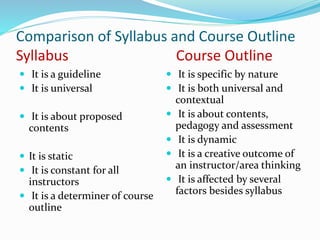
Comparison of Syllabusand Course Outline
Syllabus Course Outline
It is a guideline
It is universal
It is about proposed
contents
It is static
It is constant for all
instructors
It is a determiner of course
outline
It is specific by nature
It is both universal and
contextual
It is about contents,
pedagogy and assessment
It is dynamic
It is a creative outcome of
an instructor/area thinking
It is affected by several
factors besides syllabus
6.
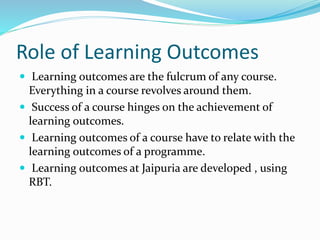
Role of LearningOutcomes
Learning outcomes are the fulcrum of any course.
Everything in a course revolves around them.
Success of a course hinges on the achievement of
learning outcomes.
Learning outcomes of a course have to relate with the
learning outcomes of a programme.
Learning outcomes at Jaipuria are developed , using
RBT.
7.
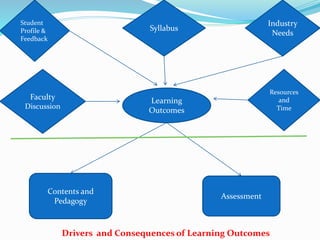
Learning
Outcomes
Contentsand
Pedagogy
Assessment
Student
Profile &
Feedback
Faculty
Discussion
Syllabus
Industry
Needs
Resources
and
Time
Drivers and Consequences of Learning Outcomes
8.
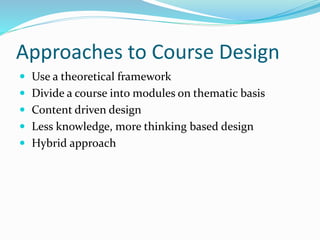
Approaches to CourseDesign
Use a theoretical framework
Divide a course into modules on thematic basis
Content driven design
Less knowledge, more thinking based design
Hybrid approach
9.
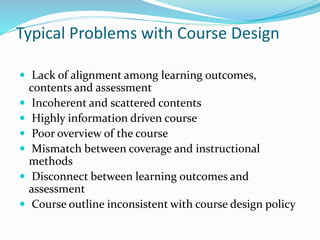
Typical Problems withCourse Design
Lack of alignment among learning outcomes,
contents and assessment
Incoherent and scattered contents
Highly information driven course
Poor overview of the course
Mismatch between coverage and instructional
methods
Disconnect between learning outcomes and
assessment
Course outline inconsistent with course design policy