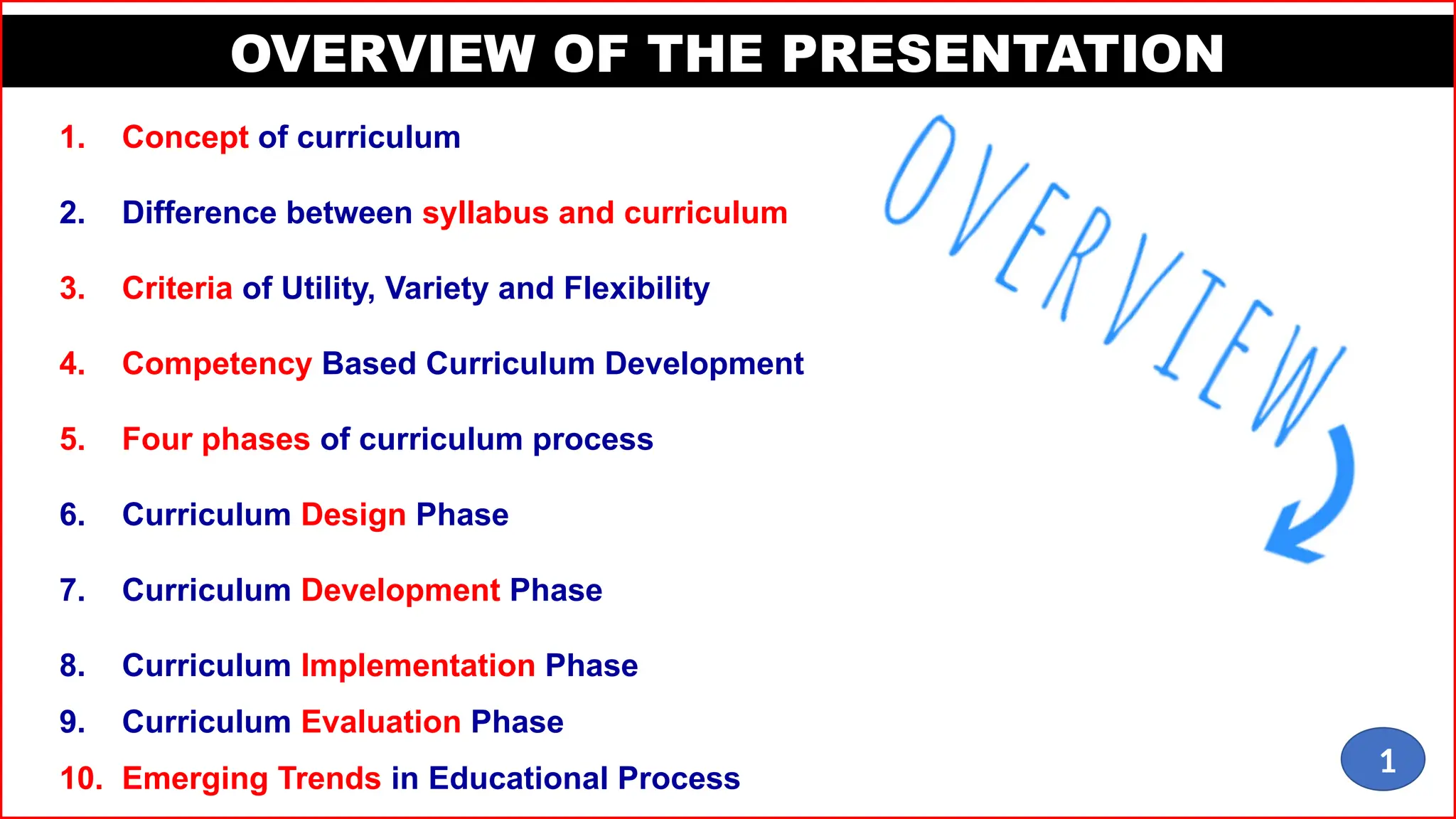
1. Concept of curriculum
2. Difference between syllabus and curriculum
3. Criteria of Utility, Variety and Flexibility
4. Competency Based Curriculum Development
5. Four phases of curriculum process
6. Curriculum Design Phase
7. Curriculum Development Phase
8. Curriculum Implementation Phase
9. Curriculum Evaluation Phase
10. Emerging Trends in Educational Process
OVERVIEW OF THE PRESENTATION
1
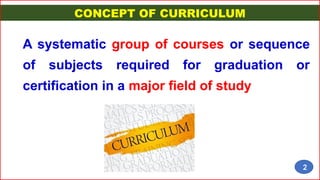
CONCEPT OF CURRICULUM
A systematic group of courses or sequence
of subjects required for graduation or
certification in a major field of study
2
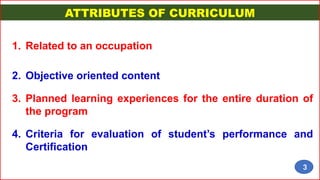
ATTRIBUTES OF CURRICULUM
1. Related to an occupation
2. Objective oriented content
3. Planned learning experiences for the entire duration of
the program
4. Criteria for evaluation of student’s performance and
Certification
3
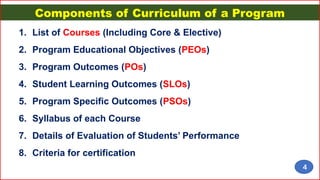
Components of Curriculum of a Program
1. List of Courses (Including Core & Elective)
2. Program Educational Objectives (PEOs)
3. Program Outcomes (POs)
4. Student Learning Outcomes (SLOs)
5. Program Specific Outcomes (PSOs)
6. Syllabus of each Course
7. Details of Evaluation of Students’ Performance
8. Criteria for certification
4
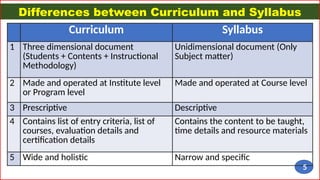
Differences between Curriculum and Syllabus
Curriculum Syllabus
1 Three dimensional document
(Students + Contents + Instructional
Methodology)
Unidimensional document (Only
Subject matter)
2 Made and operated at Institute level
or Program level
Made and operated at Course level
3 Prescriptive Descriptive
4 Contains list of entry criteria, list of
courses, evaluation details and
certification details
Contains the content to be taught,
time details and resource materials
5 Wide and holistic Narrow and specific
5
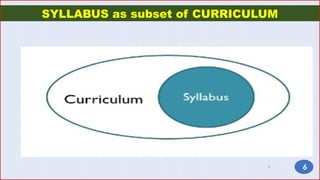
SYLLABUS as subset of CURRICULUM
6 6
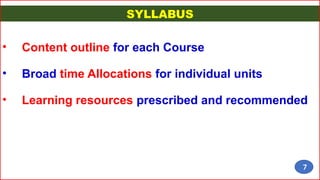
SYLLABUS
• Content outline for each Course
• Broad time Allocations for individual units
• Learning resources prescribed and recommended
7
What are the defects / deficiencies in
the syllabus of a course you are
teaching?
8
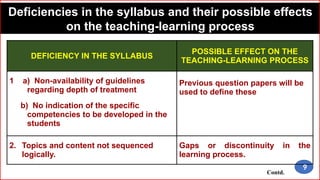
DEFICIENCY IN THE SYLLABUS
POSSIBLE EFFECT ON THE
TEACHING-LEARNING PROCESS
1 a) Non-availability of guidelines
regarding depth of treatment
b) No indication of the specific
competencies to be developed in the
students
Previous question papers will be
used to define these
2. Topics and content not sequenced
logically.
Gaps or discontinuity in the
learning process.
Contd.
Deficiencies in the syllabus and their possible effects
on the teaching-learning process
9
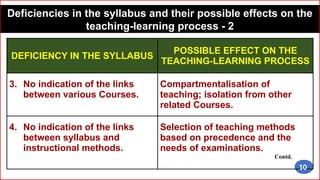
DEFICIENCY IN THE SYLLABUS
POSSIBLE EFFECT ON THE
TEACHING-LEARNING PROCESS
3. No indication of the links
between various Courses.
Compartmentalisation of
teaching; isolation from other
related Courses.
4. No indication of the links
between syllabus and
instructional methods.
Selection of teaching methods
based on precedence and the
needs of examinations.
Contd.
Deficiencies in the syllabus and their possible effects on the
teaching-learning process - 2
10
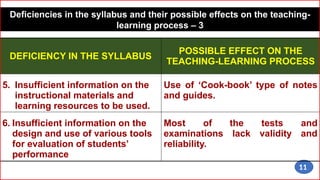
DEFICIENCY IN THE SYLLABUS
POSSIBLE EFFECT ON THE
TEACHING-LEARNING PROCESS
5. Insufficient information on the
instructional materials and
learning resources to be used.
Use of ‘Cook-book’ type of notes
and guides.
6. Insufficient information on the
design and use of various tools
for evaluation of students’
performance
Most of the tests and
examinations lack validity and
reliability.
Deficiencies in the syllabus and their possible effects on the teaching-
learning process – 3
11
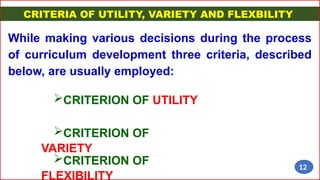
CRITERIA OF UTILITY, VARIETY AND FLEXBILITY
While making various decisions during the process
of curriculum development three criteria, described
below, are usually employed:
CRITERION OF UTILITY
CRITERION OF
VARIETY
CRITERION OF
FLEXIBILITY
12
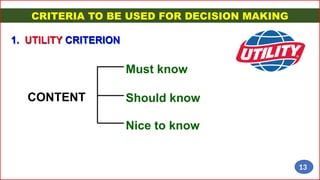
CRITERIA TO BE USED FOR DECISION MAKING
1. UTILITY CRITERION
CONTENT
Must know
Should know
Nice to know
13
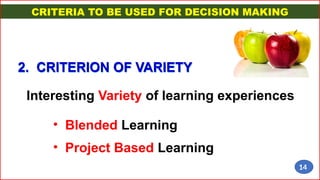
2. CRITERION OF VARIETY
Interesting Variety of learning experiences
CRITERIA TO BE USED FOR DECISION MAKING
• Blended Learning
• Project Based Learning
14
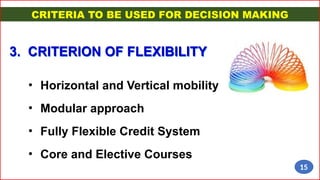
3. CRITERION OF FLEXIBILITY
• Horizontal and Vertical mobility
• Modular approach
• Fully Flexible Credit System
• Core and Elective Courses
CRITERIA TO BE USED FOR DECISION MAKING
15
COMPETENCY BASED
CURRICULUM DEVELOPMENT
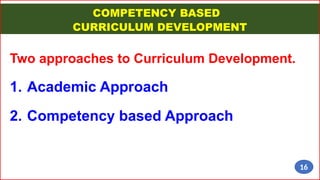
Two approaches to Curriculum Development.
1. Academic Approach
2. Competency based Approach
16
COMPETENCY
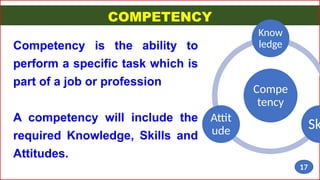
Competency is the ability to
perform a specific task which is
part of a job or profession
A competency will include the
required Knowledge, Skills and
Attitudes.
17
Compe
tency
Know
ledge
Sk
Attit
ude
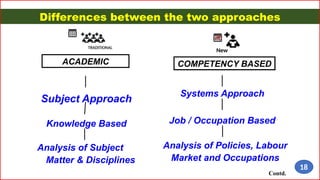
Differences between the two approaches
COMPETENCY BASED
ACADEMIC
Subject Approach
Knowledge Based
Analysis of Subject
Matter & Disciplines
Systems Approach
Job / Occupation Based
Analysis of Policies, Labour
Market and Occupations
Contd.
18
New
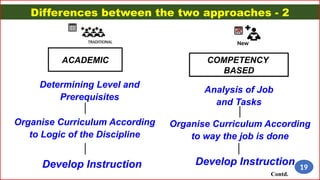
Differences between the two approaches - 2
Determining Level and
Prerequisites
Organise Curriculum According
to Logic of the Discipline
Develop Instruction
Analysis of Job
and Tasks
Contd.
Develop Instruction
Organise Curriculum According
to way the job is done
COMPETENCY
BASED
ACADEMIC
19
New
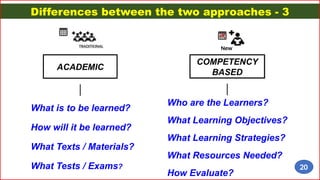
Differences between the two approaches - 3
Who are the Learners?
What Learning Objectives?
What Learning Strategies?
What Resources Needed?
How Evaluate?
What is to be learned?
How will it be learned?
What Texts / Materials?
What Tests / Exams?
COMPETENCY
BASED
ACADEMIC
20
New
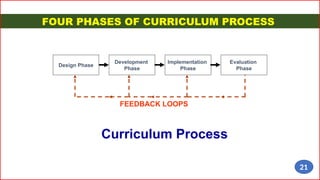
FOUR PHASES OF CURRICULUM PROCESS
Design Phase
Development
Phase
Implementation
Phase
Evaluation
Phase
Curriculum Process
FEEDBACK LOOPS
21
CURRICULUM DESIGN
PHASE
22
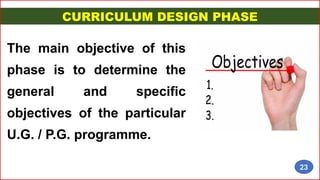
CURRICULUM DESIGN PHASE
The main objective of this
phase is to determine the
general and specific
objectives of the particular
U.G. / P.G. programme.
23
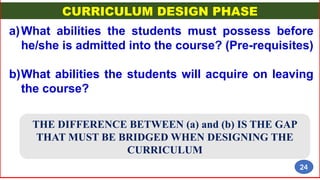
CURRICULUM DESIGN PHASE
a)What abilities the students must possess before
he/she is admitted into the course? (Pre-requisites)
b)What abilities the students will acquire on leaving
the course?
THE DIFFERENCE BETWEEN (a) and (b) IS THE GAP
THAT MUST BE BRIDGED WHEN DESIGNING THE
CURRICULUM
24
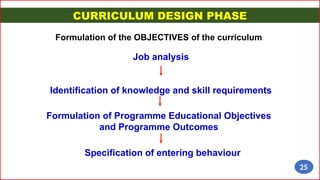
Formulation of the OBJECTIVES of the curriculum
Job analysis
Identification of knowledge and skill requirements
Formulation of Programme Educational Objectives
and Programme Outcomes
Specification of entering behaviour
CURRICULUM DESIGN PHASE
25
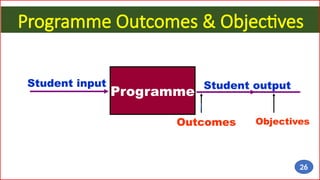
Programme Outcomes & Objectives
Student output
Student input
Programme
Outcomes Objectives
26
Slide # 26
26
27
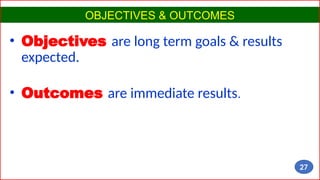
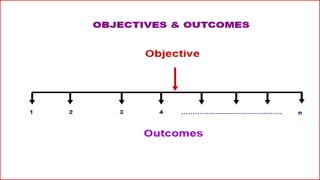
• Objectives are long term goals & results
expected.
• Outcomes are immediate results.
OBJECTIVES & OUTCOMES
Slide # 27
27
28
Slide # 28
28
OBJECTIVES & OUTCOMES
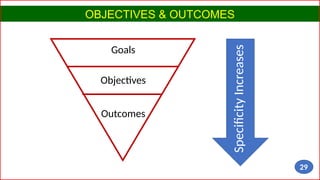
29
Slide # 29
Outcomes
Objectives
Goals
Specificity
Increases
29
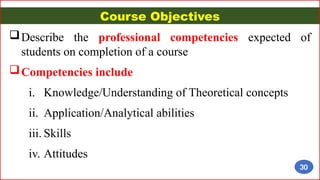
Course Objectives
Describe the professional competencies expected of
students on completion of a course
Competencies include
i. Knowledge/Understanding of Theoretical concepts
ii. Application/Analytical abilities
iii. Skills
iv. Attitudes
30
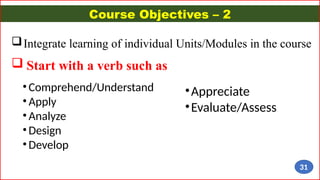
Course Objectives – 2
Integrate learning of individual Units/Modules in the course
 Start with a verb such as
• Comprehend/Understand
• Apply
• Analyze
• Design
• Develop
•Appreciate
•Evaluate/Assess
31
Example of Course Objectives
Title of the course: Data Structures and
Algorithms
On completion of the course, the student will be able to:
1. Appreciate the importance of Algorithms and Data structures
in becoming a more productive computer scientist.
2. Understand the principle that Algorithm and Data structures
used for solving a problem are more important than knowing
the exact code for it in some programming language
32
Example of Course Objectives – 2
3.Design and develop solution techniques,
based on the intrinsic nature of the problem,
independent of programming language,
programming paradigms, computer
hardware or any other implementation
technique.
33
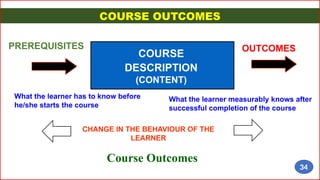
COURSE OUTCOMES
COURSE
DESCRIPTION
(CONTENT)
PREREQUISITES OUTCOMES
What the learner has to know before
he/she starts the course
What the learner measurably knows after
successful completion of the course
CHANGE IN THE BEHAVIOUR OF THE
LEARNER
Course Outcomes
34
COURSE OUTCOMES
Course Outcomes are statements that communicate in
behavioural terms the expected performance of students at
the END of the course
35
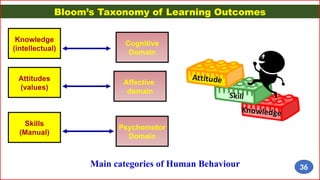
Knowledge
(intellectual)
Cognitive
Domain
Affective
domain
Attitudes
(values)
Skills
(Manual)
Psychomotor
Domain
Bloom’s Taxonomy of Learning Outcomes
Main categories of Human Behaviour 36
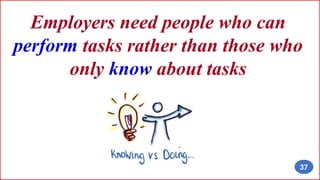
Employers need people who can
perform tasks rather than those who
only know about tasks
37
Examples of Course Outcomes
Title of the course:
Data Structures & Algorithms
38
On Completion of the course, the student will be able to:
1. Analyze the worst-case running time of Algorithms.
2. Explain the major data structures and their analysis.
3. Describe the major algorithm design – Paradigms and their analyses.
4. Illustrate major graph algorithms and their analysis.
5. Compare and contrast different data structures and. algorithmic
techniques for a give problem and assess the trade offs involved.
6. Synthesize efficient data structures and algorithms and provide
program solutions in emerging design situations.
7. Provide algorithmic solutions to real world problems.
39
CURRICULUM
DEVELOPMENT PHASE
40
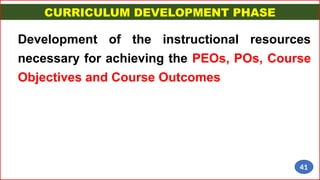
CURRICULUM DEVELOPMENT PHASE
Development of the instructional resources
necessary for achieving the PEOs, POs, Course
Objectives and Course Outcomes
41
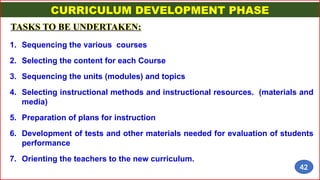
1. Sequencing the various courses
2. Selecting the content for each Course
3. Sequencing the units (modules) and topics
4. Selecting instructional methods and instructional resources. (materials and
media)
5. Preparation of plans for instruction
6. Development of tests and other materials needed for evaluation of students
performance
7. Orienting the teachers to the new curriculum.
TASKS TO BE UNDERTAKEN:
CURRICULUM DEVELOPMENT PHASE
42
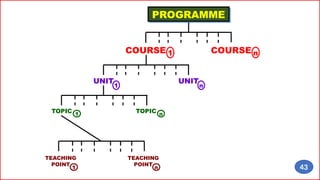
PROGRAMME
COURSE 1 COURSE n
UNIT
1 n
UNIT
TOPIC 1 TOPIC n
TEACHING
POINT
1
TEACHING
POINT
n 43
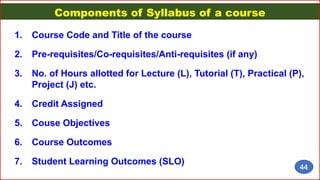
Components of Syllabus of a course
1. Course Code and Title of the course
2. Pre-requisites/Co-requisites/Anti-requisites (if any)
3. No. of Hours allotted for Lecture (L), Tutorial (T), Practical (P),
Project (J) etc.
4. Credit Assigned
5. Couse Objectives
6. Course Outcomes
7. Student Learning Outcomes (SLO)
44
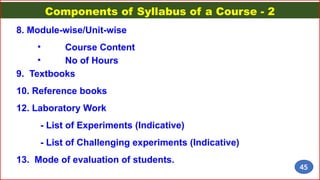
Components of Syllabus of a Course - 2
8. Module-wise/Unit-wise
• Course Content
• No of Hours
9. Textbooks
10. Reference books
12. Laboratory Work
- List of Experiments (Indicative)
- List of Challenging experiments (Indicative)
13. Mode of evaluation of students.
45
CURRICULUM
IMPLEMENTATION PHASE
46
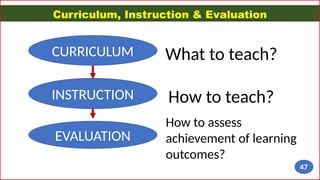
Curriculum, Instruction & Evaluation
CURRICULUM
INSTRUCTION
EVALUATION
What to teach?
How to teach?
How to assess
achievement of learning
outcomes?
47
INTENDED CURRICULUM Vs. OPERATIONAL
CURRICULUM
INTENDED CURRICULUM:
Refers to the PRESCRIPTIONS in the curriculum
document
The intended curriculum is an inert document containing
the objectives of the curriculum, content matter, time
schedules and the performance standards expected
Contd.
48
INTENDED CURRICULUM Vs. OPERATIONAL
CURRICULUM
OPERATIONAL CURRICULUM:
When an “intended curriculum” is enacted in a classroom
or given life through teaching it becomes an
“OPERATIONAL CURRICULUM”
It deals with the processes of teaching and learning,
organization of the class and the milieu in which
instruction takes place.
49
FACTORS INFLUENCING THE EFFECTIVENESS OF
CURRICULUM IMPLEMENTATION
1. FACTORS RELATED TO THE STUDENT:
 Aptitude for the subject
 Proficiency in the language which is used as the
medium of instruction
 Entering behaviour
 Motivation
Contd. 50
FACTORS INFLUENCING THE EFFECTIVENESS OF
CURRICULUM IMPLEMENTATION
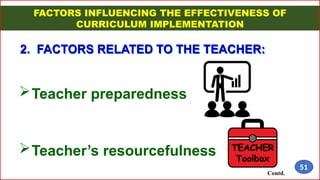
2. FACTORS RELATED TO THE TEACHER:
Teacher preparedness
Teacher’s resourcefulness
Contd.
51
FACTORS INFLUENCING THE EFFECTIVENESS OF
CURRICULUM IMPLEMENTATION
3. FACTORS RELATED TO THE INSTRUCTIONAL ENVIRONMENT:
 Appropriateness of curricular objectives
 Adequacy of instructional time
 Instructional resources
 Instructional methods and procedures
 Task orientation of the class
 Evaluation procedures used
 Feedback provided to students 52
CURRICULUM
EVALUATION PHASE
53
CURRICULUM
EVALUATION PHASE
Curriculum evaluation can be defined as the collection and
provision of evidence, on the basis of which decisions can
be taken about the efficiency, effectiveness and educational
value of curricula
54
Why should we evaluate a curriculum?
1. To bring the curricular content abreast of modern advances
2. To remove the ‘Dead Wood’ from the curriculum
3. To improve the EFFECTIVENESS of the curriculum
4. To improve the EFFICIENCY of curriculum Implementation
process
Why?
Contd…
55
Why should we evaluate a curriculum? - 2
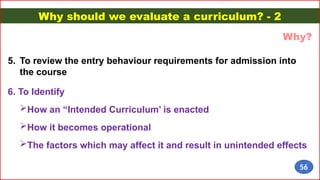
5. To review the entry behaviour requirements for admission into
the course
6. To Identify
How an “Intended Curriculum’ is enacted
How it becomes operational
The factors which may affect it and result in unintended effects
Why?
56
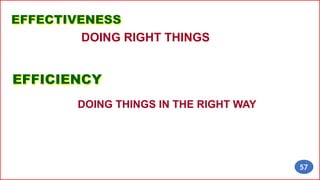
EFFECTIVENESS
DOING RIGHT THINGS
EFFICIENCY
DOING THINGS IN THE RIGHT WAY
57
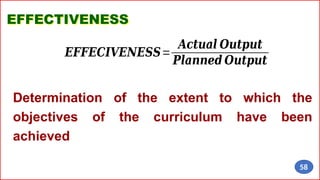
EFFECTIVENESS
Determination of the extent to which the
objectives of the curriculum have been
achieved
58
𝑬𝑭𝑭𝑬𝑪𝑰𝑽𝑬𝑵𝑬𝑺𝑺=
𝑨𝒄𝒕𝒖𝒂𝒍 𝑶𝒖𝒕𝒑𝒖𝒕
𝑷𝒍𝒂𝒏𝒏𝒆𝒅 𝑶𝒖𝒕𝒑𝒖𝒕
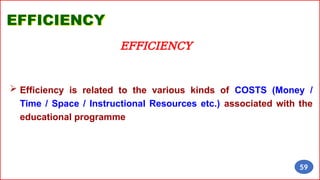
EFFICIENCY
 Efficiency is related to the various kinds of COSTS (Money /
Time / Space / Instructional Resources etc.) associated with the
educational programme
59
EFFICIENCY
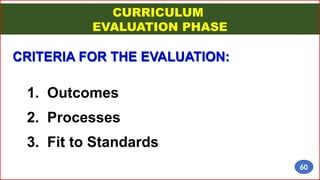
CURRICULUM
EVALUATION PHASE
1. Outcomes
2. Processes
3. Fit to Standards
CRITERIA FOR THE EVALUATION:
60
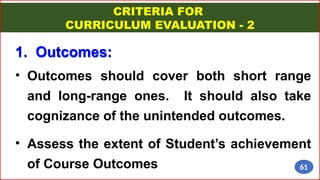
CRITERIA FOR
CURRICULUM EVALUATION - 2
• Outcomes should cover both short range
and long-range ones. It should also take
cognizance of the unintended outcomes.
• Assess the extent of Student’s achievement
of Course Outcomes
1. Outcomes:
61
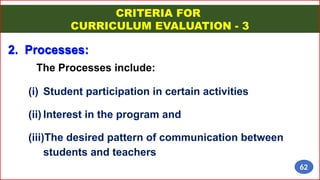
The Processes include:
2. Processes:
CRITERIA FOR
CURRICULUM EVALUATION - 3
(i) Student participation in certain activities
(ii) Interest in the program and
(iii)The desired pattern of communication between
students and teachers
62
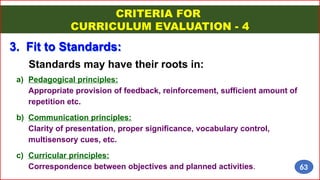
Standards may have their roots in:
3. Fit to Standards:
a) Pedagogical principles:
Appropriate provision of feedback, reinforcement, sufficient amount of
repetition etc.
b) Communication principles:
Clarity of presentation, proper significance, vocabulary control,
multisensory cues, etc.
c) Curricular principles:
Correspondence between objectives and planned activities.
CRITERIA FOR
CURRICULUM EVALUATION - 4
63
1.Formative evaluation
2.Summative evaluation
3.Curriculum Revision
Tasks to be undertaken:
CURRICULUM EVALUATION
64
This is carried out during the process of curriculum
development and implementation. The evaluation
results provide information to curriculum
developers and enable them to correct flaws
detected in the curriculum.
1. Formative evaluation:
CURRICULUM EVALUATION - 2
65
This is carried out after offering the
curriculum once or twice. Such an
evaluation will summarize the merits (as well
as the weaknesses) of the programme, hence
the notion of summative evaluation.
2. Summative evaluation:
CURRICULUM EVALUATION - 3
66
A curriculum that operates satisfactorily over a
certain period of time may gradually become
obsolete or deteriorate over time.
Curriculum evaluation will reveal whether some or
all portions of the programme should be revised.
3. Curriculum Revision
CURRICULUM EVALUATION - 4
67
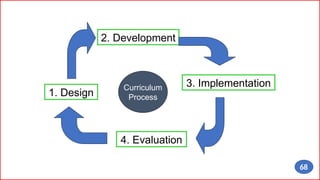
1. Design
2. Development
3. Implementation
4. Evaluation
Curriculum
Process
68 68
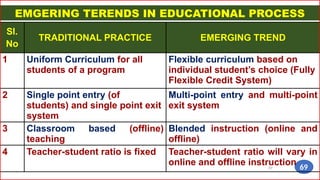
EMGERING TERENDS IN EDUCATIONAL PROCESS
69
Sl.
No
TRADITIONAL PRACTICE EMERGING TREND
1 Uniform Curriculum for all
students of a program
Flexible curriculum based on
individual student’s choice (Fully
Flexible Credit System)
2 Single point entry (of
students) and single point exit
system
Multi-point entry and multi-point
exit system
3 Classroom based (offline)
teaching
Blended instruction (online and
offline)
4 Teacher-student ratio is fixed Teacher-student ratio will vary in
online and offline instruction 69
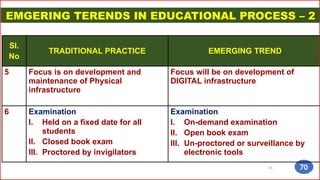
EMGERING TERENDS IN EDUCATIONAL PROCESS – 2
70
Sl.
No
TRADITIONAL PRACTICE EMERGING TREND
5 Focus is on development and
maintenance of Physical
infrastructure
Focus will be on development of
DIGITAL infrastructure
6 Examination
I. Held on a fixed date for all
students
II. Closed book exam
III. Proctored by invigilators
Examination
I. On-demand examination
II. Open book exam
III. Un-proctored or surveillance by
electronic tools
70
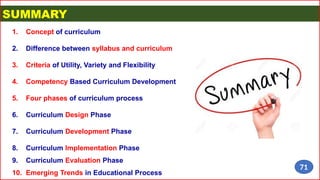
SUMMARY
1. Concept of curriculum
2. Difference between syllabus and curriculum
3. Criteria of Utility, Variety and Flexibility
4. Competency Based Curriculum Development
5. Four phases of curriculum process
6. Curriculum Design Phase
7. Curriculum Development Phase
8. Curriculum Implementation Phase
9. Curriculum Evaluation Phase
10. Emerging Trends in Educational Process
71
72
72

Competency-Based-Curriculum--development

  • 1.
    1. Concept ofcurriculum 2. Difference between syllabus and curriculum 3. Criteria of Utility, Variety and Flexibility 4. Competency Based Curriculum Development 5. Four phases of curriculum process 6. Curriculum Design Phase 7. Curriculum Development Phase 8. Curriculum Implementation Phase 9. Curriculum Evaluation Phase 10. Emerging Trends in Educational Process OVERVIEW OF THE PRESENTATION 1
  • 2.
    CONCEPT OF CURRICULUM Asystematic group of courses or sequence of subjects required for graduation or certification in a major field of study 2
  • 3.
    ATTRIBUTES OF CURRICULUM 1.Related to an occupation 2. Objective oriented content 3. Planned learning experiences for the entire duration of the program 4. Criteria for evaluation of student’s performance and Certification 3
  • 4.
    Components of Curriculumof a Program 1. List of Courses (Including Core & Elective) 2. Program Educational Objectives (PEOs) 3. Program Outcomes (POs) 4. Student Learning Outcomes (SLOs) 5. Program Specific Outcomes (PSOs) 6. Syllabus of each Course 7. Details of Evaluation of Students’ Performance 8. Criteria for certification 4
  • 5.
    Differences between Curriculumand Syllabus Curriculum Syllabus 1 Three dimensional document (Students + Contents + Instructional Methodology) Unidimensional document (Only Subject matter) 2 Made and operated at Institute level or Program level Made and operated at Course level 3 Prescriptive Descriptive 4 Contains list of entry criteria, list of courses, evaluation details and certification details Contains the content to be taught, time details and resource materials 5 Wide and holistic Narrow and specific 5
  • 6.
    SYLLABUS as subsetof CURRICULUM 6 6
  • 7.
    SYLLABUS • Content outlinefor each Course • Broad time Allocations for individual units • Learning resources prescribed and recommended 7
  • 8.
    What are thedefects / deficiencies in the syllabus of a course you are teaching? 8
  • 9.
    DEFICIENCY IN THESYLLABUS POSSIBLE EFFECT ON THE TEACHING-LEARNING PROCESS 1 a) Non-availability of guidelines regarding depth of treatment b) No indication of the specific competencies to be developed in the students Previous question papers will be used to define these 2. Topics and content not sequenced logically. Gaps or discontinuity in the learning process. Contd. Deficiencies in the syllabus and their possible effects on the teaching-learning process 9
  • 10.
    DEFICIENCY IN THESYLLABUS POSSIBLE EFFECT ON THE TEACHING-LEARNING PROCESS 3. No indication of the links between various Courses. Compartmentalisation of teaching; isolation from other related Courses. 4. No indication of the links between syllabus and instructional methods. Selection of teaching methods based on precedence and the needs of examinations. Contd. Deficiencies in the syllabus and their possible effects on the teaching-learning process - 2 10
  • 11.
    DEFICIENCY IN THESYLLABUS POSSIBLE EFFECT ON THE TEACHING-LEARNING PROCESS 5. Insufficient information on the instructional materials and learning resources to be used. Use of ‘Cook-book’ type of notes and guides. 6. Insufficient information on the design and use of various tools for evaluation of students’ performance Most of the tests and examinations lack validity and reliability. Deficiencies in the syllabus and their possible effects on the teaching- learning process – 3 11
  • 12.
    CRITERIA OF UTILITY,VARIETY AND FLEXBILITY While making various decisions during the process of curriculum development three criteria, described below, are usually employed: CRITERION OF UTILITY CRITERION OF VARIETY CRITERION OF FLEXIBILITY 12
  • 13.
    CRITERIA TO BEUSED FOR DECISION MAKING 1. UTILITY CRITERION CONTENT Must know Should know Nice to know 13
  • 14.
    2. CRITERION OFVARIETY Interesting Variety of learning experiences CRITERIA TO BE USED FOR DECISION MAKING • Blended Learning • Project Based Learning 14
  • 15.
    3. CRITERION OFFLEXIBILITY • Horizontal and Vertical mobility • Modular approach • Fully Flexible Credit System • Core and Elective Courses CRITERIA TO BE USED FOR DECISION MAKING 15
  • 16.
    COMPETENCY BASED CURRICULUM DEVELOPMENT Twoapproaches to Curriculum Development. 1. Academic Approach 2. Competency based Approach 16
  • 17.
    COMPETENCY Competency is theability to perform a specific task which is part of a job or profession A competency will include the required Knowledge, Skills and Attitudes. 17 Compe tency Know ledge Sk Attit ude
  • 18.
    Differences between thetwo approaches COMPETENCY BASED ACADEMIC Subject Approach Knowledge Based Analysis of Subject Matter & Disciplines Systems Approach Job / Occupation Based Analysis of Policies, Labour Market and Occupations Contd. 18 New
  • 19.
    Differences between thetwo approaches - 2 Determining Level and Prerequisites Organise Curriculum According to Logic of the Discipline Develop Instruction Analysis of Job and Tasks Contd. Develop Instruction Organise Curriculum According to way the job is done COMPETENCY BASED ACADEMIC 19 New
  • 20.
    Differences between thetwo approaches - 3 Who are the Learners? What Learning Objectives? What Learning Strategies? What Resources Needed? How Evaluate? What is to be learned? How will it be learned? What Texts / Materials? What Tests / Exams? COMPETENCY BASED ACADEMIC 20 New
  • 21.
    FOUR PHASES OFCURRICULUM PROCESS Design Phase Development Phase Implementation Phase Evaluation Phase Curriculum Process FEEDBACK LOOPS 21
  • 22.
  • 23.
    CURRICULUM DESIGN PHASE Themain objective of this phase is to determine the general and specific objectives of the particular U.G. / P.G. programme. 23
  • 24.
    CURRICULUM DESIGN PHASE a)Whatabilities the students must possess before he/she is admitted into the course? (Pre-requisites) b)What abilities the students will acquire on leaving the course? THE DIFFERENCE BETWEEN (a) and (b) IS THE GAP THAT MUST BE BRIDGED WHEN DESIGNING THE CURRICULUM 24
  • 25.
    Formulation of theOBJECTIVES of the curriculum Job analysis Identification of knowledge and skill requirements Formulation of Programme Educational Objectives and Programme Outcomes Specification of entering behaviour CURRICULUM DESIGN PHASE 25
  • 26.
    Programme Outcomes &Objectives Student output Student input Programme Outcomes Objectives 26 Slide # 26 26
  • 27.
    27 • Objectives arelong term goals & results expected. • Outcomes are immediate results. OBJECTIVES & OUTCOMES Slide # 27 27
  • 28.
  • 29.
    OBJECTIVES & OUTCOMES 29 Slide# 29 Outcomes Objectives Goals Specificity Increases 29
  • 30.
    Course Objectives Describe theprofessional competencies expected of students on completion of a course Competencies include i. Knowledge/Understanding of Theoretical concepts ii. Application/Analytical abilities iii. Skills iv. Attitudes 30
  • 31.
    Course Objectives –2 Integrate learning of individual Units/Modules in the course  Start with a verb such as • Comprehend/Understand • Apply • Analyze • Design • Develop •Appreciate •Evaluate/Assess 31
  • 32.
    Example of CourseObjectives Title of the course: Data Structures and Algorithms On completion of the course, the student will be able to: 1. Appreciate the importance of Algorithms and Data structures in becoming a more productive computer scientist. 2. Understand the principle that Algorithm and Data structures used for solving a problem are more important than knowing the exact code for it in some programming language 32
  • 33.
    Example of CourseObjectives – 2 3.Design and develop solution techniques, based on the intrinsic nature of the problem, independent of programming language, programming paradigms, computer hardware or any other implementation technique. 33
  • 34.
    COURSE OUTCOMES COURSE DESCRIPTION (CONTENT) PREREQUISITES OUTCOMES Whatthe learner has to know before he/she starts the course What the learner measurably knows after successful completion of the course CHANGE IN THE BEHAVIOUR OF THE LEARNER Course Outcomes 34
  • 35.
    COURSE OUTCOMES Course Outcomesare statements that communicate in behavioural terms the expected performance of students at the END of the course 35
  • 36.
  • 37.
    Employers need peoplewho can perform tasks rather than those who only know about tasks 37
  • 38.
    Examples of CourseOutcomes Title of the course: Data Structures & Algorithms 38
  • 39.
    On Completion ofthe course, the student will be able to: 1. Analyze the worst-case running time of Algorithms. 2. Explain the major data structures and their analysis. 3. Describe the major algorithm design – Paradigms and their analyses. 4. Illustrate major graph algorithms and their analysis. 5. Compare and contrast different data structures and. algorithmic techniques for a give problem and assess the trade offs involved. 6. Synthesize efficient data structures and algorithms and provide program solutions in emerging design situations. 7. Provide algorithmic solutions to real world problems. 39
  • 40.
  • 41.
    CURRICULUM DEVELOPMENT PHASE Developmentof the instructional resources necessary for achieving the PEOs, POs, Course Objectives and Course Outcomes 41
  • 42.
    1. Sequencing thevarious courses 2. Selecting the content for each Course 3. Sequencing the units (modules) and topics 4. Selecting instructional methods and instructional resources. (materials and media) 5. Preparation of plans for instruction 6. Development of tests and other materials needed for evaluation of students performance 7. Orienting the teachers to the new curriculum. TASKS TO BE UNDERTAKEN: CURRICULUM DEVELOPMENT PHASE 42
  • 43.
    PROGRAMME COURSE 1 COURSEn UNIT 1 n UNIT TOPIC 1 TOPIC n TEACHING POINT 1 TEACHING POINT n 43
  • 44.
    Components of Syllabusof a course 1. Course Code and Title of the course 2. Pre-requisites/Co-requisites/Anti-requisites (if any) 3. No. of Hours allotted for Lecture (L), Tutorial (T), Practical (P), Project (J) etc. 4. Credit Assigned 5. Couse Objectives 6. Course Outcomes 7. Student Learning Outcomes (SLO) 44
  • 45.
    Components of Syllabusof a Course - 2 8. Module-wise/Unit-wise • Course Content • No of Hours 9. Textbooks 10. Reference books 12. Laboratory Work - List of Experiments (Indicative) - List of Challenging experiments (Indicative) 13. Mode of evaluation of students. 45
  • 46.
  • 47.
    Curriculum, Instruction &Evaluation CURRICULUM INSTRUCTION EVALUATION What to teach? How to teach? How to assess achievement of learning outcomes? 47
  • 48.
    INTENDED CURRICULUM Vs.OPERATIONAL CURRICULUM INTENDED CURRICULUM: Refers to the PRESCRIPTIONS in the curriculum document The intended curriculum is an inert document containing the objectives of the curriculum, content matter, time schedules and the performance standards expected Contd. 48
  • 49.
    INTENDED CURRICULUM Vs.OPERATIONAL CURRICULUM OPERATIONAL CURRICULUM: When an “intended curriculum” is enacted in a classroom or given life through teaching it becomes an “OPERATIONAL CURRICULUM” It deals with the processes of teaching and learning, organization of the class and the milieu in which instruction takes place. 49
  • 50.
    FACTORS INFLUENCING THEEFFECTIVENESS OF CURRICULUM IMPLEMENTATION 1. FACTORS RELATED TO THE STUDENT:  Aptitude for the subject  Proficiency in the language which is used as the medium of instruction  Entering behaviour  Motivation Contd. 50
  • 51.
    FACTORS INFLUENCING THEEFFECTIVENESS OF CURRICULUM IMPLEMENTATION 2. FACTORS RELATED TO THE TEACHER: Teacher preparedness Teacher’s resourcefulness Contd. 51
  • 52.
    FACTORS INFLUENCING THEEFFECTIVENESS OF CURRICULUM IMPLEMENTATION 3. FACTORS RELATED TO THE INSTRUCTIONAL ENVIRONMENT:  Appropriateness of curricular objectives  Adequacy of instructional time  Instructional resources  Instructional methods and procedures  Task orientation of the class  Evaluation procedures used  Feedback provided to students 52
  • 53.
  • 54.
    CURRICULUM EVALUATION PHASE Curriculum evaluationcan be defined as the collection and provision of evidence, on the basis of which decisions can be taken about the efficiency, effectiveness and educational value of curricula 54
  • 55.
    Why should weevaluate a curriculum? 1. To bring the curricular content abreast of modern advances 2. To remove the ‘Dead Wood’ from the curriculum 3. To improve the EFFECTIVENESS of the curriculum 4. To improve the EFFICIENCY of curriculum Implementation process Why? Contd… 55
  • 56.
    Why should weevaluate a curriculum? - 2 5. To review the entry behaviour requirements for admission into the course 6. To Identify How an “Intended Curriculum’ is enacted How it becomes operational The factors which may affect it and result in unintended effects Why? 56
  • 57.
  • 58.
    EFFECTIVENESS Determination of theextent to which the objectives of the curriculum have been achieved 58 𝑬𝑭𝑭𝑬𝑪𝑰𝑽𝑬𝑵𝑬𝑺𝑺= 𝑨𝒄𝒕𝒖𝒂𝒍 𝑶𝒖𝒕𝒑𝒖𝒕 𝑷𝒍𝒂𝒏𝒏𝒆𝒅 𝑶𝒖𝒕𝒑𝒖𝒕
  • 59.
    EFFICIENCY  Efficiency isrelated to the various kinds of COSTS (Money / Time / Space / Instructional Resources etc.) associated with the educational programme 59 EFFICIENCY
  • 60.
    CURRICULUM EVALUATION PHASE 1. Outcomes 2.Processes 3. Fit to Standards CRITERIA FOR THE EVALUATION: 60
  • 61.
    CRITERIA FOR CURRICULUM EVALUATION- 2 • Outcomes should cover both short range and long-range ones. It should also take cognizance of the unintended outcomes. • Assess the extent of Student’s achievement of Course Outcomes 1. Outcomes: 61
  • 62.
    The Processes include: 2.Processes: CRITERIA FOR CURRICULUM EVALUATION - 3 (i) Student participation in certain activities (ii) Interest in the program and (iii)The desired pattern of communication between students and teachers 62
  • 63.
    Standards may havetheir roots in: 3. Fit to Standards: a) Pedagogical principles: Appropriate provision of feedback, reinforcement, sufficient amount of repetition etc. b) Communication principles: Clarity of presentation, proper significance, vocabulary control, multisensory cues, etc. c) Curricular principles: Correspondence between objectives and planned activities. CRITERIA FOR CURRICULUM EVALUATION - 4 63
  • 64.
    1.Formative evaluation 2.Summative evaluation 3.CurriculumRevision Tasks to be undertaken: CURRICULUM EVALUATION 64
  • 65.
    This is carriedout during the process of curriculum development and implementation. The evaluation results provide information to curriculum developers and enable them to correct flaws detected in the curriculum. 1. Formative evaluation: CURRICULUM EVALUATION - 2 65
  • 66.
    This is carriedout after offering the curriculum once or twice. Such an evaluation will summarize the merits (as well as the weaknesses) of the programme, hence the notion of summative evaluation. 2. Summative evaluation: CURRICULUM EVALUATION - 3 66
  • 67.
    A curriculum thatoperates satisfactorily over a certain period of time may gradually become obsolete or deteriorate over time. Curriculum evaluation will reveal whether some or all portions of the programme should be revised. 3. Curriculum Revision CURRICULUM EVALUATION - 4 67
  • 68.
    1. Design 2. Development 3.Implementation 4. Evaluation Curriculum Process 68 68
  • 69.
    EMGERING TERENDS INEDUCATIONAL PROCESS 69 Sl. No TRADITIONAL PRACTICE EMERGING TREND 1 Uniform Curriculum for all students of a program Flexible curriculum based on individual student’s choice (Fully Flexible Credit System) 2 Single point entry (of students) and single point exit system Multi-point entry and multi-point exit system 3 Classroom based (offline) teaching Blended instruction (online and offline) 4 Teacher-student ratio is fixed Teacher-student ratio will vary in online and offline instruction 69
  • 70.
    EMGERING TERENDS INEDUCATIONAL PROCESS – 2 70 Sl. No TRADITIONAL PRACTICE EMERGING TREND 5 Focus is on development and maintenance of Physical infrastructure Focus will be on development of DIGITAL infrastructure 6 Examination I. Held on a fixed date for all students II. Closed book exam III. Proctored by invigilators Examination I. On-demand examination II. Open book exam III. Un-proctored or surveillance by electronic tools 70
  • 71.
    SUMMARY 1. Concept ofcurriculum 2. Difference between syllabus and curriculum 3. Criteria of Utility, Variety and Flexibility 4. Competency Based Curriculum Development 5. Four phases of curriculum process 6. Curriculum Design Phase 7. Curriculum Development Phase 8. Curriculum Implementation Phase 9. Curriculum Evaluation Phase 10. Emerging Trends in Educational Process 71
  • 72.