Drug Stability
B. Pharmacy 4th Semester
Subject: Physical Pharmaceutics-II
Prepared By: Mr. Vivek Kumar
Associate Professor
SRCP, KARNAL
Drug Stability
• Contents
•Reaction kinetics: zero, pseudo-zero, first & second order, units of basic rate
constants, determination of reaction order
• Physical and chemical factors influencing the chemical degradation of
pharmaceutical product: temperature, solvent, ionic strength, dielectric constant,
specific & general acid base catalysis, Simple numerical problems
• Stabilization of medicinal agents against common reactions like hydrolysis &
oxidation
• Accelerated stability testing in expiration dating of pharmaceutical dosage forms
• Photolytic degradation and its prevention
Drug Stability
➢ Stability
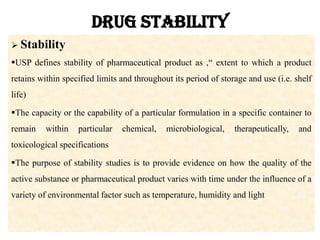
▪USP defines stability of pharmaceutical product as ,“ extent to which a product
retains within specified limits and throughout its period of storage and use (i.e. shelf
life)
▪The capacity or the capability of a particular formulation in a specific container to
remain within particular chemical, microbiological, therapeutically, and
toxicological specifications
▪The purpose of stability studies is to provide evidence on how the quality of the
active substance or pharmaceutical product varies with time under the influence of a
variety of environmental factor such as temperature, humidity and light
Drug Stability
▪ Chemical and physical degradation of drug substances may change their
pharmacological effects, which is then affecting on their therapeutic and
toxicological effect
▪ Pharmaceuticals products are used therapeutically based on their efficacy and
safety, they should be stable
▪ Maintenance of quality until the time of usage or until their expiration date
▪ The quality should be maintained under the various conditions that
pharmaceuticals encounter, during production, storage in warehouses, transportation
and storage in hospitals as well as in the home
Drug Stability
➢Adverse effects of instability of drugs
✓ Loss of active drug (e.g. aspirin hydrolysis, oxidation of adrenaline).
✓Loss of vehicle (e.g. evaporation of water from o/w creams, evaporation of
alcohol from alcoholic mixtures).
✓Loss of content uniformity (e.g. creaming of emulsions, impaction of suspensions)
✓Loss of elegance (e.g. fading of tablets and colored solutions)
✓Reduction in bioavailability (e.g. ageing of tablets resulting in a change in
dissolution profile)
✓Production of potential toxic materials (e.g. breakdown products from drug
degradation)
Drug Stability
➢ Reaction kinetics
✓ Kinetics is the study of the rate at which processes occur. It is useful in providing
information that:
✓ Gives an insight into the mechanisms of changes involved
✓ Allows a prediction of the degree of the change that will occur after a given time has
elapsed
➢ Order Of Reaction
✓ This is the number of concentration terms that determine the rate. Consider the
reaction: A + B C + D
✓ The rate of the reaction is proportional to the concentration of A to the power of x,
[A]x and also the rate may be proportional to the concentration of B to the power of y,
[B]y.
✓The overall equation is, Rate = k [A]x [B]y
✓The overall order of reaction is x+y
Drug Stability
➢ Rate Constant
✓ A rate constant is a proportionality constant that appears in a rate law. For
example, k is the rate constant in the rate law
d [A]/dt = k [A]
✓ Rate constants are independent of concentration but depend on other factors,
most notably temperature
➢ Zero Order Reaction
✓ When the reaction rate is independent of concentration of the reacting
substance, it depends on the zero power of the reactant and therefore is zero order
reaction
✓ In this type of reaction, the limiting factor is something other than
concentration, for example, absorption of light in certain photochemical reactions
Drug Stability
➢ Zero Order Reaction
✓ The rate of decomposition can be described mathematically as:
Rate of concentration decrease =
- dCx/dt = K …………… (1)
Integrating the equation yields
X= Kt ……………… (2)
A plot of X v/s Time results in straight line with slope equal to K. The value of K
indicate the amount of drug that is degraded per unit time, and intercept of line at
time zero is equal to constant in equation (2)
The unit of K is conc./ time
Drug Stability
Drug Stability
✓ Examples: -Vitamin A acetate to anhydrous
vitamin A
✓ Photolysis of cefotaxime
✓ Loss in color of multi sulfa product
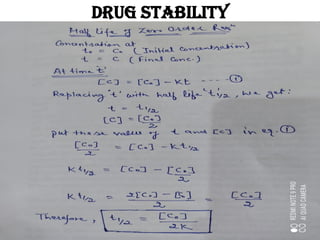
Half-life is given by equation
t1/2 = Co/2k
Drug Stability
➢ Half-Life of a Zero Order Reaction
✓ The timescale in which there is a 50% reduction in the initial population is
referred to as half-life. Half-life is denoted by the symbol ‘t1/2’
✓Derivation on next slide
✓ It can be noted from the equation given above that the half-life is dependent on
the rate constant as well as the reactant’s initial concentration
Drug Stability
Drug Stability
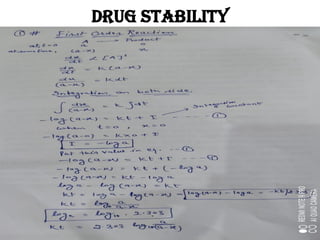
➢ First Order Reaction
✓ When the reaction rate depends on the first power of concentration of a single
reactant, it is considered to be first order
✓ Examples are: Absorption, distribution, elimination rates, Microbial death kinetics
✓ Thus the rate of reaction is directly proportional to the concentration of reacting
substance and can be expressed as follows:
Rate of concentration decrease = -dCX/dt = KCx .........(3)
If concentration of reactant X is ‘a’ at beginning of reaction when t = 0, & if amount
that has reacted after time t is denoted by x then amount of X remaining at time t will
be (a-x).Therefore equation (3) can be rewritten as:
-dCX/dt = K (a-x)
dCX/(a-x) = -Kdt-----------------------(4)
Drug Stability
➢ First Order Reaction
Drug Stability
Drug Stability
Drug Stability
➢ First Order Reaction
If first order law is obeyed then a graph of log (a-x) v/s time t will give straight line
with slope of –K/2.303 and an intercept of log a at t = 0
Drug Stability
➢ First Order Reaction
Rearranging equation (5) we have
K = 2.303 log (a/a-x) --------------(6)
t
Unit of K for first order is time-1 i.e. SI unit is (sec)-1because K is inversely
proportional to t
The half-life, t1/2, of a drug is the time required for 50% of drug to degrade and can
be calculated as follows:
Drug Stability
➢ Second Order Reaction
Rate of change in conc. of product and reactant is dependent on second power of
conc. of single reactant or to first powers of the conc. of two reactants
Here decrease in conc. of Y is similar to X. If conc. of X and Y at time t = 0 are a
and b respectively, and conc. of each substance that has reacted after time t is equal
to x then conc. of X and Y remaining will be (a-x) & (b-x) respectively
Drug Stability
➢ Second Order Reaction
Drug Stability
➢ Second Order Reaction
So, if second order reaction is observed then graph of
Drug Stability
➢ Second Order Reaction
Drug Stability
Drug Stability
Drug Stability
➢ Pseudo-zero Order Reaction
• How suspension degradation follows pseudo zero order reaction?
✓Suspension is the case of zero order kinetics in which the concentration in
solution depends on the drug’s solubility. As the drug decomposes in solution, more
drug is released from the suspended particles so that the concentration remains
constant.
✓This concentration is of course the drug’s equilibrium solubility in a particular
solvent at a particular temperature. The important point is that the amount of the
drug in the solution remains constant despite its decomposition with time
Drug Stability
➢ Pseudo-zero Order Reaction
✓ The reservoir of solid drug in suspension is responsible for this. It follows zero
order kinetics because the suspended drug reservoir that ensures constant
concentration
✓Once all the suspended particles have been converted into drug in solution the
system changes to a first –order reaction
➢ Pseudo-first Order Reaction
Here a second order or bimolecular reaction is made to behave like first order. This
is found in the case in which one reacting material is present in great excess or is
maintained at constant concentration as compared with other substance. Here
reaction rate is determined by one reactant even though two are present.
Examples: Decomposition of ascorbic acid tablet and Aspirin hydrolysis.
Drug Stability
➢ Methods to Determine Reaction Order
• Substitution Method
✓The data accumulated in a kinetic study may be substituted in the integrated form of the
equations which describes the various orders. When the equation is found in which the
calculated k values remain constant the reaction is considered to be of that order
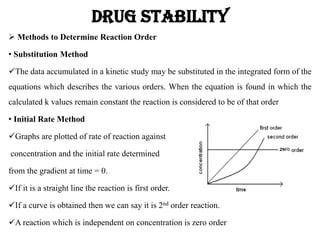
• Initial Rate Method
✓Graphs are plotted of rate of reaction against
concentration and the initial rate determined
from the gradient at time = 0.
✓If it is a straight line the reaction is first order.
✓If a curve is obtained then we can say it is 2nd order reaction.
✓A reaction which is independent on concentration is zero order
Drug Stability
➢ Methods to Determine Reaction Order
• Data Plotting Method
✓Plot of conc. against time is if linear then it is zero order reaction.
✓Plot of 1/c against time is linear then second order.
✓Plot of ln c against time is linear then first order reaction
• Half-life Determination Method
✓ The relationship in general between half-life of a reaction in which the
concentrations of all reactants are identical, is
where ‘n’ is the order of reaction
Drug Stability
Drug Stability
➢ Factors influencing rate of reaction
• Temperature
✓ The speed of reactions can be increased two to three times with each increase of
10 degree in temperature
✓ An increase in temperature will raise the average kinetic energy of the reactant
molecules
✓ A greater proportion of molecules will have the minimum energy necessary for an
effective collision
✓ The effect of temperature can be studied with the help of Arrhenius equation on
the next slide
Drug Stability
➢ Factors influencing rate of reaction
• Temperature
Drug Stability
➢ Factors influencing rate of reaction
• Temperature
When we convert the equation into logarithmic form, then we get:
Where log A is a constant
Plot of log k versus 1/T gives a straight line with slop equal to –Ea/2.303R and
intercept at Y axis equal to log A.
Drug Stability
➢Factors influencing rate of reaction
• Temperature
✓ Ea can also be determined by determining k1 at t1 and k2 at t2 by using following
equation:
Drug Stability
➢ Factors influencing rate of reaction
• Solvent
✓ Effect of solvent on the rate of decomposition of drug is related to the relative
solubility of the reactants and products in the given solvents
✓The quantitative relationship between the reaction rate constant and the solubility of the
reactants and products is given by the equation:
k is observed reaction rate constant
is reaction rate constant in an infinitely dilute solution
V is molar volume of the reactants A and B and the activated complex formed during
the reaction and prior to the formation of the product
are the solubility parameters of reactants A, B and the activated
complex respectively
Drug Stability
➢Factors influencing rate of reaction
• Solvent
✓ Polar solvents tend to accelerate reactions in which the products formed are more
polar than the reactants
✓ if the product formed less polar than the reactants, then the reaction proceeds
better in solvent of relatively low polarity
Drug Stability
➢ Factors influencing rate of reaction
• Ionic Strength
✓ Effect of ionic strength of a solution of the rate of degradation can be expressed in
the following equation:
k is the degradation rate constant
is the reaction rate constant at infinite dilution
are the charges carried by the reactants A and B in solution
respectively
μ is the ionic strength of the solution
Drug Stability
➢ Factors influencing rate of reaction
• Ionic Strength
✓ According to the previous equation, an increase in the ionic strength of the solution
would tend to decrease the rate of reaction involving interaction between oppositely
charged ions
✓And increase the rate of reaction between similarly charged ions
✓ For example:
✓Reaction between ions and dipolar molecules and reaction between neutral molecules
are generally not affected to a significant extent by change in ionic concentration
✓ Reactions which results in formation of oppositely charged ions (as product) exhibit
considerable increase in reaction rate on increasing the ionic strength
Drug Stability
➢ Factors influencing rate of reaction
• Dielectric constant of solvent
✓ For a reaction involving a charged reactant molecule and another ionic species (H+ or
OH-), the effect of the dielectric constant on the reaction rate is given by following
equation:
k is the observed reaction rate in a solvent of dielectric constant ε
is the reaction rate constant in a solvent of infinite dielectric constant
N is the Avogadro’s number
e is the unit of electric charge
r* is the distance between the ionic species in the activated complex
According to the above equation, reactions involving ions of opposite charge are
accelerated by solvents of low dielectric constant
Drug Stability
➢Factors influencing rate of reaction
• Catalysis
✓ A catalyst is a substance which increase or decrease the rate of a reaction without
itself being altered chemically
• (a) Specific acid-base catalysis
✓ A number of drugs in solution undergo hydrolytic degradation in solution upon
addition of an acid or a base
✓ If the drug solution is buffered, the decomposition may not be accompanied by a
significant change in the concentration of acid or base and the reaction may be
considered to be catalyzed by hydrogen or hydroxyl ions and called specific acid-
base catalyze
Drug Stability
➢Factors influencing rate of reaction
• Catalysis
✓ The effect of hydrogen or hydroxyl ion concentration on specific acid or base
catalyzed reactions can be expressed as:
✓The observed rate constant is given by:
✓ At low pH, the hydrogen ion concentration is high and hence
is greater than and observed reaction rate constant becomes:
and the reaction is said to be acid catalyzed or specific hydrogen ion catalyzed
Drug Stability
➢Factors influencing rate of reaction
• Catalysis
✓ At higher pH, the hydroxyl ion concentration is high and hence the term
is greater than the and observed reaction becomes:
The reaction is said to be specific hydroxyl ion or base catalyzed.
At an intermediate pH, when the concentrations of hydrogen and hydroxyl ions are
low or if the products of are small in value and the observed
reaction rate becomes:
In this case, the reaction is said to be solvent catalyzed
Drug Stability
➢Factors influencing rate of reaction
• Catalysis
• (b) General acid-base catalysis
✓ In this, undissociated acids or base also produce a catalytic effect on the reaction
✓ Buffers are employed to maintain the pH of the solution and one or more
component of buffer catalyze the rate of reaction
✓ If the catalytic component is acidic, the reaction is said to be general acid
catalysis
✓ If the catalytic component is basic, the reaction is said to be general base
catalysis
Drug Stability
➢Factors influencing rate of reaction
• Surfactants
✓ The presence of surfactants in micellar form has been shown to have a modifying
effect on the rate of hydrolysis of drugs
✓ The magnitude of this effect depends upon the difference in the rate constant in
aqueous solution and when the drug is solubilized within the micelle and on the
extent of solubilization
✓ Drugs which are solubilized within the interior of the micelle are less susceptible
to hydrolysis than those on the micellar surface
Drug Stability
➢ Causes of instability and their Stabilization
✓ Chemical degradation of a dosage form occurs through several pathways like–
hydrolysis, oxidation, decarboxylation, photolysis, racemization. Which may lead to
lowering of therapeutic agent in the dosage form, formation of toxic product,
decreased bioavailability etc.
▪ Hydrolysis
✓Most important in systems containing water such as emulsion, suspension,
solutions, etc.
✓Also for drugs which are affected by moisture (water vapor) from atmosphere.
✓It is usually catalyzed by hydrogen ion (acid) or hydroxyl ion (base)
✓ Main classes of drugs that undergo hydrolysis are the Esters, Amide, Lactams
Drug Stability
➢ Causes of instability and their Stabilization
▪ Hydrolysis
✓ Ester Hydrolysis: involve acyl-oxygen cleavage
✓Example of drugs: Aspirin, Atropine, Physostigmine, Procaine
✓ Amide Hydrolysis: more stable than ester, susceptible to specific and general acid
base hydrolysis. It involves cleavage of amide linkage to give an amine instead of
alcohol as in case of esters
✓ Example of drugs: Chloramphenicol, Barbiturates
Drug Stability
➢Causes of instability and their Stabilization
▪ Hydrolysis
✓ Amide Hydrolysis
Drug Stability
➢ Protection against Hydrolysis
✓ Avoiding contact with moisture at time of manufacture
✓ Packaging in suitable moisture resistant packs such as strip packs and storage in
controlled humidity and temperature
✓ In liquid dosage form since, hydrolysis is acid or base catalyzed, an optimum pH
for maximum stability should be selected and the formulation should be stabilized at
this pH by inclusion of proper buffering agents
✓ Hydrolysis of certain drugs such as benzocaine and procaine can be decreased by
the addition of specific complexing agent like caffeine to the drug solutions
✓ Hydrolysis susceptible drugs such as penicillin and derivatives can be prevented
by formulating them in the dry powder form for reconstitution or dispersible tablets
instead of a liquid dosage form such as solutions or suspensions
Drug Stability
➢Causes of instability and their Stabilization
▪ Oxidation
✓ Occurs when exposed to atmospheric oxygen
✓ Either the addition of oxygen or removal of hydrogen
✓Oxidation is the loss of electrons while reduction is the gain of electrons
✓ The reaction between the compounds, only a small amount of oxygen is required
for initiating the chain reaction is called autoxidation
✓ Free radicals produced during initial reaction are highly reactive and further
catalyze the reaction produced additional free radicals and causing a chain reaction
✓ Heavy metals such as copper, iron, cobalt, and nickel have been known to catalyze
the oxidative degradation
✓ Heat and light further influence the kinetics of oxidative degradation processes
Drug Stability
➢Causes of instability and their Stabilization
▪ Oxidation
➢ Protection against Oxidation
✓ Use Of Antioxidants: antioxidants are Mainly of 3 types: 1.The first group
probably inhibits the oxidation by reacting with free radicals. Example–tocopherol,
butylated hydroxyl anisole (BHA), butylated hydroxyl toluene's (BHT).
Concentration 0.001–0.1%
✓ The second group comprising the reducing agents, have a lower redox potential
than the drug or other substance that they should protect and are therefore more
readily oxidized Example–ascorbic acid and isoascorbic acid, potassium or sodium
salts of metabisulfite
✓ The third group, little antioxidant effect them self but enhance the action of true
antioxidant .Example—Citric acid, tartaric acid, disodium edetate and lecithin
Drug Stability
➢Causes of instability and their Stabilization
▪ Oxidation
➢ Protection against Oxidation
✓ Use Of Chelating Agent: when heavy metals catalyze oxidation. Example--
EDTA, citric acid, tartaric acid form complexes
Drug Stability
➢ Accelerated Stability Analysis
✓ These are designed to predict the stability of product under normal conditions or
recommended storage conditions of temperature, light and moisture
✓ Storage conditions of 40°C±2°C and relative humidity of 75±5%
• Objectives
✓ For selection of best formulations
✓ To predict the shelf life of the product
✓ To check quality control
• Common high stresses during stability testing
✓ Temperature
✓ Humidity
✓ Light
Drug Stability
➢ Accelerated Stability Analysis
• Prediction of Shelf Life
✓ Shelf life is the time period during which the dosage form is supposed to retains
its original qualities
✓ Evaluation is done to determine the decrease in the concentration of active
ingredient or increase in the concentration of degradation product under accelerated
storage conditions
✓ The stability is studied in the containers in which they are intended to be marketed
or in containers which sufficiently mimic the actual containers
Drug Stability
➢Accelerated Stability Analysis
• Prediction of Shelf Life
✓ Prepared formulation is divided into different portions and each portion is stored at
different elevated temperature
✓ Order of reaction or Reaction rate constant for the degradation at each of the elevated
temperature calculated
✓ With the help of Arrhenius relationship, the reaction rate constant for the degradation
at room temperature is determined
Drug Stability
➢Accelerated Stability Analysis
• Prediction of Shelf Life
✓ The k value obtained for room temperature is then substituted in the appropriate
rate equation and find the time period
✓ Calculations for overages is carried out to compensate for the loss in concentration
during the shelf life
Drug Stability
➢ Accelerated Stability Analysis
• Limitations of Accelerated Stability Analysis
✓ Valid only when the energy of activation for the thermal decomposition lies within
the range of 10-30 kcal/mol
✓ Actual information may not be obtained
✓ Order of reaction may be different in real and accelerated conditions
✓ Accelerated testing can not be used if decomposition is due to freezing, micro-
organisms, excessive agitation during transport
✓ Ointments, suppositories, products containing proteins, methyl cellulose are NOT
suitable for accelerated testing
Drug Stability
➢ Photolysis
✓ When degradation of the drug take place in presence of light
✓ Exposure to light may produce oxidation-reduction, ring rearrangement,
polymerisation
✓ The shorter wavelength of light, the greater is the effect of light in initiating the
chemical reaction due to high energy
Drug Stability
• Prevention of Photolysis
✓ It can be reduced by using amber colored container or by storing the product in
dark place
✓ Packing in cartons also act as a physical barrier to light
✓ Coating of tablets with polymer films containing ultraviolet absorbers also reduce
the photolysis of drug
Drug Stability
▪ Numerical Problems
Drug Stability
▪ Numerical Problems
Drug Stability
▪ Numerical Problems

Drug Stability.pdf

  • 1.
    Drug Stability B. Pharmacy4th Semester Subject: Physical Pharmaceutics-II Prepared By: Mr. Vivek Kumar Associate Professor SRCP, KARNAL
  • 2.
    Drug Stability • Contents •Reactionkinetics: zero, pseudo-zero, first & second order, units of basic rate constants, determination of reaction order • Physical and chemical factors influencing the chemical degradation of pharmaceutical product: temperature, solvent, ionic strength, dielectric constant, specific & general acid base catalysis, Simple numerical problems • Stabilization of medicinal agents against common reactions like hydrolysis & oxidation • Accelerated stability testing in expiration dating of pharmaceutical dosage forms • Photolytic degradation and its prevention
  • 3.
    Drug Stability ➢ Stability ▪USPdefines stability of pharmaceutical product as ,“ extent to which a product retains within specified limits and throughout its period of storage and use (i.e. shelf life) ▪The capacity or the capability of a particular formulation in a specific container to remain within particular chemical, microbiological, therapeutically, and toxicological specifications ▪The purpose of stability studies is to provide evidence on how the quality of the active substance or pharmaceutical product varies with time under the influence of a variety of environmental factor such as temperature, humidity and light
  • 4.
    Drug Stability ▪ Chemicaland physical degradation of drug substances may change their pharmacological effects, which is then affecting on their therapeutic and toxicological effect ▪ Pharmaceuticals products are used therapeutically based on their efficacy and safety, they should be stable ▪ Maintenance of quality until the time of usage or until their expiration date ▪ The quality should be maintained under the various conditions that pharmaceuticals encounter, during production, storage in warehouses, transportation and storage in hospitals as well as in the home
  • 5.
    Drug Stability ➢Adverse effectsof instability of drugs ✓ Loss of active drug (e.g. aspirin hydrolysis, oxidation of adrenaline). ✓Loss of vehicle (e.g. evaporation of water from o/w creams, evaporation of alcohol from alcoholic mixtures). ✓Loss of content uniformity (e.g. creaming of emulsions, impaction of suspensions) ✓Loss of elegance (e.g. fading of tablets and colored solutions) ✓Reduction in bioavailability (e.g. ageing of tablets resulting in a change in dissolution profile) ✓Production of potential toxic materials (e.g. breakdown products from drug degradation)
  • 6.
    Drug Stability ➢ Reactionkinetics ✓ Kinetics is the study of the rate at which processes occur. It is useful in providing information that: ✓ Gives an insight into the mechanisms of changes involved ✓ Allows a prediction of the degree of the change that will occur after a given time has elapsed ➢ Order Of Reaction ✓ This is the number of concentration terms that determine the rate. Consider the reaction: A + B C + D ✓ The rate of the reaction is proportional to the concentration of A to the power of x, [A]x and also the rate may be proportional to the concentration of B to the power of y, [B]y. ✓The overall equation is, Rate = k [A]x [B]y ✓The overall order of reaction is x+y
  • 7.
    Drug Stability ➢ RateConstant ✓ A rate constant is a proportionality constant that appears in a rate law. For example, k is the rate constant in the rate law d [A]/dt = k [A] ✓ Rate constants are independent of concentration but depend on other factors, most notably temperature ➢ Zero Order Reaction ✓ When the reaction rate is independent of concentration of the reacting substance, it depends on the zero power of the reactant and therefore is zero order reaction ✓ In this type of reaction, the limiting factor is something other than concentration, for example, absorption of light in certain photochemical reactions
  • 8.
    Drug Stability ➢ ZeroOrder Reaction ✓ The rate of decomposition can be described mathematically as: Rate of concentration decrease = - dCx/dt = K …………… (1) Integrating the equation yields X= Kt ……………… (2) A plot of X v/s Time results in straight line with slope equal to K. The value of K indicate the amount of drug that is degraded per unit time, and intercept of line at time zero is equal to constant in equation (2) The unit of K is conc./ time
  • 9.
  • 10.
    Drug Stability ✓ Examples:-Vitamin A acetate to anhydrous vitamin A ✓ Photolysis of cefotaxime ✓ Loss in color of multi sulfa product Half-life is given by equation t1/2 = Co/2k
  • 11.
    Drug Stability ➢ Half-Lifeof a Zero Order Reaction ✓ The timescale in which there is a 50% reduction in the initial population is referred to as half-life. Half-life is denoted by the symbol ‘t1/2’ ✓Derivation on next slide ✓ It can be noted from the equation given above that the half-life is dependent on the rate constant as well as the reactant’s initial concentration
  • 12.
  • 13.
    Drug Stability ➢ FirstOrder Reaction ✓ When the reaction rate depends on the first power of concentration of a single reactant, it is considered to be first order ✓ Examples are: Absorption, distribution, elimination rates, Microbial death kinetics ✓ Thus the rate of reaction is directly proportional to the concentration of reacting substance and can be expressed as follows: Rate of concentration decrease = -dCX/dt = KCx .........(3) If concentration of reactant X is ‘a’ at beginning of reaction when t = 0, & if amount that has reacted after time t is denoted by x then amount of X remaining at time t will be (a-x).Therefore equation (3) can be rewritten as: -dCX/dt = K (a-x) dCX/(a-x) = -Kdt-----------------------(4)
  • 14.
  • 15.
  • 16.
  • 17.
    Drug Stability ➢ FirstOrder Reaction If first order law is obeyed then a graph of log (a-x) v/s time t will give straight line with slope of –K/2.303 and an intercept of log a at t = 0
  • 18.
    Drug Stability ➢ FirstOrder Reaction Rearranging equation (5) we have K = 2.303 log (a/a-x) --------------(6) t Unit of K for first order is time-1 i.e. SI unit is (sec)-1because K is inversely proportional to t The half-life, t1/2, of a drug is the time required for 50% of drug to degrade and can be calculated as follows:
  • 19.
    Drug Stability ➢ SecondOrder Reaction Rate of change in conc. of product and reactant is dependent on second power of conc. of single reactant or to first powers of the conc. of two reactants Here decrease in conc. of Y is similar to X. If conc. of X and Y at time t = 0 are a and b respectively, and conc. of each substance that has reacted after time t is equal to x then conc. of X and Y remaining will be (a-x) & (b-x) respectively
  • 20.
  • 21.
    Drug Stability ➢ SecondOrder Reaction So, if second order reaction is observed then graph of
  • 22.
  • 23.
  • 24.
  • 25.
    Drug Stability ➢ Pseudo-zeroOrder Reaction • How suspension degradation follows pseudo zero order reaction? ✓Suspension is the case of zero order kinetics in which the concentration in solution depends on the drug’s solubility. As the drug decomposes in solution, more drug is released from the suspended particles so that the concentration remains constant. ✓This concentration is of course the drug’s equilibrium solubility in a particular solvent at a particular temperature. The important point is that the amount of the drug in the solution remains constant despite its decomposition with time
  • 26.
    Drug Stability ➢ Pseudo-zeroOrder Reaction ✓ The reservoir of solid drug in suspension is responsible for this. It follows zero order kinetics because the suspended drug reservoir that ensures constant concentration ✓Once all the suspended particles have been converted into drug in solution the system changes to a first –order reaction ➢ Pseudo-first Order Reaction Here a second order or bimolecular reaction is made to behave like first order. This is found in the case in which one reacting material is present in great excess or is maintained at constant concentration as compared with other substance. Here reaction rate is determined by one reactant even though two are present. Examples: Decomposition of ascorbic acid tablet and Aspirin hydrolysis.
  • 27.
    Drug Stability ➢ Methodsto Determine Reaction Order • Substitution Method ✓The data accumulated in a kinetic study may be substituted in the integrated form of the equations which describes the various orders. When the equation is found in which the calculated k values remain constant the reaction is considered to be of that order • Initial Rate Method ✓Graphs are plotted of rate of reaction against concentration and the initial rate determined from the gradient at time = 0. ✓If it is a straight line the reaction is first order. ✓If a curve is obtained then we can say it is 2nd order reaction. ✓A reaction which is independent on concentration is zero order
  • 28.
    Drug Stability ➢ Methodsto Determine Reaction Order • Data Plotting Method ✓Plot of conc. against time is if linear then it is zero order reaction. ✓Plot of 1/c against time is linear then second order. ✓Plot of ln c against time is linear then first order reaction • Half-life Determination Method ✓ The relationship in general between half-life of a reaction in which the concentrations of all reactants are identical, is where ‘n’ is the order of reaction
  • 29.
  • 30.
    Drug Stability ➢ Factorsinfluencing rate of reaction • Temperature ✓ The speed of reactions can be increased two to three times with each increase of 10 degree in temperature ✓ An increase in temperature will raise the average kinetic energy of the reactant molecules ✓ A greater proportion of molecules will have the minimum energy necessary for an effective collision ✓ The effect of temperature can be studied with the help of Arrhenius equation on the next slide
  • 31.
    Drug Stability ➢ Factorsinfluencing rate of reaction • Temperature
  • 32.
    Drug Stability ➢ Factorsinfluencing rate of reaction • Temperature When we convert the equation into logarithmic form, then we get: Where log A is a constant Plot of log k versus 1/T gives a straight line with slop equal to –Ea/2.303R and intercept at Y axis equal to log A.
  • 33.
    Drug Stability ➢Factors influencingrate of reaction • Temperature ✓ Ea can also be determined by determining k1 at t1 and k2 at t2 by using following equation:
  • 34.
    Drug Stability ➢ Factorsinfluencing rate of reaction • Solvent ✓ Effect of solvent on the rate of decomposition of drug is related to the relative solubility of the reactants and products in the given solvents ✓The quantitative relationship between the reaction rate constant and the solubility of the reactants and products is given by the equation: k is observed reaction rate constant is reaction rate constant in an infinitely dilute solution V is molar volume of the reactants A and B and the activated complex formed during the reaction and prior to the formation of the product are the solubility parameters of reactants A, B and the activated complex respectively
  • 35.
    Drug Stability ➢Factors influencingrate of reaction • Solvent ✓ Polar solvents tend to accelerate reactions in which the products formed are more polar than the reactants ✓ if the product formed less polar than the reactants, then the reaction proceeds better in solvent of relatively low polarity
  • 36.
    Drug Stability ➢ Factorsinfluencing rate of reaction • Ionic Strength ✓ Effect of ionic strength of a solution of the rate of degradation can be expressed in the following equation: k is the degradation rate constant is the reaction rate constant at infinite dilution are the charges carried by the reactants A and B in solution respectively μ is the ionic strength of the solution
  • 37.
    Drug Stability ➢ Factorsinfluencing rate of reaction • Ionic Strength ✓ According to the previous equation, an increase in the ionic strength of the solution would tend to decrease the rate of reaction involving interaction between oppositely charged ions ✓And increase the rate of reaction between similarly charged ions ✓ For example: ✓Reaction between ions and dipolar molecules and reaction between neutral molecules are generally not affected to a significant extent by change in ionic concentration ✓ Reactions which results in formation of oppositely charged ions (as product) exhibit considerable increase in reaction rate on increasing the ionic strength
  • 38.
    Drug Stability ➢ Factorsinfluencing rate of reaction • Dielectric constant of solvent ✓ For a reaction involving a charged reactant molecule and another ionic species (H+ or OH-), the effect of the dielectric constant on the reaction rate is given by following equation: k is the observed reaction rate in a solvent of dielectric constant ε is the reaction rate constant in a solvent of infinite dielectric constant N is the Avogadro’s number e is the unit of electric charge r* is the distance between the ionic species in the activated complex According to the above equation, reactions involving ions of opposite charge are accelerated by solvents of low dielectric constant
  • 39.
    Drug Stability ➢Factors influencingrate of reaction • Catalysis ✓ A catalyst is a substance which increase or decrease the rate of a reaction without itself being altered chemically • (a) Specific acid-base catalysis ✓ A number of drugs in solution undergo hydrolytic degradation in solution upon addition of an acid or a base ✓ If the drug solution is buffered, the decomposition may not be accompanied by a significant change in the concentration of acid or base and the reaction may be considered to be catalyzed by hydrogen or hydroxyl ions and called specific acid- base catalyze
  • 40.
    Drug Stability ➢Factors influencingrate of reaction • Catalysis ✓ The effect of hydrogen or hydroxyl ion concentration on specific acid or base catalyzed reactions can be expressed as: ✓The observed rate constant is given by: ✓ At low pH, the hydrogen ion concentration is high and hence is greater than and observed reaction rate constant becomes: and the reaction is said to be acid catalyzed or specific hydrogen ion catalyzed
  • 41.
    Drug Stability ➢Factors influencingrate of reaction • Catalysis ✓ At higher pH, the hydroxyl ion concentration is high and hence the term is greater than the and observed reaction becomes: The reaction is said to be specific hydroxyl ion or base catalyzed. At an intermediate pH, when the concentrations of hydrogen and hydroxyl ions are low or if the products of are small in value and the observed reaction rate becomes: In this case, the reaction is said to be solvent catalyzed
  • 42.
    Drug Stability ➢Factors influencingrate of reaction • Catalysis • (b) General acid-base catalysis ✓ In this, undissociated acids or base also produce a catalytic effect on the reaction ✓ Buffers are employed to maintain the pH of the solution and one or more component of buffer catalyze the rate of reaction ✓ If the catalytic component is acidic, the reaction is said to be general acid catalysis ✓ If the catalytic component is basic, the reaction is said to be general base catalysis
  • 43.
    Drug Stability ➢Factors influencingrate of reaction • Surfactants ✓ The presence of surfactants in micellar form has been shown to have a modifying effect on the rate of hydrolysis of drugs ✓ The magnitude of this effect depends upon the difference in the rate constant in aqueous solution and when the drug is solubilized within the micelle and on the extent of solubilization ✓ Drugs which are solubilized within the interior of the micelle are less susceptible to hydrolysis than those on the micellar surface
  • 44.
    Drug Stability ➢ Causesof instability and their Stabilization ✓ Chemical degradation of a dosage form occurs through several pathways like– hydrolysis, oxidation, decarboxylation, photolysis, racemization. Which may lead to lowering of therapeutic agent in the dosage form, formation of toxic product, decreased bioavailability etc. ▪ Hydrolysis ✓Most important in systems containing water such as emulsion, suspension, solutions, etc. ✓Also for drugs which are affected by moisture (water vapor) from atmosphere. ✓It is usually catalyzed by hydrogen ion (acid) or hydroxyl ion (base) ✓ Main classes of drugs that undergo hydrolysis are the Esters, Amide, Lactams
  • 45.
    Drug Stability ➢ Causesof instability and their Stabilization ▪ Hydrolysis ✓ Ester Hydrolysis: involve acyl-oxygen cleavage ✓Example of drugs: Aspirin, Atropine, Physostigmine, Procaine ✓ Amide Hydrolysis: more stable than ester, susceptible to specific and general acid base hydrolysis. It involves cleavage of amide linkage to give an amine instead of alcohol as in case of esters ✓ Example of drugs: Chloramphenicol, Barbiturates
  • 46.
    Drug Stability ➢Causes ofinstability and their Stabilization ▪ Hydrolysis ✓ Amide Hydrolysis
  • 47.
    Drug Stability ➢ Protectionagainst Hydrolysis ✓ Avoiding contact with moisture at time of manufacture ✓ Packaging in suitable moisture resistant packs such as strip packs and storage in controlled humidity and temperature ✓ In liquid dosage form since, hydrolysis is acid or base catalyzed, an optimum pH for maximum stability should be selected and the formulation should be stabilized at this pH by inclusion of proper buffering agents ✓ Hydrolysis of certain drugs such as benzocaine and procaine can be decreased by the addition of specific complexing agent like caffeine to the drug solutions ✓ Hydrolysis susceptible drugs such as penicillin and derivatives can be prevented by formulating them in the dry powder form for reconstitution or dispersible tablets instead of a liquid dosage form such as solutions or suspensions
  • 48.
    Drug Stability ➢Causes ofinstability and their Stabilization ▪ Oxidation ✓ Occurs when exposed to atmospheric oxygen ✓ Either the addition of oxygen or removal of hydrogen ✓Oxidation is the loss of electrons while reduction is the gain of electrons ✓ The reaction between the compounds, only a small amount of oxygen is required for initiating the chain reaction is called autoxidation ✓ Free radicals produced during initial reaction are highly reactive and further catalyze the reaction produced additional free radicals and causing a chain reaction ✓ Heavy metals such as copper, iron, cobalt, and nickel have been known to catalyze the oxidative degradation ✓ Heat and light further influence the kinetics of oxidative degradation processes
  • 49.
    Drug Stability ➢Causes ofinstability and their Stabilization ▪ Oxidation ➢ Protection against Oxidation ✓ Use Of Antioxidants: antioxidants are Mainly of 3 types: 1.The first group probably inhibits the oxidation by reacting with free radicals. Example–tocopherol, butylated hydroxyl anisole (BHA), butylated hydroxyl toluene's (BHT). Concentration 0.001–0.1% ✓ The second group comprising the reducing agents, have a lower redox potential than the drug or other substance that they should protect and are therefore more readily oxidized Example–ascorbic acid and isoascorbic acid, potassium or sodium salts of metabisulfite ✓ The third group, little antioxidant effect them self but enhance the action of true antioxidant .Example—Citric acid, tartaric acid, disodium edetate and lecithin
  • 50.
    Drug Stability ➢Causes ofinstability and their Stabilization ▪ Oxidation ➢ Protection against Oxidation ✓ Use Of Chelating Agent: when heavy metals catalyze oxidation. Example-- EDTA, citric acid, tartaric acid form complexes
  • 51.
    Drug Stability ➢ AcceleratedStability Analysis ✓ These are designed to predict the stability of product under normal conditions or recommended storage conditions of temperature, light and moisture ✓ Storage conditions of 40°C±2°C and relative humidity of 75±5% • Objectives ✓ For selection of best formulations ✓ To predict the shelf life of the product ✓ To check quality control • Common high stresses during stability testing ✓ Temperature ✓ Humidity ✓ Light
  • 52.
    Drug Stability ➢ AcceleratedStability Analysis • Prediction of Shelf Life ✓ Shelf life is the time period during which the dosage form is supposed to retains its original qualities ✓ Evaluation is done to determine the decrease in the concentration of active ingredient or increase in the concentration of degradation product under accelerated storage conditions ✓ The stability is studied in the containers in which they are intended to be marketed or in containers which sufficiently mimic the actual containers
  • 53.
    Drug Stability ➢Accelerated StabilityAnalysis • Prediction of Shelf Life ✓ Prepared formulation is divided into different portions and each portion is stored at different elevated temperature ✓ Order of reaction or Reaction rate constant for the degradation at each of the elevated temperature calculated ✓ With the help of Arrhenius relationship, the reaction rate constant for the degradation at room temperature is determined
  • 54.
    Drug Stability ➢Accelerated StabilityAnalysis • Prediction of Shelf Life ✓ The k value obtained for room temperature is then substituted in the appropriate rate equation and find the time period ✓ Calculations for overages is carried out to compensate for the loss in concentration during the shelf life
  • 55.
    Drug Stability ➢ AcceleratedStability Analysis • Limitations of Accelerated Stability Analysis ✓ Valid only when the energy of activation for the thermal decomposition lies within the range of 10-30 kcal/mol ✓ Actual information may not be obtained ✓ Order of reaction may be different in real and accelerated conditions ✓ Accelerated testing can not be used if decomposition is due to freezing, micro- organisms, excessive agitation during transport ✓ Ointments, suppositories, products containing proteins, methyl cellulose are NOT suitable for accelerated testing
  • 56.
    Drug Stability ➢ Photolysis ✓When degradation of the drug take place in presence of light ✓ Exposure to light may produce oxidation-reduction, ring rearrangement, polymerisation ✓ The shorter wavelength of light, the greater is the effect of light in initiating the chemical reaction due to high energy
  • 57.
    Drug Stability • Preventionof Photolysis ✓ It can be reduced by using amber colored container or by storing the product in dark place ✓ Packing in cartons also act as a physical barrier to light ✓ Coating of tablets with polymer films containing ultraviolet absorbers also reduce the photolysis of drug
  • 58.
  • 59.
  • 60.