The Psychopathic CEO-By
Dr.MAHBOOB KHAN
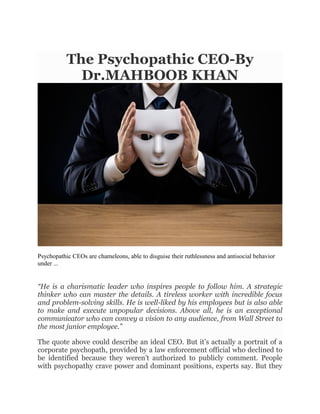
Psychopathic CEOs are chameleons, able to disguise their ruthlessness and antisocial behavior
under ...
“He is a charismatic leader who inspires people to follow him. A strategic
thinker who can master the details. A tireless worker with incredible focus
and problem-solving skills. He is well-liked by his employees but is also able
to make and execute unpopular decisions. Above all, he is an exceptional
communicator who can convey a vision to any audience, from Wall Street to
the most junior employee.”
The quote above could describe an ideal CEO. But it’s actually a portrait of a
corporate psychopath, provided by a law enforcement official who declined to
be identified because they weren’t authorized to publicly comment. People
with psychopathy crave power and dominant positions, experts say. But they
are also chameleons, able to disguise their ruthlessness and antisocial
behavior under the veneer of charm and eloquence. In the most extreme,
clinical, cases those traits have allowed serial killers to elude capture.
But when it comes to the corporate world, non-violent, corporate psychopaths
are not running from the law, but instead, rushing to the executive suite. One
route to grabbing power for the highly intelligent psychopath is to climb the
corporate ladder. There is a real chance that at some point a chief financial
officer will be confronted with a psychopathic boss. Roughly 4% to as high as
12% of CEOs exhibit psychopathic traits, according to some expert estimates,
many times more than the 1% rate found in the general population and more
in line with the 15% rate found in prisons.
“I would say that psychopaths or people with psychopathic traits, thrive in
chaos and know that others don’t, so they will often create chaos at work for
this reason,” says Tara Swart, a neuroscientist and faculty member at the MIT
Sloan School of Management. “As the right-hand person, and with an element
of control over the finances as well as strategy, CFOs can work to create
certainty and stability for people, to mitigate this.”
A psychopath is different from a psychotic in that the latter is a person who
has lost touch with reality, often suffering from delusions, while the former is
not detached from reality but lacks empathy and doesn’t care about the
consequences of his or her actions. Psychopaths are generally considered
intelligent, manipulative and charming – and lack the ability to learn from
mistakes or punishment.
“They are typically very charming on the surface, they are bold and not afraid,”
says Karen Landay, a Ph.D. candidate in business management at University
of Alabama. Earlier this year she co-authored a research report on
psychopathy and leadership with her advisor, Associate Professor Peter
Harms and Marcus Crede, a member of the psychology department at Iowa
State University. “They don’t care that they are hurting you. They will do what
they have to do.”
Psychopaths are more closely related to sociopaths than to psychotics, because
both are categorized as having antisocial personality disorders. In their
ground-breaking 2006 book “Snakes in Suits,” Paul Babiak and Robert Hare
were among the first to attempt to quantify the presence of corporate
psychopaths in the C-suite. They estimated the rate of psychopathy in the
executive suite to be 3.9%. Since the release of the book there has been much
disagreement over the extent of the presence of psychopaths in corporate
America with most other estimates landing between 8% and 12%.
Landay says that over the course of her research she has found that there is no
conclusive evidence indicating that a large percentage of CEOs are
psychopaths. Her work did find, however, that people with psychopathic
tendencies were slightly more likely to become leaders. People with these
traits are good at “impression management” and know how to get people to
like them, she says. Landay added that men were more likely than women to
be rewarded for exhibiting psychopathic traits.
“Clinical psychopathy is a personality disorder and that is something that is
diagnosed by a medical doctor,” Landay says. “That is not what we are talking
about when we are looking at psychopathic CEOs. We are just talking about
people who have really, really crappy personalities,” who share some of the
personality traits of psychopaths, including boldness, meanness and
impulsivity. “Lack of empathy is definitely a hallmark trait,” she says.
According to British psychologist Kevin Dutton, the top four career choices for
psychopaths are CEO, attorney, media personality and salesperson. Editor’s
Note: The author has held three of these four roles.
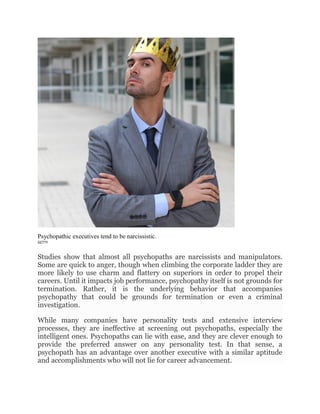
Psychopathic executives tend to be narcissistic.
GETTY
Studies show that almost all psychopaths are narcissists and manipulators.
Some are quick to anger, though when climbing the corporate ladder they are
more likely to use charm and flattery on superiors in order to propel their
careers. Until it impacts job performance, psychopathy itself is not grounds for
termination. Rather, it is the underlying behavior that accompanies
psychopathy that could be grounds for termination or even a criminal
investigation.
While many companies have personality tests and extensive interview
processes, they are ineffective at screening out psychopaths, especially the
intelligent ones. Psychopaths can lie with ease, and they are clever enough to
provide the preferred answer on any personality test. In that sense, a
psychopath has an advantage over another executive with a similar aptitude
and accomplishments who will not lie for career advancement.
The “Me too” movement has raised awareness of psychopaths in corporate
environments. When noting the accusations against Harvey Weinstein, it’s not
a stretch to wonder if he could possibly share some of the classic traits of a
psychopath. Based on media reports, it appears likely he was a very persuasive
and charismatic person.
Elizabeth Holmes, founder and CEO of Theranos. Miss Holmes was the youngest female self-
made ... [+]
GETTY IMAGES
Elizabeth Holmes, the founder of Theranos, also appeared to hold a similar
sway over supporters, which included the Clintons and the Obamas.
Opinions vary on how to deal with the psychopathic CEO. MIT’s Swart says a
CFO is among the first line of defense against an out-of-control leader. Landay
disagrees. “There is no dealing with a corporate psychopath,” she says. “You
need to get out.” Several CFOs advised that psychopaths should not be trifled
with because they are typically more ruthless, better at scheming and far more
manipulative than their colleagues. Whatever the tactic, carefully
documenting all aberrant behavior can prove useful down the road.
Members of the CFO Leadership Council, a global membership organization
for financial leaders, shared their stories of CEOs whom they believe might be
psychopaths. They did so anonymously to avoid any retribution. Much of this
behavior falls in a gray area and it’s perhaps not clear if the misdeeds are the
product of psychopathic traits or just abhorrent behavior. But, at a certain
point, there is no difference. A sample of their stories include the following:
· CEO who worked with several pregnant women told people that he had
impregnated his colleagues. Gave S&M paraphernalia as Christmas gifts to
female employees. Lied to CFO and said her husband was having an affair. He
was finally reported to the board, but employees feared him, so the complaint
went nowhere.
· CEO made employees wait outside his office, often for hours, to talk to him
about routine matters. Even the CFO was made to wait outside his office in a
classic power trip.
· CEO told CFO not to hire “fat chicks” but instead to focus on women who
look like “Lara Croft, Tomb Raider.” He didn’t see a problem with putting a
down payment for his Ferrari on a company credit card.
· CFO thought his CEO had a split personality, until he realized that he was
simply playing different characters based on what he needed from his
audience.
· Autocratic CEO fired a well-respected engineer “just to make a statement.”
He fired anyone who challenged him, explaining there was no reason to
second-guess him because he was always right and needed people to execute
his vision rather than challenge it.
· CFO and CEO were presenting to a private equity investor who asked for the
financial model to be rerun with reduced revenue growth assumptions,
causing the CEO to go ballistic and charge at the investor. CFO believes there
would have been a physical fight if he had not been present.
· CEO requests reports but does not read them. Routinely tells employees they
are stupid and untalented. Encourages the CFO to yell at employees to inspire
fear.
· CEO wanted a “kiss my ass” club, inspired by Vince McMahon of World
Wrestling Entertainment. Employees who made mistakes had to literally kiss
his backside if they wanted to keep their jobs. CEO did not understand why an
employee would have a problem doing so, though eventually the CFO
persuaded him not to do this. He did not seem to realize that McMahon had
created the routine as a gimmick.
· CFO informed VP of Sales (who would later be promoted to CEO) that his
sales team was cheating on orders by taking side letters and not reporting
them. VP lost his cool, poked his finger into the CFO’s chest and repeatedly
said “how dare you?” CFO therefore assumed VP did not know about the
practice, but emails eventually proved that not only did he know but that he
had orchestrated it. CFO remembers thinking that the VP was a better actor
than Meryl Streep.
· CEO kept large picture of himself on the wall of his office, a picture which
multiple employees reported seeing him kiss. He also fired a receptionist who
had been a model employee for 20 years because he “wanted somebody
prettier” to reflect the image of the company he was building.
· CEO would show up to work and begin yelling at an employee (usually
someone in sales) for no obvious reason. He believed in managing through
intimidation and considered yelling at people a motivational tool.

The Psychopathic CEO

  • 1.
    The Psychopathic CEO-By Dr.MAHBOOBKHAN Psychopathic CEOs are chameleons, able to disguise their ruthlessness and antisocial behavior under ... “He is a charismatic leader who inspires people to follow him. A strategic thinker who can master the details. A tireless worker with incredible focus and problem-solving skills. He is well-liked by his employees but is also able to make and execute unpopular decisions. Above all, he is an exceptional communicator who can convey a vision to any audience, from Wall Street to the most junior employee.” The quote above could describe an ideal CEO. But it’s actually a portrait of a corporate psychopath, provided by a law enforcement official who declined to be identified because they weren’t authorized to publicly comment. People with psychopathy crave power and dominant positions, experts say. But they
  • 2.
    are also chameleons,able to disguise their ruthlessness and antisocial behavior under the veneer of charm and eloquence. In the most extreme, clinical, cases those traits have allowed serial killers to elude capture. But when it comes to the corporate world, non-violent, corporate psychopaths are not running from the law, but instead, rushing to the executive suite. One route to grabbing power for the highly intelligent psychopath is to climb the corporate ladder. There is a real chance that at some point a chief financial officer will be confronted with a psychopathic boss. Roughly 4% to as high as 12% of CEOs exhibit psychopathic traits, according to some expert estimates, many times more than the 1% rate found in the general population and more in line with the 15% rate found in prisons. “I would say that psychopaths or people with psychopathic traits, thrive in chaos and know that others don’t, so they will often create chaos at work for this reason,” says Tara Swart, a neuroscientist and faculty member at the MIT Sloan School of Management. “As the right-hand person, and with an element of control over the finances as well as strategy, CFOs can work to create certainty and stability for people, to mitigate this.” A psychopath is different from a psychotic in that the latter is a person who has lost touch with reality, often suffering from delusions, while the former is not detached from reality but lacks empathy and doesn’t care about the consequences of his or her actions. Psychopaths are generally considered intelligent, manipulative and charming – and lack the ability to learn from mistakes or punishment. “They are typically very charming on the surface, they are bold and not afraid,” says Karen Landay, a Ph.D. candidate in business management at University of Alabama. Earlier this year she co-authored a research report on psychopathy and leadership with her advisor, Associate Professor Peter Harms and Marcus Crede, a member of the psychology department at Iowa State University. “They don’t care that they are hurting you. They will do what they have to do.” Psychopaths are more closely related to sociopaths than to psychotics, because both are categorized as having antisocial personality disorders. In their ground-breaking 2006 book “Snakes in Suits,” Paul Babiak and Robert Hare were among the first to attempt to quantify the presence of corporate psychopaths in the C-suite. They estimated the rate of psychopathy in the
  • 3.
    executive suite tobe 3.9%. Since the release of the book there has been much disagreement over the extent of the presence of psychopaths in corporate America with most other estimates landing between 8% and 12%. Landay says that over the course of her research she has found that there is no conclusive evidence indicating that a large percentage of CEOs are psychopaths. Her work did find, however, that people with psychopathic tendencies were slightly more likely to become leaders. People with these traits are good at “impression management” and know how to get people to like them, she says. Landay added that men were more likely than women to be rewarded for exhibiting psychopathic traits. “Clinical psychopathy is a personality disorder and that is something that is diagnosed by a medical doctor,” Landay says. “That is not what we are talking about when we are looking at psychopathic CEOs. We are just talking about people who have really, really crappy personalities,” who share some of the personality traits of psychopaths, including boldness, meanness and impulsivity. “Lack of empathy is definitely a hallmark trait,” she says. According to British psychologist Kevin Dutton, the top four career choices for psychopaths are CEO, attorney, media personality and salesperson. Editor’s Note: The author has held three of these four roles.
  • 4.
    Psychopathic executives tendto be narcissistic. GETTY Studies show that almost all psychopaths are narcissists and manipulators. Some are quick to anger, though when climbing the corporate ladder they are more likely to use charm and flattery on superiors in order to propel their careers. Until it impacts job performance, psychopathy itself is not grounds for termination. Rather, it is the underlying behavior that accompanies psychopathy that could be grounds for termination or even a criminal investigation. While many companies have personality tests and extensive interview processes, they are ineffective at screening out psychopaths, especially the intelligent ones. Psychopaths can lie with ease, and they are clever enough to provide the preferred answer on any personality test. In that sense, a psychopath has an advantage over another executive with a similar aptitude and accomplishments who will not lie for career advancement.
  • 5.
    The “Me too”movement has raised awareness of psychopaths in corporate environments. When noting the accusations against Harvey Weinstein, it’s not a stretch to wonder if he could possibly share some of the classic traits of a psychopath. Based on media reports, it appears likely he was a very persuasive and charismatic person. Elizabeth Holmes, founder and CEO of Theranos. Miss Holmes was the youngest female self- made ... [+] GETTY IMAGES Elizabeth Holmes, the founder of Theranos, also appeared to hold a similar sway over supporters, which included the Clintons and the Obamas. Opinions vary on how to deal with the psychopathic CEO. MIT’s Swart says a CFO is among the first line of defense against an out-of-control leader. Landay disagrees. “There is no dealing with a corporate psychopath,” she says. “You need to get out.” Several CFOs advised that psychopaths should not be trifled with because they are typically more ruthless, better at scheming and far more
  • 6.
    manipulative than theircolleagues. Whatever the tactic, carefully documenting all aberrant behavior can prove useful down the road. Members of the CFO Leadership Council, a global membership organization for financial leaders, shared their stories of CEOs whom they believe might be psychopaths. They did so anonymously to avoid any retribution. Much of this behavior falls in a gray area and it’s perhaps not clear if the misdeeds are the product of psychopathic traits or just abhorrent behavior. But, at a certain point, there is no difference. A sample of their stories include the following: · CEO who worked with several pregnant women told people that he had impregnated his colleagues. Gave S&M paraphernalia as Christmas gifts to female employees. Lied to CFO and said her husband was having an affair. He was finally reported to the board, but employees feared him, so the complaint went nowhere. · CEO made employees wait outside his office, often for hours, to talk to him about routine matters. Even the CFO was made to wait outside his office in a classic power trip. · CEO told CFO not to hire “fat chicks” but instead to focus on women who look like “Lara Croft, Tomb Raider.” He didn’t see a problem with putting a down payment for his Ferrari on a company credit card. · CFO thought his CEO had a split personality, until he realized that he was simply playing different characters based on what he needed from his audience. · Autocratic CEO fired a well-respected engineer “just to make a statement.” He fired anyone who challenged him, explaining there was no reason to second-guess him because he was always right and needed people to execute his vision rather than challenge it. · CFO and CEO were presenting to a private equity investor who asked for the financial model to be rerun with reduced revenue growth assumptions, causing the CEO to go ballistic and charge at the investor. CFO believes there would have been a physical fight if he had not been present. · CEO requests reports but does not read them. Routinely tells employees they are stupid and untalented. Encourages the CFO to yell at employees to inspire fear.
  • 7.
    · CEO wanteda “kiss my ass” club, inspired by Vince McMahon of World Wrestling Entertainment. Employees who made mistakes had to literally kiss his backside if they wanted to keep their jobs. CEO did not understand why an employee would have a problem doing so, though eventually the CFO persuaded him not to do this. He did not seem to realize that McMahon had created the routine as a gimmick. · CFO informed VP of Sales (who would later be promoted to CEO) that his sales team was cheating on orders by taking side letters and not reporting them. VP lost his cool, poked his finger into the CFO’s chest and repeatedly said “how dare you?” CFO therefore assumed VP did not know about the practice, but emails eventually proved that not only did he know but that he had orchestrated it. CFO remembers thinking that the VP was a better actor than Meryl Streep. · CEO kept large picture of himself on the wall of his office, a picture which multiple employees reported seeing him kiss. He also fired a receptionist who had been a model employee for 20 years because he “wanted somebody prettier” to reflect the image of the company he was building. · CEO would show up to work and begin yelling at an employee (usually someone in sales) for no obvious reason. He believed in managing through intimidation and considered yelling at people a motivational tool.