External Factors
(SWOT Analysis)
External Factors
What happens outside of the
organization is equally as important
to the success of an organization as
internal factors.
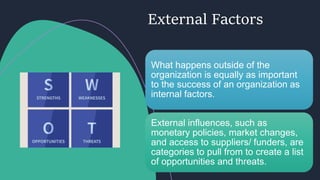
External influences, such as
monetary policies, market changes,
and access to suppliers/ funders, are
categories to pull from to create a list
of opportunities and threats.
Identifying the External Factors
What trends are evident in the marketplace/ grant application space?
What demographics/communities are we not targeting?
How many competitors exist, and what is their market share/ impact
factor?
Are there new regulations that potentially could harm our operations or
products pr services?
OPPORTUNITY THREAT
THREAT
OPPORTUNITY
THERE ARE TWO TYPES OF EXTERNAL FACTORS.
Opportunities
Opportunities refer to favourable
external factors that could give an
organization a competitive
advantage.
For example, if a country cuts
tariffs, a car manufacturer can
export its cars into a new market,
increasing sales and market share.
Opportunities
They usually arise from situations
outside your organization and require
an eye to what might happen in the
future.
They might arise as developments in
the market you serve, or in the
technology you use.
Being able to spot and exploit
opportunities can make a huge
difference to your organization's ability
to compete and take the lead in your
market.
Threats
Threats refer to factors that have the
potential to harm an organization.
For example, a drought is a threat to a
wheat-producing company, as it may
destroy or reduce the crop yield.
Other common threats include things like
rising costs for materials, increasing
competition, tight labour supply.
Threats
They consist of competitive
advantages of rivals,
uncontrollable influences such as
natural disasters, governmental
policies, and more.
Identifying threats can help
expose barriers to success and
position companies to develop
strategies to overcome them.
How to do a SWOT Analysis
Avoid relying on your own, partial understanding of
your organization. Your assumptions could be wrong.
Instead, gather a team of people from a range of
functions and levels to build a broad and insightful
list of observations.
Then, every time you identify a Strength, Weakness,
Opportunity, or Threat, write it down in the relevant
part of the SWOT analysis grid for all to see.
Guiding Questions
• What technology can we use to improve
operations?
• Can we expand our core operations?
• What new market segments can we
explore?
Opportunities
• What new regulations threaten operations?
• What do our competitors do well?
• What consumer trends threaten business?
Threats
SWOT Analysis
Case Study
EXAMPLE 2
Mistakes in conducting SWOT
Making your lists too long. Ask yourself if your ideas are feasible as you go along.
Being vague. Be specific to provide more focus for later discussions.
Not seeing weaknesses. Be sure to ask customers and colleagues what they experience in real life.
Not thinking ahead. It's easy to come up with nice ideas without taking them through to their logical conclusion. Always
consider their practical impact.
Being unrealistic. Don't plan in detail for opportunities that don't exist yet. For example, that export market you've been
eyeing may be available at some point, but the trade negotiations to open it up could take years.
Relying on SWOT Analysis alone. SWOT Analysis is valuable. But when you use it alongside other planning tools (SOAR,
TOWS or PEST), the results will be more vigorous.
Bottom Line
A SWOT analysis is a great way to guide
business-strategy meetings. It's powerful
to have everyone in the room discuss
the organization's core strengths and
weaknesses, define the opportunities
and threats, and brainstorm ideas.
Oftentimes, the SWOT analysis you
envision before the session changes
throughout to reflect factors you were
unaware of and would never have
captured if not for the group’s input.

External Factors (SWOT Analysis)

  • 1.
  • 2.
    External Factors What happensoutside of the organization is equally as important to the success of an organization as internal factors. External influences, such as monetary policies, market changes, and access to suppliers/ funders, are categories to pull from to create a list of opportunities and threats.
  • 3.
    Identifying the ExternalFactors What trends are evident in the marketplace/ grant application space? What demographics/communities are we not targeting? How many competitors exist, and what is their market share/ impact factor? Are there new regulations that potentially could harm our operations or products pr services? OPPORTUNITY THREAT THREAT OPPORTUNITY THERE ARE TWO TYPES OF EXTERNAL FACTORS.
  • 4.
    Opportunities Opportunities refer tofavourable external factors that could give an organization a competitive advantage. For example, if a country cuts tariffs, a car manufacturer can export its cars into a new market, increasing sales and market share.
  • 5.
    Opportunities They usually arisefrom situations outside your organization and require an eye to what might happen in the future. They might arise as developments in the market you serve, or in the technology you use. Being able to spot and exploit opportunities can make a huge difference to your organization's ability to compete and take the lead in your market.
  • 6.
    Threats Threats refer tofactors that have the potential to harm an organization. For example, a drought is a threat to a wheat-producing company, as it may destroy or reduce the crop yield. Other common threats include things like rising costs for materials, increasing competition, tight labour supply.
  • 7.
    Threats They consist ofcompetitive advantages of rivals, uncontrollable influences such as natural disasters, governmental policies, and more. Identifying threats can help expose barriers to success and position companies to develop strategies to overcome them.
  • 8.
    How to doa SWOT Analysis Avoid relying on your own, partial understanding of your organization. Your assumptions could be wrong. Instead, gather a team of people from a range of functions and levels to build a broad and insightful list of observations. Then, every time you identify a Strength, Weakness, Opportunity, or Threat, write it down in the relevant part of the SWOT analysis grid for all to see.
  • 9.
    Guiding Questions • Whattechnology can we use to improve operations? • Can we expand our core operations? • What new market segments can we explore? Opportunities • What new regulations threaten operations? • What do our competitors do well? • What consumer trends threaten business? Threats
  • 10.
  • 14.
  • 17.
    Mistakes in conductingSWOT Making your lists too long. Ask yourself if your ideas are feasible as you go along. Being vague. Be specific to provide more focus for later discussions. Not seeing weaknesses. Be sure to ask customers and colleagues what they experience in real life. Not thinking ahead. It's easy to come up with nice ideas without taking them through to their logical conclusion. Always consider their practical impact. Being unrealistic. Don't plan in detail for opportunities that don't exist yet. For example, that export market you've been eyeing may be available at some point, but the trade negotiations to open it up could take years. Relying on SWOT Analysis alone. SWOT Analysis is valuable. But when you use it alongside other planning tools (SOAR, TOWS or PEST), the results will be more vigorous.
  • 18.
    Bottom Line A SWOTanalysis is a great way to guide business-strategy meetings. It's powerful to have everyone in the room discuss the organization's core strengths and weaknesses, define the opportunities and threats, and brainstorm ideas. Oftentimes, the SWOT analysis you envision before the session changes throughout to reflect factors you were unaware of and would never have captured if not for the group’s input.