A firm's strengths are its resources and capabilities that can be used for developing a competitive advantage. Strong brand names  Good reputation among customers  Affiliation/registeration with some reknowned  Institutions.
The absence of certain strengths are a weakness. Lack of patent protection  A weak brand name  Poor reputation among customers  High cost structure  Lack of access to key distribution channels
In some cases, a weakness may be the flip side of a strength.  For example, a firm has a large amount of manufacturing capacity.  While this capacity may be considered a strength that competitors do not share, it also may be a considered a weakness if the large investment in manufacturing capacity prevents the firm from reacting quickly to changes in the strategic environment.
The external environmental analysis may reveal certain new opportunities for profit and growth. Some examples of such opportunities include: An unfulfilled customer need  Arrival of new technologies  Loosening of regulations  Removal of international trade barriers
Changes in the external environmental also may present threats to the firm. Some examples of such threats include: Shifts in consumer tastes away from the firm's products  Emergence of substitute products  New regulations  Increased trade barriers
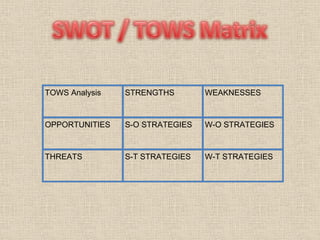
To develop strategies that take into account the SWOT profile, a matrix of these factors can be constructed. The SWOT matrix, can be changed into what is known as the  TOWS Matrix  that is shown on the next slide:
TOWS Analysis STRENGTHS WEAKNESSES OPPORTUNITIES THREATS S-O STRATEGIES W-O STRATEGIES S-T STRATEGIES W-T STRATEGIES
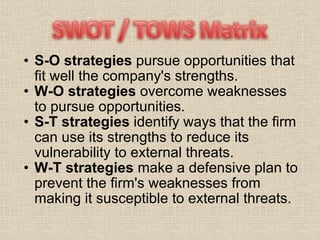
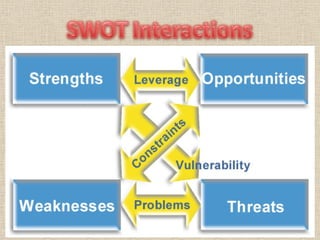
S-O strategies  pursue opportunities that fit well the company's strengths. W-O strategies  overcome weaknesses to pursue opportunities. S-T strategies  identify ways that the firm can use its strengths to reduce its vulnerability to external threats. W-T strategies  make a defensive plan to prevent the firm's weaknesses from making it susceptible to external threats.
 
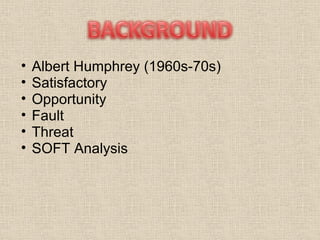
Albert Humphrey (1960s-70s) Satisfactory Opportunity Fault Threat SOFT Analysis
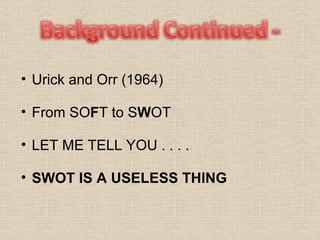
Urick and Orr (1964) From SO F T to S W OT LET ME TELL YOU . . . .  SWOT IS A USELESS THING
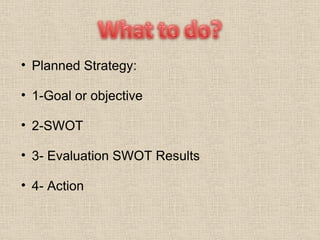
Planned Strategy: 1-Goal or objective  2-SWOT 3- Evaluation SWOT Results 4- Action
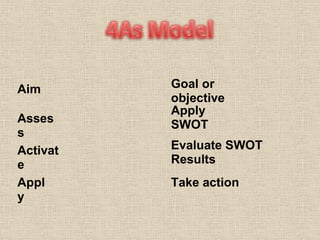
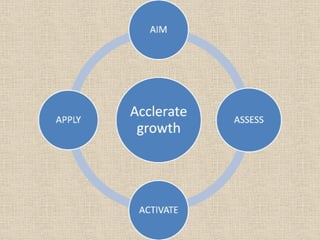
Aim Assess Activate Apply Goal or objective  Apply SWOT Evaluate SWOT Results Take action
 
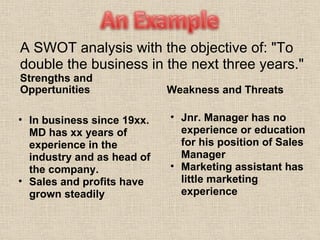
Strengths and Oppertunities In business since 19xx. MD has xx years of experience in the industry and as head of the company.  Sales and profits have grown steadily  Weakness and Threats Jnr. Manager has no experience or education for his position of Sales Manager              Marketing assistant has little marketing experience A SWOT analysis with the objective of: "To double the business in the next three years."  .
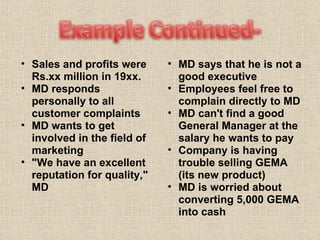
Sales and profits were Rs.xx million in 19xx. MD responds personally to all customer complaints MD wants to get involved in the field of marketing "We have an excellent reputation for quality," MD MD says that he is not a good executive Employees feel free to complain directly to MD MD can't find a good General Manager at the salary he wants to pay Company is having trouble selling GEMA (its new product) MD is worried about converting 5,000 GEMA into cash
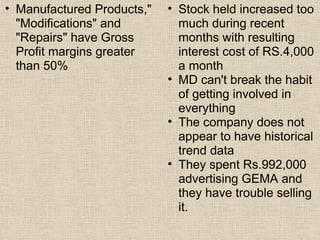
Manufactured Products," "Modifications" and "Repairs" have Gross Profit margins greater than 50% Stock held increased too much during recent months with resulting interest cost of RS.4,000 a month MD can't break the habit of getting involved in everything The company does not appear to have historical trend data They spent Rs.992,000 advertising GEMA and they have trouble selling it.
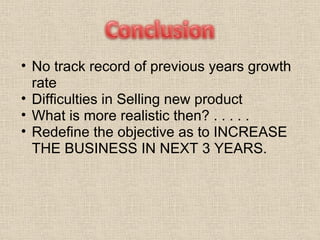
No track record of previous years growth rate Difficulties in Selling new product What is more realistic then? . . . . . Redefine the objective as to INCREASE THE BUSINESS IN NEXT 3 YEARS.
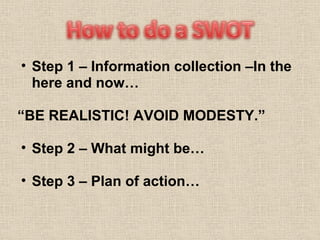
Step 1 – Information collection –In the here and now… “ BE REALISTIC! AVOID MODESTY.” Step 2 – What might be… Step 3 – Plan of action…
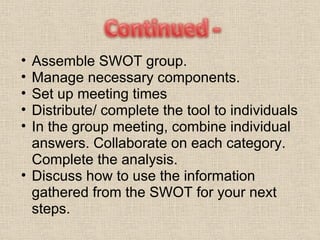
Assemble SWOT group. Manage necessary components. Set up meeting times Distribute/ complete the tool to individuals In the group meeting, combine individual answers. Collaborate on each category. Complete the analysis.  Discuss how to use the information gathered from the SWOT for your next steps.
SWOT may result in an  exercise for the sake of an exercise  (i.e. useless).
 
Trust . . . .  1- in your SWOT Team 2- in your abilities to face the challenges the weakness and threats Ability and willingness to implement change Diversity Time
 

SWOT

  • 1.
  • 2.
  • 3.
    A firm's strengthsare its resources and capabilities that can be used for developing a competitive advantage. Strong brand names Good reputation among customers Affiliation/registeration with some reknowned Institutions.
  • 4.
    The absence ofcertain strengths are a weakness. Lack of patent protection A weak brand name Poor reputation among customers High cost structure Lack of access to key distribution channels
  • 5.
    In some cases,a weakness may be the flip side of a strength. For example, a firm has a large amount of manufacturing capacity. While this capacity may be considered a strength that competitors do not share, it also may be a considered a weakness if the large investment in manufacturing capacity prevents the firm from reacting quickly to changes in the strategic environment.
  • 6.
    The external environmentalanalysis may reveal certain new opportunities for profit and growth. Some examples of such opportunities include: An unfulfilled customer need Arrival of new technologies Loosening of regulations Removal of international trade barriers
  • 7.
    Changes in theexternal environmental also may present threats to the firm. Some examples of such threats include: Shifts in consumer tastes away from the firm's products Emergence of substitute products New regulations Increased trade barriers
  • 8.
    To develop strategiesthat take into account the SWOT profile, a matrix of these factors can be constructed. The SWOT matrix, can be changed into what is known as the TOWS Matrix that is shown on the next slide:
  • 9.
    TOWS Analysis STRENGTHSWEAKNESSES OPPORTUNITIES THREATS S-O STRATEGIES W-O STRATEGIES S-T STRATEGIES W-T STRATEGIES
  • 10.
    S-O strategies pursue opportunities that fit well the company's strengths. W-O strategies overcome weaknesses to pursue opportunities. S-T strategies identify ways that the firm can use its strengths to reduce its vulnerability to external threats. W-T strategies make a defensive plan to prevent the firm's weaknesses from making it susceptible to external threats.
  • 11.
  • 12.
    Albert Humphrey (1960s-70s)Satisfactory Opportunity Fault Threat SOFT Analysis
  • 13.
    Urick and Orr(1964) From SO F T to S W OT LET ME TELL YOU . . . . SWOT IS A USELESS THING
  • 14.
    Planned Strategy: 1-Goalor objective 2-SWOT 3- Evaluation SWOT Results 4- Action
  • 15.
    Aim Assess ActivateApply Goal or objective Apply SWOT Evaluate SWOT Results Take action
  • 16.
  • 17.
    Strengths and OppertunitiesIn business since 19xx. MD has xx years of experience in the industry and as head of the company. Sales and profits have grown steadily Weakness and Threats Jnr. Manager has no experience or education for his position of Sales Manager             Marketing assistant has little marketing experience A SWOT analysis with the objective of: "To double the business in the next three years." .
  • 18.
    Sales and profitswere Rs.xx million in 19xx. MD responds personally to all customer complaints MD wants to get involved in the field of marketing "We have an excellent reputation for quality," MD MD says that he is not a good executive Employees feel free to complain directly to MD MD can't find a good General Manager at the salary he wants to pay Company is having trouble selling GEMA (its new product) MD is worried about converting 5,000 GEMA into cash
  • 19.
    Manufactured Products," "Modifications"and "Repairs" have Gross Profit margins greater than 50% Stock held increased too much during recent months with resulting interest cost of RS.4,000 a month MD can't break the habit of getting involved in everything The company does not appear to have historical trend data They spent Rs.992,000 advertising GEMA and they have trouble selling it.
  • 20.
    No track recordof previous years growth rate Difficulties in Selling new product What is more realistic then? . . . . . Redefine the objective as to INCREASE THE BUSINESS IN NEXT 3 YEARS.
  • 21.
    Step 1 –Information collection –In the here and now… “ BE REALISTIC! AVOID MODESTY.” Step 2 – What might be… Step 3 – Plan of action…
  • 22.
    Assemble SWOT group.Manage necessary components. Set up meeting times Distribute/ complete the tool to individuals In the group meeting, combine individual answers. Collaborate on each category. Complete the analysis. Discuss how to use the information gathered from the SWOT for your next steps.
  • 23.
    SWOT may resultin an exercise for the sake of an exercise (i.e. useless).
  • 24.
  • 25.
    Trust . .. . 1- in your SWOT Team 2- in your abilities to face the challenges the weakness and threats Ability and willingness to implement change Diversity Time
  • 26.

Editor's Notes

  • #3 A SWOT is a planning tool used to understand the Strengths, Weaknesses, Opportunities, and Threats involved in a project or in a business. It involves specifying the objective of the business or project and identifying the internal and external factors that are supportive or unfavourable to achieving that objective.
  • #13 After having an introduction of SWOT analysis, let me take you back to the years 1960s to 70s where Albert Humphrey, who led a research project at Stanford University in the 1960s and 1970s using data from top companies .  The goal was to identify why corporate planning failed. He categorized the the positives and the negatives in 4 basi elements . “What is good in the present is Satisfactory , good in the future is an O pportunity; bad in the present is a F ault and bad in the future is a T hreat.” This was called the SOFT analysis.
  • #15 Unless it is a part of an overall strategy or in a given context or situation.  This strategy may be as simple as: Goal or objective SWOT Evaluation or measures of success Action
  • #16 This is sometimes known as the 4As model – Aim, Assess, Activate and Apply where: Aim - is the Goal or objective Assess - is the SWOT review itself Activate – identify the strengths or measures of success and use them to advantage Apply - take action
  • #22 Step 1 – Information collection - In the here and now… List all strengths that exist now. Then in turn, list all weaknesses that exist now. Be realistic but avoid modesty ! You can conduct one-on-one interviews . Or get a group together to brainstorm. A bit of both is frequently best. Step 2 – What might be… List all opportunities that exist in the future. Opportunities are potential future strengths. Then in turn, list all threats that exist in the future. Threats are potential future weaknesses. Step 3 – Plan of action… Review your SWOT matrix with a view to creating an action plan to address each of the four areas. A SWOT analysis can be very subjective , and two people rarely come-up with the same final version of SWOT. Use SWOT as guide and not a prescription .
  • #23 Establish that your coalition has the necessary components to successfully conduct a SWOT analysis (above). Assemble the group that will conduct the SWOT Set up meeting times (if the SWOT is not going to be completed in one 'sitting' Distribute/ complete the tool individually In the group meeting, combine individual answers. Collaborate on each category. Complete the analysis. Discuss how to use the information gathered from the SWOT to inform your next steps.
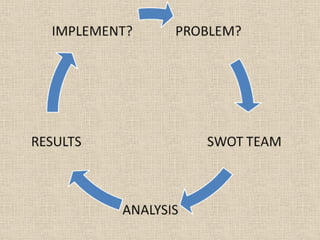
  • #25 It is like you are facing a problem and you establish a SWOT Team. They carry out the ANALYSIS and give you RESULTS. You analyse the results for their applicability and if you can not implement , you repeat the process.
  • #26 Due to the collaborative nature of this tool, your working group will need certain qualities to succeed: Diversity – The team conducting the SWOT analysis should be represent ative of your entire planning team . Time – Taking time to do a thorough SWOT assessment will help your group move forward in developing a workable plan. Steps/ Process