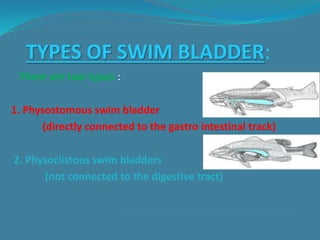
The document discusses the swim bladder in fish. It describes the swim bladder as an internal gas-filled organ that helps fish control their buoyancy and acts as an accessory respiratory and sound-producing organ. The swim bladder is located between the kidneys and alimentary canal, and is connected to the esophagus. There are two types of swim bladders: physostomous, which is directly connected to the digestive tract, and physoclistous, which is not connected. The swim bladder allows fish to rise and sink in water by increasing or decreasing the volume of gas inside through intake or release of air. It functions to control buoyancy and also plays roles in hearing, sensory perception, and sound production.







![Neural_control_of_animal_behaviour[1]789.pptx](https://cdn.slidesharecdn.com/ss_thumbnails/neuralcontrolofanimalbehaviour1789-230207172442-5de82c6f-thumbnail.jpg?width=640&height=640&fit=bounds)


