Download to read offline
![IJRET: International Journal of Research in Engineering and Technology eISSN: 2319-1163 | pISSN: 2321-7308
_______________________________________________________________________________________
Volume: 05 Issue: 03 | Mar-2016, Available @ http://www.ijret.org 145
CHEMICAL ENGINEERING AND COMPETENCES IN ECOLOGY
Antonio Valiente Barderas1
, Carlos Galdeano Bienzobas2
1,2
Fac. de Quimica, UNAM, CU. México City, Mexico
faty_avb@yahoo.com
Abstract
Environmental degradation, global warming and sustainable development are topics to be included in the curriculum of the
chemical engineer to reach cognitive skills and attitude competences to deal with these burning issues of today. While the current
curricula have some materials dealing with the issue of ecology and pollution, the authors have found, by means of a survey, that
students are not sufficiently informed or trained to understand the complexity of pollution, global warming and sustainable
development. Therefore we recommend to support the formation of these competences through the cross and hidden curricula.
Keywords: Competences, Global Warming, Pollution, Ecology, Sustainable Development.
---------------------------------------------------------------------***---------------------------------------------------------------------
I. INTRODUCTION
In the context of globalization that we live in, we have
witnessed the rapid changes that are generated in each of the
spheres of the society. The various technological advances,
instant communication, the evolution and revolution in
different fields of knowledge and the emergence of new
ideologies are some of the triggers that have altered the
interpersonal relationships, the everyday life and the
educational models.
The society of today requires flexible strong educational
systems, in permanent innovation, which respond to the
social development in constant transition and renewal. It is
no coincidence then, that in the late 1960s, there emerged
simultaneously in some countries of the First World an
alternative educational movement aimed at bringing together
theory and practice in the training of workers and in the
training of professionals.
Much of the academic literature claims that the new model,
which is usually called 'education competency', originated
simultaneously in Australia, New Zealand, United States,
England and Canada. These were educational model that
aims to narrow the gap between the school of social needs
and the world of work.
What characterized this new educational model was that it
helped build bridges of communication between school,
work and social requirements. In addition, it provided a
permanent dialogue between educators, industry production
and services.
Competency-based education displaces the teaching of
traditional content, as they do not have a practical use and
expire quickly in this abundant knowledge generation. The
new education changes the attention towards the formation
of theoretical and practical contents that leverage cognitive
structuring of strategies and procedures for action and
intervention; thus teaching works in the formation of
attitudes, values, abilities, skills and capabilities in specific
thematic fields and relevant to the changing needs of job
performance.
In short, competency-based education requires the
institution to form efficient and successful labor
performances that allow the student or future worker to
exercise with ethical, efficient and successful way its work
.Coll [1]
The competencies in the jobs include the professionals,
those that enable flexible, creative and competitive
performance in a specific professional field, and promote the
continuous improvement of being, knowing and doing.
These "must enhance and enable performance competitive,
flexible and creative, and should prepare the individual for
the profession, society, family and also for the work, but not
exclusively for this. The professional of today has a high
probability of being forced to assume different occupations
throughout his life. These must be demonstrated by
competitive performance; you need to be aware of their
knowledge and the way to put them into practice in complex
and changing occupations and tasks. The challenge is to
move from an 'unconscious competence', i.e. know-how
without knowing how, to a 'conscious competition', that is,
the knowledge do and know how. In addition, as a
professional, the person should know what is well done and
be able to propose new ways of doing it.
1.1. Skills on Sustainable Development and Ecology
Historically, the way of thinking that resulted in the
industrial revolution of the 19th century introduced criteria
determined by economic growth. These criteria can be found
in the calculation of the Gross National Product, dating back
to the 1930's . Some corrections were made in the second
half of the 19th century in the social sphere, with the
emergence of non-profit organizations and trade unionism.
The term "economic and social" is part of the vocabulary.
But the developed countries (or countries of the North)
realized in the years 1970 that its prosperity is based on the
intensive use of finite natural resources, and therefore, in](https://image.slidesharecdn.com/chemicalengineeringandcompetencesinecology-160921075037/85/Chemical-engineering-and-competences-in-ecology-1-320.jpg)
![IJRET: International Journal of Research in Engineering and Technology eISSN: 2319-1163 | pISSN: 2321-7308
_______________________________________________________________________________________
Volume: 05 Issue: 03 | Mar-2016, Available @ http://www.ijret.org 145
CHEMICAL ENGINEERING AND COMPETENCES IN ECOLOGY
Antonio Valiente Barderas1
, Carlos Galdeano Bienzobas2
1,2
Fac. de Quimica, UNAM, CU. México City, Mexico
faty_avb@yahoo.com
Abstract
Environmental degradation, global warming and sustainable development are topics to be included in the curriculum of the
chemical engineer to reach cognitive skills and attitude competences to deal with these burning issues of today. While the current
curricula have some materials dealing with the issue of ecology and pollution, the authors have found, by means of a survey, that
students are not sufficiently informed or trained to understand the complexity of pollution, global warming and sustainable
development. Therefore we recommend to support the formation of these competences through the cross and hidden curricula.
Keywords: Competences, Global Warming, Pollution, Ecology, Sustainable Development.
---------------------------------------------------------------------***---------------------------------------------------------------------
I. INTRODUCTION
In the context of globalization that we live in, we have
witnessed the rapid changes that are generated in each of the
spheres of the society. The various technological advances,
instant communication, the evolution and revolution in
different fields of knowledge and the emergence of new
ideologies are some of the triggers that have altered the
interpersonal relationships, the everyday life and the
educational models.
The society of today requires flexible strong educational
systems, in permanent innovation, which respond to the
social development in constant transition and renewal. It is
no coincidence then, that in the late 1960s, there emerged
simultaneously in some countries of the First World an
alternative educational movement aimed at bringing together
theory and practice in the training of workers and in the
training of professionals.
Much of the academic literature claims that the new model,
which is usually called 'education competency', originated
simultaneously in Australia, New Zealand, United States,
England and Canada. These were educational model that
aims to narrow the gap between the school of social needs
and the world of work.
What characterized this new educational model was that it
helped build bridges of communication between school,
work and social requirements. In addition, it provided a
permanent dialogue between educators, industry production
and services.
Competency-based education displaces the teaching of
traditional content, as they do not have a practical use and
expire quickly in this abundant knowledge generation. The
new education changes the attention towards the formation
of theoretical and practical contents that leverage cognitive
structuring of strategies and procedures for action and
intervention; thus teaching works in the formation of
attitudes, values, abilities, skills and capabilities in specific
thematic fields and relevant to the changing needs of job
performance.
In short, competency-based education requires the
institution to form efficient and successful labor
performances that allow the student or future worker to
exercise with ethical, efficient and successful way its work
.Coll [1]
The competencies in the jobs include the professionals,
those that enable flexible, creative and competitive
performance in a specific professional field, and promote the
continuous improvement of being, knowing and doing.
These "must enhance and enable performance competitive,
flexible and creative, and should prepare the individual for
the profession, society, family and also for the work, but not
exclusively for this. The professional of today has a high
probability of being forced to assume different occupations
throughout his life. These must be demonstrated by
competitive performance; you need to be aware of their
knowledge and the way to put them into practice in complex
and changing occupations and tasks. The challenge is to
move from an 'unconscious competence', i.e. know-how
without knowing how, to a 'conscious competition', that is,
the knowledge do and know how. In addition, as a
professional, the person should know what is well done and
be able to propose new ways of doing it.
1.1. Skills on Sustainable Development and Ecology
Historically, the way of thinking that resulted in the
industrial revolution of the 19th century introduced criteria
determined by economic growth. These criteria can be found
in the calculation of the Gross National Product, dating back
to the 1930's . Some corrections were made in the second
half of the 19th century in the social sphere, with the
emergence of non-profit organizations and trade unionism.
The term "economic and social" is part of the vocabulary.
But the developed countries (or countries of the North)
realized in the years 1970 that its prosperity is based on the
intensive use of finite natural resources, and therefore, in](https://image.slidesharecdn.com/chemicalengineeringandcompetencesinecology-160921075037/75/Chemical-engineering-and-competences-in-ecology-1-2048.jpg)
![IJRET: International Journal of Research in Engineering and Technology eISSN: 2319-1163 | pISSN: 2321-7308
_______________________________________________________________________________________
Volume: 05 Issue: 03 | Mar-2016, Available @ http://www.ijret.org 146
addition to the economic and social issues, a third aspect
was neglected: the environment. For example, the ecological
footprint worldwide exceeded the Earth's "biological"
capacity to recover in the mid-1970s. The term sustainable
development applies to socio-economic development and it
was formalized for the first time in the document known as
the Brundtland report (1987), fruit of the work of the World
Commission on environment and development of the United
Nations, created in the Assembly of the United Nations in
1983. This definition would assume in third principle of the
Rio Declaration (1992)
Meet the needs of present generations without
compromising the ability of the future to meet their own
needs.
The field of sustainable development can be divided
conceptually into three parts: environmental, economic and
social. It is considered the social aspect by the relationship
between social welfare to the environment and the economic
bonanza. The triple result is a set of performance indicators
of an organization in three areas.
They must meet the needs of society such as food, clothing,
housing and work, but if poverty is common, the world will
be heading to disasters of various types, including the
ecological. In addition, development and social welfare, are
limited by the technological level, the resources of the
environment and the capacity of the environment to absorb
the effects of human activity.(Rojas,[4])
This situation raises the possibility of improving the
technology and social organization in such a way that the
environment can recover at the same rate that is affected by
human activity. To some analysts, the current industrial
development model is not sustainable in environmental
terms. The critical points are: the depletion of natural
resources (such as raw materials and fossil fuels), the
destruction and fragmentation of ecosystems and the loss of
biodiversity, which reduces the capacity of resistance of the
planet. The industrial, agricultural and urban development
generates immediate and postponed contamination (for
example, acid rain and the greenhouse gases that contribute
to climate change and to the excessive exploitation of
natural resources, or the deforestation of the rain forest).
This causes an inestimable loss of biological diversity in
terms of extinction (and therefore irreversible) species of
plants or animals. This evolution leads to a depletion of
fossil fuels and raw materials making imminent peak oil and
bring us closer to the depletion of many vital natural
resources. A problem of equity is added to the problem of
viability: the poor are those who suffer most from the
ecological and climate crises, and is afraid that the
legitimate desire of growth in countries developing towards
a state of similar prosperity, based on equivalent principles,
involve an even more important and accelerated biosphere
degradation. If all the Nations of the world were to adopt the
American way of life (which consumes nearly a quarter of
the Earth's resources for 7% of the population) one needed
from five to six planets like Earth to supply them. And if all
the inhabitants of the planet lived with the same standard of
living than the average in France, at least three planets
would be needed as the Earth.(Savater,[5]).
In addition, the industrial disasters of the last thirty years
(of Chernobyl, Seveso, Bhopal, Exxon Valdez, etc.) have
called attention to public opinion and to associations such as
WWF, Greenpeace or Friends of the Earth . It is noted that
sustainable development is not by itself a sociological
element, but should be part of a tissue in which the
production, economy, welfare and the environment play
always on the same side. This concept of sustainable
development, focuses from the environmental supply side.
I.e. a basic productivity, according to the capacity that can
be supplied by the ecosystems. The evolution of thinking on
development, in historical terms, has been given within the
framework of social struggles: through the struggle between
capitalism and socialism, between the working class and the
capital, and between the human thought and the forces of
nature. Over the last seven decades of the 20th century, and
part of this first decade of the 21st century, the concept of
development has been expanded and enriched, but it also has
been fragmented, since that it is taking the aspects according
to the severity that confront countries in their environmental
diagnosis, without assuming an universal orientation of care
for the environment. The planet Earth is facing the challenge
of reversing the impacts caused by man. The environmental
crisis is complex and has to do with the ways in which
society has been linked to the environment. This relationship
involves historical and social aspects. Any human activity
has to do with nature in its different areas and spaces,
regardless of the level that you want to observe.
Environmental problems have to do with the lack of
environmental awareness, shown by the attitude that we
express to our environment. We need to learn new ways of
seeing reality, assuming the new paradigms with a world
view of the context in which we live. Sustainable
development has emerged as an alternative. It is defined as
the model of development that meets the needs of current
generations without compromising the ability of future
generations to meet their own. It is a proposal that seeks to
balance economic growth, environmental protection and
social equity. One of the aspects that has been given
importance is the eco-friendly. The global environmental
situation demands us to remedy the discomforts of the Earth.
Constitutes a central aspect of the ecological question the
relationship of love and intelligence of the man with the
world, which leads to recognize that nature is not an
absolute reality, that is, nature is not God. If we diviniced
the nature, if it is considered a Supreme and absolute value,
we invent a kind of false religion in which the man is
subordinate to the "Mother Earth", in a destructive
naturalism for the man and the same environment. The
relationship of love and intelligence of the man with the
ecology leads to the recognition that nature is not a mere
instrument that man can use at will, misuse or destroy it.
Based on before this, man comes to recognize that the
environment constitutes a richness and a good man to have;
but it is for all mankind present and future; and that it must
be kept so that current and future generations to live with](https://image.slidesharecdn.com/chemicalengineeringandcompetencesinecology-160921075037/85/Chemical-engineering-and-competences-in-ecology-2-320.jpg)
![IJRET: International Journal of Research in Engineering and Technology eISSN: 2319-1163 | pISSN: 2321-7308
_______________________________________________________________________________________
Volume: 05 Issue: 03 | Mar-2016, Available @ http://www.ijret.org 147
dignity. It is to promote sustainable development, consider
the man conservative environment, and responsible place
science and technology at the service of life and human
dignity; and eliminate poverty, which is one of the worst
enemies of the environment as a consequence of the
degradation that it produces.
Ultimately, the ecology is an anthropological question.
Ecology is a human science, i.e., a knowledge that only
comes from man ; and since the human nature, the
ecosystems and the environment can only be considered and
treated in their intrinsic value. Also part of the ecology the
field of wildlife of man, because the human body and
corporeal life of human beings connect it with nature in an
intimacy such that the same man is a natural being. The
development of science and technology have allowed man to
learn that man can influence, modify and even destroy the
rhythms and laws of nature; but there are limits to that
power. Use the strength of the technique in the bosom of
nature as expression of a pure will power means not to take
into consideration the value of living beings, of the natural
life of man, ecosystems, etc. Not considering the value of
things, which is the result of a judgement of the
consciousness of the man from the discovery of the truth and
of being, puts in a way in which everything is subject to the
arbitrariness of power, with the risk of this becomes a
destroyer of nature, man and other living beings of the
Earth. Moderation and the criteria of intervention of man in
the ecosystem, the human person, in plants and animals, are
the truth and the value of these. These beings, only the man
is person and, therefore, the only one that has an absolute
value, source of inalienable rights, including the right to life,
from conception to natural death; the right to freedom; the
right to the family as human home for every man in the
world; the right to education and culture. These rights are
for the man the source of human and ecosystem ecology,
because they contribute to raising awareness and ecological
commitment, both in relation to nature, in each and every
one of the men as regards natural life, your life and the
people, which has special relevance for scarce natural
resources. It is possible through sustainable development to
avoid the distress of waking up every day in a world
governed by the excessive ambition and selfishness; a world
that is heading for destruction in various fields; destruction
of our habitat, of the values essential to the survival and
viability of any society... Destruction, in short, of the
heritage that is for us to build and protect for those who will
come after us. Humanity must face its responsibility before
the current state of need faced by millions of people, as well
as the imminent danger that looms over the viability of
human life on Earth the current over-exploitation of
resources. It is urgent, necessary and urgent to give an
immediate step towards the revision and amendment of the
development models.
1.2. Ecology, Pollution and Sustainable
Development A Necessary Competence for
Engineers
The model of professional skills sets three levels: basic
skills, the generic and the specific or techniques, whose
generality range from the large to the particular. (Valiente,
2010 [8]). Among the basic skills that should have been
reached at the end of the compulsory education stage so that
the person is prepared for their adult lives, but which also
should continue perfecting through new experiences., is the
competence in the knowledge and interaction with the
physical world. A competition that allows you to interact
with the environment and to predict consequences. To show
care and respect for the environment and to procure its
enhancement and preservation as a way to improve the
conditions of life of its own and of others and the rest of
living beings. Generic or transversal competencies have
been defined as the attributes that should have a university
graduate regardless of their profession. They can pick up
generic aspects of knowledge, abilities and skills and
abilities that should have any entitled before joining the
work market. They are the common basis of the profession
or refer to the specific situations of professional practice that
require complex answers. Generic competences are those
that not only have a technical component, but also one
essentially human. They are the skills and resources that we
all have, by the simple fact of being human, and therefore
put into play in areas where we operate. Systemic
(transverse) generic skills that every professional should
possess include sensitivity to environmental issues and the
ability to apply theoretical knowledge to practice (Valiente,
2010 [8]). Finally, specific competences are the particular
basis of professional practice and are linked to specific
conditions of execution. Specific competencies have been
defined as the attributes that need to acquire the future
graduates during their stay at the University and they must
be defined by the experience of graduates. When speaking
of specific professional skills we talk about the typical
functions or role of a professional in the society and the
typical situations of the professional field. There is no doubt
that chemical engineering professionals should possess skills
in the resolution of pollution problems, environmental and
their own criteria to evaluate which is the technique that
promotes the sustainable development and which not. The
ecology problems are not only solvable from the point of
view of science and technology, but it must be addressed as
ethical and economic problems. The ethic part of
considering, above all, the quality of man's relationship with
the other men, recognizing them beings that have the same
dignity and the same value as the base. Once recognized the
personal dignity of other men, we can enter to consider the
relationship of humans with the environment. In this regard,
we should bear in mind that only the man knows and can
recognize the value and the sense of ecosystem,
environment, organisms - plants and animals - and also
itself. Ecology arises when man becomes aware of his
relationship with the natural ecosystem of the Earth.
Scientific and technical knowledge as well as the ethical
assessment of what is sustainable development and care for
the environment are competencies that should be part of the
knowledge, skills and attitudes of chemical engineers. The
mission of the universities is to educate future professionals](https://image.slidesharecdn.com/chemicalengineeringandcompetencesinecology-160921075037/85/Chemical-engineering-and-competences-in-ecology-3-320.jpg)
![IJRET: International Journal of Research in Engineering and Technology eISSN: 2319-1163 | pISSN: 2321-7308
_______________________________________________________________________________________
Volume: 05 Issue: 03 | Mar-2016, Available @ http://www.ijret.org 148
in chemistry capable of analyzing, identifying and assessing
the limitations of development and undertake work and
original and multidisciplinary research that contributes to
the solution of the problems posed by industrialization and
the conservation of natural resources.
Until recently the chemical industry and its scientists,
engineers and technicians were considered as the biggest
destroyers of the environment, but that perception is
changing because of the emphasis that some pioneering
institutions are doing about sustainable development and the
green chemistry. Moreover in the majority of the schools
and colleges where chemical engineering is taught within
the official curriculum there are subjects such as ecology,
sanitary engineering, environmental engineering, etc. But
that, we believe is not enough, we must raise awareness
among both students and teachers on the importance and
relevance that has the knowledge, skills and good attitudes
about the treatment of industrial waste, energy-saving and
green chemical call for the future of our species. For a world
hungry of energy, the science and the technic offer today
more possibilities than the use of oil, gas and coal. Today
many countries obtain energy from the sun, of the tides,
wind, biomass (fermentation) and rivers (dams). The
atmosphere is essential for life so its alterations have a great
impact in humans and other living beings and, in general,
across the globe. It is an extraordinarily complex
environment and the situation becomes still more
complicated and difficult to study when you add in many
man-made emissions, as it is happening in these last
decades. Contaminated atmosphere can damage people's
health and affect the lives of plants and animals. But, in
addition, the changes that occur in the chemical composition
of the atmosphere can change the climateproducing acid rain
or ozone destroying, all phenomena of a great global
importance. It is understood the urgency of knowing these
processes and take the necessary measures so that there are
no serious situations of humanity and of all life the
biosphere. Since time immemorial, rivers, lakes and seas
collected wastes produced by human activity. The natural
cycle of water has a great capacity of purification. But this
same ease of regeneration of the water, and its apparent
wealth, makes it the usual dump where we throw the waste
produced by our activities. Pesticides, chemical waste,
heavy metals, radioactive waste, etc., are in amounts higher
or lower, when analyzing the waters of the most remote
places in the world. Many waters are contaminated to the
point of making them dangerous to human health, and
harmful to life. The degradation of the water comes from
old, but has been in this century when this problem has
spread to rivers and seas around the world. First it was
rivers, port areas of big cities and industrial zones which
became dirty drains, loaded with chemicals, foam and all
kinds of contaminants. With industrialization and economic
development this problem is has been moving to countries
developing, while major improvements occurred in
developed countries. Soil contamination is the presence of
chemical compounds made by man or other alteration to the
natural soil environment. This contamination usually
appears when on the ground we have either voluntary or
accidental various products such as paper, glass, plastic,
organic materials, solvents, pesticides, hazardous wastes or
radiactive substances among others. Contamination also
occurs to produce a rupture of underground tanks, with the
application of pesticides, leaks from landfills or direct
accumulation of industrial products. The most common
chemicals include derivatives of petroleum, solvents,
pesticides and other heavy metals. This phenomenon is
closely related to the degree of industrialization and
intensity of use of chemicals. With regard to soil
contamination risk is primarily health, directly and to come
into contact with drinking water sources. The delimitation of
the contaminated areas and the resulting cleaning of this are
tasks that consume time and money.
To the IPCC (Intergovernmental Panel on climate change),
the term 'climate change' denotes The warming of the
climate system is unequivocal, as it can be seen already
from the observed increase in global average temperature of
the air and ocean, the widespread snow and ice melting, and
the increase in the global average of the sea level. A change
in the State of the climate (for example, by statistical
analysis) as a result of a change identifiable in its properties,
and that persists for an extended period, usually encrypted in
decades or longer periods. It denotes any change in climate
over time, so if it is due to the natural variability as if it is
the result of human activity. Most of the observed increase
in global average temperature since the mid-20th century is
most likely due to the observed increase in the
concentrations of GHG (greenhouse gas) anthropogenic.
2. CHEMICAL ENGINEERING AND THE
TEACHING OF ECONOMIC VALUES.
Many aspects have changed in recent years with the
development of new technologies because the access to
information is much faster, and this last factor has caused
radical changes in the subjects and in the process of teaching
and learning (Gordillo and Osorio, 2003 [3]).
The UNESCO (1998 [7]) stated that it is necessary to
promote a lifelong learning and the construction of adequate
skills to contribute to the economic, social and cultural
development of the society. It also noted that the main tasks
of higher education have been and will continue to be linked
to four of its main functions:
Generation of new knowledge (research functions).
The training of highly qualified people (education
function).
Provide services to society (social function).
Social criticism (involving ethical function).
We can define education as an educational system that
emphasizes the learning and demonstration of those
competencies (knowledge, skills, attitudes and values) that
are of central importance for the execution of a task,
activity.( Valiente , 2010 [8]).
Skills-based learning offers the training of professionals,
whereas basically training required to transform to a basic
professional preparation, provided by successive majors,](https://image.slidesharecdn.com/chemicalengineeringandcompetencesinecology-160921075037/85/Chemical-engineering-and-competences-in-ecology-4-320.jpg)
![IJRET: International Journal of Research in Engineering and Technology eISSN: 2319-1163 | pISSN: 2321-7308
_______________________________________________________________________________________
Volume: 05 Issue: 03 | Mar-2016, Available @ http://www.ijret.org 149
higher adaptive capacity and versatility, allowing a
professional mobility and subsequent professional
retraining, for which should be amended education at all
levels.(Coll,[1]).
The knowledge, skills and values related to a discipline are
important aspects in which the graduate has to
work.(Scheler, [7]) However, in general, a new professional
is not prepared or, at least, is not aware of the values and
generic skills that has developed and doesn't know how to
apply them in the daily performance of their jobs.
It is therefore very important that top-level institutions based
their education in competitions, since in this way prepares
the student to be able, in an effective and efficient way to
apply the knowledge acquired at the University.
The importance of skills-based education, is based on the
fact that knowledge that students learn today will be
obsolete tomorrow. Generic skills, on the other hand, do not
age, they develop and increase, especially if learned in an
institutional climate that it promotes learning.
The careers related to the field of the chemical sciences
study the composition, structure and properties of matter, as
well as the changes that occur therein, the also study the
relationship of the changes with power and the laws that
govern those changes or transformations. They have as a
mission, not only the research of new substances and their
properties, but also how to create those new substances and
the study of the positive or negative effects that could result
on human beings, other living beings and especially the
environment. The foregoing has economic undertones. Both
research, production, education and the fight against
pollution have a cost, which will have an impact on the
decisions and actions taken.
In some chemistry careers, notably in chemical engineering,
there is more emphasis on the economic aspect of the
practice of the profession and is therefore included some
subjects in the curriculum such as: economics, economic
engineering, engineering costs, etc. (Faculty of chemistry,
2011 [2]). However, it is distressing to note that the majority
of the students have no idea of the costs that have the
materials, or the energy, and they do not realize how costly
is the research and even the teaching of these topics.
3. SURVEY APPLIED TO SEVERAL CAREERS
AT THE FACULTY OF CHEMISTRY.
Obviously, the students do not have an idea of the impact of
chemistry in the economy, the dependent which is the
society of energy, materials and services that are obtained
from chemical, petrochemical, food, metallurgical,
pharmaceutical, cosmetics, etc. The do not realize the costs
that have pollution and the fight against. This is shown in
the results of a series of questions that were made to the
students of the Faculty of chemistry of the UNAM in
Mexico City. Of the survey that was made with 126 students
we can point out the following:
Profile of Respondents
A total of 126 respondents classified in three careers:
chemical engineering (74), food chemistry (24) and
chemical pharmacist biologist (28). See Fig. 1.
Figure No. 1. Surveyed students and careers.
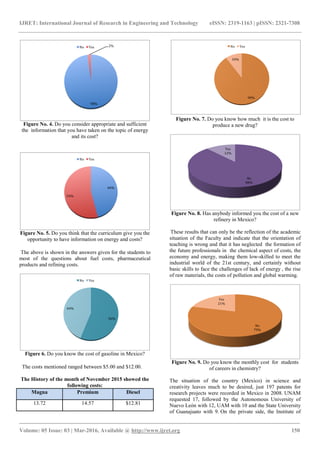
Although most of the respondents (125) believe that it is
important to know the cost of energy, and 75 of them said
that they have taken some subjets on economy and
economic engineering, (Fig. 2). Most of them indicated that
the information they possess on energy and the cost of this is
not adequate (124 replies). Fig. 3 and 4.
Figures No. 2 and 3. Have you taken some subjetcs related
to economy and costs?](https://image.slidesharecdn.com/chemicalengineeringandcompetencesinecology-160921075037/85/Chemical-engineering-and-competences-in-ecology-5-320.jpg)
![IJRET: International Journal of Research in Engineering and Technology eISSN: 2319-1163 | pISSN: 2321-7308
_______________________________________________________________________________________
Volume: 05 Issue: 03 | Mar-2016, Available @ http://www.ijret.org 151
Technology and superior studies of Monterrey submitted 31
requests. There is currently no state policy that establishes
what wants to be Mexico in 20 years. India and South Korea
have been good examples in electronics and information
technology, as well as in chemistry.
4. CONCLUSIONS
We believe that a solid background in skills related to
ecology and pollution, and sustainable development is
essential to the chemical engineer of the 21st century.
Certainly they can be included in the curriculum materials
that support these topics, but we believe that the most
important is that it is between the missions of the school the
form individuals trained in skills cognitive type, skills, and
attitudes towards the dangers and costs presented by the
pollution and environmental degradation, in addition to form
citizens capable of creating sustainable development need
our planet. To do this it should be implicit and explicit in
each and every one of the subjects that the teacher touched
these issues, emphasizing its importance and interest for the
formation integrate 21st century professionals. Matters
dealing with these issues, not only in the trunks of
specialization or terminals, but as obligatory subjects
common to all engineers should certainly be included.
REFERENCES
[1] Coll, C., Aprendizaje escolar y construcción del
conocimiento, Barcelona, Ed. Páidos, 1990.
[2] Facultad de Química, UNAM-C.U, “Planes de estudio y
materias en la carrera de Ingeniería Química”,
dirección electrónica consultada por última vez en
diciembre 7, 2011.
http://www.quimica.unam.mx/materias.php?id_rubrique
=92&id_article=1613&color=227AB9&rub2=92
[3] Gordillo, M. y Osorio, C, Educar para participar en
ciencia y tecnología. Un proyecto para la difusión de la
cultura científica, Revista Iberoamericana de
Educación, ( 32), 165-210, 2003..
[4] Rojas ,Enrique , El hombre Light, Una vida sin valores
,México ,Editorial Planeta Mexicana, 2003.
[5] Savater , Fernando , Los caminos para la libertad. Ética
y educación- México- Ariel - 2000.
[6] Scheler, Max , Ética , Madrid , Caparrós editores ,
2001.
[7] UNESCO, Concepts and Methods of the Compentency
Outcomes and Performance Assessment, New York,
Unesco,1998.
[8] Valiente, Antonio y Galdeano Carlos, Competencias en
Ingeniería Química, Revista de educación
Química,21(3),260-264,2010.](https://image.slidesharecdn.com/chemicalengineeringandcompetencesinecology-160921075037/85/Chemical-engineering-and-competences-in-ecology-7-320.jpg)

The document discusses the importance of integrating environmental issues and sustainability into the curriculum for chemical engineering education. It highlights that current curricula do not adequately prepare students to handle ecological challenges, urging the need for improved competencies in sustainability and pollution management. The authors advocate for a shift towards a competency-based education model that emphasizes ethical, social, and practical skills related to ecological responsibilities and sustainable practices.


![Green Economy & related concepts[1] (1).pptx](https://cdn.slidesharecdn.com/ss_thumbnails/greeneconomyrelatedconcepts11-240603061818-ef73c34b-thumbnail.jpg?width=640&height=640&fit=bounds)


