SUSPENSIONS
(CONTD)
B. PHARM 1ST
SEMESTER
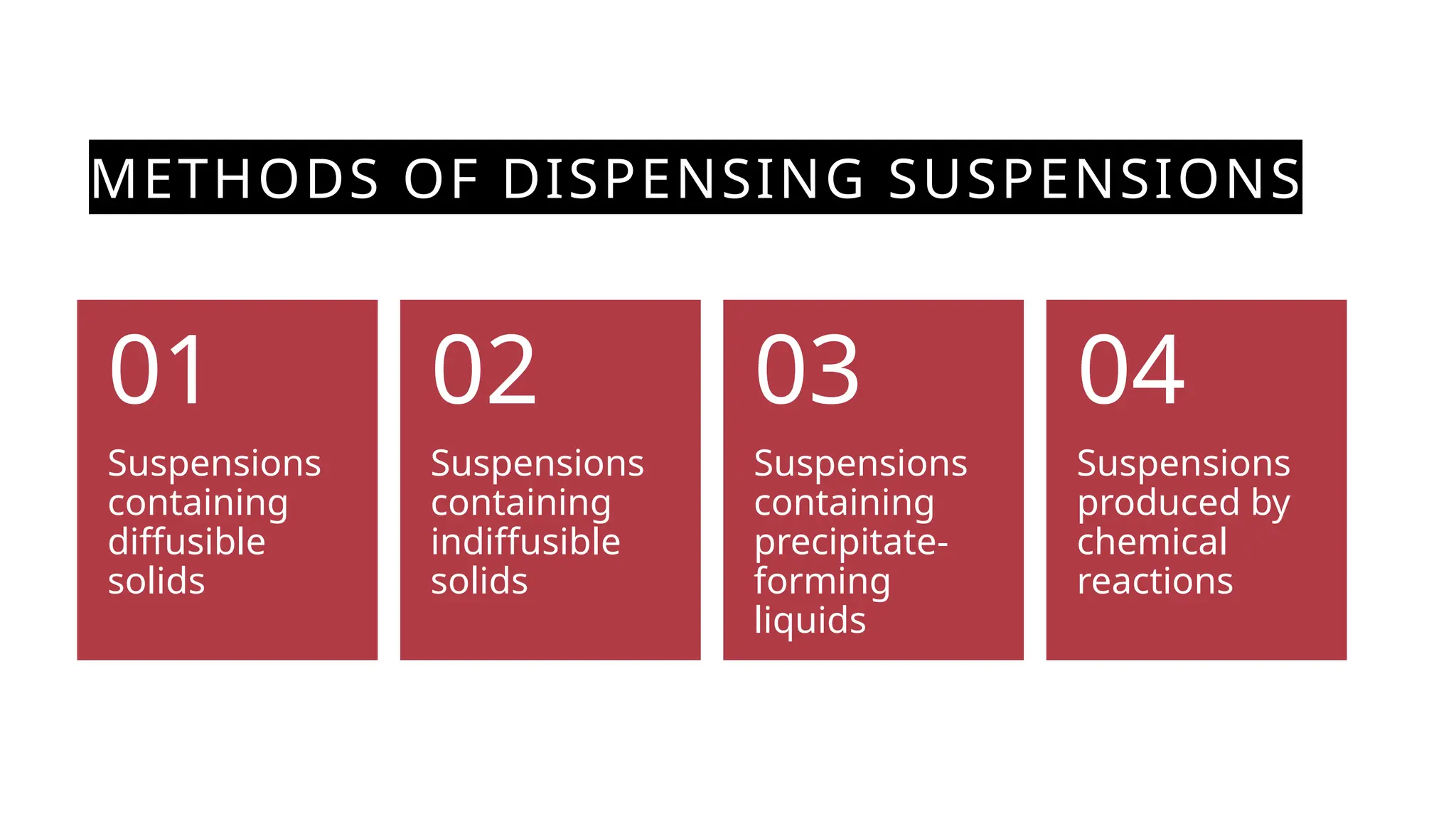
METHODS OF DISPENSING SUSPENSIONS
Suspensions
containing
diffusible
solids
01
Suspensions
containing
indiffusible
solids
02
Suspensions
containing
precipitate-
forming
liquids
03
Suspensions
produced by
chemical
reactions
04
SUSPENSIONS
CONTAINING
DIFFUSIBLE
SOLIDS
Some insoluble powdered
compounds are light, mix well with
water, and stay suspended in the
liquid for a long enough period
after shaking to be useful.
Substances like these are called
diffusible solids.
Light kaolin, rhubarb powder,
magnesium trisilicate, calcium
carbonate, and light magnesium
carbonate are a few examples.
SUSPENSIONS
CONTAINING
DIFFUSIBLE
SOLIDS
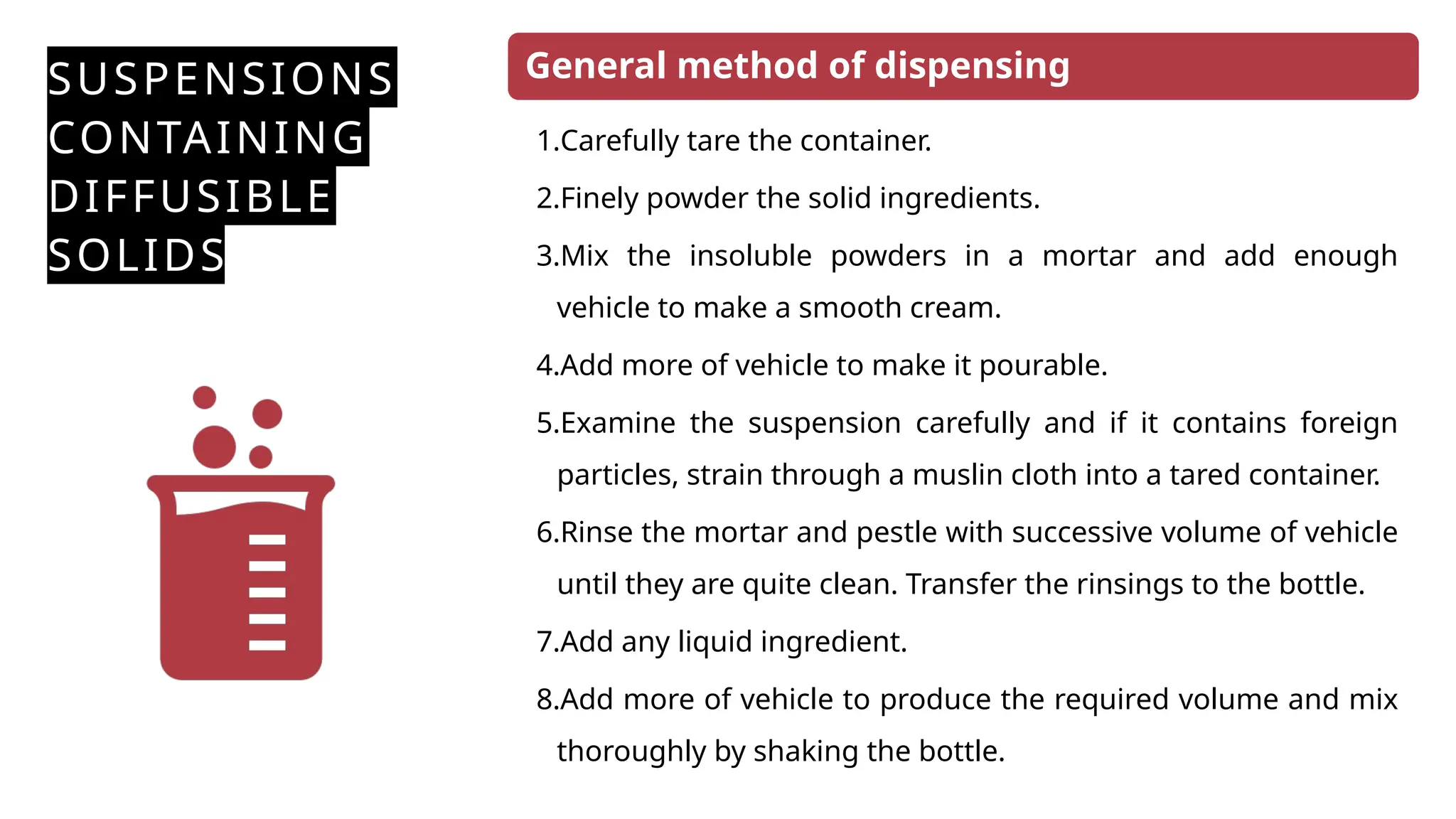
General method of dispensing
1.Carefully tare the container.
2.Finely powder the solid ingredients.
3.Mix the insoluble powders in a mortar and add enough
vehicle to make a smooth cream.
4.Add more of vehicle to make it pourable.
5.Examine the suspension carefully and if it contains foreign
particles, strain through a muslin cloth into a tared container.
6.Rinse the mortar and pestle with successive volume of vehicle
until they are quite clean. Transfer the rinsings to the bottle.
7.Add any liquid ingredient.
8.Add more of vehicle to produce the required volume and mix
thoroughly by shaking the bottle.
SUSPENSIONS
CONTAINING
INDIFFUSIBLE SOLIDS
Substances that are insoluble in water and do not
disperse uniformly in a medium for an extended
enough period to provide dosing uniformity are
known as indiffusible solids.
Used externally Used internally
Calamine Aspirin
Hydrocortisone Aromatic chalk powder
Sulphur precipitated Chalk
Zinc oxide Phenobarbitone
SUSPENSIONS
CONTAINING
INDIFFUSIBLE
SOLIDS
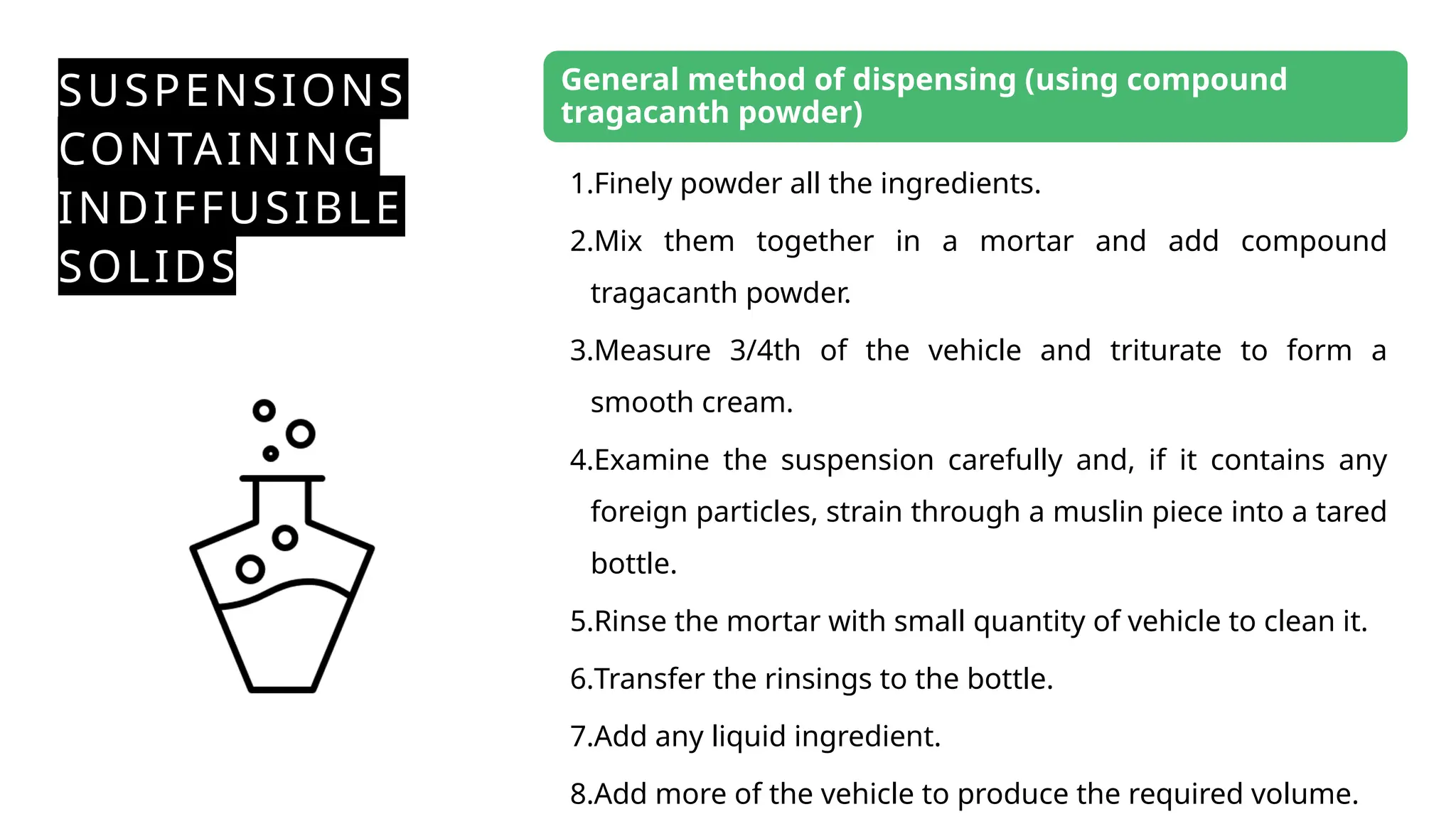
General method of dispensing (using compound
tragacanth powder)
1.Finely powder all the ingredients.
2.Mix them together in a mortar and add compound
tragacanth powder.
3.Measure 3/4th of the vehicle and triturate to form a
smooth cream.
4.Examine the suspension carefully and, if it contains any
foreign particles, strain through a muslin piece into a tared
bottle.
5.Rinse the mortar with small quantity of vehicle to clean it.
6.Transfer the rinsings to the bottle.
7.Add any liquid ingredient.
8.Add more of the vehicle to produce the required volume.
SUSPENSIONS
CONTAINING
INDIFFUSIBLE
SOLIDS
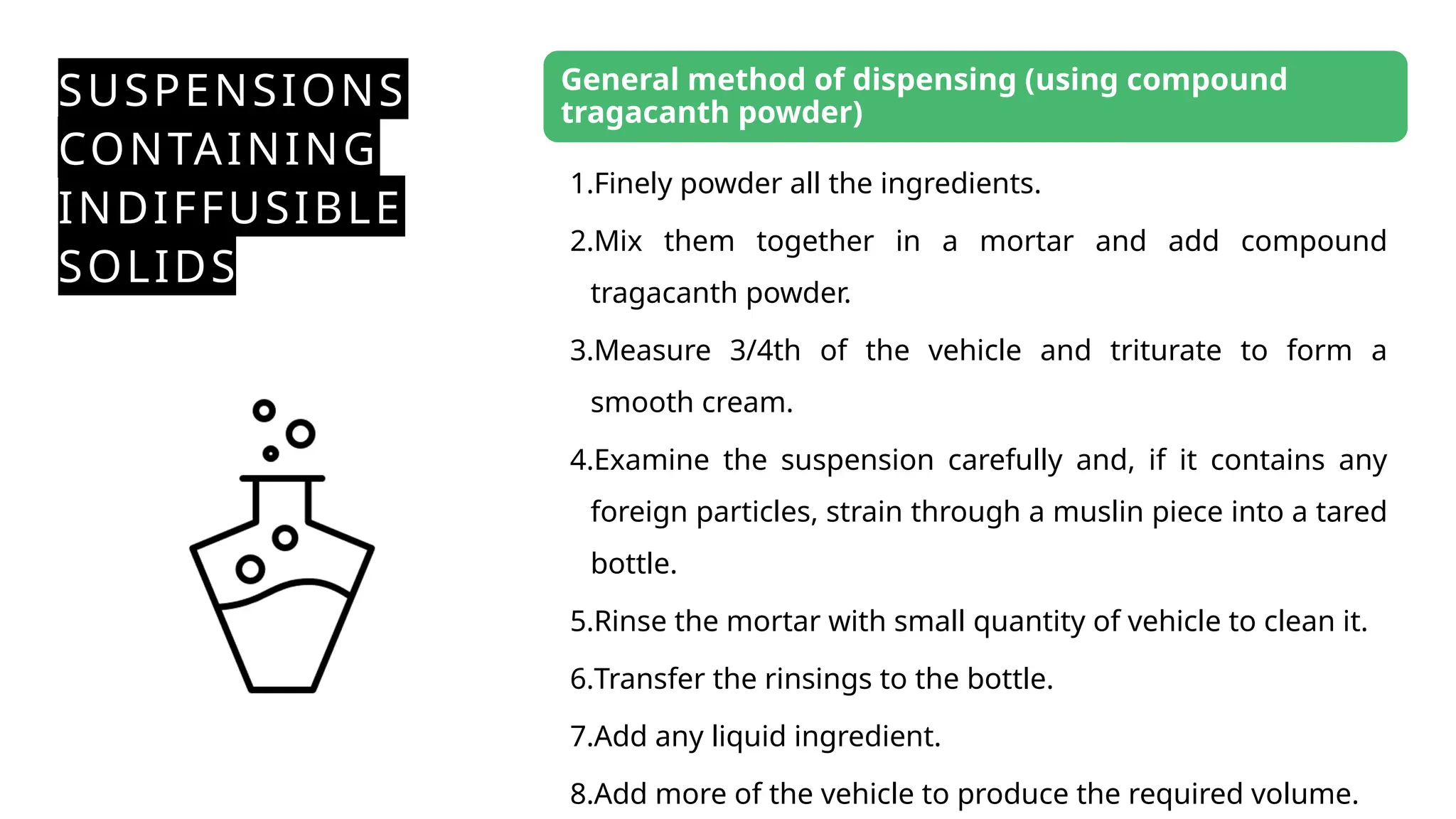
General method of dispensing (using compound
tragacanth powder)
1.Finely powder all the ingredients.
2.Mix them together in a mortar and add compound
tragacanth powder.
3.Measure 3/4th of the vehicle and triturate to form a
smooth cream.
4.Examine the suspension carefully and, if it contains any
foreign particles, strain through a muslin piece into a tared
bottle.
5.Rinse the mortar with small quantity of vehicle to clean it.
6.Transfer the rinsings to the bottle.
7.Add any liquid ingredient.
8.Add more of the vehicle to produce the required volume.
SUSPENSIONS
CONTAINING
PRECIPITATE-
FORMING LIQUIDS
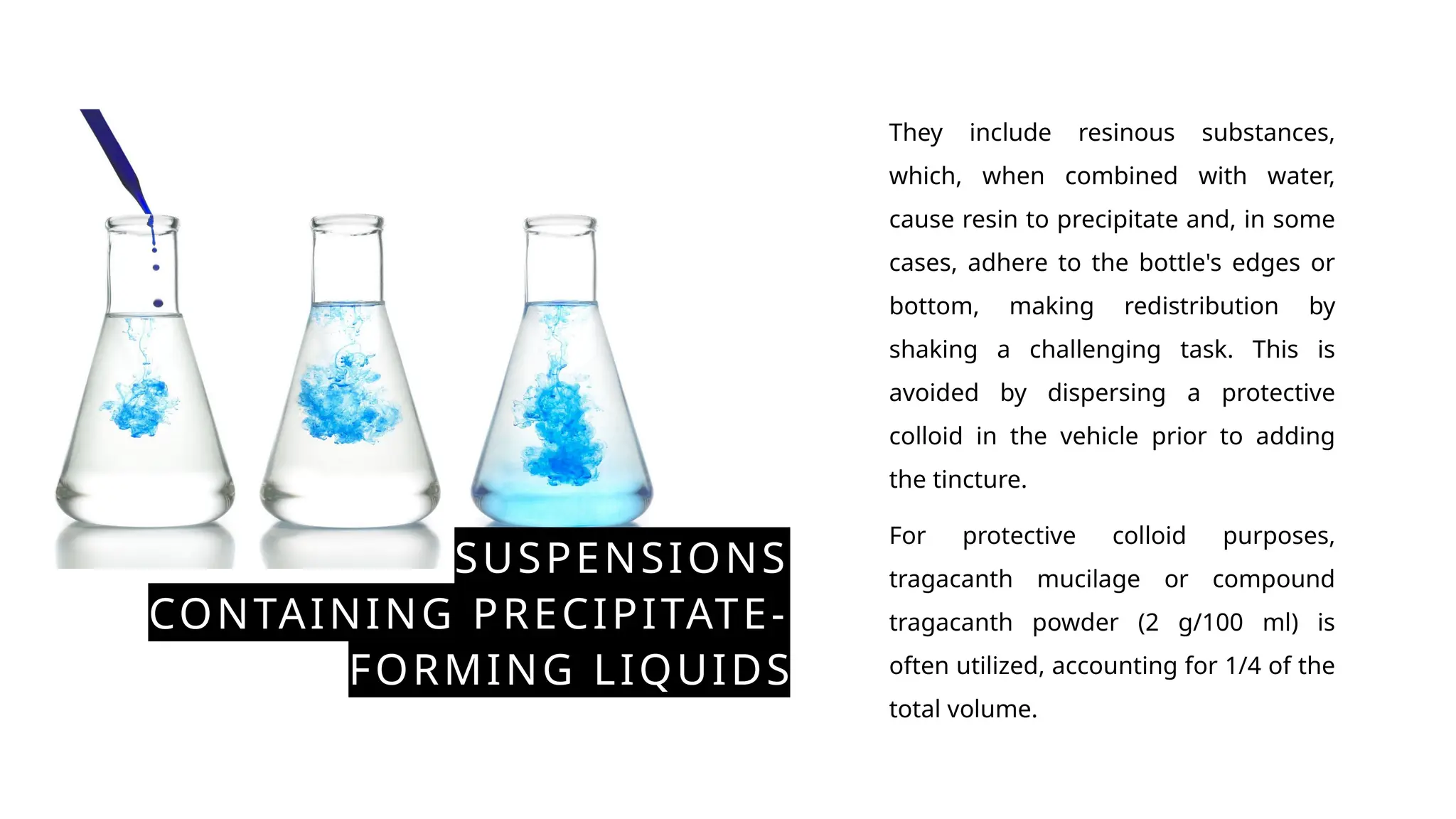
When added to water, some
liquid preparations
precipitate. Benzoic,
compound, myrrh, and tolu
tinctures are a few
examples. Not only do
these liquids not dissolve in
water, but they also create
insoluble precipitates,
especially when combined
with salts.
SUSPENSIONS
CONTAINING PRECIPITATE-
FORMING LIQUIDS
They include resinous substances,
which, when combined with water,
cause resin to precipitate and, in some
cases, adhere to the bottle's edges or
bottom, making redistribution by
shaking a challenging task. This is
avoided by dispersing a protective
colloid in the vehicle prior to adding
the tincture.
For protective colloid purposes,
tragacanth mucilage or compound
tragacanth powder (2 g/100 ml) is
often utilized, accounting for 1/4 of the
total volume.
SUSPENSIONS
CONTAINING
PRECIPITATE-
FORMING
LIQUIDS
General method of dispensing (using compound tragacanth powder)
1. Grind the indiffusible solid and diffusible solid into a fine powder using
a mortar. Combine with compound tragacanth powder in a mortar.
2. Measure half of the vehicle and mix a small quantity with the powders
through trituration until a smooth cream is achieved. Subsequently,
incorporate the remaining components of the vehicle.
3. Measure the precipitate-forming liquid using a dry measuring device
and gradually add it to the center of the cream while stirring rapidly.
4. Dissolve the soluble ingredient, if applicable, in an adequate quantity
of vehicle derived from the remaining half of the vehicle.
5. Introduce it gradually while continuously stirring the cream to prevent
localized high concentrations that could diminish the effectiveness of
the suspending agent.
SUSPENSIONS
CONTAINING
PRECIPITATE-
FORMING
LIQUIDS
6. Critically assess the mortar's contents for the presence of
foreign particles. In the presence of these components, strain
the suspension through a muslin cloth into a bottle.
7. Increase the quantity of the vehicle to rinse the mortar and
transfer the rinsing into the bottle.
8. Incorporate any liquid component.
9. Increase the quantity of the vehicle to achieve the desired
volume.
SUSPENSIONS
CONTAINING
PRECIPITATE-
FORMING
LIQUIDS
General method of dispensing (using tragacanth mucilage)
Tragacanth mucilage is used when the vehicle is water or
chloroform water.
1. Mix the tragacanth mucilage with an equal volume of the
vehicle.
2. Measure the precipitate-forming liquid in a dry measure
and pour slowly into the centre of the mucilage with
constant stirring.
3. Dissolve the solid substance if any, in about 1/4th of the
vehicle and mix it with above mixture.
Rest of the steps are the same as that of the previous method
of dispensing (using compound tragacanth powder)
SUSPENSIONS
PRODUCED BY
CHEMICAL
REACTIONS
In this method of suspension
preparation, highly diluted
solutions of reactants are
combined to create finely
divided precipitates that can be
readily dispersed throughout the
liquid by shaking. The resulting
precipitates exhibit diffusible
characteristics. Therefore, the
inclusion of a suspending agent
is unnecessary.
SUSPENSIONS
PRODUCED BY
CHEMICAL
REACTIONS
RX
Sulphurated potash-5g
Zinc sulphate-5 g
Concentrated camphor water- 2.5 ml
Water add upto 100 ml
Make a mixture.
Direction : To be used as directed.
Method : Dissolve the sulphurated potash and zinc sulphate
separately in small quantity of water. Add the sulphurated potash
solution slowly to the zinc sulphate solution with constant stirring.
Transfer to a tared bottle. Add camphor water with vigorous shaking
to redissolve precipitated camphor. Mix it well. Add more water to
make up 90 ml. Transfer to a bottle, label and dispense.
CONTAINERS, LABELLING, STORAGE
• Containers: Suspensions should be packed in containers which are having adequate
air space above the liquid to permit adequate shaking. The oral suspensions should be
packed in wide mouth bottles to permit prompt removal of the suspension.
• Labelling: The containers having liquid suspension must be labelled with a secondary
label "Shake well before use". In case of dry suspension powders, the specified amount
of vehicle to be mixed may be indicated clearly on the label.
• Storage: Suspensions should be stored in a cool place but should not be kept in a
refrigerator. Freezing at a very low temperatures should be avoided which may lead to
aggregation of the suspended particles.
STABILITY PROBLEMS OF SUSPENSIONS
Sedimentati
on
Flocculation Caking
Ostwald
ripening
Aggregation
Phase
separation
Viscosity
changes
SEDIMENTATIO
N
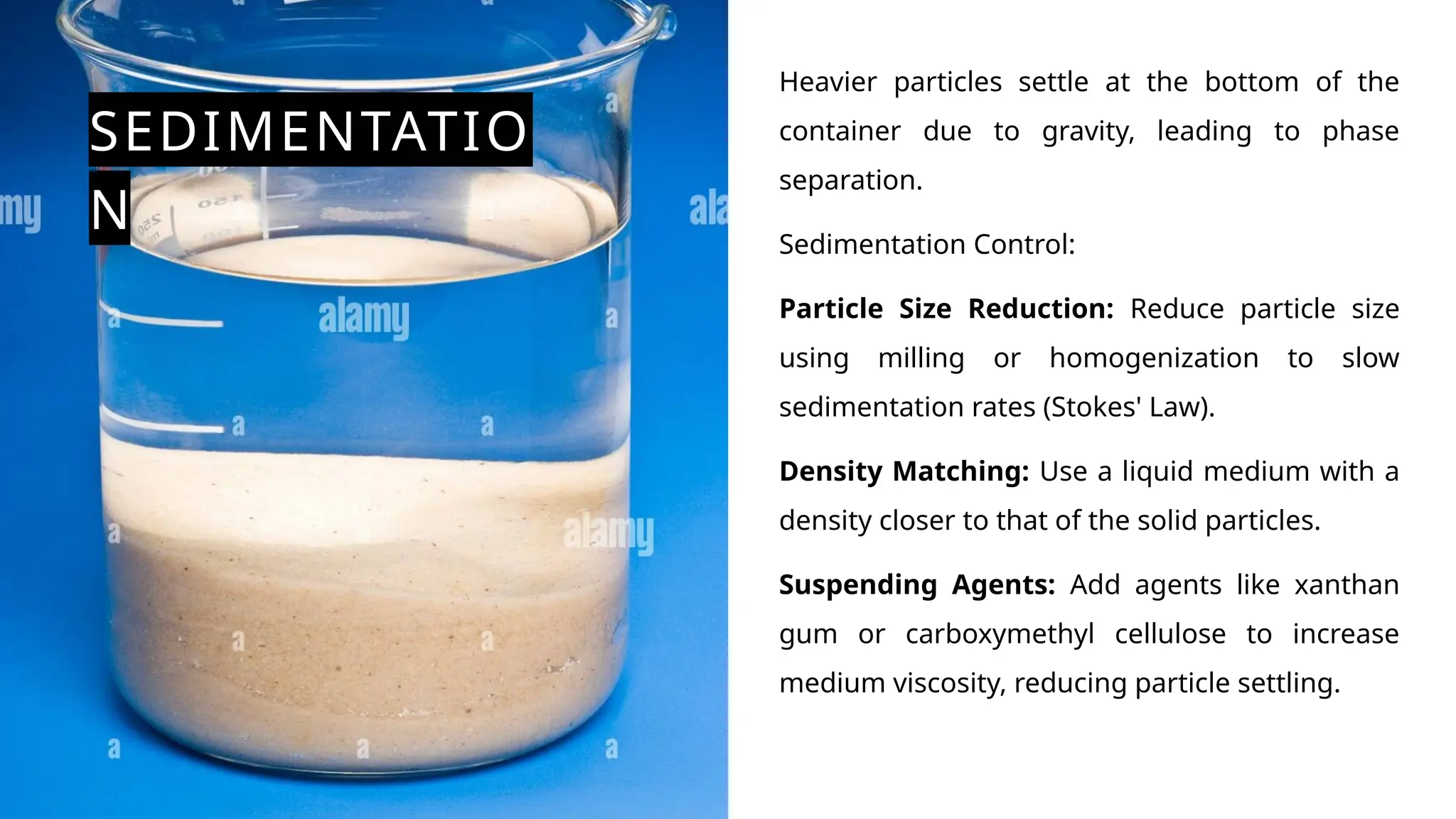
Heavier particles settle at the bottom of the
container due to gravity, leading to phase
separation.
Sedimentation Control:
Particle Size Reduction: Reduce particle size
using milling or homogenization to slow
sedimentation rates (Stokes' Law).
Density Matching: Use a liquid medium with a
density closer to that of the solid particles.
Suspending Agents: Add agents like xanthan
gum or carboxymethyl cellulose to increase
medium viscosity, reducing particle settling.
FLOCCULATION
Particles aggregate loosely, forming flocs or
clusters that may settle faster than individual
particles.
Preventing Flocculation and Aggregation
Electrostatic Stabilization: Adjust pH or add
ionic surfactants to create a repulsive electric
double layer around particles.
Steric Stabilization: Use polymers or nonionic
surfactants to provide steric hindrance,
preventing close particle interactions.
Zeta Potential Optimization: Maintain an
adequate zeta potential to stabilize particles.
CAKING
Once sedimented, particles may form a
compact layer at the bottom that is
difficult to redisperse.
Caking Prevention
Flocculation Control: Induce controlled
flocculation using appropriate
electrolytes or polymers to create soft,
easily redispersible sediments.
Thixotropic Agents: Use materials like
bentonite or certain polymers that form
reversible gels upon standing.
OSTWALD RIPENING
(PARTICLE GROWTH)
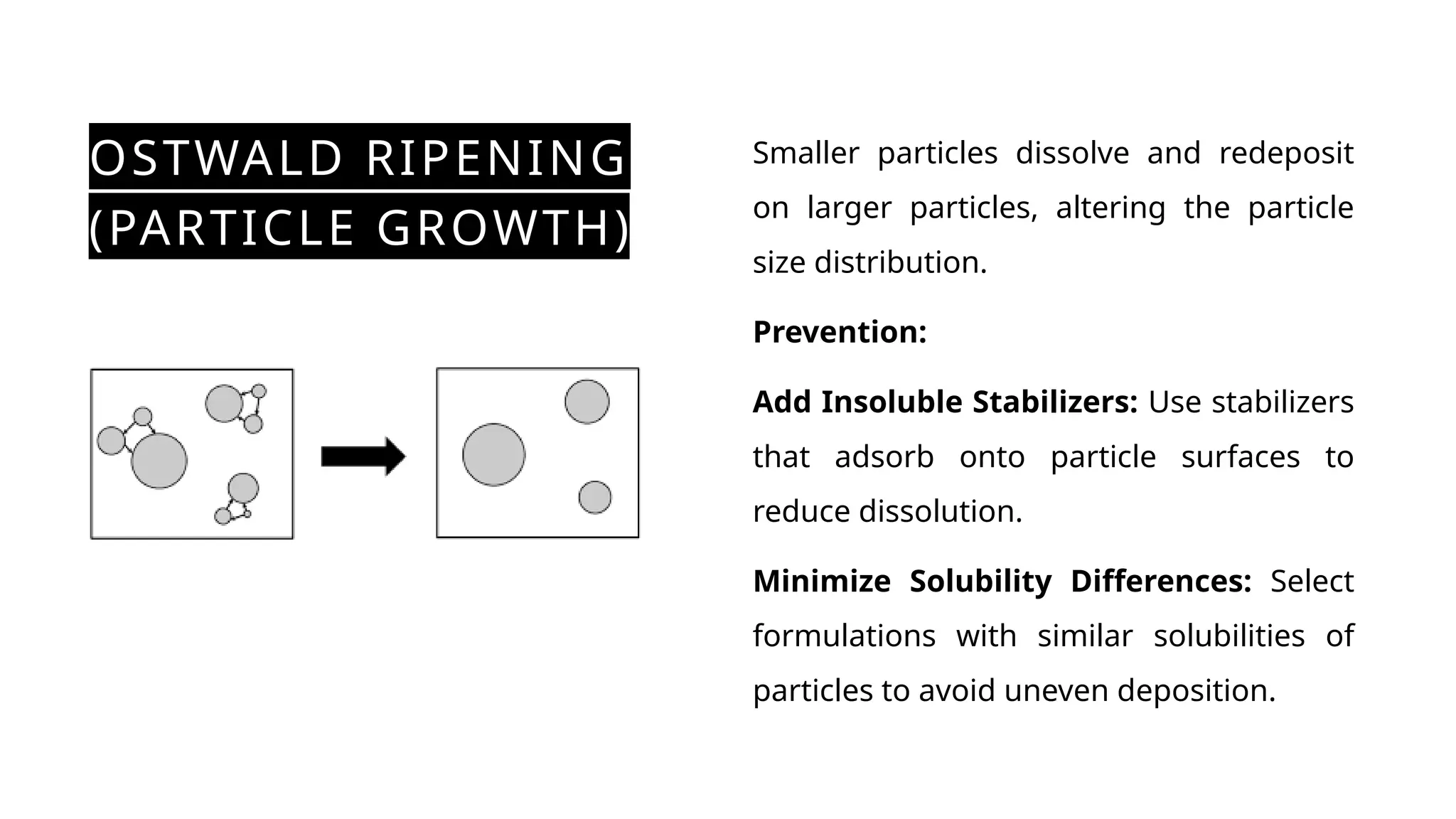
Smaller particles dissolve and redeposit
on larger particles, altering the particle
size distribution.
Prevention:
Add Insoluble Stabilizers: Use stabilizers
that adsorb onto particle surfaces to
reduce dissolution.
Minimize Solubility Differences: Select
formulations with similar solubilities of
particles to avoid uneven deposition.
PHASE SEPARATION
Liquid phases in the suspension may separate due to
incompatibility or poor formulation.
Phase Separation Prevention
Surfactants: Add surfactants to stabilize liquid phases.
Optimize Formulation: Ensure compatibility of all components,
including active ingredients, solvents, and stabilizers.
VISCOSITY CHANGES
Suspensions may become too viscous or too thin over time, affecting
flow and usability.
Viscosity adjustments:
Rheology Modifiers: Use thickeners or gelling agents to optimize
suspension flow properties.
Control Temperature: Maintain a consistent temperature to prevent
viscosity fluctuations due to thermal changes.

SUSPENSIONS and types of suspension explained

  • 1.
  • 2.
    METHODS OF DISPENSINGSUSPENSIONS Suspensions containing diffusible solids 01 Suspensions containing indiffusible solids 02 Suspensions containing precipitate- forming liquids 03 Suspensions produced by chemical reactions 04
  • 3.
    SUSPENSIONS CONTAINING DIFFUSIBLE SOLIDS Some insoluble powdered compoundsare light, mix well with water, and stay suspended in the liquid for a long enough period after shaking to be useful. Substances like these are called diffusible solids. Light kaolin, rhubarb powder, magnesium trisilicate, calcium carbonate, and light magnesium carbonate are a few examples.
  • 4.
    SUSPENSIONS CONTAINING DIFFUSIBLE SOLIDS General method ofdispensing 1.Carefully tare the container. 2.Finely powder the solid ingredients. 3.Mix the insoluble powders in a mortar and add enough vehicle to make a smooth cream. 4.Add more of vehicle to make it pourable. 5.Examine the suspension carefully and if it contains foreign particles, strain through a muslin cloth into a tared container. 6.Rinse the mortar and pestle with successive volume of vehicle until they are quite clean. Transfer the rinsings to the bottle. 7.Add any liquid ingredient. 8.Add more of vehicle to produce the required volume and mix thoroughly by shaking the bottle.
  • 5.
    SUSPENSIONS CONTAINING INDIFFUSIBLE SOLIDS Substances thatare insoluble in water and do not disperse uniformly in a medium for an extended enough period to provide dosing uniformity are known as indiffusible solids. Used externally Used internally Calamine Aspirin Hydrocortisone Aromatic chalk powder Sulphur precipitated Chalk Zinc oxide Phenobarbitone
  • 6.
    SUSPENSIONS CONTAINING INDIFFUSIBLE SOLIDS General method ofdispensing (using compound tragacanth powder) 1.Finely powder all the ingredients. 2.Mix them together in a mortar and add compound tragacanth powder. 3.Measure 3/4th of the vehicle and triturate to form a smooth cream. 4.Examine the suspension carefully and, if it contains any foreign particles, strain through a muslin piece into a tared bottle. 5.Rinse the mortar with small quantity of vehicle to clean it. 6.Transfer the rinsings to the bottle. 7.Add any liquid ingredient. 8.Add more of the vehicle to produce the required volume.
  • 7.
    SUSPENSIONS CONTAINING INDIFFUSIBLE SOLIDS General method ofdispensing (using compound tragacanth powder) 1.Finely powder all the ingredients. 2.Mix them together in a mortar and add compound tragacanth powder. 3.Measure 3/4th of the vehicle and triturate to form a smooth cream. 4.Examine the suspension carefully and, if it contains any foreign particles, strain through a muslin piece into a tared bottle. 5.Rinse the mortar with small quantity of vehicle to clean it. 6.Transfer the rinsings to the bottle. 7.Add any liquid ingredient. 8.Add more of the vehicle to produce the required volume.
  • 8.
    SUSPENSIONS CONTAINING PRECIPITATE- FORMING LIQUIDS When addedto water, some liquid preparations precipitate. Benzoic, compound, myrrh, and tolu tinctures are a few examples. Not only do these liquids not dissolve in water, but they also create insoluble precipitates, especially when combined with salts.
  • 9.
    SUSPENSIONS CONTAINING PRECIPITATE- FORMING LIQUIDS Theyinclude resinous substances, which, when combined with water, cause resin to precipitate and, in some cases, adhere to the bottle's edges or bottom, making redistribution by shaking a challenging task. This is avoided by dispersing a protective colloid in the vehicle prior to adding the tincture. For protective colloid purposes, tragacanth mucilage or compound tragacanth powder (2 g/100 ml) is often utilized, accounting for 1/4 of the total volume.
  • 10.
    SUSPENSIONS CONTAINING PRECIPITATE- FORMING LIQUIDS General method ofdispensing (using compound tragacanth powder) 1. Grind the indiffusible solid and diffusible solid into a fine powder using a mortar. Combine with compound tragacanth powder in a mortar. 2. Measure half of the vehicle and mix a small quantity with the powders through trituration until a smooth cream is achieved. Subsequently, incorporate the remaining components of the vehicle. 3. Measure the precipitate-forming liquid using a dry measuring device and gradually add it to the center of the cream while stirring rapidly. 4. Dissolve the soluble ingredient, if applicable, in an adequate quantity of vehicle derived from the remaining half of the vehicle. 5. Introduce it gradually while continuously stirring the cream to prevent localized high concentrations that could diminish the effectiveness of the suspending agent.
  • 11.
    SUSPENSIONS CONTAINING PRECIPITATE- FORMING LIQUIDS 6. Critically assessthe mortar's contents for the presence of foreign particles. In the presence of these components, strain the suspension through a muslin cloth into a bottle. 7. Increase the quantity of the vehicle to rinse the mortar and transfer the rinsing into the bottle. 8. Incorporate any liquid component. 9. Increase the quantity of the vehicle to achieve the desired volume.
  • 12.
    SUSPENSIONS CONTAINING PRECIPITATE- FORMING LIQUIDS General method ofdispensing (using tragacanth mucilage) Tragacanth mucilage is used when the vehicle is water or chloroform water. 1. Mix the tragacanth mucilage with an equal volume of the vehicle. 2. Measure the precipitate-forming liquid in a dry measure and pour slowly into the centre of the mucilage with constant stirring. 3. Dissolve the solid substance if any, in about 1/4th of the vehicle and mix it with above mixture. Rest of the steps are the same as that of the previous method of dispensing (using compound tragacanth powder)
  • 13.
    SUSPENSIONS PRODUCED BY CHEMICAL REACTIONS In thismethod of suspension preparation, highly diluted solutions of reactants are combined to create finely divided precipitates that can be readily dispersed throughout the liquid by shaking. The resulting precipitates exhibit diffusible characteristics. Therefore, the inclusion of a suspending agent is unnecessary.
  • 14.
    SUSPENSIONS PRODUCED BY CHEMICAL REACTIONS RX Sulphurated potash-5g Zincsulphate-5 g Concentrated camphor water- 2.5 ml Water add upto 100 ml Make a mixture. Direction : To be used as directed. Method : Dissolve the sulphurated potash and zinc sulphate separately in small quantity of water. Add the sulphurated potash solution slowly to the zinc sulphate solution with constant stirring. Transfer to a tared bottle. Add camphor water with vigorous shaking to redissolve precipitated camphor. Mix it well. Add more water to make up 90 ml. Transfer to a bottle, label and dispense.
  • 15.
    CONTAINERS, LABELLING, STORAGE •Containers: Suspensions should be packed in containers which are having adequate air space above the liquid to permit adequate shaking. The oral suspensions should be packed in wide mouth bottles to permit prompt removal of the suspension. • Labelling: The containers having liquid suspension must be labelled with a secondary label "Shake well before use". In case of dry suspension powders, the specified amount of vehicle to be mixed may be indicated clearly on the label. • Storage: Suspensions should be stored in a cool place but should not be kept in a refrigerator. Freezing at a very low temperatures should be avoided which may lead to aggregation of the suspended particles.
  • 16.
    STABILITY PROBLEMS OFSUSPENSIONS Sedimentati on Flocculation Caking Ostwald ripening Aggregation Phase separation Viscosity changes
  • 17.
    SEDIMENTATIO N Heavier particles settleat the bottom of the container due to gravity, leading to phase separation. Sedimentation Control: Particle Size Reduction: Reduce particle size using milling or homogenization to slow sedimentation rates (Stokes' Law). Density Matching: Use a liquid medium with a density closer to that of the solid particles. Suspending Agents: Add agents like xanthan gum or carboxymethyl cellulose to increase medium viscosity, reducing particle settling.
  • 18.
    FLOCCULATION Particles aggregate loosely,forming flocs or clusters that may settle faster than individual particles. Preventing Flocculation and Aggregation Electrostatic Stabilization: Adjust pH or add ionic surfactants to create a repulsive electric double layer around particles. Steric Stabilization: Use polymers or nonionic surfactants to provide steric hindrance, preventing close particle interactions. Zeta Potential Optimization: Maintain an adequate zeta potential to stabilize particles.
  • 19.
    CAKING Once sedimented, particlesmay form a compact layer at the bottom that is difficult to redisperse. Caking Prevention Flocculation Control: Induce controlled flocculation using appropriate electrolytes or polymers to create soft, easily redispersible sediments. Thixotropic Agents: Use materials like bentonite or certain polymers that form reversible gels upon standing.
  • 20.
    OSTWALD RIPENING (PARTICLE GROWTH) Smallerparticles dissolve and redeposit on larger particles, altering the particle size distribution. Prevention: Add Insoluble Stabilizers: Use stabilizers that adsorb onto particle surfaces to reduce dissolution. Minimize Solubility Differences: Select formulations with similar solubilities of particles to avoid uneven deposition.
  • 21.
    PHASE SEPARATION Liquid phasesin the suspension may separate due to incompatibility or poor formulation. Phase Separation Prevention Surfactants: Add surfactants to stabilize liquid phases. Optimize Formulation: Ensure compatibility of all components, including active ingredients, solvents, and stabilizers.
  • 22.
    VISCOSITY CHANGES Suspensions maybecome too viscous or too thin over time, affecting flow and usability. Viscosity adjustments: Rheology Modifiers: Use thickeners or gelling agents to optimize suspension flow properties. Control Temperature: Maintain a consistent temperature to prevent viscosity fluctuations due to thermal changes.