Surgical Approaches
Tibia & Fibula
Dr. Mirant Dave
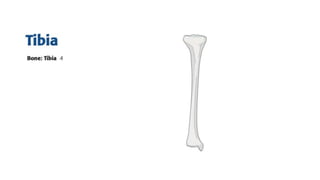
Tibia
Approaches
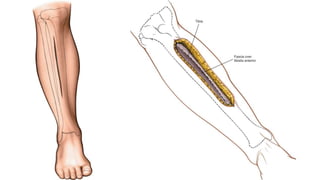
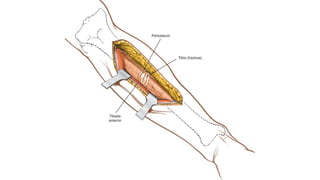
Anterior Approach
• Make a longitudinal incision on either side of the anterior border of
the bone.
• Reflect the skin and incise and elevate the periosteum over the
desired area.
• Strip the periosteum as little as possible because its circulation is a
source of nutrition for the bone.
Medial Approach (Phemister)
• In some delayed unions and nonunions, Phemister inserted a bone
graft in a bed prepared on the posterior surface of the tibia.
• Make a longitudinal incision along the posteromedial border of the
tibia.
• Incise the subcutaneous tissues and deep fascia and reflect the
periosteum from the posterior surface for the required distance.
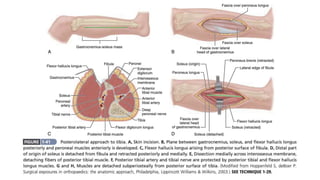
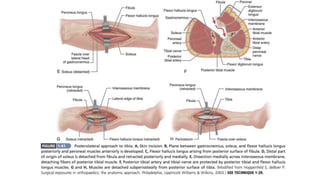
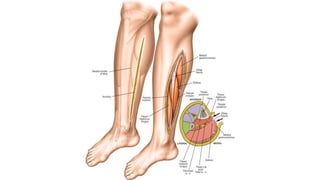
Posterolateral Approach (Harmon, Modified)
• The posterolateral approach is valuable in the middle two thirds of
the tibia when the anterior and anteromedial aspects of the leg are
badly scarred. It also is satisfactory for removing a portion of the
fibula for transfer.
• Position the patient prone or on the side, with the affected extremity
uppermost.
• Make the skin incision the desired length along the lateral border of
the gastrocnemius muscle on the posterolateral aspect of the leg.
Posterolateral Approach (Harmon, Modified)
• Develop the plane between the gastrocnemius, the soleus, and the
flexor hallucis longus muscles posteriorly and the peroneal muscles
anteriorly.
• Find the lateral border of the soleus muscle and retract it and the
gastrocnemius muscle medially and posteriorly; arising from the
posterior surface of the fibula is the flexor hallucis longus.
Posterolateral Approach (Harmon, Modified)
• Detach the distal part of the origin of the soleus muscle from the
fibula and retract it posteriorly and medially.
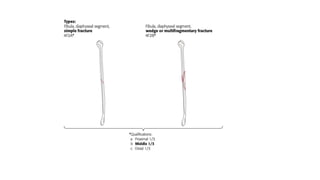
• Continue the dissection medially across the interosseous membrane,
detaching those fibers of the posterior tibial muscle arising from it.
The posterior tibial artery and the tibial nerve are posterior and
separated from the dissection by the posterior tibial and flexor
hallucis longus muscles.
Posterolateral Approach (Harmon, Modified)
• Follow the interosseous membrane to the lateral border of the tibia
and detach subperiosteally the muscles that arise from the posterior
surface of the tibia.
• The posterior half of the fibula lies in the lateral part of the wound; its
entire shaft can be explored. The flat posterior surface of the tibial
shaft can be completely exposed except for its proximal fourth, which
lies in close relation to the popliteus muscle and to the proximal parts
of the posterior tibial vessels and the tibial nerve.
Posterolateral Approach (Harmon, Modified)
• When the operation is completed, release the tourniquet, secure
hemostasis, and let the posterior muscle mass fall back into place.
• Loosely close the deep fascia on the lateral side of the leg with a few
interrupted sutures.
Dangers
• The small (short) saphenous vein may be damaged when the skin
flaps are mobilized. Although the vein should be preserved if possible,
it may be ligated, if necessary, without impairing venous return from
the leg.
• Branches of the peroneal artery cross the intermuscular plane
between the gastrocnemius and peroneus brevis muscles. They
should be ligated or coagulated to reduce postoperative bleeding.
• The posterior tibial artery and tibial nerve are safe as long as the
surgical plane of operation remains on the interosseous membrane
and does not wander into a plane posterior to the flexor hallucis
longus and tibialis posterior muscles.
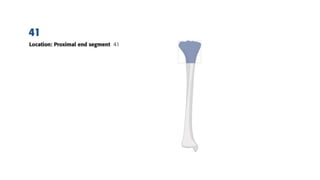
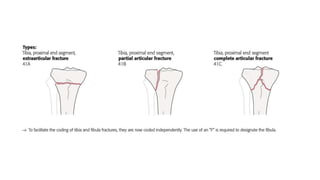
Tibial Plateau
Approaches
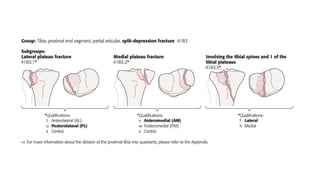
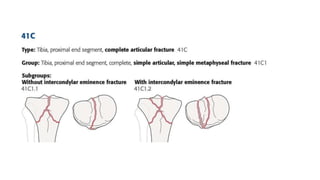
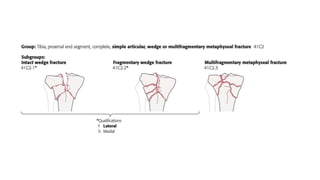
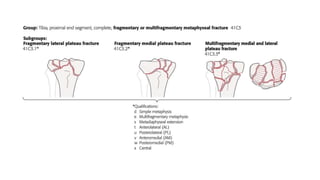
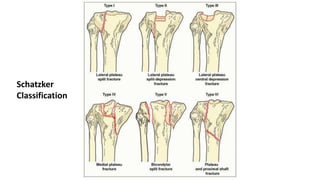
Schatzker
Classification
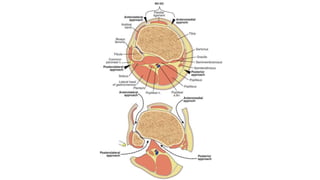
ANTEROLATERAL APPROACH TO THE
LATERAL TIBIAL PLATEAU
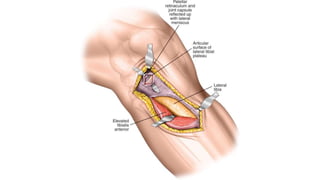
• The anterolateral approach is commonly used because most tibial
plateau fractures involve the lateral tibial plateau.
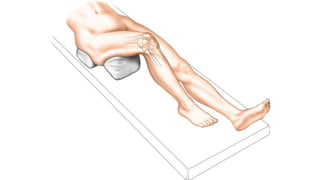
• Place the patient supine on a radiolucent table.
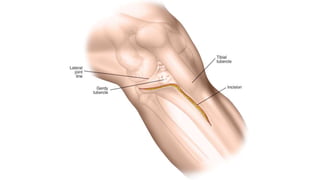
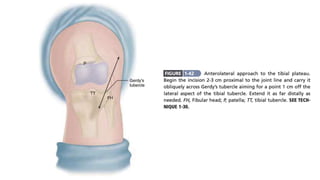
• Begin the incision 2 to 3 cm proximal to the joint line and extend it 3
cm below the inferior margin of the tibial tubercle crossing Gerdy’s
tubercle at the midpoint of the incision.
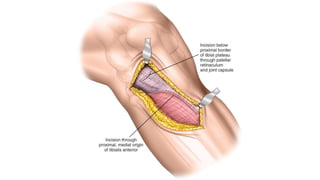
• Detach the iliotibial band and develop the interval between it and the
joint capsule.
ANTEROLATERAL APPROACH TO THE
LATERAL TIBIAL PLATEAU
• Reflect the origin of the tibialis anterior muscle from the anterolateral
tibia and reflect it posteriorly exposing the anterolateral surface of
the tibial plateau.
• If direct exposure of the articular surface is necessary, perform a
submeniscal arthrotomy incising the menisco-tibial ligaments. Leave
the anterior horn of the meniscus intact.
ANTEROLATERAL APPROACH TO THE
LATERAL TIBIAL PLATEAU
• Place three or four sutures in the periphery of the meniscus to serve
as retractors and for later repair. If a repairable vertical meniscal tear
is present, pass the necessary number of sutures in a vertical fashion
through the inner part of the meniscus for later attachment to the
capsule.
• If a submeniscal arthrotomy is not planned, a hockey-stick skin
incision can be used for minimally invasive procedures. Make the
proximal limb of the incision parallel to the lateral joint line and cross
Gerdy’s tubercle.
Uses
• Open reduction and internal fixation of fractures of the lateral tibial
plateau
• Bone grafting for delayed union and nonunion of fractures
• Treatment of osteomyelitis
• Excision and biopsy of tumors
• Harvesting of bone graft
Dangers
• Nerves
• The deep branch of the peroneal nerve has a variable course.
Normally, it lies well posterior to the area of dissection and it should
not be injured.
• The lateral meniscus has to be detached from some of its soft tissue
attachments inferiorly to allow adequate visualization of the articular
surface of the tibia. Take care not to completely detach it, preserving
anterior and posterior attachments, however. It is at most risk during
the incision of the knee joint synovium.
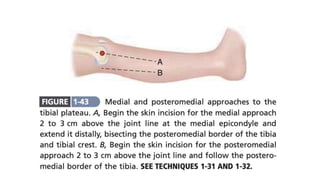
MEDIAL APPROACH TO THE MEDIAL
TIBIAL PLATEAU
• This approach is useful for isolated medial plateau fractures and for
medial half of bicondylar plateau fractures.
• With the patient supine, make an incision 1 to 2 cm proximal to the
joint line in line with the medial femoral epicondyle and extend it
over the pes anserinus insertion. Avoid the saphenous vein and nerve
that usually are posterior.
MEDIAL APPROACH TO THE MEDIAL
TIBIAL PLATEAU
• Take the pes anserinus tendons down sharply from the tibia, exposing
the superficial and deep medial collateral ligaments (MCL).
• Indirectly reduce the fracture and apply a plate over the MCL.
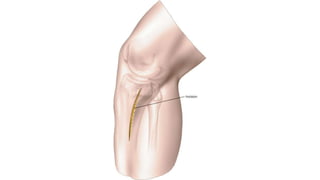
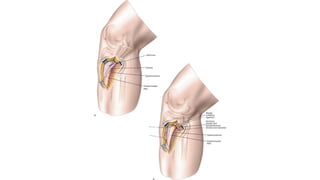
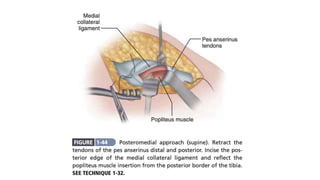
POSTEROMEDIAL APPROACH TO THE
MEDIAL TIBIAL PLATEAU (SUPINE)
• This approach is useful for shear fractures of the medial plateau. It
can be performed with the patient supine or prone.
• Externally rotate and slightly flex the knee.
• Make a longitudinal incision along the posteromedial aspect of the
tibia, beginning 3 cm above the joint line and extend it as far distally
as needed. Avoid the great saphenous vein and saphenous nerve
anterior to the incision.
POSTEROMEDIAL APPROACH TO THE
MEDIAL TIBIAL PLATEAU
• Mobilize and retract the pes anserinus tendons proximally and
anteriorly or distally and posteriorly.
• Retract the medial gastrocnemius and soleus muscles posteriorly,
exposing the junction of popliteal fascia, the semimembranosus
insertion, and the MCL.
• Incise the periosteum longitudinally and subperiosteally elevate the
popliteus muscle insertion off the posterior tibia.
Two techniques
• Direct approach—Divide the pes anserinus longitudinally in the line of
the skin incision. This technique has the advantage of simplicity but
repair of the pes is difficult during closure especially since a plate will
almost always have been applied to the bone.
• Pes reflecting approach—Identify the anterior border of the pes
which is the anterior border of the sartorius tendon. Reflect the
sartorius tendon posteriorly entering the bursa underneath the
tendon. Identify the tendons of gracilis and semitendinosus and
reflect all three tendons posteriorly partially resecting them from
their insertion into the tibia
POSTEROMEDIAL APPROACH (PRONE)
TO THE SUPEROMEDIAL TIBIA (BANKS AND LAUFMAN)
• The posterior approach to the superomedial region of the tibia is
useful for fixation of posteromedial split fractures of the tibial
plateau.
• With the patient positioned prone, begin the transverse segment of a
hockey-stick incision at the lateral end of the flexion crease of the
knee, and extend it across the popliteal space. Turn the incision
distally along the medial side of the calf for 7 to 10 cm.
POSTEROMEDIAL APPROACH (PRONE)
TO THE SUPEROMEDIAL TIBIA (BANKS AND LAUFMAN)
• Develop the angular flap of skin and subcutaneous tissue and incise
the deep fascia in line with the skin incision. Identify and protect the
cutaneous nerves and superficial vessels.
• Define the interval between the tendon of the semitendinosus
muscle and the medial head of the gastrocnemius muscle.
• Retract the semitendinosus proximally and medially and the gastroc-
soleus component distally and laterally; the popliteus and flexor
digitorum longus muscles lie in the floor of the interval.
POSTEROMEDIAL APPROACH (PRONE)
TO THE SUPEROMEDIAL TIBIA (BANKS AND LAUFMAN)
• Elevate subperiosteally the flexor digitorum longus muscle distally
and laterally and the popliteus muscle proximally and medially, and
expose the posterior surface of the proximal fourth of the tibia.
Further elevation of the popliteus will expose the posterior cruciate
ligament fossa.
• If necessary, extend the incision distally along the medial side of the
calf by continuing the dissection in the same intermuscular plane. The
tibial nerve and posterior tibial artery lie beneath the soleus muscle.
Uses
• Open reduction and internal fixation of fractures of the medial tibial
plateau (Schatzker Type 4)
• Open reduction and internal fixation of complex bicondylar tibial
plateau fractures (Schatzker Types 5 and 6)
• Upper tibial osteotomy
• Drainage of abscess
• Biopsy of tumors
Dangers
• The saphenous nerve and vein are encountered during the superficial
surgical dissection and should be preserved and protected.
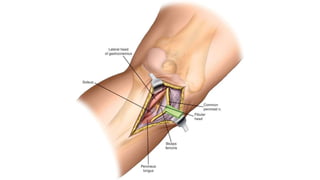
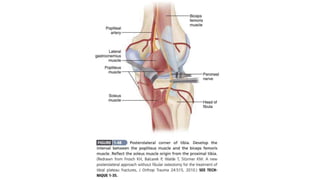
POSTEROLATERAL APPROACH TO THE
TIBIAL PLATEAU (SOLOMON)
• This approach is useful for lateral and posterolateral plateau fractures.
This approach with a fibular osteotomy is useful for fractures of the
posterolateral plateau.
• Position the patient supine with the knee extended. Make a 6-cm
longitudinal incision anterior to the biceps femoris tendon contour on
the fibular head. The incision can be extended distally as needed.
POSTEROLATERAL APPROACH TO THE
TIBIAL PLATEAU (SOLOMON)
• Flex the knee to 60 degrees.
• Incise the subcutaneous fat in line with the skin incision, exposing the
deep fascia.
• Incise the fascia lata over the biceps tendon and the common
peroneal nerve. Identify the common peroneal nerve in the adipose
tissue of the popliteal fossa.
POSTEROLATERAL APPROACH TO THE
TIBIAL PLATEAU (SOLOMON)
• Knee flexion relaxes the common peroneal nerve. Expose the nerve
down to the fibular head. Protect the sural nerve branch from the
common peroneal nerve in the popliteal fossa.
• Transect the branch of the common peroneal nerve to the proximal
tibiofibular joint.
• Release the common peroneal nerve from the posterior
intermuscular septum posterior to the peroneus longus muscle as it
enters the lateral compartment.
POSTEROLATERAL APPROACH TO THE
TIBIAL PLATEAU (SOLOMON)
• Expose the deep peroneal nerve by detaching the peroneus longus
and tibialis anterior muscles from the posterior and anterior aspects
of the anterior intermuscular septum, respectively.
• Release the deep peroneal nerve as it enters the anterior
compartment and goes through the anterior septum.
• Pre-drill the fibular head and neck just lateral to the biceps femoris
insertion.
POSTEROLATERAL APPROACH TO THE
TIBIAL PLATEAU (SOLOMON)
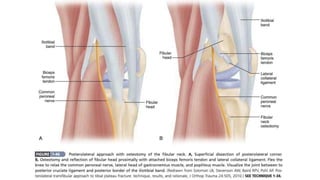
• Osteotomize the fibular neck with an osteotome just above the
peroneal nerve.
• Release the joint capsule from the proximal tibiofibular joint and
reflect the fibular head proximally with attached biceps femoris
tendon and lateral collateral ligament complex, exposing the postural
corner of the knee joint.
• Mobilize the lateral meniscus by detaching the coronary ligament
from the posterior cruciate ligament medially to the iliotibial band
laterally, and elevate it to expose the tibial articular surfaces.
POSTEROLATERAL APPROACH TO THE
TIBIAL PLATEAU (SOLOMON)
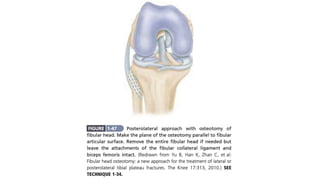
• At closure, repair the osteotomy with a longitudinal screw.
• Alternatively, the fibular head can be osteotomized in a longitudinal
direction as described by Yu et al. One-third of the fibular head or the
entire fibular head can be removed, depending on the exposure
required. The biceps femoris and lateral collateral ligament insertions
are left intact.
POSTEROLATERAL APPROACH TO THE TIBIAL
PLATEAU WITHOUT FIBULAR OSTEOTOMY
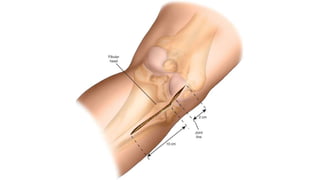
• Place the patient in the lateral decubitus position with the operative
side up.
• Support the knee with a thick, rolled pillow.
• Make a 15-cm posterolateral incision starting 3 cm above the joint
line then following the fibula distally.
• Incise the posterior portion of the iliotibial band from Gerdy’s
tubercle and perform a lateral arthrotomy.
POSTEROLATERAL APPROACH TO THE TIBIAL
PLATEAU WITHOUT FIBULAR OSTEOTOMY
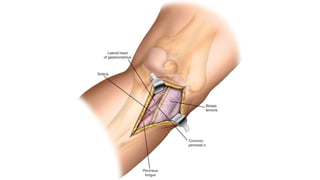
• Bluntly dissect into the popliteal fossa between the lateral origin of
the gastrocnemius muscle and soleus muscle, exposing the popliteus
muscle.
• Ligate the inferior geniculate vessels if necessary.
• Develop the interval between the biceps femoris muscle and the
popliteus muscle.
• Detach the soleus muscle from the posterior aspect of the fibula
exposing the posterolateral plateau.
Dangers
• The common peroneal nerve is vulnerable during the incision of the
deep fascia. It may also be damaged by over vigorous retraction of
the biceps tendon.
TSCHERNE-JOHNSON EXTENSILE APPROACH
TO THE LATERAL TIBIAL PLATEAU
• This approach is useful for depressed lateral plateau fractures.
• Position the patient supine with a bump under the ipsilateral hip.
• Flex the knee over a large bump so that the leg will rest just off the
edge of the table.
• Perform a lateral parapatellar incision from the supracondylar area of
the distal femur to below and lateral to the tibial tubercle.
• Develop a lateral soft-tissue flap from the wound edge to the
posterolateral corner of the tibial plateau.
TSCHERNE-JOHNSON EXTENSILE APPROACH
TO THE LATERAL TIBIAL PLATEAU
• Identify Gerdy’s tubercle and the anterior and posterior edges of the
iliotibial band.
• Flex the knee to 40 degrees and incise the central portion of the
iliotibial band distally from a point 4 cm above the joint line to the
joint line and continue it anteriorly, dividing the anterior half of the
band. Carry the incision anteriorly to the patellar tendon.
• Retract the anterior half of the iliotibial band exposing the lateral joint
line.
• Incise the meniscal coronary ligament from posterior to anterior
ending at the level of the patellar tendon.
TSCHERNE-JOHNSON EXTENSILE APPROACH
TO THE LATERAL TIBIAL PLATEAU
• Place three 2-0 absorbable sutures in the meniscal edge and elevate
it. The sutures will be used to later repair the meniscus to the lateral
plateau rim.
• Incise the origin of the tibialis anterior muscle along the lateral tibial
metaphyseal flair and elevate it distally.
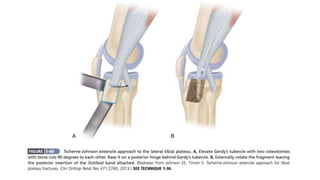
• Perform two osteotomies anterior and distal to Gerdy’s tubercle with
a narrow osteotome.
TSCHERNE-JOHNSON EXTENSILE APPROACH
TO THE LATERAL TIBIAL PLATEAU
• Rotate the Gerdy’s tubercle fragment posteriorly on its posterior soft-
tissue hinge to expose the under surface of the lateral plateau.
• At closure, repair the osteotomy with an overlying plate and screws
with one of the screws directly repairing the osteotomy.
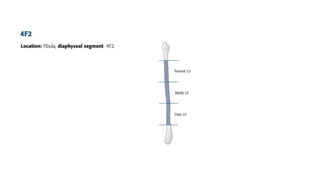
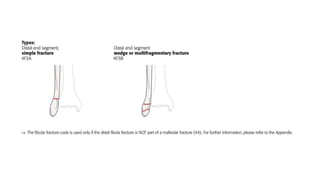
Fibula
Approaches
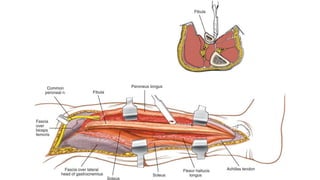
POSTEROLATERAL APPROACH TO THE FIBULA
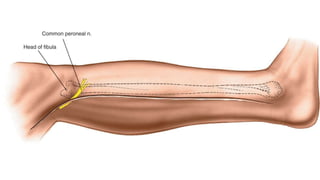
• Beginning 13 cm proximal to the lateral malleolus, incise the skin
proximally along the posterior margin of the fibula to the posterior
margin of the head of the bone and continue farther proximally for 10
cm along the posterior aspect of the biceps tendon.
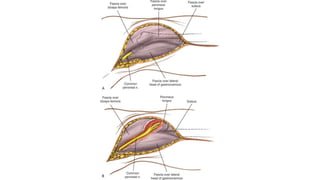
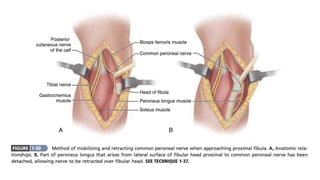
• Divide the superficial and deep fasciae. Isolate the common peroneal
nerve along the posteromedial aspect of the biceps tendon in the
proximal part of the wound, and free it distally to its entrance into the
peroneus longus muscle.
POSTEROLATERAL APPROACH TO THE FIBULA
• Pointing the knife blade proximally and anteriorly, detach the part of
the peroneus longus muscle that arises from the lateral surface of the
head of the fibula proximal to the common peroneal nerve. Retract
the nerve over the head of the fibula.
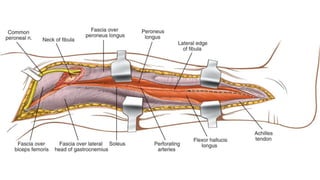
• Locate the fascial plane between the soleus muscle posteriorly and
the peroneal muscles anteriorly and deepen the dissection along the
plane to the fibula.
POSTEROLATERAL APPROACH TO THE FIBULA
• Expose the bone by retracting the peroneal muscles anteriorly and
incising the periosteum. When retracting these muscles, avoid
injuring the branches of the deep peroneal nerve that lie on their
deep surfaces and are in close contact with the neck of the fibula and
proximal 5 cm of the shaft.
• The distal fourth of the fibula is subcutaneous on its lateral aspect
and may be exposed by a longitudinal incision through the skin,
fascia, and periosteum.
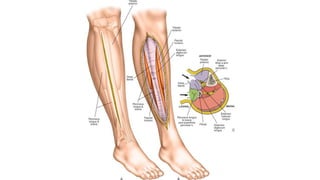
Compartment Syndrome
• Anterolateral Incision
• Make a longitudinal incision overlying the anterolateral aspect of the
lower leg. Begin at the level of the tibial tubercle and extend the
incision to end 6 cm above the level of the ankle.
• Posteromedial Incision
• Make a longitudinal incision overlying the posteromedial aspect of
the lower leg. Begin at the level of the tibial tubercle and extend the
incision distally ending 6 cm above the ankle.
Thank You

Surgical approaches tibia fibula

  • 1.
    Surgical Approaches Tibia &Fibula Dr. Mirant Dave
  • 2.
  • 33.
    Anterior Approach • Makea longitudinal incision on either side of the anterior border of the bone. • Reflect the skin and incise and elevate the periosteum over the desired area. • Strip the periosteum as little as possible because its circulation is a source of nutrition for the bone.
  • 36.
    Medial Approach (Phemister) •In some delayed unions and nonunions, Phemister inserted a bone graft in a bed prepared on the posterior surface of the tibia. • Make a longitudinal incision along the posteromedial border of the tibia. • Incise the subcutaneous tissues and deep fascia and reflect the periosteum from the posterior surface for the required distance.
  • 37.
    Posterolateral Approach (Harmon,Modified) • The posterolateral approach is valuable in the middle two thirds of the tibia when the anterior and anteromedial aspects of the leg are badly scarred. It also is satisfactory for removing a portion of the fibula for transfer. • Position the patient prone or on the side, with the affected extremity uppermost. • Make the skin incision the desired length along the lateral border of the gastrocnemius muscle on the posterolateral aspect of the leg.
  • 38.
    Posterolateral Approach (Harmon,Modified) • Develop the plane between the gastrocnemius, the soleus, and the flexor hallucis longus muscles posteriorly and the peroneal muscles anteriorly. • Find the lateral border of the soleus muscle and retract it and the gastrocnemius muscle medially and posteriorly; arising from the posterior surface of the fibula is the flexor hallucis longus.
  • 39.
    Posterolateral Approach (Harmon,Modified) • Detach the distal part of the origin of the soleus muscle from the fibula and retract it posteriorly and medially. • Continue the dissection medially across the interosseous membrane, detaching those fibers of the posterior tibial muscle arising from it. The posterior tibial artery and the tibial nerve are posterior and separated from the dissection by the posterior tibial and flexor hallucis longus muscles.
  • 40.
    Posterolateral Approach (Harmon,Modified) • Follow the interosseous membrane to the lateral border of the tibia and detach subperiosteally the muscles that arise from the posterior surface of the tibia. • The posterior half of the fibula lies in the lateral part of the wound; its entire shaft can be explored. The flat posterior surface of the tibial shaft can be completely exposed except for its proximal fourth, which lies in close relation to the popliteus muscle and to the proximal parts of the posterior tibial vessels and the tibial nerve.
  • 41.
    Posterolateral Approach (Harmon,Modified) • When the operation is completed, release the tourniquet, secure hemostasis, and let the posterior muscle mass fall back into place. • Loosely close the deep fascia on the lateral side of the leg with a few interrupted sutures.
  • 44.
    Dangers • The small(short) saphenous vein may be damaged when the skin flaps are mobilized. Although the vein should be preserved if possible, it may be ligated, if necessary, without impairing venous return from the leg. • Branches of the peroneal artery cross the intermuscular plane between the gastrocnemius and peroneus brevis muscles. They should be ligated or coagulated to reduce postoperative bleeding. • The posterior tibial artery and tibial nerve are safe as long as the surgical plane of operation remains on the interosseous membrane and does not wander into a plane posterior to the flexor hallucis longus and tibialis posterior muscles.
  • 45.
  • 46.
  • 48.
    ANTEROLATERAL APPROACH TOTHE LATERAL TIBIAL PLATEAU • The anterolateral approach is commonly used because most tibial plateau fractures involve the lateral tibial plateau. • Place the patient supine on a radiolucent table. • Begin the incision 2 to 3 cm proximal to the joint line and extend it 3 cm below the inferior margin of the tibial tubercle crossing Gerdy’s tubercle at the midpoint of the incision. • Detach the iliotibial band and develop the interval between it and the joint capsule.
  • 49.
    ANTEROLATERAL APPROACH TOTHE LATERAL TIBIAL PLATEAU • Reflect the origin of the tibialis anterior muscle from the anterolateral tibia and reflect it posteriorly exposing the anterolateral surface of the tibial plateau. • If direct exposure of the articular surface is necessary, perform a submeniscal arthrotomy incising the menisco-tibial ligaments. Leave the anterior horn of the meniscus intact.
  • 50.
    ANTEROLATERAL APPROACH TOTHE LATERAL TIBIAL PLATEAU • Place three or four sutures in the periphery of the meniscus to serve as retractors and for later repair. If a repairable vertical meniscal tear is present, pass the necessary number of sutures in a vertical fashion through the inner part of the meniscus for later attachment to the capsule. • If a submeniscal arthrotomy is not planned, a hockey-stick skin incision can be used for minimally invasive procedures. Make the proximal limb of the incision parallel to the lateral joint line and cross Gerdy’s tubercle.
  • 51.
    Uses • Open reductionand internal fixation of fractures of the lateral tibial plateau • Bone grafting for delayed union and nonunion of fractures • Treatment of osteomyelitis • Excision and biopsy of tumors • Harvesting of bone graft
  • 57.
    Dangers • Nerves • Thedeep branch of the peroneal nerve has a variable course. Normally, it lies well posterior to the area of dissection and it should not be injured. • The lateral meniscus has to be detached from some of its soft tissue attachments inferiorly to allow adequate visualization of the articular surface of the tibia. Take care not to completely detach it, preserving anterior and posterior attachments, however. It is at most risk during the incision of the knee joint synovium.
  • 58.
    MEDIAL APPROACH TOTHE MEDIAL TIBIAL PLATEAU • This approach is useful for isolated medial plateau fractures and for medial half of bicondylar plateau fractures. • With the patient supine, make an incision 1 to 2 cm proximal to the joint line in line with the medial femoral epicondyle and extend it over the pes anserinus insertion. Avoid the saphenous vein and nerve that usually are posterior.
  • 59.
    MEDIAL APPROACH TOTHE MEDIAL TIBIAL PLATEAU • Take the pes anserinus tendons down sharply from the tibia, exposing the superficial and deep medial collateral ligaments (MCL). • Indirectly reduce the fracture and apply a plate over the MCL.
  • 61.
    POSTEROMEDIAL APPROACH TOTHE MEDIAL TIBIAL PLATEAU (SUPINE) • This approach is useful for shear fractures of the medial plateau. It can be performed with the patient supine or prone. • Externally rotate and slightly flex the knee. • Make a longitudinal incision along the posteromedial aspect of the tibia, beginning 3 cm above the joint line and extend it as far distally as needed. Avoid the great saphenous vein and saphenous nerve anterior to the incision.
  • 62.
    POSTEROMEDIAL APPROACH TOTHE MEDIAL TIBIAL PLATEAU • Mobilize and retract the pes anserinus tendons proximally and anteriorly or distally and posteriorly. • Retract the medial gastrocnemius and soleus muscles posteriorly, exposing the junction of popliteal fascia, the semimembranosus insertion, and the MCL. • Incise the periosteum longitudinally and subperiosteally elevate the popliteus muscle insertion off the posterior tibia.
  • 65.
    Two techniques • Directapproach—Divide the pes anserinus longitudinally in the line of the skin incision. This technique has the advantage of simplicity but repair of the pes is difficult during closure especially since a plate will almost always have been applied to the bone. • Pes reflecting approach—Identify the anterior border of the pes which is the anterior border of the sartorius tendon. Reflect the sartorius tendon posteriorly entering the bursa underneath the tendon. Identify the tendons of gracilis and semitendinosus and reflect all three tendons posteriorly partially resecting them from their insertion into the tibia
  • 67.
    POSTEROMEDIAL APPROACH (PRONE) TOTHE SUPEROMEDIAL TIBIA (BANKS AND LAUFMAN) • The posterior approach to the superomedial region of the tibia is useful for fixation of posteromedial split fractures of the tibial plateau. • With the patient positioned prone, begin the transverse segment of a hockey-stick incision at the lateral end of the flexion crease of the knee, and extend it across the popliteal space. Turn the incision distally along the medial side of the calf for 7 to 10 cm.
  • 68.
    POSTEROMEDIAL APPROACH (PRONE) TOTHE SUPEROMEDIAL TIBIA (BANKS AND LAUFMAN) • Develop the angular flap of skin and subcutaneous tissue and incise the deep fascia in line with the skin incision. Identify and protect the cutaneous nerves and superficial vessels. • Define the interval between the tendon of the semitendinosus muscle and the medial head of the gastrocnemius muscle. • Retract the semitendinosus proximally and medially and the gastroc- soleus component distally and laterally; the popliteus and flexor digitorum longus muscles lie in the floor of the interval.
  • 69.
    POSTEROMEDIAL APPROACH (PRONE) TOTHE SUPEROMEDIAL TIBIA (BANKS AND LAUFMAN) • Elevate subperiosteally the flexor digitorum longus muscle distally and laterally and the popliteus muscle proximally and medially, and expose the posterior surface of the proximal fourth of the tibia. Further elevation of the popliteus will expose the posterior cruciate ligament fossa. • If necessary, extend the incision distally along the medial side of the calf by continuing the dissection in the same intermuscular plane. The tibial nerve and posterior tibial artery lie beneath the soleus muscle.
  • 70.
    Uses • Open reductionand internal fixation of fractures of the medial tibial plateau (Schatzker Type 4) • Open reduction and internal fixation of complex bicondylar tibial plateau fractures (Schatzker Types 5 and 6) • Upper tibial osteotomy • Drainage of abscess • Biopsy of tumors
  • 71.
    Dangers • The saphenousnerve and vein are encountered during the superficial surgical dissection and should be preserved and protected.
  • 72.
    POSTEROLATERAL APPROACH TOTHE TIBIAL PLATEAU (SOLOMON) • This approach is useful for lateral and posterolateral plateau fractures. This approach with a fibular osteotomy is useful for fractures of the posterolateral plateau. • Position the patient supine with the knee extended. Make a 6-cm longitudinal incision anterior to the biceps femoris tendon contour on the fibular head. The incision can be extended distally as needed.
  • 73.
    POSTEROLATERAL APPROACH TOTHE TIBIAL PLATEAU (SOLOMON) • Flex the knee to 60 degrees. • Incise the subcutaneous fat in line with the skin incision, exposing the deep fascia. • Incise the fascia lata over the biceps tendon and the common peroneal nerve. Identify the common peroneal nerve in the adipose tissue of the popliteal fossa.
  • 74.
    POSTEROLATERAL APPROACH TOTHE TIBIAL PLATEAU (SOLOMON) • Knee flexion relaxes the common peroneal nerve. Expose the nerve down to the fibular head. Protect the sural nerve branch from the common peroneal nerve in the popliteal fossa. • Transect the branch of the common peroneal nerve to the proximal tibiofibular joint. • Release the common peroneal nerve from the posterior intermuscular septum posterior to the peroneus longus muscle as it enters the lateral compartment.
  • 75.
    POSTEROLATERAL APPROACH TOTHE TIBIAL PLATEAU (SOLOMON) • Expose the deep peroneal nerve by detaching the peroneus longus and tibialis anterior muscles from the posterior and anterior aspects of the anterior intermuscular septum, respectively. • Release the deep peroneal nerve as it enters the anterior compartment and goes through the anterior septum. • Pre-drill the fibular head and neck just lateral to the biceps femoris insertion.
  • 76.
    POSTEROLATERAL APPROACH TOTHE TIBIAL PLATEAU (SOLOMON) • Osteotomize the fibular neck with an osteotome just above the peroneal nerve. • Release the joint capsule from the proximal tibiofibular joint and reflect the fibular head proximally with attached biceps femoris tendon and lateral collateral ligament complex, exposing the postural corner of the knee joint. • Mobilize the lateral meniscus by detaching the coronary ligament from the posterior cruciate ligament medially to the iliotibial band laterally, and elevate it to expose the tibial articular surfaces.
  • 77.
    POSTEROLATERAL APPROACH TOTHE TIBIAL PLATEAU (SOLOMON) • At closure, repair the osteotomy with a longitudinal screw. • Alternatively, the fibular head can be osteotomized in a longitudinal direction as described by Yu et al. One-third of the fibular head or the entire fibular head can be removed, depending on the exposure required. The biceps femoris and lateral collateral ligament insertions are left intact.
  • 80.
    POSTEROLATERAL APPROACH TOTHE TIBIAL PLATEAU WITHOUT FIBULAR OSTEOTOMY • Place the patient in the lateral decubitus position with the operative side up. • Support the knee with a thick, rolled pillow. • Make a 15-cm posterolateral incision starting 3 cm above the joint line then following the fibula distally. • Incise the posterior portion of the iliotibial band from Gerdy’s tubercle and perform a lateral arthrotomy.
  • 81.
    POSTEROLATERAL APPROACH TOTHE TIBIAL PLATEAU WITHOUT FIBULAR OSTEOTOMY • Bluntly dissect into the popliteal fossa between the lateral origin of the gastrocnemius muscle and soleus muscle, exposing the popliteus muscle. • Ligate the inferior geniculate vessels if necessary. • Develop the interval between the biceps femoris muscle and the popliteus muscle. • Detach the soleus muscle from the posterior aspect of the fibula exposing the posterolateral plateau.
  • 86.
    Dangers • The commonperoneal nerve is vulnerable during the incision of the deep fascia. It may also be damaged by over vigorous retraction of the biceps tendon.
  • 87.
    TSCHERNE-JOHNSON EXTENSILE APPROACH TOTHE LATERAL TIBIAL PLATEAU • This approach is useful for depressed lateral plateau fractures. • Position the patient supine with a bump under the ipsilateral hip. • Flex the knee over a large bump so that the leg will rest just off the edge of the table. • Perform a lateral parapatellar incision from the supracondylar area of the distal femur to below and lateral to the tibial tubercle. • Develop a lateral soft-tissue flap from the wound edge to the posterolateral corner of the tibial plateau.
  • 88.
    TSCHERNE-JOHNSON EXTENSILE APPROACH TOTHE LATERAL TIBIAL PLATEAU • Identify Gerdy’s tubercle and the anterior and posterior edges of the iliotibial band. • Flex the knee to 40 degrees and incise the central portion of the iliotibial band distally from a point 4 cm above the joint line to the joint line and continue it anteriorly, dividing the anterior half of the band. Carry the incision anteriorly to the patellar tendon. • Retract the anterior half of the iliotibial band exposing the lateral joint line. • Incise the meniscal coronary ligament from posterior to anterior ending at the level of the patellar tendon.
  • 89.
    TSCHERNE-JOHNSON EXTENSILE APPROACH TOTHE LATERAL TIBIAL PLATEAU • Place three 2-0 absorbable sutures in the meniscal edge and elevate it. The sutures will be used to later repair the meniscus to the lateral plateau rim. • Incise the origin of the tibialis anterior muscle along the lateral tibial metaphyseal flair and elevate it distally. • Perform two osteotomies anterior and distal to Gerdy’s tubercle with a narrow osteotome.
  • 90.
    TSCHERNE-JOHNSON EXTENSILE APPROACH TOTHE LATERAL TIBIAL PLATEAU • Rotate the Gerdy’s tubercle fragment posteriorly on its posterior soft- tissue hinge to expose the under surface of the lateral plateau. • At closure, repair the osteotomy with an overlying plate and screws with one of the screws directly repairing the osteotomy.
  • 92.
  • 100.
    POSTEROLATERAL APPROACH TOTHE FIBULA • Beginning 13 cm proximal to the lateral malleolus, incise the skin proximally along the posterior margin of the fibula to the posterior margin of the head of the bone and continue farther proximally for 10 cm along the posterior aspect of the biceps tendon. • Divide the superficial and deep fasciae. Isolate the common peroneal nerve along the posteromedial aspect of the biceps tendon in the proximal part of the wound, and free it distally to its entrance into the peroneus longus muscle.
  • 101.
    POSTEROLATERAL APPROACH TOTHE FIBULA • Pointing the knife blade proximally and anteriorly, detach the part of the peroneus longus muscle that arises from the lateral surface of the head of the fibula proximal to the common peroneal nerve. Retract the nerve over the head of the fibula. • Locate the fascial plane between the soleus muscle posteriorly and the peroneal muscles anteriorly and deepen the dissection along the plane to the fibula.
  • 102.
    POSTEROLATERAL APPROACH TOTHE FIBULA • Expose the bone by retracting the peroneal muscles anteriorly and incising the periosteum. When retracting these muscles, avoid injuring the branches of the deep peroneal nerve that lie on their deep surfaces and are in close contact with the neck of the fibula and proximal 5 cm of the shaft. • The distal fourth of the fibula is subcutaneous on its lateral aspect and may be exposed by a longitudinal incision through the skin, fascia, and periosteum.
  • 108.
    Compartment Syndrome • AnterolateralIncision • Make a longitudinal incision overlying the anterolateral aspect of the lower leg. Begin at the level of the tibial tubercle and extend the incision to end 6 cm above the level of the ankle. • Posteromedial Incision • Make a longitudinal incision overlying the posteromedial aspect of the lower leg. Begin at the level of the tibial tubercle and extend the incision distally ending 6 cm above the ankle.
  • 111.