1
Implementing SGRT for Left Breast DIBH
from Start to Finish
Phil Silgen, MS, DABR
Chief Medical Physicist
HealthEast Cancer Care
Surface Guided Radiation Therapy: Turning Plans into Reality
2017 AAPM Meeting VisionRT Dinner Event
2
Disclosures
Surface Guided Radiation Therapy: Turning Plans into Reality
2017 AAPM Meeting VisionRT Dinner Event
3
Outline
1. Practical Considerations for Starting a DIBH Program
2. VisionRT System Implementation with Varian TrueBeam 2.0/2.5
3. Evaluation and Simulation
4. Treatment Planning Considerations
5. Patient Setup and Treatment
4
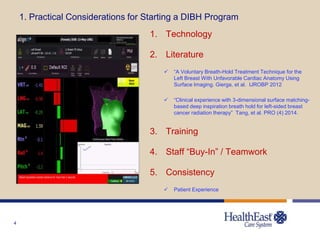
1. Practical Considerations for Starting a DIBH Program
1. Technology
2. Literature
 “A Voluntary Breath-Hold Treatment Technique for the
Left Breast With Unfavorable Cardiac Anatomy Using
Surface Imaging. Gierga, et al. IJROBP 2012
 “Clinical experience with 3-dimensional surface matching-
based deep inspiration breath hold for left-sided breast
cancer radiation therapy” Tang, et al. PRO (4) 2014.
3. Training
4. Staff “Buy-In” / Teamwork
5. Consistency
 Patient Experience
5
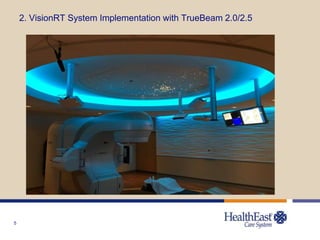
2. VisionRT System Implementation with TrueBeam 2.0/2.5
6
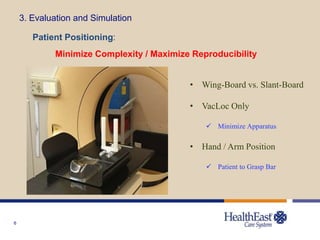
3. Evaluation and Simulation
Patient Positioning:
Minimize Complexity / Maximize Reproducibility
• Wing-Board vs. Slant-Board
• VacLoc Only
 Minimize Apparatus
• Hand / Arm Position
 Patient to Grasp Bar
7
3. Evaluation and Simulation
Discussion with the Patient:
• Explanation of the DIBH Technique
• Patient Comprehension of Process
• Evaluation:
 Is the Patient “Willing & Able” ?
 Can the Patient hold her breath (Approximately 20 sec) ?
 What if the Patient is not a Candidate?
8
3. Evaluation and Simulation
DIBH - Deep Inspiration Breath Hold
• Comfortable Deep Breath
 Hold Breath about 20 sec
• Nasal vs. Mouth (Chest vs. Belly Breathing)
• No Arching Back
• Reproducible Breath
9
3. Evaluation and Simulation
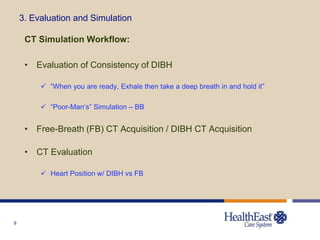
CT Simulation Workflow:
• Evaluation of Consistency of DIBH
 “When you are ready, Exhale then take a deep breath in and hold it”
 “Poor-Man’s” Simulation – BB
• Free-Breath (FB) CT Acquisition / DIBH CT Acquisition
• CT Evaluation
 Heart Position w/ DIBH vs FB
10
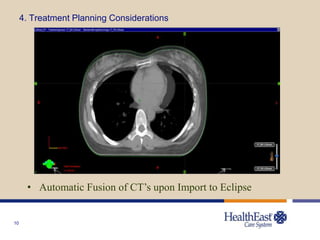
4. Treatment Planning Considerations
• Automatic Fusion of CT’s upon Import to Eclipse
11
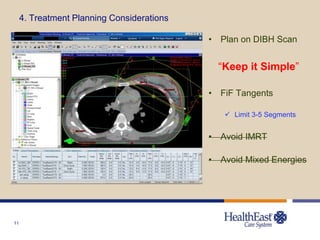
4. Treatment Planning Considerations
• Plan on DIBH Scan
“Keep it Simple”
• FiF Tangents
 Limit 3-5 Segments
• Avoid IMRT
• Avoid Mixed Energies
12
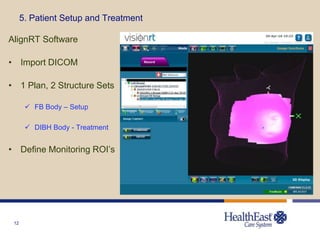
5. Patient Setup and Treatment
AlignRT Software
• Import DICOM
• 1 Plan, 2 Structure Sets
 FB Body – Setup
 DIBH Body - Treatment
• Define Monitoring ROI’s
13
5. Patient Setup and Treatment
1. Setup to General ISO – Use LASERS to Position Mid Left Breast
2. Use FB Reference Image for Initial Alignment
 Manually Adjust Rotations and Translations
3. Turn ON DIBH Reference Image
 ”When you are ready, Exhale then take a deep breath in and hold it”
 Minor Adjustments to Patient Position
 DO NOT ADJUST Vert!
14
5. Patient Setup and Treatment
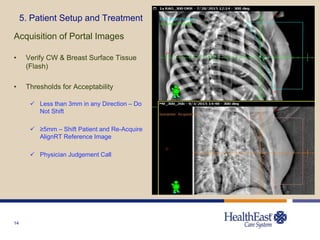
Acquisition of Portal Images
• Verify CW & Breast Surface Tissue
(Flash)
• Thresholds for Acceptability
 Less than 3mm in any Direction – Do
Not Shift
 ≥5mm – Shift Patient and Re-Acquire
AlignRT Reference Image
 Physician Judgement Call
15
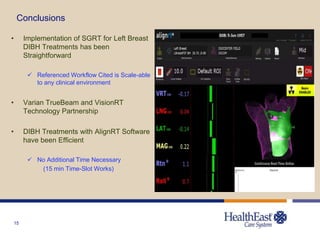
Conclusions
• Implementation of SGRT for Left Breast
DIBH Treatments has been
Straightforward
 Referenced Workflow Cited is Scale-able
to any clinical environment
• Varian TrueBeam and VisionRT
Technology Partnership
• DIBH Treatments with AlignRT Software
have been Efficient
 No Additional Time Necessary
(15 min Time-Slot Works)
16
Thank You!

Implementing SGRT for Left Breast DIBH from Start to Finish

  • 1.
    1 Implementing SGRT forLeft Breast DIBH from Start to Finish Phil Silgen, MS, DABR Chief Medical Physicist HealthEast Cancer Care Surface Guided Radiation Therapy: Turning Plans into Reality 2017 AAPM Meeting VisionRT Dinner Event
  • 2.
    2 Disclosures Surface Guided RadiationTherapy: Turning Plans into Reality 2017 AAPM Meeting VisionRT Dinner Event
  • 3.
    3 Outline 1. Practical Considerationsfor Starting a DIBH Program 2. VisionRT System Implementation with Varian TrueBeam 2.0/2.5 3. Evaluation and Simulation 4. Treatment Planning Considerations 5. Patient Setup and Treatment
  • 4.
    4 1. Practical Considerationsfor Starting a DIBH Program 1. Technology 2. Literature  “A Voluntary Breath-Hold Treatment Technique for the Left Breast With Unfavorable Cardiac Anatomy Using Surface Imaging. Gierga, et al. IJROBP 2012  “Clinical experience with 3-dimensional surface matching- based deep inspiration breath hold for left-sided breast cancer radiation therapy” Tang, et al. PRO (4) 2014. 3. Training 4. Staff “Buy-In” / Teamwork 5. Consistency  Patient Experience
  • 5.
    5 2. VisionRT SystemImplementation with TrueBeam 2.0/2.5
  • 6.
    6 3. Evaluation andSimulation Patient Positioning: Minimize Complexity / Maximize Reproducibility • Wing-Board vs. Slant-Board • VacLoc Only  Minimize Apparatus • Hand / Arm Position  Patient to Grasp Bar
  • 7.
    7 3. Evaluation andSimulation Discussion with the Patient: • Explanation of the DIBH Technique • Patient Comprehension of Process • Evaluation:  Is the Patient “Willing & Able” ?  Can the Patient hold her breath (Approximately 20 sec) ?  What if the Patient is not a Candidate?
  • 8.
    8 3. Evaluation andSimulation DIBH - Deep Inspiration Breath Hold • Comfortable Deep Breath  Hold Breath about 20 sec • Nasal vs. Mouth (Chest vs. Belly Breathing) • No Arching Back • Reproducible Breath
  • 9.
    9 3. Evaluation andSimulation CT Simulation Workflow: • Evaluation of Consistency of DIBH  “When you are ready, Exhale then take a deep breath in and hold it”  “Poor-Man’s” Simulation – BB • Free-Breath (FB) CT Acquisition / DIBH CT Acquisition • CT Evaluation  Heart Position w/ DIBH vs FB
  • 10.
    10 4. Treatment PlanningConsiderations • Automatic Fusion of CT’s upon Import to Eclipse
  • 11.
    11 4. Treatment PlanningConsiderations • Plan on DIBH Scan “Keep it Simple” • FiF Tangents  Limit 3-5 Segments • Avoid IMRT • Avoid Mixed Energies
  • 12.
    12 5. Patient Setupand Treatment AlignRT Software • Import DICOM • 1 Plan, 2 Structure Sets  FB Body – Setup  DIBH Body - Treatment • Define Monitoring ROI’s
  • 13.
    13 5. Patient Setupand Treatment 1. Setup to General ISO – Use LASERS to Position Mid Left Breast 2. Use FB Reference Image for Initial Alignment  Manually Adjust Rotations and Translations 3. Turn ON DIBH Reference Image  ”When you are ready, Exhale then take a deep breath in and hold it”  Minor Adjustments to Patient Position  DO NOT ADJUST Vert!
  • 14.
    14 5. Patient Setupand Treatment Acquisition of Portal Images • Verify CW & Breast Surface Tissue (Flash) • Thresholds for Acceptability  Less than 3mm in any Direction – Do Not Shift  ≥5mm – Shift Patient and Re-Acquire AlignRT Reference Image  Physician Judgement Call
  • 15.
    15 Conclusions • Implementation ofSGRT for Left Breast DIBH Treatments has been Straightforward  Referenced Workflow Cited is Scale-able to any clinical environment • Varian TrueBeam and VisionRT Technology Partnership • DIBH Treatments with AlignRT Software have been Efficient  No Additional Time Necessary (15 min Time-Slot Works)
  • 16.

Editor's Notes

  • #2 HealthEast CancerCare – 3 Locations: St. John’s Radiation Oncology, St. Joseph’s CyberKnife Center & Woodwinds Radiation Oncology 3 Physicists: Phil Silgen, MS, DABR, Joseph Ott, MS, DABR & Bonnie Velasco, MS, DABR 2 Dosimetrists, 5.6 RTT’s + Casual
  • #3 No Conflicts of Interest! (Rich)
  • #6 Varian TrueBeam 2.5 w/ 6D Couch and MMI Interface Varian Aria/Eclipse v13.6 VisionRT System w/ 3 HD Cameras and Remote Console AlignRT Software v5.0
  • #9 Nasal Breathing Improves Consistency
  • #11 Shared DICOM Coordinates If Necessary – Perform Fusion on Spine
  • #12 Each Independent Field Requires a New Breath Hold IMRT / Mixed Energies – May not be an issue depending on clinic and equipment
  • #13 ROI’s – Can Add Arm and/or Chin – We are not finding it necessary
  • #14 Adjust Rotations first, then move couch to adjust Translations Minimize Delta’s
  • #15 Excellent Correlation – AlignRT vs. Portal Image !! Rarely Making Adjustments after Ports!
  • #17 Special “Thanks” to Colleagues Joseph Ott and Bonnie Velasco Questions?