I would like to express my special thanks of
   gratitude to my teacher (name of the teacher),
   who gave me the golden opportunity to do this
 wonderful Project, which also helped me in doing a
  lot of Research and I came to know about so many
                         new things.
               I am really thankful to them.
  Secondly i would also like to thank my parents and
  friends who helped me a lot in finishing this project
                   within the limited time.
I am making this project not only for marks but to also
                 increase my knowledge .
      THANKS AGAIN TO ALL WHO HELPED ME.
arc length
                                   sphere

     parametric surfaces


                       calculus
   partial derivatives    double integration
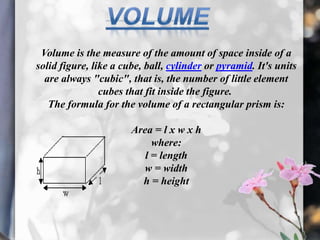
Volume is the measure of the amount of space inside of a
solid figure, like a cube, ball, cylinder or pyramid. It's units
  are always "cubic", that is, the number of little element
                cubes that fit inside the figure.
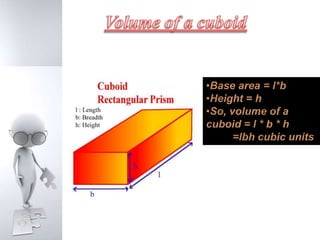
   The formula for the volume of a rectangular prism is:

                       Area = l x w x h
                            where:
                          l = length
                         w = width
                         h = height
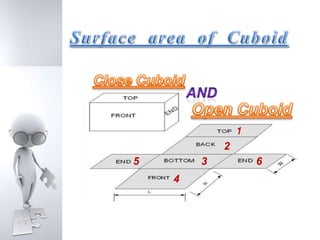
2
5       3       6
    4
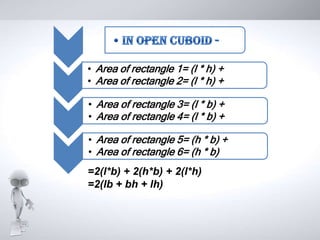
• Area of rectangle 1= (l * h) +
• Area of rectangle 2= (l * h) +

• Area of rectangle 3= (l * b) +
• Area of rectangle 4= (l * b) +

• Area of rectangle 5= (h * b) +
• Area of rectangle 6= (h * b)
=2(l*b) + 2(h*b) + 2(l*h)
=2(lb + bh + lh)
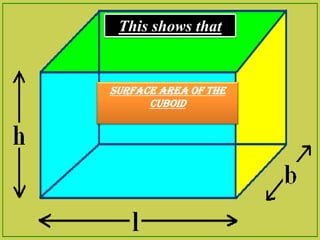
This shows that


Surface area of the
      cuboid
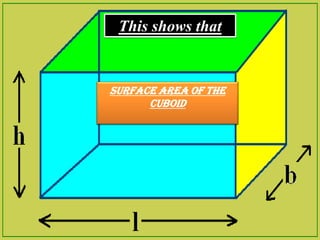
This shows that


  2(lb+bh+lh)
Surface area of the
      cuboid
    sq units
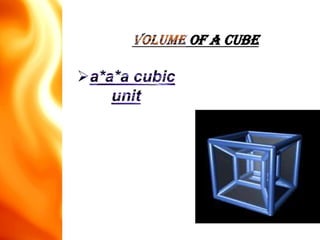
of a cube
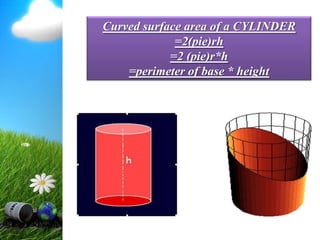
Curved surface area of a CYLINDER
             =2(pie)rh
            =2 (pie)r*h
    =perimeter of base * height
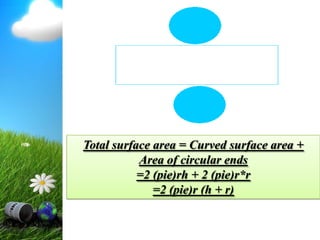
Total surface area = Curved surface area +
           Area of circular ends
           =2 (pie)rh + 2 (pie)r*r
              =2 (pie)r (h + r)
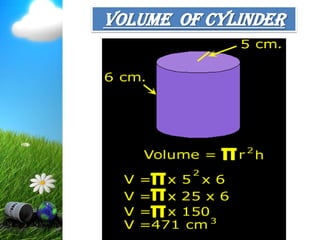
VOLUME OF CYLINDER
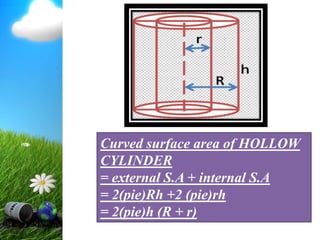
Curved surface area of HOLLOW
CYLINDER
= external S.A + internal S.A
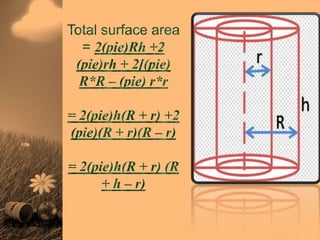
= 2(pie)Rh +2 (pie)rh
= 2(pie)h (R + r)
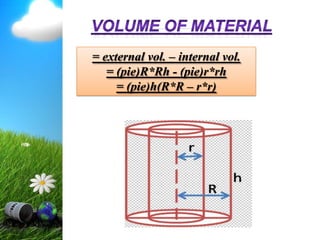
= external vol. – internal vol.
   = (pie)R*Rh - (pie)r*rh
     = (pie)h(R*R – r*r)
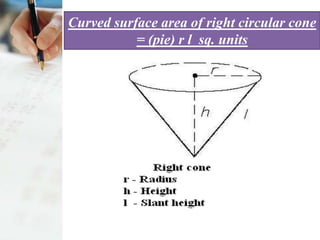
Curved surface area of right circular cone
           = (pie) r l sq. units
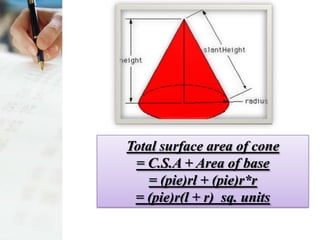
Total surface area of cone
 = C.S.A + Area of base
    = (pie)rl + (pie)r*r
 = (pie)r(l + r) sq. units
Surface Area & Volumes

Surface Area & Volumes

  • 3.
    I would liketo express my special thanks of gratitude to my teacher (name of the teacher), who gave me the golden opportunity to do this wonderful Project, which also helped me in doing a lot of Research and I came to know about so many new things. I am really thankful to them. Secondly i would also like to thank my parents and friends who helped me a lot in finishing this project within the limited time. I am making this project not only for marks but to also increase my knowledge . THANKS AGAIN TO ALL WHO HELPED ME.
  • 4.
    arc length sphere parametric surfaces calculus partial derivatives double integration
  • 5.
    Volume is themeasure of the amount of space inside of a solid figure, like a cube, ball, cylinder or pyramid. It's units are always "cubic", that is, the number of little element cubes that fit inside the figure. The formula for the volume of a rectangular prism is: Area = l x w x h where: l = length w = width h = height
  • 6.
    2 5 3 6 4
  • 7.
    • Area ofrectangle 1= (l * h) + • Area of rectangle 2= (l * h) + • Area of rectangle 3= (l * b) + • Area of rectangle 4= (l * b) + • Area of rectangle 5= (h * b) + • Area of rectangle 6= (h * b) =2(l*b) + 2(h*b) + 2(l*h) =2(lb + bh + lh)
  • 8.
    This shows that Surfacearea of the cuboid
  • 9.
    This shows that 2(lb+bh+lh) Surface area of the cuboid sq units
  • 17.
  • 18.
    Curved surface areaof a CYLINDER =2(pie)rh =2 (pie)r*h =perimeter of base * height
  • 19.
    Total surface area= Curved surface area + Area of circular ends =2 (pie)rh + 2 (pie)r*r =2 (pie)r (h + r)
  • 20.
  • 21.
    Curved surface areaof HOLLOW CYLINDER = external S.A + internal S.A = 2(pie)Rh +2 (pie)rh = 2(pie)h (R + r)
  • 23.
    = external vol.– internal vol. = (pie)R*Rh - (pie)r*rh = (pie)h(R*R – r*r)
  • 24.
    Curved surface areaof right circular cone = (pie) r l sq. units
  • 25.
    Total surface areaof cone = C.S.A + Area of base = (pie)rl + (pie)r*r = (pie)r(l + r) sq. units